
Module 10 
Session 6 
(Seoul, Korea, 25 February 2011) 
Session 6 Enabling effects of ICTs – 
part 2 smart motors, smart buildings, 
smart logistics & transportation, smart 
cities 
Richard Labelle 
rlab@sympatico.ca
2 
Objectives of Module 10 
To show that ICTs can be used to 
address climate change 
To demonstrate why ICTs are a 
crucial part of the solution – i.e. in 
promoting efficiency, Green Growth 
& sustainable development
3 
What is a smart motor (1) 
A variable rate motor with a 
microprocessor embedded in it that 
can be connected by mostly short 
range communication technologies to 
a central control system (a server on 
the Internet for example). 
Variable rate motor: can spin at 
different speeds depending on load or 
instructions
4 
What is a smart motor (2) 
The embedded microprocessor is a 
sensor with an actuator in it
5 
What is a smart motor (3) 
Many smart motors connected 
together can control motor processes 
in different application areas: 
Building motor systems: HVAC, lighting 
Manufacturing processes: speed up the 
production line or slow it down 
Appliances in a home: wash / dry 
cycles, etc. 
PCs, peripherals, etc.
6 
What is a smart motor (4) 
Smart motors connected together 
form a WSN… 
… that can be controlled centrally (or 
locally) by a server system running 
supervisory control and data 
acquisition (SCADA) software…
7 
What is a smart motor (5) 
… or that can be self controlled by 
microprocessor in the motor 
communicating with other smart 
motors in its network… 
PC or peripherals that shut down 
automatically or that power down to 
lower load levels (PC power 
management software * power 
consuming devices – not always 
motors)
8 
What is a smart motor (6) 
… enabling intelligent control of 
motors, work and the possibility of 
optimizing energy consumption over 
time and space… 
Allows integration with the smart 
grid, 
Facilitates demand side 
management, etc.
9 
Definition of smart building 
In a smart building, energy, 
technology, telecommunications 
and other building systems are all 
interconnected in a way that allows 
them to communicate with, and be 
controlled by, a central ICT based 
system, the building 
management system (BMS).
Environmental impact of buildings 
Responsible for about 40 % of global 
GHG emissions 
70 % global energy consumption 
30 % of output of raw materials into 
buildings 
10
What are smart buildings systems 
11 
used for? 
Controlling everything, not just 
energy use 
Other application areas: 
Security 
Deliveries 
Entrance and exit 
Elevators 
Etc.
How does a smart building work? (1) 
12 
Various sensors connected to the 
BMS measure and report on: 
Occupancy 
CO2, CO, NH4, etc. 
Smoke levels 
Light levels 
Temperature 
Humidity 
Air flow 
Video suveillance, etc. 
Wired or 
Wireless SNs
How does a smart building work? (2) 
Readout of data from sensor 
networks: done by a smart meter 
Network of smart meters involving 
embedded sensors called advanced 
meter infrastructure (AMI) 
All brought together under a building 
management system (BMS) using 
SCADA type software 
13
14 
What can a smart building do? 
Consider elevators (again!) 
Readout of data from sensor 
networks: done by a smart meter 
Network of smart meters involving 
embedded sensors called advanced 
meter infrastructure (AMI)
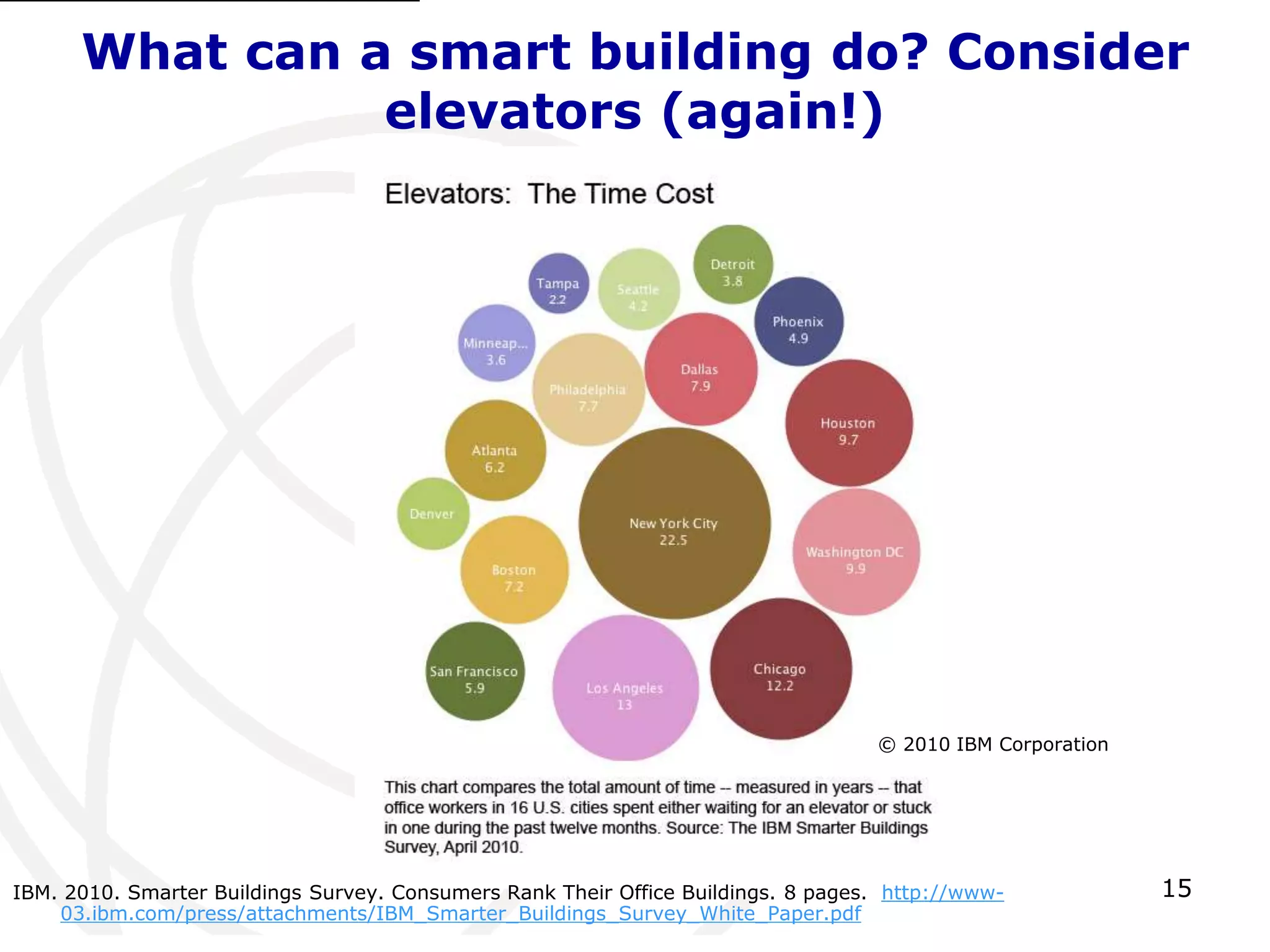
What can a smart building do? Consider 
15 
elevators (again!) 
IBM. 2010. Smarter Buildings Survey. Consumers Rank Their Office Buildings. 8 pages. http://www- 
03.ibm.com/press/attachments/IBM_Smarter_Buildings_Survey_White_Paper.pdf 
© 2010 IBM Corporation
Smart buildings allow for integration 
of renewable energy & water sources 
16 
Energy harvesting 
Passive and active solar, wind 
Heat pumps: heat exchange & 
harvesting from ground (sub-soil) 
Micro hydro 
Energy generation 
Fuel cells 
Rain water harvesting
Other benefits of smart buildings 
17 
ROI: very high because of energy 
and other savings (water) and 
productivity benefits 
Facilitate design of Leadership in 
Energy and Environmental Design 
(LEED) certified buildings 
Smart buildings and LEED certification 
are NOT the same thing, but using 
smart building technologies & practices 
can contribute to achieving LEED 
certification.
Building information modeling (BIM) 
18 
Design tool that enables architects, 
engineers, and builders to explore a 
project digitally before it is built 
Facilitates construction workflow 
Explore multiple design options within a 
single building model and simulate 
energy, water and carbon use 
Feed in site specific data & use software 
to optimize environmental design 
factors.
19 
Examples from the region 
Mostly in China, Korea, Japan, 
Singapore
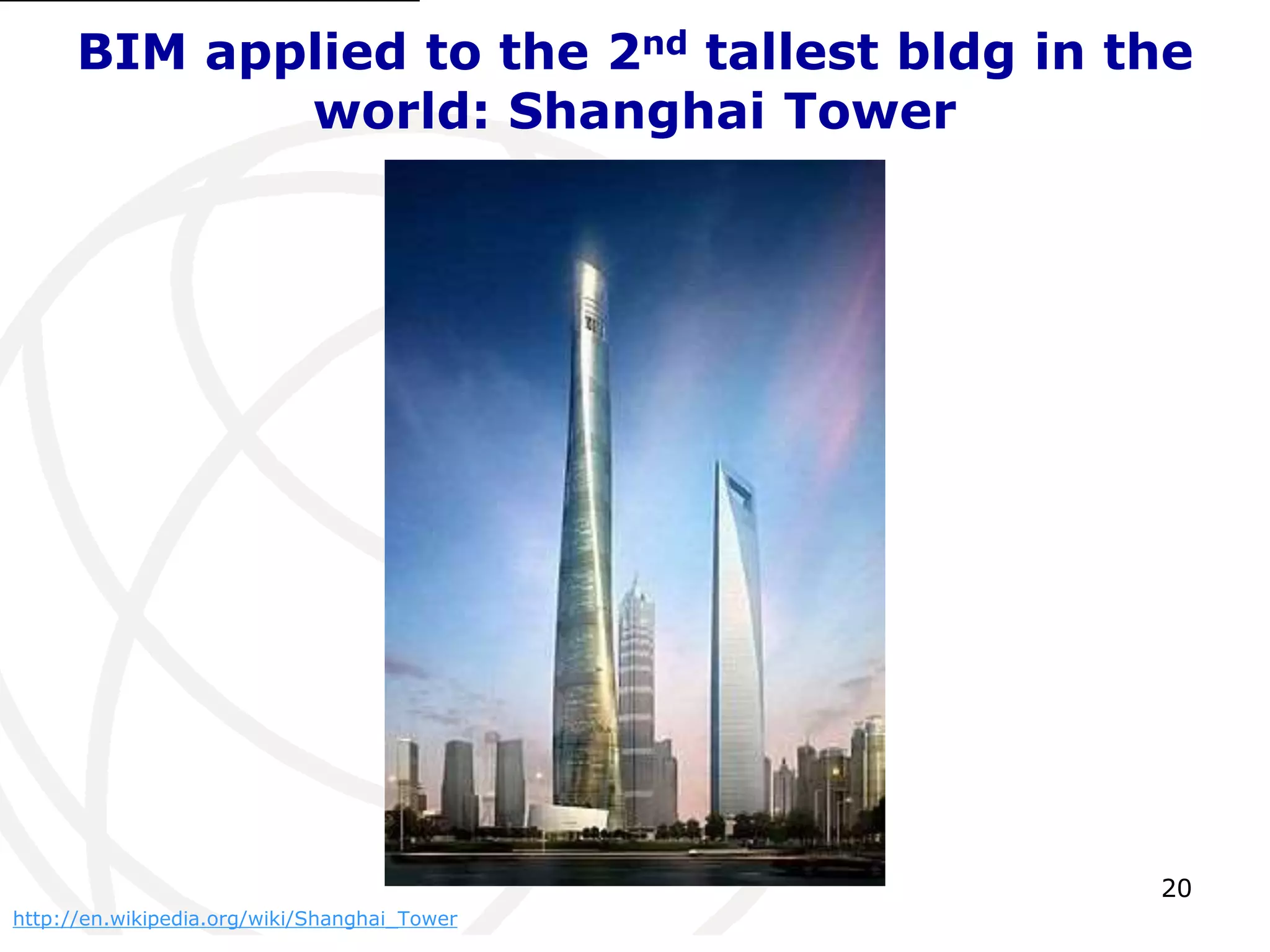
BIM applied to the 2nd tallest bldg in the 
20 
world: Shanghai Tower 
http://en.wikipedia.org/wiki/Shanghai_Tower
21 
Shanghai Tower 
Consider the: Shanghai Tower 
632 metres 
128 stories 
Contain an area of 380,000 m2 
Tallest building in China 
Second tallest in the world.
22 
Shanghai Tower 
The tower will be organized as nine 
cylindrical buildings stacked atop 
each other, enclosed by the glass 
façade's inner layer 
Between that and the outer layer, 
which twists as it rises, nine indoor 
zones will provide public space for 
visitors
23 
Shanghai Tower 
The design of the glass façade is 
described to be able to reduce wind 
loads on the building by 24% 
Meaning less construction materials are 
needed 
The twisting feature will collect 
rainwater to be used for the tower's 
air conditioning and heating systems.
24 
Shanghai Tower 
Wind turbines will generate power for 
the building 
The first super-tall (300 metres or 
taller) double-skin building in the 
world, acting much like a "thermos 
bottle,“ to insulate it and save 
energy 
Designed and built using BIM!
25 
BIM – how does it work! 
Look at Autodesk Presentation from 
Cop15
26 
BIM use 
Increasingly used everywhere 
The US General Services 
Administration (GSA) responsible for 
all buildings requires BIM analysis for 
all new buildings and retrofits 
Show Autodesk BIM video: 
http://usa.autodesk.com/company/build 
ing-information-modeling/sustainability 
or here: 
http://bit.ly/GL6Le
27 
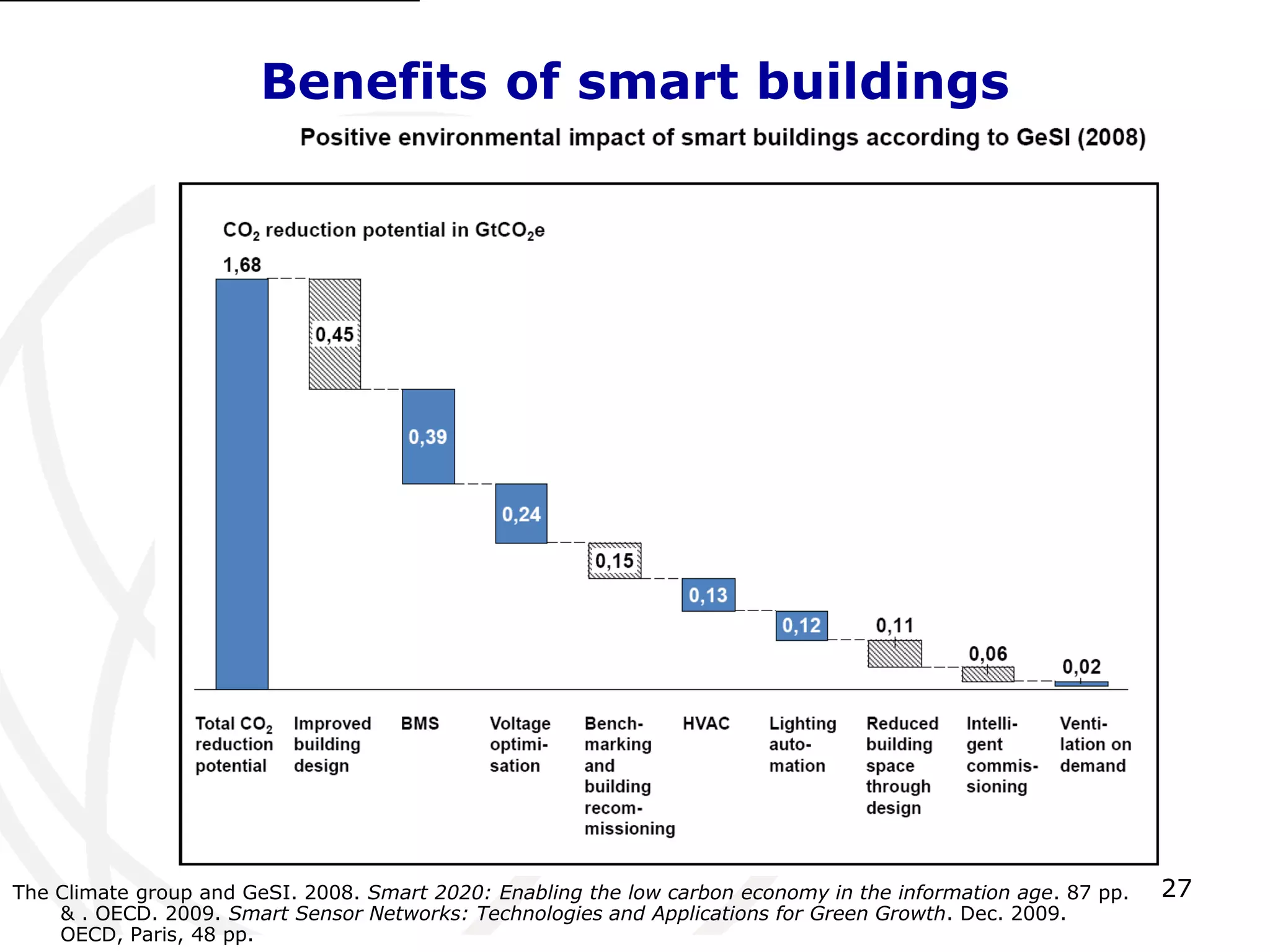
Benefits of smart buildings 
The Climate group and GeSI. 2008. Smart 2020: Enabling the low carbon economy in the information age. 87 pp. 
& . OECD. 2009. Smart Sensor Networks: Technologies and Applications for Green Growth. Dec. 2009. 
OECD, Paris, 48 pp.
28 
Conclusions 
Green design 
Building information Modeling (BIM) 
Instrumenting buildings: 
HVAC, power consumption, etc. with 
smart motors, sensors and actuators 
Connecting all motor driven systems 
to a network of sensors and control 
devices 
Improve air quality 
Reduce energy consumption
29 
Smart logistics 
Using ICTs to manage the supply 
chain 
Focus on the transport of goods 
packaging, transport, storage, 
consumer purchasing and waste” 
Major source of emissions & energy 
consumption
30 
Smart logistics & transportation 
Most emissions come from transport 
and storage. 
Optimizing logistics using ICTs could 
result in a 16 % reduction in transport 
emissions and a 27 % reduction in total 
global emissions from transport
Smart logistics: benefits of using ICTs 
31 
Efficiency gains: 
When a company uses ICTs to more 
effectively manage its supply chain 
Structural gains: 
Using the Internet to limit inventories 
and the use of warehouses 
Placing stores on the Internet (online 
shopping) rather than constructing retail 
facilities (bricks and mortar)
Smart logistics: benefits of using ICTs 
32 
When companies put their supply 
chain on the Internet: 
Reduce inventories, overproduction, 
unnecessary capital purchases, paper 
transactions, mistaken orders, etc.  
greater output with less energy 
consumption
33 
Smart logistics: examples (1) 
IBM uses the Internet to link all of its 
production facilities to find out before 
hand the availability of production 
facilities and to shift production 
accordingly. 
By mid-1998, the reduced investments 
and operating costs had saved the 
company USD 500 billion.
34 
Smart logistics: examples (2) 
Home Depot bypasses the 
warehouse: 
85% of its merchandise moves directly 
from the manufacturer to the storefront.
35 
Smart logistics: examples (3) 
Collaborative Planning Forecasting 
Replenishment (CPFR) makes use of 
the Internet to improve forecasting 
and restocking. 
Ernst & Young has estimated this could 
lead to a 25% to 35% cut in finished 
goods inventory across the supply 
chain.
36 
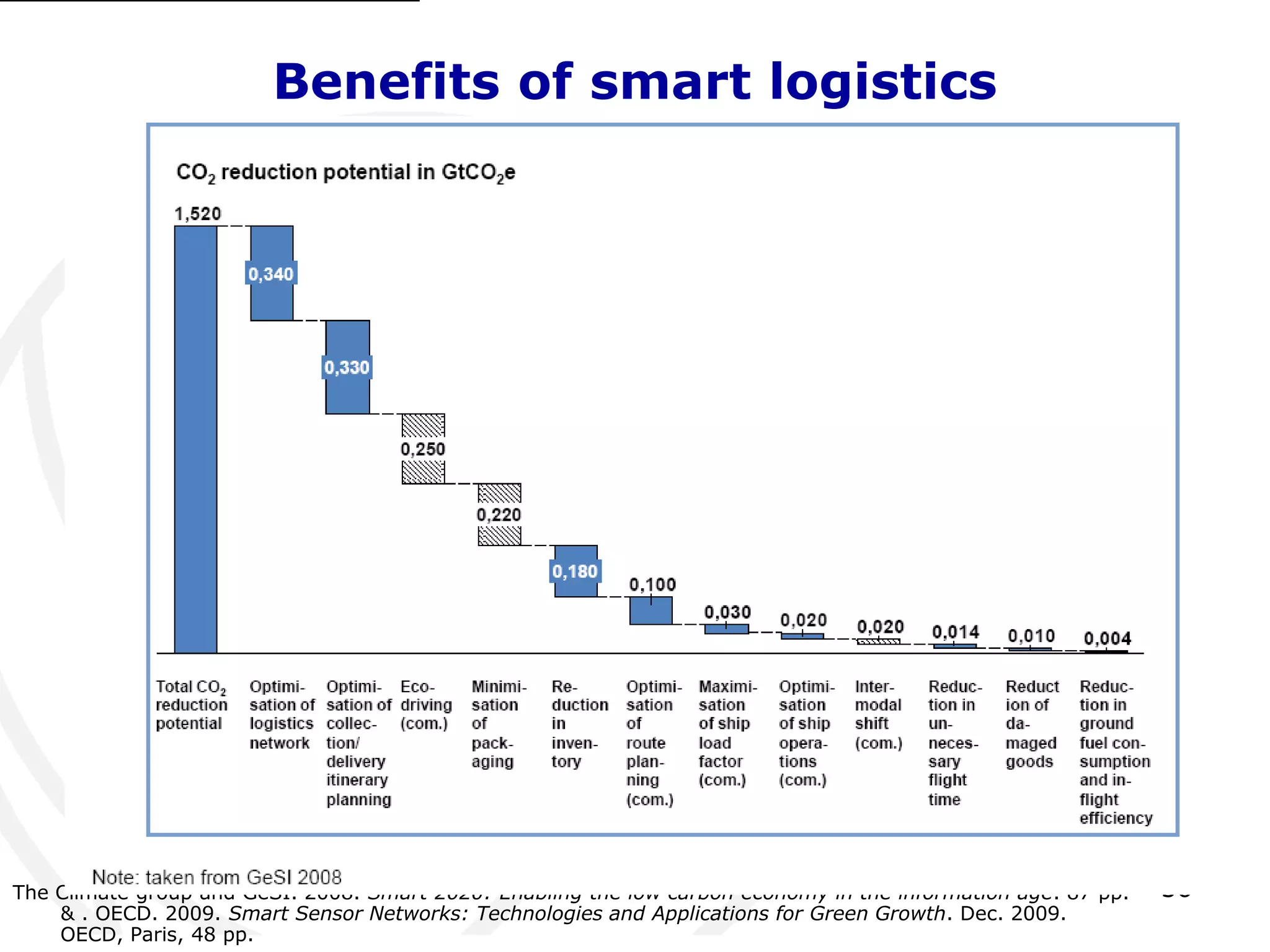
Benefits of smart logistics 
The Climate group and GeSI. 2008. Smart 2020: Enabling the low carbon economy in the information age. 87 pp. 
& . OECD. 2009. Smart Sensor Networks: Technologies and Applications for Green Growth. Dec. 2009. 
OECD, Paris, 48 pp.
37 
Conclusion 
Massive inventory savings possible 
using e-commerce 
This applies everywhere
38 
Smart transportation 
Intelligent transportation systems 
(ITS) allow for transport optimization 
and make use of traffic flow 
monitoring, planning and simulation 
technologies
39 
Smart transportation 
Advanced traveler information 
systems 
Real time traffic information 
Advanced transportation 
management systems 
Smart transportation pricing systems 
Advanced public transportation 
systems 
Smart vehicles (communications with 
transportation system sensors, etc.)
40 
Smart transportation 
ICTs “enable elements within the 
transportation system - vehicles, 
roads, traffic lights, message signs, 
etc., to become intelligent by 
embedding them with microchips and 
sensors and empowering them to 
communicate with each other 
through wireless technologies
41 
Key technologies 
Global Positioning System (GPS) 
Short Range Communications 
Wireless Networks 
Mobile Telephony 
Radiowave or Infrared Beacons 
Roadside Camera Recognition 
Probe Vehicles or Devices
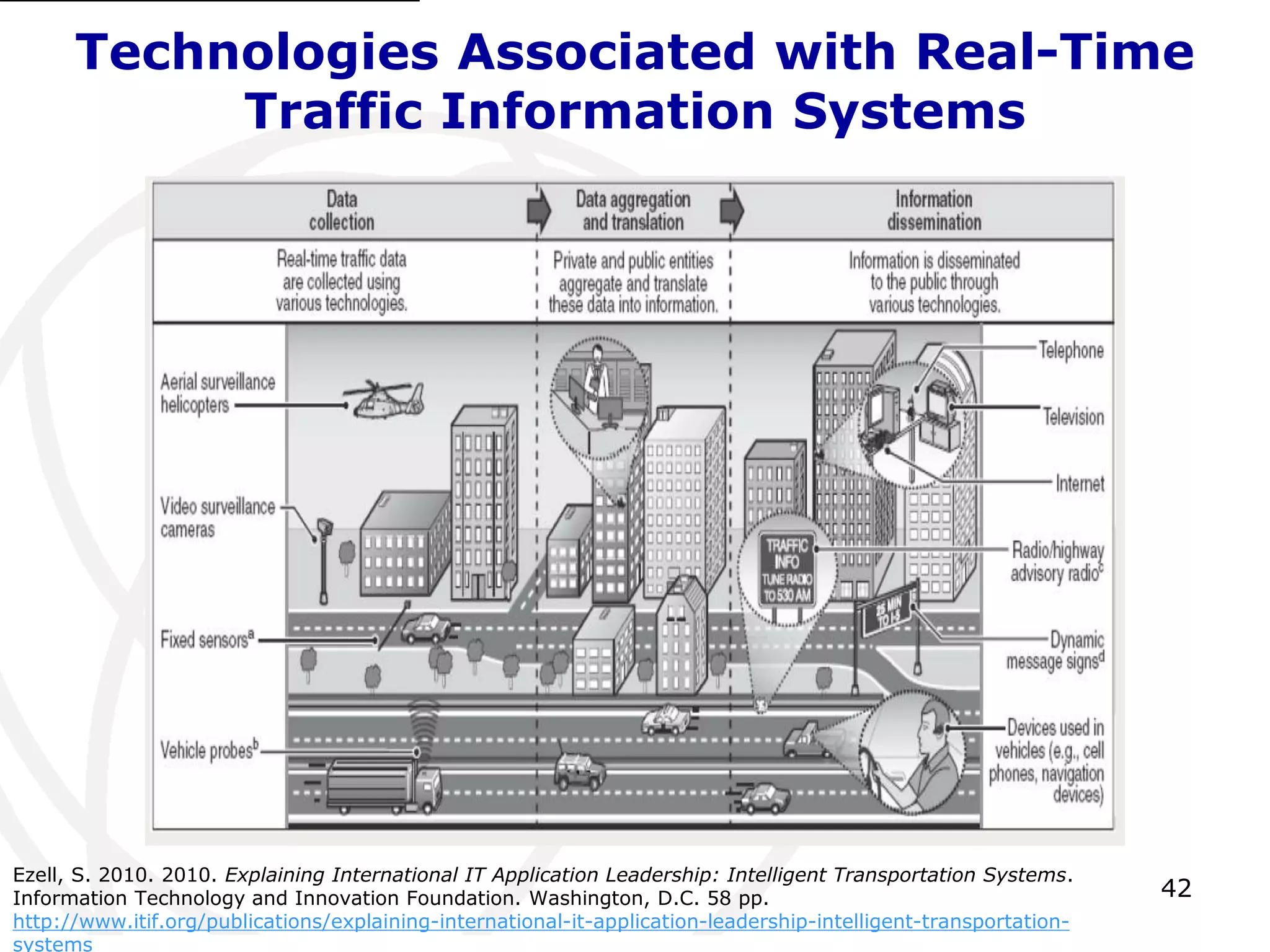
Technologies Associated with Real-Time 
42 
Traffic Information Systems 
Ezell, S. 2010. 2010. Explaining International IT Application Leadership: Intelligent Transportation Systems. 
Information Technology and Innovation Foundation. Washington, D.C. 58 pp. 
http://www.itif.org/publications/explaining-international-it-application-leadership-intelligent-transportation-systems
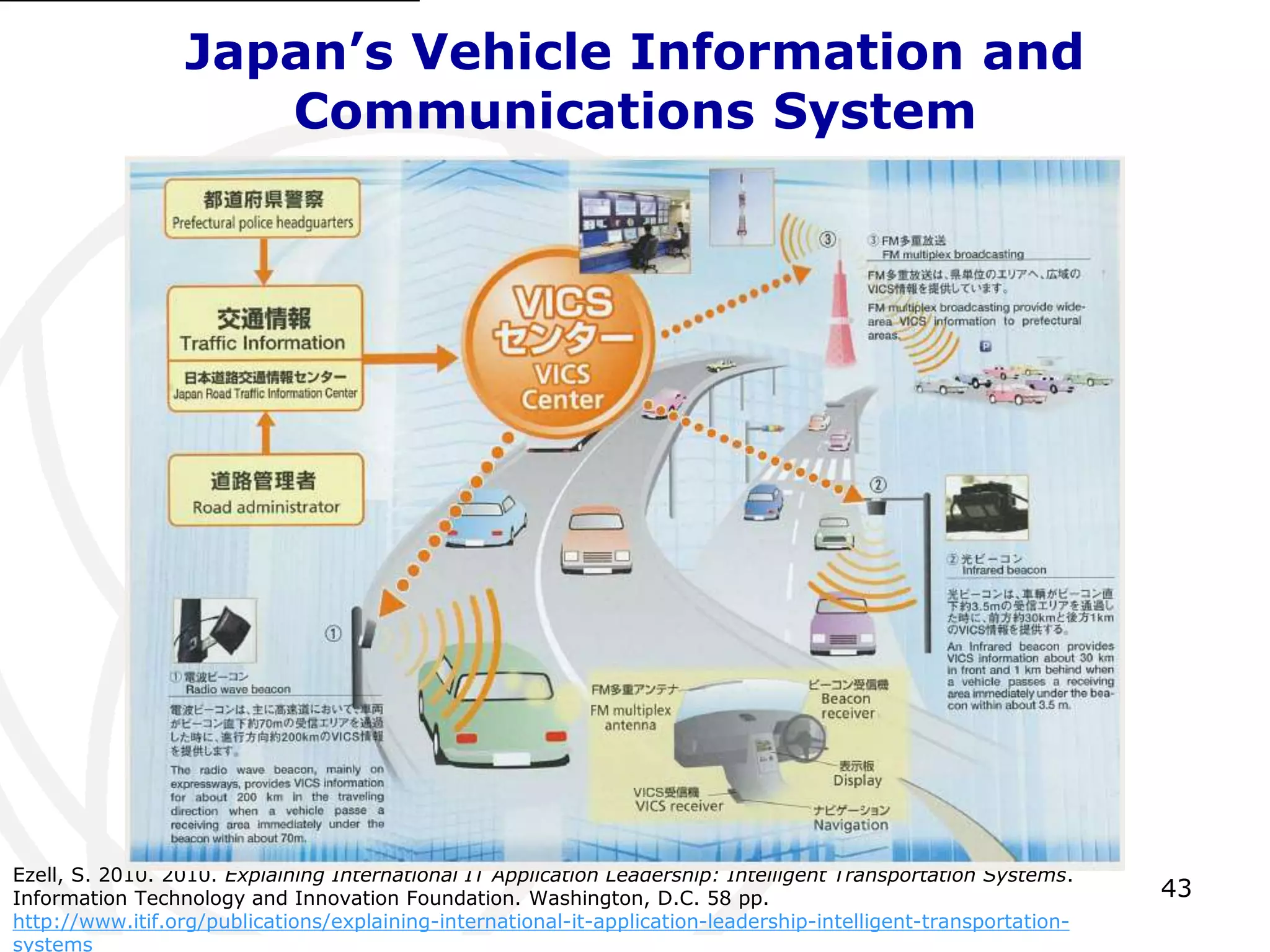
43 
Japan’s Vehicle Information and 
Communications System 
Ezell, S. 2010. 2010. Explaining International IT Application Leadership: Intelligent Transportation Systems. 
Information Technology and Innovation Foundation. Washington, D.C. 58 pp. 
http://www.itif.org/publications/explaining-international-it-application-leadership-intelligent-transportation-systems
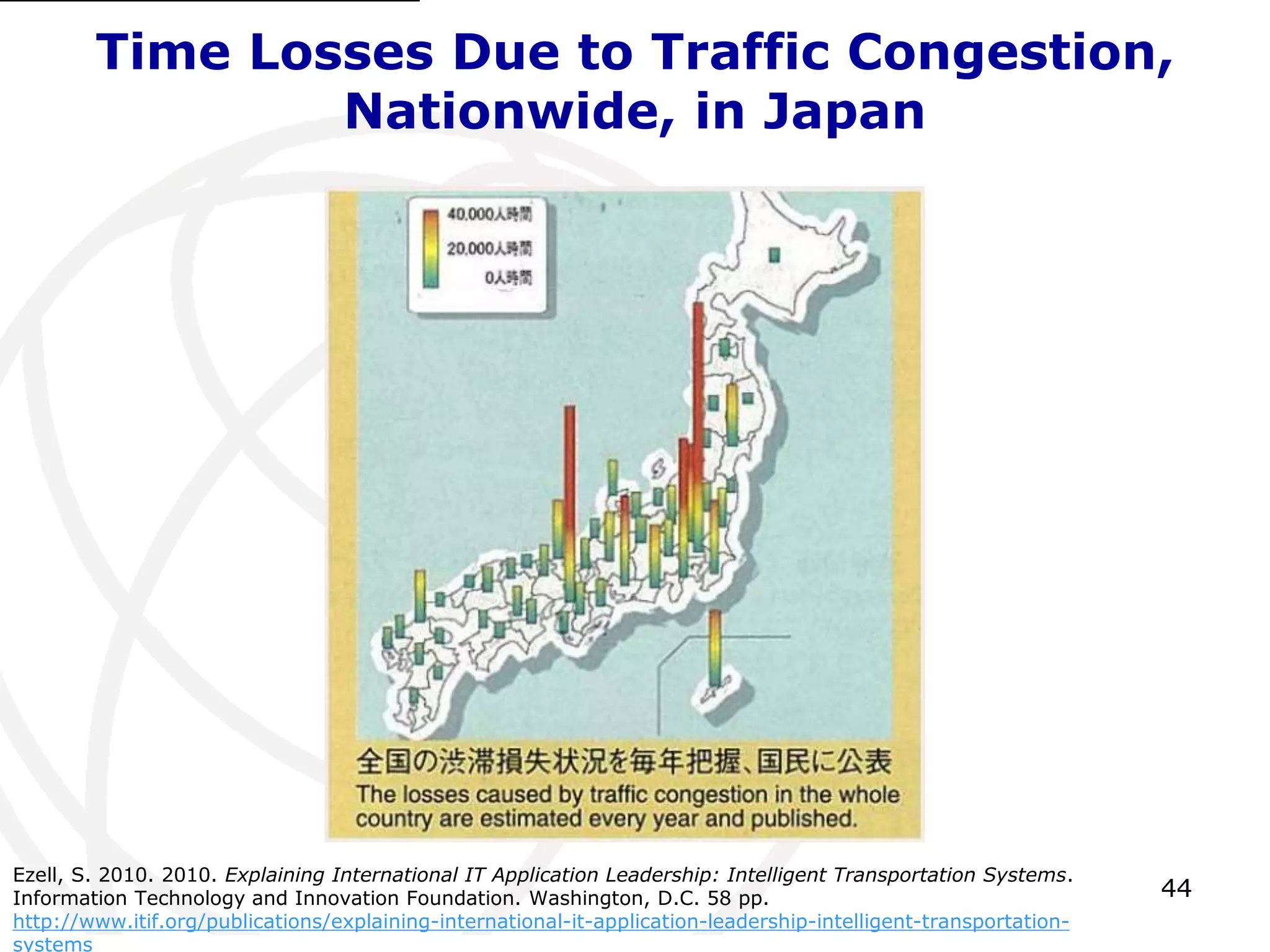
Time Losses Due to Traffic Congestion, 
44 
Nationwide, in Japan 
Ezell, S. 2010. 2010. Explaining International IT Application Leadership: Intelligent Transportation Systems. 
Information Technology and Innovation Foundation. Washington, D.C. 58 pp. 
http://www.itif.org/publications/explaining-international-it-application-leadership-intelligent-transportation-systems
45 
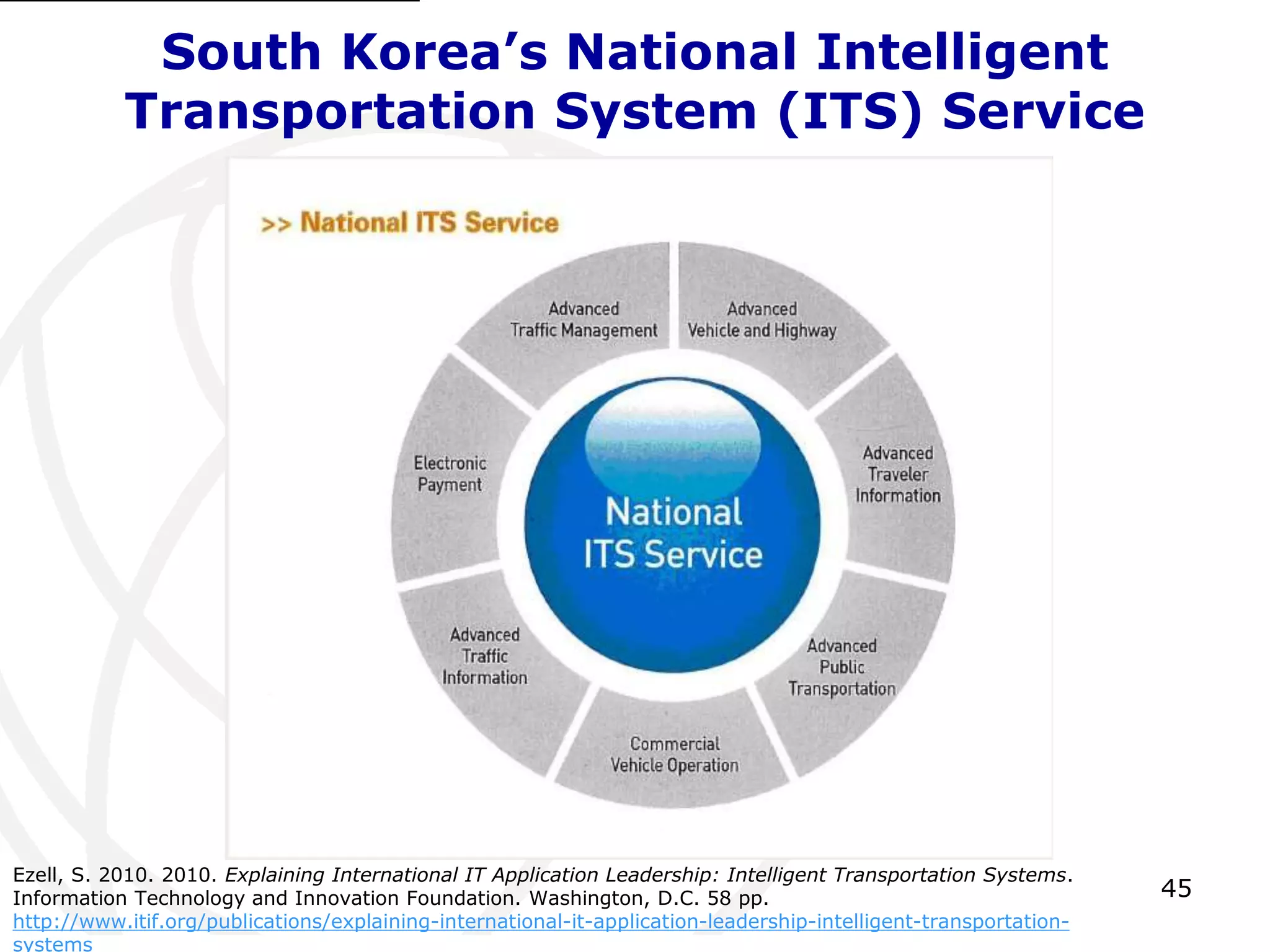
South Korea’s National Intelligent 
Transportation System (ITS) Service 
Ezell, S. 2010. 2010. Explaining International IT Application Leadership: Intelligent Transportation Systems. 
Information Technology and Innovation Foundation. Washington, D.C. 58 pp. 
http://www.itif.org/publications/explaining-international-it-application-leadership-intelligent-transportation-systems
46 
Conclusions 
Applicable everywhere, but especially 
to highly congested cities 
Real energy savings and GHG 
emission reductions, but important 
for improving quality of life in cities
47 
Discussion

Module 10 - Session 6 enabling effects of ICTs part 2. Smart motor systems, smart buildings, logistics & transportation

  • 1.
    Module 10 Session6 (Seoul, Korea, 25 February 2011) Session 6 Enabling effects of ICTs – part 2 smart motors, smart buildings, smart logistics & transportation, smart cities Richard Labelle rlab@sympatico.ca
  • 2.
    2 Objectives ofModule 10 To show that ICTs can be used to address climate change To demonstrate why ICTs are a crucial part of the solution – i.e. in promoting efficiency, Green Growth & sustainable development
  • 3.
    3 What isa smart motor (1) A variable rate motor with a microprocessor embedded in it that can be connected by mostly short range communication technologies to a central control system (a server on the Internet for example). Variable rate motor: can spin at different speeds depending on load or instructions
  • 4.
    4 What isa smart motor (2) The embedded microprocessor is a sensor with an actuator in it
  • 5.
    5 What isa smart motor (3) Many smart motors connected together can control motor processes in different application areas: Building motor systems: HVAC, lighting Manufacturing processes: speed up the production line or slow it down Appliances in a home: wash / dry cycles, etc. PCs, peripherals, etc.
  • 6.
    6 What isa smart motor (4) Smart motors connected together form a WSN… … that can be controlled centrally (or locally) by a server system running supervisory control and data acquisition (SCADA) software…
  • 7.
    7 What isa smart motor (5) … or that can be self controlled by microprocessor in the motor communicating with other smart motors in its network… PC or peripherals that shut down automatically or that power down to lower load levels (PC power management software * power consuming devices – not always motors)
  • 8.
    8 What isa smart motor (6) … enabling intelligent control of motors, work and the possibility of optimizing energy consumption over time and space… Allows integration with the smart grid, Facilitates demand side management, etc.
  • 9.
    9 Definition ofsmart building In a smart building, energy, technology, telecommunications and other building systems are all interconnected in a way that allows them to communicate with, and be controlled by, a central ICT based system, the building management system (BMS).
  • 10.
    Environmental impact ofbuildings Responsible for about 40 % of global GHG emissions 70 % global energy consumption 30 % of output of raw materials into buildings 10
  • 11.
    What are smartbuildings systems 11 used for? Controlling everything, not just energy use Other application areas: Security Deliveries Entrance and exit Elevators Etc.
  • 12.
    How does asmart building work? (1) 12 Various sensors connected to the BMS measure and report on: Occupancy CO2, CO, NH4, etc. Smoke levels Light levels Temperature Humidity Air flow Video suveillance, etc. Wired or Wireless SNs
  • 13.
    How does asmart building work? (2) Readout of data from sensor networks: done by a smart meter Network of smart meters involving embedded sensors called advanced meter infrastructure (AMI) All brought together under a building management system (BMS) using SCADA type software 13
  • 14.
    14 What cana smart building do? Consider elevators (again!) Readout of data from sensor networks: done by a smart meter Network of smart meters involving embedded sensors called advanced meter infrastructure (AMI)
  • 15.
    What can asmart building do? Consider 15 elevators (again!) IBM. 2010. Smarter Buildings Survey. Consumers Rank Their Office Buildings. 8 pages. http://www- 03.ibm.com/press/attachments/IBM_Smarter_Buildings_Survey_White_Paper.pdf © 2010 IBM Corporation
  • 16.
    Smart buildings allowfor integration of renewable energy & water sources 16 Energy harvesting Passive and active solar, wind Heat pumps: heat exchange & harvesting from ground (sub-soil) Micro hydro Energy generation Fuel cells Rain water harvesting
  • 17.
    Other benefits ofsmart buildings 17 ROI: very high because of energy and other savings (water) and productivity benefits Facilitate design of Leadership in Energy and Environmental Design (LEED) certified buildings Smart buildings and LEED certification are NOT the same thing, but using smart building technologies & practices can contribute to achieving LEED certification.
  • 18.
    Building information modeling(BIM) 18 Design tool that enables architects, engineers, and builders to explore a project digitally before it is built Facilitates construction workflow Explore multiple design options within a single building model and simulate energy, water and carbon use Feed in site specific data & use software to optimize environmental design factors.
  • 19.
    19 Examples fromthe region Mostly in China, Korea, Japan, Singapore
  • 20.
    BIM applied tothe 2nd tallest bldg in the 20 world: Shanghai Tower http://en.wikipedia.org/wiki/Shanghai_Tower
  • 21.
    21 Shanghai Tower Consider the: Shanghai Tower 632 metres 128 stories Contain an area of 380,000 m2 Tallest building in China Second tallest in the world.
  • 22.
    22 Shanghai Tower The tower will be organized as nine cylindrical buildings stacked atop each other, enclosed by the glass façade's inner layer Between that and the outer layer, which twists as it rises, nine indoor zones will provide public space for visitors
  • 23.
    23 Shanghai Tower The design of the glass façade is described to be able to reduce wind loads on the building by 24% Meaning less construction materials are needed The twisting feature will collect rainwater to be used for the tower's air conditioning and heating systems.
  • 24.
    24 Shanghai Tower Wind turbines will generate power for the building The first super-tall (300 metres or taller) double-skin building in the world, acting much like a "thermos bottle,“ to insulate it and save energy Designed and built using BIM!
  • 25.
    25 BIM –how does it work! Look at Autodesk Presentation from Cop15
  • 26.
    26 BIM use Increasingly used everywhere The US General Services Administration (GSA) responsible for all buildings requires BIM analysis for all new buildings and retrofits Show Autodesk BIM video: http://usa.autodesk.com/company/build ing-information-modeling/sustainability or here: http://bit.ly/GL6Le
  • 27.
    27 Benefits ofsmart buildings The Climate group and GeSI. 2008. Smart 2020: Enabling the low carbon economy in the information age. 87 pp. & . OECD. 2009. Smart Sensor Networks: Technologies and Applications for Green Growth. Dec. 2009. OECD, Paris, 48 pp.
  • 28.
    28 Conclusions Greendesign Building information Modeling (BIM) Instrumenting buildings: HVAC, power consumption, etc. with smart motors, sensors and actuators Connecting all motor driven systems to a network of sensors and control devices Improve air quality Reduce energy consumption
  • 29.
    29 Smart logistics Using ICTs to manage the supply chain Focus on the transport of goods packaging, transport, storage, consumer purchasing and waste” Major source of emissions & energy consumption
  • 30.
    30 Smart logistics& transportation Most emissions come from transport and storage. Optimizing logistics using ICTs could result in a 16 % reduction in transport emissions and a 27 % reduction in total global emissions from transport
  • 31.
    Smart logistics: benefitsof using ICTs 31 Efficiency gains: When a company uses ICTs to more effectively manage its supply chain Structural gains: Using the Internet to limit inventories and the use of warehouses Placing stores on the Internet (online shopping) rather than constructing retail facilities (bricks and mortar)
  • 32.
    Smart logistics: benefitsof using ICTs 32 When companies put their supply chain on the Internet: Reduce inventories, overproduction, unnecessary capital purchases, paper transactions, mistaken orders, etc.  greater output with less energy consumption
  • 33.
    33 Smart logistics:examples (1) IBM uses the Internet to link all of its production facilities to find out before hand the availability of production facilities and to shift production accordingly. By mid-1998, the reduced investments and operating costs had saved the company USD 500 billion.
  • 34.
    34 Smart logistics:examples (2) Home Depot bypasses the warehouse: 85% of its merchandise moves directly from the manufacturer to the storefront.
  • 35.
    35 Smart logistics:examples (3) Collaborative Planning Forecasting Replenishment (CPFR) makes use of the Internet to improve forecasting and restocking. Ernst & Young has estimated this could lead to a 25% to 35% cut in finished goods inventory across the supply chain.
  • 36.
    36 Benefits ofsmart logistics The Climate group and GeSI. 2008. Smart 2020: Enabling the low carbon economy in the information age. 87 pp. & . OECD. 2009. Smart Sensor Networks: Technologies and Applications for Green Growth. Dec. 2009. OECD, Paris, 48 pp.
  • 37.
    37 Conclusion Massiveinventory savings possible using e-commerce This applies everywhere
  • 38.
    38 Smart transportation Intelligent transportation systems (ITS) allow for transport optimization and make use of traffic flow monitoring, planning and simulation technologies
  • 39.
    39 Smart transportation Advanced traveler information systems Real time traffic information Advanced transportation management systems Smart transportation pricing systems Advanced public transportation systems Smart vehicles (communications with transportation system sensors, etc.)
  • 40.
    40 Smart transportation ICTs “enable elements within the transportation system - vehicles, roads, traffic lights, message signs, etc., to become intelligent by embedding them with microchips and sensors and empowering them to communicate with each other through wireless technologies
  • 41.
    41 Key technologies Global Positioning System (GPS) Short Range Communications Wireless Networks Mobile Telephony Radiowave or Infrared Beacons Roadside Camera Recognition Probe Vehicles or Devices
  • 42.
    Technologies Associated withReal-Time 42 Traffic Information Systems Ezell, S. 2010. 2010. Explaining International IT Application Leadership: Intelligent Transportation Systems. Information Technology and Innovation Foundation. Washington, D.C. 58 pp. http://www.itif.org/publications/explaining-international-it-application-leadership-intelligent-transportation-systems
  • 43.
    43 Japan’s VehicleInformation and Communications System Ezell, S. 2010. 2010. Explaining International IT Application Leadership: Intelligent Transportation Systems. Information Technology and Innovation Foundation. Washington, D.C. 58 pp. http://www.itif.org/publications/explaining-international-it-application-leadership-intelligent-transportation-systems
  • 44.
    Time Losses Dueto Traffic Congestion, 44 Nationwide, in Japan Ezell, S. 2010. 2010. Explaining International IT Application Leadership: Intelligent Transportation Systems. Information Technology and Innovation Foundation. Washington, D.C. 58 pp. http://www.itif.org/publications/explaining-international-it-application-leadership-intelligent-transportation-systems
  • 45.
    45 South Korea’sNational Intelligent Transportation System (ITS) Service Ezell, S. 2010. 2010. Explaining International IT Application Leadership: Intelligent Transportation Systems. Information Technology and Innovation Foundation. Washington, D.C. 58 pp. http://www.itif.org/publications/explaining-international-it-application-leadership-intelligent-transportation-systems
  • 46.
    46 Conclusions Applicableeverywhere, but especially to highly congested cities Real energy savings and GHG emission reductions, but important for improving quality of life in cities
  • 47.