Integumentary
system:
Dr. Sami
Definition:
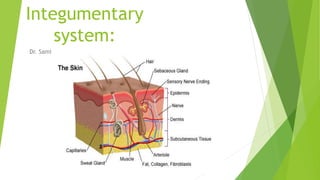
 The organs of the integumentary system include the skin and its accessory
structures including hair, nails, and glands, as well as blood vessels, muscles
and nerves
 Dermatology is the medical specialty for the diagnosis and treatment of
disorders of the integumentary system.
Skin:
 The skin is a vital organ that covers the entire outside of the body, forming a
protective barrier against pathogens and injuries from the environment.
 The skin is the body's largest organ; covering the entire outside of the body, it
is about 2 mm thick and weighs approximately six pounds.
 It shields the body against heat, light, injury, and infection.
 The skin also helps regulate body temperature, gathers sensory information
from the environment, stores water, fat, and vitamin D, and plays a role in
the immune system protecting us from disease.
 The color, thickness and texture of skin vary over the body.
 There are two general types of skin; thin and hairy, which is more prevalent
on the body, and thick and hairless, which is found on parts of the body that
are used heavily and endure a large amount of friction, like the palms of the
hands or the soles of the feet.
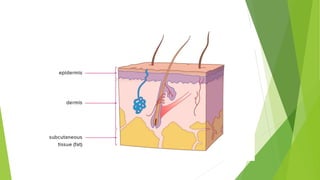
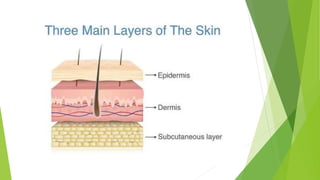
 Basically, the skin is comprised of two layers that cover a third fatty layer.
 These three layers differ in function, thickness, and strength.
 The outer layer is called the epidermis; it is a tough protective layer that
contains the melanin-producing melanocytes.
 The second layer (located under the epidermis) is called the dermis; it
contains nerve endings, sweat glands, oil glands, and hair follicles.
 Under these two skin layers is a fatty layer of subcutaneous tissue, known as
the subcutis or hypodermis. The skin contains many specialized cells and
structures:
Structure:
 The Epidermis
 The epidermis is the outermost layer of the skin, and protects the body from
the environment. The thickness of the epidermis varies in different types of
skin; it is only .05 mm thick on the eyelids, and is 1.5 mm thick on the palms
and the soles of the feet.
EPIDERMIS
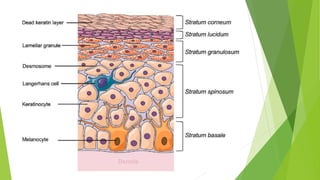
 • The epidermis is composed of keratinized stratified squamous epithelium.
 It contains four principal types of cells: keratinocytes, melanocytes,
Langerhans cells, and Merkel cells
 keratinocytes
 About 90% of epidermal cells are keratinocytes, which are arranged in four or
five layers and produce the protein keratin.
 keratin is a tough, fibrous protein that helps protect the skin and underlying
tissues from heat, microbes, and chemicals.
 Melanocytes
 About 8% of the epidermal cells are melanocytes, which produces the pigment
melanin.
 Their long, slender projections extend between the keratinocytes and
transfer melanin granules to them.
 Melanin is a yellow-red or brown-black pigment that contributes to skin color
and absorbs damaging ultraviolet (UV) light.
 Langerhans cells
 Langerhans cells arise from red bone marrow and migrate to the epidermis
 where they constitute a small fraction of the epidermal cells.
 They participate in immune responses mounted against microbes that invade
the skin, and are easily damaged by UV light.
 Their role in the immune response is to help other cells of the immune system
recognize an invading microbe and destroy it.
 Merkel cells
 Merkel cells are the least numerous of the epidermal cells.
 Close to the nerve endings
 They are located in the deepest layer of the epidermis, where they contact
the flattened process of a sensory neuron (nerve cell), a structure called a
Merkel (tactile) disc.
 Merkel cells and their associated Merkel discs detect touch sensations.
Layers of Epidermis:
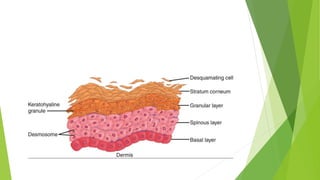
 Stratum basale (stratum germinativum)
 Deepest layer of the epidermis.
 The basal layer is the innermost layer of the epidermis, and contains small
round cells called basal cells.
 The basal cells continually divide, and new cells constantly push older ones up
toward the surface of the skin, where they are eventually shed.
 The basal cell layer is also known as the stratum germinativum due to the
fact that it is constantly germinating (producing) new cells.
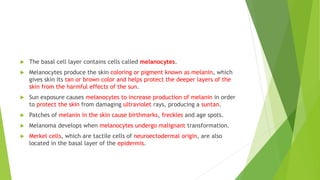
 The basal cell layer contains cells called melanocytes.
 Melanocytes produce the skin coloring or pigment known as melanin, which
gives skin its tan or brown color and helps protect the deeper layers of the
skin from the harmful effects of the sun.
 Sun exposure causes melanocytes to increase production of melanin in order
to protect the skin from damaging ultraviolet rays, producing a suntan.
 Patches of melanin in the skin cause birthmarks, freckles and age spots.
 Melanoma develops when melanocytes undergo malignant transformation.
 Merkel cells, which are tactile cells of neuroectodermal origin, are also
located in the basal layer of the epidermis.
 Stratum spinosum
 Between the stratum basale layer and the stratum granulosum layer.
 The squamous cell layer is located above the basal layer, and is also known as
the stratum spinosum or "spiny layer" due to the fact that the cells are held
together with spiny projections.
 Within this layer are the basal cells that have been pushed upward, however
these maturing cells are now called squamous cells, or keratinocytes.
 Keratinocytes produce keratin, a tough, protective protein that makes up the
majority of the structure of the skin, hair, and nails.
 The squamous cell layer is the thickest layer of the epidermis, and is involved
in the transfer of certain substances in and out of the body.
 The squamous cell layer also contains cells called Langerhans cells. These
cells attach themselves to antigens that invade damaged skin and alert the
immune system to their presence.
 The Stratum Granulosum & the Stratum Lucidum
 The keratinocytes from the squamous layer are then pushed up through two
thin epidermal layers called the stratum granulosum and the stratum
lucidum.
 As these cells move further towards the surface of the skin, they get bigger
and flatter and adhere together, and then eventually become dehydrated and
die.
 This process results in the cells fusing together into layers of tough, durable
material, which continue to migrate up to the surface of the skin.
 The Stratum Corneum
 The stratum corneum is the outermost layer of the epidermis, and is made up
of 10 to 30 thin layers of continually shedding, dead keratinocytes.
 The stratum corneum is also known as the "horny layer," because its cells are
toughened like an animal's horn.
 As the outermost cells age and wear down, they are replaced by new layers of
strong, long-wearing cells.
 The stratum corneum is sloughed off continually as new cells take its place,
but this shedding process slows down with age.
 Complete cell turnover occurs every 28 to 30 days in young adults, while the
same process takes 45 to 50 days in elderly adults.
The Dermis
 The dermis is located beneath the epidermis and is the thickest of the three
layers of the skin (1.5 to 4 mm thick), making up approximately 90 percent of
the thickness of the skin.
 The main functions of the dermis are to regulate temperature and to supply
the epidermis with nutrient-saturated blood.
 Much of the body's water supply is stored within the dermis.
 This layer contains most of the skins' specialized cells and structures,
including:
 Blood Vessels
 The blood vessels supply nutrients and oxygen to the skin and take away cell
waste and cell products. The blood vessels also transport the vitamin D
produced in the skin back to the rest of the body.
 Lymph Vessels
 The lymph vessels bathe the tissues of the skin with lymph, a milky substance
that contains the infection-fighting cells of the immune system. These cells
work to destroy any infection or invading organisms as the lymph circulates to
the lymph nodes.
 Hair Follicles
 The hair follicle is a tube-shaped sheath that surrounds the part of the hair
that is under the skin and nourishes the hair.
 Sweat Glands
 The average person has about 3 million sweat glands. Sweat glands are
classified according to two types:
 Apocrine glands are specialized sweat glands that can be found only in the
armpits and pubic region. These glands secrete a milky sweat that encourages
the growth of the bacteria responsible for body odor.
 Eccrine glands are the true sweat glands. Found over the entire body, these
glands regulate body temperature by bringing water via the pores to the
surface of the skin, where it evaporates and reduces skin temperature. These
glands can produce up to two liters of sweat an hour, however, they secrete
mostly water, which doesn't encourage the growth of odor-producing bacteria.
 Sebaceous glands
 Sebaceous, or oil, glands, are attached to hair follicles and can be found
everywhere on the body except for the palms of the hands and the soles of
the feet. These glands secrete oil that helps keep the skin smooth and supple.
The oil also helps keep skin waterproof and protects against an overgrowth of
bacteria and fungi on the skin.
 Nerve Endings
 The dermis layer also contains pain and touch receptors that transmit
sensations of pain, itch, pressure and information regarding temperature to
the brain for interpretation. If necessary, shivering (involuntary contraction
and relaxation of muscles) is triggered, generating body heat.
 Collagen and Elastin
 The dermis is held together by a protein called collagen, made by fibroblasts.
 Fibroblasts are skin cells that give the skin its strength and resilience.
 Collagen is a tough, insoluble protein found throughout the body in the
connective tissues that hold muscles and organs in place.
 In the skin, collagen supports the epidermis, lending it its durability.
 Elastin, a similar protein, is the substance that allows the skin to spring back
into place when stretched and keeps the skin flexible.
 The dermis layer is made up of two sublayers:
 The Papillary Layer
 The upper, papillary layer, contains a thin arrangement of collagen fibers. The
papillary layer supplies nutrients to select layers of the epidermis and
regulates temperature. Both of these functions are accomplished with a thin,
extensive vascular system that operates similarly to other vascular systems in
the body.
 Constriction and expansion control the amount of blood that flows through
the skin and dictate whether body heat is dispelled when the skin is hot or
conserved when it is cold.
 The Reticular Layer
 The lower, reticular layer, is thicker and made of thick collagen fibers that
are arranged in parallel to the surface of the skin.
 The reticular layer is denser than the papillary dermis, and it strengthens the
skin, providing structure and elasticity. I
 t also supports other components of the skin, such as hair follicles, sweat
glands, and sebaceous glands.
 The Subcutis
 The subcutis is the innermost layer of the skin, and consists of a network of
fat and collagen cells.
 The subcutis is also known as the hypodermis or subcutaneous layer, and
functions as both an insulator, conserving the body's heat, and as a shock-
absorber, protecting the inner organs.
 It also stores fat as an energy reserve for the body. The blood vessels, nerves,
lymph vessels, and hair follicles also cross through this layer.
 The thickness of the subcutis layer varies throughout the body and from
person to person.

Integumentary system by Dr. Sami

  • 1.
  • 2.
    Definition:  The organsof the integumentary system include the skin and its accessory structures including hair, nails, and glands, as well as blood vessels, muscles and nerves  Dermatology is the medical specialty for the diagnosis and treatment of disorders of the integumentary system.
  • 3.
    Skin:  The skinis a vital organ that covers the entire outside of the body, forming a protective barrier against pathogens and injuries from the environment.  The skin is the body's largest organ; covering the entire outside of the body, it is about 2 mm thick and weighs approximately six pounds.  It shields the body against heat, light, injury, and infection.  The skin also helps regulate body temperature, gathers sensory information from the environment, stores water, fat, and vitamin D, and plays a role in the immune system protecting us from disease.
  • 4.
     The color,thickness and texture of skin vary over the body.  There are two general types of skin; thin and hairy, which is more prevalent on the body, and thick and hairless, which is found on parts of the body that are used heavily and endure a large amount of friction, like the palms of the hands or the soles of the feet.
  • 5.
     Basically, theskin is comprised of two layers that cover a third fatty layer.  These three layers differ in function, thickness, and strength.  The outer layer is called the epidermis; it is a tough protective layer that contains the melanin-producing melanocytes.  The second layer (located under the epidermis) is called the dermis; it contains nerve endings, sweat glands, oil glands, and hair follicles.  Under these two skin layers is a fatty layer of subcutaneous tissue, known as the subcutis or hypodermis. The skin contains many specialized cells and structures:
  • 8.
    Structure:  The Epidermis The epidermis is the outermost layer of the skin, and protects the body from the environment. The thickness of the epidermis varies in different types of skin; it is only .05 mm thick on the eyelids, and is 1.5 mm thick on the palms and the soles of the feet.
  • 9.
    EPIDERMIS  • Theepidermis is composed of keratinized stratified squamous epithelium.  It contains four principal types of cells: keratinocytes, melanocytes, Langerhans cells, and Merkel cells
  • 10.
     keratinocytes  About90% of epidermal cells are keratinocytes, which are arranged in four or five layers and produce the protein keratin.  keratin is a tough, fibrous protein that helps protect the skin and underlying tissues from heat, microbes, and chemicals.
  • 11.
     Melanocytes  About8% of the epidermal cells are melanocytes, which produces the pigment melanin.  Their long, slender projections extend between the keratinocytes and transfer melanin granules to them.  Melanin is a yellow-red or brown-black pigment that contributes to skin color and absorbs damaging ultraviolet (UV) light.
  • 12.
     Langerhans cells Langerhans cells arise from red bone marrow and migrate to the epidermis  where they constitute a small fraction of the epidermal cells.  They participate in immune responses mounted against microbes that invade the skin, and are easily damaged by UV light.  Their role in the immune response is to help other cells of the immune system recognize an invading microbe and destroy it.
  • 13.
     Merkel cells Merkel cells are the least numerous of the epidermal cells.  Close to the nerve endings  They are located in the deepest layer of the epidermis, where they contact the flattened process of a sensory neuron (nerve cell), a structure called a Merkel (tactile) disc.  Merkel cells and their associated Merkel discs detect touch sensations.
  • 14.
    Layers of Epidermis: Stratum basale (stratum germinativum)  Deepest layer of the epidermis.  The basal layer is the innermost layer of the epidermis, and contains small round cells called basal cells.  The basal cells continually divide, and new cells constantly push older ones up toward the surface of the skin, where they are eventually shed.  The basal cell layer is also known as the stratum germinativum due to the fact that it is constantly germinating (producing) new cells.
  • 17.
     The basalcell layer contains cells called melanocytes.  Melanocytes produce the skin coloring or pigment known as melanin, which gives skin its tan or brown color and helps protect the deeper layers of the skin from the harmful effects of the sun.  Sun exposure causes melanocytes to increase production of melanin in order to protect the skin from damaging ultraviolet rays, producing a suntan.  Patches of melanin in the skin cause birthmarks, freckles and age spots.  Melanoma develops when melanocytes undergo malignant transformation.  Merkel cells, which are tactile cells of neuroectodermal origin, are also located in the basal layer of the epidermis.
  • 18.
     Stratum spinosum Between the stratum basale layer and the stratum granulosum layer.  The squamous cell layer is located above the basal layer, and is also known as the stratum spinosum or "spiny layer" due to the fact that the cells are held together with spiny projections.  Within this layer are the basal cells that have been pushed upward, however these maturing cells are now called squamous cells, or keratinocytes.  Keratinocytes produce keratin, a tough, protective protein that makes up the majority of the structure of the skin, hair, and nails.
  • 19.
     The squamouscell layer is the thickest layer of the epidermis, and is involved in the transfer of certain substances in and out of the body.  The squamous cell layer also contains cells called Langerhans cells. These cells attach themselves to antigens that invade damaged skin and alert the immune system to their presence.
  • 20.
     The StratumGranulosum & the Stratum Lucidum  The keratinocytes from the squamous layer are then pushed up through two thin epidermal layers called the stratum granulosum and the stratum lucidum.  As these cells move further towards the surface of the skin, they get bigger and flatter and adhere together, and then eventually become dehydrated and die.  This process results in the cells fusing together into layers of tough, durable material, which continue to migrate up to the surface of the skin.
  • 21.
     The StratumCorneum  The stratum corneum is the outermost layer of the epidermis, and is made up of 10 to 30 thin layers of continually shedding, dead keratinocytes.  The stratum corneum is also known as the "horny layer," because its cells are toughened like an animal's horn.  As the outermost cells age and wear down, they are replaced by new layers of strong, long-wearing cells.  The stratum corneum is sloughed off continually as new cells take its place, but this shedding process slows down with age.  Complete cell turnover occurs every 28 to 30 days in young adults, while the same process takes 45 to 50 days in elderly adults.
  • 22.
    The Dermis  Thedermis is located beneath the epidermis and is the thickest of the three layers of the skin (1.5 to 4 mm thick), making up approximately 90 percent of the thickness of the skin.  The main functions of the dermis are to regulate temperature and to supply the epidermis with nutrient-saturated blood.  Much of the body's water supply is stored within the dermis.  This layer contains most of the skins' specialized cells and structures, including:
  • 23.
     Blood Vessels The blood vessels supply nutrients and oxygen to the skin and take away cell waste and cell products. The blood vessels also transport the vitamin D produced in the skin back to the rest of the body.  Lymph Vessels  The lymph vessels bathe the tissues of the skin with lymph, a milky substance that contains the infection-fighting cells of the immune system. These cells work to destroy any infection or invading organisms as the lymph circulates to the lymph nodes.  Hair Follicles  The hair follicle is a tube-shaped sheath that surrounds the part of the hair that is under the skin and nourishes the hair.
  • 24.
     Sweat Glands The average person has about 3 million sweat glands. Sweat glands are classified according to two types:  Apocrine glands are specialized sweat glands that can be found only in the armpits and pubic region. These glands secrete a milky sweat that encourages the growth of the bacteria responsible for body odor.  Eccrine glands are the true sweat glands. Found over the entire body, these glands regulate body temperature by bringing water via the pores to the surface of the skin, where it evaporates and reduces skin temperature. These glands can produce up to two liters of sweat an hour, however, they secrete mostly water, which doesn't encourage the growth of odor-producing bacteria.
  • 25.
     Sebaceous glands Sebaceous, or oil, glands, are attached to hair follicles and can be found everywhere on the body except for the palms of the hands and the soles of the feet. These glands secrete oil that helps keep the skin smooth and supple. The oil also helps keep skin waterproof and protects against an overgrowth of bacteria and fungi on the skin.  Nerve Endings  The dermis layer also contains pain and touch receptors that transmit sensations of pain, itch, pressure and information regarding temperature to the brain for interpretation. If necessary, shivering (involuntary contraction and relaxation of muscles) is triggered, generating body heat.
  • 26.
     Collagen andElastin  The dermis is held together by a protein called collagen, made by fibroblasts.  Fibroblasts are skin cells that give the skin its strength and resilience.  Collagen is a tough, insoluble protein found throughout the body in the connective tissues that hold muscles and organs in place.  In the skin, collagen supports the epidermis, lending it its durability.  Elastin, a similar protein, is the substance that allows the skin to spring back into place when stretched and keeps the skin flexible.
  • 27.
     The dermislayer is made up of two sublayers:  The Papillary Layer  The upper, papillary layer, contains a thin arrangement of collagen fibers. The papillary layer supplies nutrients to select layers of the epidermis and regulates temperature. Both of these functions are accomplished with a thin, extensive vascular system that operates similarly to other vascular systems in the body.  Constriction and expansion control the amount of blood that flows through the skin and dictate whether body heat is dispelled when the skin is hot or conserved when it is cold.
  • 28.
     The ReticularLayer  The lower, reticular layer, is thicker and made of thick collagen fibers that are arranged in parallel to the surface of the skin.  The reticular layer is denser than the papillary dermis, and it strengthens the skin, providing structure and elasticity. I  t also supports other components of the skin, such as hair follicles, sweat glands, and sebaceous glands.
  • 29.
     The Subcutis The subcutis is the innermost layer of the skin, and consists of a network of fat and collagen cells.  The subcutis is also known as the hypodermis or subcutaneous layer, and functions as both an insulator, conserving the body's heat, and as a shock- absorber, protecting the inner organs.  It also stores fat as an energy reserve for the body. The blood vessels, nerves, lymph vessels, and hair follicles also cross through this layer.  The thickness of the subcutis layer varies throughout the body and from person to person.