Creating an Assessment Toolbox
Amber Garrison Duncan

Division of Student Affairs

University of Oregon
Learning Outcomes
 Understand the role of learning outcomes in shaping
  student learning experiences
 Understand the learning outcomes formula
 Understand levels of Blooms taxonomy
 Participants will be able to recognize different types
  of assessment
 Participants will be able to describe different types
  of data collection
 Participants will be able to locate data collection
  tools for use in assessment
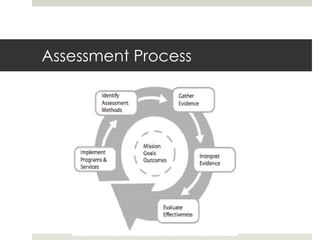
Assessment Process
Learning Outcomes…

…are goals that describe how a student will be different
  because of a learning experience. More
  specifically, learning outcomes are the
  knowledge, skills, attitudes, and habits of mind that
  students take with them from a learning experience.
  (Suskie, 2009).
Brainstorm

 What do you want the student to be able to
  know or do as a result of participation?

 What knowledge, skill or ability should the ideal
  participant demonstrate?
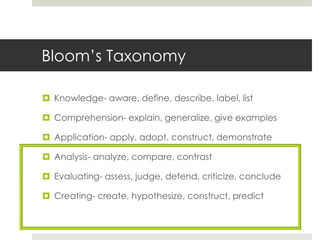
Bloom’s Taxonomy

 Knowledge- aware, define, describe, label, list

 Comprehension- explain, generalize, give examples

 Application- apply, adopt, construct, demonstrate

 Analysis- analyze, compare, contrast

 Evaluating- assess, judge, defend, criticize, conclude

 Creating- create, hypothesize, construct, predict
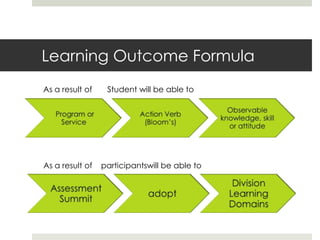
Learning Outcome Formula
As a result of    Student will be able to


As a result of   participantswill be able to
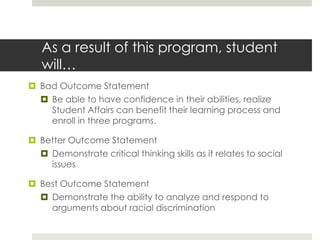
As a result of this program, student
   will…
 Bad Outcome Statement
   Be able to have confidence in their abilities, realize
    Student Affairs can benefit their learning process and
    enroll in three programs.

 Better Outcome Statement
   Demonstrate critical thinking skills as it relates to social
    issues

 Best Outcome Statement
   Demonstrate the ability to analyze and respond to
    arguments about racial discrimination
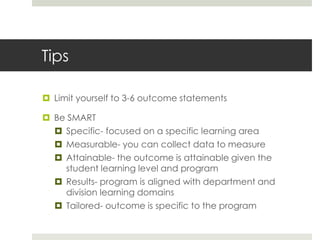
Tips

 Limit yourself to 3-6 outcome statements

 Be SMART
   Specific- focused on a specific learning area
   Measurable- you can collect data to measure
   Attainable- the outcome is attainable given the
    student learning level and program
   Results- program is aligned with department and
    division learning domains
   Tailored- outcome is specific to the program
Let’s Try
Pick one of your responsibilities and write outcomes statements.
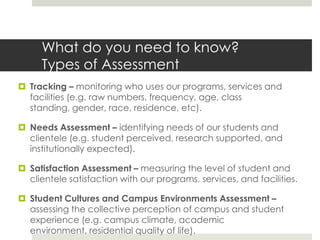
What do you need to know?
     Types of Assessment
 Tracking – monitoring who uses our programs, services and
  facilities (e.g. raw numbers, frequency, age, class
  standing, gender, race, residence, etc).

 Needs Assessment – identifying needs of our students and
  clientele (e.g. student perceived, research supported, and
  institutionally expected).

 Satisfaction Assessment – measuring the level of student and
  clientele satisfaction with our programs, services, and facilities.

 Student Cultures and Campus Environments Assessment –
  assessing the collective perception of campus and student
  experience (e.g. campus climate, academic
  environment, residential quality of life).
Types of Assessment
 Outcomes Assessment – measuring the impact our
  services, programs and facilities have on students’
  learning, development, and student success.

 Comparable Institution Assessment – identifying how the
  quality of our programs, services and facilities compare
  with peer institutions’ best practices.

 National Standards Assessment – using nationally
  accepted standards to assess our programs and services
  (e.g. national assessment inventory– EBI, CAS standard
  self-assessment, departmental review by consulting
  group).

 Cost Effectiveness Assessment – determining whether the
  programs, services and facilities we offer to students are
  worth the cost.
Creating an Assessment Toolbox
 Assessing can include a variety of data collection
  methods and it’s important to know when to use each

 What are tools you have in your toolbox?
   Obtrusive
     Surveys
     Rubrics
     Focus groups and interviews
     Student produced work (reflections, oral/written
      presentations)
   Unobtrusive
     Banner or Database Systems
     Observations
     Document analysis
Exploring New Tools

 Student Voice

 Student Affairs Assessment Website
Let’s Try!
For the outcomes you just wrote, what type of assessment would
you use to measure the impact of your program?
Questions?

3 tool box

  • 1.
    Creating an AssessmentToolbox Amber Garrison Duncan Division of Student Affairs University of Oregon
  • 2.
    Learning Outcomes  Understandthe role of learning outcomes in shaping student learning experiences  Understand the learning outcomes formula  Understand levels of Blooms taxonomy  Participants will be able to recognize different types of assessment  Participants will be able to describe different types of data collection  Participants will be able to locate data collection tools for use in assessment
  • 3.
  • 4.
    Learning Outcomes… …are goalsthat describe how a student will be different because of a learning experience. More specifically, learning outcomes are the knowledge, skills, attitudes, and habits of mind that students take with them from a learning experience. (Suskie, 2009).
  • 5.
    Brainstorm  What doyou want the student to be able to know or do as a result of participation?  What knowledge, skill or ability should the ideal participant demonstrate?
  • 6.
    Bloom’s Taxonomy  Knowledge-aware, define, describe, label, list  Comprehension- explain, generalize, give examples  Application- apply, adopt, construct, demonstrate  Analysis- analyze, compare, contrast  Evaluating- assess, judge, defend, criticize, conclude  Creating- create, hypothesize, construct, predict
  • 7.
    Learning Outcome Formula Asa result of Student will be able to As a result of participantswill be able to
  • 8.
    As a resultof this program, student will…  Bad Outcome Statement  Be able to have confidence in their abilities, realize Student Affairs can benefit their learning process and enroll in three programs.  Better Outcome Statement  Demonstrate critical thinking skills as it relates to social issues  Best Outcome Statement  Demonstrate the ability to analyze and respond to arguments about racial discrimination
  • 9.
    Tips  Limit yourselfto 3-6 outcome statements  Be SMART  Specific- focused on a specific learning area  Measurable- you can collect data to measure  Attainable- the outcome is attainable given the student learning level and program  Results- program is aligned with department and division learning domains  Tailored- outcome is specific to the program
  • 10.
    Let’s Try Pick oneof your responsibilities and write outcomes statements.
  • 11.
    What do youneed to know? Types of Assessment  Tracking – monitoring who uses our programs, services and facilities (e.g. raw numbers, frequency, age, class standing, gender, race, residence, etc).  Needs Assessment – identifying needs of our students and clientele (e.g. student perceived, research supported, and institutionally expected).  Satisfaction Assessment – measuring the level of student and clientele satisfaction with our programs, services, and facilities.  Student Cultures and Campus Environments Assessment – assessing the collective perception of campus and student experience (e.g. campus climate, academic environment, residential quality of life).
  • 12.
    Types of Assessment Outcomes Assessment – measuring the impact our services, programs and facilities have on students’ learning, development, and student success.  Comparable Institution Assessment – identifying how the quality of our programs, services and facilities compare with peer institutions’ best practices.  National Standards Assessment – using nationally accepted standards to assess our programs and services (e.g. national assessment inventory– EBI, CAS standard self-assessment, departmental review by consulting group).  Cost Effectiveness Assessment – determining whether the programs, services and facilities we offer to students are worth the cost.
  • 13.
    Creating an AssessmentToolbox  Assessing can include a variety of data collection methods and it’s important to know when to use each  What are tools you have in your toolbox?  Obtrusive  Surveys  Rubrics  Focus groups and interviews  Student produced work (reflections, oral/written presentations)  Unobtrusive  Banner or Database Systems  Observations  Document analysis
  • 14.
    Exploring New Tools Student Voice  Student Affairs Assessment Website
  • 15.
    Let’s Try! For theoutcomes you just wrote, what type of assessment would you use to measure the impact of your program?
  • 16.

Editor's Notes

  • #3 As we are going through this presentation, pick one program that you want to write learning outcomes for and assess
  • #4 What do you want the student to learn? (outcome)What knowledge, skills or abilities do they need to learn? (curriculum or what you intend to teach)What activity will facilitate the learning? (program or service)How will student demonstrate learning? (assessment)How will you improve the learning for next time? (improvement)
  • #7 Lower levels are rote memorization or surface level learning. Procedural knowledge and answers can be found in materials provided.Higher levels are meaningful or deep learning. Students creative, original and critical thinking are required.