Assessment of Student Learning   College of Arts and Sciences   Progress Report March, 2008 Assessment and Continuous Improvement Office (A+ Office) Dr. Vivian Navas Dr. Eddie Marrero Dr. Mario Núñez
Objectives Describe the Arts and Sciences (A&S) Assessment and Continuous Improvement Office (A+) structure Present the model used by A&S to  assess student learning  Discuss assessment achievements in A&S Present A&S dissemination strategies
Arts and Sciences Assessment Office (A+) Structure
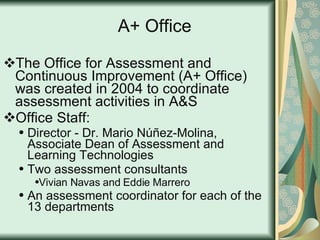
A+ Office The Office for Assessment and Continuous Improvement (A+ Office) was created in 2004 to coordinate assessment activities in A&S  Office Staff: Director - Dr. Mario Núñez-Molina, Associate Dean of Assessment and Learning Technologies Two assessment consultants  Vivian Navas and Eddie Marrero  An assessment coordinator for each of the 13 departments
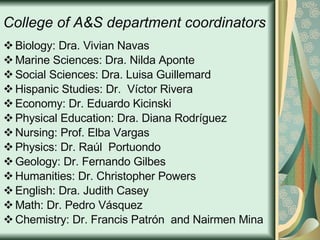
College of A&S department coordinators Biology: Dra. Vivian Navas Marine Sciences: Dra. Nilda Aponte Social Sciences: Dra. Luisa Guillemard Hispanic Studies:  Dr.  Víctor Rivera Economy: Dr. Eduardo Kicinski Physical Education: Dra. Diana Rodríguez Nursing: Prof. Elba Vargas Physics:  Dr. Raúl  Portuondo Geology: Dr. Fernando Gilbes Humanities: Dr. Christopher Powers English: Dra. Judith Casey Math:  Dr. Pedro Vásquez Chemistry: Dr. Francis Patrón  and Nairmen Mina
  Arts and Sciences assessment strategy and methodology Monthly meetings to coordinate  activities and follow-up  Assessment training for coordinators  Continuous mentoring to department coordinators
Department coordinator tasks Coordinate the development of a departmental student learning assessment plan Do one learning assessment cycle (loop) per year Present results and actions taken to other faculty, coordinators and university officials Submit a report
Participation incentives 3 credits release time for department coordinator Professional enhancement education credits  (CEP Center) for faculty participants Seed money to conduct learning assessment research  Opportunity to publish in Avalúo Plus Journal
Model used by College of A&S to  assess student learning
MSCHE recommendation- June, 2005 “ Each program should complete at least one significant assessment project during the next academic year on a topic of importance to that program.”(MSCHE Report, 2005, p.20 )
Assessment strategy A template with the fundamental elements in an assessment project was designed. The template serves as a guide for designing, implementing and reporting the assessment cycle.
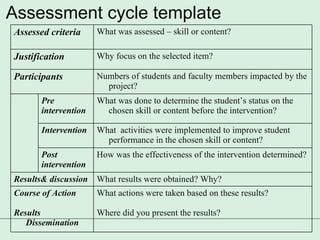
Assessment cycle template Assessed criteria What was assessed – skill or content?  Justification Why focus on the selected item?  Participants  Numbers of students and faculty members impacted by the project? Pre intervention What was done to determine the student’s status on the chosen skill or content before the intervention?  Intervention What  activities were implemented to improve student performance in the chosen skill or content? Post intervention How was the effectiveness of the intervention determined?  Results& discussion What results were obtained? Why? Course of Action Results Dissemination   What actions were taken based on these results?  Where did you present the results?
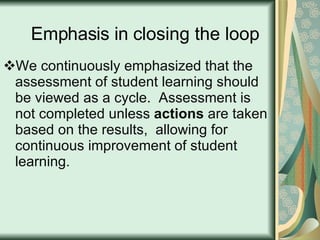
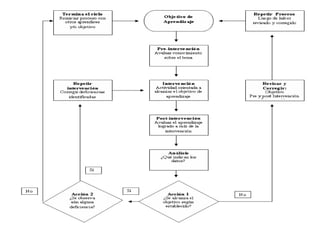
Emphasis in closing the loop We continuously emphasized that the assessment of student learning should be viewed as a cycle.  Assessment is not completed unless  actions  are taken based on the results,  allowing for continuous improvement of student learning.
 
Assessment achievements in the Departments of the College of Arts & Sciences
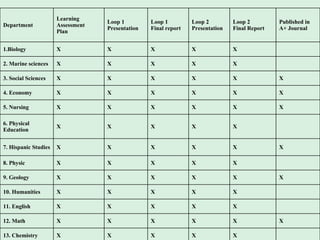
Department Learning Assessment Plan Loop 1  Presentation Loop 1 Final report Loop 2 Presentation Loop 2 Final Report Published in A+ Journal 1.Biology X X X X X   2. Marine sciences X X X X X   3. Social Sciences X X X X X X 4. Economy X X X X X X 5. Nursing X X X X X X 6. Physical Education X X X X X   7. Hispanic Studies X X X X X X 8. Physic X X X X X   9. Geology X X X X X X 10. Humanities X X X X X   11. English X X X X X   12. Math X X X X X X 13. Chemistry X X X X X  
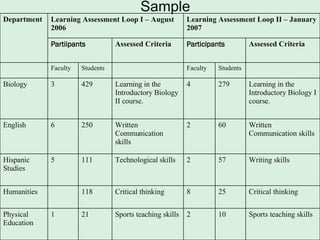
Sample Department Learning Assessment Loop I – August 2006 Learning Assessment Loop II – January 2007 Partiipants Assessed Criteria Participants Assessed Criteria   Faculty Students   Faculty Students   Biology 3 429 Learning in the Introductory Biology II course. 4  279  Learning in the Introductory Biology I course. English 6  250  Written Communication skills 2 60 Written Communication skills  Hispanic Studies 5  111 Technological skills 2  57  Writing skills Humanities   118 Critical thinking 8  25  Critical thinking Physical Education 1 21 Sports teaching skills 2 10 Sports teaching skills
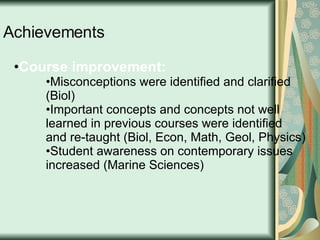
Achievements Course improvement:  Misconceptions were identified and clarified (Biol)  Important concepts and concepts not well learned in previous courses were identified and re-taught (Biol, Econ, Math, Geol, Physics) Student awareness on contemporary issues increased (Marine Sciences)
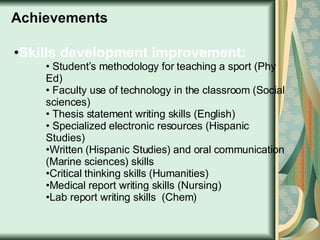
Skills development improvement: Student’s methodology for teaching a sport (Phy Ed) Faculty use of technology in the classroom (Social sciences) Thesis statement writing skills (English) Specialized electronic resources (Hispanic Studies) Written (Hispanic Studies) and oral communication (Marine sciences) skills  Critical thinking skills (Humanities) Medical report writing skills (Nursing) Lab report writing skills  (Chem) Achievements
In progress Third assessment loop project implementation Presentation (may 08) Final report Publication  Department  assessment plan revision Departmental workshops to increase faculty involvement
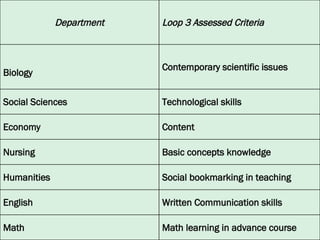
Department Loop 3 Assessed Criteria Biology Contemporary scientific issues Social Sciences Technological skills Economy Content Nursing Basic concepts knowledge Humanities Social bookmarking in teaching English Written Communication skills Math Math learning in advance course
Next semester  Coordinator will become department assessment facilitator (consultant) Faculty will conduct student learning assessment in their particular courses.  Coordinator will mentor them. Coordinator has been empowered Objective: Involve more faculty in assessment
College of Arts and Sciences Dissemination Strategies
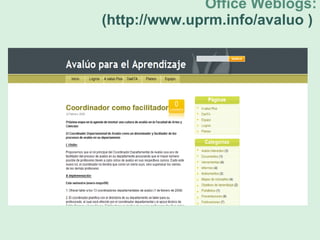
Office Weblogs:  (http://www.uprm.info/avaluo   )
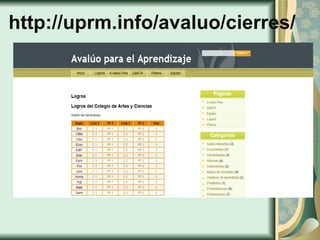
http://uprm.info/avaluo/cierres/
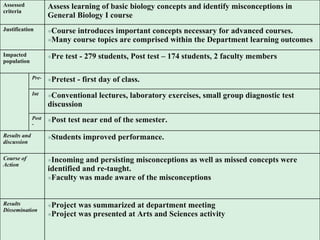
Assessed criteria Assess learning of basic biology concepts and identify misconceptions in  General Biology I course Justification Course introduces important concepts necessary for advanced courses. Many course topics are comprised within the Department learning outcomes Impacted population  Pre test - 279 students, Post test – 174 students, 2 faculty members Pre- Pretest - first day of class. Int Conventional lectures, laboratory exercises, small group diagnostic test discussion Post- Post test near end of the semester.  Results and discussion Students improved performance. Course of Action Incoming and persisting misconceptions as well as missed concepts were identified and re-taught. Faculty was made aware of the misconceptions  Results Dissemination  Project was summarized at department meeting Project was presented at Arts and Sciences activity
Avalúo Plus: Learning Assessment Journal (http://uprm.info/avaluoplus/  )
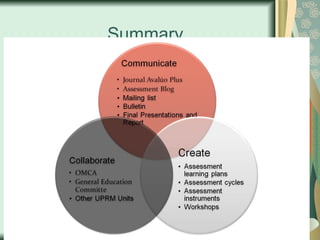
Summary
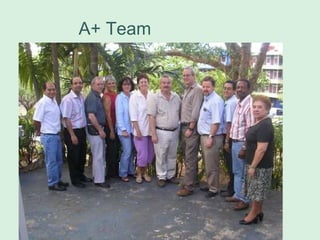
A+ Team
Available Resources PowerPoint presentation  Avalúo Plus  Journal (both editions) College of Arts and Science Progress report (submitted on May 2007)
QUESTIONS?

Assessmentt Report A&C To Msche Final

  • 1.
    Assessment of StudentLearning College of Arts and Sciences Progress Report March, 2008 Assessment and Continuous Improvement Office (A+ Office) Dr. Vivian Navas Dr. Eddie Marrero Dr. Mario Núñez
  • 2.
    Objectives Describe theArts and Sciences (A&S) Assessment and Continuous Improvement Office (A+) structure Present the model used by A&S to assess student learning Discuss assessment achievements in A&S Present A&S dissemination strategies
  • 3.
    Arts and SciencesAssessment Office (A+) Structure
  • 4.
    A+ Office TheOffice for Assessment and Continuous Improvement (A+ Office) was created in 2004 to coordinate assessment activities in A&S Office Staff: Director - Dr. Mario Núñez-Molina, Associate Dean of Assessment and Learning Technologies Two assessment consultants Vivian Navas and Eddie Marrero An assessment coordinator for each of the 13 departments
  • 5.
    College of A&Sdepartment coordinators Biology: Dra. Vivian Navas Marine Sciences: Dra. Nilda Aponte Social Sciences: Dra. Luisa Guillemard Hispanic Studies: Dr.  Víctor Rivera Economy: Dr. Eduardo Kicinski Physical Education: Dra. Diana Rodríguez Nursing: Prof. Elba Vargas Physics: Dr. Raúl Portuondo Geology: Dr. Fernando Gilbes Humanities: Dr. Christopher Powers English: Dra. Judith Casey Math: Dr. Pedro Vásquez Chemistry: Dr. Francis Patrón and Nairmen Mina
  • 6.
    Artsand Sciences assessment strategy and methodology Monthly meetings to coordinate activities and follow-up Assessment training for coordinators Continuous mentoring to department coordinators
  • 7.
    Department coordinator tasksCoordinate the development of a departmental student learning assessment plan Do one learning assessment cycle (loop) per year Present results and actions taken to other faculty, coordinators and university officials Submit a report
  • 8.
    Participation incentives 3credits release time for department coordinator Professional enhancement education credits (CEP Center) for faculty participants Seed money to conduct learning assessment research Opportunity to publish in Avalúo Plus Journal
  • 9.
    Model used byCollege of A&S to assess student learning
  • 10.
    MSCHE recommendation- June,2005 “ Each program should complete at least one significant assessment project during the next academic year on a topic of importance to that program.”(MSCHE Report, 2005, p.20 )
  • 11.
    Assessment strategy Atemplate with the fundamental elements in an assessment project was designed. The template serves as a guide for designing, implementing and reporting the assessment cycle.
  • 12.
    Assessment cycle templateAssessed criteria What was assessed – skill or content? Justification Why focus on the selected item? Participants Numbers of students and faculty members impacted by the project? Pre intervention What was done to determine the student’s status on the chosen skill or content before the intervention? Intervention What activities were implemented to improve student performance in the chosen skill or content? Post intervention How was the effectiveness of the intervention determined? Results& discussion What results were obtained? Why? Course of Action Results Dissemination What actions were taken based on these results? Where did you present the results?
  • 13.
    Emphasis in closingthe loop We continuously emphasized that the assessment of student learning should be viewed as a cycle. Assessment is not completed unless actions are taken based on the results, allowing for continuous improvement of student learning.
  • 14.
  • 15.
    Assessment achievements inthe Departments of the College of Arts & Sciences
  • 16.
    Department Learning AssessmentPlan Loop 1 Presentation Loop 1 Final report Loop 2 Presentation Loop 2 Final Report Published in A+ Journal 1.Biology X X X X X   2. Marine sciences X X X X X   3. Social Sciences X X X X X X 4. Economy X X X X X X 5. Nursing X X X X X X 6. Physical Education X X X X X   7. Hispanic Studies X X X X X X 8. Physic X X X X X   9. Geology X X X X X X 10. Humanities X X X X X   11. English X X X X X   12. Math X X X X X X 13. Chemistry X X X X X  
  • 17.
    Sample Department LearningAssessment Loop I – August 2006 Learning Assessment Loop II – January 2007 Partiipants Assessed Criteria Participants Assessed Criteria   Faculty Students   Faculty Students   Biology 3 429 Learning in the Introductory Biology II course. 4 279 Learning in the Introductory Biology I course. English 6 250 Written Communication skills 2 60 Written Communication skills Hispanic Studies 5 111 Technological skills 2 57 Writing skills Humanities   118 Critical thinking 8 25 Critical thinking Physical Education 1 21 Sports teaching skills 2 10 Sports teaching skills
  • 18.
    Achievements Course improvement: Misconceptions were identified and clarified (Biol) Important concepts and concepts not well learned in previous courses were identified and re-taught (Biol, Econ, Math, Geol, Physics) Student awareness on contemporary issues increased (Marine Sciences)
  • 19.
    Skills development improvement:Student’s methodology for teaching a sport (Phy Ed) Faculty use of technology in the classroom (Social sciences) Thesis statement writing skills (English) Specialized electronic resources (Hispanic Studies) Written (Hispanic Studies) and oral communication (Marine sciences) skills Critical thinking skills (Humanities) Medical report writing skills (Nursing) Lab report writing skills (Chem) Achievements
  • 20.
    In progress Thirdassessment loop project implementation Presentation (may 08) Final report Publication Department assessment plan revision Departmental workshops to increase faculty involvement
  • 21.
    Department Loop 3Assessed Criteria Biology Contemporary scientific issues Social Sciences Technological skills Economy Content Nursing Basic concepts knowledge Humanities Social bookmarking in teaching English Written Communication skills Math Math learning in advance course
  • 22.
    Next semester Coordinator will become department assessment facilitator (consultant) Faculty will conduct student learning assessment in their particular courses. Coordinator will mentor them. Coordinator has been empowered Objective: Involve more faculty in assessment
  • 23.
    College of Artsand Sciences Dissemination Strategies
  • 24.
    Office Weblogs: (http://www.uprm.info/avaluo )
  • 25.
  • 26.
    Assessed criteria Assesslearning of basic biology concepts and identify misconceptions in General Biology I course Justification Course introduces important concepts necessary for advanced courses. Many course topics are comprised within the Department learning outcomes Impacted population Pre test - 279 students, Post test – 174 students, 2 faculty members Pre- Pretest - first day of class. Int Conventional lectures, laboratory exercises, small group diagnostic test discussion Post- Post test near end of the semester. Results and discussion Students improved performance. Course of Action Incoming and persisting misconceptions as well as missed concepts were identified and re-taught. Faculty was made aware of the misconceptions Results Dissemination Project was summarized at department meeting Project was presented at Arts and Sciences activity
  • 27.
    Avalúo Plus: LearningAssessment Journal (http://uprm.info/avaluoplus/ )
  • 28.
  • 29.
  • 30.
    Available Resources PowerPointpresentation Avalúo Plus Journal (both editions) College of Arts and Science Progress report (submitted on May 2007)
  • 31.