Integrating UX
and evidence-based
approaches to design
effective online youth mental
health services with young
people.
@pennyhagen
@kittyrahilly
@mariesanicholas

With much thanks to:
Brain & Mind Research Institute
Young and Well CRC
Victoria Blake, Inspire
Stephen McKernon
And our co-designers
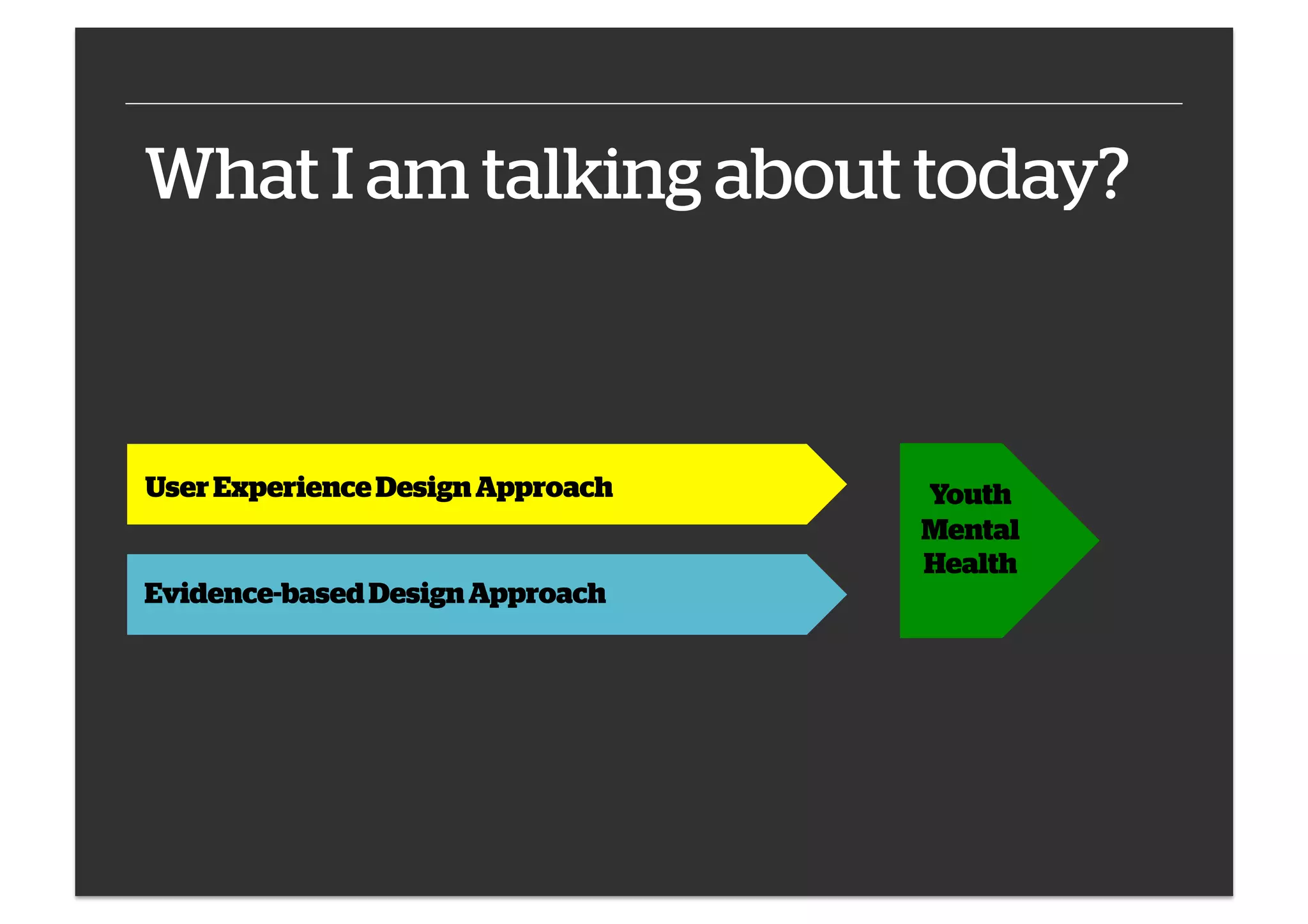
What I am talking about today?

User Experience Design Approach
Evidence-based Design Approach

Youth
Mental
Health
In collaboration with:

@mariesanicholas
Senior Manager, UX
Research and Service Design

@kittyrahilly
Manager, UX Research
& Service Design
The Inspire
Foundation
Inspire Foundation
What we’ll cover
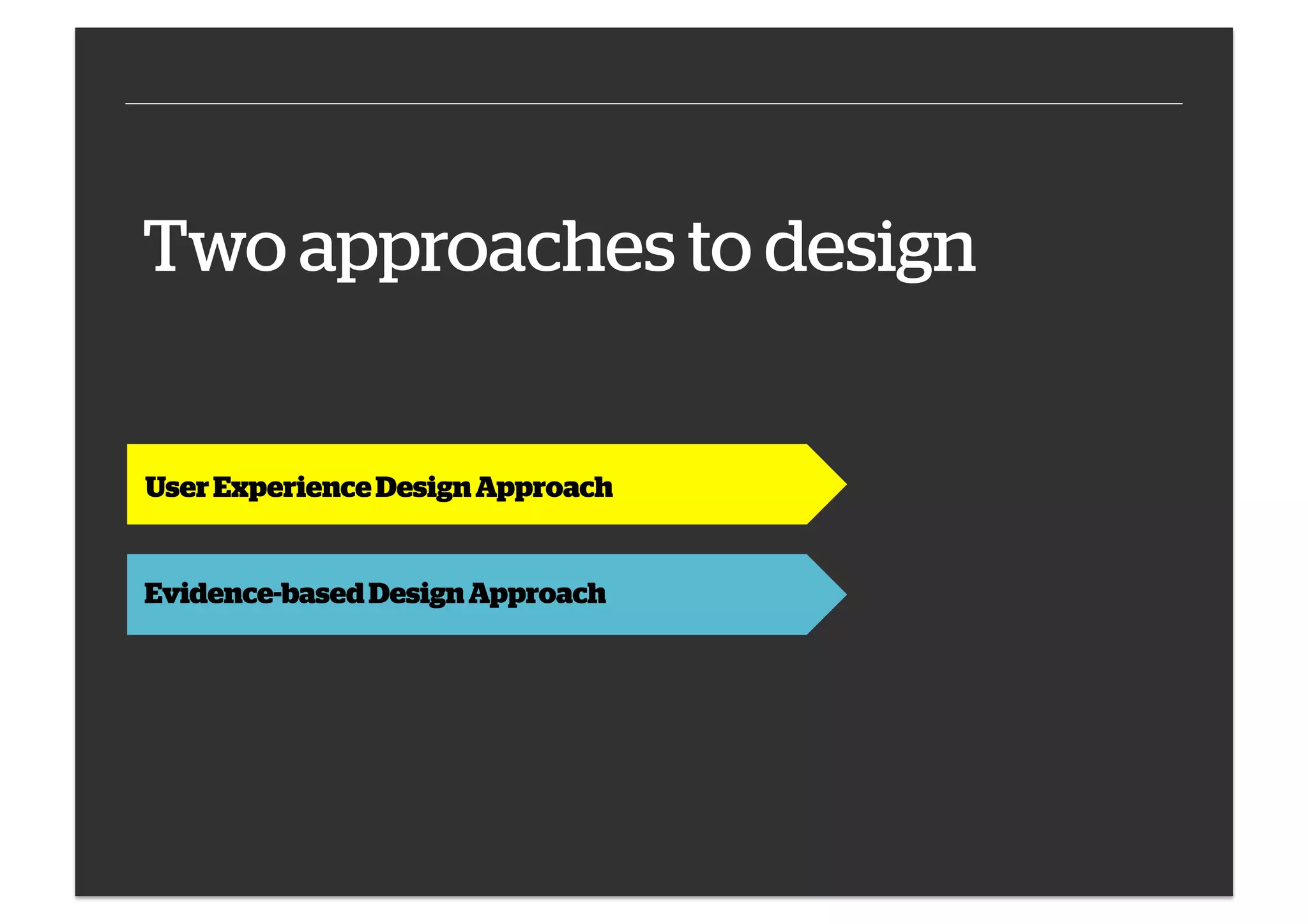
Two approaches to design

User Experience Design Approach
Evidence-based Design Approach
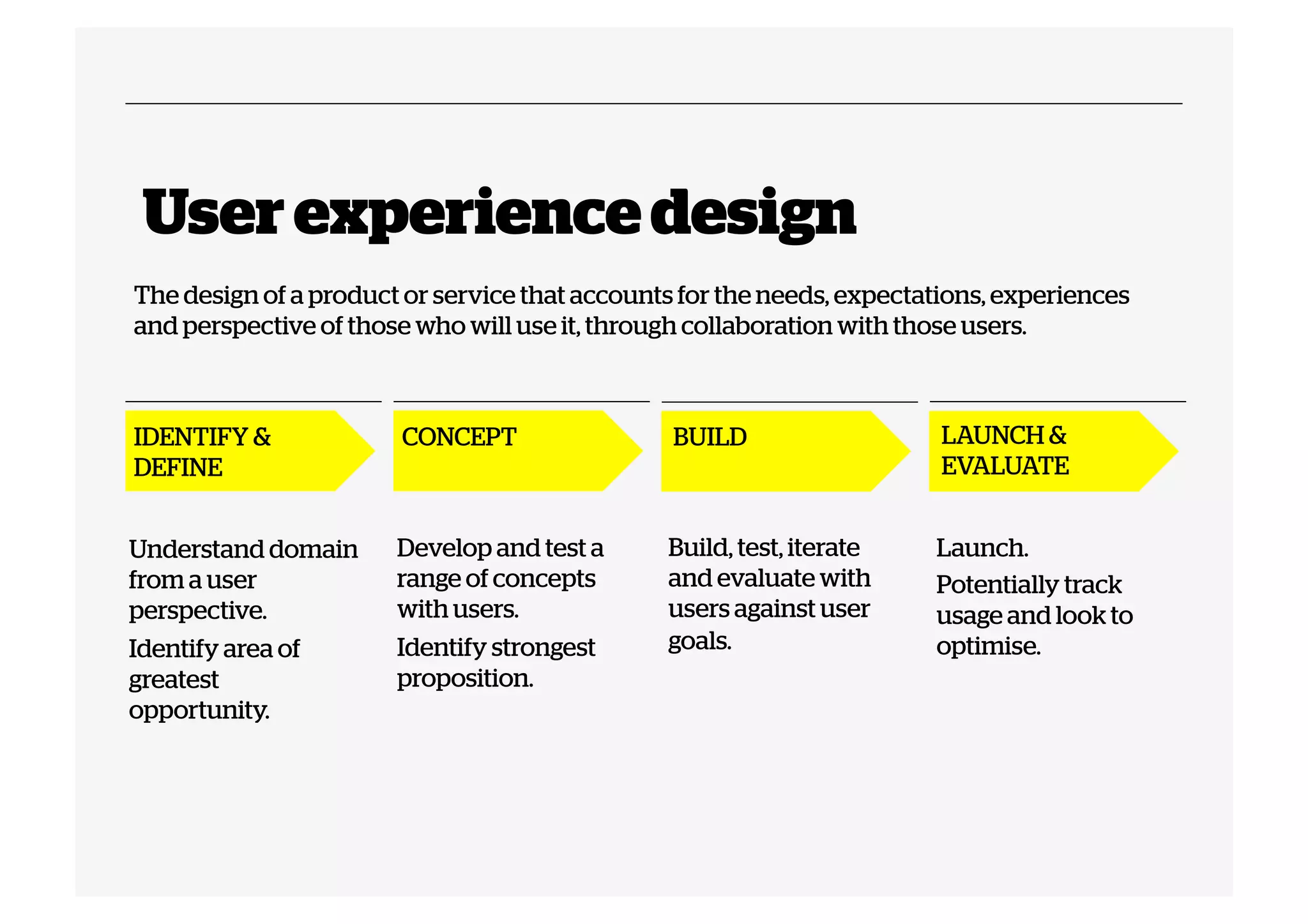
User experience design
The design of a product or service that accounts for the needs, expectations, experiences
and perspective of those who will use it, through collaboration with those users.

IDENTIFY &
DEFINE

CONCEPT

BUILD

LAUNCH &
EVALUATE

Understand domain
from a user
perspective.
Identify area of
greatest
opportunity.

Develop and test a
range of concepts
with users.
Identify strongest
proposition.

Build, test, iterate
and evaluate with
users against user
goals.

Launch.
Potentially track
usage and look to
optimise.
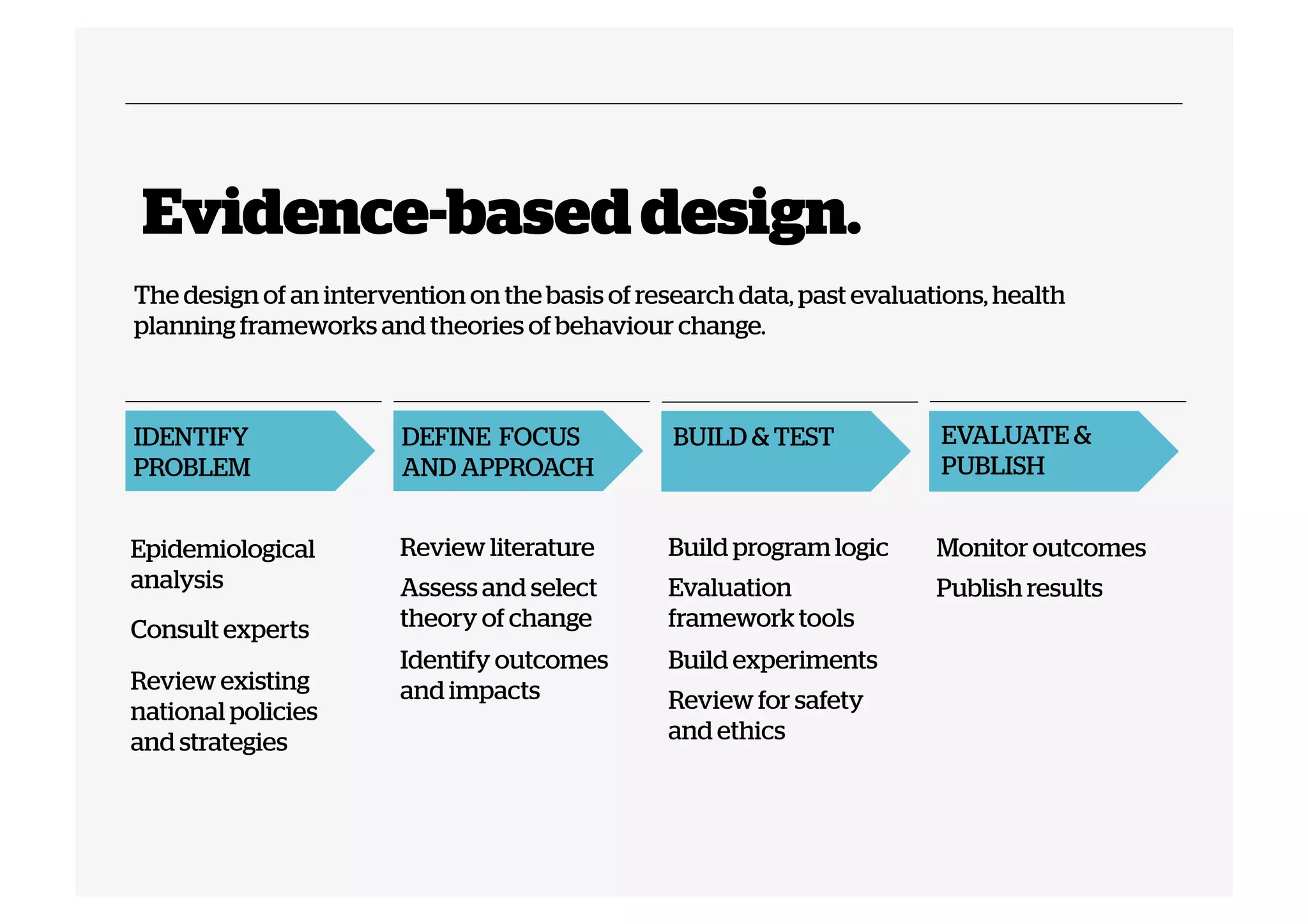
Evidence-based design.
The design of an intervention on the basis of research data, past evaluations, health
planning frameworks and theories of behaviour change.

IDENTIFY
PROBLEM

DEFINE FOCUS
AND APPROACH

BUILD & TEST

EVALUATE &
PUBLISH

Epidemiological
analysis

Review literature

Build program logic

Monitor outcomes

Assess and select
theory of change

Evaluation
framework tools

Publish results

Identify outcomes
and impacts

Build experiments

Consult experts
Review existing
national policies
and strategies

Review for safety
and ethics
Why integrate?

To achieve greater impact through interventions that
are based on sound evidence and are also engaging for
young people .
Why integrate?
Re-thinking clinical models and
service delivery within an online,
anonymous, self-service context.

Ways to actively involve the young
people who will use the service in
the design of the service.

A specific focus on the
perspectives and experiences of
the end-users of a service.

Connecting the models and
theories of evidence-based
approaches with the lived
experiences of the young people.
How do we do it?
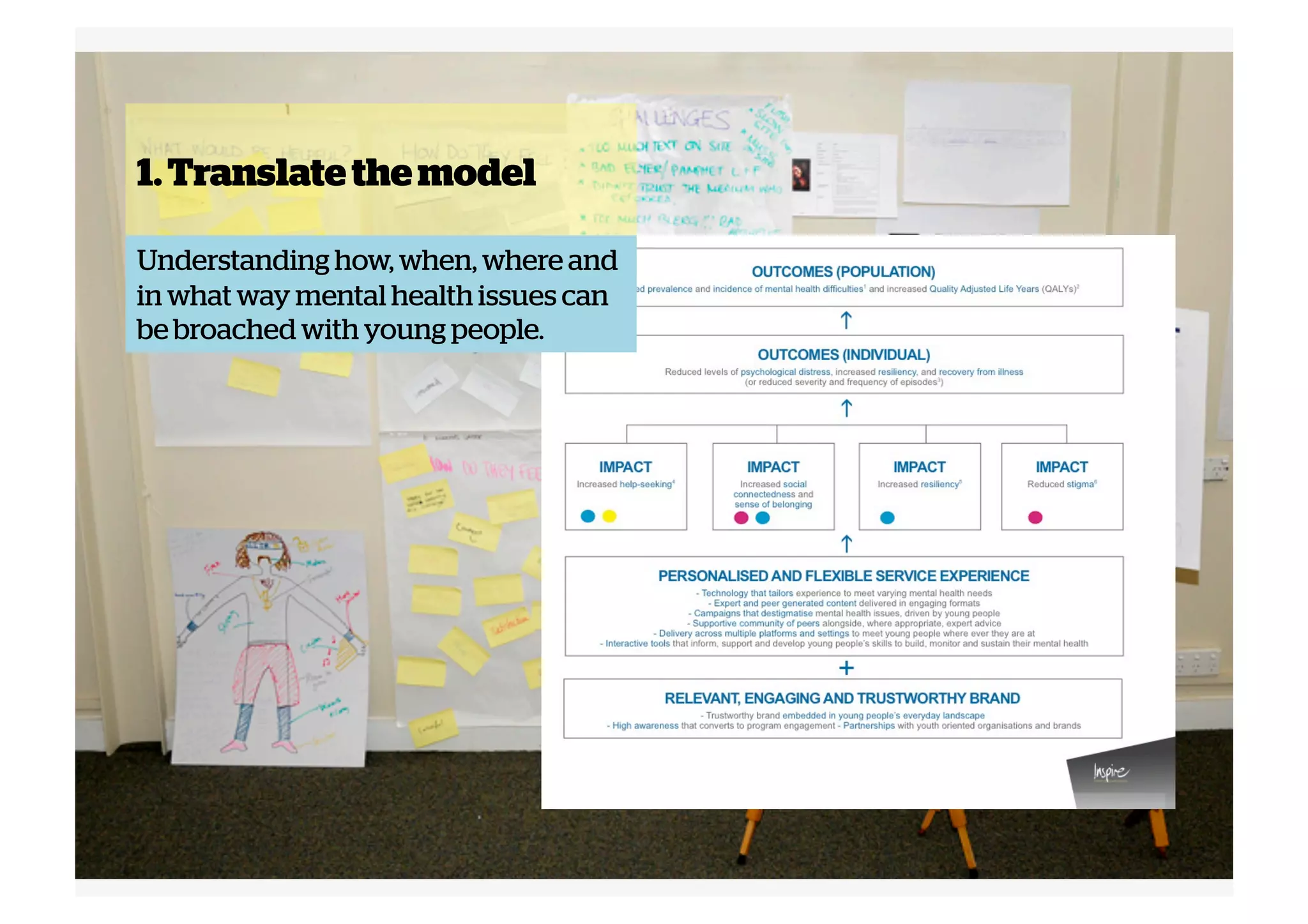
1. Translate the model
Understanding how, when, where and
in what way mental health issues can
be broached with young people.
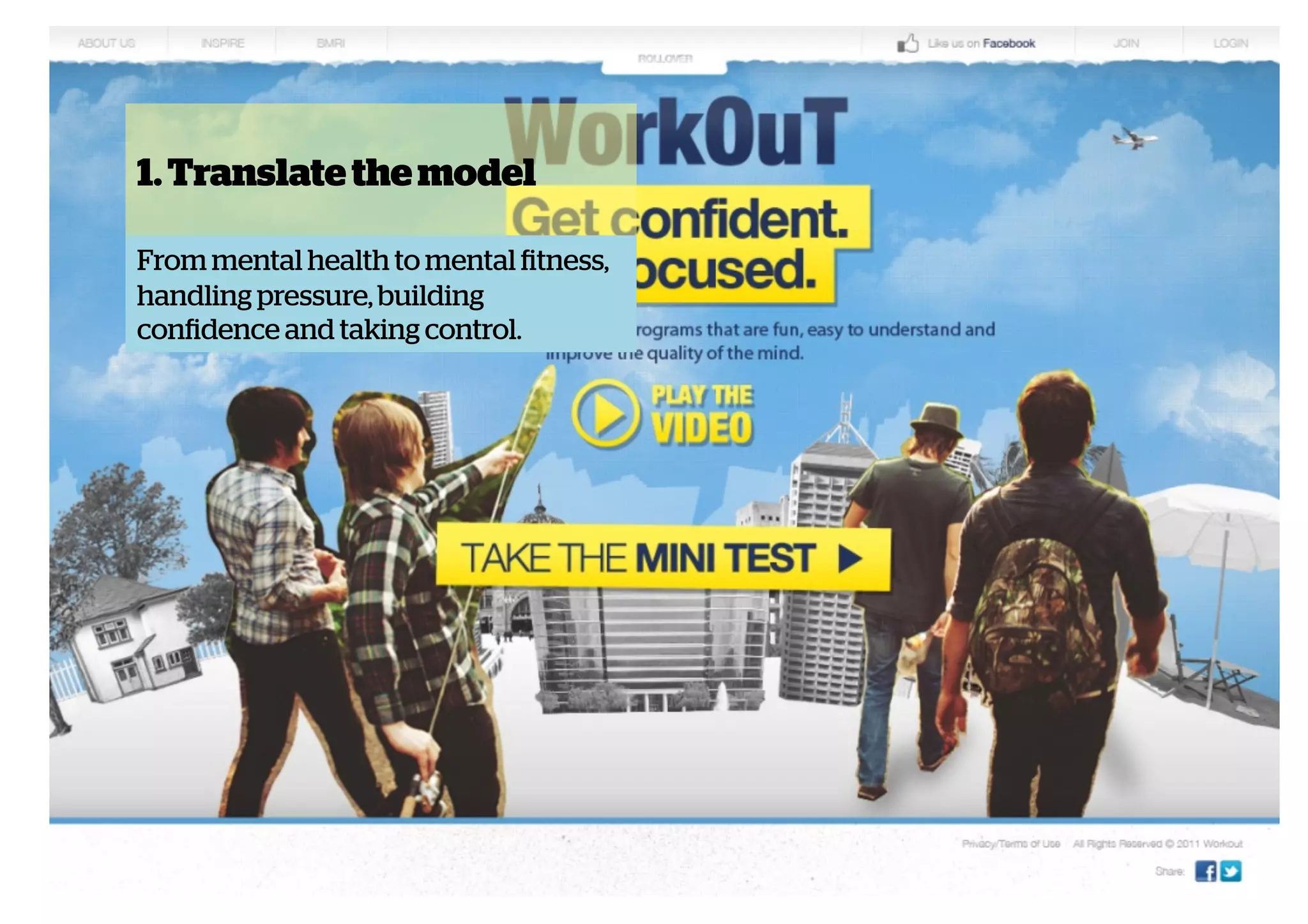
1. Translate the model
From mental health to mental fitness,
handling pressure, building
confidence and taking control.
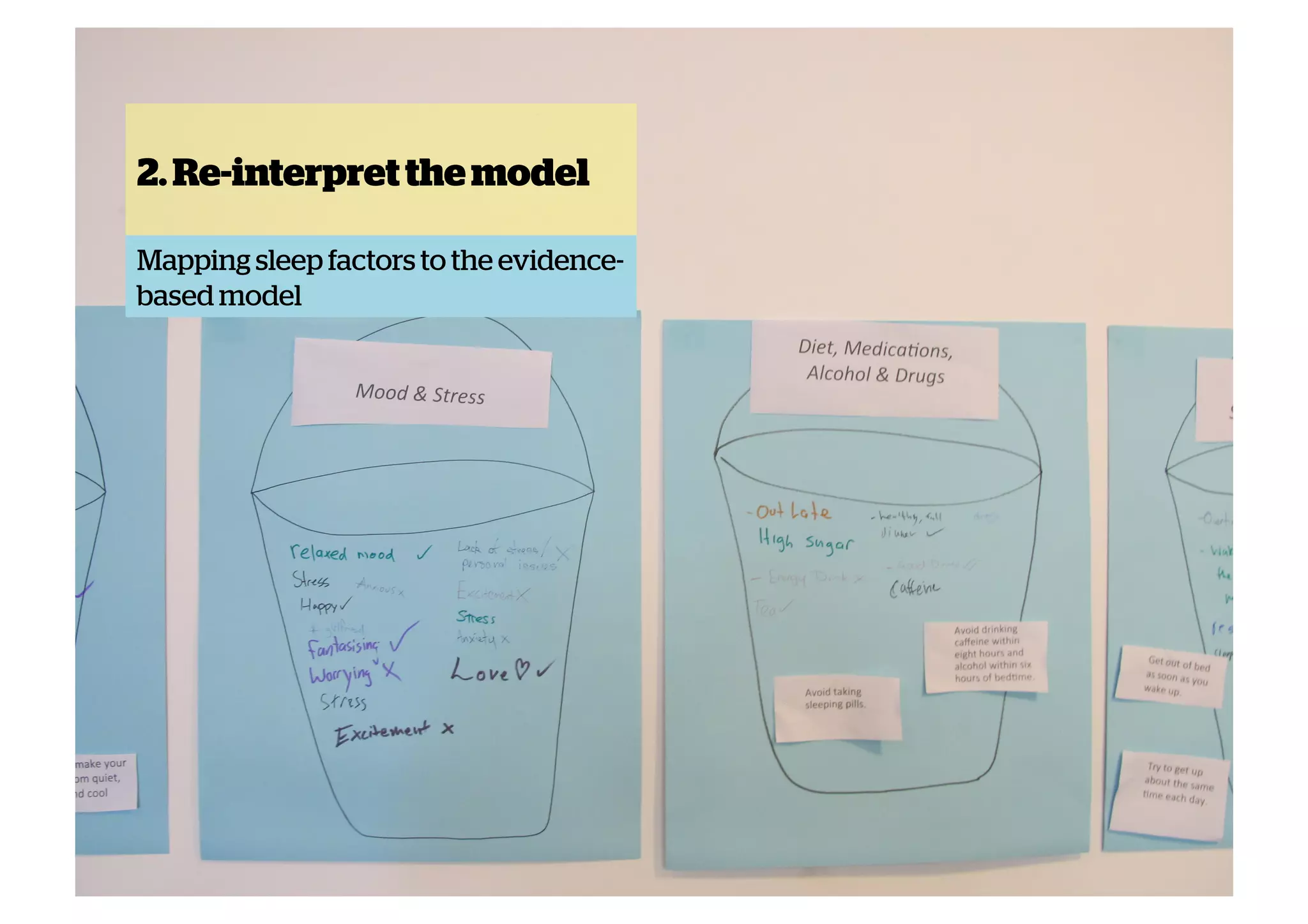
2. Re-interpret the model
Mapping sleep factors to the evidencebased model
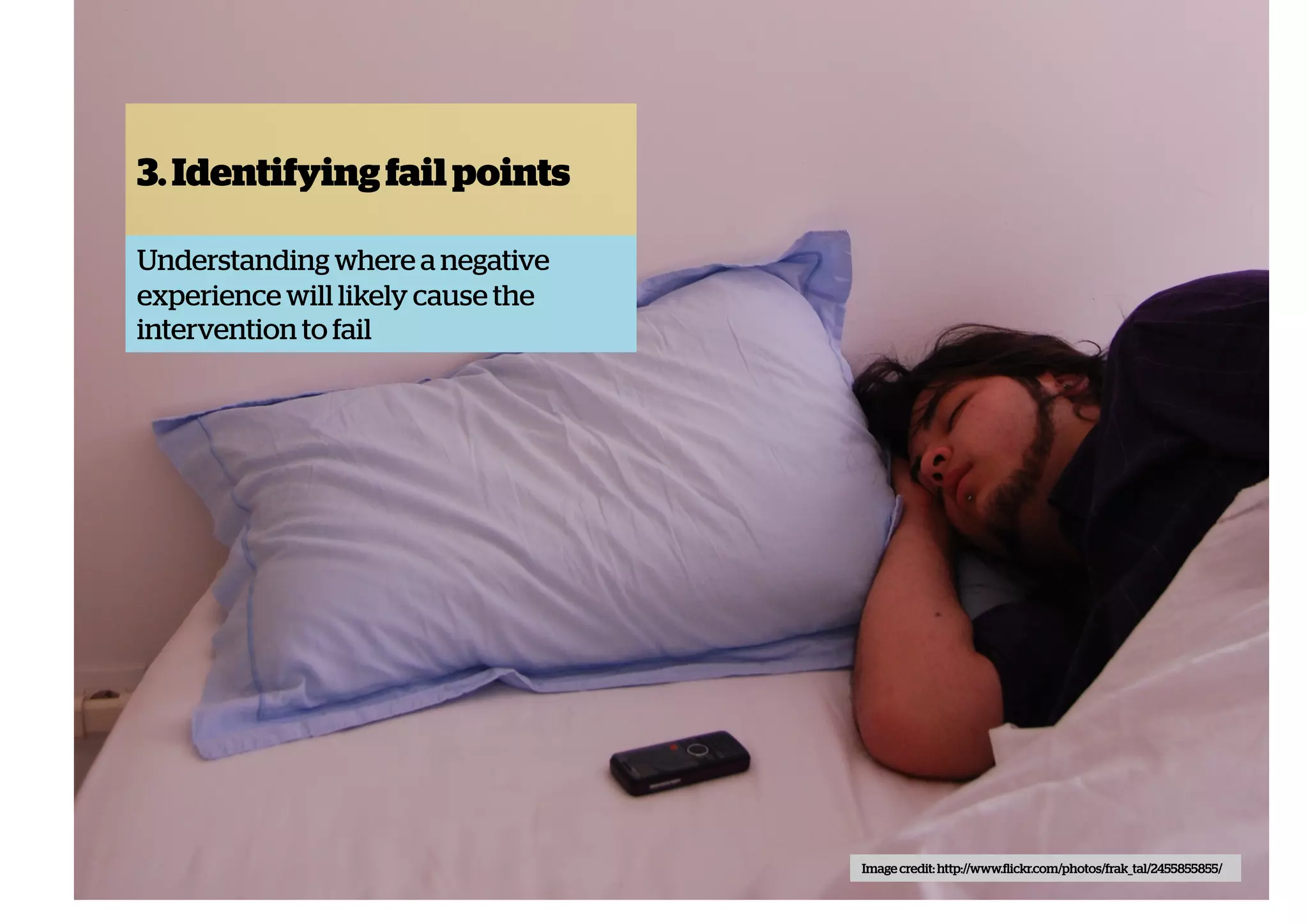
3. Identifying fail points
Understanding where a negative
experience will likely cause the
intervention to fail

Image credit: http://www.flickr.com/photos/frak_tal/2455855855/
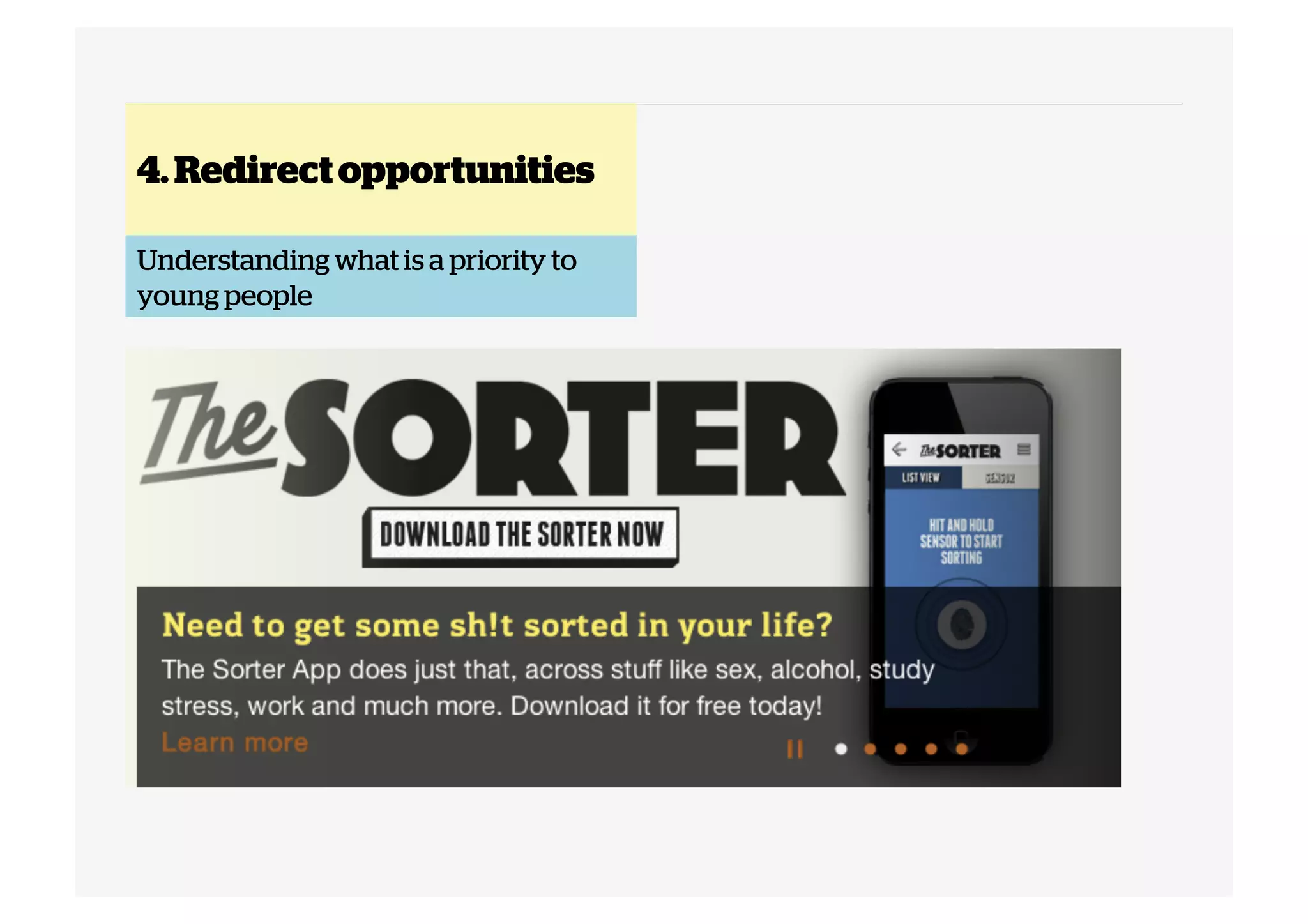
4. Redirect opportunities
Understanding what is a priority to
young people
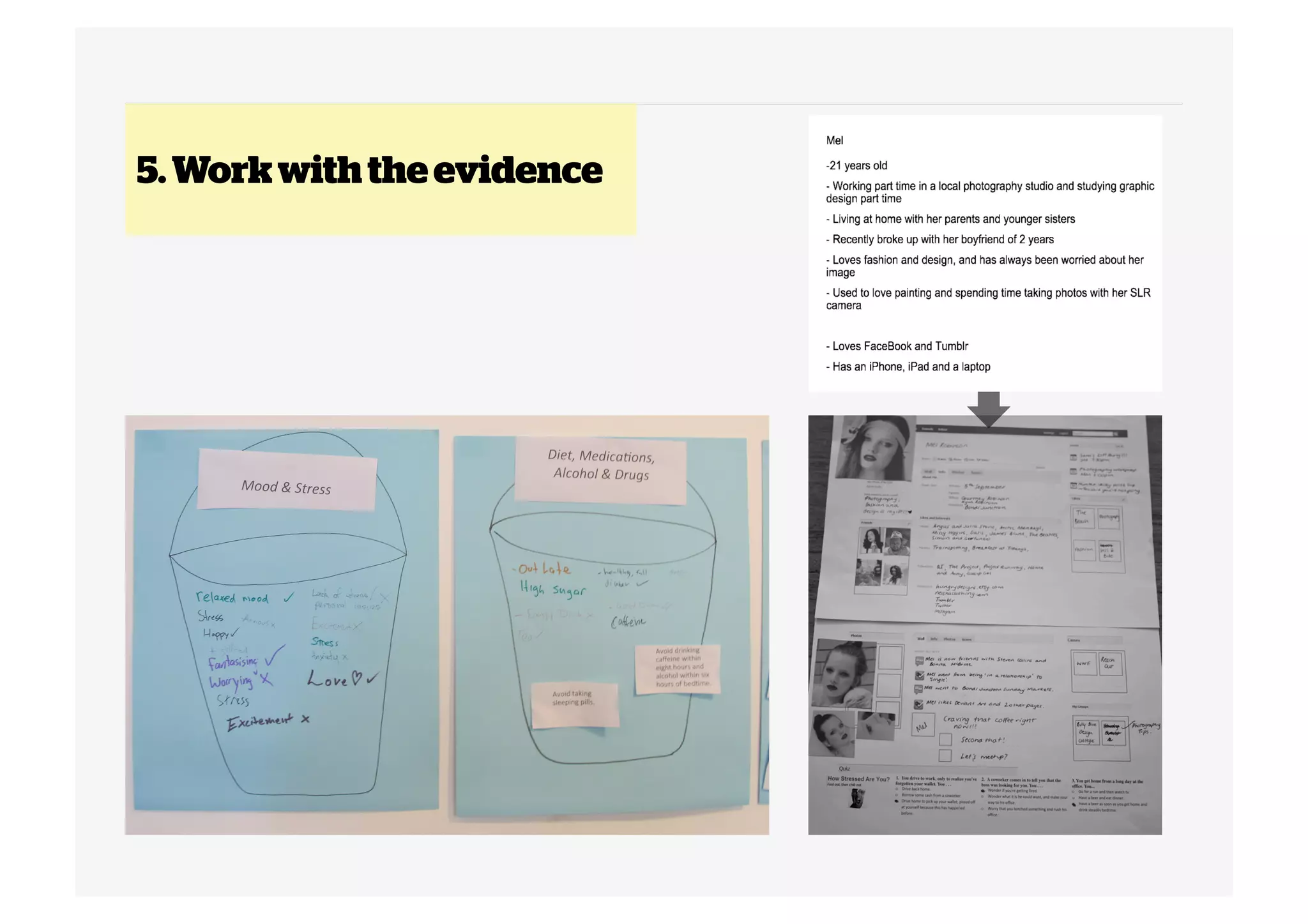
5. Work with the evidence
How we do it

#1 Translate models from the evidence-base
#2 Re-interpret models from the evidence-base
#3 Identify fail points
#4 Re-direct opportunities
#5 Work with the evidence
Challenges
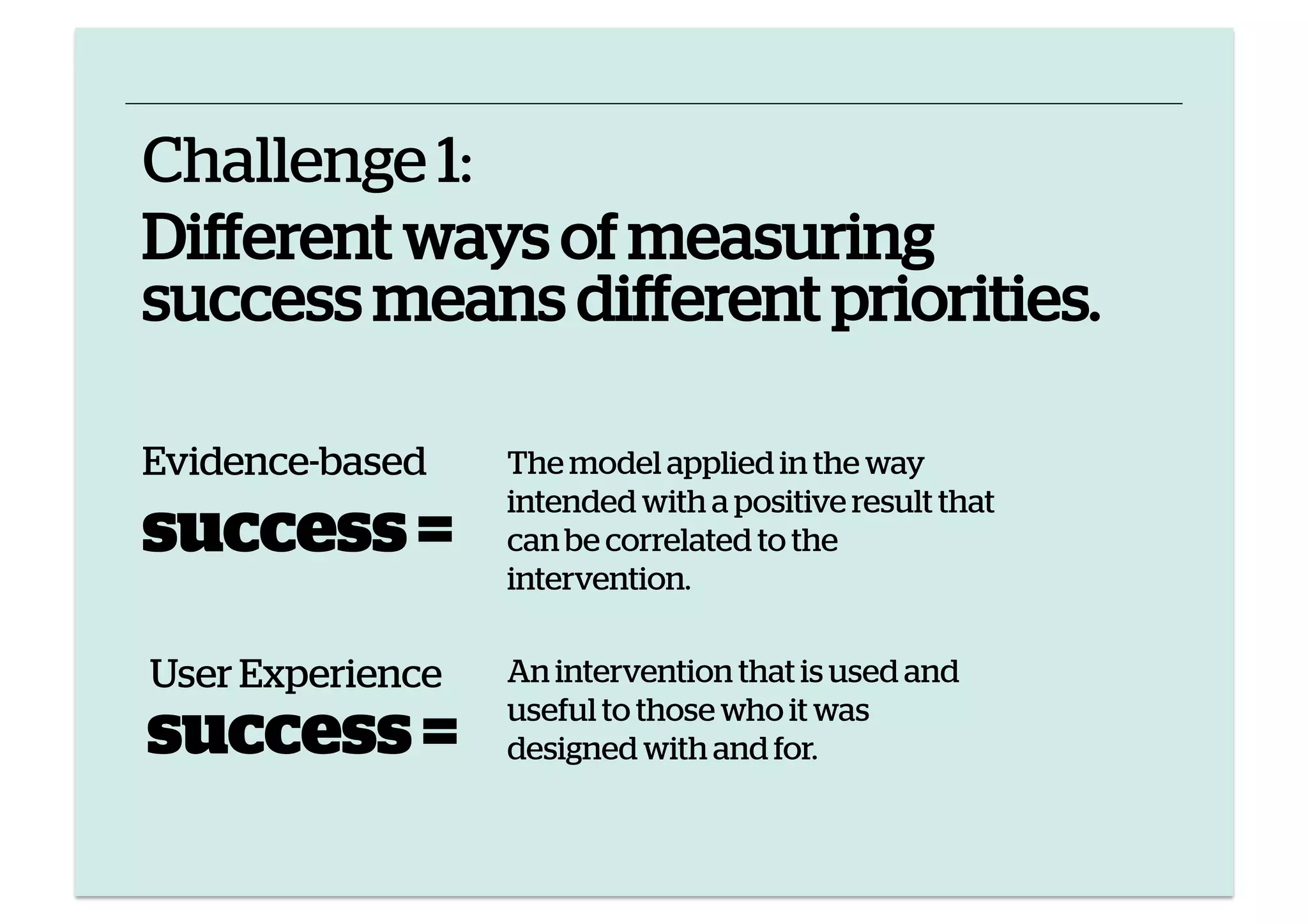
Challenge 1:
Different ways of measuring
success means different priorities.
Challenge 1:
Different ways of measuring
success means different priorities.
Evidence-based

success =
User Experience

success =

The model applied in the way
intended with a positive result that
can be correlated to the
intervention.
An intervention that is used and
useful to those who it was
designed with and for.
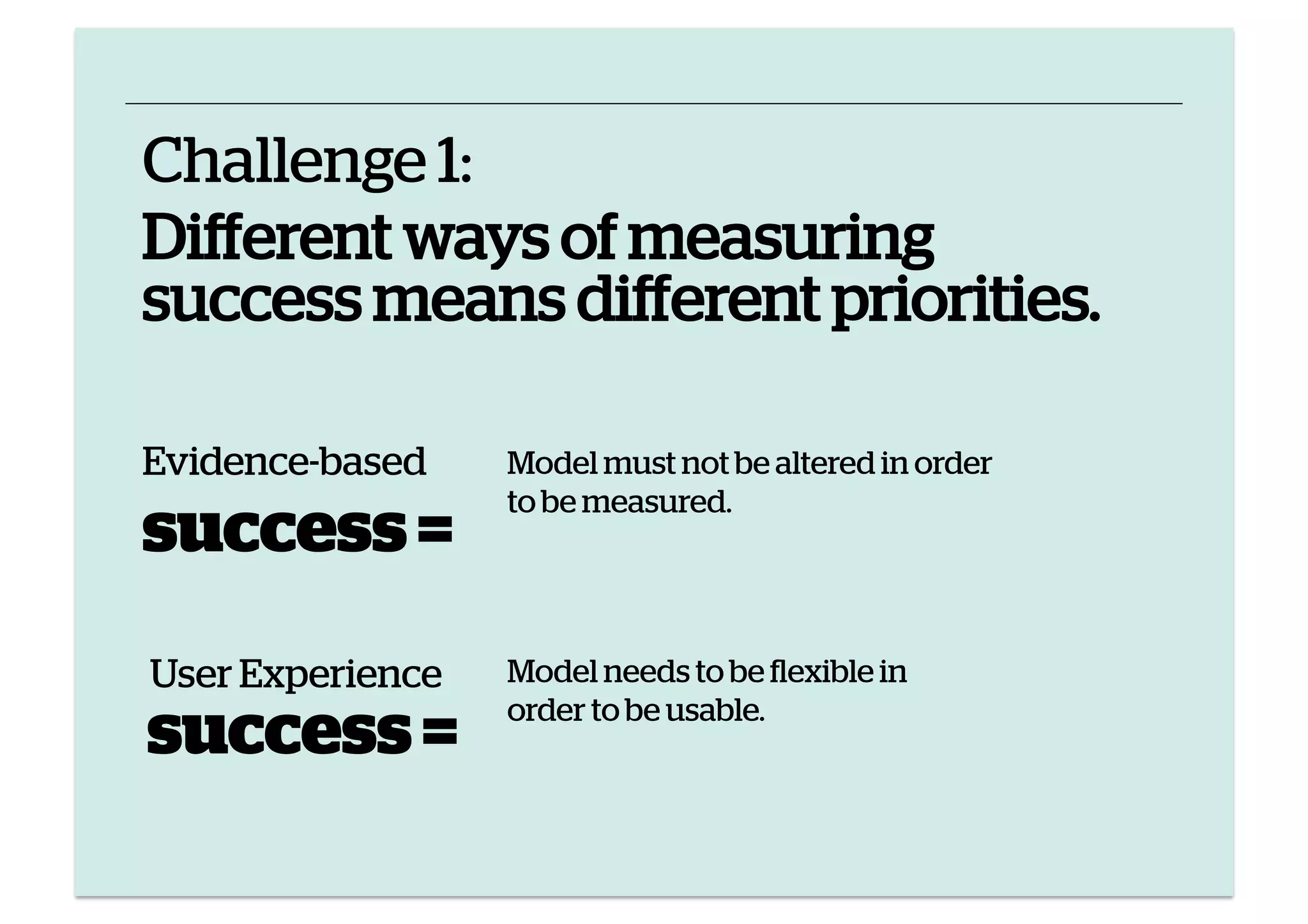
Challenge 1:
Different ways of measuring
success means different priorities.
Evidence-based

success =
User Experience

success =

Model must not be altered in order
to be measured.

Model needs to be flexible in
order to be usable.
Challenge 2:
Our forms of evidence and
how we manage them are not
the same
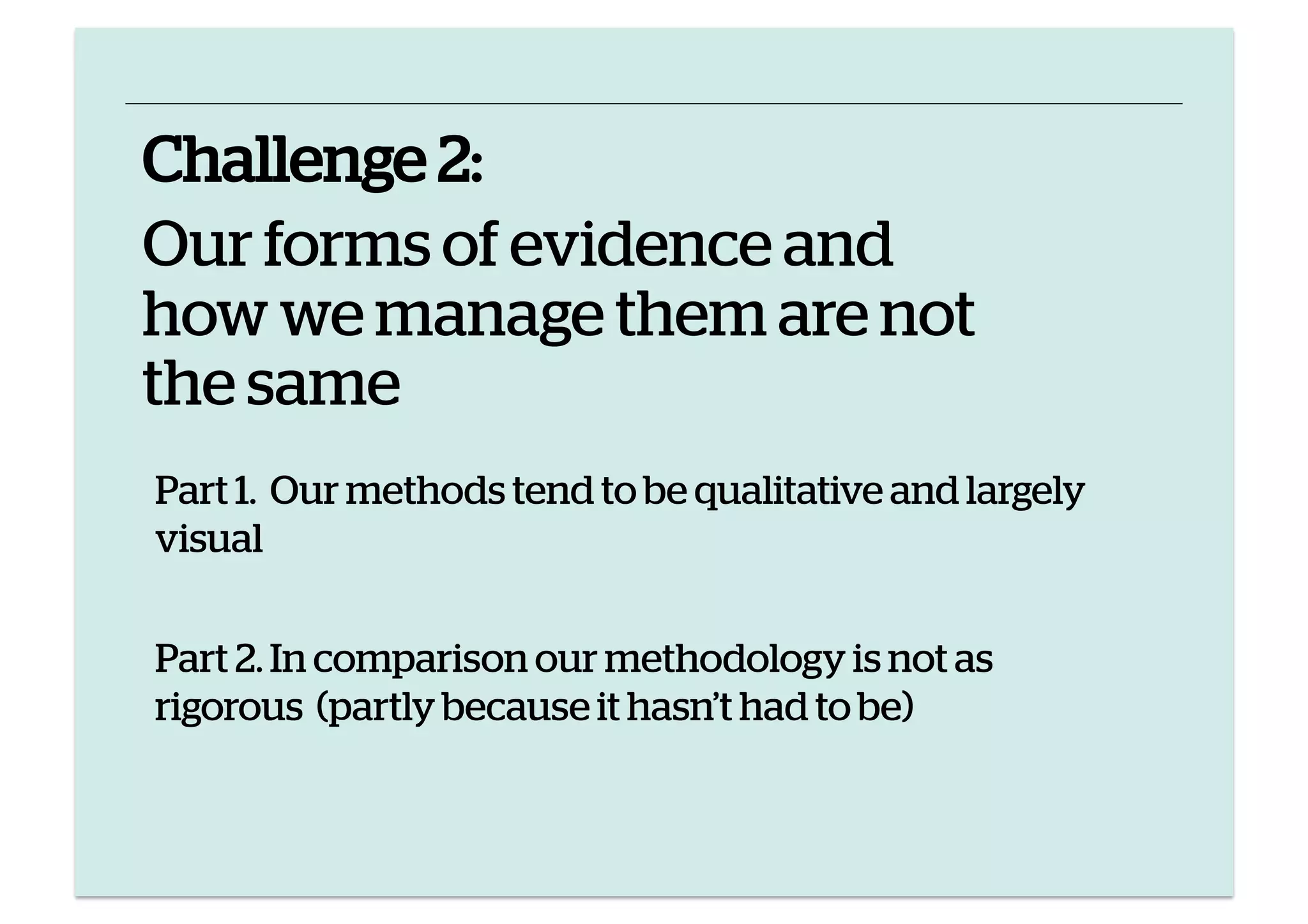
Challenge 2:
Our forms of evidence and
how we manage them are not
the same
Part 1. Our methods tend to be qualitative and largely
visual
Part 2. In comparison our methodology is not as
rigorous (partly because it hasn’t had to be)
Evolving our tools and
methods
01 design tools to
Adapting

connect and integrate both
perspectives as inputs for
design.
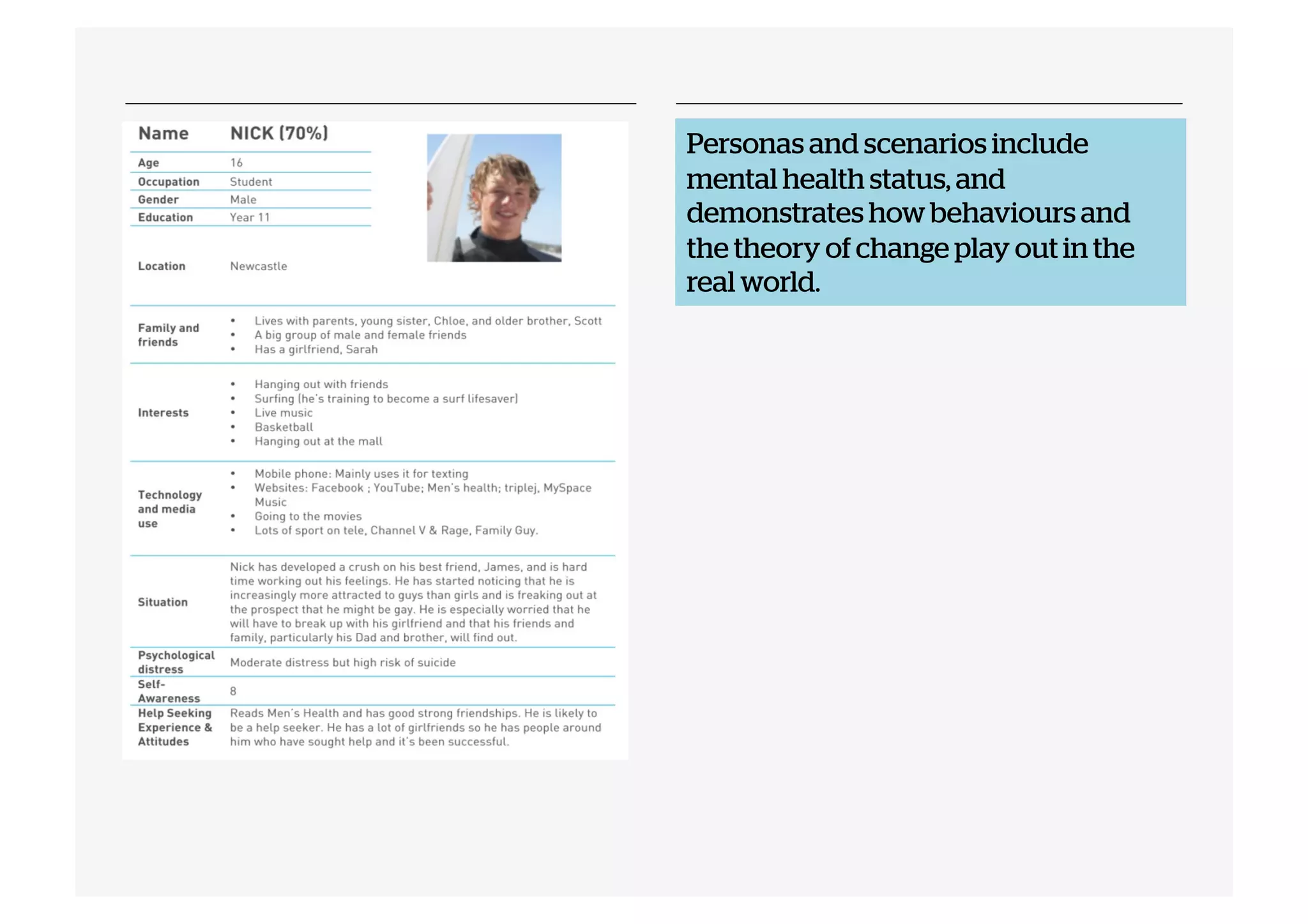
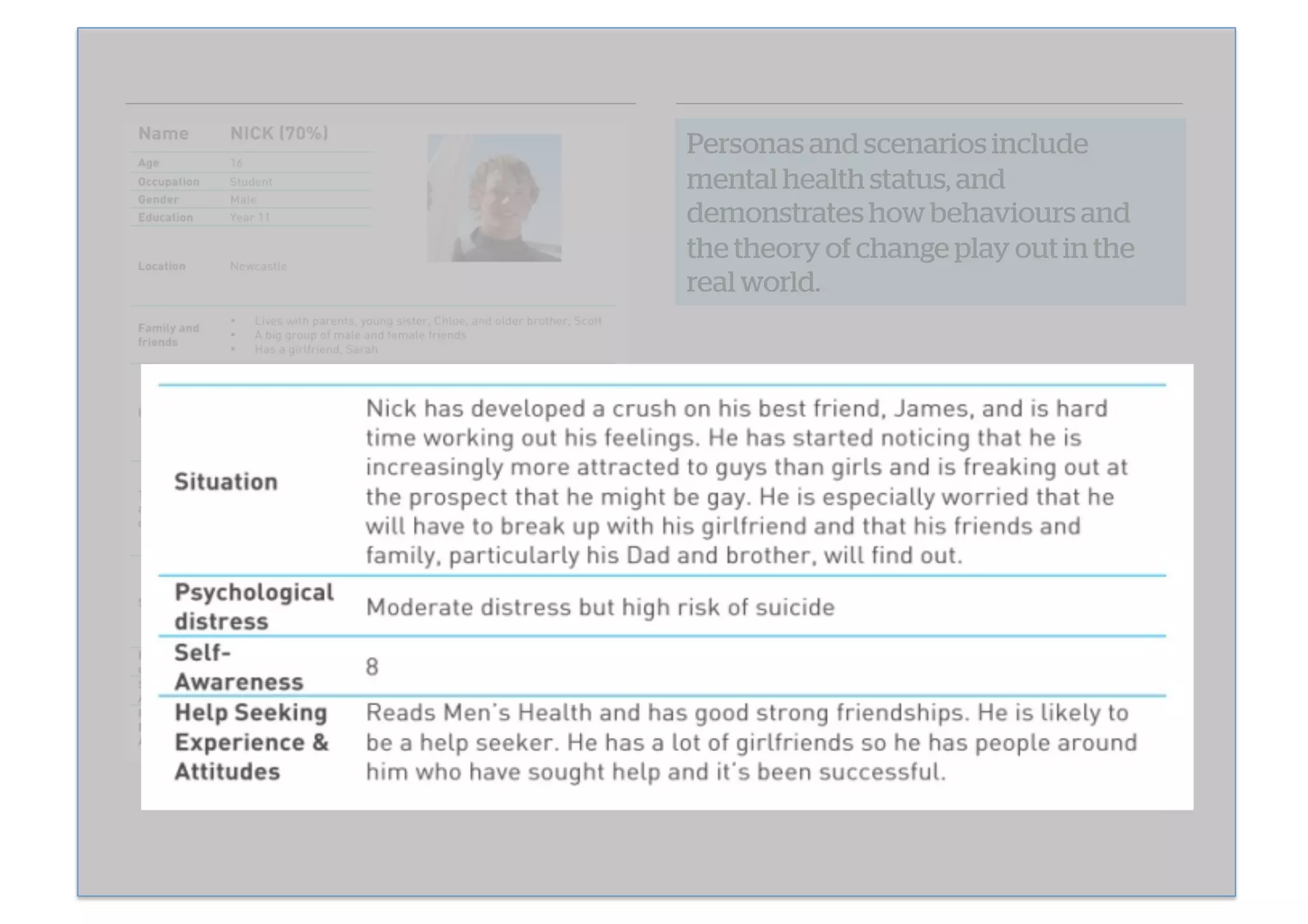
Personas and scenarios include
mental health status, and
demonstrates how behaviours and
the theory of change play out in the
real world.
Personas and scenarios include
mental health status, and
demonstrates how behaviours and
the theory of change play out in the
real world.
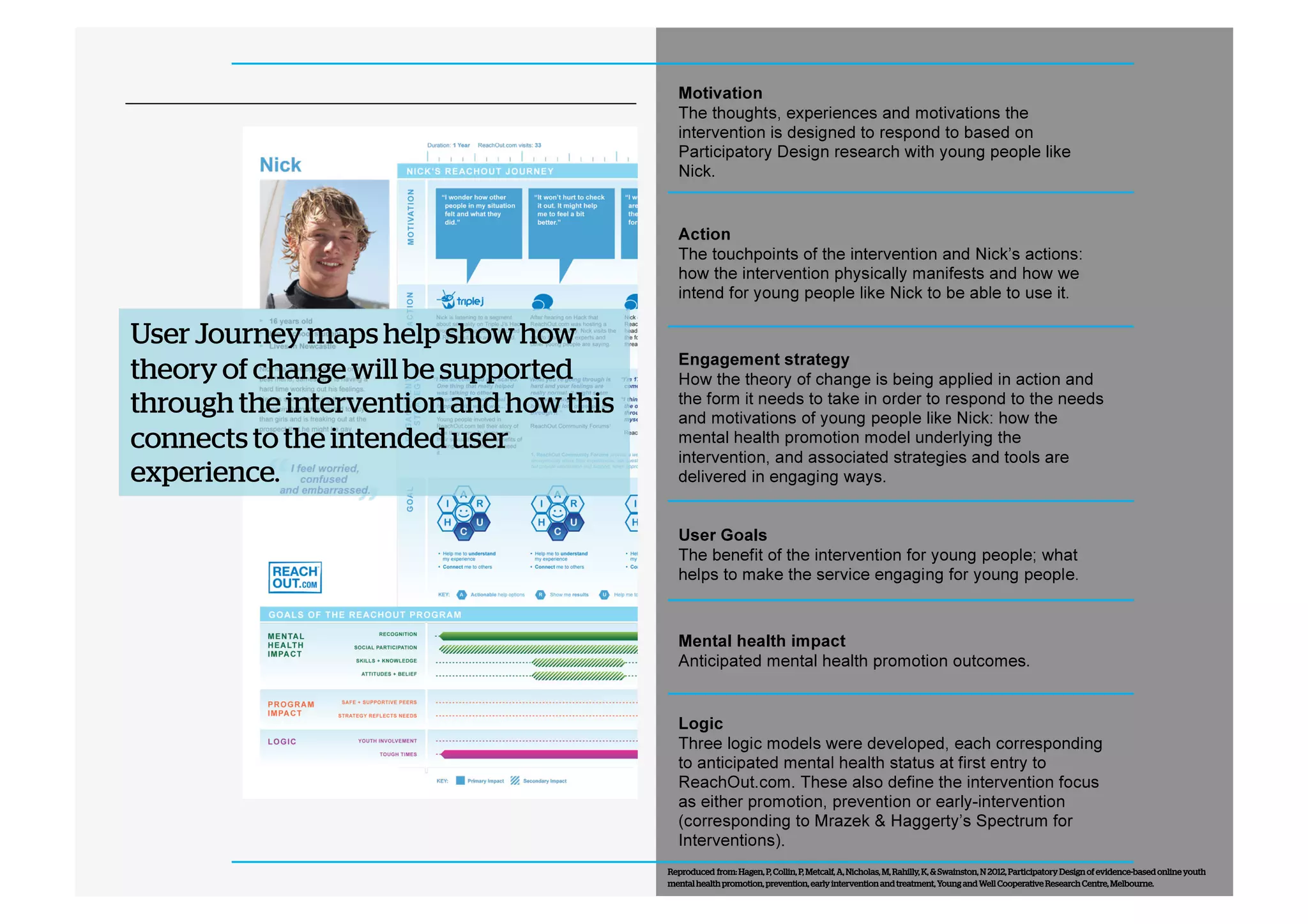
User Journey maps help show how
theory of change will be supported
through the intervention and how this
connects to the intended user
experience.

Reproduced from: Hagen, P, Collin, P, Metcalf, A, Nicholas, M, Rahilly, K, & Swainston, N 2012, Participatory Design of evidence-based online youth
mental health promotion, prevention, early intervention and treatment, Young and Well Cooperative Research Centre, Melbourne.
02

Evolving how method and
findings are communicated
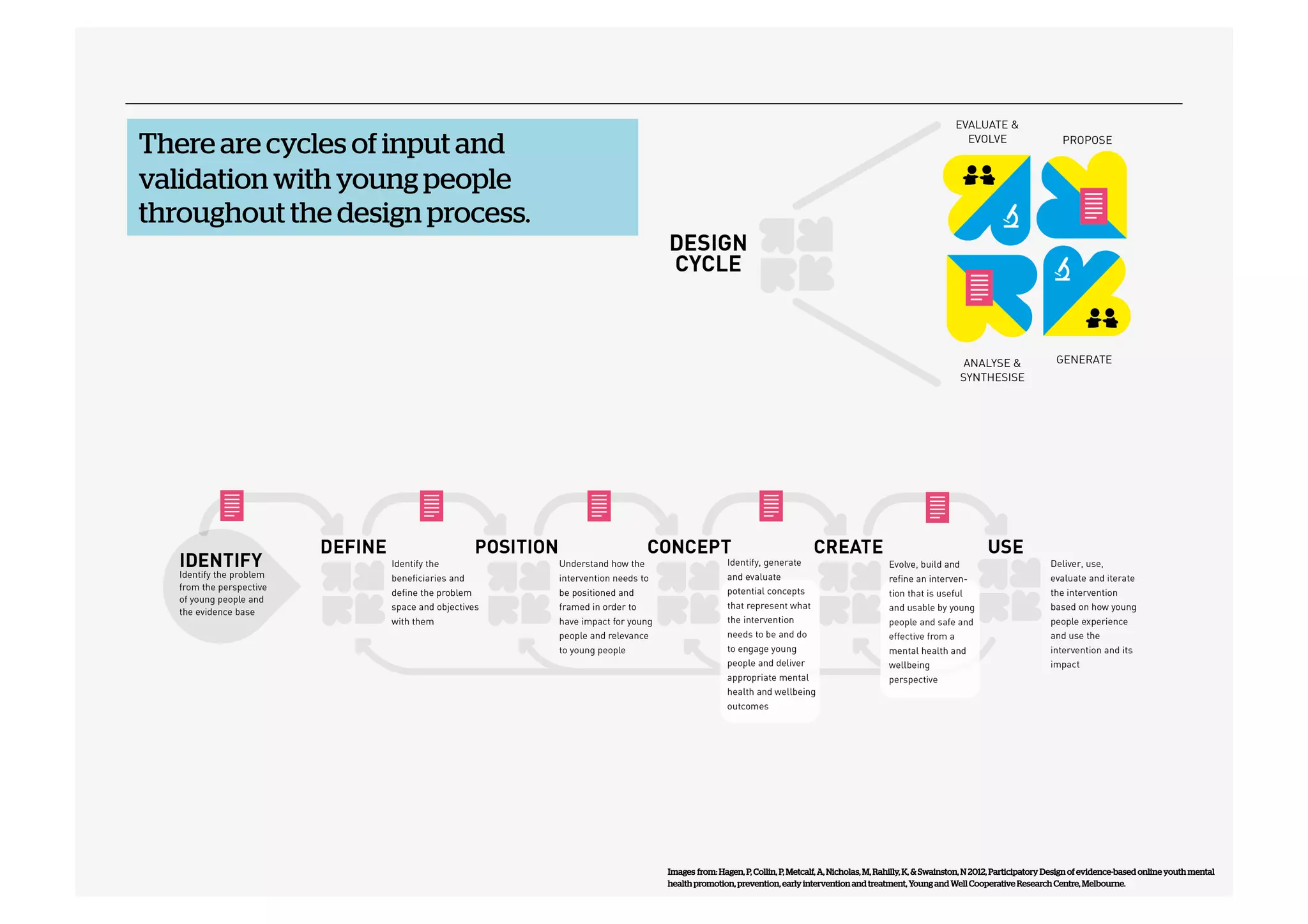
There are cycles of input and
validation with young people
throughout the design process.

Images from: Hagen, P, Collin, P, Metcalf, A, Nicholas, M, Rahilly, K, & Swainston, N 2012, Participatory Design of evidence-based online youth mental
health promotion, prevention, early intervention and treatment, Young and Well Cooperative Research Centre, Melbourne.
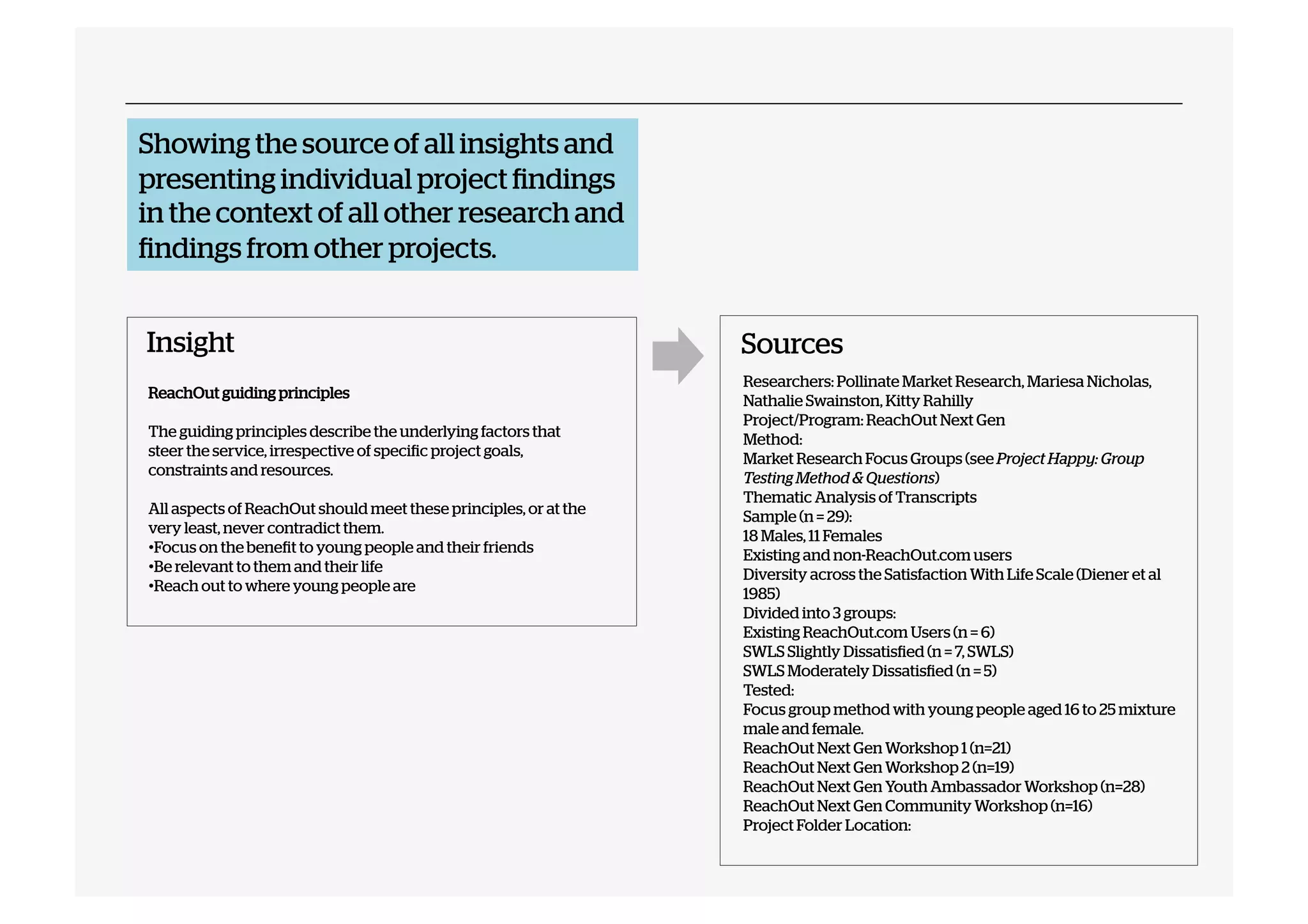
Showing the source of all insights and
presenting individual project findings
in the context of all other research and
findings from other projects.
Insight
ReachOut guiding principles
The guiding principles describe the underlying factors that
steer the service, irrespective of specific project goals,
constraints and resources.
All aspects of ReachOut should meet these principles, or at the
very least, never contradict them.
• Focus on the benefit to young people and their friends
• Be relevant to them and their life
• Reach out to where young people are

Sources
Researchers: Pollinate Market Research, Mariesa Nicholas,
Nathalie Swainston, Kitty Rahilly
Project/Program: ReachOut Next Gen
Method:
Market Research Focus Groups (see Project Happy: Group
Testing Method & Questions)
Thematic Analysis of Transcripts
Sample (n = 29):
18 Males, 11 Females
Existing and non-ReachOut.com users
Diversity across the Satisfaction With Life Scale (Diener et al
1985)
Divided into 3 groups:
Existing ReachOut.com Users (n = 6)
SWLS Slightly Dissatisfied (n = 7, SWLS)
SWLS Moderately Dissatisfied (n = 5)
Tested:
Focus group method with young people aged 16 to 25 mixture
male and female.
ReachOut Next Gen Workshop 1 (n=21)
ReachOut Next Gen Workshop 2 (n=19)
ReachOut Next Gen Youth Ambassador Workshop (n=28)
ReachOut Next Gen Community Workshop (n=16)
Project Folder Location:
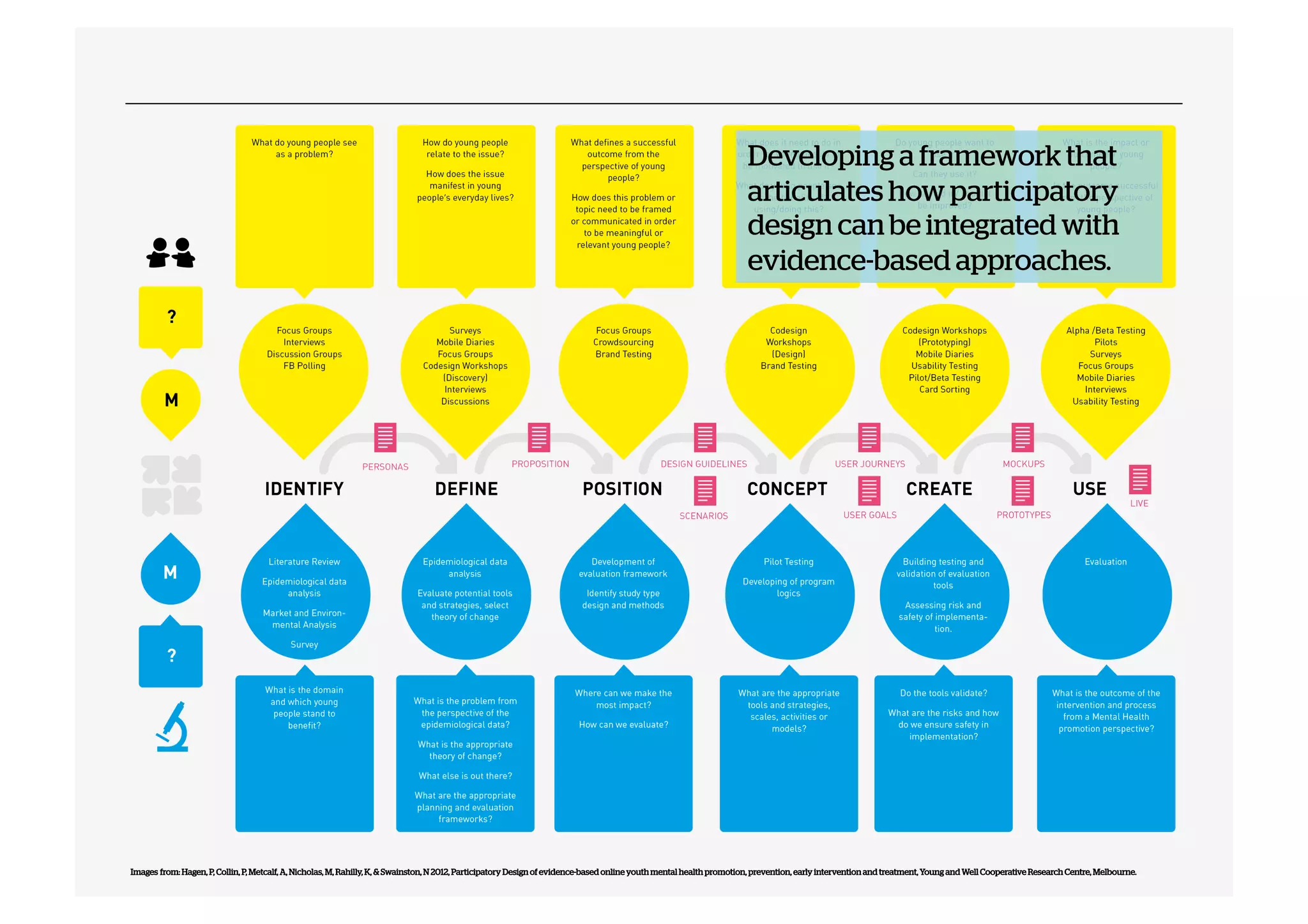
Developing a framework that
articulates how participatory
design can be integrated with
evidence-based approaches.

Images from: Hagen, P, Collin, P, Metcalf, A, Nicholas, M, Rahilly, K, & Swainston, N 2012, Participatory Design of evidence-based online youth mental health promotion, prevention, early intervention and treatment, Young and Well Cooperative Research Centre, Melbourne.
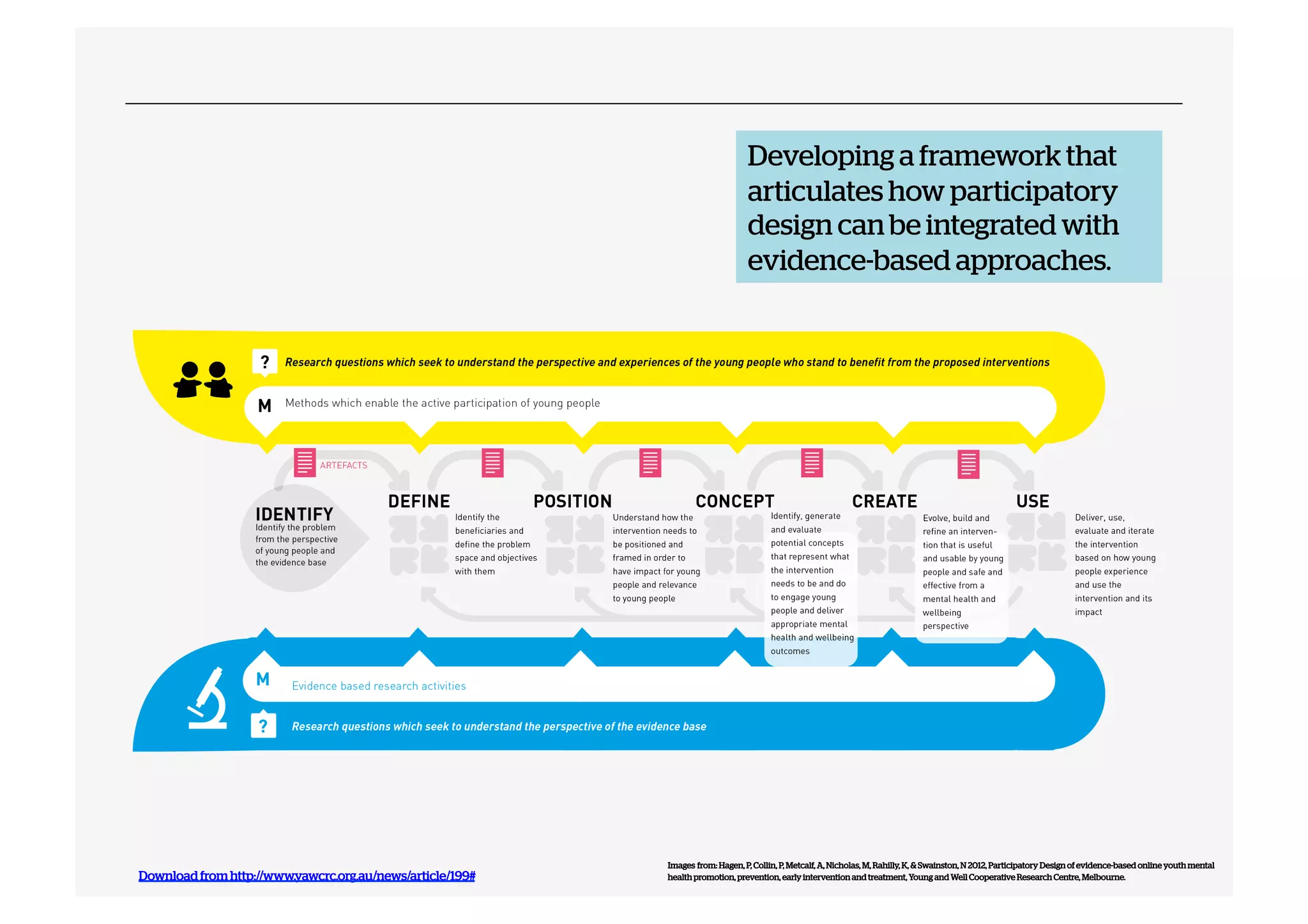
Developing a framework that
articulates how participatory
design can be integrated with
evidence-based approaches.

Download from http://www.yawcrc.org.au/news/article/199#

Images from: Hagen, P, Collin, P, Metcalf, A, Nicholas, M, Rahilly, K, & Swainston, N 2012, Participatory Design of evidence-based online youth mental
health promotion, prevention, early intervention and treatment, Young and Well Cooperative Research Centre, Melbourne.
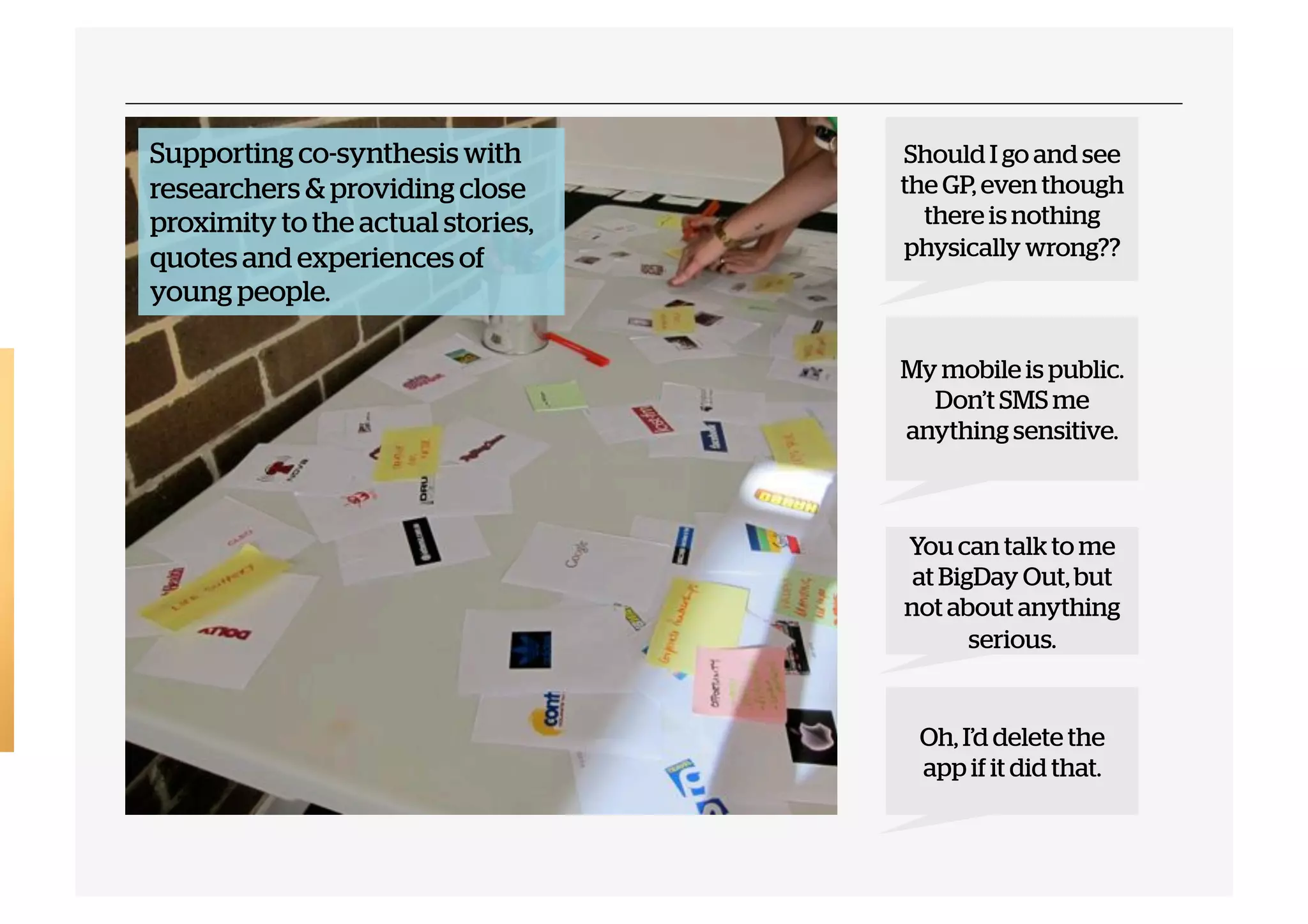
Supporting co-synthesis with
researchers & providing close
proximity to the actual stories,
quotes and experiences of
young people.

Should I go and see
the GP, even though
there is nothing
physically wrong??

My mobile is public.
Don’t SMS me
anything sensitive.

You can talk to me
at BigDay Out, but
not about anything
serious.

Oh, I’d delete the
app if it did that.
03 our tools and
Evolving

approach to actually be more
rigorous
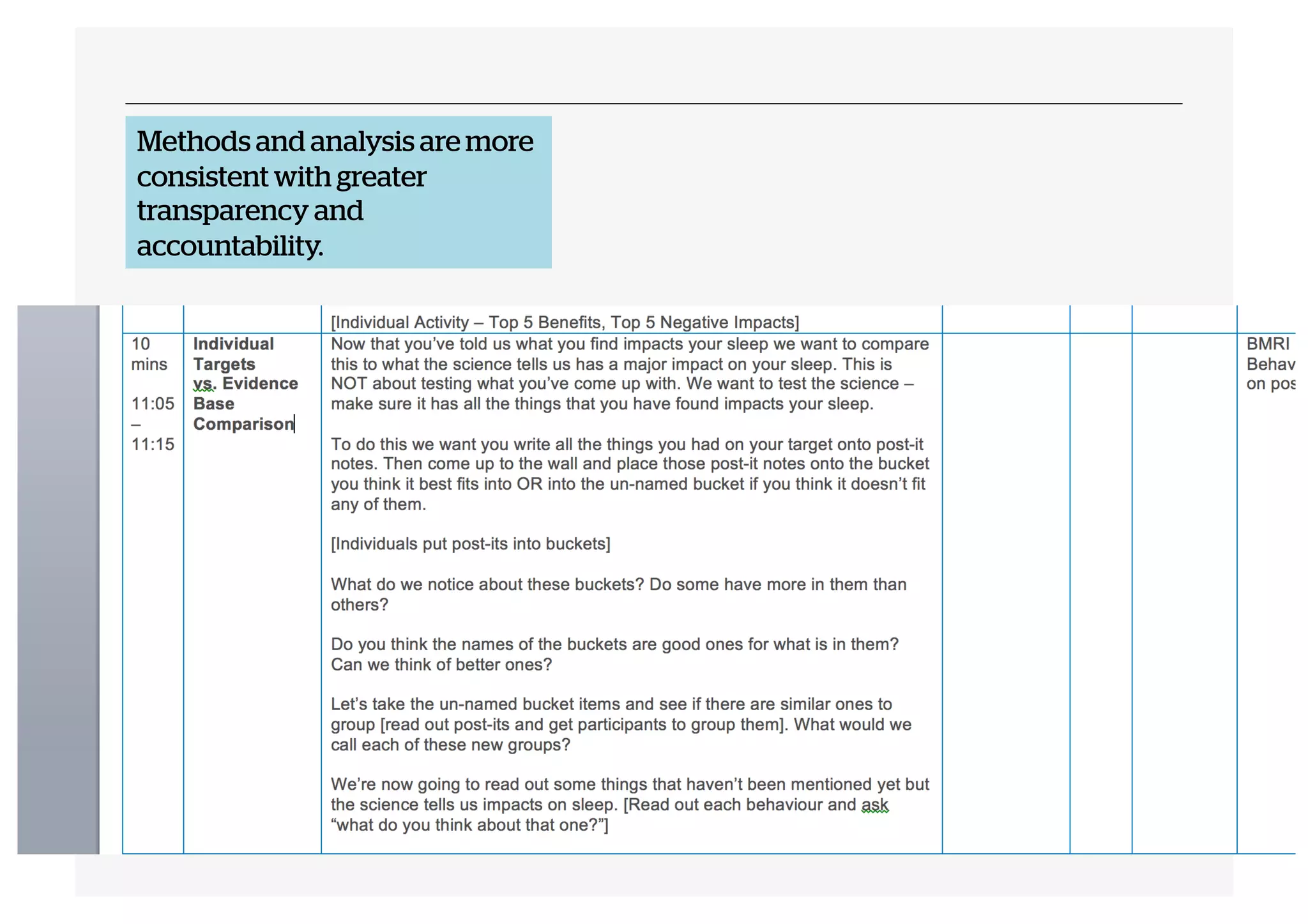
Methods and analysis are more
consistent with greater
transparency and
accountability.
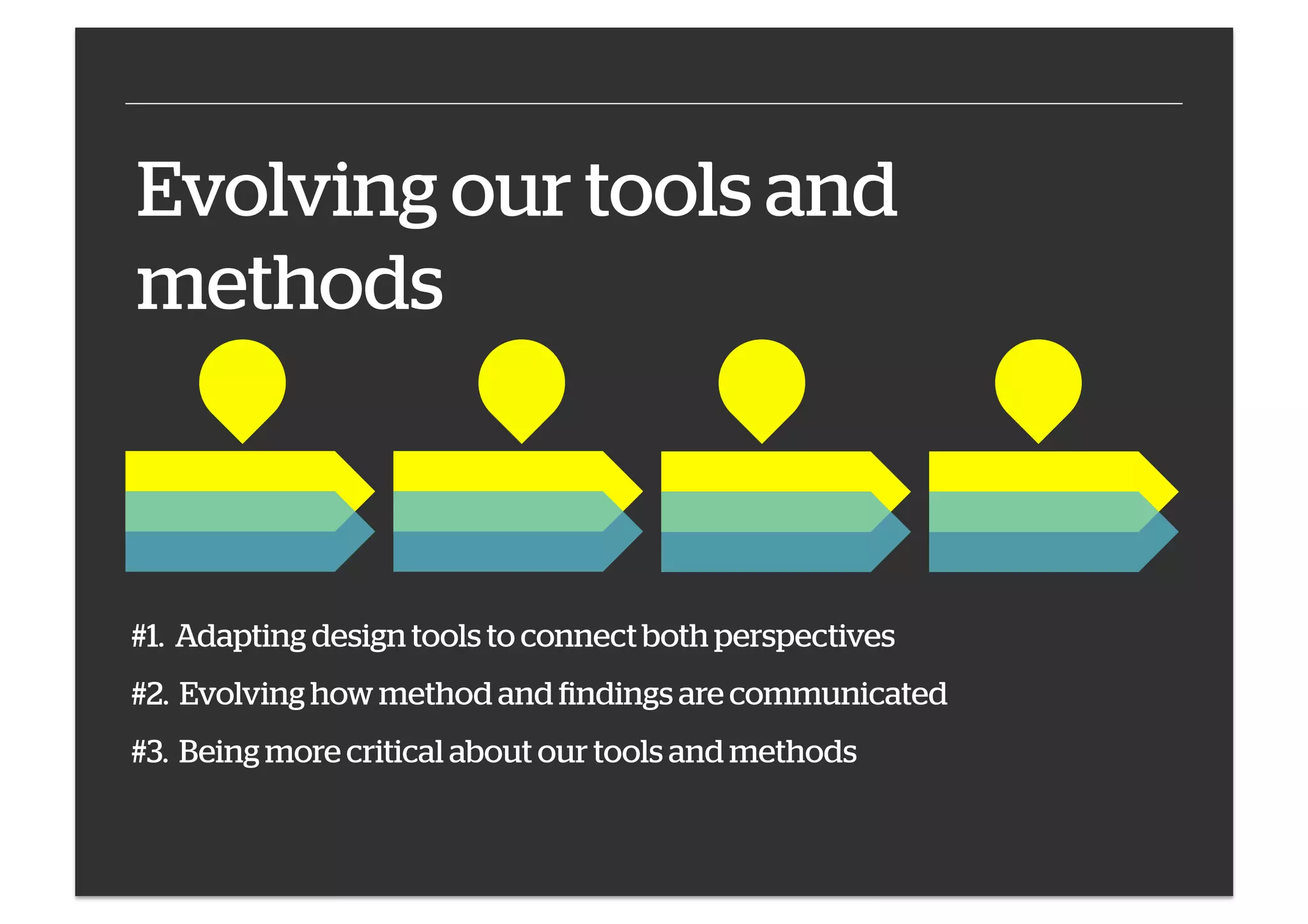
Evolving our tools and
methods

#1. Adapting design tools to connect both perspectives
#2. Evolving how method and findings are communicated
#3. Being more critical about our tools and methods
Lessons Learned
Lesson 1.

There are inherent tensions between the two
approaches that may not be resolved. Neither is
a complete solution to the complexities and
challenges we face.
Lesson 2.

Both approaches should be challenged, and the
opportunity is in the new things we can build
out of this collaboration
Lesson 3.

Negotiating which perspective has greater
influence will be ongoing.
But how we gather and communicate our ‘data’
matters.
Lesson 4.

We bring lots of value but we need to communicate that
value and practice in a way that earns us the right to
have influence.
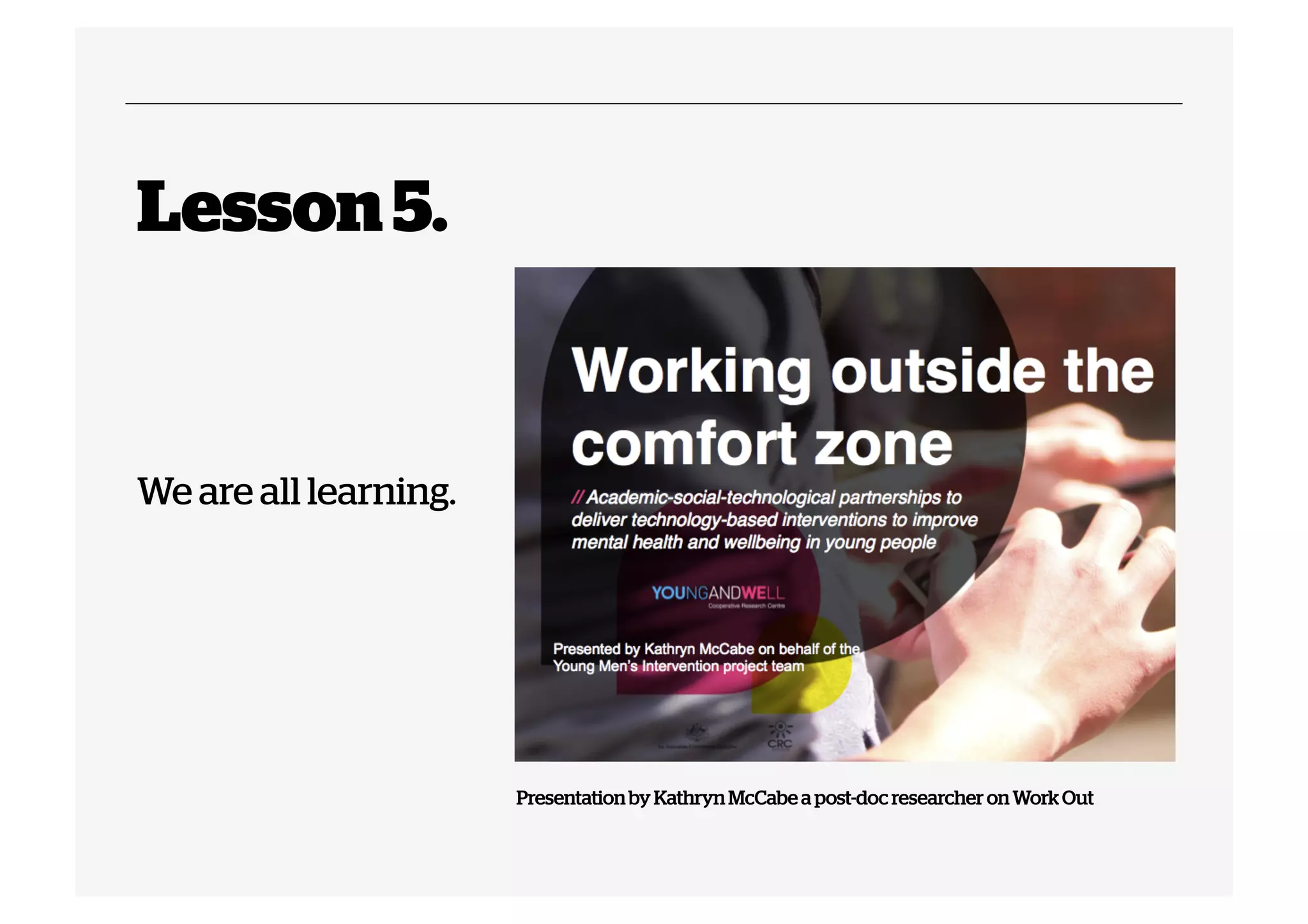
Lesson 5.

We are all learning.

Presentation by Kathryn McCabe a post-doc researcher on Work Out
In closing…
Opportunity

Marketing design as a
holistic approach

Opportunity =

Better integrating design
with other approaches
and perspectives
Being challenged is what helps
us to build a richer practice
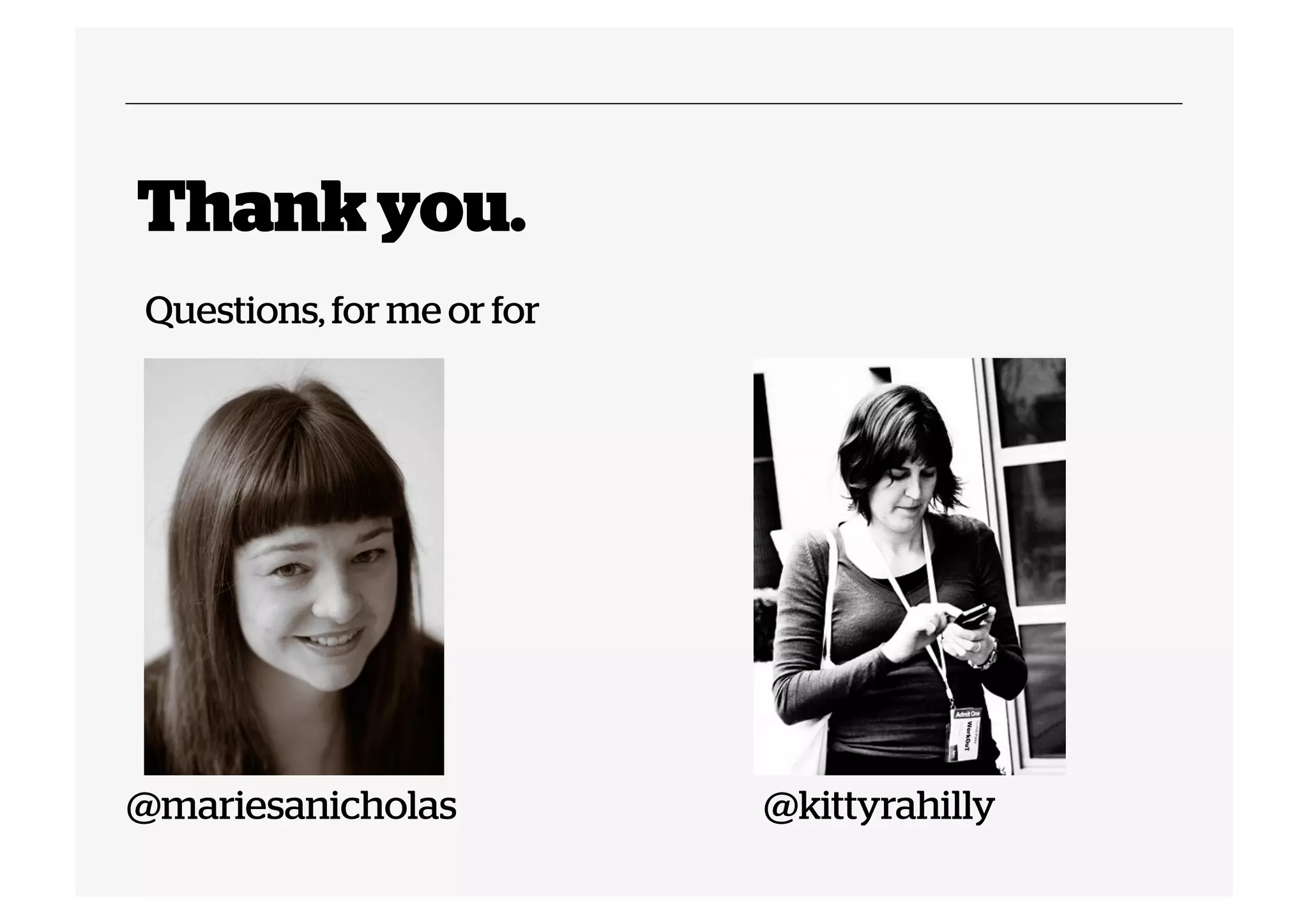
Thank you.
Questions, for me or for

@mariesanicholas

@kittyrahilly

Integrating UX and evidence-based approaches to design effective youth mental health services

  • 1.
    Integrating UX and evidence-based approachesto design effective online youth mental health services with young people. @pennyhagen @kittyrahilly @mariesanicholas With much thanks to: Brain & Mind Research Institute Young and Well CRC Victoria Blake, Inspire Stephen McKernon And our co-designers
  • 2.
    What I amtalking about today? User Experience Design Approach Evidence-based Design Approach Youth Mental Health
  • 3.
    In collaboration with: @mariesanicholas SeniorManager, UX Research and Service Design @kittyrahilly Manager, UX Research & Service Design
  • 4.
  • 5.
  • 6.
  • 7.
    Two approaches todesign User Experience Design Approach Evidence-based Design Approach
  • 8.
    User experience design Thedesign of a product or service that accounts for the needs, expectations, experiences and perspective of those who will use it, through collaboration with those users. IDENTIFY & DEFINE CONCEPT BUILD LAUNCH & EVALUATE Understand domain from a user perspective. Identify area of greatest opportunity. Develop and test a range of concepts with users. Identify strongest proposition. Build, test, iterate and evaluate with users against user goals. Launch. Potentially track usage and look to optimise.
  • 9.
    Evidence-based design. The designof an intervention on the basis of research data, past evaluations, health planning frameworks and theories of behaviour change. IDENTIFY PROBLEM DEFINE FOCUS AND APPROACH BUILD & TEST EVALUATE & PUBLISH Epidemiological analysis Review literature Build program logic Monitor outcomes Assess and select theory of change Evaluation framework tools Publish results Identify outcomes and impacts Build experiments Consult experts Review existing national policies and strategies Review for safety and ethics
  • 10.
    Why integrate? To achievegreater impact through interventions that are based on sound evidence and are also engaging for young people .
  • 11.
    Why integrate? Re-thinking clinicalmodels and service delivery within an online, anonymous, self-service context. Ways to actively involve the young people who will use the service in the design of the service. A specific focus on the perspectives and experiences of the end-users of a service. Connecting the models and theories of evidence-based approaches with the lived experiences of the young people.
  • 12.
    How do wedo it?
  • 13.
    1. Translate themodel Understanding how, when, where and in what way mental health issues can be broached with young people.
  • 14.
    1. Translate themodel From mental health to mental fitness, handling pressure, building confidence and taking control.
  • 15.
    2. Re-interpret themodel Mapping sleep factors to the evidencebased model
  • 16.
    3. Identifying failpoints Understanding where a negative experience will likely cause the intervention to fail Image credit: http://www.flickr.com/photos/frak_tal/2455855855/
  • 17.
    4. Redirect opportunities Understandingwhat is a priority to young people
  • 18.
    5. Work withthe evidence
  • 19.
    How we doit #1 Translate models from the evidence-base #2 Re-interpret models from the evidence-base #3 Identify fail points #4 Re-direct opportunities #5 Work with the evidence
  • 20.
  • 21.
    Challenge 1: Different waysof measuring success means different priorities.
  • 22.
    Challenge 1: Different waysof measuring success means different priorities. Evidence-based success = User Experience success = The model applied in the way intended with a positive result that can be correlated to the intervention. An intervention that is used and useful to those who it was designed with and for.
  • 23.
    Challenge 1: Different waysof measuring success means different priorities. Evidence-based success = User Experience success = Model must not be altered in order to be measured. Model needs to be flexible in order to be usable.
  • 24.
    Challenge 2: Our formsof evidence and how we manage them are not the same
  • 25.
    Challenge 2: Our formsof evidence and how we manage them are not the same Part 1. Our methods tend to be qualitative and largely visual Part 2. In comparison our methodology is not as rigorous (partly because it hasn’t had to be)
  • 26.
    Evolving our toolsand methods
  • 27.
    01 design toolsto Adapting connect and integrate both perspectives as inputs for design.
  • 28.
    Personas and scenariosinclude mental health status, and demonstrates how behaviours and the theory of change play out in the real world.
  • 29.
    Personas and scenariosinclude mental health status, and demonstrates how behaviours and the theory of change play out in the real world.
  • 30.
    User Journey mapshelp show how theory of change will be supported through the intervention and how this connects to the intended user experience. Reproduced from: Hagen, P, Collin, P, Metcalf, A, Nicholas, M, Rahilly, K, & Swainston, N 2012, Participatory Design of evidence-based online youth mental health promotion, prevention, early intervention and treatment, Young and Well Cooperative Research Centre, Melbourne.
  • 31.
    02 Evolving how methodand findings are communicated
  • 32.
    There are cyclesof input and validation with young people throughout the design process. Images from: Hagen, P, Collin, P, Metcalf, A, Nicholas, M, Rahilly, K, & Swainston, N 2012, Participatory Design of evidence-based online youth mental health promotion, prevention, early intervention and treatment, Young and Well Cooperative Research Centre, Melbourne.
  • 33.
    Showing the sourceof all insights and presenting individual project findings in the context of all other research and findings from other projects. Insight ReachOut guiding principles The guiding principles describe the underlying factors that steer the service, irrespective of specific project goals, constraints and resources. All aspects of ReachOut should meet these principles, or at the very least, never contradict them. • Focus on the benefit to young people and their friends • Be relevant to them and their life • Reach out to where young people are Sources Researchers: Pollinate Market Research, Mariesa Nicholas, Nathalie Swainston, Kitty Rahilly Project/Program: ReachOut Next Gen Method: Market Research Focus Groups (see Project Happy: Group Testing Method & Questions) Thematic Analysis of Transcripts Sample (n = 29): 18 Males, 11 Females Existing and non-ReachOut.com users Diversity across the Satisfaction With Life Scale (Diener et al 1985) Divided into 3 groups: Existing ReachOut.com Users (n = 6) SWLS Slightly Dissatisfied (n = 7, SWLS) SWLS Moderately Dissatisfied (n = 5) Tested: Focus group method with young people aged 16 to 25 mixture male and female. ReachOut Next Gen Workshop 1 (n=21) ReachOut Next Gen Workshop 2 (n=19) ReachOut Next Gen Youth Ambassador Workshop (n=28) ReachOut Next Gen Community Workshop (n=16) Project Folder Location:
  • 34.
    Developing a frameworkthat articulates how participatory design can be integrated with evidence-based approaches. Images from: Hagen, P, Collin, P, Metcalf, A, Nicholas, M, Rahilly, K, & Swainston, N 2012, Participatory Design of evidence-based online youth mental health promotion, prevention, early intervention and treatment, Young and Well Cooperative Research Centre, Melbourne.
  • 35.
    Developing a frameworkthat articulates how participatory design can be integrated with evidence-based approaches. Download from http://www.yawcrc.org.au/news/article/199# Images from: Hagen, P, Collin, P, Metcalf, A, Nicholas, M, Rahilly, K, & Swainston, N 2012, Participatory Design of evidence-based online youth mental health promotion, prevention, early intervention and treatment, Young and Well Cooperative Research Centre, Melbourne.
  • 36.
    Supporting co-synthesis with researchers& providing close proximity to the actual stories, quotes and experiences of young people. Should I go and see the GP, even though there is nothing physically wrong?? My mobile is public. Don’t SMS me anything sensitive. You can talk to me at BigDay Out, but not about anything serious. Oh, I’d delete the app if it did that.
  • 37.
    03 our toolsand Evolving approach to actually be more rigorous
  • 38.
    Methods and analysisare more consistent with greater transparency and accountability.
  • 39.
    Evolving our toolsand methods #1. Adapting design tools to connect both perspectives #2. Evolving how method and findings are communicated #3. Being more critical about our tools and methods
  • 40.
  • 41.
    Lesson 1. There areinherent tensions between the two approaches that may not be resolved. Neither is a complete solution to the complexities and challenges we face.
  • 42.
    Lesson 2. Both approachesshould be challenged, and the opportunity is in the new things we can build out of this collaboration
  • 43.
    Lesson 3. Negotiating whichperspective has greater influence will be ongoing. But how we gather and communicate our ‘data’ matters.
  • 44.
    Lesson 4. We bringlots of value but we need to communicate that value and practice in a way that earns us the right to have influence.
  • 45.
    Lesson 5. We areall learning. Presentation by Kathryn McCabe a post-doc researcher on Work Out
  • 46.
    In closing… Opportunity Marketing designas a holistic approach Opportunity = Better integrating design with other approaches and perspectives
  • 47.
    Being challenged iswhat helps us to build a richer practice
  • 48.
    Thank you. Questions, forme or for @mariesanicholas @kittyrahilly