Impact Practice
Sharing experience from
Third Sector wellbeing projects
Catherine Greaves, Project Manager
Outcomes for this session
A greater understanding of
• What the third sector means by
“impact practice” & associated terms.
• How to use a Planning triangle and a
Monitoring & Evaluation Framework.
An awareness of
• The Theory of Change.
• Third sector resources for Impact
Practice
What & Why?
“Impact is the difference you make. By focusing on your impact, you can make
more of a difference through your work. This means planning what impact you
want to have and how best to achieve it, collecting information about your
impact, assessing what impact you’re having, communicating this information
and learning from it. We call this cycle of activities impact practice. This
includes, but is significantly bigger than, the tasks of measuring, monitoring
and evaluating your work.
Many terms are used to talk about the difference you make and the work
you’re doing, including outcomes, activities and outputs. The most important
distinction is between the work you do and the difference it makes: it is all too
easy to focus on your day-to-day work, when it is the impact you’re having,
and how you can have more, that is arguably more important.”
From: the Code of Good Impact Practice
Why is it more important than your day-to-day
work?
Professional development
• Fresh thinking
• Improve performance
• Show effectiveness
Accountability - stakeholders
• Service users & communities
• Funders
• Commissioners
Sustainability
• Secure funding and commissioning
Jargon buster
Impact: the broad or longer-term effects of your project or your
organisation’s work (also referred to as the difference you make). This can
include effects on people who are direct users, effects on those who are not
direct users, or effects on a wider field such as NHS practice or government
policy.
Impact practice: the activities that your team or your organisation does to
focus on its impact. This can include planning desired impact, planning how
to measure it, collecting information about it, making sense of that
information, communicating it and learning from it.
From: the Code of Good Impact Practice
Jargon Buster – over to you
1. Activities
2. Evaluation
3. Indicator
4. Monitoring
5. Overall aim
6. Outputs Outcomes
7. Processes
8. Theory of change
9. User Satisfaction
What is a Theory of Change?
Theory of change
“ A description of why a particular way of working will be effective,
showing how change happens in the short, medium and long term to
achieve the intended outcome.”
Usually represented as a visual map but can be narrative.
From: NCVO Charities Evaluation Services
What makes it different & potentially difficult?
• A critical, reflective process.
• Challenges assumptions that we make about our work.
• Starts with impact and works backwards.
• Shows interrelationships between outputs and outcomes.
• Suggests new possibilities.
• Acknowledges that there are a range of stakeholders that contribute
to the impact we are working towards.
• A thinking process as well as a product.
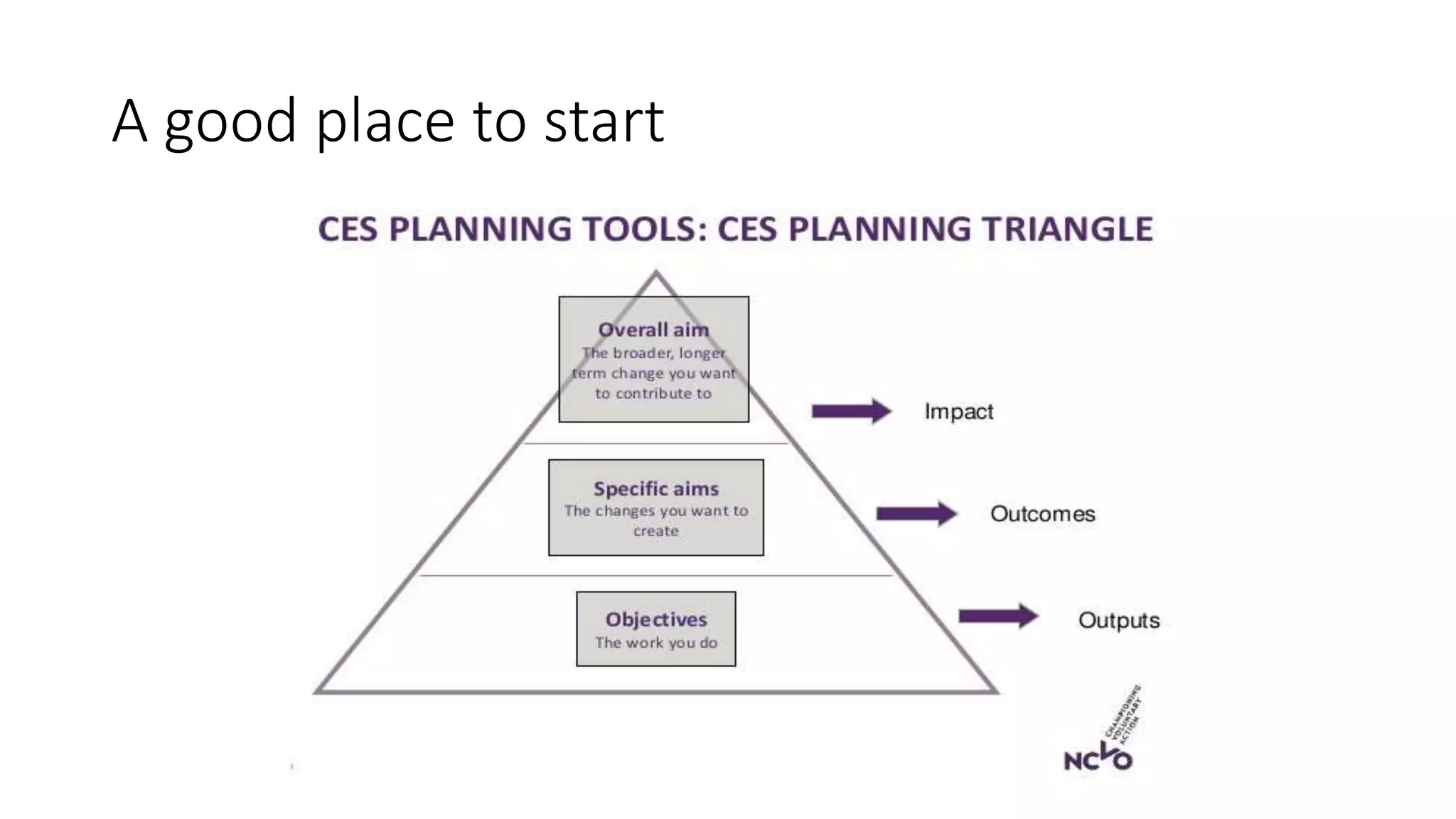
A good place to start
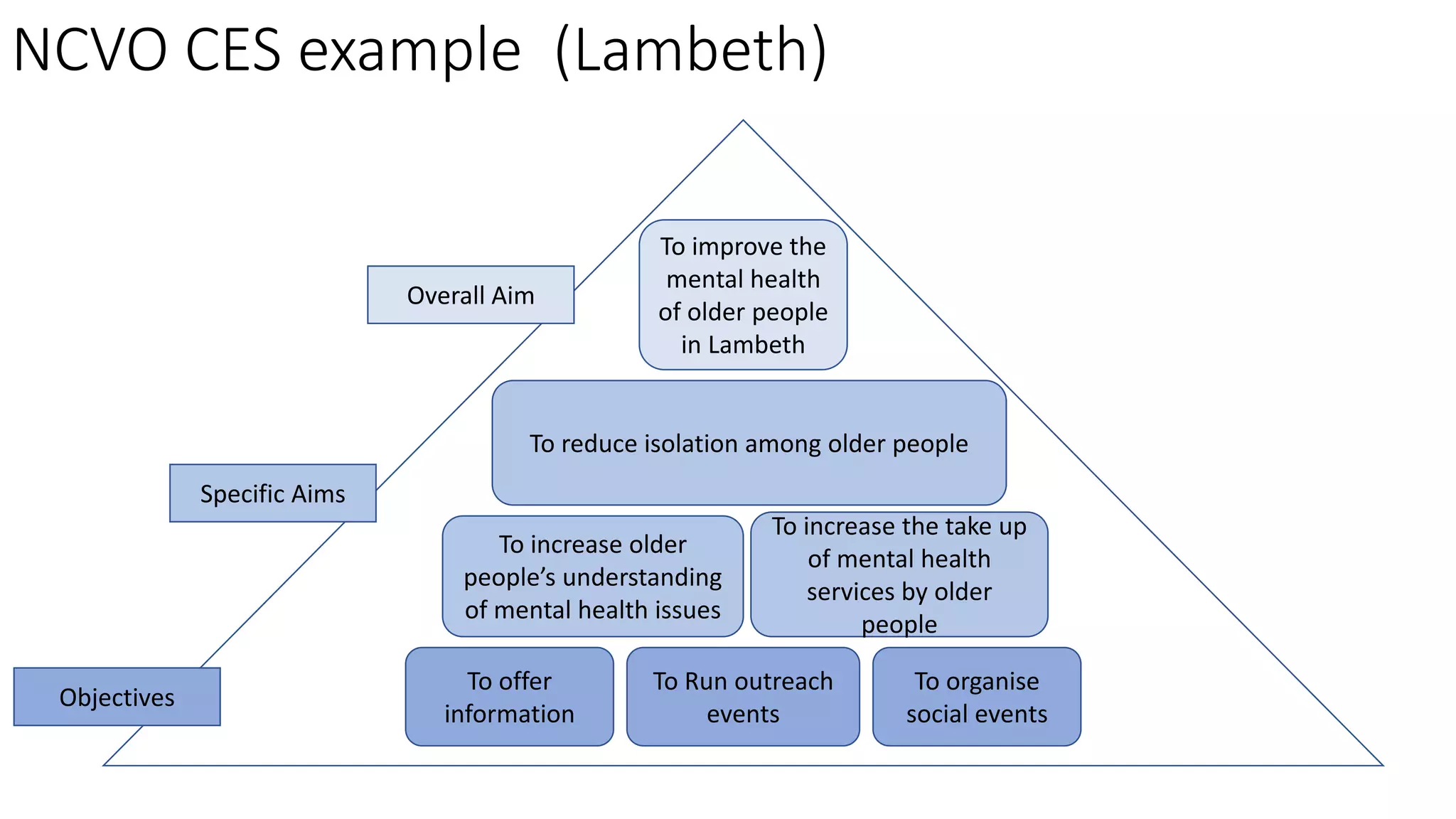
NCVO CES example (Lambeth)
To reduce isolation among older people
To increase the take up
of mental health
services by older
people
To increase older
people’s understanding
of mental health issues
To offer
information
To organise
social events
To Run outreach
events
To improve the
mental health
of older people
in Lambeth
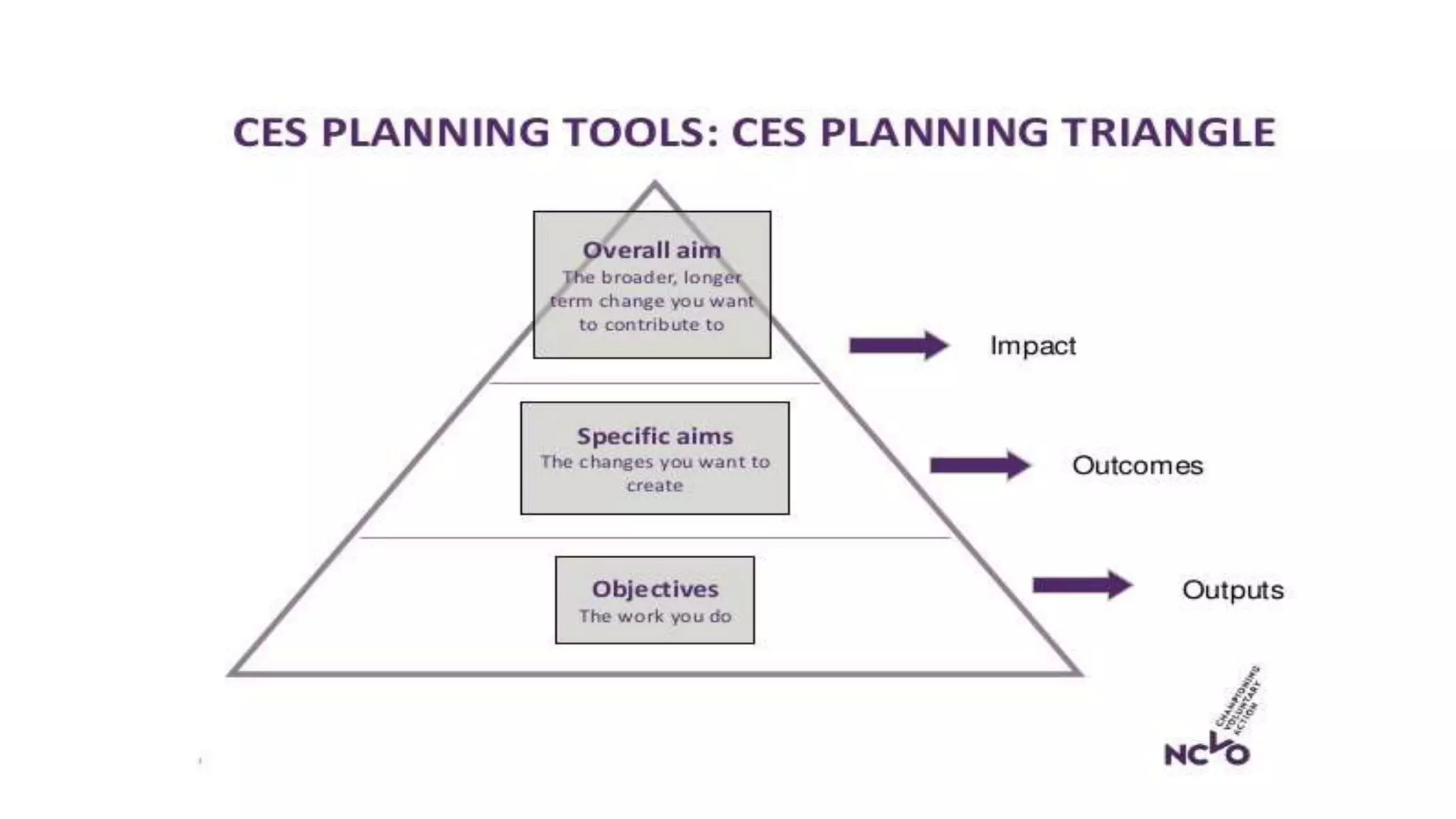
Overall Aim
Specific Aims
Objectives
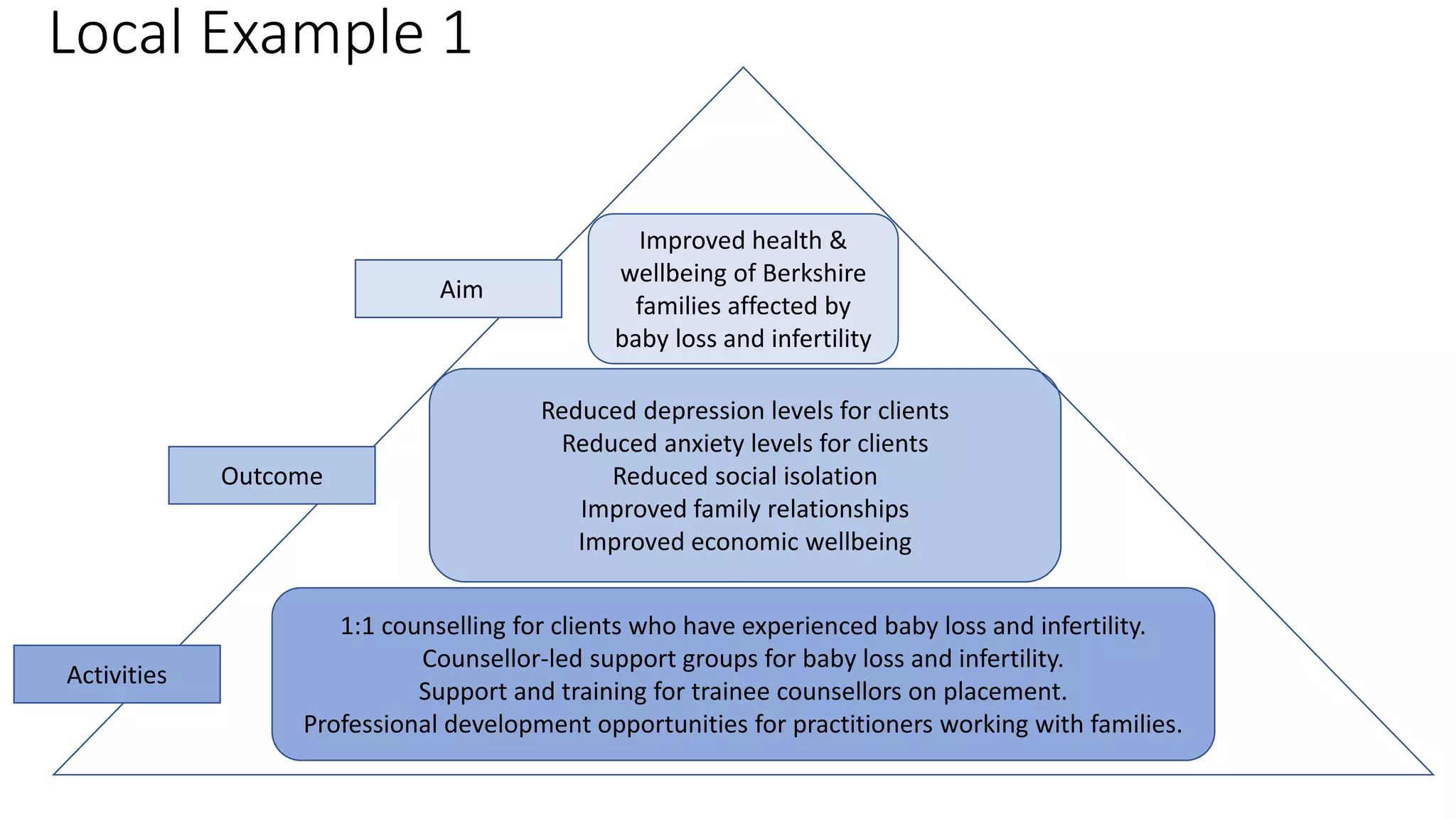
Local Example 1
Reduced depression levels for clients
Reduced anxiety levels for clients
Reduced social isolation
Improved family relationships
Improved economic wellbeing
1:1 counselling for clients who have experienced baby loss and infertility.
Counsellor-led support groups for baby loss and infertility.
Support and training for trainee counsellors on placement.
Professional development opportunities for practitioners working with families.
Improved health &
wellbeing of Berkshire
families affected by
baby loss and infertility
Aim
Outcome
Activities
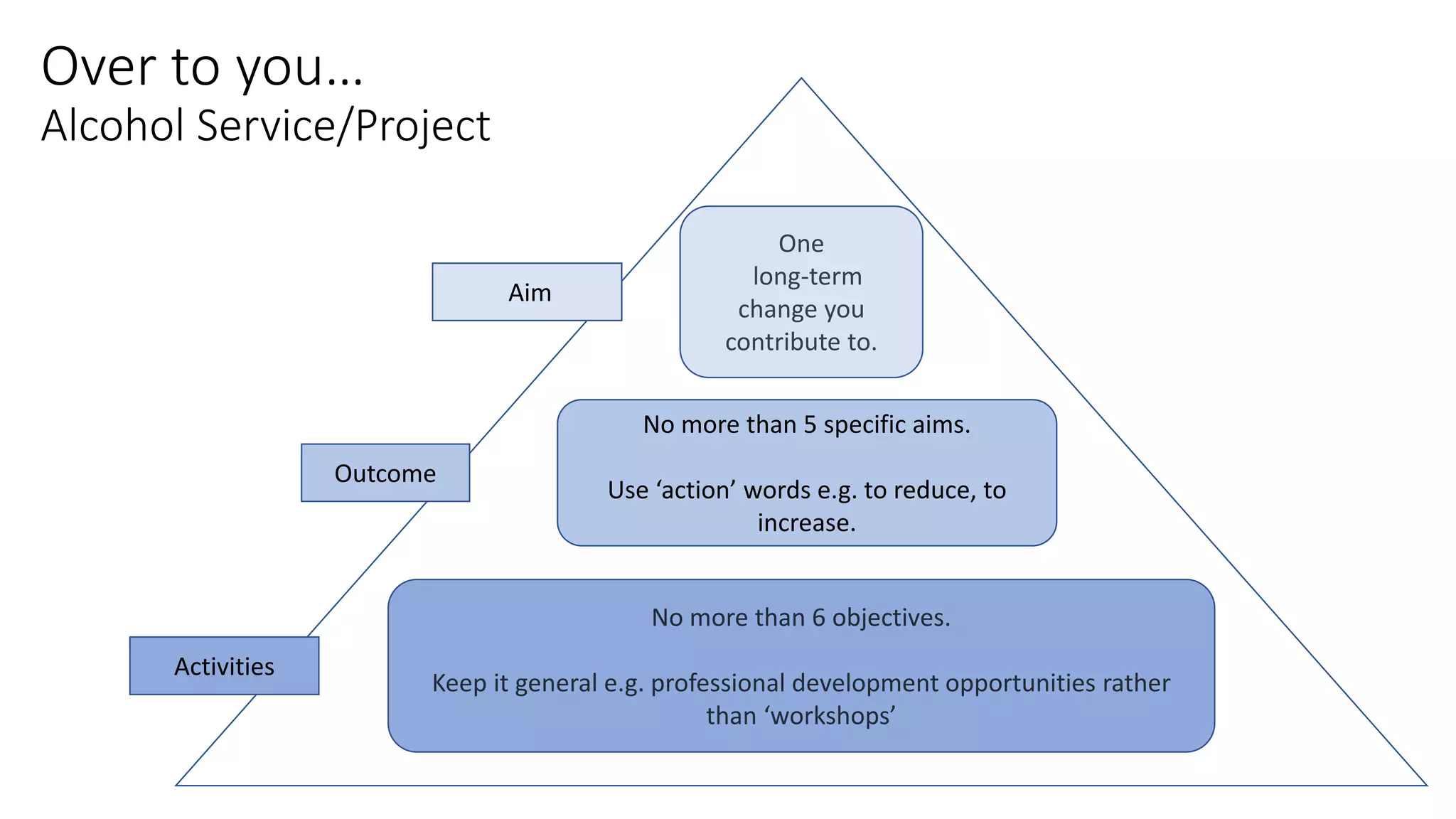
Over to you…
Alcohol Service/Project
No more than 5 specific aims.
Use ‘action’ words e.g. to reduce, to
increase.
No more than 6 objectives.
Keep it general e.g. professional development opportunities rather
than ‘workshops’
One
long-term
change you
contribute to.
Aim
Outcome
Activities
Writing your own planning triangle – more tips
• Whose health are you seeking to improve?
• What behaviour are you seeking to change?
• How will you know if you have succeeded in changing behaviour?
• How will you know if you have succeeded in contributing to improving
the health of your target population?
• What processes and inputs need to be taken into account
• What assumptions have been made about the theoretical links
between the services/interventions and outcome?
Writing your own planning triangle – more tips
Outcomes for alcohol – some ideas
• Reduction in problematic drinking behaviour
• Clients have improved wellbeing
• Improved social support/functioning
• Improved help-seeking behaviour
• Improved capacity for families to cope with negative consequences of
drinking behaviour
From http://www.effectiveservices.org/downloads/BIG_Impact_of_Alcohol_evaluation_framework_website_dec15.pdf
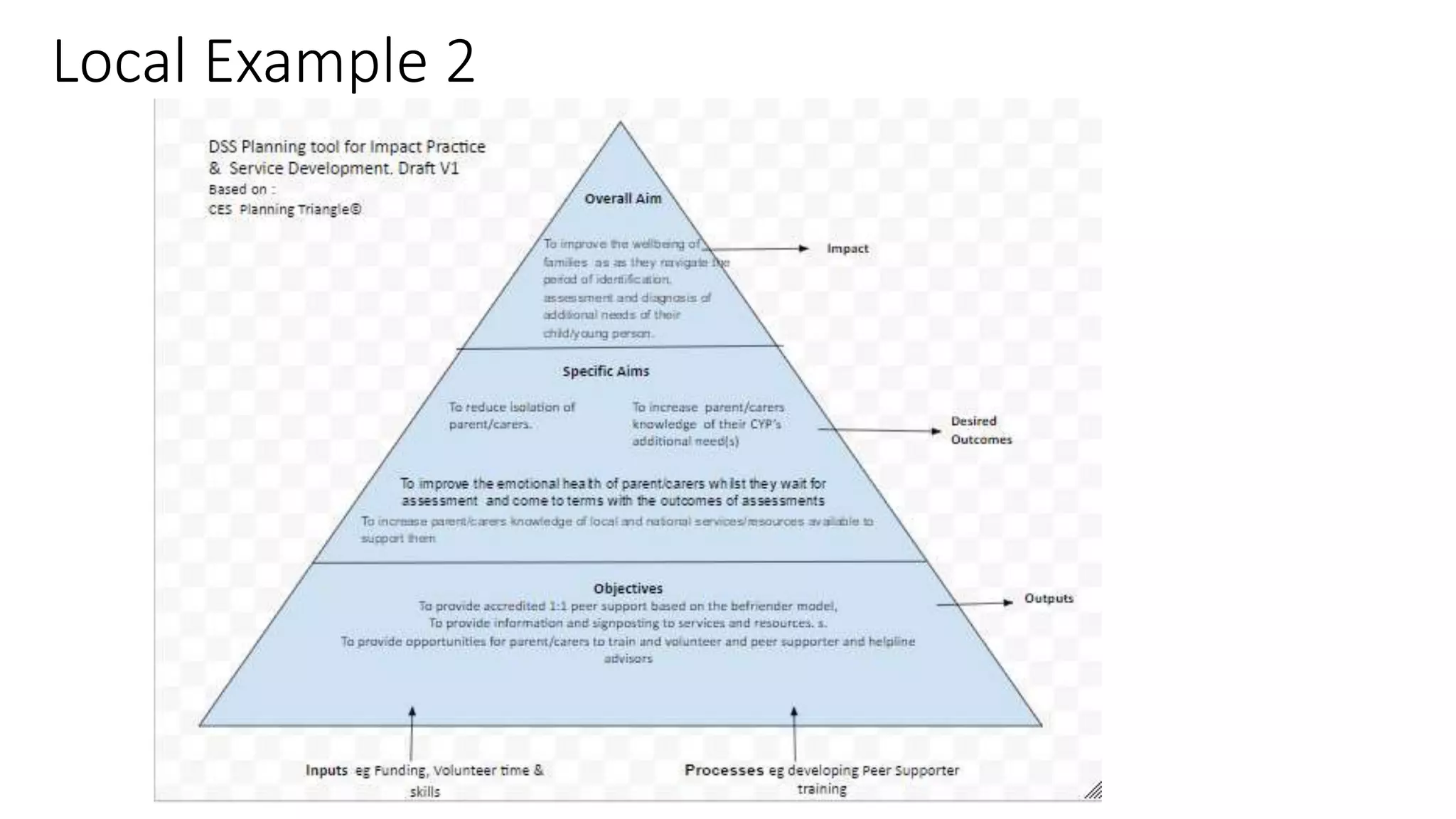
Local Example 2
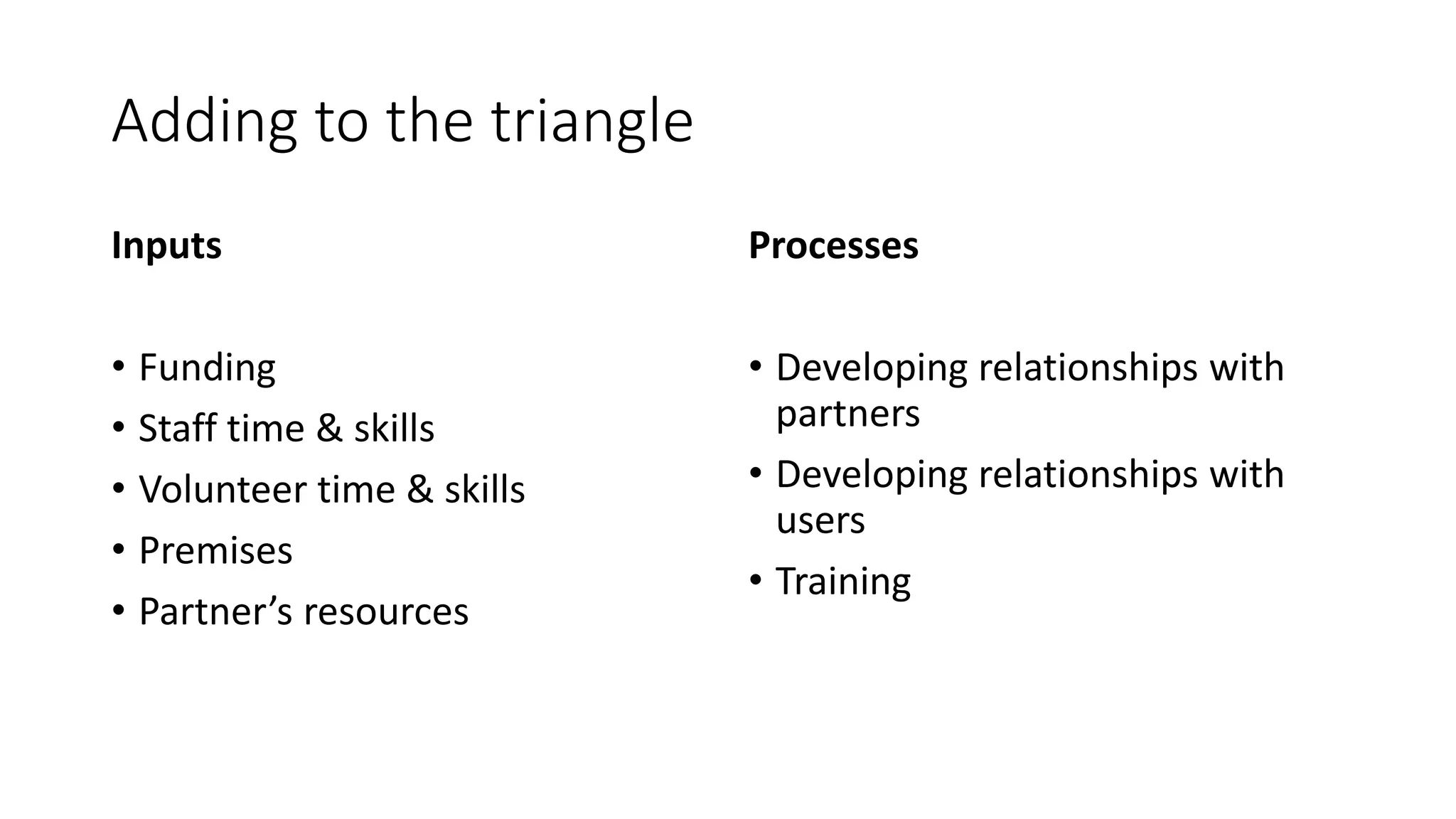
Adding to the triangle
Inputs
• Funding
• Staff time & skills
• Volunteer time & skills
• Premises
• Partner’s resources
Processes
• Developing relationships with
partners
• Developing relationships with
users
• Training
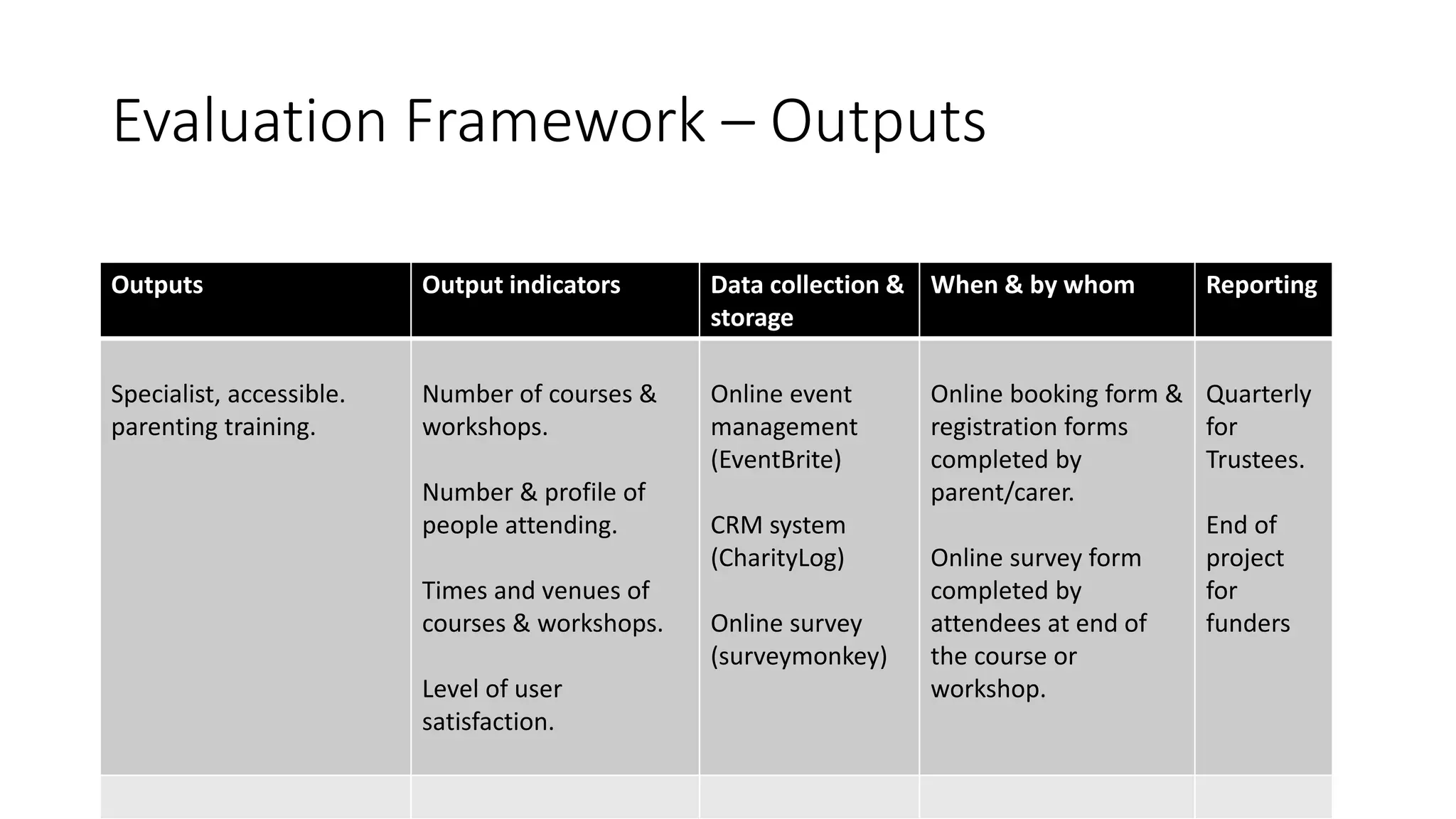
Evaluation Framework – Outputs
A
Outputs Output indicators Data collection &
storage
When & by whom Reporting
Specialist, accessible.
parenting training.
Number of courses &
workshops.
Number & profile of
people attending.
Times and venues of
courses & workshops.
Level of user
satisfaction.
Online event
management
(EventBrite)
CRM system
(CharityLog)
Online survey
(surveymonkey)
Online booking form &
registration forms
completed by
parent/carer.
Online survey form
completed by
attendees at end of
the course or
workshop.
Quarterly
for
Trustees.
End of
project
for
funders
Evaluation Framework – Outcomes
A
Outcomes Outcome indicators Data collection &
storage
When & by
whom
Reporting
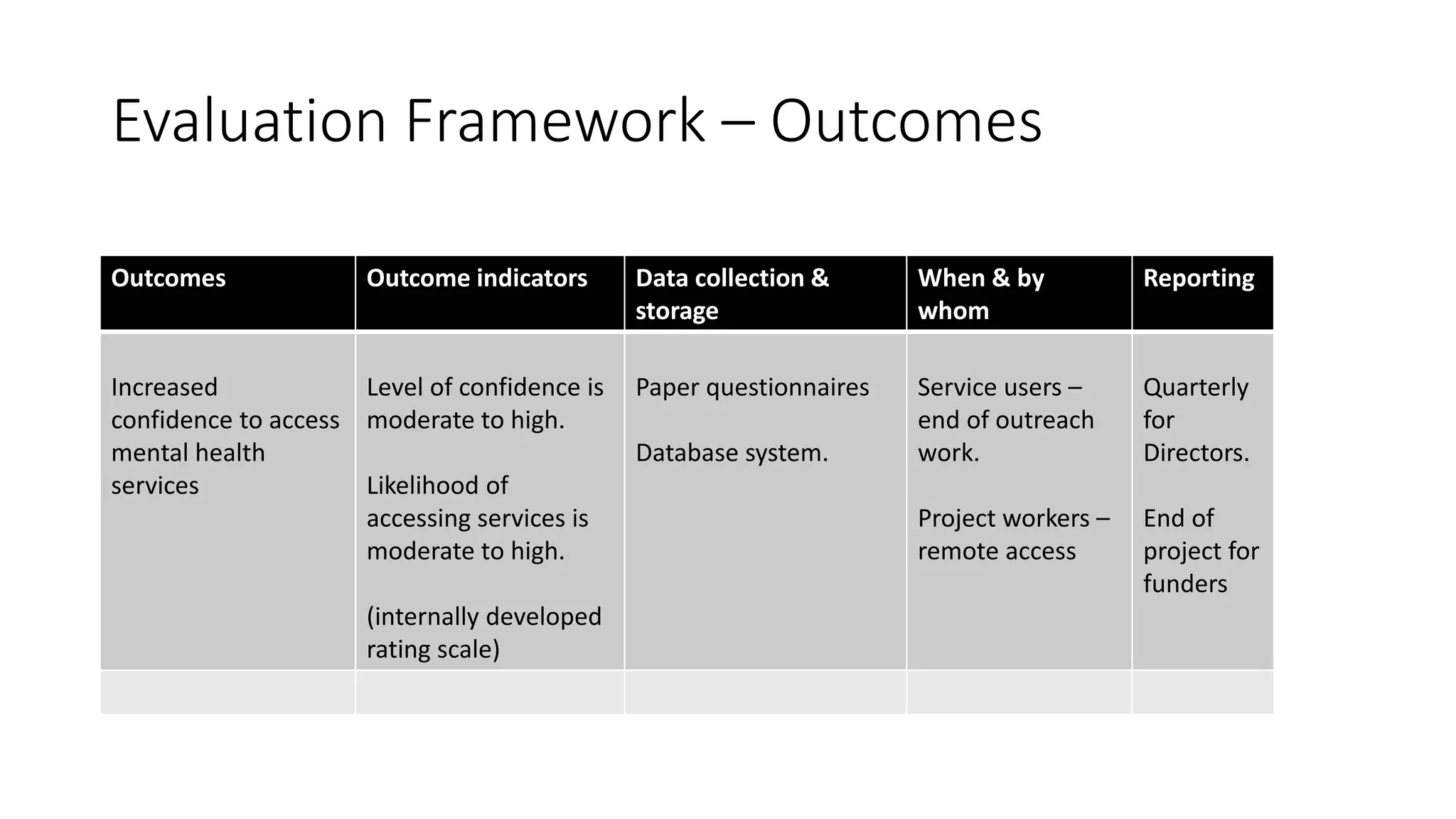
Increased
confidence to access
mental health
services
Level of confidence is
moderate to high.
Likelihood of
accessing services is
moderate to high.
(internally developed
rating scale)
Paper questionnaires
Database system.
Service users –
end of outreach
work.
Project workers –
remote access
Quarterly
for
Directors.
End of
project for
funders
Evaluation Framework – Outcomes
A
Outcomes Outcome indicators Data collection &
storage
When & by
whom
Reportin
g
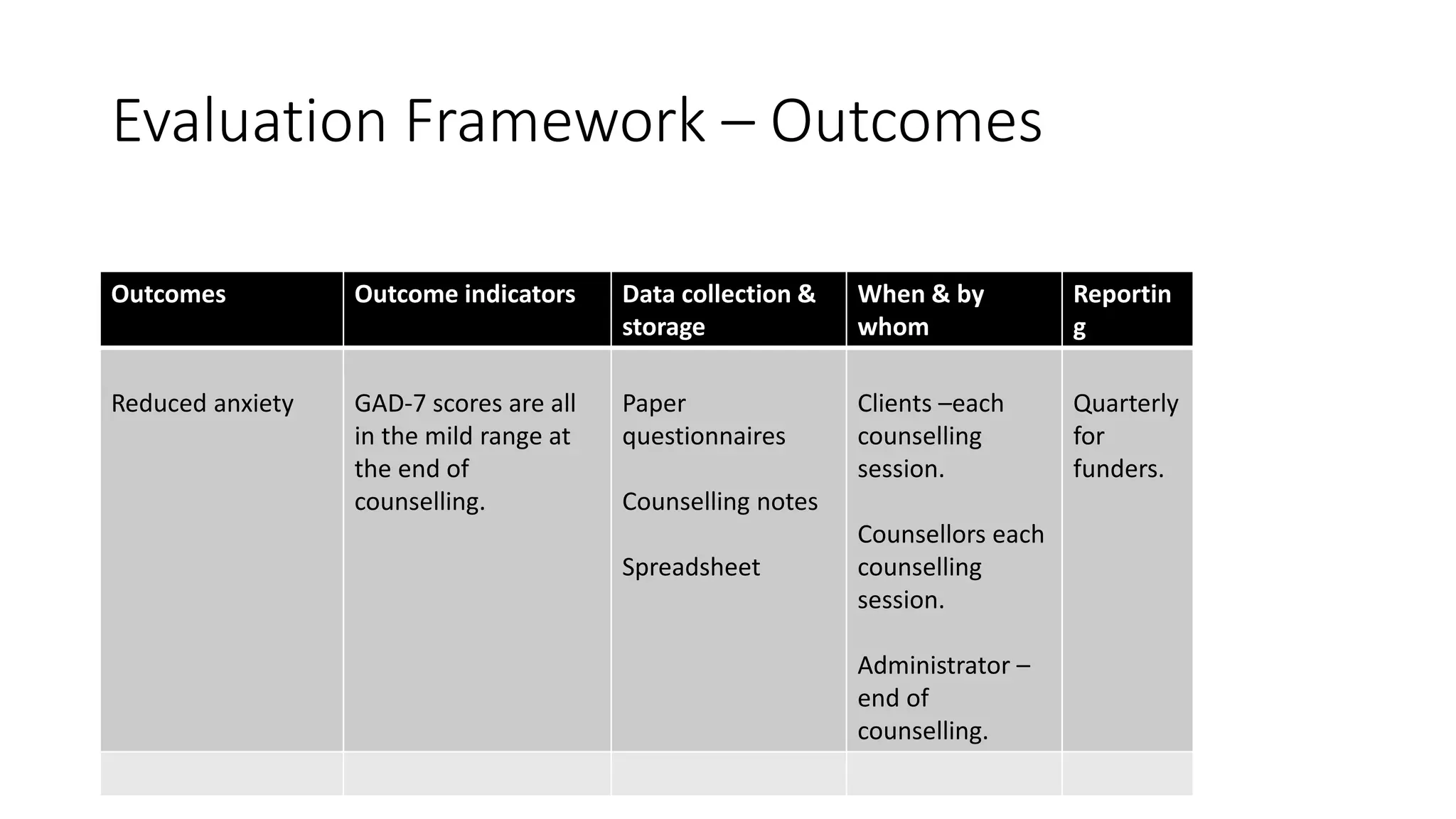
Reduced anxiety GAD-7 scores are all
in the mild range at
the end of
counselling.
Paper
questionnaires
Counselling notes
Spreadsheet
Clients –each
counselling
session.
Counsellors each
counselling
session.
Administrator –
end of
counselling.
Quarterly
for
funders.
Evaluation Framework – Outcomes
A
Outcomes Outcome indicators Data collection &
storage
When & by whom Reporting
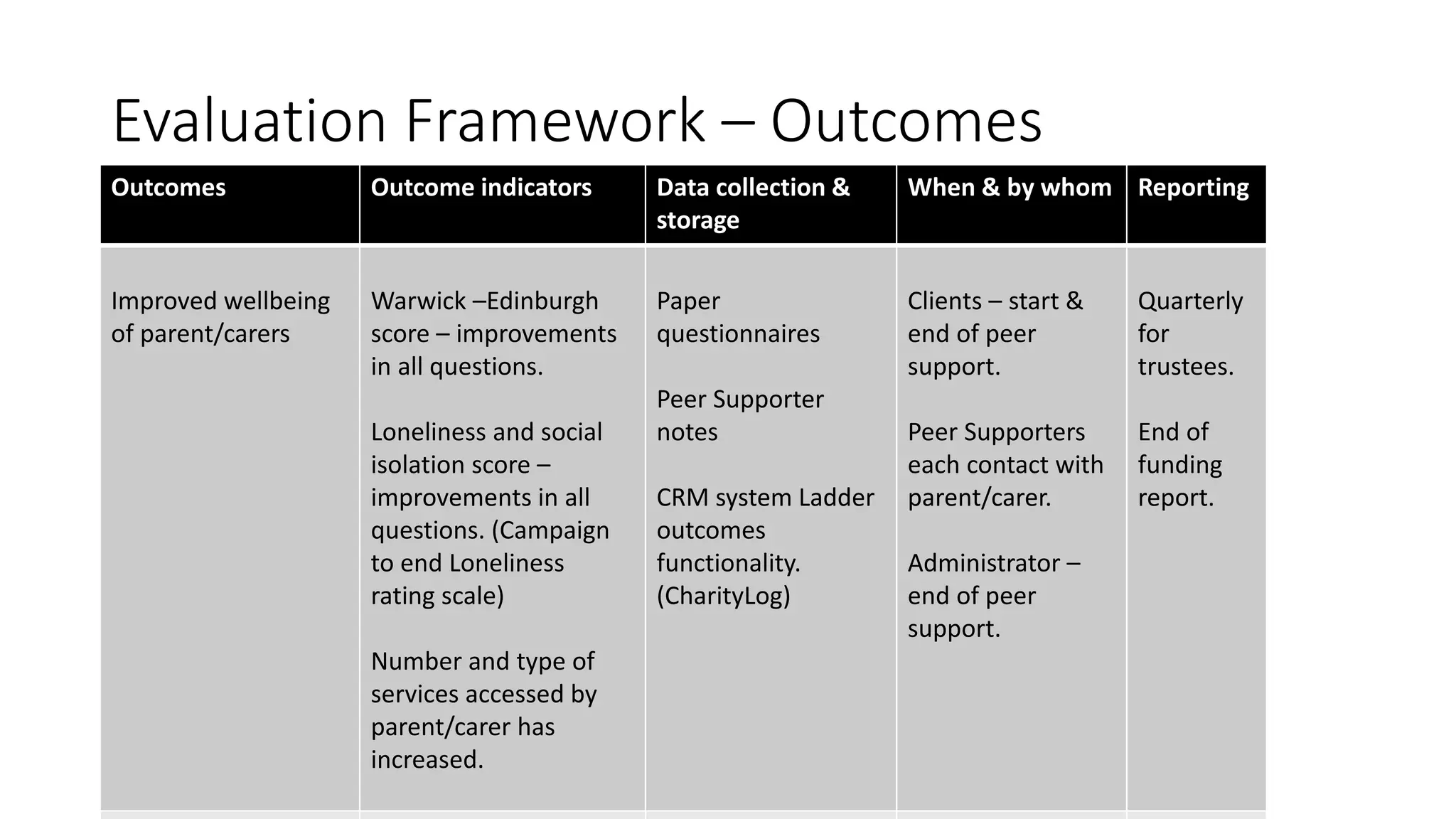
Improved wellbeing
of parent/carers
Warwick –Edinburgh
score – improvements
in all questions.
Loneliness and social
isolation score –
improvements in all
questions. (Campaign
to end Loneliness
rating scale)
Number and type of
services accessed by
parent/carer has
increased.
Paper
questionnaires
Peer Supporter
notes
CRM system Ladder
outcomes
functionality.
(CharityLog)
Clients – start &
end of peer
support.
Peer Supporters
each contact with
parent/carer.
Administrator –
end of peer
support.
Quarterly
for
trustees.
End of
funding
report.
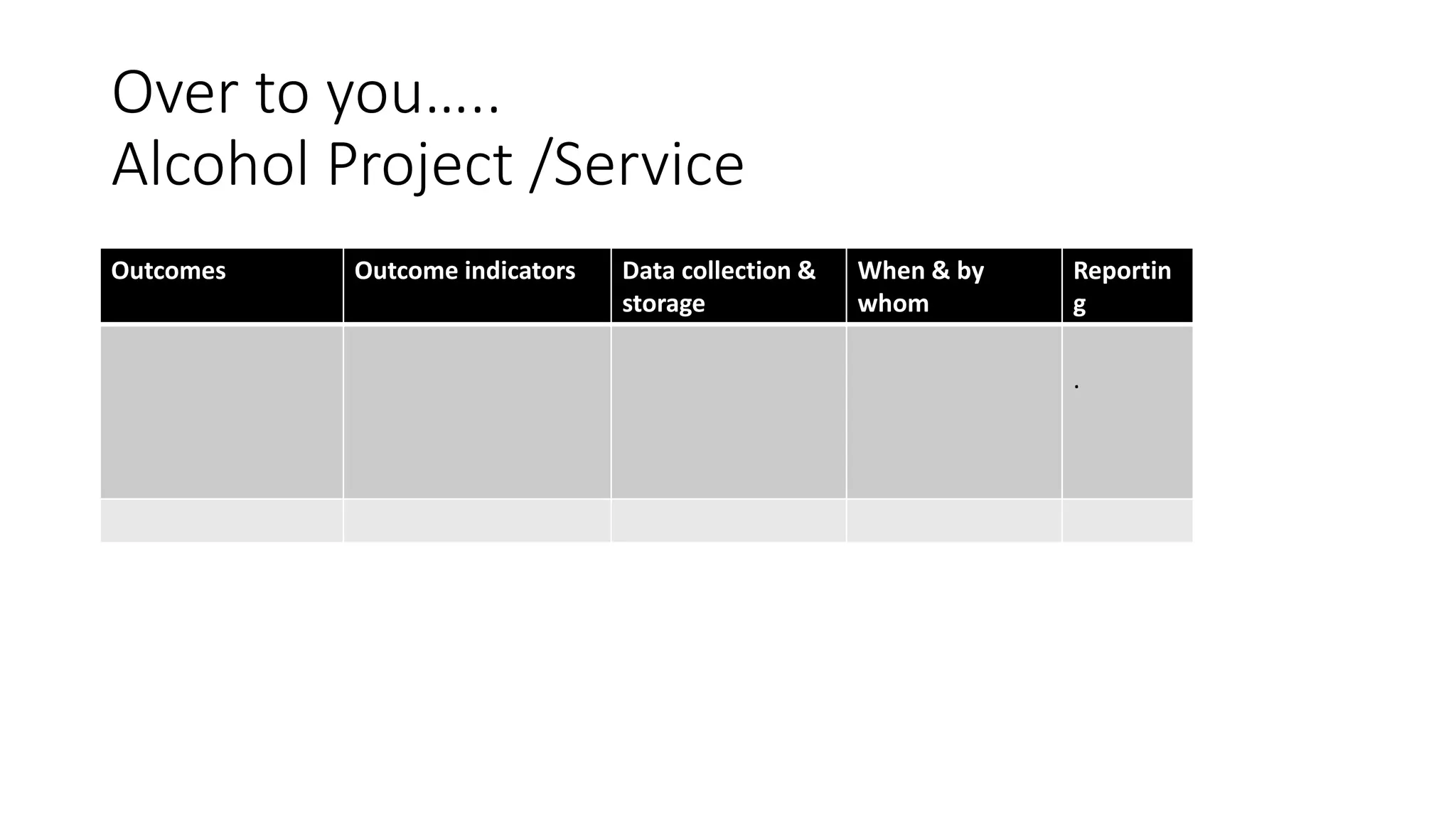
Over to you…..
Alcohol Project /Service
A
Outcomes Outcome indicators Data collection &
storage
When & by
whom
Reportin
g
.
Over to you… Evaluation Framework for an
Alcohol Misuse Service
Some ideas for outcome indicators:
• Reduced levels of alcohol intake
• Increased knowledge of harmful effects
• Better coping/abstinence strategy
• Increased self-esteem/self-confidence
• Reduced anti-social behaviour
• Increased knowledge of the services available.
From http://www.effectiveservices.org/downloads/BIG_Impact_of_Alcohol_evaluation_framework_website_dec15.pdf
Recommended resources
• https://knowhownonprofit.org/
• www.ncvo.org.uk/charities-evaluation-services
• inspiringimpact.org
• https://www.biglotteryfund.org.uk/research/making-the-most-of-
funding/impact-and-outcomes/measuring-the-difference-projects-
make
Outcomes for this session
A greater understanding of:
• What the third sector means by
“impact practice” & associated terms.
• How to use a Planning triangle and a
Monitoring & Evaluation Framework.
An awareness o:
• The Theory of Change.
• Third sector resources for Impact
Practice
Catherine Greaves
catherinegreaves@gmail.com
Twitter: @categreaves @pscsleep
LinkedIn: https://www.linkedin.com/in/catherineagreaves

Impact practice in the third sector for public health practitioners

  • 1.
    Impact Practice Sharing experiencefrom Third Sector wellbeing projects Catherine Greaves, Project Manager
  • 2.
    Outcomes for thissession A greater understanding of • What the third sector means by “impact practice” & associated terms. • How to use a Planning triangle and a Monitoring & Evaluation Framework. An awareness of • The Theory of Change. • Third sector resources for Impact Practice
  • 3.
  • 4.
    “Impact is thedifference you make. By focusing on your impact, you can make more of a difference through your work. This means planning what impact you want to have and how best to achieve it, collecting information about your impact, assessing what impact you’re having, communicating this information and learning from it. We call this cycle of activities impact practice. This includes, but is significantly bigger than, the tasks of measuring, monitoring and evaluating your work. Many terms are used to talk about the difference you make and the work you’re doing, including outcomes, activities and outputs. The most important distinction is between the work you do and the difference it makes: it is all too easy to focus on your day-to-day work, when it is the impact you’re having, and how you can have more, that is arguably more important.” From: the Code of Good Impact Practice
  • 5.
    Why is itmore important than your day-to-day work? Professional development • Fresh thinking • Improve performance • Show effectiveness Accountability - stakeholders • Service users & communities • Funders • Commissioners Sustainability • Secure funding and commissioning
  • 6.
    Jargon buster Impact: thebroad or longer-term effects of your project or your organisation’s work (also referred to as the difference you make). This can include effects on people who are direct users, effects on those who are not direct users, or effects on a wider field such as NHS practice or government policy. Impact practice: the activities that your team or your organisation does to focus on its impact. This can include planning desired impact, planning how to measure it, collecting information about it, making sense of that information, communicating it and learning from it. From: the Code of Good Impact Practice
  • 7.
    Jargon Buster –over to you 1. Activities 2. Evaluation 3. Indicator 4. Monitoring 5. Overall aim 6. Outputs Outcomes 7. Processes 8. Theory of change 9. User Satisfaction
  • 8.
    What is aTheory of Change?
  • 9.
    Theory of change “A description of why a particular way of working will be effective, showing how change happens in the short, medium and long term to achieve the intended outcome.” Usually represented as a visual map but can be narrative. From: NCVO Charities Evaluation Services
  • 10.
    What makes itdifferent & potentially difficult? • A critical, reflective process. • Challenges assumptions that we make about our work. • Starts with impact and works backwards. • Shows interrelationships between outputs and outcomes. • Suggests new possibilities. • Acknowledges that there are a range of stakeholders that contribute to the impact we are working towards. • A thinking process as well as a product.
  • 11.
    A good placeto start
  • 12.
    NCVO CES example(Lambeth) To reduce isolation among older people To increase the take up of mental health services by older people To increase older people’s understanding of mental health issues To offer information To organise social events To Run outreach events To improve the mental health of older people in Lambeth Overall Aim Specific Aims Objectives
  • 13.
    Local Example 1 Reduceddepression levels for clients Reduced anxiety levels for clients Reduced social isolation Improved family relationships Improved economic wellbeing 1:1 counselling for clients who have experienced baby loss and infertility. Counsellor-led support groups for baby loss and infertility. Support and training for trainee counsellors on placement. Professional development opportunities for practitioners working with families. Improved health & wellbeing of Berkshire families affected by baby loss and infertility Aim Outcome Activities
  • 14.
    Over to you… AlcoholService/Project No more than 5 specific aims. Use ‘action’ words e.g. to reduce, to increase. No more than 6 objectives. Keep it general e.g. professional development opportunities rather than ‘workshops’ One long-term change you contribute to. Aim Outcome Activities
  • 15.
    Writing your ownplanning triangle – more tips • Whose health are you seeking to improve? • What behaviour are you seeking to change? • How will you know if you have succeeded in changing behaviour? • How will you know if you have succeeded in contributing to improving the health of your target population? • What processes and inputs need to be taken into account • What assumptions have been made about the theoretical links between the services/interventions and outcome?
  • 16.
    Writing your ownplanning triangle – more tips Outcomes for alcohol – some ideas • Reduction in problematic drinking behaviour • Clients have improved wellbeing • Improved social support/functioning • Improved help-seeking behaviour • Improved capacity for families to cope with negative consequences of drinking behaviour From http://www.effectiveservices.org/downloads/BIG_Impact_of_Alcohol_evaluation_framework_website_dec15.pdf
  • 18.
  • 19.
    Adding to thetriangle Inputs • Funding • Staff time & skills • Volunteer time & skills • Premises • Partner’s resources Processes • Developing relationships with partners • Developing relationships with users • Training
  • 20.
    Evaluation Framework –Outputs A Outputs Output indicators Data collection & storage When & by whom Reporting Specialist, accessible. parenting training. Number of courses & workshops. Number & profile of people attending. Times and venues of courses & workshops. Level of user satisfaction. Online event management (EventBrite) CRM system (CharityLog) Online survey (surveymonkey) Online booking form & registration forms completed by parent/carer. Online survey form completed by attendees at end of the course or workshop. Quarterly for Trustees. End of project for funders
  • 21.
    Evaluation Framework –Outcomes A Outcomes Outcome indicators Data collection & storage When & by whom Reporting Increased confidence to access mental health services Level of confidence is moderate to high. Likelihood of accessing services is moderate to high. (internally developed rating scale) Paper questionnaires Database system. Service users – end of outreach work. Project workers – remote access Quarterly for Directors. End of project for funders
  • 22.
    Evaluation Framework –Outcomes A Outcomes Outcome indicators Data collection & storage When & by whom Reportin g Reduced anxiety GAD-7 scores are all in the mild range at the end of counselling. Paper questionnaires Counselling notes Spreadsheet Clients –each counselling session. Counsellors each counselling session. Administrator – end of counselling. Quarterly for funders.
  • 23.
    Evaluation Framework –Outcomes A Outcomes Outcome indicators Data collection & storage When & by whom Reporting Improved wellbeing of parent/carers Warwick –Edinburgh score – improvements in all questions. Loneliness and social isolation score – improvements in all questions. (Campaign to end Loneliness rating scale) Number and type of services accessed by parent/carer has increased. Paper questionnaires Peer Supporter notes CRM system Ladder outcomes functionality. (CharityLog) Clients – start & end of peer support. Peer Supporters each contact with parent/carer. Administrator – end of peer support. Quarterly for trustees. End of funding report.
  • 24.
    Over to you….. AlcoholProject /Service A Outcomes Outcome indicators Data collection & storage When & by whom Reportin g .
  • 25.
    Over to you…Evaluation Framework for an Alcohol Misuse Service Some ideas for outcome indicators: • Reduced levels of alcohol intake • Increased knowledge of harmful effects • Better coping/abstinence strategy • Increased self-esteem/self-confidence • Reduced anti-social behaviour • Increased knowledge of the services available. From http://www.effectiveservices.org/downloads/BIG_Impact_of_Alcohol_evaluation_framework_website_dec15.pdf
  • 26.
    Recommended resources • https://knowhownonprofit.org/ •www.ncvo.org.uk/charities-evaluation-services • inspiringimpact.org • https://www.biglotteryfund.org.uk/research/making-the-most-of- funding/impact-and-outcomes/measuring-the-difference-projects- make
  • 27.
    Outcomes for thissession A greater understanding of: • What the third sector means by “impact practice” & associated terms. • How to use a Planning triangle and a Monitoring & Evaluation Framework. An awareness o: • The Theory of Change. • Third sector resources for Impact Practice
  • 28.
    Catherine Greaves catherinegreaves@gmail.com Twitter: @categreaves@pscsleep LinkedIn: https://www.linkedin.com/in/catherineagreaves

Editor's Notes

  • #2  NCVO CES Inspiring Impact Berkshire Autistic Society Parenting Special Children Mustard Tree Reading Alliance for Family Mental Health Funders: Big Lottery, Children in Need Commissioners East & West Berkshire CCGs
  • #3 Rating Scale Hand out I How well do you understand Impact Practice and how it applies to your wokrk ? Not at all well                    Very well 1 2 3 4 5 6 7 8 9 10
  • #6 pract
  • #29  NCVO CES Inspiring Impact Berkshire Autistic Society Parenting Special Children Mustard Tree Reading Alliance for Family Mental Health