



Product Design
Sprints
Alex Britez @abritez
alex@unthinkmedia.com
Who am I?
Originally a Designer
Full Stack developer
Graduate degree in Digital Media
Design for Learning
Alex Britez
Director of Digital Innovation
alex@unthinkmedia.com
www.linkedin.com/in/unthinkmedia
@abritez
look at my super awesome idea
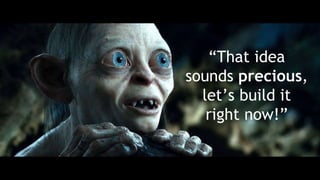
“That idea
sounds precious,
let’s build it
right now!”
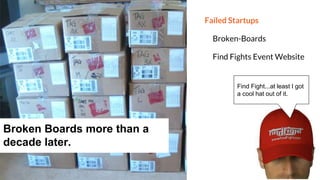
Failed Startups
Broken-Boards
Find Fights Event Website
Broken Boards more than a
decade later.
Find Fight...at least I got
a cool hat out of it.
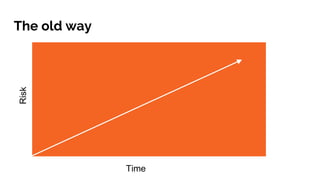
The old wayRisk
Time
I’m probably wrong
how fast can i know? how far am I from success?
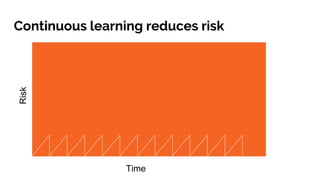
Continuous learning reduces riskRisk
Time
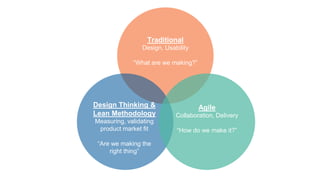
Traditional
Design, Usability
“What are we making?”
Design Thinking &
Lean Methodology
Measuring, validating
product market fit
“Are we making the
right thing”
Agile
Collaboration, Delivery
“How do we make it?”
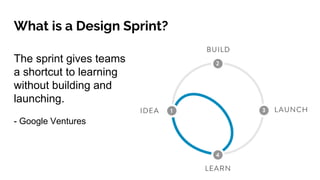
What is a Design Sprint?
The sprint gives teams
a shortcut to learning
without building and
launching.
- Google Ventures
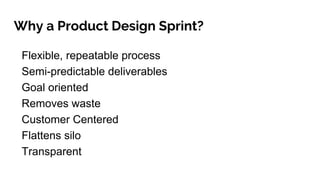
Why a Product Design Sprint?
Flexible, repeatable process
Semi-predictable deliverables
Goal oriented
Removes waste
Customer Centered
Flattens silo
Transparent
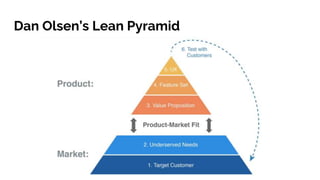
Dan Olsen’s Lean Pyramid
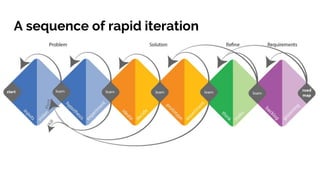
A sequence of rapid iteration
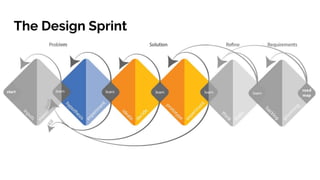
The Design Sprint
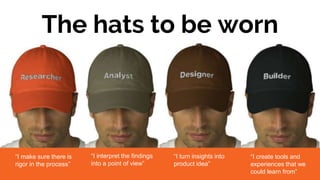
The hats to be worn
“I make sure there is
rigor in the process”
“I interpret the findings
into a point of view”
“I turn insights into
product idea”
“I create tools and
experiences that we
could learn from”
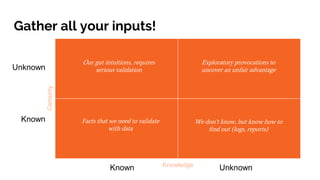
Gather all your inputs!
Unknown
Known
UnknownKnown
Facts that we need to validate
with data
Our gut intuitions, requires
serious validation
Exploratory provocations to
uncover an unfair advantage
We don’t know, but know how to
find out (logs, reports)
Certainty
Knowledge
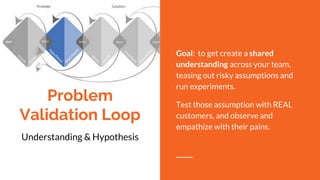
Problem
Validation Loop
Understanding & Hypothesis
Goal: to get create a shared
understanding across your team,
teasing out risky assumptions and
run experiments.
Test those assumption with REAL
customers, and observe and
empathize with their pains.
credit: unknown
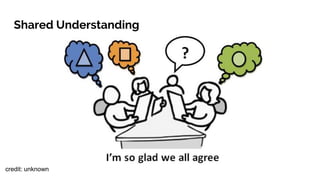
Shared Understanding
What problem are we solving?
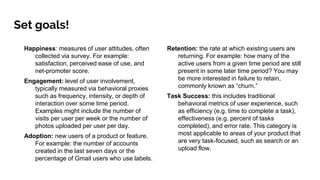
Set goals!
Happiness: measures of user attitudes, often
collected via survey. For example:
satisfaction, perceived ease of use, and
net-promoter score.
Engagement: level of user involvement,
typically measured via behavioral proxies
such as frequency, intensity, or depth of
interaction over some time period.
Examples might include the number of
visits per user per week or the number of
photos uploaded per user per day.
Adoption: new users of a product or feature.
For example: the number of accounts
created in the last seven days or the
percentage of Gmail users who use labels.
Retention: the rate at which existing users are
returning. For example: how many of the
active users from a given time period are still
present in some later time period? You may
be more interested in failure to retain,
commonly known as “churn.”
Task Success: this includes traditional
behavioral metrics of user experience, such
as efficiency (e.g. time to complete a task),
effectiveness (e.g. percent of tasks
completed), and error rate. This category is
most applicable to areas of your product that
are very task-focused, such as search or an
upload flow.
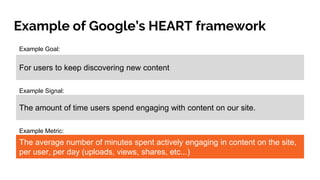
Example of Google’s HEART framework
Example Goal:
For users to keep discovering new content
Example Signal:
The amount of time users spend engaging with content on our site.
Example Metric:
The average number of minutes spent actively engaging in content on the site,
per user, per day (uploads, views, shares, etc...)
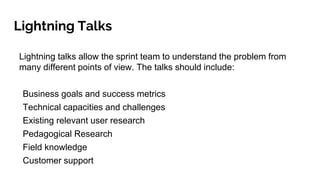
Lightning Talks
Lightning talks allow the sprint team to understand the problem from
many different points of view. The talks should include:
Business goals and success metrics
Technical capacities and challenges
Existing relevant user research
Pedagogical Research
Field knowledge
Customer support
Define your market segments
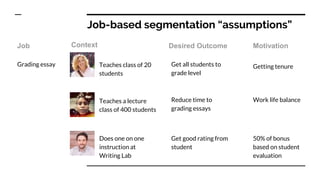
Job-based segmentation “assumptions”
Does one on one
instruction at
Writing Lab
Teaches a lecture
class of 400 students
Teaches class of 20
students
Job Context Desired Outcome
Grading essay Get all students to
grade level
Motivation
Reduce time to
grading essays
Get good rating from
student
50% of bonus
based on student
evaluation
Work life balance
Getting tenure
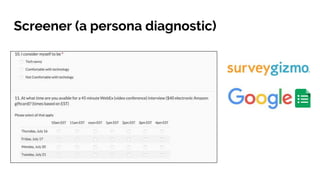
Screener (a persona diagnostic)
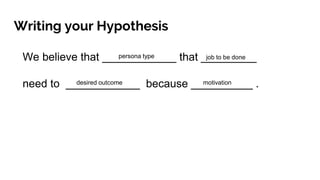
Writing your Hypothesis
We believe that ____________ that _________
need to ____________ because __________ .
persona type job to be done
motivationdesired outcome
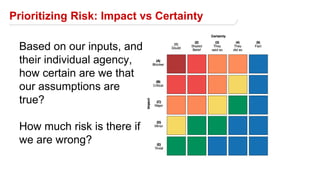
Prioritizing Risk: Impact vs Certainty
Based on our inputs, and
their individual agency,
how certain are we that
our assumptions are
true?
How much risk is there if
we are wrong?
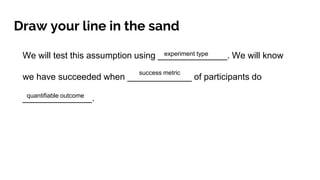
Draw your line in the sand
We will test this assumption using ______________. We will know
we have succeeded when _____________ of participants do
______________.
experiment type
success metric
quantifiable outcome
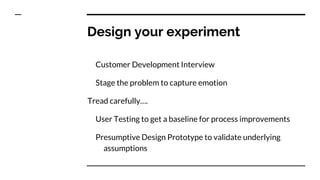
Design your experiment
Customer Development Interview
Stage the problem to capture emotion
Tread carefully….
User Testing to get a baseline for process improvements
Presumptive Design Prototype to validate underlying
assumptions
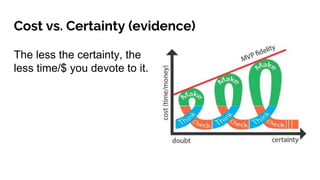
Cost vs. Certainty (evidence)
The less the certainty, the
less time/$ you devote to it.
The science of asking questions
Problem Discovery
Describe your each step
involved to complete [job to
be done]. What are you
thinking during each step?
What are you feeling?
Problem Validation
Tell me about the last time you
[process you’re improving]
What are you currently doing
to solve this problem/get
this value?
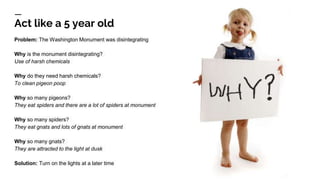
Act like a 5 year old
Problem: The Washington Monument was disintegrating
Why is the monument disintegrating?
Use of harsh chemicals
Why do they need harsh chemicals?
To clean pigeon poop
Why so many pigeons?
They eat spiders and there are a lot of spiders at monument
Why so many spiders?
They eat gnats and lots of gnats at monument
Why so many gnats?
They are attracted to the light at dusk
Solution: Turn on the lights at a later time
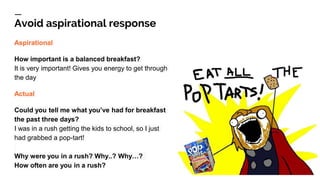
Avoid aspirational response
Aspirational
How important is a balanced breakfast?
It is very important! Gives you energy to get through
the day
Actual
Could you tell me what you’ve had for breakfast
the past three days?
I was in a rush getting the kids to school, so I just
had grabbed a pop-tart!
Why were you in a rush? Why..? Why…?
How often are you in a rush?
Get out of
the building!
Get out of the building
Look at how differently
that instructor’s teacher
assistants give
feedback.
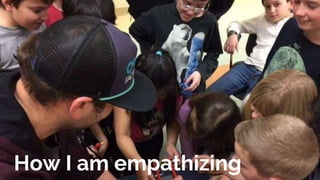
How I am empathizing
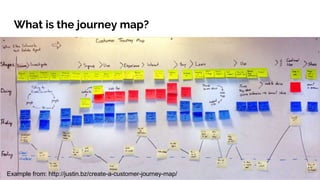
What is the journey map?
Example from: http://justin.bz/create-a-customer-journey-map/
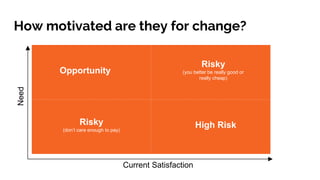
How motivated are they for change?
Need
Current Satisfaction
Opportunity
Risky
(you better be really good or
really cheap)
Risky
(don’t care enough to pay)
High Risk
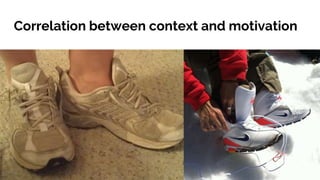
Correlation between context and motivation
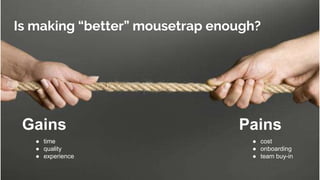
Gains Pains
● time
● quality
● experience
● cost
● onboarding
● team buy-in
Is making “better” mousetrap enough?
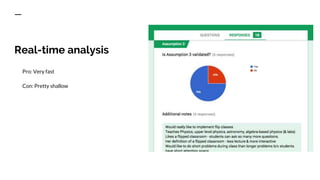
Real-time analysis
Pro: Very fast
Con: Pretty shallow
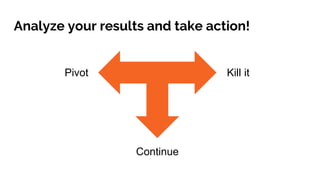
Analyze your results and take action!
Pivot Kill it
Continue
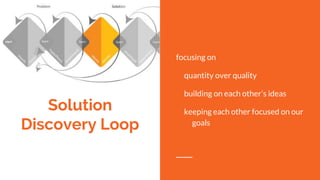
Solution
Discovery Loop
focusing on
quantity over quality
building on each other’s ideas
keeping each other focused on our
goals
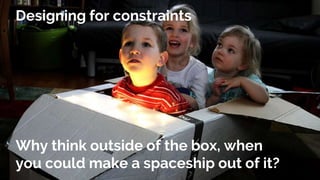
Why think outside of the box, when
you could make a spaceship out of it?
Designing for constraints
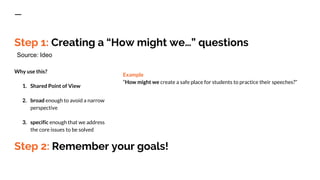
Step 1: Creating a “How might we…” questions
Why use this?
1. Shared Point of View
2. broad enough to avoid a narrow
perspective
3. specific enough that we address
the core issues to be solved
Example
“How might we create a safe place for students to practice their speeches?”
Source: Ideo
Step 2: Remember your goals!
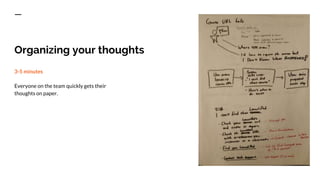
Organizing your thoughts
3-5 minutes
Everyone on the team quickly gets their
thoughts on paper.
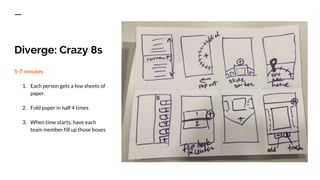
Diverge: Crazy 8s
5-7 minutes
1. Each person gets a few sheets of
paper.
2. Fold paper in half 4 times
3. When time starts, have each
team member fill up those boxes
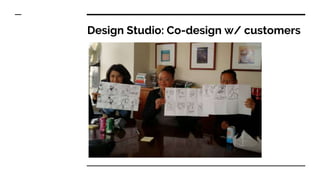
Design Studio: Co-design w/ customers
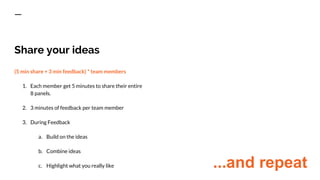
Share your ideas
(5 min share + 3 min feedback) * team members
1. Each member get 5 minutes to share their entire
8 panels.
2. 3 minutes of feedback per team member
3. During Feedback
a. Build on the ideas
b. Combine ideas
c. Highlight what you really like ...and repeat
converge
select 2-3 of your favorite concepts
combining is okay, but don’t go crazy. it becomes
impossible to explain
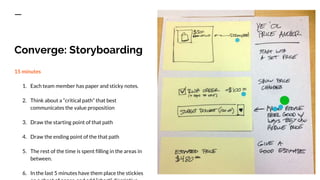
Converge: Storyboarding
15 minutes
1. Each team member has paper and sticky notes.
2. Think about a “critical path” that best
communicates the value proposition
3. Draw the starting point of that path
4. Draw the ending point of the that path
5. The rest of the time is spent filling in the areas in
between.
6. In the last 5 minutes have them place the stickies
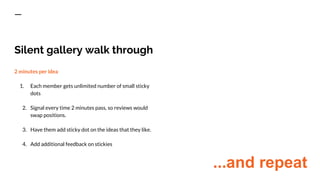
Silent gallery walk through
2 minutes per idea
1. Each member gets unlimited number of small sticky
dots
2. Signal every time 2 minutes pass, so reviews would
swap positions.
3. Have them add sticky dot on the ideas that they like.
4. Add additional feedback on stickies
...and repeat
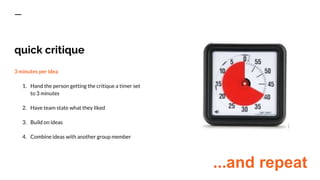
quick critique
3 minutes per idea
1. Hand the person getting the critique a timer set
to 3 minutes
2. Have team state what they liked
3. Build on ideas
4. Combine ideas with another group member
...and repeat
converge
select 2-3 of your favorites in the entire group
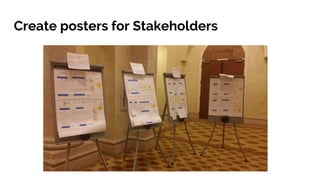
Create posters for Stakeholders
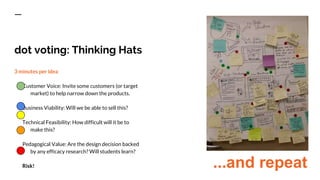
dot voting: Thinking Hats
3 minutes per idea
Customer Voice: Invite some customers (or target
market) to help narrow down the products.
Business Viability: Will we be able to sell this?
Technical Feasibility: How difficult will it be to
make this?
Pedagogical Value: Are the design decision backed
by any efficacy research? Will students learn?
Risk! ...and repeat
converge
& create
Select 2-3 of the most popular product to prototype
Solution
Validation Loop
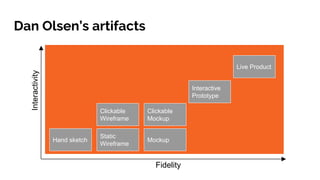
Dan Olsen’s artifacts
Interactivity
Fidelity
Hand sketch
Static
Wireframe
Mockup
Clickable
Wireframe
Clickable
Mockup
Interactive
Prototype
Live Product
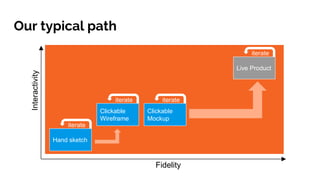
Our typical path
Interactivity
Fidelity
Hand sketch
Clickable
Wireframe
Clickable
Mockup
Live Product
iterate
iterate iterate
iterate
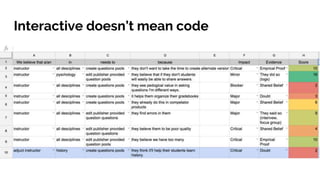
Interactive doesn’t mean code
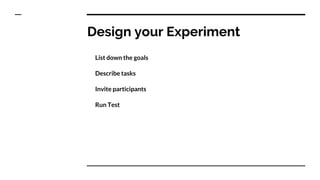
Design your Experiment
List down the goals
Describe tasks
Invite participants
Run Test
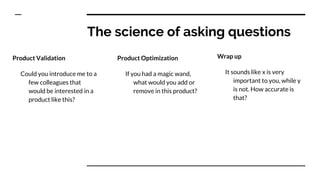
The science of asking questions
Product Validation
Could you introduce me to a
few colleagues that
would be interested in a
product like this?
Product Optimization
If you had a magic wand,
what would you add or
remove in this product?
Wrap up
It sounds like x is very
important to you, while y
is not. How accurate is
that?
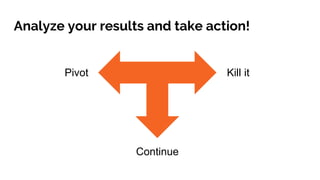
Analyze your results and take action!
Pivot Kill it
Continue
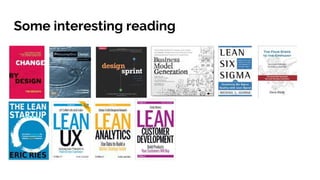
Some interesting reading
Thanks!
alex@unthinkmedia.com
www.linkedin.com/in/unthinkmedia
@abritez

LaunchNJ: Product Design Sprints

  • 1.
    Product Design Sprints Alex Britez@abritez alex@unthinkmedia.com
  • 2.
    Who am I? Originallya Designer Full Stack developer Graduate degree in Digital Media Design for Learning Alex Britez Director of Digital Innovation alex@unthinkmedia.com www.linkedin.com/in/unthinkmedia @abritez
  • 3.
    look at mysuper awesome idea
  • 4.
  • 5.
    Failed Startups Broken-Boards Find FightsEvent Website Broken Boards more than a decade later. Find Fight...at least I got a cool hat out of it.
  • 6.
  • 7.
    I’m probably wrong howfast can i know? how far am I from success?
  • 8.
  • 11.
    Traditional Design, Usability “What arewe making?” Design Thinking & Lean Methodology Measuring, validating product market fit “Are we making the right thing” Agile Collaboration, Delivery “How do we make it?”
  • 12.
    What is aDesign Sprint? The sprint gives teams a shortcut to learning without building and launching. - Google Ventures
  • 13.
    Why a ProductDesign Sprint? Flexible, repeatable process Semi-predictable deliverables Goal oriented Removes waste Customer Centered Flattens silo Transparent
  • 14.
  • 15.
    A sequence ofrapid iteration
  • 16.
  • 17.
    The hats tobe worn “I make sure there is rigor in the process” “I interpret the findings into a point of view” “I turn insights into product idea” “I create tools and experiences that we could learn from”
  • 18.
    Gather all yourinputs! Unknown Known UnknownKnown Facts that we need to validate with data Our gut intuitions, requires serious validation Exploratory provocations to uncover an unfair advantage We don’t know, but know how to find out (logs, reports) Certainty Knowledge
  • 19.
    Problem Validation Loop Understanding &Hypothesis Goal: to get create a shared understanding across your team, teasing out risky assumptions and run experiments. Test those assumption with REAL customers, and observe and empathize with their pains.
  • 20.
  • 21.
    What problem arewe solving?
  • 22.
    Set goals! Happiness: measuresof user attitudes, often collected via survey. For example: satisfaction, perceived ease of use, and net-promoter score. Engagement: level of user involvement, typically measured via behavioral proxies such as frequency, intensity, or depth of interaction over some time period. Examples might include the number of visits per user per week or the number of photos uploaded per user per day. Adoption: new users of a product or feature. For example: the number of accounts created in the last seven days or the percentage of Gmail users who use labels. Retention: the rate at which existing users are returning. For example: how many of the active users from a given time period are still present in some later time period? You may be more interested in failure to retain, commonly known as “churn.” Task Success: this includes traditional behavioral metrics of user experience, such as efficiency (e.g. time to complete a task), effectiveness (e.g. percent of tasks completed), and error rate. This category is most applicable to areas of your product that are very task-focused, such as search or an upload flow.
  • 23.
    Example of Google’sHEART framework Example Goal: For users to keep discovering new content Example Signal: The amount of time users spend engaging with content on our site. Example Metric: The average number of minutes spent actively engaging in content on the site, per user, per day (uploads, views, shares, etc...)
  • 24.
    Lightning Talks Lightning talksallow the sprint team to understand the problem from many different points of view. The talks should include: Business goals and success metrics Technical capacities and challenges Existing relevant user research Pedagogical Research Field knowledge Customer support
  • 25.
  • 26.
    Job-based segmentation “assumptions” Doesone on one instruction at Writing Lab Teaches a lecture class of 400 students Teaches class of 20 students Job Context Desired Outcome Grading essay Get all students to grade level Motivation Reduce time to grading essays Get good rating from student 50% of bonus based on student evaluation Work life balance Getting tenure
  • 27.
  • 28.
    Writing your Hypothesis Webelieve that ____________ that _________ need to ____________ because __________ . persona type job to be done motivationdesired outcome
  • 29.
    Prioritizing Risk: Impactvs Certainty Based on our inputs, and their individual agency, how certain are we that our assumptions are true? How much risk is there if we are wrong?
  • 30.
    Draw your linein the sand We will test this assumption using ______________. We will know we have succeeded when _____________ of participants do ______________. experiment type success metric quantifiable outcome
  • 31.
    Design your experiment CustomerDevelopment Interview Stage the problem to capture emotion Tread carefully…. User Testing to get a baseline for process improvements Presumptive Design Prototype to validate underlying assumptions
  • 32.
    Cost vs. Certainty(evidence) The less the certainty, the less time/$ you devote to it.
  • 33.
    The science ofasking questions Problem Discovery Describe your each step involved to complete [job to be done]. What are you thinking during each step? What are you feeling? Problem Validation Tell me about the last time you [process you’re improving] What are you currently doing to solve this problem/get this value?
  • 34.
    Act like a5 year old Problem: The Washington Monument was disintegrating Why is the monument disintegrating? Use of harsh chemicals Why do they need harsh chemicals? To clean pigeon poop Why so many pigeons? They eat spiders and there are a lot of spiders at monument Why so many spiders? They eat gnats and lots of gnats at monument Why so many gnats? They are attracted to the light at dusk Solution: Turn on the lights at a later time
  • 35.
    Avoid aspirational response Aspirational Howimportant is a balanced breakfast? It is very important! Gives you energy to get through the day Actual Could you tell me what you’ve had for breakfast the past three days? I was in a rush getting the kids to school, so I just had grabbed a pop-tart! Why were you in a rush? Why..? Why…? How often are you in a rush?
  • 36.
    Get out of thebuilding!
  • 37.
    Get out ofthe building Look at how differently that instructor’s teacher assistants give feedback.
  • 38.
    How I amempathizing
  • 39.
    What is thejourney map? Example from: http://justin.bz/create-a-customer-journey-map/
  • 40.
    How motivated arethey for change? Need Current Satisfaction Opportunity Risky (you better be really good or really cheap) Risky (don’t care enough to pay) High Risk
  • 42.
  • 43.
    Gains Pains ● time ●quality ● experience ● cost ● onboarding ● team buy-in Is making “better” mousetrap enough?
  • 45.
    Real-time analysis Pro: Veryfast Con: Pretty shallow
  • 46.
    Analyze your resultsand take action! Pivot Kill it Continue
  • 47.
    Solution Discovery Loop focusing on quantityover quality building on each other’s ideas keeping each other focused on our goals
  • 48.
    Why think outsideof the box, when you could make a spaceship out of it? Designing for constraints
  • 49.
    Step 1: Creatinga “How might we…” questions Why use this? 1. Shared Point of View 2. broad enough to avoid a narrow perspective 3. specific enough that we address the core issues to be solved Example “How might we create a safe place for students to practice their speeches?” Source: Ideo Step 2: Remember your goals!
  • 50.
    Organizing your thoughts 3-5minutes Everyone on the team quickly gets their thoughts on paper.
  • 51.
    Diverge: Crazy 8s 5-7minutes 1. Each person gets a few sheets of paper. 2. Fold paper in half 4 times 3. When time starts, have each team member fill up those boxes
  • 52.
  • 53.
    Share your ideas (5min share + 3 min feedback) * team members 1. Each member get 5 minutes to share their entire 8 panels. 2. 3 minutes of feedback per team member 3. During Feedback a. Build on the ideas b. Combine ideas c. Highlight what you really like ...and repeat
  • 54.
    converge select 2-3 ofyour favorite concepts combining is okay, but don’t go crazy. it becomes impossible to explain
  • 55.
    Converge: Storyboarding 15 minutes 1.Each team member has paper and sticky notes. 2. Think about a “critical path” that best communicates the value proposition 3. Draw the starting point of that path 4. Draw the ending point of the that path 5. The rest of the time is spent filling in the areas in between. 6. In the last 5 minutes have them place the stickies
  • 56.
    Silent gallery walkthrough 2 minutes per idea 1. Each member gets unlimited number of small sticky dots 2. Signal every time 2 minutes pass, so reviews would swap positions. 3. Have them add sticky dot on the ideas that they like. 4. Add additional feedback on stickies ...and repeat
  • 57.
    quick critique 3 minutesper idea 1. Hand the person getting the critique a timer set to 3 minutes 2. Have team state what they liked 3. Build on ideas 4. Combine ideas with another group member ...and repeat
  • 58.
    converge select 2-3 ofyour favorites in the entire group
  • 59.
    Create posters forStakeholders
  • 60.
    dot voting: ThinkingHats 3 minutes per idea Customer Voice: Invite some customers (or target market) to help narrow down the products. Business Viability: Will we be able to sell this? Technical Feasibility: How difficult will it be to make this? Pedagogical Value: Are the design decision backed by any efficacy research? Will students learn? Risk! ...and repeat
  • 61.
    converge & create Select 2-3of the most popular product to prototype
  • 62.
  • 63.
    Dan Olsen’s artifacts Interactivity Fidelity Handsketch Static Wireframe Mockup Clickable Wireframe Clickable Mockup Interactive Prototype Live Product
  • 64.
    Our typical path Interactivity Fidelity Handsketch Clickable Wireframe Clickable Mockup Live Product iterate iterate iterate iterate
  • 65.
  • 66.
    Design your Experiment Listdown the goals Describe tasks Invite participants Run Test
  • 67.
    The science ofasking questions Product Validation Could you introduce me to a few colleagues that would be interested in a product like this? Product Optimization If you had a magic wand, what would you add or remove in this product? Wrap up It sounds like x is very important to you, while y is not. How accurate is that?
  • 68.
    Analyze your resultsand take action! Pivot Kill it Continue
  • 69.
  • 70.

Editor's Notes

  • #19 Surveys Marketing Research
  • #22 What problem are you trying to solve?
  • #26 Who is your target market? All the sheep? Just the black sheep? Define the size of your oppertunity
  • #42 Is his need high? How would you gauge his current satisfaction?