Youth Mental Health – setting up a
       dedicated service in Norfolk


      Dr Uju Ugochukwu (Consultant Adult Psychiatrist)
Dr Sarah Maxwell (Consultant Child & Adolescent Psychiatrist)
         Norfolk and Suffolk NHS Foundation Trust
Acknowledgements
• Professor David Fowler
• Dr Jon Wilson
• Debbie White
Collaborations for Leadership in Applied
Health Research and Care For Cambridgeshire
 and Peterborough (CLAHRC CP) Fellowship


• Quantitative mapping project
  – Description of the characteristics of 14 – 25
    year olds within the service
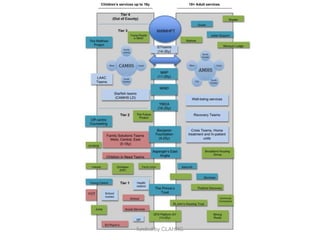
  – Description of mental health services
    available to young people in Norfolk
• Qualitative Study
www.slideshare.net
How did it all start?
• CAMHS perspective
     • Problems with transfer to AMHS
• AMHS/EI perspective
     • Young people with emerging disorders who are not
       psychotic
• Central Norfolk EIT - Team C
  – Service to young people with emerging disorders
  – Mentioned as an example of good practice in SCIE:
    http://www.scie.org.uk/publications/guides/guide44/pr
    acticeexamples/norfolk.asp
Bridging the gap
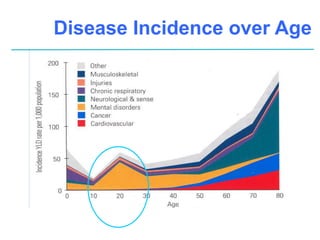
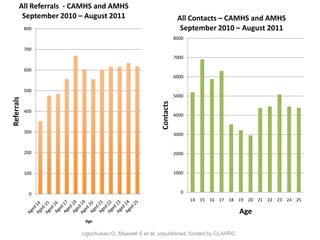
Disease Incidence over Age
All Referrals - CAMHS and AMHS
        September 2010 – August 2011                              All Contacts – CAMHS and AMHS
            800                                                    September 2010 – August 2011
                                                                 8000

            700
                                                                 7000

            600
                                                                 6000

            500
                                                                 5000
Referrals


                                                      Contacts
            400
                                                                 4000


            300                                                  3000


            200                                                  2000


            100                                                  1000


             0                                                      0
                                                                        14 15 16 17 18 19 20 21 22 23 24 25

                                                                                       Age
                         Age

                        Ugochukwu O, Maxwell S et al, unpublished, funded by CLAHRC
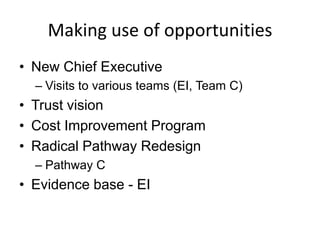
Making use of opportunities
• New Chief Executive
  – Visits to various teams (EI, Team C)
• Trust vision
• Cost Improvement Program
• Radical Pathway Redesign
  – Pathway C
• Evidence base - EI
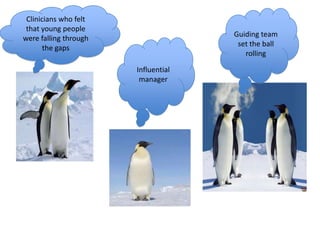
Clinicians who felt
 that young people
                                     Guiding team
were falling through
                                      set the ball
       the gaps
                                        rolling

                       Influential
                        manager
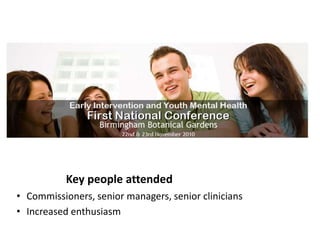
Key people attended
• Commissioners, senior managers, senior clinicians
• Increased enthusiasm
Project Management


• Project Teams
• Stakeholders Group
• Youth Advisory Council
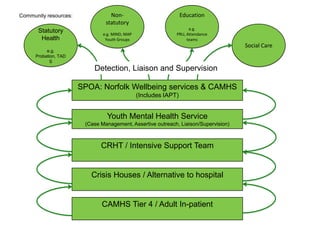
Community resources:              Non-                            Education
                                statutory
                                                                    e.g.
       Statutory               e.g. MIND, MAP                 PRU, Attendance
        Health                  Youth Groups                       teams
                                                                                     Social Care
           e.g.
      Probation, TAD
             S
                           Detection, Liaison and Supervision

                       SPOA: Norfolk Wellbeing services & CAMHS
                                                (Includes IAPT)


                                Youth Mental Health Service
                        (Case Management, Assertive outreach, Liaison/Supervision)


                              CRHT / Intensive Support Team


                          Crisis Houses / Alternative to hospital


                              CAMHS Tier 4 / Adult In-patient
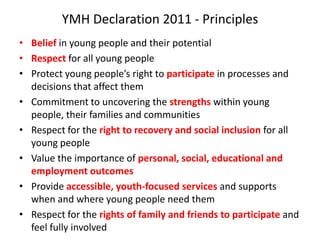
YMH Declaration 2011 - Principles
• Belief in young people and their potential
• Respect for all young people
• Protect young people’s right to participate in processes and
  decisions that affect them
• Commitment to uncovering the strengths within young
  people, their families and communities
• Respect for the right to recovery and social inclusion for all
  young people
• Value the importance of personal, social, educational and
  employment outcomes
• Provide accessible, youth-focused services and supports
  when and where young people need them
• Respect for the rights of family and friends to participate and
  feel fully involved
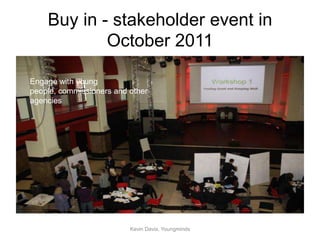
Buy in - stakeholder event in
            October 2011

Engage with young
people, commissioners and other
agencies


                          Kevin Davis, Youngminds
What do our young people want?
Right information in the right way

• Accurate and up to date
  information
   – Leaflets, websites
• Staff qualifications
• Patient rights
• Confidentiality


       Adapted from report “Creating the best mental health service” Kevin Davis, Youngminds.
                                            Unpublished
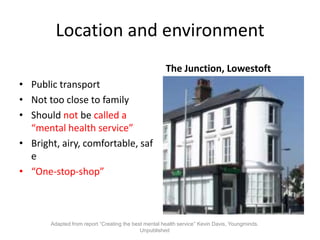
Location and environment
                                                      The Junction, Lowestoft
• Public transport
• Not too close to family
• Should not be called a
  “mental health service”
• Bright, airy, comfortable, saf
  e
• “One-stop-shop”


       Adapted from report “Creating the best mental health service” Kevin Davis, Youngminds.
                                            Unpublished
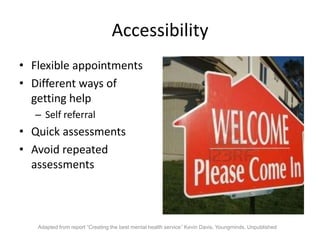
Accessibility
• Flexible appointments
• Different ways of
  getting help
  – Self referral
• Quick assessments
• Avoid repeated
  assessments


   Adapted from report “Creating the best mental health service” Kevin Davis, Youngminds. Unpublished
Staff
•   Honest and reliable
•   Good knowledge base
•   Experienced
•   Caring and understanding
•   “someone who makes you feel like a person
    and not an illness”


       Adapted from report “Creating the best mental health service” Kevin Davis, Youngminds
                                            Unpublished
Young people’s involvement
• Youth Council
  – Supported by Youngminds
  – Vision statement
  – Name for service
• Involvement in project teams and wider
  steering group
• Interview panels
funded by CLAHRC
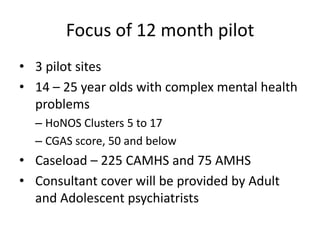
Focus of 12 month pilot
• 3 pilot sites
• 14 – 25 year olds with complex mental health
  problems
  – HoNOS Clusters 5 to 17
  – CGAS score, 50 and below
• Caseload – 225 CAMHS and 75 AMHS
• Consultant cover will be provided by Adult
  and Adolescent psychiatrists
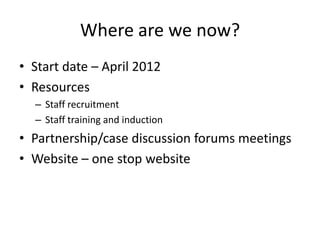
Where are we now?
• Start date – April 2012
• Resources
  – Staff recruitment
  – Staff training and induction
• Partnership/case discussion forums meetings
• Website – one stop website
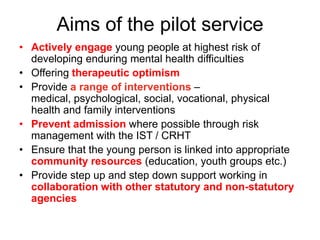
Aims of the pilot service
• Actively engage young people at highest risk of
  developing enduring mental health difficulties
• Offering therapeutic optimism
• Provide a range of interventions –
  medical, psychological, social, vocational, physical
  health and family interventions
• Prevent admission where possible through risk
  management with the IST / CRHT
• Ensure that the young person is linked into appropriate
  community resources (education, youth groups etc.)
• Provide step up and step down support working in
  collaboration with other statutory and non-statutory
  agencies
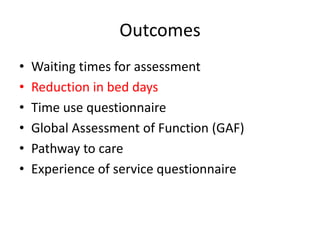
Outcomes
•   Waiting times for assessment
•   Reduction in bed days
•   Time use questionnaire
•   Global Assessment of Function (GAF)
•   Pathway to care
•   Experience of service questionnaire
Research
• Prevention of long term social disability amongst
  young people with emerging signs of severe
  mental illness
    – A pilot randomised controlled trial of social recovery cognitive
      behaviour therapy for young people with emerging severe
      mental illness.
      (NIHR trials funded, UEA led with Manchester)


• Detection and intervention with young people at
  high risk of social disabling severe mental illness
    (Programme grant bid, UEA with Manchester & Birmingham)
•
                        Professor David Fowler, UEA
Challenges – NoNo
• Resistance from some clinicians
  – Early engagement is vital
• Resources
  – Time
  – Cost improvement program
  – Negotiating for staff from teams with stretched
    resources
• Changing culture and mindset
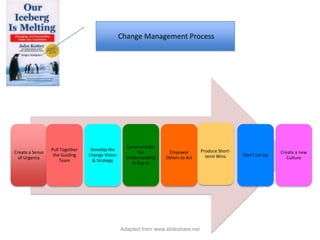
Change Management Process


                                                   Communicate
                 Pull Together    Develop the                                      Produce Short-
Create a Sense                                          for         Empower                                        Create a new
                  the Guiding    Change Vision                                       term Wins      Don’t Let Up
  of Urgency                                       Understanding   Others to Act                                      Culture
                     Team          & Strategy
                                                     & Buy-in


                                                 Adapted from www.slideshare.net
Summary

• Young people want to be an integral part
  of the whole process
   –Their feedback should make a difference
• Early engagement of carers, other
  clinicians and the third sector is crucial

         Overall an exciting process!

Dr Uju Ugochukwu & Dr Sarah Maxwell - Developing A Youth Mental Health Service in Norfolk

  • 1.
    Youth Mental Health– setting up a dedicated service in Norfolk Dr Uju Ugochukwu (Consultant Adult Psychiatrist) Dr Sarah Maxwell (Consultant Child & Adolescent Psychiatrist) Norfolk and Suffolk NHS Foundation Trust
  • 2.
    Acknowledgements • Professor DavidFowler • Dr Jon Wilson • Debbie White
  • 3.
    Collaborations for Leadershipin Applied Health Research and Care For Cambridgeshire and Peterborough (CLAHRC CP) Fellowship • Quantitative mapping project – Description of the characteristics of 14 – 25 year olds within the service – Description of mental health services available to young people in Norfolk • Qualitative Study
  • 4.
  • 5.
    How did itall start? • CAMHS perspective • Problems with transfer to AMHS • AMHS/EI perspective • Young people with emerging disorders who are not psychotic • Central Norfolk EIT - Team C – Service to young people with emerging disorders – Mentioned as an example of good practice in SCIE: http://www.scie.org.uk/publications/guides/guide44/pr acticeexamples/norfolk.asp
  • 6.
  • 7.
  • 8.
    All Referrals -CAMHS and AMHS September 2010 – August 2011 All Contacts – CAMHS and AMHS 800 September 2010 – August 2011 8000 700 7000 600 6000 500 5000 Referrals Contacts 400 4000 300 3000 200 2000 100 1000 0 0 14 15 16 17 18 19 20 21 22 23 24 25 Age Age Ugochukwu O, Maxwell S et al, unpublished, funded by CLAHRC
  • 9.
    Making use ofopportunities • New Chief Executive – Visits to various teams (EI, Team C) • Trust vision • Cost Improvement Program • Radical Pathway Redesign – Pathway C • Evidence base - EI
  • 10.
    Clinicians who felt that young people Guiding team were falling through set the ball the gaps rolling Influential manager
  • 11.
    Key people attended •Commissioners, senior managers, senior clinicians • Increased enthusiasm
  • 12.
    Project Management • ProjectTeams • Stakeholders Group • Youth Advisory Council
  • 13.
    Community resources: Non- Education statutory e.g. Statutory e.g. MIND, MAP PRU, Attendance Health Youth Groups teams Social Care e.g. Probation, TAD S Detection, Liaison and Supervision SPOA: Norfolk Wellbeing services & CAMHS (Includes IAPT) Youth Mental Health Service (Case Management, Assertive outreach, Liaison/Supervision) CRHT / Intensive Support Team Crisis Houses / Alternative to hospital CAMHS Tier 4 / Adult In-patient
  • 14.
    YMH Declaration 2011- Principles • Belief in young people and their potential • Respect for all young people • Protect young people’s right to participate in processes and decisions that affect them • Commitment to uncovering the strengths within young people, their families and communities • Respect for the right to recovery and social inclusion for all young people • Value the importance of personal, social, educational and employment outcomes • Provide accessible, youth-focused services and supports when and where young people need them • Respect for the rights of family and friends to participate and feel fully involved
  • 15.
    Buy in -stakeholder event in October 2011 Engage with young people, commissioners and other agencies Kevin Davis, Youngminds
  • 17.
    What do ouryoung people want?
  • 18.
    Right information inthe right way • Accurate and up to date information – Leaflets, websites • Staff qualifications • Patient rights • Confidentiality Adapted from report “Creating the best mental health service” Kevin Davis, Youngminds. Unpublished
  • 19.
    Location and environment The Junction, Lowestoft • Public transport • Not too close to family • Should not be called a “mental health service” • Bright, airy, comfortable, saf e • “One-stop-shop” Adapted from report “Creating the best mental health service” Kevin Davis, Youngminds. Unpublished
  • 20.
    Accessibility • Flexible appointments •Different ways of getting help – Self referral • Quick assessments • Avoid repeated assessments Adapted from report “Creating the best mental health service” Kevin Davis, Youngminds. Unpublished
  • 21.
    Staff • Honest and reliable • Good knowledge base • Experienced • Caring and understanding • “someone who makes you feel like a person and not an illness” Adapted from report “Creating the best mental health service” Kevin Davis, Youngminds Unpublished
  • 22.
    Young people’s involvement •Youth Council – Supported by Youngminds – Vision statement – Name for service • Involvement in project teams and wider steering group • Interview panels
  • 23.
  • 24.
    Focus of 12month pilot • 3 pilot sites • 14 – 25 year olds with complex mental health problems – HoNOS Clusters 5 to 17 – CGAS score, 50 and below • Caseload – 225 CAMHS and 75 AMHS • Consultant cover will be provided by Adult and Adolescent psychiatrists
  • 25.
    Where are wenow? • Start date – April 2012 • Resources – Staff recruitment – Staff training and induction • Partnership/case discussion forums meetings • Website – one stop website
  • 26.
    Aims of thepilot service • Actively engage young people at highest risk of developing enduring mental health difficulties • Offering therapeutic optimism • Provide a range of interventions – medical, psychological, social, vocational, physical health and family interventions • Prevent admission where possible through risk management with the IST / CRHT • Ensure that the young person is linked into appropriate community resources (education, youth groups etc.) • Provide step up and step down support working in collaboration with other statutory and non-statutory agencies
  • 27.
    Outcomes • Waiting times for assessment • Reduction in bed days • Time use questionnaire • Global Assessment of Function (GAF) • Pathway to care • Experience of service questionnaire
  • 28.
    Research • Prevention oflong term social disability amongst young people with emerging signs of severe mental illness – A pilot randomised controlled trial of social recovery cognitive behaviour therapy for young people with emerging severe mental illness. (NIHR trials funded, UEA led with Manchester) • Detection and intervention with young people at high risk of social disabling severe mental illness (Programme grant bid, UEA with Manchester & Birmingham) • Professor David Fowler, UEA
  • 29.
    Challenges – NoNo •Resistance from some clinicians – Early engagement is vital • Resources – Time – Cost improvement program – Negotiating for staff from teams with stretched resources • Changing culture and mindset
  • 30.
    Change Management Process Communicate Pull Together Develop the Produce Short- Create a Sense for Empower Create a new the Guiding Change Vision term Wins Don’t Let Up of Urgency Understanding Others to Act Culture Team & Strategy & Buy-in Adapted from www.slideshare.net
  • 31.
    Summary • Young peoplewant to be an integral part of the whole process –Their feedback should make a difference • Early engagement of carers, other clinicians and the third sector is crucial Overall an exciting process!