#SprintSchool
February 21, 2018
Introduction
1. Why Sprints?
2. Expectations
Design Thinking
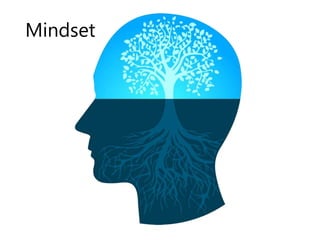
Mindset
Your brain is like a parachute,
it must be fully open
to work effectively.
–Maya Angelou
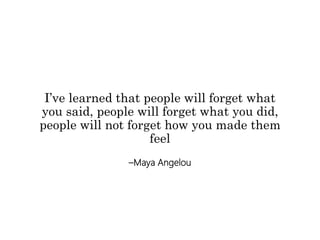
I’ve learned that people will forget what
you said, people will forget what you did,
people will not forget how you made them
feel
@Design4AHS
www.d4ahs.com
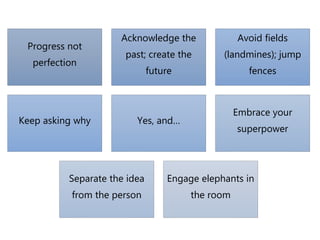
Progress not
perfection
Acknowledge the
past; create the
future
Avoid fields
(landmines); jump
fences
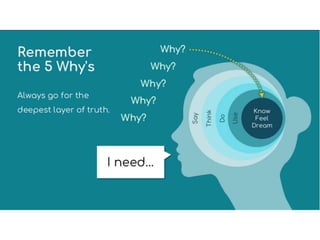
Keep asking why Yes, and…
Embrace your
superpower
Separate the idea
from the person
Engage elephants in
the room
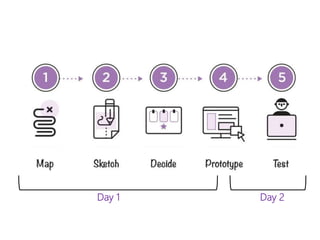
Day 1 Day 2
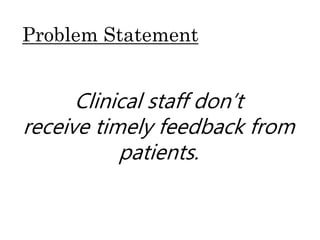
Problem Statement
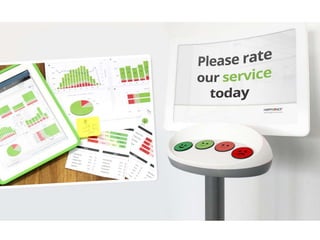
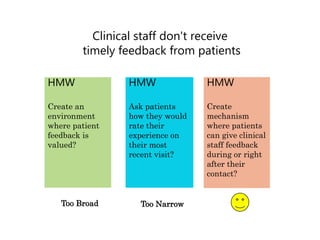
Clinical staff don’t
receive timely feedback from
patients.
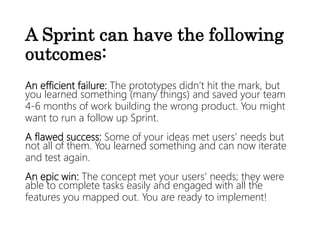
A Sprint can have the following
outcomes:
An efficient failure: The prototypes didn’t hit the mark, but
you learned something (many things) and saved your team
4-6 months of work building the wrong product. You might
want to run a follow up Sprint.
A flawed success: Some of your ideas met users’ needs but
not all of them. You learned something and can now iterate
and test again.
An epic win: The concept met your users’ needs; they were
able to complete tasks easily and engaged with all the
features you mapped out. You are ready to implement!
When do you use a sprint?
•High Stakes
•Not enough time
•Just plain stuck
Plan
1. Sprint - worthy
2. Right people, place & time
Questions
• What is missing?
• What worries you?
• What sounds promising?
Exercise: Who has a problem that
might be sprint-able?
FAMILY FEUD FAMILY FEUD FAMILY FEUD FAMILY FEUD FAMILY FEU
FAMILY FEUD FAMILY FEUD FAMILY FEUD FAMILY FEUD FAMILY FE
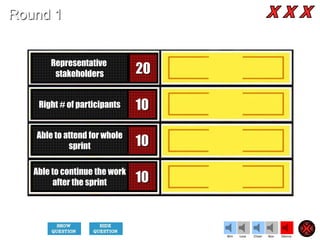
20
10
10
10
Representative
stakeholders
Right # of participants
Able to attend for whole
sprint
Able to continue the work
after the sprint
Cheer SilenceLoseWin Boo
Round 1
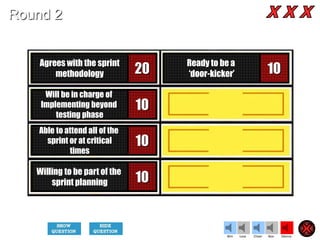
20
10
10
10
10
Agrees with the sprint
methodology
Will be in charge of
Implementing beyond
testing phase
Able to attend all of the
sprint or at critical
times
Willing to be part of the
sprint planning
Ready to be a
‘door-kicker’
Cheer SilenceLoseWin Boo
Round 2
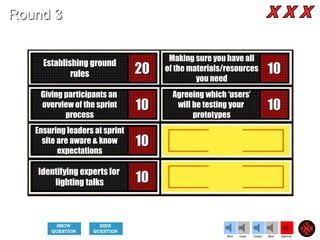
20
10
10
10
10
10
Establishing ground
rules
Giving participants an
overview of the sprint
process
Ensuring leaders at sprint
site are aware & know
expectations
Identifying experts for
lighting talks
Making sure you have all
of the materials/resources
you need
Agreeing which ‘users’
will be testing your
prototypes
Cheer SilenceLoseWin Boo
Round 3
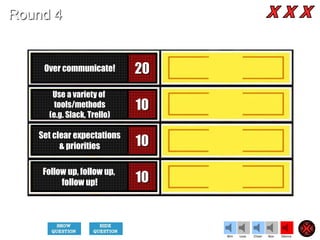
20
10
10
10
Over communicate!
Use a variety of
tools/methods
(e.g. Slack, Trello)
Set clear expectations
& priorities
Follow up, follow up,
follow up!
Cheer SilenceLoseWin Boo
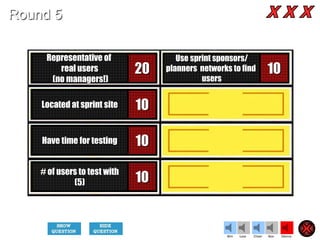
Round 4
20
10
10
10
10
Representative of
real users
(no managers!)
Located at sprint site
Have time for testing
# of users to test with
(5)
Use sprint sponsors/
planners networks to find
users
Cheer SilenceLoseWin Boo
Round 5
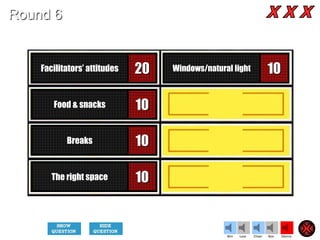
20
10
10
10
10Facilitators’ attitudes
Food & snacks
Breaks
The right space
Windows/natural light
Cheer SilenceLoseWin Boo
Round 6
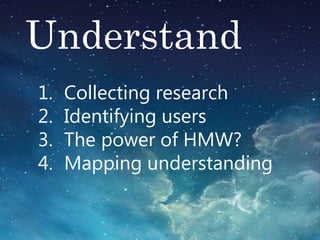
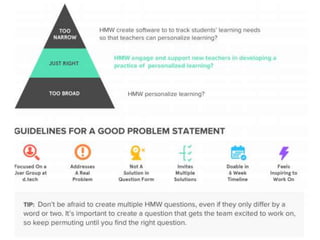
Understand
1. Collecting research
2. Identifying users
3. The power of HMW?
4. Mapping understanding
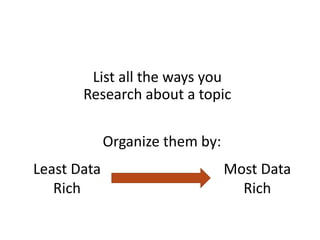
List all the ways you
Research about a topic
Most Data
Rich
Least Data
Rich
Organize them by:
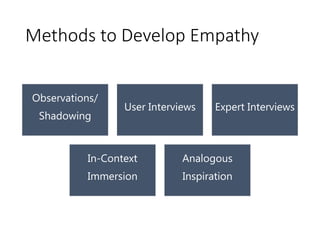
Methods to Develop Empathy
Observations/
Shadowing
User Interviews Expert Interviews
In-Context
Immersion
Analogous
Inspiration
Immersion
HMW
Create an
environment
where patient
feedback is
valued?
HMW
Ask patients
how they would
rate their
experience on
their most
recent visit?
HMW
Create
mechanism
where patients
can give clinical
staff feedback
during or right
after their
contact?
Too Broad Too Narrow
Clinical staff don't receive
timely feedback from patients
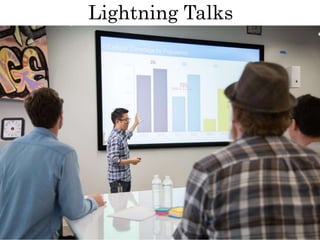
Lightning Talks
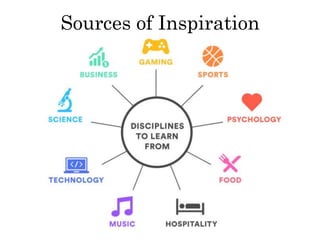
Sources of Inspiration
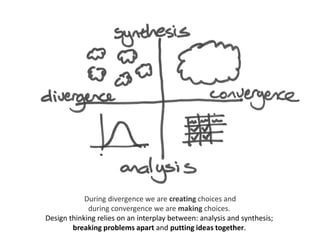
During divergence we are creating choices and
during convergence we are making choices.
Design thinking relies on an interplay between: analysis and synthesis;
breaking problems apart and putting ideas together.
What questions do we need
to answer through this SPRINT?
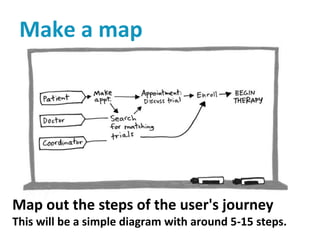
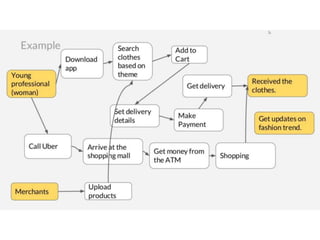
Make a map
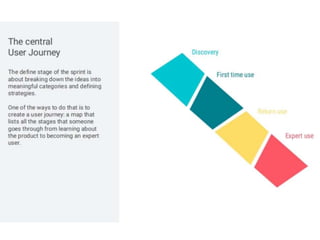
Map out the steps of the user's journey
This will be a simple diagram with around 5-15 steps.
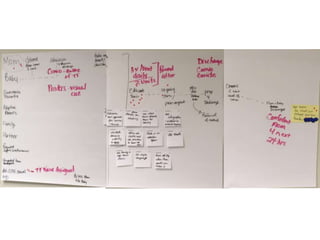
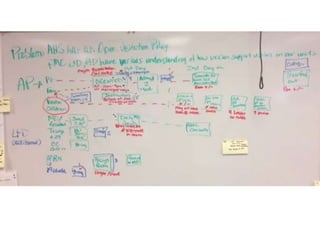
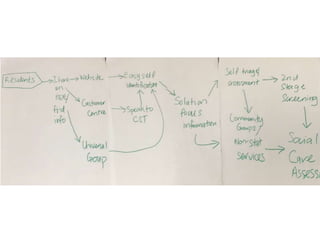
EXAMPLE MAPS
Let’s Try It…
Diverge
The creative magic of constraints
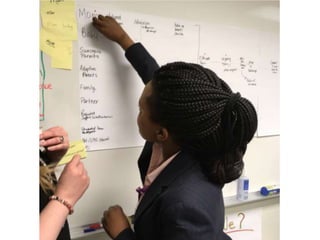
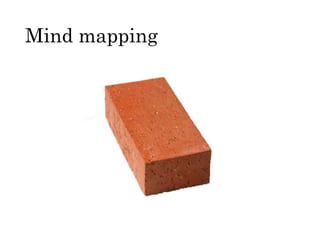
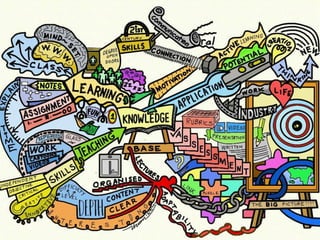
Mind mapping
Decide
1. Solution sketches
2. Sprint questions
3. Voting to decide
“a testable idea is better
than a good idea”.
Michael Schrage of MIT
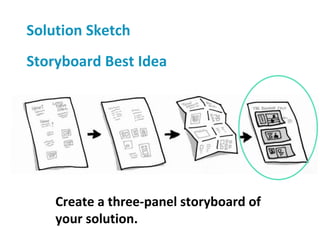
Solution Sketch
Storyboard Best Idea
Create a three-panel storyboard of
your solution.
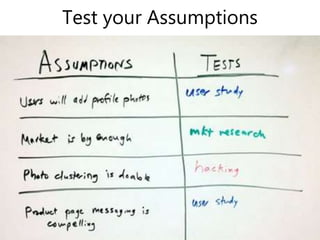
Test your Assumptions
Prototype
1. Storyboarding
2. Prototyping
3. Interview questions
• Should stem from your sprint questions & assumptions
• Let participants figure it out on their own. Don’t pitch or
explain the product. Answer questions with questions.
• Ask who, what, where, when, why, and how questions.
• Ask follow-up questions. Silence and pregnant pauses are
also effective ways to draw people out.
• Avoid leading questions.
Interview Questions - Testing
Test
1. Setting up users
2. Capturing feedback
Why User Testing?
Focus on solving problems that have a direct impact
on your users and impact
User Testing immediately shows you REAL
PROBLEMS with your Prototype….Not problems you
think you have.
Cheap, Simple and EXTREMELY Effective
What are ways
you can test your
Patient Feedback Prototype?
How many users should you
test on?
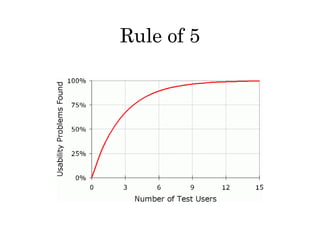
Rule of 5
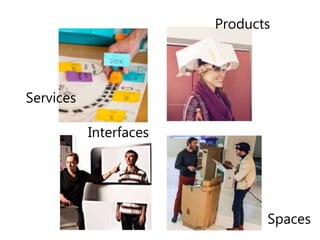
Products
Interfaces
Spaces
Services
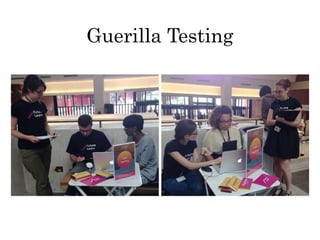
Guerilla Testing
Follow-up
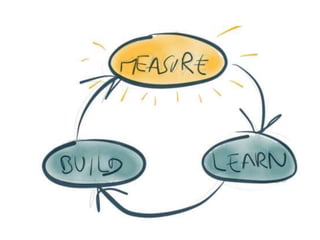
1. Iterating
2. Avoiding traps
3. Sharing value
Traps
• Richard
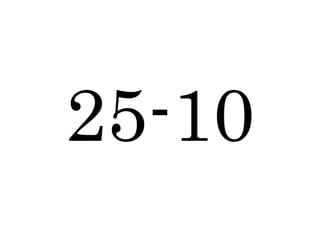
25-10
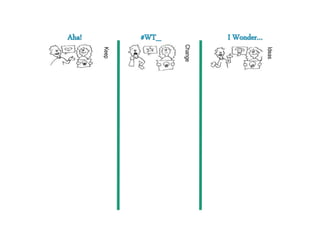
Keep
Ideas
Change
Aha! #WT_ I Wonder…
Closing

Sprint school slidepack final

Editor's Notes

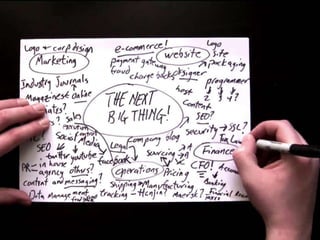
  • #4 A methodology for creative problem solving Starts with a problem It’s about creating ideas, lots of them It’s not about consensus
  • #5 Bring an open mind Be curious and challenge the status quo It’s safe to be uncomfortable Challenge your own biases
  • #7 To help solve complex problems It combines business strategy, science, behavioral observations and visual arts Done with passion and desire it works Unintended ideas are often solutions
  • #11 Sprintitis has taken over AHS! People are motivated to improve our health system! We have exceptional talent in our organization People are now ready for action and no more talk Designing with and for our patients, clients and residents is becoming paramount We have seen the down side of steering committees and working groups to produce results Design Sprint School OBJECTIVES Describe a sprint Understand what kind of problems can be addressed in a sprint Know the 5 phases of a design sprint Be familiar with some of the methods/tools used in each phase Know how to prepare for a sprint Be able to run a sprint or co-facilitate one with a more experienced sprint master
  • #14 You mention this the minute someone gets a whiff of trying to do a sprint You can not run a sprint without building prototypes and testing. That is what distinguishes it from other type of days that use design thinking.
  • #17 We have an opportunity to shift how our organization works This is a huge thing So we thought it was worthy – of making sure that SPRINTS get a good reputation! Often asking – do you want action – do you want to test something will weed out the people who are still in the talking phase The prototype building and testing is a defining element of a sprint
  • #19 Family Feud Template Introduction Slide – The Countdown!
  • #20 Family Feud Template Introduction Slide – Family Feud!
  • #21 Family Feud Template 4 Panel Slide
  • #22 Family Feud Template 5 Panel Slide
  • #23 Family Feud Template 6 Panel Slide
  • #24 Family Feud Template 4 Panel Slide
  • #25 Family Feud Template 5 Panel Slide
  • #26 Family Feud Template 5 Panel Slide
  • #34 Power of Observation FIND OUT SOMETHING UNEXPECTED Create 3 columns, WHAT ( what is the person doing in the photo? , HOW are they doing it, WHY ( Why are they doing it this way?)
  • #40 Ask the experts
  • #42 Analogous Reasoning/inspiration Source: https://static1.squarespace.com/static/57c6b79629687fde090a0fdd/t/58d3fa1e20099e1b0371a403/1490287182304/DESIGN+THINKING+PLAYBOOK.pdf
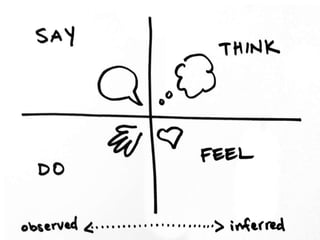
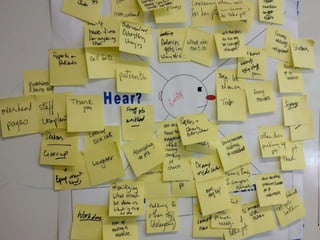
  • #48 Good design is grounded in a deep understanding of the person for whom you are designing.. An Empathy Map is one tool to help you synthesize your observations and draw out unexpected insights.
  • #49 Empathy maps start out clean but can quickly get crazy busy
  • #50 https://designthinking.ideo.com/?tag=synthesis
  • #51 https://www.slideshare.net/br2msi/google-design-sprint?qid=d0251b07-e7fb-4eb8-8b38-76e5d595db51&v=&b=&from_search=1
  • #52 https://www.slideshare.net/FrdricZugaj/design-sprintmethods
  • #53 https://www.slideshare.net/FrdricZugaj/design-sprintmethods
  • #54 https://www.slideshare.net/FrdricZugaj/design-sprintmethods
  • #56 What problem do our patients and families say needs improvement? What is the motivation behind what the user wants? Is this a root cause? starts with exploration & research. First we ask, "What are we trying to solve?", "Is this the best method to solve this problem?", & "Are we sure this is the users' problem?." The more you research your users to better understand a day in their shoes, the more empathetic you'll be to fully understand a day in their life & their needs. The problem the client or user thinks they have isn't always the actual issue so we constantly ask 'Why?' to drill deeper. What are all the jobs-to-be-done? What is the problem that this product is going to solve? What is the motivation behind what the user wants? https://github.com/thoughtbot/design-sprint/blob/master/Exercises/problem-statement.md __________________________ Needs a way to ________ (write down their need) Surprisingly / because / but (circle one) ________(insight)
  • #57 What questions do we need answered through this SPRINT? Get pessimistic. Ask: How could we fail? Turn these fears into questions you could answer this week. List them on a whiteboard. (SPRINT book p. 57)
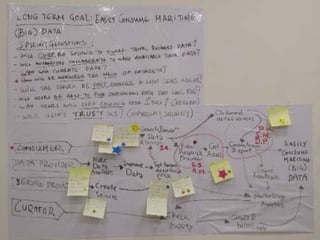
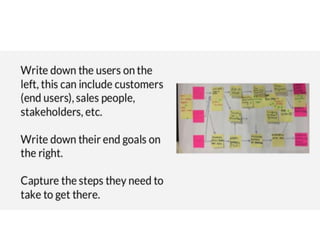
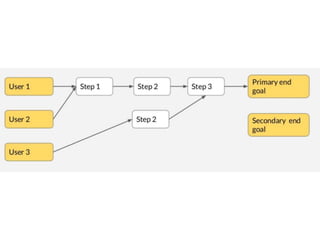
  • #58 List customers and key players on the left. Draw the ending, with your completed goal, on the right. Finally, make a flowchart in between showing how customers interact with your product. Keep it simple: five to fifteen steps. (p. 65) Starting with the Problem Statement as the first step, as a group, use your understanding of the Problem Statement to map out the steps of the user's journey through solving that problem The Facilitator should stand at the whiteboard and draw the flow. Keep adding steps until you've reached a solution.
  • #59 https://www.slideshare.net/borryshasian/solving-design-and-business-problems-in-3-days-with-design-sprint-by-borrys-hasian-from-circle-ux?qid=e519598a-b2a6-454a-aa38-9e68a9ba9f80&v=&b=&from_search=12
  • #60 https://www.slideshare.net/FrdricZugaj/design-sprintmethods
  • #66 Decide on top customer and key step in process to focus ideation on for the remainder of the sprint; or a few areas of the map and assign people to sections for ideation
  • #68 List customers and key players on the left. Draw the ending, with your completed goal, on the right. Finally, make a flowchart in between showing how customers interact with your product. Keep it simple: five to fifteen steps. Starting with the Problem Statement as the first step, as a group, use your understanding of the Problem Statement to map out the steps of the user's journey through solving that problem The Facilitator should stand at the whiteboard and draw the flow. Keep adding steps until you've reached a goal.
  • #69 https://www.slideshare.net/borryshasian/solving-design-and-business-problems-in-3-days-with-design-sprint-by-borrys-hasian-from-circle-ux?qid=e519598a-b2a6-454a-aa38-9e68a9ba9f80&v=&b=&from_search=12
  • #70 https://www.slideshare.net/borryshasian/solving-design-and-business-problems-in-3-days-with-design-sprint-by-borrys-hasian-from-circle-ux?qid=e519598a-b2a6-454a-aa38-9e68a9ba9f80&v=&b=&from_search=12
  • #72 Illuminating all the possible paths - Include pre-conceived ideas -all solutions on a level playing field. - See where that path takes you If you don’t bring out your pre-existing ideas, you do yourself a disservice.
  • #74 Use basic shapes to doodle
  • #78 Think of it this way. Imagine you were asked to write down as many uses for a brick as possible. Many people would just start listing all their ideas (building a wall, building a walkway, etc.). But what if you started from a broader perspective, such as thinking about the properties of a brick. - It's heavy, so you could use it: as a paperweight, to hold down a garbage bag while raking, as an exercise weight, to grill juicer chicken, etc. It's also thick, so you could use it to prop up a planter or as a doorstop. It's red, it's hard, it's rectangular, etc. That's the magic of mind mapping: Once you start, the possibilities seem almost endless.
  • #81 Crazy 8s 2 different ways to do it: refine the same idea with different versions, or get more ideas out on the table with 8 different ideas If you get stuck, use same idea with slight variation: keeps you moving Do two rounds to get best results
  • #82 Reflect: what makes divergence uncomfortable, and how can we mitigate that discomfort?
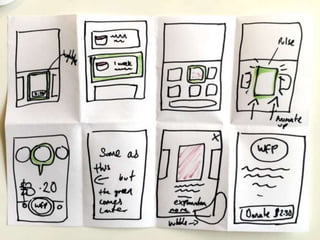
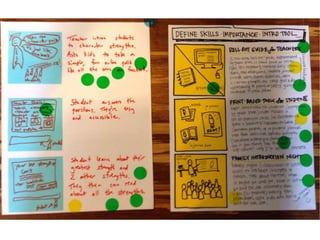
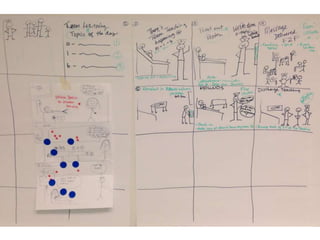
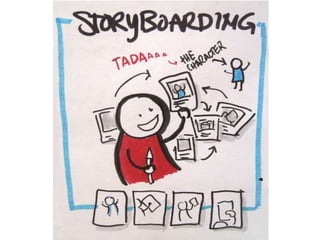
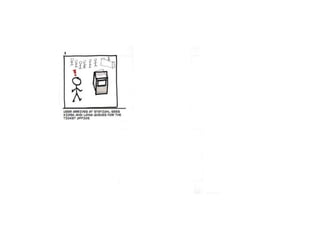
  • #85 Solution sketch. Create a three-panel storyboard by sketching in three sticky notes on a sheet of paper. Make it self-explanatory. Keep it anonymous. Ugly is okay. Words matter. Give it a catchy title. Storyboards are great to use when the group has had some time to think individually about the problem and many possible solutions to it. Storyboards allow people to develop those early ideas further by giving them more time to dive into details of the interaction. https://github.com/thoughtbot/design-sprint/blob/master/Exercises/storyboards.md
  • #86 Before solution sketching, remind group of what they are designing for – the sprint questions and the map. The magic of user centered design and prototyping
  • #87 Best to use when Storyboards are great to use when the group has had some time to think individually about the problem and many possible solutions to it. Storyboards allow people to develop those early ideas further by giving them more time to dive into details of the interaction. They are part of the Google Ventures Diverge day cycle along with Mind Mapping, Crazy Eights, Silent Critique. Instructions: The goal is to take the ideas we’ve generated so far and sketch an actual UI showing how a user would move through this part of the story — where they click, what info they enter, what they think, etc. From The product design sprint: diverge (day 2) Start with a blank sheet of paper and put 3 sticky notes going down the side of the page. Choose an idea that you had previously from another exercise like Mind Mapping or Crazy Eights to put more thought and detail into. Each sticky note is one frame in the storyboard. The sticky note should be used to draw the action that is happening. Use the room on the paper to the side of the Post-it to give a brief explanation. Make sure that each frame is understandable without further verbal explanation. Fill in each frame in the storyboard. Give the storyboard a title that encapsulates what is happening. Hang each story board on the wall with tape or a pin. Have either a Silent Critique, a Group Critique or both. https://github.com/thoughtbot/design-sprint/blob/master/Exercises/storyboards.md
  • #90 Art Gallery Review and Voting
  • #93 What else should you test in your user study? Listing out your underlying assumptions is a good way to revisit the big picture, especially when you’ve been heads down in a sprint for a few days.
  • #114 Simulation Role Playing
  • #117 Simulation Role Playing
  • #119 Talk less, you facilitate, don’t prime their response. Don’t put words in their mouth. 1 person only.
  • #122 Discussion – how to avoid going back to committee land
  • #123 People feed off the sprint master – energy pushing envelope – kind and pushing Different between a great sprint and a medium sprint Reassure people that is OK At the end of day one – people are uncertain Going through the adversity – to get to something magnificent (end of day 1) Environment and food you are feeding them Walking the walk – I am a participant No observers Make have all the critical roles filled – magic of the sprint might not happen
  • #124 Things that need sprinting at AHS
  • #125 Throughout the SPRINT capture what you like, what you wish could happen or be different, and what you’d want to try next time.