Downloaded 205 times
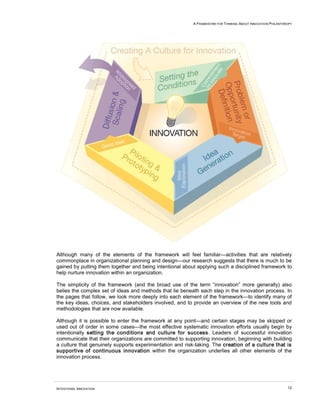
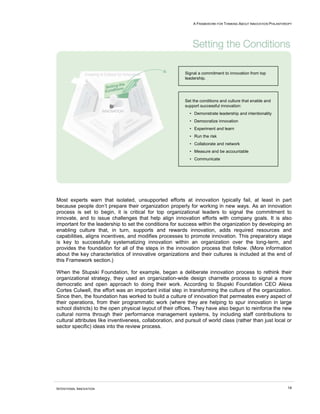
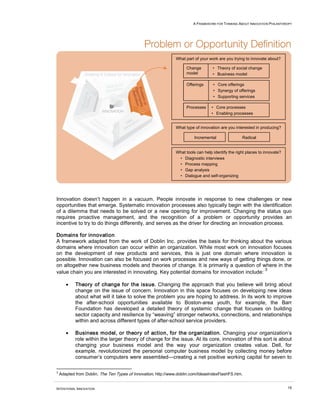

![OPPORTUNITIES FOR INNOVATION IN PHILANTHROPY
Opening up strategy development
David and Lucile Packard Foundation and the Stupski Foundation
A growing trend in philanthropy is the practice of opening up strategy development to input
from a wider community. According to Walt Reid, Director of the Packard Foundation’s
Conservation and Science Program, “[Philanthropic] strategies are typically developed by
foundation staff, by philanthropic intermediaries, or by consulting firms…. [But there is a
concern] that existing models for strategy development cast far too narrow a net in their
search for creative solutions. They are unable to benefit from the wisdom, experience, and
expertise present within civil society, private sector, and acidic institutions. So the Packard
Foundation created a wiki to bring the “wisdom of crowds” to bear on its new strategy for
addressing nitrogen pollution. The goal was to experiment with an alternative model for
strategy development that would improve the goals and elements of the strategy while also
helping the foundation to identify individuals, institutions, and projects that could play a role in
carrying the strategy out.
At the level of strategy for a whole foundation, the Stupski Foundation used collaborative
tools like design charettes and gallery walks to develop and share big ideas and emerging
strategies for its work to improve large public school systems. This began with staff and an
initial group of external stakeholders, including key program staff and leaders from other
foundations with similar goals. The foundation then created an online tool to solicit feedback
from 100 external experts, both inside and outside of the education field (to get a cross-
sectoral perspective). Based on this feedback, the foundation drafted a strategy that it ran
through more rigorous peer review sessions. And it brought together individuals from
education and other sectors in various configurations or “advisory groups” to provide
feedback on iterations of the approach, to co-create program implementation plans, and to
begin outlining prospective partnerships.
Grantmaking Processes
The grantmaking function—the process of delivering social impact by selecting and supporting
recipients of grants, who in turn manage programs that create social impact within a given sector or
issue area—is seen by most observers as the core function by which a philanthropist drives change
in the world. But in virtually all aspects of the grantmaking process, funders are experimenting with
new ways to streamline and improve the way grants are made. The new innovations run the spectrum
from small improvements in traditional applications processes to fundamental shifts in a foundation’s
grantmaking strategy. And they go beyond how a funder selects successful programs to fund—
“picking winners”—into the way grant ideas are developed and solicited, the mechanics of the
application process, the strategy for reviewing potential grantees (due diligence), the way grants are
handled and processed, and the approach taken to making grant decisions. A few examples of some
of the innovations occurring in the grantmaking process include:
Open sourcing the applications process
Ashoka Changemakers and the Case Foundation
Some funders are trying out new online platforms to test “open source” models for soliciting
new ideas and grantees. Ashoka’s Changemakers initiative, for example, uses online
competitions to engage a broader set of stakeholders and promote innovation around
problems stuck in conventional approaches. Often developed in partnership with other
funders, Changemakers competitions create an online community of peers, experts,
investors, and interested members of the public that competes to surface the best social
solutions, and then collaborates to refine, enrich, and implement those solutions.
Changemakers begins by providing an overarching intellectual framework for thinking about a
particular social issue. It then manages an open application process, where entries are
posted transparently online and available for anyone to view and collaborate with by
providing new ideas, asking questions, and providing connections to new resources. At the
end of the applications period, a set of expert judges selects finalists, and a winner is chosen
INTENTIONAL INNOVATION 40](https://image.slidesharecdn.com/intentionalinnovation-110120111411-phpapp02/85/Intentional-Innovation-40-320.jpg)

This document discusses three examples of systematic innovation: 1) The Medici family in 15th century Florence systematically supported innovators from different fields and places, fostering unprecedented collaboration and cross-pollination of ideas that sparked the European Renaissance. 2) Modern companies like Google systematically apply principles like collaboration across disciplines, creating support systems for innovation, and embracing new technologies to consistently generate innovations. 3) Open-source software projects demonstrate how systematically involving large networks of people in problem-solving through new Internet technologies can lead to transformative innovations.


![Eban impactinvesting final200711_light[1]](https://cdn.slidesharecdn.com/ss_thumbnails/ebanimpactinvestingfinal200711light1-110727113800-phpapp01-thumbnail.jpg?width=640&height=640&fit=bounds)


