Market-oriented livestock production and sustainable
    watershed management in Astbi and Mieso districts,
                 Ethiopia: IPMS experience

     Azage Tegegne, Berhanu Gebremedhin, Dirk Hoekstra, Gebremedhin
                   W/wahid, Zewdu Ayele, Kahsay Berhe


   “Training on Participatory Integrated Watershed Management Planning and
               Implementation”, Bahir Dar, 22-27 November 2012

Improving Productivity and Market Success (IPMS) Project, International Livestock
         Research Institute (ILRI), P.O. Box 5689, Addis Ababa, Ethiopia
                  Corresponding Author: a.tegegne@cgiar.org
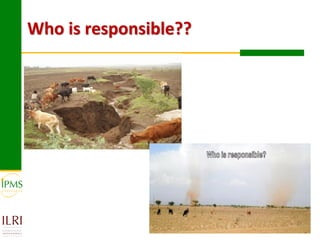
Who is responsible??
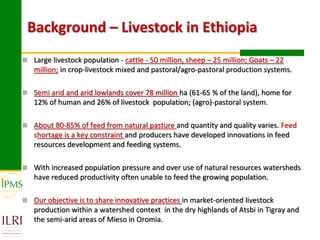
Background – Livestock in Ethiopia
 Large livestock population - cattle - 50 million, sheep – 25 million; Goats – 22
   million; in crop-livestock mixed and pastoral/agro-pastoral production systems.

 Semi arid and arid lowlands cover 78 million ha (61-65 % of the land), home for
   12% of human and 26% of livestock population; (agro)-pastoral system.

 About 80-85% of feed from natural pasture and quantity and quality varies. Feed
   shortage is a key constraint and producers have developed innovations in feed
   resources development and feeding systems.
 With increased population pressure and over use of natural resources watersheds
   have reduced productivity often unable to feed the growing population.

 Our objective is to share innovative practices in market-oriented livestock
   production within a watershed context in the dry highlands of Atsbi in Tigray and
   the semi-arid areas of Mieso in Oromia.
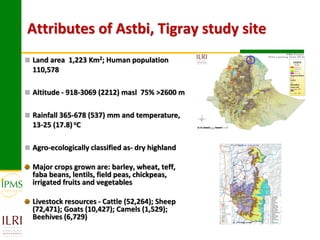
Attributes of Astbi, Tigray study site
 Land area 1,223 Km2; Human population
  110,578

 Altitude - 918-3069 (2212) masl 75% >2600 m


 Rainfall 365-678 (537) mm and temperature,
  13-25 (17.8) oC

 Agro-ecologically classified as- dry highland

  Major crops grown are: barley, wheat, teff,
  faba beans, lentils, field peas, chickpeas,
  irrigated fruits and vegetables

  Livestock resources - Cattle (52,264); Sheep
  (72,471); Goats (10,427); Camels (1,529);
  Beehives (6,729)
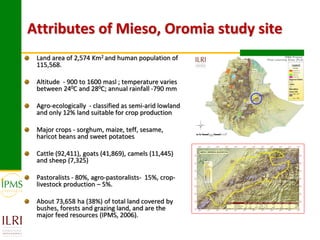
Attributes of Mieso, Oromia study site
 Land area of 2,574 Km2 and human population of
 115,568.

 Altitude - 900 to 1600 masl ; temperature varies
 between 240C and 280C; annual rainfall -790 mm

 Agro-ecologically - classified as semi-arid lowland
 and only 12% land suitable for crop production

 Major crops - sorghum, maize, teff, sesame,
 haricot beans and sweet potatoes

 Cattle (92,411), goats (41,869), camels (11,445)
 and sheep (7,325)

 Pastoralists - 80%, agro-pastoralists- 15%, crop-
 livestock production – 5%.

 About 73,658 ha (38%) of total land covered by
 bushes, forests and grazing land, and are the
 major feed resources (IPMS, 2006).
Watershed
 A watershed consists of a steep land as runoff generating
  and valley bottoms as run-on zones in a continuum fashion.

 With increased population pressure, over use of natural
  resources results in low watershed productivity often
  unable to feed the growing population.

 In this regard, IPMS has been working on watershed based
  market-oriented crop and livestock commodities
  development to improve productivity and income of
  smallholder farmers.
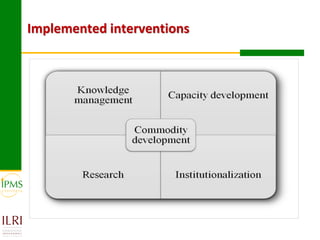
Implemented interventions
Intervention approaches
 Potentials, limitations and interventions (including GIS) of
  market oriented livestock commodities were identified
  along the value chain framework (VCF)

      Natural pasture improvement
      Crop residue improvement
      Introduction of improved forage species in conserved watersheds
      Introduction of cut and carry system of livestock feeding


 Interventions implemented along the commodity value
  chain – Beef and goats in Mieso and sheep and apiculture
  in Atsbi
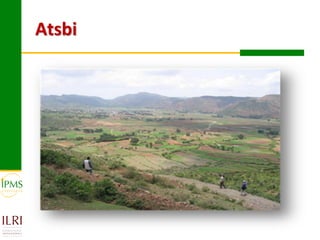
Atsbi
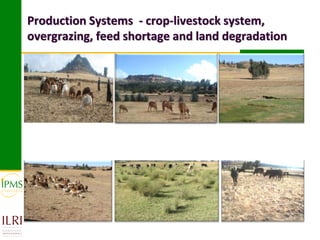
Production Systems - crop-livestock system,
overgrazing, feed shortage and land degradation
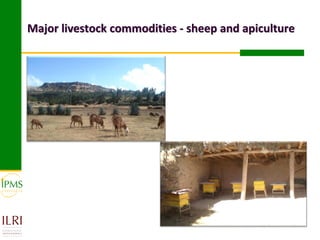
Major livestock commodities - sheep and apiculture
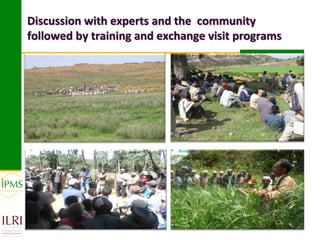
Discussion with experts and the community
followed by training and exchange visit programs
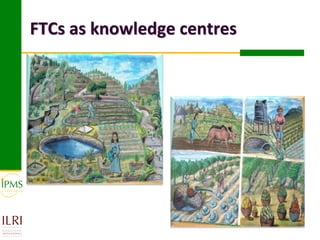
FTCs as knowledge centres
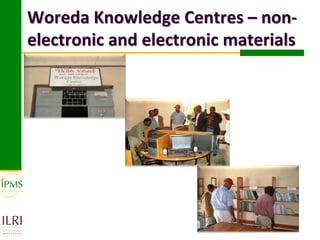
Woreda Knowledge Centres – non-
electronic and electronic materials
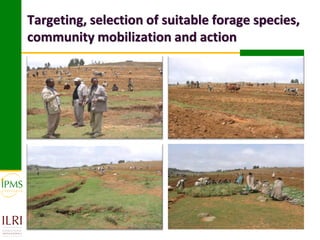
Targeting, selection of suitable forage species,
community mobilization and action
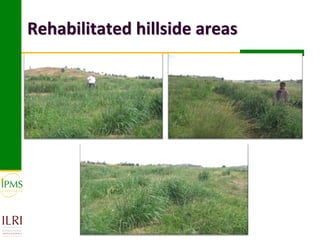
Rehabilitated hillside areas
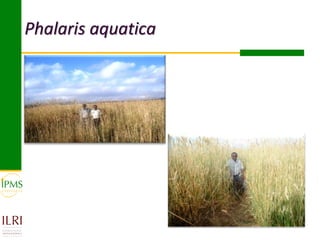
Phalaris aquatica
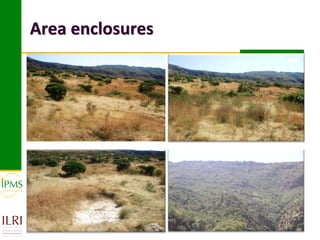
Area enclosures
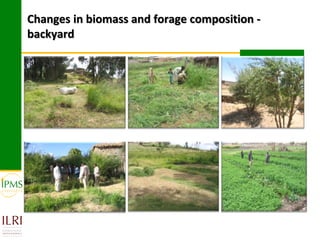
Changes in biomass and forage composition -
backyard
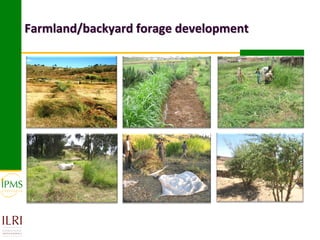
Farmland/backyard forage development
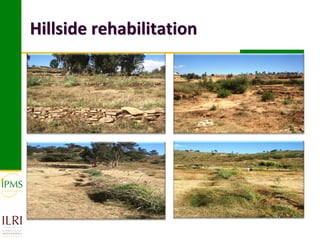
Hillside rehabilitation
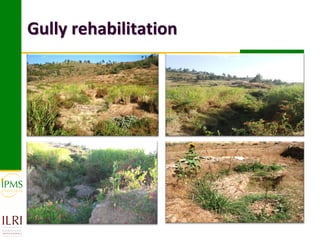
Gully rehabilitation
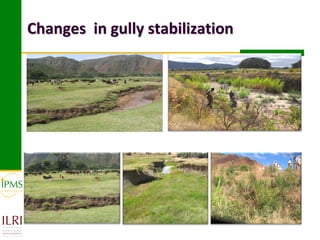
Changes in gully stabilization
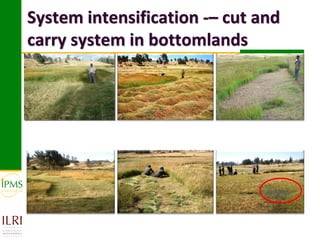
System intensification -– cut and
carry system in bottomlands
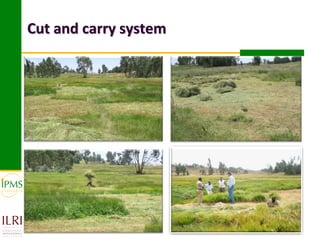
Cut and carry system
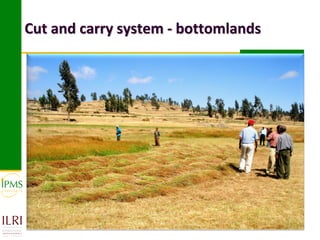
Cut and carry system - bottomlands
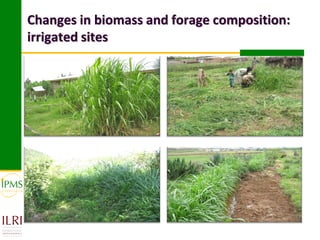
Changes in biomass and forage composition:
irrigated sites
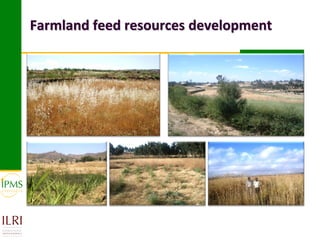
Farmland feed resources development
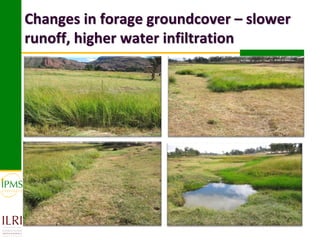
Changes in forage groundcover – slower
runoff, higher water infiltration
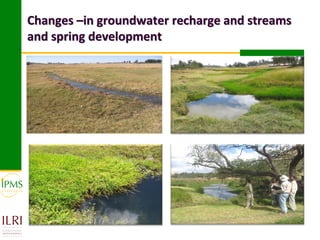
Changes –in groundwater recharge and streams
and spring development
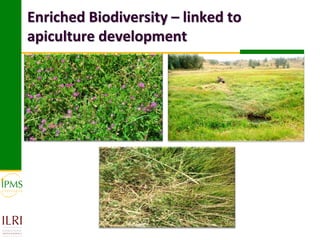
Enriched Biodiversity – linked to
apiculture development
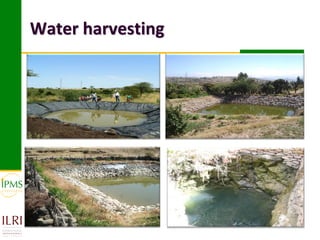
Water harvesting
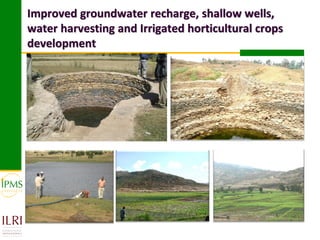
Improved groundwater recharge, shallow wells,
water harvesting and Irrigated horticultural crops
development
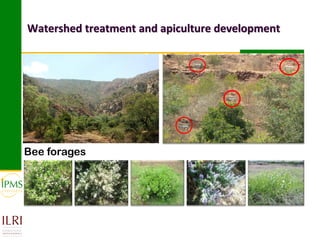
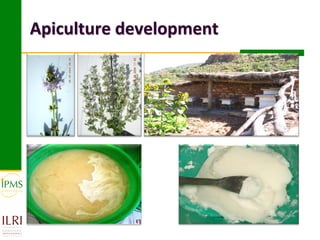
Watershed treatment and apiculture development


Bee forages
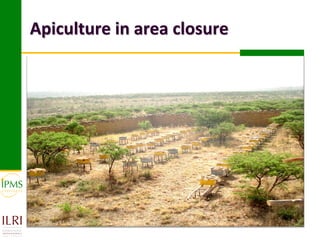
Apiculture in area closure
Apiculture development
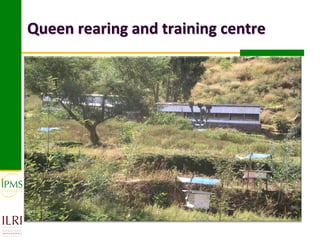
Queen rearing and training centre
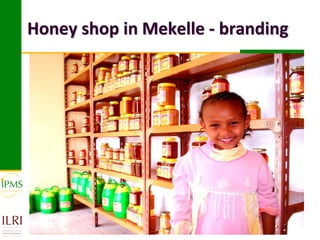
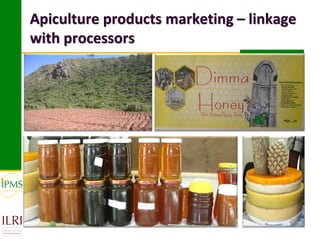
Apiculture products marketing – linkage
with processors
Honey shop in Mekelle - branding
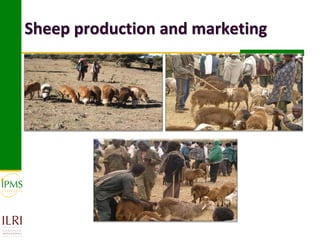
Sheep production and marketing
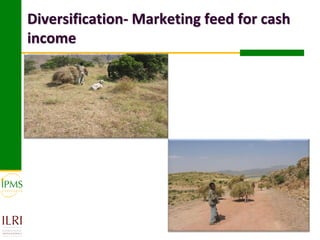
Diversification- Marketing feed for cash
income
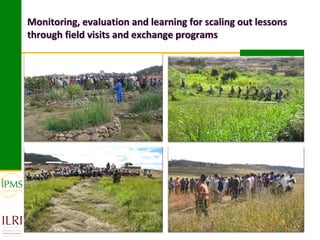
Monitoring, evaluation and learning for scaling out lessons
through field visits and exchange programs
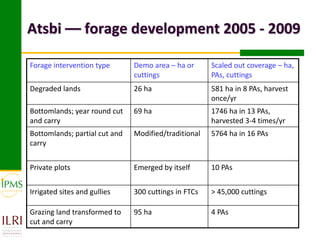
Atsbi –– forage development 2005 - 2009

Forage intervention type       Demo area – ha or      Scaled out coverage – ha,
                               cuttings               PAs, cuttings
Degraded lands                 26 ha                  581 ha in 8 PAs, harvest
                                                      once/yr
Bottomlands; year round cut    69 ha                  1746 ha in 13 PAs,
and carry                                             harvested 3-4 times/yr
Bottomlands; partial cut and   Modified/traditional   5764 ha in 16 PAs
carry


Private plots                  Emerged by itself      10 PAs


Irrigated sites and gullies    300 cuttings in FTCs   > 45,000 cuttings

Grazing land transformed to    95 ha                  4 PAs
cut and carry
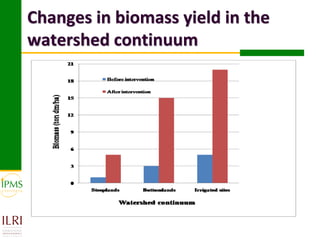
Changes in biomass yield in the
watershed continuum
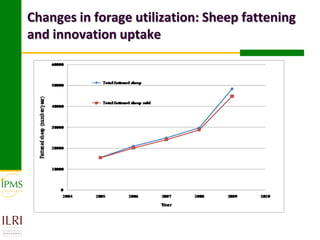
Changes in forage utilization: Sheep fattening
and innovation uptake
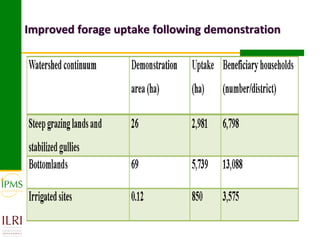
Improved forage uptake following demonstration
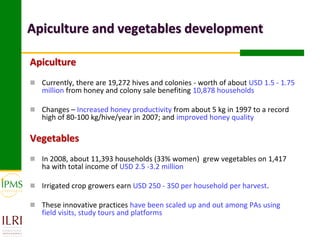
Apiculture and vegetables development

Apiculture
 Currently, there are 19,272 hives and colonies - worth of about USD 1.5 - 1.75
   million from honey and colony sale benefiting 10,878 households

 Changes – Increased honey productivity from about 5 kg in 1997 to a record
   high of 80-100 kg/hive/year in 2007; and improved honey quality

Vegetables
 In 2008, about 11,393 households (33% women) grew vegetables on 1,417
   ha with total income of USD 2.5 -3.2 million

 Irrigated crop growers earn USD 250 - 350 per household per harvest.

 These innovative practices have been scaled up and out among PAs using
   field visits, study tours and platforms
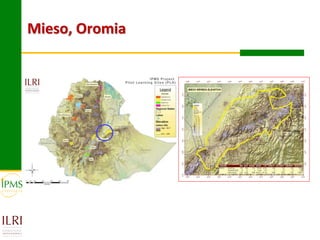
Mieso, Oromia
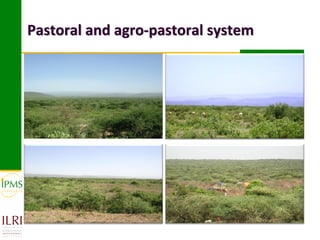
Pastoral and agro-pastoral system
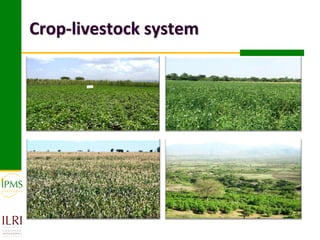
Crop-livestock system
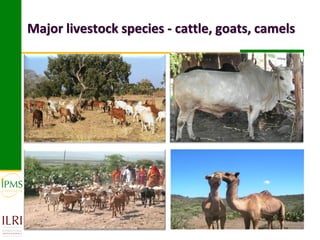
Major livestock species - cattle, goats, camels
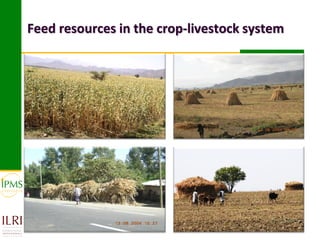
Feed resources in the crop-livestock system
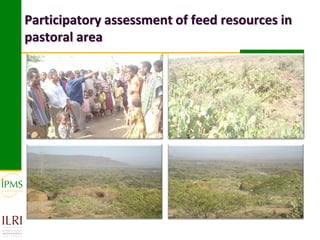
Participatory assessment of feed resources in
pastoral area
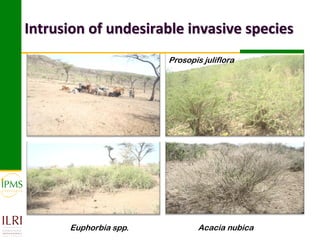
Intrusion of undesirable invasive species
                       Prosopis juliflora


      Euphorbia spp.           Acacia nubica
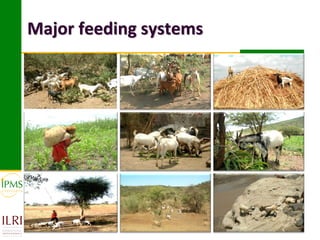
Major feeding systems
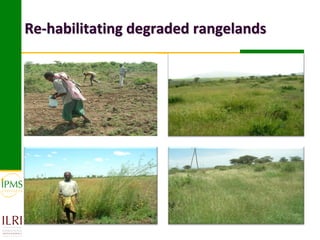
Re-habilitating degraded rangelands
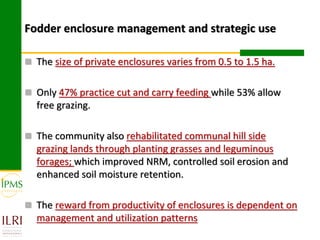
Fodder enclosure management and strategic use

 The size of private enclosures varies from 0.5 to 1.5 ha.


 Only 47% practice cut and carry feeding while 53% allow
  free grazing.

 The community also rehabilitated communal hill side
  grazing lands through planting grasses and leguminous
  forages; which improved NRM, controlled soil erosion and
  enhanced soil moisture retention.

 The reward from productivity of enclosures is dependent on
  management and utilization patterns
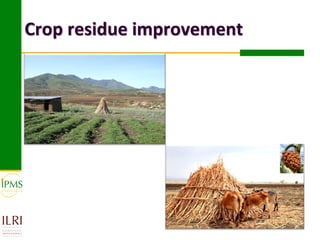
Crop residue improvement
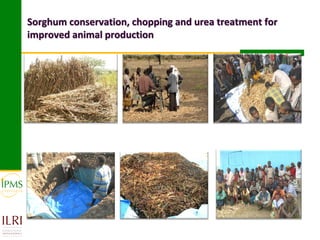
Sorghum conservation, chopping and urea treatment for
improved animal production
Production of food/feed crops

 Sorghum, maize, haricot bean and sweet potato
  production cover 73%, 22%, 3% and 1%, respectively
  of the arable land area.


 They are used as food/feed crops, for cash income,
  up keep of soil fertility and fulfilling social functions.
Sweet sorghum
 Cultivated in crop livestock and agro-pastoralist areas on 80%
  of the arable land (about 13,000 ha).

 Hardy and drought tolerant, survives 7 shocks per cropping
  season; stays on field for 7 months and produces tillers.

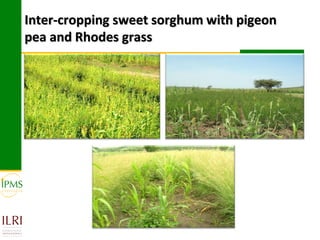
 Intercropped with cow pea, pigeon pea, sweet potatoes,
  haricot beans.

 Is palatable, has higher voluntary intake, fresh stalk is eaten
  by humans and stover is used for construction and firewood.
Inter-cropping sweet sorghum with pigeon
pea and Rhodes grass
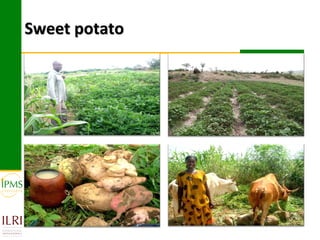
Sweet potato
 Is a food/feed crop often inter-cropped with cereals and is also
   used for income generation.

 Five types cultivated and criteria for selection are early maturity
   (>120 days), drought resistance, yield and market demand.

 Tubers for fattening; leaves and vines for milking animals
   (increases yield and shortens post-partum anoestrus period).

 According to farmers, cows become over fat and infertile when
   supplemented with tubers, and fattening cattle do not respond
   to supplementation with leaves and vines.
Sweet potato
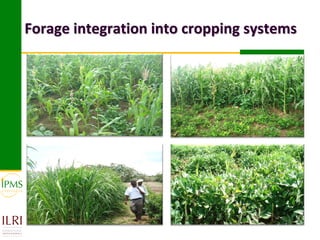
Forage integration into cropping systems
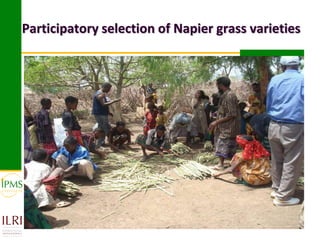
Participatory selection of Napier grass varieties
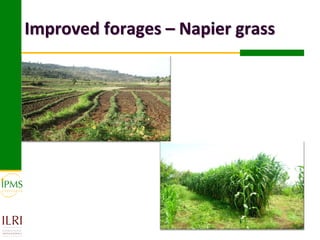
Improved forages – Napier grass
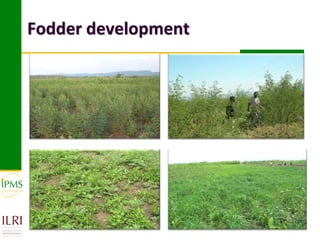
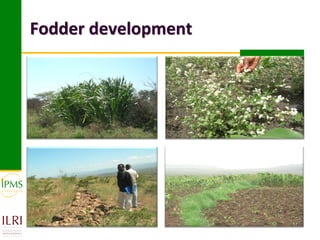
Fodder development
Fodder development
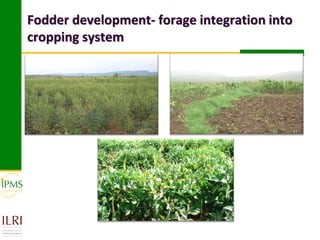
Fodder development- forage integration into
cropping system
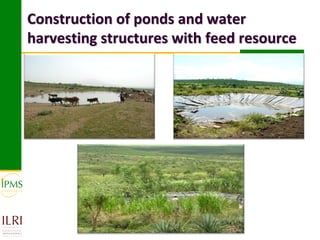
Construction of ponds and water
harvesting structures with feed resource
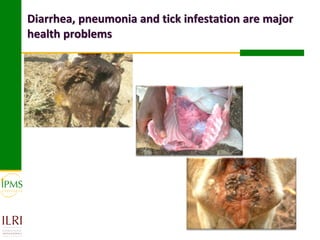
Diarrhea, pneumonia and tick infestation are major
health problems
Use of locally available concentrate feeds
and other farmer innovations
 Drenching fenugreek powder mixed with water to
  clean up the digestive system and internal
  parasites

 Feeding maize, haricot bean, sweet potato tubers,
  grain flours and dough stage maize

 Drenching sugar, use of salt, mineral soil and small
  quantities of di-ammonium phosphate (DAP) to
  supplement phosphorus
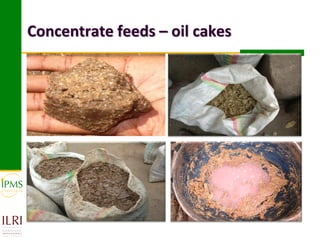
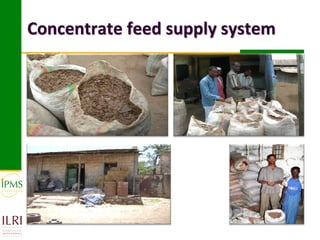
Concentrate feeds – oil cakes
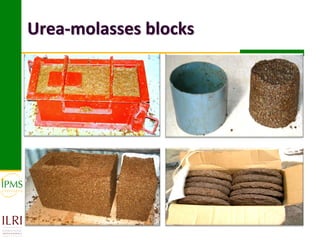
Urea-molasses blocks
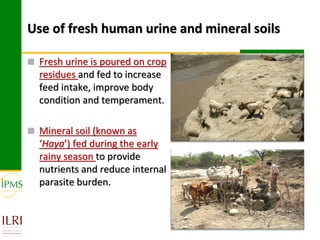
Use of fresh human urine and mineral soils

 Fresh urine is poured on crop
  residues and fed to increase
  feed intake, improve body
  condition and temperament.

 Mineral soil (known as
  ‘Haya’) fed during the early
  rainy season to provide
  nutrients and reduce internal
  parasite burden.
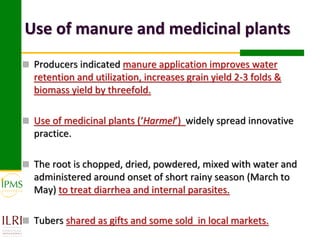
Use of manure and medicinal plants
 Producers indicated manure application improves water
  retention and utilization, increases grain yield 2-3 folds &
  biomass yield by threefold.

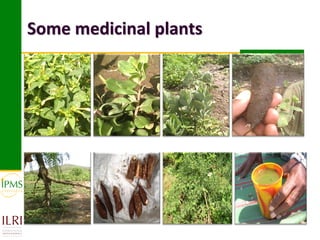
 Use of medicinal plants (‘Harmel’) widely spread innovative
  practice.

 The root is chopped, dried, powdered, mixed with water and
  administered around onset of short rainy season (March to
  May) to treat diarrhea and internal parasites.

 Tubers shared as gifts and some sold in local markets.
Some medicinal plants
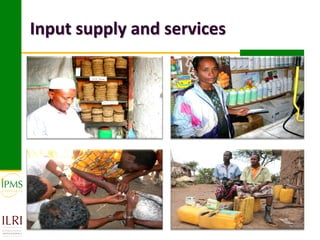
Input supply and services
Concentrate feed supply system
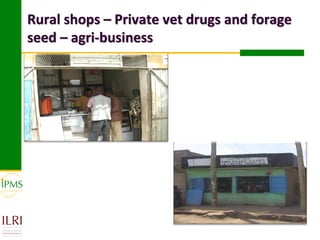
Rural shops – Private vet drugs and forage
seed – agri-business
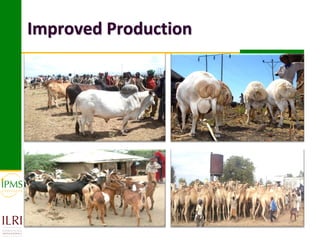
Improved Production
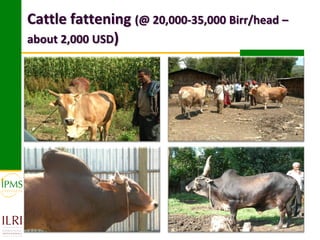
Cattle fattening (@ 20,000-35,000 Birr/head –
about 2,000 USD)
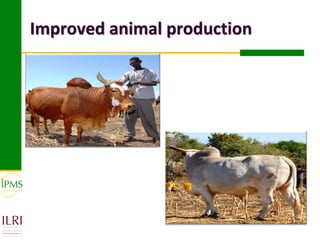
Improved animal production
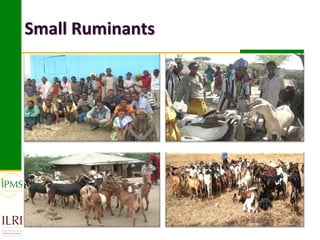
Small Ruminants
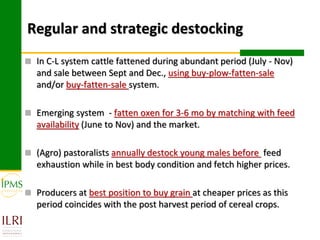
Regular and strategic destocking
 In C-L system cattle fattened during abundant period (July - Nov)
   and sale between Sept and Dec., using buy-plow-fatten-sale
   and/or buy-fatten-sale system.

 Emerging system - fatten oxen for 3-6 mo by matching with feed
   availability (June to Nov) and the market.

 (Agro) pastoralists annually destock young males before feed
   exhaustion while in best body condition and fetch higher prices.

 Producers at best position to buy grain at cheaper prices as this
   period coincides with the post harvest period of cereal crops.
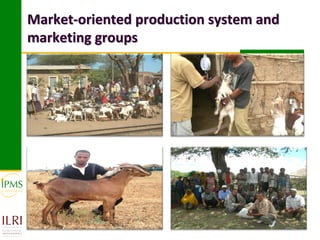
Market-oriented production system and
marketing groups
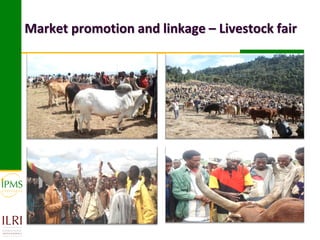
Market promotion and linkage – Livestock fair
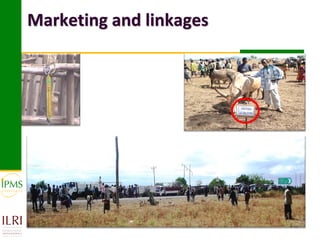
Marketing and linkages
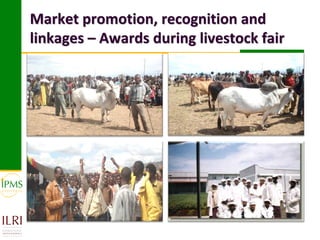
Market promotion, recognition and
linkages – Awards during livestock fair
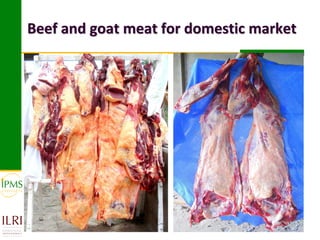
Beef and goat meat for domestic market
Farmer innovation in Mieso
   Fodder enclosure management and strategic use

   Regular and strategic destocking (matching livestock number with feed resources)

   Supplement locally available mineral soils

   Pouring urine/fresh urine from human/ on feeds to enhance intake

   Deliberate production of food/feed crops (sweet sorghum, maize, beans, sweet potato)

   Use of organic manure on crop fields

   Use of supplemental feeds like dough stage maize, sorghum and haricot bean and grains,
    sweet potato tubers, and various multipurpose leguminous plants

   Targeted feeding to specific group of animals like lactating cows, fattening animals

   Cut and carry feeding system with proper shade and feeding and watering troughs
Farmer innovation in Mieso
 Improving the quality of feed resources through boiling, roasting,
   soaking, and making flour from grains,

 Wilting feeds like sweet potato leaves and vines, various weeds and
   grasses

 Use of salt consistently

 Use of locally available medicinal plants as wormicidal and false neem
   tree seeds against mild level of bloat cases

 Improving presentation of crop residues like sorghum stover and maize
   stalk by chopping

 Massaging finished cattle at night
Key issues for integrated approach
to commodity development
 Knowledge Management
 Capacity Development
 Commodity NOT Technology Development
      Production Technologies
      Input supply system and service provision including
       innovative credit
      Marketing and linkages


 Lessons for scaling out and up
Conclusions and Outlook
 Key factors to stimulate local innovation - economic
  incentives, erratic rainfall and drought, food
  insecurity, strong social bond and agile community
  asset, etc.


 Determination of the community to learn to
  innovate and internalize innovativeness serve as a
  spring board in adapting, sustaining natural
  resources and transforming the livelihoods of the
  rural community.
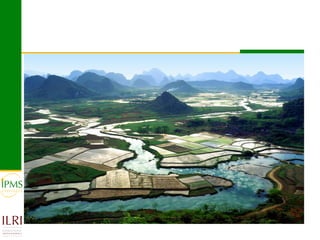
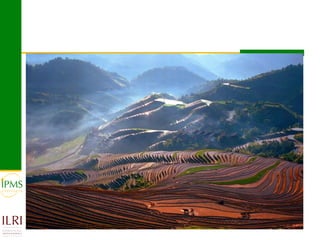
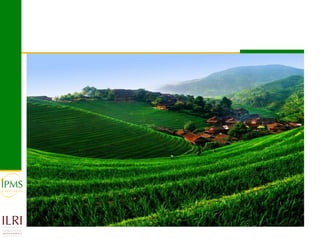
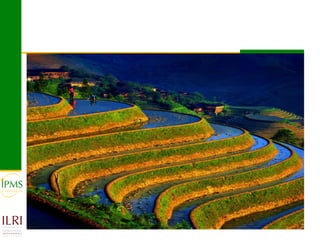
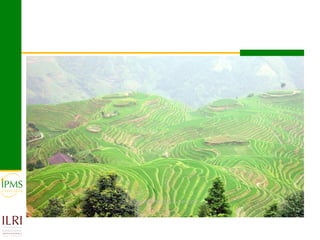
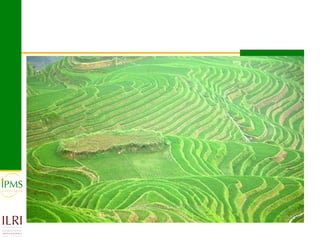
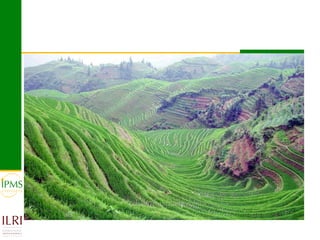
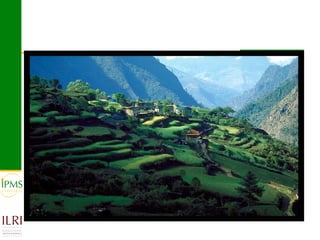
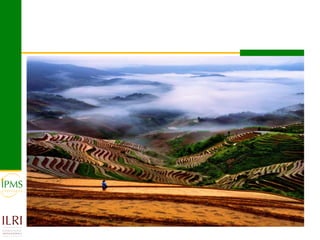
Some interesting landscapes
Thank You!!

www.ipms-ethiopia.org

Market-oriented livestock production and sustainable watershed management in Astbi and Mieso Districts, Ethiopia: IPMS experience

  • 1.
    Market-oriented livestock productionand sustainable watershed management in Astbi and Mieso districts, Ethiopia: IPMS experience Azage Tegegne, Berhanu Gebremedhin, Dirk Hoekstra, Gebremedhin W/wahid, Zewdu Ayele, Kahsay Berhe “Training on Participatory Integrated Watershed Management Planning and Implementation”, Bahir Dar, 22-27 November 2012 Improving Productivity and Market Success (IPMS) Project, International Livestock Research Institute (ILRI), P.O. Box 5689, Addis Ababa, Ethiopia Corresponding Author: a.tegegne@cgiar.org
  • 2.
  • 3.
    Background – Livestockin Ethiopia  Large livestock population - cattle - 50 million, sheep – 25 million; Goats – 22 million; in crop-livestock mixed and pastoral/agro-pastoral production systems.  Semi arid and arid lowlands cover 78 million ha (61-65 % of the land), home for 12% of human and 26% of livestock population; (agro)-pastoral system.  About 80-85% of feed from natural pasture and quantity and quality varies. Feed shortage is a key constraint and producers have developed innovations in feed resources development and feeding systems.  With increased population pressure and over use of natural resources watersheds have reduced productivity often unable to feed the growing population.  Our objective is to share innovative practices in market-oriented livestock production within a watershed context in the dry highlands of Atsbi in Tigray and the semi-arid areas of Mieso in Oromia.
  • 4.
    Attributes of Astbi,Tigray study site  Land area 1,223 Km2; Human population 110,578  Altitude - 918-3069 (2212) masl 75% >2600 m  Rainfall 365-678 (537) mm and temperature, 13-25 (17.8) oC  Agro-ecologically classified as- dry highland Major crops grown are: barley, wheat, teff, faba beans, lentils, field peas, chickpeas, irrigated fruits and vegetables Livestock resources - Cattle (52,264); Sheep (72,471); Goats (10,427); Camels (1,529); Beehives (6,729)
  • 5.
    Attributes of Mieso,Oromia study site Land area of 2,574 Km2 and human population of 115,568. Altitude - 900 to 1600 masl ; temperature varies between 240C and 280C; annual rainfall -790 mm Agro-ecologically - classified as semi-arid lowland and only 12% land suitable for crop production Major crops - sorghum, maize, teff, sesame, haricot beans and sweet potatoes Cattle (92,411), goats (41,869), camels (11,445) and sheep (7,325) Pastoralists - 80%, agro-pastoralists- 15%, crop- livestock production – 5%. About 73,658 ha (38%) of total land covered by bushes, forests and grazing land, and are the major feed resources (IPMS, 2006).
  • 6.
    Watershed  A watershedconsists of a steep land as runoff generating and valley bottoms as run-on zones in a continuum fashion.  With increased population pressure, over use of natural resources results in low watershed productivity often unable to feed the growing population.  In this regard, IPMS has been working on watershed based market-oriented crop and livestock commodities development to improve productivity and income of smallholder farmers.
  • 7.
  • 8.
    Intervention approaches  Potentials,limitations and interventions (including GIS) of market oriented livestock commodities were identified along the value chain framework (VCF)  Natural pasture improvement  Crop residue improvement  Introduction of improved forage species in conserved watersheds  Introduction of cut and carry system of livestock feeding  Interventions implemented along the commodity value chain – Beef and goats in Mieso and sheep and apiculture in Atsbi
  • 9.
  • 10.
    Production Systems -crop-livestock system, overgrazing, feed shortage and land degradation
  • 11.
    Major livestock commodities- sheep and apiculture
  • 12.
    Discussion with expertsand the community followed by training and exchange visit programs
  • 13.
  • 14.
    Woreda Knowledge Centres– non- electronic and electronic materials
  • 15.
    Targeting, selection ofsuitable forage species, community mobilization and action
  • 16.
  • 17.
  • 18.
  • 19.
    Changes in biomassand forage composition - backyard
  • 20.
  • 21.
  • 22.
  • 23.
    Changes in gullystabilization
  • 24.
    System intensification -–cut and carry system in bottomlands
  • 25.
  • 26.
    Cut and carrysystem - bottomlands
  • 27.
    Changes in biomassand forage composition: irrigated sites
  • 28.
  • 29.
    Changes in foragegroundcover – slower runoff, higher water infiltration
  • 30.
    Changes –in groundwaterrecharge and streams and spring development
  • 31.
    Enriched Biodiversity –linked to apiculture development
  • 32.
  • 33.
    Improved groundwater recharge,shallow wells, water harvesting and Irrigated horticultural crops development
  • 34.
    Watershed treatment andapiculture development Bee forages
  • 35.
  • 36.
  • 37.
    Queen rearing andtraining centre
  • 38.
    Apiculture products marketing– linkage with processors
  • 39.
    Honey shop inMekelle - branding
  • 40.
  • 41.
  • 42.
    Monitoring, evaluation andlearning for scaling out lessons through field visits and exchange programs
  • 43.
    Atsbi –– foragedevelopment 2005 - 2009 Forage intervention type Demo area – ha or Scaled out coverage – ha, cuttings PAs, cuttings Degraded lands 26 ha 581 ha in 8 PAs, harvest once/yr Bottomlands; year round cut 69 ha 1746 ha in 13 PAs, and carry harvested 3-4 times/yr Bottomlands; partial cut and Modified/traditional 5764 ha in 16 PAs carry Private plots Emerged by itself 10 PAs Irrigated sites and gullies 300 cuttings in FTCs > 45,000 cuttings Grazing land transformed to 95 ha 4 PAs cut and carry
  • 44.
    Changes in biomassyield in the watershed continuum
  • 45.
    Changes in forageutilization: Sheep fattening and innovation uptake
  • 46.
    Improved forage uptakefollowing demonstration
  • 47.
    Apiculture and vegetablesdevelopment Apiculture  Currently, there are 19,272 hives and colonies - worth of about USD 1.5 - 1.75 million from honey and colony sale benefiting 10,878 households  Changes – Increased honey productivity from about 5 kg in 1997 to a record high of 80-100 kg/hive/year in 2007; and improved honey quality Vegetables  In 2008, about 11,393 households (33% women) grew vegetables on 1,417 ha with total income of USD 2.5 -3.2 million  Irrigated crop growers earn USD 250 - 350 per household per harvest.  These innovative practices have been scaled up and out among PAs using field visits, study tours and platforms
  • 48.
  • 49.
  • 50.
  • 51.
    Major livestock species- cattle, goats, camels
  • 52.
    Feed resources inthe crop-livestock system
  • 53.
    Participatory assessment offeed resources in pastoral area
  • 54.
    Intrusion of undesirableinvasive species Prosopis juliflora Euphorbia spp. Acacia nubica
  • 55.
  • 56.
  • 57.
    Fodder enclosure managementand strategic use  The size of private enclosures varies from 0.5 to 1.5 ha.  Only 47% practice cut and carry feeding while 53% allow free grazing.  The community also rehabilitated communal hill side grazing lands through planting grasses and leguminous forages; which improved NRM, controlled soil erosion and enhanced soil moisture retention.  The reward from productivity of enclosures is dependent on management and utilization patterns
  • 58.
  • 59.
    Sorghum conservation, choppingand urea treatment for improved animal production
  • 60.
    Production of food/feedcrops  Sorghum, maize, haricot bean and sweet potato production cover 73%, 22%, 3% and 1%, respectively of the arable land area.  They are used as food/feed crops, for cash income, up keep of soil fertility and fulfilling social functions.
  • 61.
    Sweet sorghum  Cultivatedin crop livestock and agro-pastoralist areas on 80% of the arable land (about 13,000 ha).  Hardy and drought tolerant, survives 7 shocks per cropping season; stays on field for 7 months and produces tillers.  Intercropped with cow pea, pigeon pea, sweet potatoes, haricot beans.  Is palatable, has higher voluntary intake, fresh stalk is eaten by humans and stover is used for construction and firewood.
  • 62.
    Inter-cropping sweet sorghumwith pigeon pea and Rhodes grass
  • 63.
    Sweet potato  Isa food/feed crop often inter-cropped with cereals and is also used for income generation.  Five types cultivated and criteria for selection are early maturity (>120 days), drought resistance, yield and market demand.  Tubers for fattening; leaves and vines for milking animals (increases yield and shortens post-partum anoestrus period).  According to farmers, cows become over fat and infertile when supplemented with tubers, and fattening cattle do not respond to supplementation with leaves and vines.
  • 64.
  • 65.
    Forage integration intocropping systems
  • 66.
    Participatory selection ofNapier grass varieties
  • 67.
  • 68.
  • 69.
  • 70.
    Fodder development- forageintegration into cropping system
  • 71.
    Construction of pondsand water harvesting structures with feed resource
  • 72.
    Diarrhea, pneumonia andtick infestation are major health problems
  • 73.
    Use of locallyavailable concentrate feeds and other farmer innovations  Drenching fenugreek powder mixed with water to clean up the digestive system and internal parasites  Feeding maize, haricot bean, sweet potato tubers, grain flours and dough stage maize  Drenching sugar, use of salt, mineral soil and small quantities of di-ammonium phosphate (DAP) to supplement phosphorus
  • 74.
  • 75.
  • 76.
    Use of freshhuman urine and mineral soils  Fresh urine is poured on crop residues and fed to increase feed intake, improve body condition and temperament.  Mineral soil (known as ‘Haya’) fed during the early rainy season to provide nutrients and reduce internal parasite burden.
  • 77.
    Use of manureand medicinal plants  Producers indicated manure application improves water retention and utilization, increases grain yield 2-3 folds & biomass yield by threefold.  Use of medicinal plants (‘Harmel’) widely spread innovative practice.  The root is chopped, dried, powdered, mixed with water and administered around onset of short rainy season (March to May) to treat diarrhea and internal parasites.  Tubers shared as gifts and some sold in local markets.
  • 78.
  • 79.
  • 80.
  • 81.
  • 82.
    Rural shops –Private vet drugs and forage seed – agri-business
  • 83.
  • 84.
    Cattle fattening (@20,000-35,000 Birr/head – about 2,000 USD)
  • 85.
  • 86.
  • 87.
    Regular and strategicdestocking  In C-L system cattle fattened during abundant period (July - Nov) and sale between Sept and Dec., using buy-plow-fatten-sale and/or buy-fatten-sale system.  Emerging system - fatten oxen for 3-6 mo by matching with feed availability (June to Nov) and the market.  (Agro) pastoralists annually destock young males before feed exhaustion while in best body condition and fetch higher prices.  Producers at best position to buy grain at cheaper prices as this period coincides with the post harvest period of cereal crops.
  • 88.
  • 89.
    Market promotion andlinkage – Livestock fair
  • 90.
  • 91.
    Market promotion, recognitionand linkages – Awards during livestock fair
  • 92.
    Beef and goatmeat for domestic market
  • 93.
    Farmer innovation inMieso  Fodder enclosure management and strategic use  Regular and strategic destocking (matching livestock number with feed resources)  Supplement locally available mineral soils  Pouring urine/fresh urine from human/ on feeds to enhance intake  Deliberate production of food/feed crops (sweet sorghum, maize, beans, sweet potato)  Use of organic manure on crop fields  Use of supplemental feeds like dough stage maize, sorghum and haricot bean and grains, sweet potato tubers, and various multipurpose leguminous plants  Targeted feeding to specific group of animals like lactating cows, fattening animals  Cut and carry feeding system with proper shade and feeding and watering troughs
  • 94.
    Farmer innovation inMieso  Improving the quality of feed resources through boiling, roasting, soaking, and making flour from grains,  Wilting feeds like sweet potato leaves and vines, various weeds and grasses  Use of salt consistently  Use of locally available medicinal plants as wormicidal and false neem tree seeds against mild level of bloat cases  Improving presentation of crop residues like sorghum stover and maize stalk by chopping  Massaging finished cattle at night
  • 95.
    Key issues forintegrated approach to commodity development  Knowledge Management  Capacity Development  Commodity NOT Technology Development  Production Technologies  Input supply system and service provision including innovative credit  Marketing and linkages  Lessons for scaling out and up
  • 96.
    Conclusions and Outlook Key factors to stimulate local innovation - economic incentives, erratic rainfall and drought, food insecurity, strong social bond and agile community asset, etc.  Determination of the community to learn to innovate and internalize innovativeness serve as a spring board in adapting, sustaining natural resources and transforming the livelihoods of the rural community.
  • 97.
  • 107.