Feeding Management during
Disaster
Dr.R.Murugeswari,
Dr.S.Gunasekaran
&
Dr.S.Meenakshi Sundaram
Madras Veterinary College,
Chennai
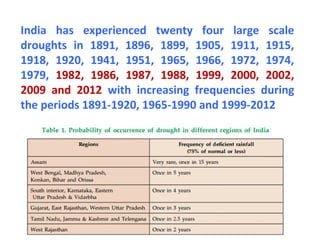
India has experienced twenty four large scale
droughts in 1891, 1896, 1899, 1905, 1911, 1915,
1918, 1920, 1941, 1951, 1965, 1966, 1972, 1974,
1979, 1982, 1986, 1987, 1988, 1999, 2000, 2002,
2009 and 2012 with increasing frequencies during
the periods 1891-1920, 1965-1990 and 1999-2012
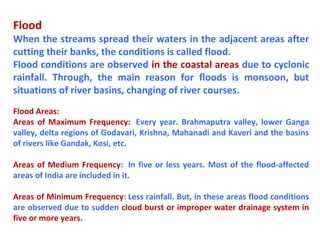
Flood
When the streams spread their waters in the adjacent areas after
cutting their banks, the conditions is called flood.
Flood conditions are observed in the coastal areas due to cyclonic
rainfall. Through, the main reason for floods is monsoon, but
situations of river basins, changing of river courses.
Flood Areas:
Areas of Maximum Frequency: Every year. Brahmaputra valley, lower Ganga
valley, delta regions of Godavari, Krishna, Mahanadi and Kaveri and the basins
of rivers like Gandak, Kosi, etc.
Areas of Medium Frequency: In five or less years. Most of the flood-affected
areas of India are included in it.
Areas of Minimum Frequency: Less rainfall. But, in these areas flood conditions
are observed due to sudden cloud burst or improper water drainage system in
five or more years.
Feeding technologies to be used during
and after Disaster
 Complete feed blocks
 Urea molasses mineral block (licks)
 Urea treatment of straws
 Use of dry and fallen tree leaves
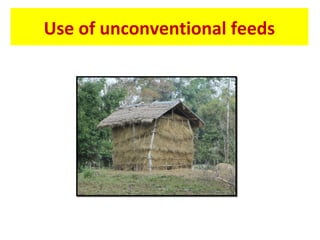
 Use of unconventional feeds
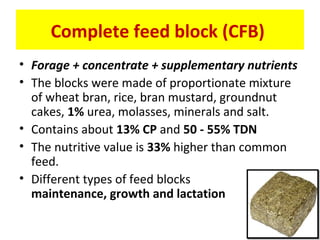
Complete feed block (CFB)
• Forage + concentrate + supplementary nutrients
• The blocks were made of proportionate mixture
of wheat bran, rice, bran mustard, groundnut
cakes, 1% urea, molasses, minerals and salt.
• Contains about 13% CP and 50 - 55% TDN
• The nutritive value is 33% higher than common
feed.
• Different types of feed blocks
maintenance, growth and lactation
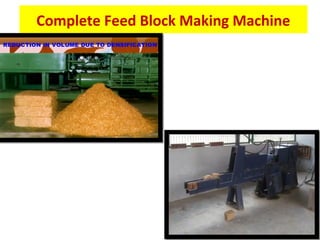
Complete Feed Block Making Machine
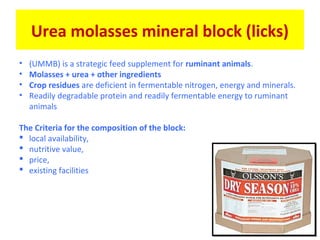
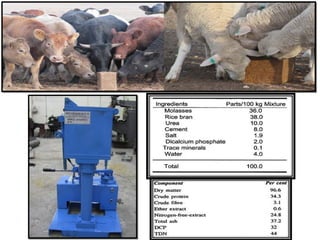
Urea molasses mineral block (licks)
• (UMMB) is a strategic feed supplement for ruminant animals.
• Molasses + urea + other ingredients
• Crop residues are deficient in fermentable nitrogen, energy and minerals.
• Readily degradable protein and readily fermentable energy to ruminant
animals
The Criteria for the composition of the block:
 local availability,
 nutritive value,
 price,
 existing facilities
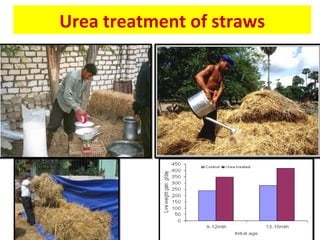
Urea treatment of straws
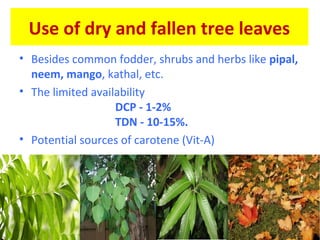
Use of dry and fallen tree leaves
• Besides common fodder, shrubs and herbs like pipal,
neem, mango, kathal, etc.
• The limited availability
DCP - 1-2%
TDN - 10-15%.
• Potential sources of carotene (Vit-A)
Use of unconventional feeds
18
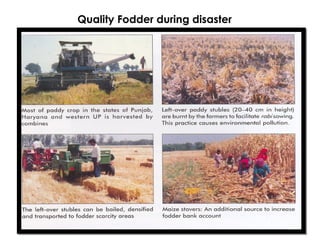
Quality Fodder during disaster
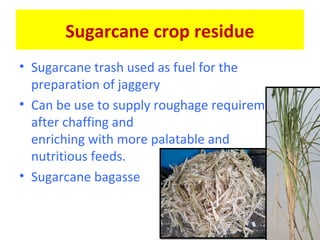
Sugarcane crop residue
• Sugarcane trash used as fuel for the
preparation of jaggery
• Can be use to supply roughage requirement
after chaffing and
enriching with more palatable and
nutritious feeds.
• Sugarcane bagasse
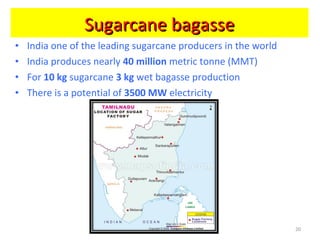
• India one of the leading sugarcane producers in the world
• India produces nearly 40 million metric tonne (MMT)
• For 10 kg sugarcane 3 kg wet bagasse production
• There is a potential of 3500 MW electricity
20
Sugarcane bagasseSugarcane bagasse
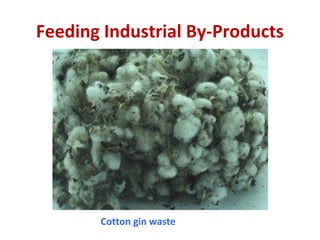
Feeding Industrial By-Products
Cotton gin waste
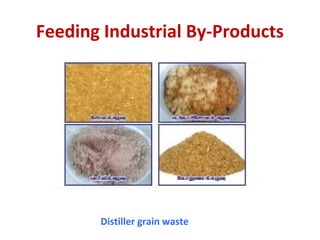
Feeding Industrial By-Products
Distiller grain waste
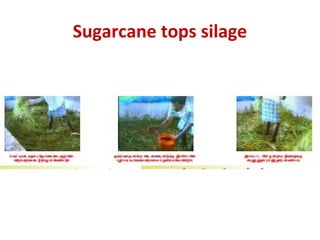
Sugarcane tops silage
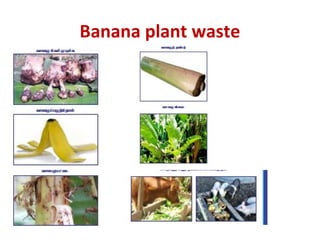
Banana plant waste
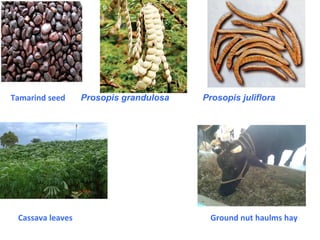
Tamarind seed Prosopis grandulosa Prosopis juliflora
Cassava leaves Ground nut haulms hay
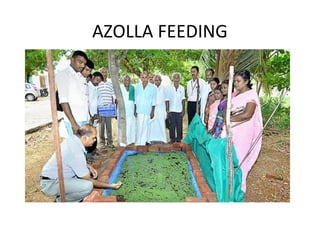
AZOLLA FEEDING
Aquatic plants
• Palatability is low (Alkaloids & polyphenol)
• Besides supplying protein and energy they are
rich sources of carotenes.
• Water hyacinth, aquatic spinach, stalks and
leaves of lotus plant (Neumbiull sp.), water
chestnut (Trapa natans), hydrilla, pistia,
aquatic weeds.
• They are available readily at most of the
places during floods
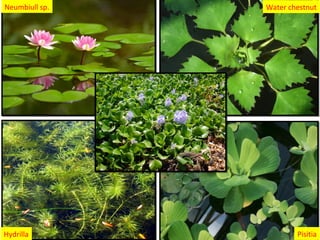
Neumbiull sp. Water chestnut
Hydrilla Pisitia
29
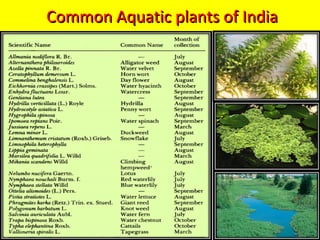
Common Aquatic plants of IndiaCommon Aquatic plants of India
Feeding mineral mixture
Minerals play vital role against disesase by
producing antibodies to increase the
immunity. During disaster period, the animal
is in stress and more prone to disease
susceptibility like FMD, RP etc. Hence, the
animal should be fed 50 gms /day/ cattle and
20gm/day/small ruminant of mineral mixture
daily with feed.
Stay alert for potential problems which
might result because of drought
conditions
• Use of salt to limit feed intake.
• Over-consumption of urea-containing
supplements – urea toxicity.
• Sorghum type hays, may contain high levels
of nitrate.
• Prussic acid or cyanide poisoning can also be
a problem in grazing drought stunted plants
such as Johnson grass, sorghum, sorghum
hybrids, and sudan grass.
Stay alert for potential problems which
might result because of drought
conditions
• Cattle grazing short pasture are more likely to
consume toxic plants .
• Rumen impaction - too much of a low quality
high fiber forage such as drought pasture or
peanut hulls, straws or gin trash & Lack of
adequate water.
• Hardware disease. Hay harvested from vacant
city lots, roadsides etc., broiler litter and other
such feed may contain nails, wire, or foreign
objects which can pierce the rumen wall
resulting in death of the animal.
Ways forward of Disaster Management
1.Establishment of Calamity Care Centre (CCC) for Animal
• Alert to department of Animal Husbandry and district
administration.
• Advice the farmers to judiciously use the locally available
feed / fodder resources to counter the calamity.
• To provide feed / fodder
• To alleviate livestock stress during calamity.
• Initiate activities related to post calamity period to restore
complete recovery
• Non calamity period, this centre to prepare and reserve
complete feed blocks as well as to process the locally available
feed ingredients to atleast sustain livestock life.
Ways forward of Disaster Management
2. Farmer’s awareness programme on different agro-
forestry system and its establishment
• Agroforestry is a dynamic, ecological based, natural resource
management system in which trees or shrubs are grown
• Agroforestry enhances the ecosystem through carbon storage,
prevents deforestation, leads to biodiversity conservation and
soil and water conservation.
• Drought resistant ability – ensures availability of fodder even
during drought.
• India is the first country in the world to come out with a
National Agroforestry policy which is aimed at not just
increasing tree cover, but providing multiple livelihood and
environmental benefits.
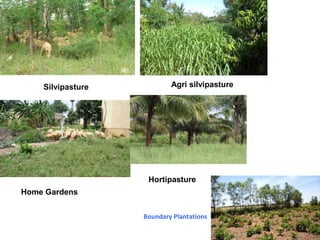
Silvipasture Agri silvipasture
Home Gardens
Hortipasture
Boundary Plantations
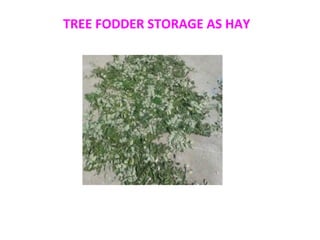
TREE FODDER STORAGE AS HAY
03/01/17 Source FAO & ESGPIP 38
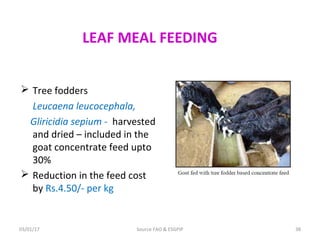
LEAF MEAL FEEDING
 Tree fodders
Leucaena leucocephala,
Gliricidia sepium - harvested
and dried – included in the
goat concentrate feed upto
30%
 Reduction in the feed cost
by Rs.4.50/- per kg
Ways forward of Disaster Management
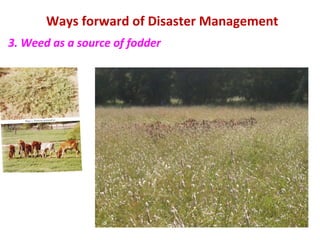
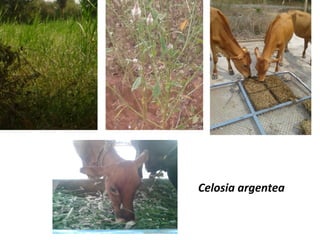
3. Weed as a source of fodder
Celosia argentea
Ways forward of Disaster Management
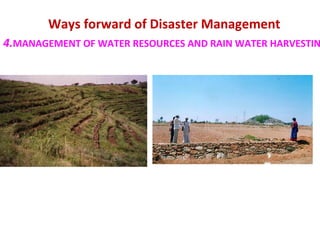
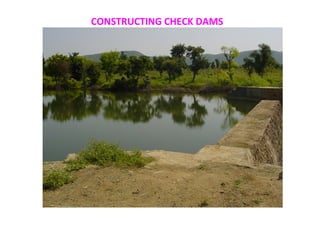
4.MANAGEMENT OF WATER RESOURCES AND RAIN WATER HARVESTIN
CONSTRUCTING CHECK DAMS
Ways forward of Disaster Management
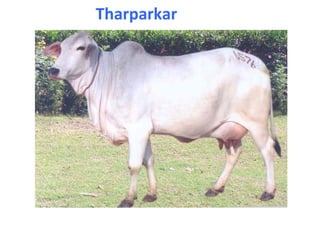
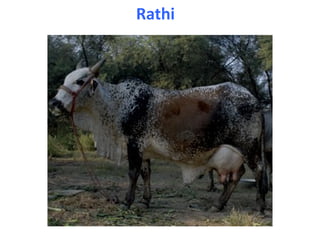
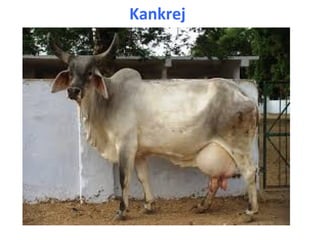
4. Drought adapted breeds of livestock:
Livestock of the arid areas is known to inherent high production
potential and drought hardiness. Cows of Tharparkar, Rathi, gir and
Kankrej breeds have high milk production capacity (1,500-2,500 litres
per lactation) and Nagauri, Hariana and Kankrej bullocks have
reputation as excellent draught animals.
Marwari, a desert goat breed can survive even on meager quantities
of feed, fodder and water.
Tharparkar
Rathi
Kankrej
Ways forward of Disaster Management
5. Animal insurance-A financial safeguard to livestock
owners during natural calamities
:The Govt. of India has launched various programmes for the benefit
of small farmers, marginal farmers, agricultural labourers, etc. Since
1980 all these schemes were integrated into Integrated Rural
Development Programme (IRDP) funded by Central and State Govts.
•CATTLE INSURANCE
•Inclusive of fire, lightning, flood, inundation, storm, hurricane,
earthquake, cyclone, tornado, tempest and famine
Sheep and Goat Insurance
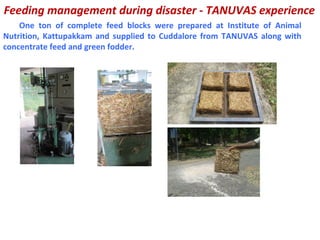
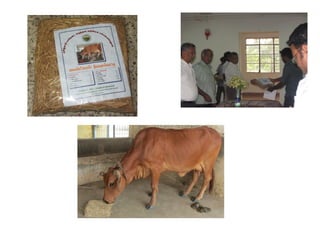
Feeding management during disaster - TANUVAS experience
One ton of complete feed blocks were prepared at Institute of Animal
Nutrition, Kattupakkam and supplied to Cuddalore from TANUVAS along with
concentrate feed and green fodder.
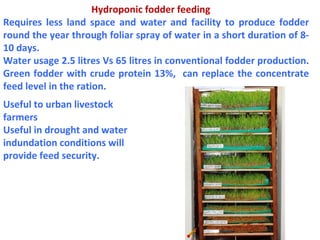
Hydroponic fodder feeding
Requires less land space and water and facility to produce fodder
round the year through foliar spray of water in a short duration of 8-
10 days.
Water usage 2.5 litres Vs 65 litres in conventional fodder production.
Green fodder with crude protein 13%, can replace the concentrate
feed level in the ration.
Useful to urban livestock
farmers
Useful in drought and water
indundation conditions will
provide feed security.
Diaster

Diaster

  • 1.
  • 6.
    India has experiencedtwenty four large scale droughts in 1891, 1896, 1899, 1905, 1911, 1915, 1918, 1920, 1941, 1951, 1965, 1966, 1972, 1974, 1979, 1982, 1986, 1987, 1988, 1999, 2000, 2002, 2009 and 2012 with increasing frequencies during the periods 1891-1920, 1965-1990 and 1999-2012
  • 8.
    Flood When the streamsspread their waters in the adjacent areas after cutting their banks, the conditions is called flood. Flood conditions are observed in the coastal areas due to cyclonic rainfall. Through, the main reason for floods is monsoon, but situations of river basins, changing of river courses. Flood Areas: Areas of Maximum Frequency: Every year. Brahmaputra valley, lower Ganga valley, delta regions of Godavari, Krishna, Mahanadi and Kaveri and the basins of rivers like Gandak, Kosi, etc. Areas of Medium Frequency: In five or less years. Most of the flood-affected areas of India are included in it. Areas of Minimum Frequency: Less rainfall. But, in these areas flood conditions are observed due to sudden cloud burst or improper water drainage system in five or more years.
  • 10.
    Feeding technologies tobe used during and after Disaster  Complete feed blocks  Urea molasses mineral block (licks)  Urea treatment of straws  Use of dry and fallen tree leaves  Use of unconventional feeds
  • 11.
    Complete feed block(CFB) • Forage + concentrate + supplementary nutrients • The blocks were made of proportionate mixture of wheat bran, rice, bran mustard, groundnut cakes, 1% urea, molasses, minerals and salt. • Contains about 13% CP and 50 - 55% TDN • The nutritive value is 33% higher than common feed. • Different types of feed blocks maintenance, growth and lactation
  • 12.
    Complete Feed BlockMaking Machine
  • 13.
    Urea molasses mineralblock (licks) • (UMMB) is a strategic feed supplement for ruminant animals. • Molasses + urea + other ingredients • Crop residues are deficient in fermentable nitrogen, energy and minerals. • Readily degradable protein and readily fermentable energy to ruminant animals The Criteria for the composition of the block:  local availability,  nutritive value,  price,  existing facilities
  • 15.
  • 16.
    Use of dryand fallen tree leaves • Besides common fodder, shrubs and herbs like pipal, neem, mango, kathal, etc. • The limited availability DCP - 1-2% TDN - 10-15%. • Potential sources of carotene (Vit-A)
  • 17.
  • 18.
  • 19.
    Sugarcane crop residue •Sugarcane trash used as fuel for the preparation of jaggery • Can be use to supply roughage requirement after chaffing and enriching with more palatable and nutritious feeds. • Sugarcane bagasse
  • 20.
    • India oneof the leading sugarcane producers in the world • India produces nearly 40 million metric tonne (MMT) • For 10 kg sugarcane 3 kg wet bagasse production • There is a potential of 3500 MW electricity 20 Sugarcane bagasseSugarcane bagasse
  • 21.
  • 22.
  • 23.
  • 24.
  • 25.
    Tamarind seed Prosopisgrandulosa Prosopis juliflora Cassava leaves Ground nut haulms hay
  • 26.
  • 27.
    Aquatic plants • Palatabilityis low (Alkaloids & polyphenol) • Besides supplying protein and energy they are rich sources of carotenes. • Water hyacinth, aquatic spinach, stalks and leaves of lotus plant (Neumbiull sp.), water chestnut (Trapa natans), hydrilla, pistia, aquatic weeds. • They are available readily at most of the places during floods
  • 28.
    Neumbiull sp. Waterchestnut Hydrilla Pisitia
  • 29.
    29 Common Aquatic plantsof IndiaCommon Aquatic plants of India
  • 30.
    Feeding mineral mixture Mineralsplay vital role against disesase by producing antibodies to increase the immunity. During disaster period, the animal is in stress and more prone to disease susceptibility like FMD, RP etc. Hence, the animal should be fed 50 gms /day/ cattle and 20gm/day/small ruminant of mineral mixture daily with feed.
  • 31.
    Stay alert forpotential problems which might result because of drought conditions • Use of salt to limit feed intake. • Over-consumption of urea-containing supplements – urea toxicity. • Sorghum type hays, may contain high levels of nitrate. • Prussic acid or cyanide poisoning can also be a problem in grazing drought stunted plants such as Johnson grass, sorghum, sorghum hybrids, and sudan grass.
  • 32.
    Stay alert forpotential problems which might result because of drought conditions • Cattle grazing short pasture are more likely to consume toxic plants . • Rumen impaction - too much of a low quality high fiber forage such as drought pasture or peanut hulls, straws or gin trash & Lack of adequate water. • Hardware disease. Hay harvested from vacant city lots, roadsides etc., broiler litter and other such feed may contain nails, wire, or foreign objects which can pierce the rumen wall resulting in death of the animal.
  • 34.
    Ways forward ofDisaster Management 1.Establishment of Calamity Care Centre (CCC) for Animal • Alert to department of Animal Husbandry and district administration. • Advice the farmers to judiciously use the locally available feed / fodder resources to counter the calamity. • To provide feed / fodder • To alleviate livestock stress during calamity. • Initiate activities related to post calamity period to restore complete recovery • Non calamity period, this centre to prepare and reserve complete feed blocks as well as to process the locally available feed ingredients to atleast sustain livestock life.
  • 35.
    Ways forward ofDisaster Management 2. Farmer’s awareness programme on different agro- forestry system and its establishment • Agroforestry is a dynamic, ecological based, natural resource management system in which trees or shrubs are grown • Agroforestry enhances the ecosystem through carbon storage, prevents deforestation, leads to biodiversity conservation and soil and water conservation. • Drought resistant ability – ensures availability of fodder even during drought. • India is the first country in the world to come out with a National Agroforestry policy which is aimed at not just increasing tree cover, but providing multiple livelihood and environmental benefits.
  • 36.
    Silvipasture Agri silvipasture HomeGardens Hortipasture Boundary Plantations
  • 37.
  • 38.
    03/01/17 Source FAO& ESGPIP 38 LEAF MEAL FEEDING  Tree fodders Leucaena leucocephala, Gliricidia sepium - harvested and dried – included in the goat concentrate feed upto 30%  Reduction in the feed cost by Rs.4.50/- per kg
  • 39.
    Ways forward ofDisaster Management 3. Weed as a source of fodder
  • 40.
  • 41.
    Ways forward ofDisaster Management 4.MANAGEMENT OF WATER RESOURCES AND RAIN WATER HARVESTIN
  • 42.
  • 43.
    Ways forward ofDisaster Management 4. Drought adapted breeds of livestock: Livestock of the arid areas is known to inherent high production potential and drought hardiness. Cows of Tharparkar, Rathi, gir and Kankrej breeds have high milk production capacity (1,500-2,500 litres per lactation) and Nagauri, Hariana and Kankrej bullocks have reputation as excellent draught animals. Marwari, a desert goat breed can survive even on meager quantities of feed, fodder and water.
  • 44.
  • 45.
  • 46.
  • 47.
    Ways forward ofDisaster Management 5. Animal insurance-A financial safeguard to livestock owners during natural calamities :The Govt. of India has launched various programmes for the benefit of small farmers, marginal farmers, agricultural labourers, etc. Since 1980 all these schemes were integrated into Integrated Rural Development Programme (IRDP) funded by Central and State Govts. •CATTLE INSURANCE •Inclusive of fire, lightning, flood, inundation, storm, hurricane, earthquake, cyclone, tornado, tempest and famine Sheep and Goat Insurance
  • 48.
    Feeding management duringdisaster - TANUVAS experience One ton of complete feed blocks were prepared at Institute of Animal Nutrition, Kattupakkam and supplied to Cuddalore from TANUVAS along with concentrate feed and green fodder.
  • 50.
    Hydroponic fodder feeding Requiresless land space and water and facility to produce fodder round the year through foliar spray of water in a short duration of 8- 10 days. Water usage 2.5 litres Vs 65 litres in conventional fodder production. Green fodder with crude protein 13%, can replace the concentrate feed level in the ration. Useful to urban livestock farmers Useful in drought and water indundation conditions will provide feed security.