Creating an EverGreen Agriculture
The Vision & The Evidence
Dennis Garrity
Distinguished Board Research Fellow
World Agroforestry Centre
UN Drylands Ambassador
Perfect Storm of Challenges
in the Drylands
 
• Rainfall is becoming more erratic and extreme.  
• Temperatures are increasing, intensifying 
crop stress. 
• Soil fertility is declining in many regions.
• Inorganic fertilizers are increasingly expensive.
• Population growth rates remain very high and  
farm sizes are rapidly declining. Farming is 
expanding into more marginal lands.
What is Evergreen Agriculture?
A form of more intensive farming that 
integrates trees into crop and livestock 
production systems.
Evergreen farming systems are systems that 
feature both perennial and annual species 
(food crops and trees), maintaining a green 
cover on the land throughout the year. 
Functional Forms of EverGreen
Agriculture in Cropping Systems
1. Directly increasing crop yields and stabilizing 
yields under drought and heat stress, while…
Providing co-benefits of dry season  livestock 
fodder, fuel wood supplies for  household use 
and sales, or
2. Providing products of higher cash value or
nutritional value than the same area occupied 
by food crops (Land Equivalent Ratio).
In both cases also providing additional environmental
services: Soil health regeneration, Microclimatic
buffering, Carbon accumulation, etc
Types of Evergreen Agriculture
1. Farmer-Managed Natural Regeneration (FMNR)
on cropland
2. Conservation agriculture with trees (CAWT)
3. Conventional agriculture interplanted with trees
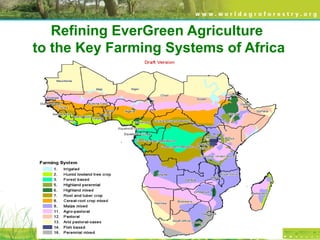
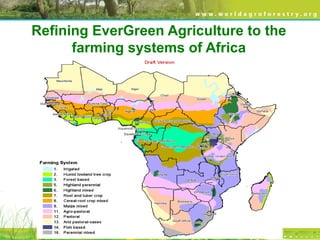
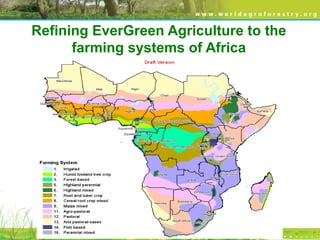
Refining EverGreen Agriculture
to the Key Farming Systems of Africa
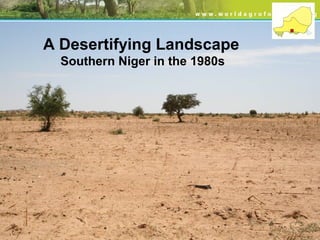
A Desertifying Landscape
Southern Niger in the 1980s
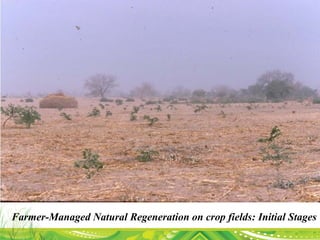
Farmer-Managed Natural Regeneration on crop fields: Initial Stages
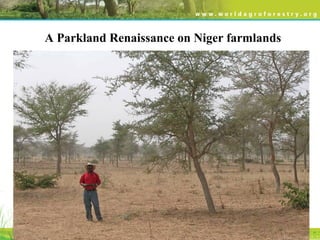
A Parkland Renaissance on Niger farmlands
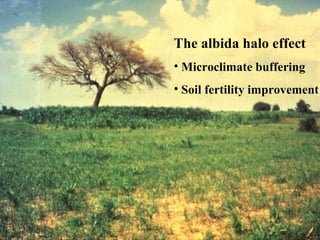
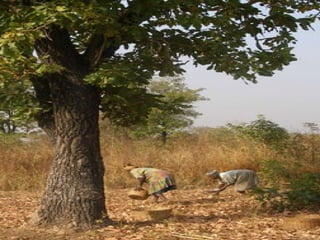
The albida halo effect
• Microclimate buffering
• Soil fertility improvement
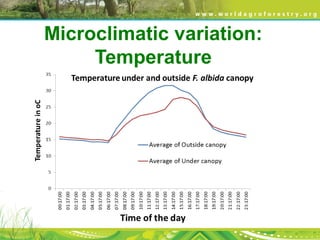
Microclimatic variation:
Temperature
12
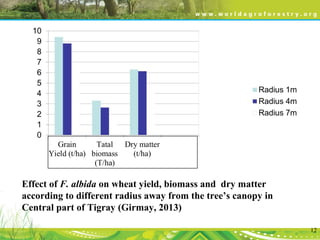
Effect of F. albida on wheat yield, biomass and dry matter
according to different radius away from the tree’s canopy in
Central part of Tigray (Girmay, 2013)
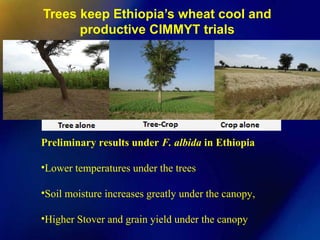
Trees keep Ethiopia’s wheat cool and
productive CIMMYT trials
Preliminary results under F. albida in Ethiopia
•Lower temperatures under the trees
•Soil moisture increases greatly under the canopy,
•Higher Stover and grain yield under the canopy
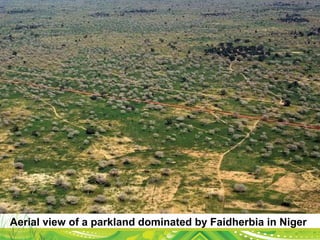
Aerial view of a parkland dominated by Faidherbia in Niger
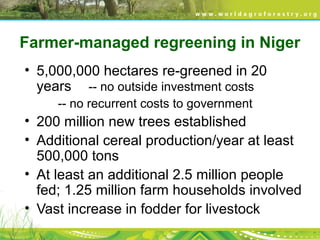
Farmer-managed regreening in Niger
• 5,000,000 hectares re-greened in 20
years -- no outside investment costs
-- no recurrent costs to government
• 200 million new trees established
• Additional cereal production/year at least
500,000 tons
• At least an additional 2.5 million people
fed; 1.25 million farm households involved
• Vast increase in fodder for livestock
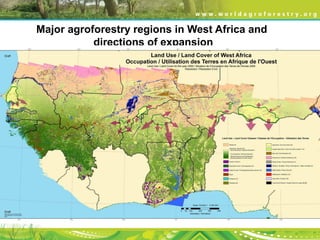
Major agroforestry regions in West Africa and
directions of expansion
Types of Evergreen Agriculture
1. Farmer-Managed Natural Regeneration (FMNR)
on cropland
2. Conservation agriculture with trees (CAWT)
3. Conventional agriculture interplanted with trees
Refining EverGreen Agriculture to the
farming systems of Africa
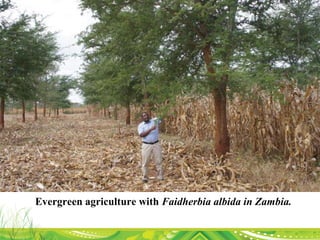
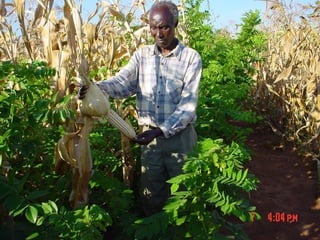
Evergreen agriculture with Faidherbia albida in Zambia.
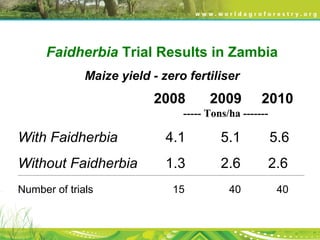
Faidherbia Trial Results in Zambia
Maize yield - zero fertiliser
2008 2009 2010
----- Tons/ha -------
With Faidherbia 4.1 5.1 5.6
Without Faidherbia 1.3 2.6 2.6
________________________________________________________________________________________________________________________________________________________________________________________________
Number of trials 15 40 40
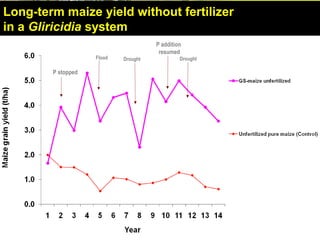
DroughtDroughtFlood
P addition
resumed
Long-term maize yield without fertilizer
in a Gliricidia system
P stopped
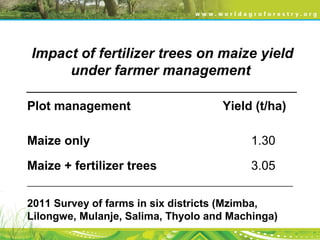
Impact of fertilizer trees on maize yield
under farmer management
_______________________________________
Plot management Yield (t/ha)
Maize only 1.30
Maize + fertilizer trees 3.05
____________________________________________________________
2011 Survey of farms in six districts (Mzimba,
Lilongwe, Mulanje, Salima, Thyolo and Machinga)
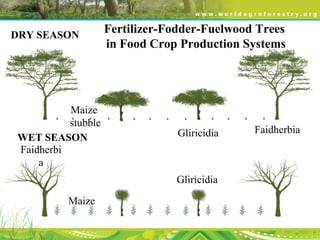
FaidherbiaGliricidia
Maize
stubble
Faidherbi
a
Gliricidia
Maize
DRY SEASON
WET SEASON
Fertilizer-Fodder-Fuelwood Trees
in Food Crop Production Systems
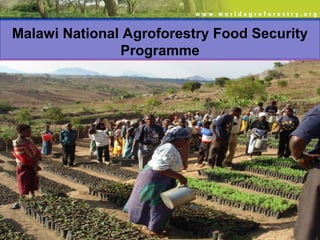
Malawi National Agroforestry Food Security
Programme
Types of Evergreen Agriculture
1. Farmer-Managed Natural Regeneration (FMNR)
on cropland
2. Conservation agriculture with trees (CAWT)
3. Conventional agriculture interplanted with trees
Refining EverGreen Agriculture to the
farming systems of Africa
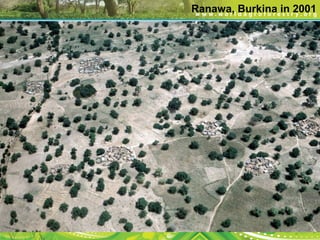
Ranawa, Burkina in 2001
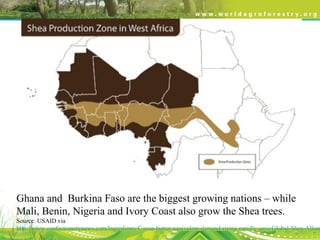
Ghana and Burkina Faso are the biggest growing nations – while
Mali, Benin, Nigeria and Ivory Coast also grow the Shea trees.
Source: USAID via
http://www.confectionerynews.com/Ingredients/Cocoa-butter-equivalent-demand-rising-rapidly-says-Global-Shea-Allian
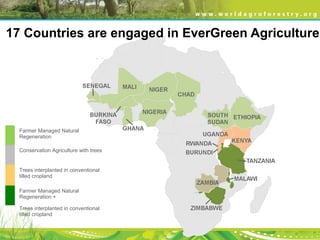
17 Countries are engaged in EverGreen Agriculture
Farmer Managed Natural
Regeneration
Conservation Agriculture with trees
Trees interplanted in conventional
tilled cropland
Farmer Managed Natural
Regeneration +
Trees interplanted in conventional
tilled cropland
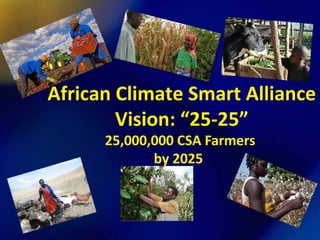
African Climate Smart Alliance
Vision: “25-25”
25,000,000 CSA Farmers
by 2025
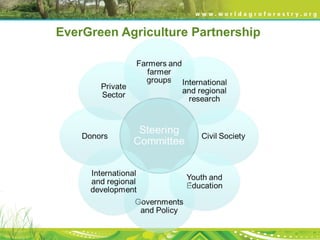
EverGreen Agriculture Partnership
Conclusions – Way Forward
• The approach of EverGreen Agriculture has
taken root in Africa, and is spreading rapidly
• Millions of smallholders are adopting effective
land regeneration methods
• Many nations are creating the policy and
institutional environments to favor adoption
• The Gates Foundation could be an
instrumental partner in expanding the scope for
EverGreen Agriculture in Africa
• The African CSA Alliance provides a great
platform to reach 25 million farmers with
EverGreen Agriculture during the coming decade

Gates convening presentation bamako may 2014

  • 1.
    Creating an EverGreenAgriculture The Vision & The Evidence Dennis Garrity Distinguished Board Research Fellow World Agroforestry Centre UN Drylands Ambassador
  • 2.
    Perfect Storm ofChallenges in the Drylands   • Rainfall is becoming more erratic and extreme.   • Temperatures are increasing, intensifying  crop stress.  • Soil fertility is declining in many regions. • Inorganic fertilizers are increasingly expensive. • Population growth rates remain very high and   farm sizes are rapidly declining. Farming is  expanding into more marginal lands.
  • 3.
    What is EvergreenAgriculture? A form of more intensive farming that  integrates trees into crop and livestock  production systems. Evergreen farming systems are systems that  feature both perennial and annual species  (food crops and trees), maintaining a green  cover on the land throughout the year. 
  • 4.
    Functional Forms ofEverGreen Agriculture in Cropping Systems 1. Directly increasing crop yields and stabilizing  yields under drought and heat stress, while… Providing co-benefits of dry season  livestock  fodder, fuel wood supplies for  household use  and sales, or 2. Providing products of higher cash value or nutritional value than the same area occupied  by food crops (Land Equivalent Ratio). In both cases also providing additional environmental services: Soil health regeneration, Microclimatic buffering, Carbon accumulation, etc
  • 5.
    Types of EvergreenAgriculture 1. Farmer-Managed Natural Regeneration (FMNR) on cropland 2. Conservation agriculture with trees (CAWT) 3. Conventional agriculture interplanted with trees
  • 6.
    Refining EverGreen Agriculture tothe Key Farming Systems of Africa
  • 7.
  • 8.
    Farmer-Managed Natural Regenerationon crop fields: Initial Stages
  • 9.
    A Parkland Renaissanceon Niger farmlands
  • 10.
    The albida haloeffect • Microclimate buffering • Soil fertility improvement
  • 11.
  • 12.
    12 Effect of F.albida on wheat yield, biomass and dry matter according to different radius away from the tree’s canopy in Central part of Tigray (Girmay, 2013)
  • 13.
    Trees keep Ethiopia’swheat cool and productive CIMMYT trials Preliminary results under F. albida in Ethiopia •Lower temperatures under the trees •Soil moisture increases greatly under the canopy, •Higher Stover and grain yield under the canopy
  • 14.
    Aerial view ofa parkland dominated by Faidherbia in Niger
  • 15.
    Farmer-managed regreening inNiger • 5,000,000 hectares re-greened in 20 years -- no outside investment costs -- no recurrent costs to government • 200 million new trees established • Additional cereal production/year at least 500,000 tons • At least an additional 2.5 million people fed; 1.25 million farm households involved • Vast increase in fodder for livestock
  • 16.
    Major agroforestry regionsin West Africa and directions of expansion
  • 17.
    Types of EvergreenAgriculture 1. Farmer-Managed Natural Regeneration (FMNR) on cropland 2. Conservation agriculture with trees (CAWT) 3. Conventional agriculture interplanted with trees
  • 18.
    Refining EverGreen Agricultureto the farming systems of Africa
  • 19.
    Evergreen agriculture withFaidherbia albida in Zambia.
  • 20.
    Faidherbia Trial Resultsin Zambia Maize yield - zero fertiliser 2008 2009 2010 ----- Tons/ha ------- With Faidherbia 4.1 5.1 5.6 Without Faidherbia 1.3 2.6 2.6 ________________________________________________________________________________________________________________________________________________________________________________________________ Number of trials 15 40 40
  • 23.
    DroughtDroughtFlood P addition resumed Long-term maizeyield without fertilizer in a Gliricidia system P stopped
  • 24.
    Impact of fertilizertrees on maize yield under farmer management _______________________________________ Plot management Yield (t/ha) Maize only 1.30 Maize + fertilizer trees 3.05 ____________________________________________________________ 2011 Survey of farms in six districts (Mzimba, Lilongwe, Mulanje, Salima, Thyolo and Machinga)
  • 25.
  • 26.
    Malawi National AgroforestryFood Security Programme
  • 27.
    Types of EvergreenAgriculture 1. Farmer-Managed Natural Regeneration (FMNR) on cropland 2. Conservation agriculture with trees (CAWT) 3. Conventional agriculture interplanted with trees
  • 28.
    Refining EverGreen Agricultureto the farming systems of Africa
  • 30.
  • 31.
    Ghana and BurkinaFaso are the biggest growing nations – while Mali, Benin, Nigeria and Ivory Coast also grow the Shea trees. Source: USAID via http://www.confectionerynews.com/Ingredients/Cocoa-butter-equivalent-demand-rising-rapidly-says-Global-Shea-Allian
  • 32.
    17 Countries areengaged in EverGreen Agriculture Farmer Managed Natural Regeneration Conservation Agriculture with trees Trees interplanted in conventional tilled cropland Farmer Managed Natural Regeneration + Trees interplanted in conventional tilled cropland
  • 34.
    African Climate SmartAlliance Vision: “25-25” 25,000,000 CSA Farmers by 2025
  • 35.
  • 36.
    Conclusions – WayForward • The approach of EverGreen Agriculture has taken root in Africa, and is spreading rapidly • Millions of smallholders are adopting effective land regeneration methods • Many nations are creating the policy and institutional environments to favor adoption • The Gates Foundation could be an instrumental partner in expanding the scope for EverGreen Agriculture in Africa • The African CSA Alliance provides a great platform to reach 25 million farmers with EverGreen Agriculture during the coming decade

Editor's Notes

  • #30 Wild shea nuts are a sustainable resource for West African communities. http://www.alaffia.com/environmental.asp
  • #35 Interactive question for Opening (What would be one word to indicate where you would start?)
  • #36 International and regional development organisations - While Worldvision is one of our most important partners, we are also speaking to the Catholic relief service amoung other organisations Donors Governments and Policy International and Regional Research organisations Farmers and agricultural groups Private Sector Education Youth Civil Society