Project Management for the Curious 21 st  January 2009 1.10 “ An ounce of action is worth a ton of theory.” Friedrich Engels
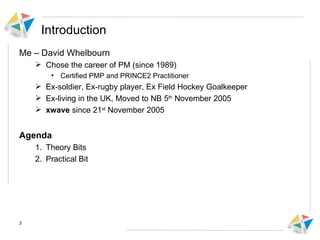
Introduction Me – David Whelbourn Chose the career of PM (since 1989)  Certified PMP and PRINCE2 Practitioner  Ex-soldier, Ex-rugby player, Ex Field Hockey Goalkeeper Ex-living in the UK, Moved to NB 5 th  November 2005 xwave  since 21 st  November 2005 Agenda Theory Bits Practical Bit
THEORY BITS Definitions Project Lifecycle PM Processes Project Planning
Definitions What is a Project? A project is a temporary endeavor undertaken to accomplish a unique purpose Attributes of projects unique purpose, has start and end dates, require resources, often from various areas should have a primary sponsor and/or customer Specific budget, and involves uncertainty What is Project Management? The application of skills, tools, and techniques to project activities in order to meet or exceed stakeholders needs or expectations.  (These needs should match the project requirements) A systematic approach to managing projects A way to generate consistent results when you undertake new initiatives What does a Project Manager do? Has overall responsibility for project Communicates expectations to stakeholders Controls planning, activities and resources to meet established costs, timetables and quality or deliverable goals
Project Lifecycles They define an effective way to deliver products They are designed to ensure consistency (learning approach) Ideas Benefits Business Case Requirements and initial Design/Test planning Iteration Design/ Test Plan Iteration Build/ Test Final Verification and Validation Project Management Checkpoint Checkpoint Checkpoint Checkpoint Delivery Iterations
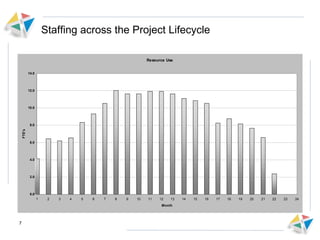
Staffing across the Project Lifecycle
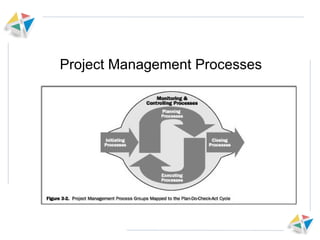
Project Management Processes
Initiating Process Group When: At Project Start (or even before the start) Some sort of Stimulus RFP arriving or being discovered Problem given at the coffee machine “Dave can you …. “ Understand Why the project is being done Plan the initiation stage / bid response Create a Project Charter / Terms of Reference / Brief Hold Kick off meeting (s) At Stage or Phase Start Trigger Stage Plan Stage Kick off meeting Chances for the project’s success are largely set in the first 20% of its time line
Hints & Tips on Initiating Write down what you are going to do Terms of Reference, Project Brief, Project Initiation Document Has it been done before ( Lessons Learned Reports available? ) Hold a Kick Off Meeting Run first, gain some ground you can walk later  Set expectations – no delays Do not allow diary shuffling or try to minimise it Communications etiquette  Expected response times for communications Broadcast emails, Attachments ? Inaction is the most dangerous enemy of the PM Most late projects cannot point to a single catastrophic event
A Controlled Project Initiation Provides  A Firm Foundation  For Success!
Planning Process Group Old Saying: “Fail to Plan --- Plan to Fail” * If project failure were a disease then Planning is a vaccination against project failure * How much Planning Research shows above 10% of the project’s budget is where the law of diminishing returns kick in. How do I plan? Use Stages (Management Control) they enable  Review and decision points, and   planning horizons Product Base Planning Product Descriptions Work Packages
Project Scope & Product Based Planning Project Scope = All the products to be delivered Work Breakdown Structure?  Better way is Product Breakdown Structure: Plan around the products your project has to produce Management Products Charter Progress reports, …Implementation report Technical Products Implemented System Accepted Solution / Product Together they represent total amount of necessary work Write Product Descriptions  Moved from “Process drives deliverables” to “Deliverables driving Process”.
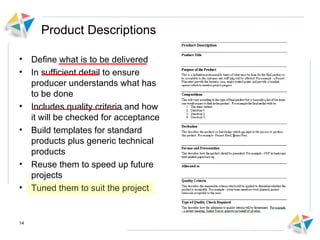
Product Descriptions Define what is to be delivered In sufficient detail to ensure producer understands what has to be done Includes quality criteria and how it will be checked for acceptance Build templates for standard products plus generic technical products  Reuse them to speed up future projects Tuned them to suit the project
Planning Process Hints & Tips Planning Sequence Product Breakdown Structure Management Products & Technical Products Define products  Write their descriptions use previous standard templates  Define dependencies & produce a flow diagram (network) Use Post IT Notes to figure out the sequence products have to be built in Generate Activities to deliver products  use verb noun style Estimate Effort  Size, effort in hours / days / months Modifiers Consider the Complexity & Staff capabilities  Environmental factors Create Schedule State your planning Assumptions No one in IT can be productive for 5 days a week remember 3.5 – 4 days per week “ Establish Requirements”
Executing Processes Execute the PLAN! Work Gets Given Out  Pass out the work packages / product descriptions Work Gets Done (only on the stuff you have passed out!) Chase, harass, hassle, plague and even harry  Remind them of quality criteria  Work Gets Accepted (hopefully) Quality check  (How Do You Know It Has Been Done Satisfactory) Thinking is easy, Action is difficult
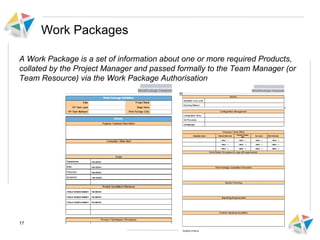
Work Packages A Work Package is a set of information about one or more required Products, collated by the Project Manager and passed formally to the Team Manager (or Team Resource) via the Work Package Authorisation
Hints & Tips on Executing Parkinson’s Law – The amount of time applied to perform work, expands to meet the estimate. Prove it wrong remember harry if you have too. Use work packages to manage external contractors Use Quality Reviews as part of acceptance Only work that has been authorised should be what is being done. Make the point to the team not to accept work from anyone else but you. Project Teams are not looking for delivery acceleration opportunities. Delivery date slips result from internal project team delays. Find ways to save work time, as saving time is usually saving money.
Controlled Progress Improves Chances of  Project Success
Closing Processes Stage Closure Gates between stages / phases?  Lessons Learned  Acceptance of the delivered product Financial Closure Budget Procurement , purchase orders etc… Contract Future Life (opportunity spotting) What has changed while the project has been running Opportunities identified during the project but out of scope Plan Post Project Review?
Hints & Tips on Closing Check if the project met the original objectives  Confirm the customer acceptance of  all  the products Check all documentation has been completed and handed over, archived, destroyed? Check there are no outstanding invoices / payments Notify the customer that you intend to close the project
A Controlled Project Closure Completes the Project and enhances  YOUR  reputation
Monitoring & Controlling Keeping an eye on everything and spinning all the plates! Managing the boundaries between the stages (close & planning) Project Status Meetings  Regularly – weekly / fortnightly Cover: Progress, Problems in progress i.e Things not delivered as planned Issues & Risks (coming up in the next step/stage etc) Next Steps and Deliverables This is about communication with the stakeholders / sponsor  No surprises is the best policy – try to forewarn if there is a problem Being Obsessed with the Quality Aspects Quality of having recorded decisions (VERY IMPORTANT FOR PM) Quality checks on work produced use a Work Package Definition!
Summary of Theory Projects are temporary and are used to produce a unique solution to an opportunity or problem.  There  should  be some sort of business case for any project highlighting the expected benefits from the project. Project Management involves exploring problems / opportunities, facilitating the development of a solution, tasking it, bring the plan into action and making things happen when the events threaten to blow your ship off course. Projects Have Lifecycles 5 PM processes (used to be IPECC now it’s I,P,E,MC,C) these processes run within the lifecycle and across the lifecycle
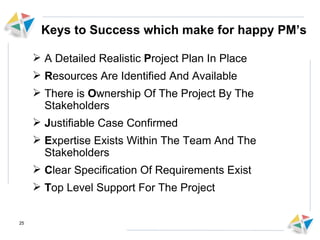
Keys to Success which make for happy PM’s A Detailed Realistic  P roject Plan In Place R esources Are Identified And Available There is  O wnership Of The Project By The Stakeholders J ustifiable Case Confirmed E xpertise Exists Within The Team And The Stakeholders  C lear Specification Of Requirements Exist T op Level Support For The Project
 
THE PRACTICAL BIT A Project Lifecycle For ANY Project  The Five Step Model
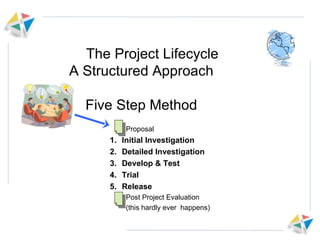
The Project Lifecycle A Structured Approach Five Step Method Proposal Initial Investigation Detailed Investigation Develop & Test Trial Release Post Project Evaluation  (this hardly ever  happens)
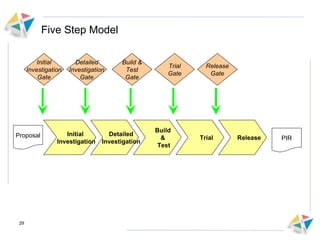
Five Step Model Detailed Investigation Build  &  Test Trial Release Initial  Investigation Proposal PIR Initial Investigation Gate Detailed Investigation Gate Build & Test Gate Trial Gate Release Gate
The Trigger for your Project - Proposal Request for Action Document  or email  could be verbal (write it down) Describes what you want to do and why Document it formally  Get it reviewed by the potential stakeholders  Go / No Go (Gate)
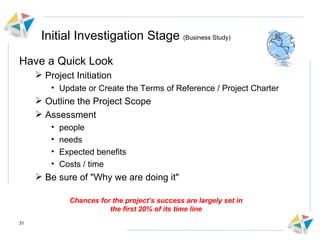
Initial Investigation Stage  (Business Study)   Have a Quick Look Project Initiation Update or Create the Terms of Reference / Project Charter  Outline the Project Scope Assessment  people needs Expected benefits Costs / time Be sure of "Why we are doing it" Chances for the project’s success are largely set in the first 20% of its time line
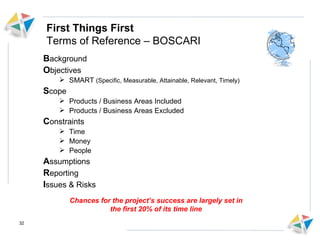
First Things First Terms of Reference – BOSCARI B ackground O bjectives SMART  (Specific, Measurable, Attainable, Relevant, Timely) S cope Products / Business Areas Included Products / Business Areas Excluded C onstraints Time Money People A ssumptions R eporting I ssues & Risks Chances for the project’s success are largely set in the first 20% of its time line
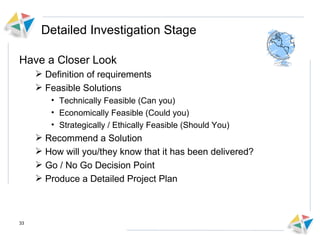
Detailed Investigation Stage Have a Closer Look Definition of requirements Feasible Solutions Technically Feasible (Can you) Economically Feasible (Could you) Strategically / Ethically Feasible (Should You) Recommend a Solution How will you/they know that it has been delivered? Go / No Go Decision Point Produce a Detailed Project Plan
Develop & Test Stage Do It!  Use work authorisation and work packages/ product descriptions to create action to deliver the products Monitor and control the project  Deliveries, internal and external communications The project uses the most resources during this stage The Work to deliver the products that will deliver the benefits I never worry about action, but only about inaction Winston Churchill
Trial Stage Try it in a customer free zone  Model Office / Conference Room Pilot Acceptance testing Validate the solution / products are acceptable to the clients and functionally correct Verify that the capabilities work in a live environment including all the business processes and supporting infrastructure
Release Stage Use It! The rubber hits the road! Project Closure Lessons Learned Future Life Planning Contract Closure
Post Project Evaluation Very Rare Checking to see if the expected benefits from the project have been delivered Requires identified metrics that will show the benefits Requires baseline of current metrics before your project starts Depends on BENEFITS being defined and tracked (Benefit Management) Only just happening in the UK who are probably one the world leaders in Project & Programme Management
Summary Definitions of PM and Project 5 Step Model Initial Investigation Detailed Investigation Develop and Test Trial Release Remember the KISS Principle Keep It Simple Stupid (A brutal army principle) Did We Achieve the Objectives Look Forward future learning opportunities, Next steps (next slide)
Next Steps - Project Management Briefings  (depends on demand?) Email me for Terms of Reference and other templates (word) and this PowerPoint. Some references or places for further information: Project Management Institute  www.pmi.org OGC (UK Office of Government Commerce)  www.ogc.gov.uk/sdtoolkit Project Management Institute Book of Knowledge (PMBOK) PRINCE2 – Managing Successful Projects  Plenty of PM books, some of which are good – I would recommend Project Management - Dennis Lock Mythical Man Month - Frederick P. Brooks –  software engineering Project Workout – Robert Buttrick

Project Management For The Curious

  • 1.
    Project Management forthe Curious 21 st January 2009 1.10 “ An ounce of action is worth a ton of theory.” Friedrich Engels
  • 3.
    Introduction Me –David Whelbourn Chose the career of PM (since 1989) Certified PMP and PRINCE2 Practitioner Ex-soldier, Ex-rugby player, Ex Field Hockey Goalkeeper Ex-living in the UK, Moved to NB 5 th November 2005 xwave since 21 st November 2005 Agenda Theory Bits Practical Bit
  • 4.
    THEORY BITS DefinitionsProject Lifecycle PM Processes Project Planning
  • 5.
    Definitions What isa Project? A project is a temporary endeavor undertaken to accomplish a unique purpose Attributes of projects unique purpose, has start and end dates, require resources, often from various areas should have a primary sponsor and/or customer Specific budget, and involves uncertainty What is Project Management? The application of skills, tools, and techniques to project activities in order to meet or exceed stakeholders needs or expectations. (These needs should match the project requirements) A systematic approach to managing projects A way to generate consistent results when you undertake new initiatives What does a Project Manager do? Has overall responsibility for project Communicates expectations to stakeholders Controls planning, activities and resources to meet established costs, timetables and quality or deliverable goals
  • 6.
    Project Lifecycles Theydefine an effective way to deliver products They are designed to ensure consistency (learning approach) Ideas Benefits Business Case Requirements and initial Design/Test planning Iteration Design/ Test Plan Iteration Build/ Test Final Verification and Validation Project Management Checkpoint Checkpoint Checkpoint Checkpoint Delivery Iterations
  • 7.
    Staffing across theProject Lifecycle
  • 8.
  • 9.
    Initiating Process GroupWhen: At Project Start (or even before the start) Some sort of Stimulus RFP arriving or being discovered Problem given at the coffee machine “Dave can you …. “ Understand Why the project is being done Plan the initiation stage / bid response Create a Project Charter / Terms of Reference / Brief Hold Kick off meeting (s) At Stage or Phase Start Trigger Stage Plan Stage Kick off meeting Chances for the project’s success are largely set in the first 20% of its time line
  • 10.
    Hints & Tipson Initiating Write down what you are going to do Terms of Reference, Project Brief, Project Initiation Document Has it been done before ( Lessons Learned Reports available? ) Hold a Kick Off Meeting Run first, gain some ground you can walk later Set expectations – no delays Do not allow diary shuffling or try to minimise it Communications etiquette Expected response times for communications Broadcast emails, Attachments ? Inaction is the most dangerous enemy of the PM Most late projects cannot point to a single catastrophic event
  • 11.
    A Controlled ProjectInitiation Provides A Firm Foundation For Success!
  • 12.
    Planning Process GroupOld Saying: “Fail to Plan --- Plan to Fail” * If project failure were a disease then Planning is a vaccination against project failure * How much Planning Research shows above 10% of the project’s budget is where the law of diminishing returns kick in. How do I plan? Use Stages (Management Control) they enable Review and decision points, and planning horizons Product Base Planning Product Descriptions Work Packages
  • 13.
    Project Scope &Product Based Planning Project Scope = All the products to be delivered Work Breakdown Structure? Better way is Product Breakdown Structure: Plan around the products your project has to produce Management Products Charter Progress reports, …Implementation report Technical Products Implemented System Accepted Solution / Product Together they represent total amount of necessary work Write Product Descriptions Moved from “Process drives deliverables” to “Deliverables driving Process”.
  • 14.
    Product Descriptions Definewhat is to be delivered In sufficient detail to ensure producer understands what has to be done Includes quality criteria and how it will be checked for acceptance Build templates for standard products plus generic technical products Reuse them to speed up future projects Tuned them to suit the project
  • 15.
    Planning Process Hints& Tips Planning Sequence Product Breakdown Structure Management Products & Technical Products Define products Write their descriptions use previous standard templates Define dependencies & produce a flow diagram (network) Use Post IT Notes to figure out the sequence products have to be built in Generate Activities to deliver products use verb noun style Estimate Effort Size, effort in hours / days / months Modifiers Consider the Complexity & Staff capabilities Environmental factors Create Schedule State your planning Assumptions No one in IT can be productive for 5 days a week remember 3.5 – 4 days per week “ Establish Requirements”
  • 16.
    Executing Processes Executethe PLAN! Work Gets Given Out Pass out the work packages / product descriptions Work Gets Done (only on the stuff you have passed out!) Chase, harass, hassle, plague and even harry Remind them of quality criteria Work Gets Accepted (hopefully) Quality check (How Do You Know It Has Been Done Satisfactory) Thinking is easy, Action is difficult
  • 17.
    Work Packages AWork Package is a set of information about one or more required Products, collated by the Project Manager and passed formally to the Team Manager (or Team Resource) via the Work Package Authorisation
  • 18.
    Hints & Tipson Executing Parkinson’s Law – The amount of time applied to perform work, expands to meet the estimate. Prove it wrong remember harry if you have too. Use work packages to manage external contractors Use Quality Reviews as part of acceptance Only work that has been authorised should be what is being done. Make the point to the team not to accept work from anyone else but you. Project Teams are not looking for delivery acceleration opportunities. Delivery date slips result from internal project team delays. Find ways to save work time, as saving time is usually saving money.
  • 19.
    Controlled Progress ImprovesChances of Project Success
  • 20.
    Closing Processes StageClosure Gates between stages / phases? Lessons Learned Acceptance of the delivered product Financial Closure Budget Procurement , purchase orders etc… Contract Future Life (opportunity spotting) What has changed while the project has been running Opportunities identified during the project but out of scope Plan Post Project Review?
  • 21.
    Hints & Tipson Closing Check if the project met the original objectives Confirm the customer acceptance of all the products Check all documentation has been completed and handed over, archived, destroyed? Check there are no outstanding invoices / payments Notify the customer that you intend to close the project
  • 22.
    A Controlled ProjectClosure Completes the Project and enhances YOUR reputation
  • 23.
    Monitoring & ControllingKeeping an eye on everything and spinning all the plates! Managing the boundaries between the stages (close & planning) Project Status Meetings Regularly – weekly / fortnightly Cover: Progress, Problems in progress i.e Things not delivered as planned Issues & Risks (coming up in the next step/stage etc) Next Steps and Deliverables This is about communication with the stakeholders / sponsor No surprises is the best policy – try to forewarn if there is a problem Being Obsessed with the Quality Aspects Quality of having recorded decisions (VERY IMPORTANT FOR PM) Quality checks on work produced use a Work Package Definition!
  • 24.
    Summary of TheoryProjects are temporary and are used to produce a unique solution to an opportunity or problem. There should be some sort of business case for any project highlighting the expected benefits from the project. Project Management involves exploring problems / opportunities, facilitating the development of a solution, tasking it, bring the plan into action and making things happen when the events threaten to blow your ship off course. Projects Have Lifecycles 5 PM processes (used to be IPECC now it’s I,P,E,MC,C) these processes run within the lifecycle and across the lifecycle
  • 25.
    Keys to Successwhich make for happy PM’s A Detailed Realistic P roject Plan In Place R esources Are Identified And Available There is O wnership Of The Project By The Stakeholders J ustifiable Case Confirmed E xpertise Exists Within The Team And The Stakeholders C lear Specification Of Requirements Exist T op Level Support For The Project
  • 26.
  • 27.
    THE PRACTICAL BITA Project Lifecycle For ANY Project The Five Step Model
  • 28.
    The Project LifecycleA Structured Approach Five Step Method Proposal Initial Investigation Detailed Investigation Develop & Test Trial Release Post Project Evaluation (this hardly ever happens)
  • 29.
    Five Step ModelDetailed Investigation Build & Test Trial Release Initial Investigation Proposal PIR Initial Investigation Gate Detailed Investigation Gate Build & Test Gate Trial Gate Release Gate
  • 30.
    The Trigger foryour Project - Proposal Request for Action Document or email could be verbal (write it down) Describes what you want to do and why Document it formally Get it reviewed by the potential stakeholders Go / No Go (Gate)
  • 31.
    Initial Investigation Stage (Business Study) Have a Quick Look Project Initiation Update or Create the Terms of Reference / Project Charter Outline the Project Scope Assessment people needs Expected benefits Costs / time Be sure of "Why we are doing it" Chances for the project’s success are largely set in the first 20% of its time line
  • 32.
    First Things FirstTerms of Reference – BOSCARI B ackground O bjectives SMART (Specific, Measurable, Attainable, Relevant, Timely) S cope Products / Business Areas Included Products / Business Areas Excluded C onstraints Time Money People A ssumptions R eporting I ssues & Risks Chances for the project’s success are largely set in the first 20% of its time line
  • 33.
    Detailed Investigation StageHave a Closer Look Definition of requirements Feasible Solutions Technically Feasible (Can you) Economically Feasible (Could you) Strategically / Ethically Feasible (Should You) Recommend a Solution How will you/they know that it has been delivered? Go / No Go Decision Point Produce a Detailed Project Plan
  • 34.
    Develop & TestStage Do It! Use work authorisation and work packages/ product descriptions to create action to deliver the products Monitor and control the project Deliveries, internal and external communications The project uses the most resources during this stage The Work to deliver the products that will deliver the benefits I never worry about action, but only about inaction Winston Churchill
  • 35.
    Trial Stage Tryit in a customer free zone Model Office / Conference Room Pilot Acceptance testing Validate the solution / products are acceptable to the clients and functionally correct Verify that the capabilities work in a live environment including all the business processes and supporting infrastructure
  • 36.
    Release Stage UseIt! The rubber hits the road! Project Closure Lessons Learned Future Life Planning Contract Closure
  • 37.
    Post Project EvaluationVery Rare Checking to see if the expected benefits from the project have been delivered Requires identified metrics that will show the benefits Requires baseline of current metrics before your project starts Depends on BENEFITS being defined and tracked (Benefit Management) Only just happening in the UK who are probably one the world leaders in Project & Programme Management
  • 38.
    Summary Definitions ofPM and Project 5 Step Model Initial Investigation Detailed Investigation Develop and Test Trial Release Remember the KISS Principle Keep It Simple Stupid (A brutal army principle) Did We Achieve the Objectives Look Forward future learning opportunities, Next steps (next slide)
  • 39.
    Next Steps -Project Management Briefings (depends on demand?) Email me for Terms of Reference and other templates (word) and this PowerPoint. Some references or places for further information: Project Management Institute www.pmi.org OGC (UK Office of Government Commerce) www.ogc.gov.uk/sdtoolkit Project Management Institute Book of Knowledge (PMBOK) PRINCE2 – Managing Successful Projects Plenty of PM books, some of which are good – I would recommend Project Management - Dennis Lock Mythical Man Month - Frederick P. Brooks – software engineering Project Workout – Robert Buttrick

Editor's Notes

  • #2 Thank you for being curious