ICT Vision and Strategy Development Alan McSweeney
Objectives To describe a view of and approach to developing an ICT strategy
Agenda IT Vision IT Challenges and Trends View of IT Strategy Approach to Developing IT Strategy
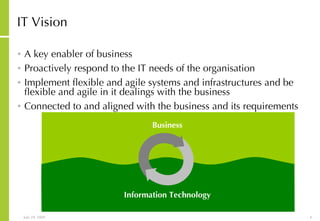
IT Vision A key enabler of business Proactively respond to the IT needs of the organisation Implement flexible and agile systems and infrastructures and be flexible and agile in it dealings with the business  Connected to and aligned with the business and its requirements Business Information Technology
IT - Core Principles Recommends that IT define a core set of principles/policies: IT strategy will be developed and maintained in line with market analysis and key stakeholder requirements and IT strategy to be aligned with the organisation’s vision IT delivers core services to cost and quality standards IT as a function is controlled and compliant to industry standards Security will be embedded in IT IT enables flexible service delivery to users IT supports business growth IT supports and enables compliance in the wider organisation IT budgets will be developed and maintained for new services or improved IT Services
IT Challenges and Trends General challenges and trends in information technology Information Security Management Identity and Access Management Conforming to Assurance and Compliance Standards Privacy Management Disaster Recovery Planning (DRP) and Business Continuity Management (BCM) IT Governance Securing and Controlling Information Distribution  Mobile and Remote Computing  Electronic Archiving and Data Retention  Document, Forms, Content and Knowledge Management  Training, Competency  and Awareness Business Process Improvement, Workflow and Process Exception Alerts Improved Application and Data Integration Web Deployed Applications Enterprise System Management Business Intelligence (BI) Customer Relationship Management (CRM) Information Portals Environmental Concerns Infrastructure Optimisation Which ones are of interest to you? IT aware of and monitoring key technologies, trends and challenges to ensure that the organisation will be ready to respond to changes quickly and effectively Benchmarking against other industries and competitors Developing best practice
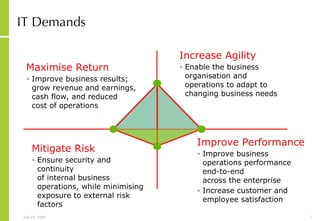
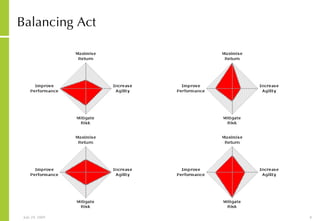
IT Demands Mitigate Risk Ensure security and continuity  of internal business operations, while minimising exposure to external risk factors Maximise Return Improve business results; grow revenue and earnings,  cash flow, and reduced  cost of operations Improve Performance Improve business operations performance end-to-end  across the enterprise Increase customer and employee satisfaction Increase Agility Enable the business organisation and operations to adapt to changing business needs
Balancing Act
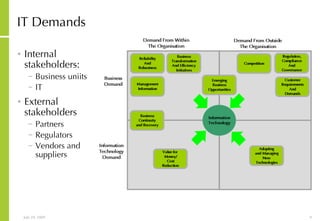
IT Demands Internal stakeholders: Business uniits IT External stakeholders Partners Regulators Vendors and suppliers
IT and Strategy Strongly believe that information technology is only a tool To be effective, it must be tightly linked to the underlying business Information Technology Strategy seeks to Align the priorities of IT with the priorities of the business Ensure that IT is capable of fulfilling its role in the business Align the characteristics of IT with those of the business Information Technology has significant leverage on the performance of an organisation An IT Strategy is a sensible and practical management action to gain control over this increasingly important element of the organisation
IT Strategy Information Technology Strategy provides benefits to the organisation Supports active management and leadership on the use of IT to support the business strategy Enhances management control over IT resources Maximises the value contribution of IT by ensuring alignment of the IT strategy with the business strategy IT strategy addresses two separate but interrelated sets of issues: Demand issues relate to what the business needs and wants from IT Supply issues relate to how the IT business area has to operate in order to satisfy business demand
IT Controls and Compliance IT Controls and Compliance IT must implement internal controls around how it operates The systems IT delivers to the business and the underlying business processes these systems actualise must be controlled – these are controls external to IT The de-facto standard for IT governance is COBIT C ontrol  Ob jectives for  I nformation and related  T echnology COBIT aims to be different from other quality and governance approaches in two ways: It is an IT governance framework and supporting set of tools that IT can use to bridge the gap between control requirements, technical issues and business risks It provides a detailed implementation structure and toolset that translates the framework theory into a practical and achievable deliverables
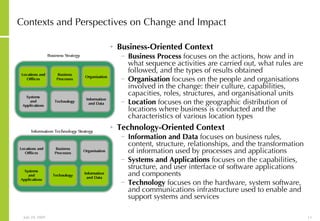
Contexts and Perspectives on Change and Impact Business-Oriented Context Business Process  focuses on the actions, how and in what sequence activities are carried out, what rules are followed, and the types of results obtained Organisation  focuses on the people and organisations involved in the change: their culture, capabilities, capacities, roles, structures, and organisational units Location  focuses on the geographic distribution of locations where business is conducted and the characteristics of various location types Technology-Oriented Context Information and Data  focuses on business rules, content, structure, relationships, and the transformation of information used by processes and applications Systems and Applications  focuses on the capabilities, structure, and user interface of software applications and components Technology  focuses on the hardware, system software, and communications infrastructure used to enable and support systems and services
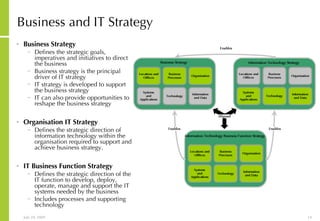
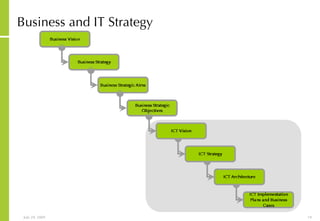
Business and IT Strategy Business Strategy Defines the strategic goals, imperatives and initiatives to direct the business Business strategy is the principal driver of IT strategy IT strategy is developed to support the business strategy IT can also provide opportunities to reshape the business strategy Organisation IT Strategy Defines the strategic direction of information technology within the organisation required to support and achieve business strategy. IT Business Function Strategy Defines the strategic direction of the IT function to develop, deploy, operate, manage and support the IT systems needed by the business Includes processes and supporting technology
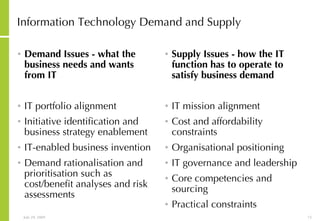
Information Technology Demand and Supply Demand Issues - what the business needs and wants from IT IT portfolio alignment  Initiative identification and business strategy enablement  IT-enabled business invention  Demand rationalisation and prioritisation such as cost/benefit analyses and risk assessments Supply Issues - how the IT function has to operate to satisfy business demand IT mission alignment  Cost and affordability constraints  Organisational positioning  IT governance and leadership  Core competencies and sourcing  Practical constraints
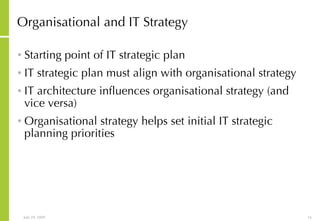
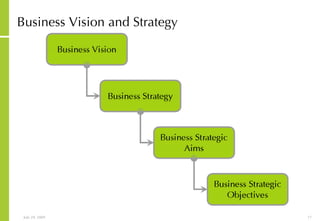
Organisational and IT Strategy Starting point of IT strategic plan IT strategic plan must align with organisational strategy IT architecture influences organisational strategy (and vice versa) Organisational strategy helps set initial IT strategic planning priorities
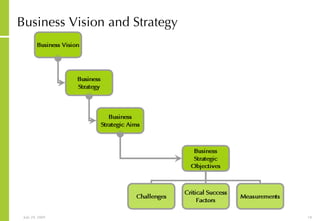
Business Vision and Strategy
Business and IT Strategy
IT Strategy Realisation Issues The strategy is unrealistic with regard to resources and investment The strategy is not consistent with the maturity of the business The strategy is not aligned with the strategic imperatives of the business The strategy contradicts the business culture
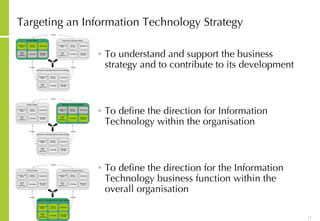
Targeting an Information Technology Strategy To understand and support the business strategy and to contribute to its development To define the direction for Information Technology within the organisation To define the direction for the Information Technology business function within the overall organisation
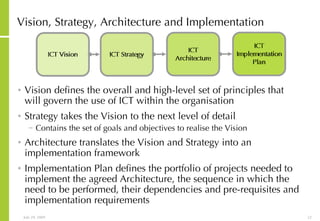
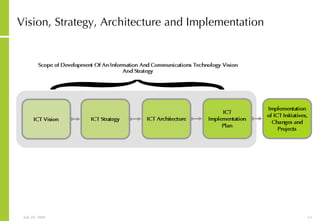
Vision, Strategy, Architecture and Implementation Vision defines the overall and high-level set of principles that will govern the use of ICT within the organisation Strategy takes the Vision to the next level of detail Contains the set of goals and objectives to realise the Vision Architecture translates the Vision and Strategy into an implementation framework Implementation Plan defines the portfolio of projects needed to implement the agreed Architecture, the sequence in which the need to be performed, their dependencies and pre-requisites and implementation requirements
Vision, Strategy, Architecture and Implementation
IT Vision Designed to meet challenges, both now and in the future Balancing the need to control costs, provide flexibility, reduce and manage risk and provide service and performance Develop an integrated IT framework Defined and costed a customised programme of work to achieve vision incrementally
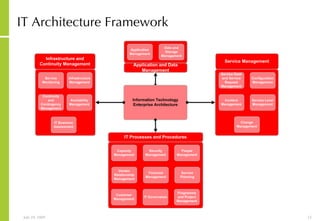
IT Architecture Framework
Service Management Information is a key strategic asset which the organisation needs to manage IT Service Management is the processes, methods, functions, roles and activities used to deliver value to the business in the form of services IT Service Management is a strategic asset, rather than an organisational capability Benefits of implementing Service Management Provide consistent service to users Measure level of service being provided Implement processes to ensure reliable IT service Enforce consistent management of IT systems and infrastructure Improve service reliability, reduce downtime Control costs Platform for organisation growth
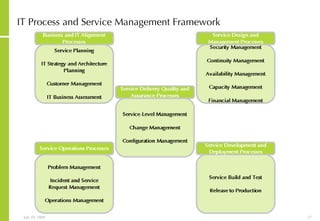
IT Process and Service Management Framework
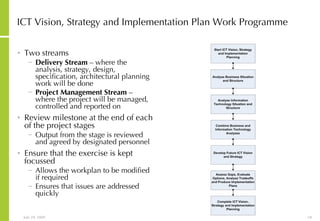
ICT Vision, Strategy and Implementation Plan Work Programme Two streams Delivery Stream  – where the analysis, strategy, design, specification, architectural planning work will be done Project Management Stream  – where the project will be managed, controlled and reported on Review milestone at the end of each of the project stages  Output from the stage is reviewed and agreed by designated personnel Ensure that the exercise is kept focussed Allows the workplan to be modified if required Ensures that issues are addressed quickly
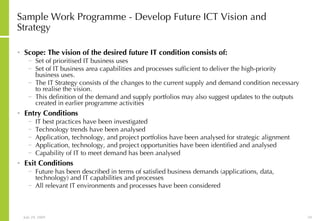
Sample Work Programme - Develop Future ICT Vision and Strategy Scope: The vision of the desired future IT condition consists of: Set of prioritised IT business uses  Set of IT business area capabilities and processes sufficient to deliver the high-priority business uses.  The IT Strategy consists of the changes to the current supply and demand condition necessary to realise the vision.  This definition of the demand and supply portfolios may also suggest updates to the outputs created in earlier programme activities Entry Conditions IT best practices have been investigated Technology trends have been analysed Application, technology, and project portfolios have been analysed for strategic alignment Application, technology, and project opportunities have been identified and analysed Capability of IT to meet demand has been analysed Exit Conditions Future has been described in terms of satisfied business demands (applications, data, technology) and IT capabilities and processes All relevant IT environments and processes have been considered
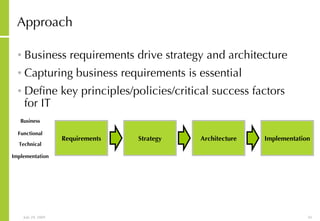
Approach Business requirements drive strategy and architecture  Capturing business requirements is essential Define key principles/policies/critical success factors for IT Requirements Strategy Architecture Implementation Business Functional Technical Implementation
ICT Vision and Strategy Deliverables Enterprise Architecture and Information and Communication Vision, Strategy  – translate the Strategic Aims and Strategic Objectives contained in the organisation’s Strategic Plan into an ICT oriented vision and strategy ICT Strategy Architecture  – translate the ICT Vision and Strategy into a physical architecture and associated sub-projects, initiatives and changes that will realise the overall strategy Suitable technologies will be identified Business cases for each project, initiative and change.  IT Architecture Implementation Plans  – overall implementation plan for the entire project and implementation plans for each constituent sub-project, initiative and change Project resources, dependencies and pre-requisites. Project Management and Delivery Documentation  – material generated during the life of the project
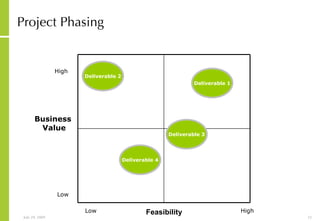
Project Phasing Feasibility Low Low High High Deliverable 1 Deliverable 2 Deliverable 3 Deliverable 4 Business  Value
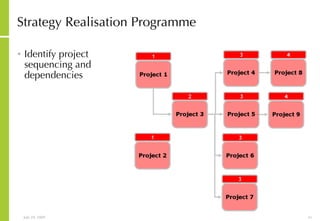
Strategy Realisation Programme Identify project sequencing and dependencies
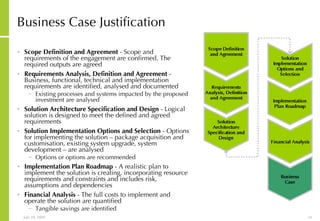
Business Case Justification Scope Definition and Agreement  - Scope and requirements of the engagement are confirmed. The required outputs are agreed Requirements Analysis, Definition and Agreement  - Business, functional, technical and implementation requirements are identified, analysed and documented Existing processes and systems impacted by the proposed investment are analysed Solution Architecture Specification and Design  - Logical solution is designed to meet the defined and agreed requirements Solution Implementation Options and Selection  - Options for implementing the solution – package acquisition and customisation, existing system upgrade, system development – are analysed Options or options are recommended Implementation Plan Roadmap  - A realistic plan to implement the solution is creating, incorporating resource requirements and constraints and includes risk, assumptions and dependencies Financial Analysis  - The full costs to implement and operate the solution are quantified Tangible savings are identified
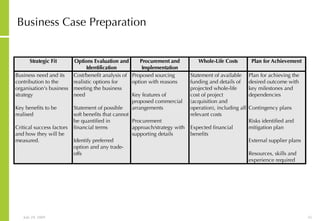
Business Case Preparation
Key Messages IT strategic plan is a key to obtaining necessary funds - worthwhile investment  IT strategic plan is an enabler of doing things better and doing better things Strategy development exercises can be short and cost-effective engagements – low cost, high-value Take a practical focussed, realistic, sensible, down-to-earth approach Develop realistic IT strategies IT strategy can unblock IT spending plans IT strategy is applicable across all business areas
More Information Alan McSweeney [email_address]

Ict Vision And Strategy Development

  • 1.
    ICT Vision andStrategy Development Alan McSweeney
  • 2.
    Objectives To describea view of and approach to developing an ICT strategy
  • 3.
    Agenda IT VisionIT Challenges and Trends View of IT Strategy Approach to Developing IT Strategy
  • 4.
    IT Vision Akey enabler of business Proactively respond to the IT needs of the organisation Implement flexible and agile systems and infrastructures and be flexible and agile in it dealings with the business Connected to and aligned with the business and its requirements Business Information Technology
  • 5.
    IT - CorePrinciples Recommends that IT define a core set of principles/policies: IT strategy will be developed and maintained in line with market analysis and key stakeholder requirements and IT strategy to be aligned with the organisation’s vision IT delivers core services to cost and quality standards IT as a function is controlled and compliant to industry standards Security will be embedded in IT IT enables flexible service delivery to users IT supports business growth IT supports and enables compliance in the wider organisation IT budgets will be developed and maintained for new services or improved IT Services
  • 6.
    IT Challenges andTrends General challenges and trends in information technology Information Security Management Identity and Access Management Conforming to Assurance and Compliance Standards Privacy Management Disaster Recovery Planning (DRP) and Business Continuity Management (BCM) IT Governance Securing and Controlling Information Distribution Mobile and Remote Computing Electronic Archiving and Data Retention Document, Forms, Content and Knowledge Management Training, Competency and Awareness Business Process Improvement, Workflow and Process Exception Alerts Improved Application and Data Integration Web Deployed Applications Enterprise System Management Business Intelligence (BI) Customer Relationship Management (CRM) Information Portals Environmental Concerns Infrastructure Optimisation Which ones are of interest to you? IT aware of and monitoring key technologies, trends and challenges to ensure that the organisation will be ready to respond to changes quickly and effectively Benchmarking against other industries and competitors Developing best practice
  • 7.
    IT Demands MitigateRisk Ensure security and continuity of internal business operations, while minimising exposure to external risk factors Maximise Return Improve business results; grow revenue and earnings, cash flow, and reduced cost of operations Improve Performance Improve business operations performance end-to-end across the enterprise Increase customer and employee satisfaction Increase Agility Enable the business organisation and operations to adapt to changing business needs
  • 8.
  • 9.
    IT Demands Internalstakeholders: Business uniits IT External stakeholders Partners Regulators Vendors and suppliers
  • 10.
    IT and StrategyStrongly believe that information technology is only a tool To be effective, it must be tightly linked to the underlying business Information Technology Strategy seeks to Align the priorities of IT with the priorities of the business Ensure that IT is capable of fulfilling its role in the business Align the characteristics of IT with those of the business Information Technology has significant leverage on the performance of an organisation An IT Strategy is a sensible and practical management action to gain control over this increasingly important element of the organisation
  • 11.
    IT Strategy InformationTechnology Strategy provides benefits to the organisation Supports active management and leadership on the use of IT to support the business strategy Enhances management control over IT resources Maximises the value contribution of IT by ensuring alignment of the IT strategy with the business strategy IT strategy addresses two separate but interrelated sets of issues: Demand issues relate to what the business needs and wants from IT Supply issues relate to how the IT business area has to operate in order to satisfy business demand
  • 12.
    IT Controls andCompliance IT Controls and Compliance IT must implement internal controls around how it operates The systems IT delivers to the business and the underlying business processes these systems actualise must be controlled – these are controls external to IT The de-facto standard for IT governance is COBIT C ontrol Ob jectives for I nformation and related T echnology COBIT aims to be different from other quality and governance approaches in two ways: It is an IT governance framework and supporting set of tools that IT can use to bridge the gap between control requirements, technical issues and business risks It provides a detailed implementation structure and toolset that translates the framework theory into a practical and achievable deliverables
  • 13.
    Contexts and Perspectiveson Change and Impact Business-Oriented Context Business Process focuses on the actions, how and in what sequence activities are carried out, what rules are followed, and the types of results obtained Organisation focuses on the people and organisations involved in the change: their culture, capabilities, capacities, roles, structures, and organisational units Location focuses on the geographic distribution of locations where business is conducted and the characteristics of various location types Technology-Oriented Context Information and Data focuses on business rules, content, structure, relationships, and the transformation of information used by processes and applications Systems and Applications focuses on the capabilities, structure, and user interface of software applications and components Technology focuses on the hardware, system software, and communications infrastructure used to enable and support systems and services
  • 14.
    Business and ITStrategy Business Strategy Defines the strategic goals, imperatives and initiatives to direct the business Business strategy is the principal driver of IT strategy IT strategy is developed to support the business strategy IT can also provide opportunities to reshape the business strategy Organisation IT Strategy Defines the strategic direction of information technology within the organisation required to support and achieve business strategy. IT Business Function Strategy Defines the strategic direction of the IT function to develop, deploy, operate, manage and support the IT systems needed by the business Includes processes and supporting technology
  • 15.
    Information Technology Demandand Supply Demand Issues - what the business needs and wants from IT IT portfolio alignment Initiative identification and business strategy enablement IT-enabled business invention Demand rationalisation and prioritisation such as cost/benefit analyses and risk assessments Supply Issues - how the IT function has to operate to satisfy business demand IT mission alignment Cost and affordability constraints Organisational positioning IT governance and leadership Core competencies and sourcing Practical constraints
  • 16.
    Organisational and ITStrategy Starting point of IT strategic plan IT strategic plan must align with organisational strategy IT architecture influences organisational strategy (and vice versa) Organisational strategy helps set initial IT strategic planning priorities
  • 17.
  • 18.
  • 19.
  • 20.
    IT Strategy RealisationIssues The strategy is unrealistic with regard to resources and investment The strategy is not consistent with the maturity of the business The strategy is not aligned with the strategic imperatives of the business The strategy contradicts the business culture
  • 21.
    Targeting an InformationTechnology Strategy To understand and support the business strategy and to contribute to its development To define the direction for Information Technology within the organisation To define the direction for the Information Technology business function within the overall organisation
  • 22.
    Vision, Strategy, Architectureand Implementation Vision defines the overall and high-level set of principles that will govern the use of ICT within the organisation Strategy takes the Vision to the next level of detail Contains the set of goals and objectives to realise the Vision Architecture translates the Vision and Strategy into an implementation framework Implementation Plan defines the portfolio of projects needed to implement the agreed Architecture, the sequence in which the need to be performed, their dependencies and pre-requisites and implementation requirements
  • 23.
  • 24.
    IT Vision Designedto meet challenges, both now and in the future Balancing the need to control costs, provide flexibility, reduce and manage risk and provide service and performance Develop an integrated IT framework Defined and costed a customised programme of work to achieve vision incrementally
  • 25.
  • 26.
    Service Management Informationis a key strategic asset which the organisation needs to manage IT Service Management is the processes, methods, functions, roles and activities used to deliver value to the business in the form of services IT Service Management is a strategic asset, rather than an organisational capability Benefits of implementing Service Management Provide consistent service to users Measure level of service being provided Implement processes to ensure reliable IT service Enforce consistent management of IT systems and infrastructure Improve service reliability, reduce downtime Control costs Platform for organisation growth
  • 27.
    IT Process andService Management Framework
  • 28.
    ICT Vision, Strategyand Implementation Plan Work Programme Two streams Delivery Stream – where the analysis, strategy, design, specification, architectural planning work will be done Project Management Stream – where the project will be managed, controlled and reported on Review milestone at the end of each of the project stages Output from the stage is reviewed and agreed by designated personnel Ensure that the exercise is kept focussed Allows the workplan to be modified if required Ensures that issues are addressed quickly
  • 29.
    Sample Work Programme- Develop Future ICT Vision and Strategy Scope: The vision of the desired future IT condition consists of: Set of prioritised IT business uses Set of IT business area capabilities and processes sufficient to deliver the high-priority business uses. The IT Strategy consists of the changes to the current supply and demand condition necessary to realise the vision. This definition of the demand and supply portfolios may also suggest updates to the outputs created in earlier programme activities Entry Conditions IT best practices have been investigated Technology trends have been analysed Application, technology, and project portfolios have been analysed for strategic alignment Application, technology, and project opportunities have been identified and analysed Capability of IT to meet demand has been analysed Exit Conditions Future has been described in terms of satisfied business demands (applications, data, technology) and IT capabilities and processes All relevant IT environments and processes have been considered
  • 30.
    Approach Business requirementsdrive strategy and architecture Capturing business requirements is essential Define key principles/policies/critical success factors for IT Requirements Strategy Architecture Implementation Business Functional Technical Implementation
  • 31.
    ICT Vision andStrategy Deliverables Enterprise Architecture and Information and Communication Vision, Strategy – translate the Strategic Aims and Strategic Objectives contained in the organisation’s Strategic Plan into an ICT oriented vision and strategy ICT Strategy Architecture – translate the ICT Vision and Strategy into a physical architecture and associated sub-projects, initiatives and changes that will realise the overall strategy Suitable technologies will be identified Business cases for each project, initiative and change. IT Architecture Implementation Plans – overall implementation plan for the entire project and implementation plans for each constituent sub-project, initiative and change Project resources, dependencies and pre-requisites. Project Management and Delivery Documentation – material generated during the life of the project
  • 32.
    Project Phasing FeasibilityLow Low High High Deliverable 1 Deliverable 2 Deliverable 3 Deliverable 4 Business Value
  • 33.
    Strategy Realisation ProgrammeIdentify project sequencing and dependencies
  • 34.
    Business Case JustificationScope Definition and Agreement - Scope and requirements of the engagement are confirmed. The required outputs are agreed Requirements Analysis, Definition and Agreement - Business, functional, technical and implementation requirements are identified, analysed and documented Existing processes and systems impacted by the proposed investment are analysed Solution Architecture Specification and Design - Logical solution is designed to meet the defined and agreed requirements Solution Implementation Options and Selection - Options for implementing the solution – package acquisition and customisation, existing system upgrade, system development – are analysed Options or options are recommended Implementation Plan Roadmap - A realistic plan to implement the solution is creating, incorporating resource requirements and constraints and includes risk, assumptions and dependencies Financial Analysis - The full costs to implement and operate the solution are quantified Tangible savings are identified
  • 35.
  • 36.
    Key Messages ITstrategic plan is a key to obtaining necessary funds - worthwhile investment IT strategic plan is an enabler of doing things better and doing better things Strategy development exercises can be short and cost-effective engagements – low cost, high-value Take a practical focussed, realistic, sensible, down-to-earth approach Develop realistic IT strategies IT strategy can unblock IT spending plans IT strategy is applicable across all business areas
  • 37.
    More Information AlanMcSweeney [email_address]