Mohamed Rashid
+919809209195
A brief introduction to Integrated
Marketing Communication (IMC)
What is marketing
 Marketing is defined by the American Marketing
Association (AMA) as
 "the activity, set of institutions, and processes for
creating, communicating, delivering, and
exchanging offerings that have value for
customers, clients, partners, and society at large."
 Advertising and sales promotion play an
important role in the exchange process by
informing consumers about an organisations
product/services and persuading them to
purchase to satisfy their needs and wants.
The Marketing Mix
 The marketing mix has been the key concept to
advertising. The marketing mix was suggested by
Jeremy McCarthy, professor at Harvard Business
School, in the 1960s.
 The four P’s-
Product, Price, Place(distribution), and Promotion
are the elements of Marketing Mix
 Marketers must combine these elements into a
cohesive marketing strategy.
 Many companies recognize the need to integrate
their various marketing communication
efforts, such as media advertising, direct
marketing, sales promotion, and public
relations, to achieve more effective marketing
communications.
Integrated Marketing
Communications
 Integrated Marketing Communications is a term
used to describe a holistic approach to marketing
communication.
 It aims to ensure consistency of message and
the complementary use of media.
 The concept includes online and offline marketing
channels.
 Online marketing channels include any e-
marketing campaigns or programs, from search
engine optimization (SEO), pay-per-
click, affiliate, email, banner to latest web related
channels for webinar, blog, micro-blogging, face
book marketing, RSS, podcast, Internet Radio
and Internet TV.
 Offline marketing channels are traditional print
(newspaper, magazine), mail order, public
relations, industry relations, billboard, radio, and
television.
 company develops its integrated marketing
communication programme using all the elements
of the marketing mix (product, price, place, and
promotion).
 An integration of all these promotional tools along
with other components of marketing mix to gain
edge over competitor is called Integrated
Marketing Communication.
Role of IMC in Branding
 A brand is the personality that identifies a
product, service or company
(name, term, sign, symbol, or design, or
combination of them) and how it relates to key
constituencies:
Customers, Staff, Partners, Investors etc.
 With more and more products and services
competing for consideration by customers who
have less and less time to make choices, well
known brand have a major competitive advantage
in today's market.
 There are many ways for a company to contact
the customer to provide them the information
about the co:
 The challenge is to understand how to use the
various IMC tools in an effective way in a right
combination.
Tools of IMC
 Advertising
 Direct Marketing
 Interactive/Internet Marketing
 Sales Promotion
 Publicity
 Public Relation
 Personal selling
Advertising
 Any paid form of nonpersonal communication
about an organization, product, service, or idea
by an identified sponsor.
Types of advertising
 Digital advertising
 Television advertising / Music in advertising
 Radio advertising
 Online advertising
 Product placements
 Physical advertising
 Press advertising
 Mobile billboard advertising
 In-store advertising
 Celebrity branding
Direct Marketing
 Traditionally this has not been considered as an
element of promotional mix.
 The development of IT and Internet have made
Direct Marketing a very powerful tool in marketing
mix
Channels of Direct Marketing
 Direct Marketing is much more than direct mail and
mail order catalog. It involves a verity of activities
including
 Database management
 Direct mail
 Telemarketing
 Email Marketing
 Door-to-Door Leaflet Marketing
 Broadcast faxing
 Voicemail Marketing
 Couponing
 Direct-response television marketing
 Direct selling
Interactive/Internet marketing
 The definition of interactive marketing comes from
John Deighton at Harvard, who says interactive
marketing is the ability to address the
customer, remember what the customer says and
address the customer again in a way that
illustrates that we remember what the customer
has told us (Deighton 1996).
 Interactive marketing is not synonymous with
online marketing, although interactive marketing
processes are facilitated by internet technology.
 Interactive media allow for a back-and-forth flow
of information whereby users can participate in
and modify the form and content of the
information they receive in real time.
 Unlike traditional forms of marketing
communication such as advertising, which are
one way oriented, the new media allows users to
perform a verity of functions such as receive and
alter the information and image, make
inquiries, respond to question, and ofcourse
make a purchase.
 Although internet is the primary media of
Interactive Marketing, There are other forms
which include
Sales Promotion
 Sales promotion is any initiative undertaken by an
organisation to promote an increase in
sales, usage or trial of a product or service (i.e.
initiatives that are not covered by the other
elements of the marketing communications or
promotions mix). It adds an extra value or
incentive to the sales force, the distributers, or the
ultimate consumer and can simulate immediate
sales.
 Sales promotions are varied. Often they are
original and creative, and hence a comprehensive
list of all available techniques is virtually
impossible.
 However it can be broken into two major
categories
 Consumer oriented sales promotion and
 Trade oriented sales promotion
 Consumer oriented sales promotion is targeted to
the ultimate user of a product or services and
includes
 couponing, samples, premiums, rebates, contests, s
weepstakes, and various point of purchase
materials.
 Trade oriented sales promotion is targeted towards
marketing intermediaries such as
wholesalers, distributers, and retailers.
 Promotion and merchandising allowances, price deals, sales
contests, and trade shows are some of the promotional tool
used.
Publicity
 Non-paid, non-personal communication to
promote the
organisation, products, services, idea or image of
the company not directly done under an identified
sponsorship.
 It usually comes in the form of a news
story, editorial, or announcement about an
organisation and/or its product and services.
 An advantage of publicity over other forms of
promotion is its credibility.
 Consumers generally tend to be less skeptical
towards favorable information about a product or
service when it comes from a source they believe
is unbiased.
 Publicity is not always under control of an
orgnisation and is sometimes unfavorable.
Public Relations
 Public Relations (or PR) is a field concerned with
maintaining public image for high-profile
people, commercial businesses and
organizations, non-profit associations or
programs.
 It defined the practice of public relations as "the
art and social science of analyzing
trends, predicting their consequences, counseling
organizational leaders, and implementing planned
programs of action, which will serve both the
organization and the public interest."
Publicity v/s Public Relations
 It is important to recognize the distinction
between publicity and public relations.
 When an organization systematically plans and
distributes information in an attempt to control
and manage its image and nature of the publicity
it receives, it is really engaged in a function
known as public relations.
Personal selling
 “Personal selling is oral communication with
potential buyers of a product with the intention of
making a sale. The personal selling may focus
initially on developing a relationship with the
potential buyer, but will always ultimately end with
an attempt to "close the sale“
 Personal selling is one of the oldest forms of
promotion.
 It involves the use of a sales force to support a
push strategy (encouraging intermediaries to buy
the product) or a pull strategy (where the role of
the sales force may be limited to supporting
retailers and providing after-sales service).
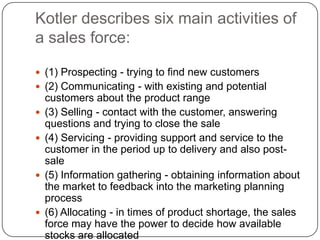
Kotler describes six main activities of
a sales force:
 (1) Prospecting - trying to find new customers
 (2) Communicating - with existing and potential
customers about the product range
 (3) Selling - contact with the customer, answering
questions and trying to close the sale
 (4) Servicing - providing support and service to the
customer in the period up to delivery and also post-
sale
 (5) Information gathering - obtaining information about
the market to feedback into the marketing planning
process
 (6) Allocating - in times of product shortage, the sales
force may have the power to decide how available
stocks are allocated
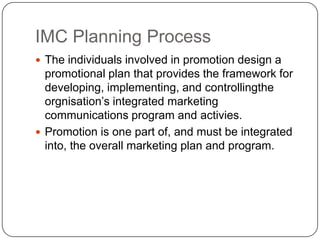
IMC Planning Process
 The individuals involved in promotion design a
promotional plan that provides the framework for
developing, implementing, and controllingthe
orgnisation’s integrated marketing
communications program and activies.
 Promotion is one part of, and must be integrated
into, the overall marketing plan and program.
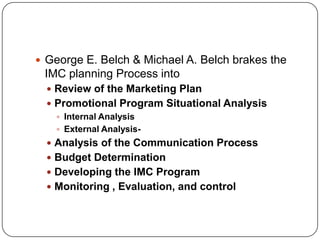
 George E. Belch & Michael A. Belch brakes the
IMC planning Process into
 Review of the Marketing Plan
 Promotional Program Situational Analysis
 Internal Analysis
 External Analysis-
 Analysis of the Communication Process
 Budget Determination
 Developing the IMC Program
 Monitoring , Evaluation, and control
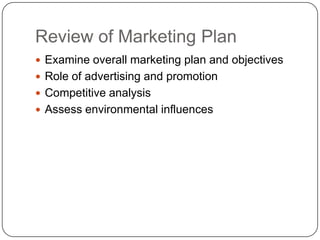
Review of Marketing Plan
 Examine overall marketing plan and objectives
 Role of advertising and promotion
 Competitive analysis
 Assess environmental influences
Analysis of Promotional Program
Situation
 Internal analysis
 Promotional department organization
 Firm’s ability to implement promotional program
 Agency evaluation and selection
 Review of previous program results
 External analysis
 Consumer behavior analysis
 Market segmentation and target marketing
 Market positioning
Analysis of Communication
Process
 Analyze receiver’s response processes
 Analyze source, message, channel factors
 Establish communications goals and objectives
Budget Determination
 Set tentative marketing communication budgets
 Allocate tentative budget
Develop IMC Program
 Advertising
 Set advertising objectives
 Determine advertising budget
 Develop advertising message
 Develop advertising media strategy
 Direct marketing
 Set direct marketing objectives
 Determine direct marketing budget
 Develop direct marketing message
 Develop direct marketing media strategy
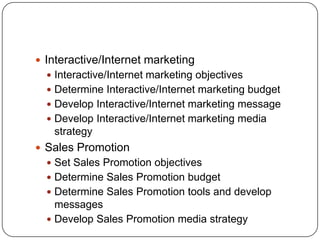
 Interactive/Internet marketing
 Interactive/Internet marketing objectives
 Determine Interactive/Internet marketing budget
 Develop Interactive/Internet marketing message
 Develop Interactive/Internet marketing media
strategy
 Sales Promotion
 Set Sales Promotion objectives
 Determine Sales Promotion budget
 Determine Sales Promotion tools and develop
messages
 Develop Sales Promotion media strategy
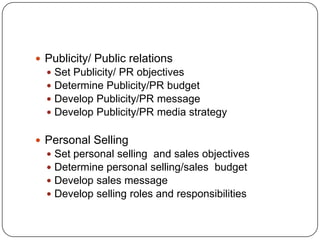
 Publicity/ Public relations
 Set Publicity/ PR objectives
 Determine Publicity/PR budget
 Develop Publicity/PR message
 Develop Publicity/PR media strategy
 Personal Selling
 Set personal selling and sales objectives
 Determine personal selling/sales budget
 Develop sales message
 Develop selling roles and responsibilities
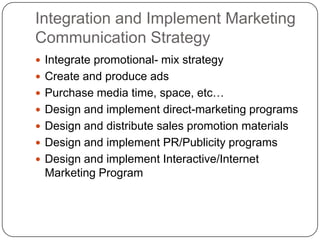
Integration and Implement Marketing
Communication Strategy
 Integrate promotional- mix strategy
 Create and produce ads
 Purchase media time, space, etc…
 Design and implement direct-marketing programs
 Design and distribute sales promotion materials
 Design and implement PR/Publicity programs
 Design and implement Interactive/Internet
Marketing Program
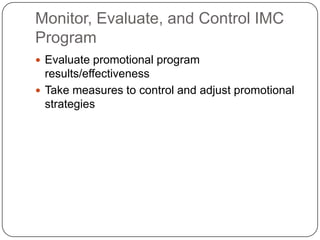
Monitor, Evaluate, and Control IMC
Program
 Evaluate promotional program
results/effectiveness
 Take measures to control and adjust promotional
strategies
References
 Advertising and promotion An Integrated
Marketing Communication Perspective
 – George E. Belch & Michael A. Belch
Thank You

A brief introductiontion ingrated marketing communication 12816463776467-phpapp02

  • 1.
    Mohamed Rashid +919809209195 A briefintroduction to Integrated Marketing Communication (IMC)
  • 2.
    What is marketing Marketing is defined by the American Marketing Association (AMA) as  "the activity, set of institutions, and processes for creating, communicating, delivering, and exchanging offerings that have value for customers, clients, partners, and society at large."
  • 3.
     Advertising andsales promotion play an important role in the exchange process by informing consumers about an organisations product/services and persuading them to purchase to satisfy their needs and wants.
  • 4.
    The Marketing Mix The marketing mix has been the key concept to advertising. The marketing mix was suggested by Jeremy McCarthy, professor at Harvard Business School, in the 1960s.  The four P’s- Product, Price, Place(distribution), and Promotion are the elements of Marketing Mix  Marketers must combine these elements into a cohesive marketing strategy.
  • 5.
     Many companiesrecognize the need to integrate their various marketing communication efforts, such as media advertising, direct marketing, sales promotion, and public relations, to achieve more effective marketing communications.
  • 6.
    Integrated Marketing Communications  IntegratedMarketing Communications is a term used to describe a holistic approach to marketing communication.  It aims to ensure consistency of message and the complementary use of media.  The concept includes online and offline marketing channels.
  • 7.
     Online marketingchannels include any e- marketing campaigns or programs, from search engine optimization (SEO), pay-per- click, affiliate, email, banner to latest web related channels for webinar, blog, micro-blogging, face book marketing, RSS, podcast, Internet Radio and Internet TV.  Offline marketing channels are traditional print (newspaper, magazine), mail order, public relations, industry relations, billboard, radio, and television.
  • 8.
     company developsits integrated marketing communication programme using all the elements of the marketing mix (product, price, place, and promotion).  An integration of all these promotional tools along with other components of marketing mix to gain edge over competitor is called Integrated Marketing Communication.
  • 9.
    Role of IMCin Branding  A brand is the personality that identifies a product, service or company (name, term, sign, symbol, or design, or combination of them) and how it relates to key constituencies: Customers, Staff, Partners, Investors etc.  With more and more products and services competing for consideration by customers who have less and less time to make choices, well known brand have a major competitive advantage in today's market.
  • 10.
     There aremany ways for a company to contact the customer to provide them the information about the co:  The challenge is to understand how to use the various IMC tools in an effective way in a right combination.
  • 11.
    Tools of IMC Advertising  Direct Marketing  Interactive/Internet Marketing  Sales Promotion  Publicity  Public Relation  Personal selling
  • 12.
    Advertising  Any paidform of nonpersonal communication about an organization, product, service, or idea by an identified sponsor.
  • 13.
    Types of advertising Digital advertising  Television advertising / Music in advertising  Radio advertising  Online advertising  Product placements  Physical advertising  Press advertising  Mobile billboard advertising  In-store advertising  Celebrity branding
  • 14.
    Direct Marketing  Traditionallythis has not been considered as an element of promotional mix.  The development of IT and Internet have made Direct Marketing a very powerful tool in marketing mix
  • 15.
    Channels of DirectMarketing  Direct Marketing is much more than direct mail and mail order catalog. It involves a verity of activities including  Database management  Direct mail  Telemarketing  Email Marketing  Door-to-Door Leaflet Marketing  Broadcast faxing  Voicemail Marketing  Couponing  Direct-response television marketing  Direct selling
  • 16.
    Interactive/Internet marketing  Thedefinition of interactive marketing comes from John Deighton at Harvard, who says interactive marketing is the ability to address the customer, remember what the customer says and address the customer again in a way that illustrates that we remember what the customer has told us (Deighton 1996).  Interactive marketing is not synonymous with online marketing, although interactive marketing processes are facilitated by internet technology.
  • 17.
     Interactive mediaallow for a back-and-forth flow of information whereby users can participate in and modify the form and content of the information they receive in real time.  Unlike traditional forms of marketing communication such as advertising, which are one way oriented, the new media allows users to perform a verity of functions such as receive and alter the information and image, make inquiries, respond to question, and ofcourse make a purchase.  Although internet is the primary media of Interactive Marketing, There are other forms which include
  • 18.
    Sales Promotion  Salespromotion is any initiative undertaken by an organisation to promote an increase in sales, usage or trial of a product or service (i.e. initiatives that are not covered by the other elements of the marketing communications or promotions mix). It adds an extra value or incentive to the sales force, the distributers, or the ultimate consumer and can simulate immediate sales.
  • 19.
     Sales promotionsare varied. Often they are original and creative, and hence a comprehensive list of all available techniques is virtually impossible.  However it can be broken into two major categories  Consumer oriented sales promotion and  Trade oriented sales promotion
  • 20.
     Consumer orientedsales promotion is targeted to the ultimate user of a product or services and includes  couponing, samples, premiums, rebates, contests, s weepstakes, and various point of purchase materials.  Trade oriented sales promotion is targeted towards marketing intermediaries such as wholesalers, distributers, and retailers.  Promotion and merchandising allowances, price deals, sales contests, and trade shows are some of the promotional tool used.
  • 21.
    Publicity  Non-paid, non-personalcommunication to promote the organisation, products, services, idea or image of the company not directly done under an identified sponsorship.  It usually comes in the form of a news story, editorial, or announcement about an organisation and/or its product and services.
  • 22.
     An advantageof publicity over other forms of promotion is its credibility.  Consumers generally tend to be less skeptical towards favorable information about a product or service when it comes from a source they believe is unbiased.  Publicity is not always under control of an orgnisation and is sometimes unfavorable.
  • 23.
    Public Relations  PublicRelations (or PR) is a field concerned with maintaining public image for high-profile people, commercial businesses and organizations, non-profit associations or programs.  It defined the practice of public relations as "the art and social science of analyzing trends, predicting their consequences, counseling organizational leaders, and implementing planned programs of action, which will serve both the organization and the public interest."
  • 24.
    Publicity v/s PublicRelations  It is important to recognize the distinction between publicity and public relations.  When an organization systematically plans and distributes information in an attempt to control and manage its image and nature of the publicity it receives, it is really engaged in a function known as public relations.
  • 25.
    Personal selling  “Personalselling is oral communication with potential buyers of a product with the intention of making a sale. The personal selling may focus initially on developing a relationship with the potential buyer, but will always ultimately end with an attempt to "close the sale“  Personal selling is one of the oldest forms of promotion.  It involves the use of a sales force to support a push strategy (encouraging intermediaries to buy the product) or a pull strategy (where the role of the sales force may be limited to supporting retailers and providing after-sales service).
  • 26.
    Kotler describes sixmain activities of a sales force:  (1) Prospecting - trying to find new customers  (2) Communicating - with existing and potential customers about the product range  (3) Selling - contact with the customer, answering questions and trying to close the sale  (4) Servicing - providing support and service to the customer in the period up to delivery and also post- sale  (5) Information gathering - obtaining information about the market to feedback into the marketing planning process  (6) Allocating - in times of product shortage, the sales force may have the power to decide how available stocks are allocated
  • 27.
    IMC Planning Process The individuals involved in promotion design a promotional plan that provides the framework for developing, implementing, and controllingthe orgnisation’s integrated marketing communications program and activies.  Promotion is one part of, and must be integrated into, the overall marketing plan and program.
  • 28.
     George E.Belch & Michael A. Belch brakes the IMC planning Process into  Review of the Marketing Plan  Promotional Program Situational Analysis  Internal Analysis  External Analysis-  Analysis of the Communication Process  Budget Determination  Developing the IMC Program  Monitoring , Evaluation, and control
  • 29.
    Review of MarketingPlan  Examine overall marketing plan and objectives  Role of advertising and promotion  Competitive analysis  Assess environmental influences
  • 30.
    Analysis of PromotionalProgram Situation  Internal analysis  Promotional department organization  Firm’s ability to implement promotional program  Agency evaluation and selection  Review of previous program results  External analysis  Consumer behavior analysis  Market segmentation and target marketing  Market positioning
  • 31.
    Analysis of Communication Process Analyze receiver’s response processes  Analyze source, message, channel factors  Establish communications goals and objectives
  • 32.
    Budget Determination  Settentative marketing communication budgets  Allocate tentative budget
  • 33.
    Develop IMC Program Advertising  Set advertising objectives  Determine advertising budget  Develop advertising message  Develop advertising media strategy  Direct marketing  Set direct marketing objectives  Determine direct marketing budget  Develop direct marketing message  Develop direct marketing media strategy
  • 34.
     Interactive/Internet marketing Interactive/Internet marketing objectives  Determine Interactive/Internet marketing budget  Develop Interactive/Internet marketing message  Develop Interactive/Internet marketing media strategy  Sales Promotion  Set Sales Promotion objectives  Determine Sales Promotion budget  Determine Sales Promotion tools and develop messages  Develop Sales Promotion media strategy
  • 35.
     Publicity/ Publicrelations  Set Publicity/ PR objectives  Determine Publicity/PR budget  Develop Publicity/PR message  Develop Publicity/PR media strategy  Personal Selling  Set personal selling and sales objectives  Determine personal selling/sales budget  Develop sales message  Develop selling roles and responsibilities
  • 36.
    Integration and ImplementMarketing Communication Strategy  Integrate promotional- mix strategy  Create and produce ads  Purchase media time, space, etc…  Design and implement direct-marketing programs  Design and distribute sales promotion materials  Design and implement PR/Publicity programs  Design and implement Interactive/Internet Marketing Program
  • 37.
    Monitor, Evaluate, andControl IMC Program  Evaluate promotional program results/effectiveness  Take measures to control and adjust promotional strategies
  • 38.
    References  Advertising andpromotion An Integrated Marketing Communication Perspective  – George E. Belch & Michael A. Belch
  • 39.