Promotion and Integrated Marketing
Communication
Advertising
Public Relations/ Publicity
Personal Selling
Sales Promotion
Direct Marketing
Chapters 12, 13 & 14
MARKETING COMMUNICATIONS
•• MARKETER INITIATED TECHNIQUES USED TO
MARKETER INITIATED TECHNIQUES USED TO
SET UP CHANNELS OF INFORMATION AND
PERSUASION WITH TARGETED AUDIENCES
TO INFLUENCE ATTITUDES AND BEHAVIOR
“Promotion”
“Promotion”
 Message and Media
 Message and Media
•• MARKETING COMMUNICATIONS MIX
MARKETING COMMUNICATIONS MIX
“Tool Box” of Media and Techniques
 Integration and Coordination
 Based on Communications Model
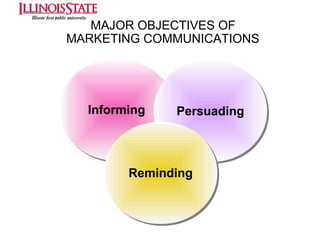
MAJOR OBJECTIVES OF
MARKETING COMMUNICATIONS

Informing
Informing

Persuading
Persuading

Reminding
Reminding
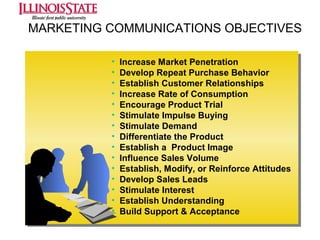
MARKETING COMMUNICATIONS OBJECTIVES
•
•
•
•
•
•
•
•
•
•
•
•
•
•
•

Increase Market Penetration
Develop Repeat Purchase Behavior
Establish Customer Relationships
Increase Rate of Consumption
Encourage Product Trial
Stimulate Impulse Buying
Stimulate Demand
Differentiate the Product
Establish a Product Image
Influence Sales Volume
Establish, Modify, or Reinforce Attitudes
Develop Sales Leads
Stimulate Interest
Establish Understanding
Build Support & Acceptance
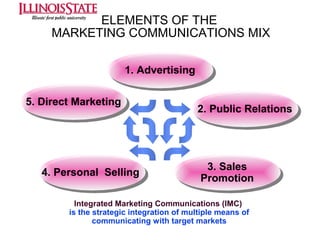
ELEMENTS OF THE
MARKETING COMMUNICATIONS MIX
1. Advertising
1. Advertising
5. Direct Marketing
5. Direct Marketing

4. Personal Selling
4. Personal Selling

2. Public Relations
2. Public Relations

3. Sales
3. Sales
Promotion
Promotion

Integrated Marketing Communications (IMC)
is the strategic integration of multiple means of
communicating with target markets
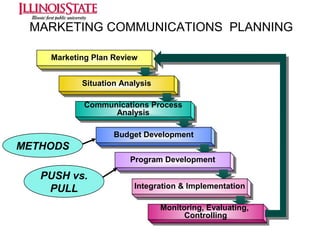
MARKETING COMMUNICATIONS PLANNING
Marketing Plan Review
Situation Analysis
Situation Analysis
Communications Process
Analysis
Analysis

METHODS

Budget Development
Budget Development
Program Development
Program Development

PUSH vs.
PULL

Integration & Implementation
Monitoring, Evaluating,
Controlling
Controlling
Push and Pull Strategies

• Push strategy is directed toward the
channel members
– Provide incentives for those in the
distribution channels to buy the product

• Pull strategy is directed toward the
ultimate purchaser
– The focus is on creating demand at the
household or ultimate consumer level
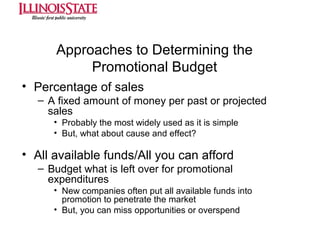
Approaches to Determining the
Promotional Budget
• Percentage of sales
– A fixed amount of money per past or projected
sales
• Probably the most widely used as it is simple
• But, what about cause and effect?

• All available funds/All you can afford
– Budget what is left over for promotional
expenditures
• New companies often put all available funds into
promotion to penetrate the market
• But, you can miss opportunities or overspend
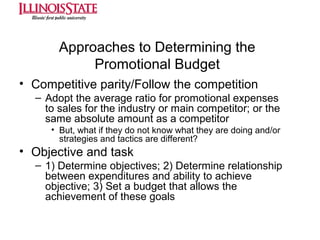
Approaches to Determining the
Promotional Budget
• Competitive parity/Follow the competition
– Adopt the average ratio for promotional expenses
to sales for the industry or main competitor; or the
same absolute amount as a competitor
• But, what if they do not know what they are doing and/or
strategies and tactics are different?

• Objective and task
– 1) Determine objectives; 2) Determine relationship
between expenditures and ability to achieve
objective; 3) Set a budget that allows the
achievement of these goals
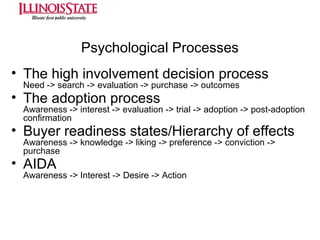
Psychological Processes
• The high involvement decision process
Need -> search -> evaluation -> purchase -> outcomes

• The adoption process

Awareness -> interest -> evaluation -> trial -> adoption -> post-adoption
confirmation

• Buyer readiness states/Hierarchy of effects
Awareness -> knowledge -> liking -> preference -> conviction ->
purchase

• AIDA

Awareness -> Interest -> Desire -> Action
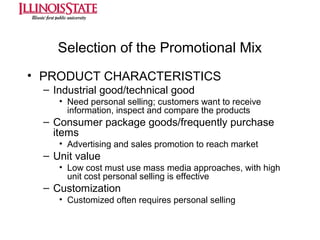
Selection of the Promotional Mix
• PRODUCT CHARACTERISTICS
– Industrial good/technical good
• Need personal selling; customers want to receive
information, inspect and compare the products

– Consumer package goods/frequently purchase
items
• Advertising and sales promotion to reach market

– Unit value
• Low cost must use mass media approaches, with high
unit cost personal selling is effective

– Customization
• Customized often requires personal selling
Selection of the Promotional Mix
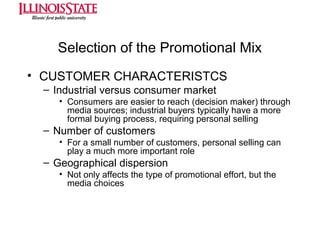
• CUSTOMER CHARACTERISTCS
– Industrial versus consumer market
• Consumers are easier to reach (decision maker) through
media sources; industrial buyers typically have a more
formal buying process, requiring personal selling

– Number of customers
• For a small number of customers, personal selling can
play a much more important role

– Geographical dispersion
• Not only affects the type of promotional effort, but the
media choices
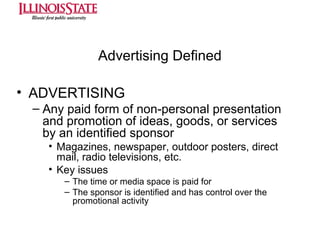
Advertising Defined
• ADVERTISING
– Any paid form of non-personal presentation
and promotion of ideas, goods, or services
by an identified sponsor
• Magazines, newspaper, outdoor posters, direct
mail, radio televisions, etc.
• Key issues
– The time or media space is paid for
– The sponsor is identified and has control over the
promotional activity
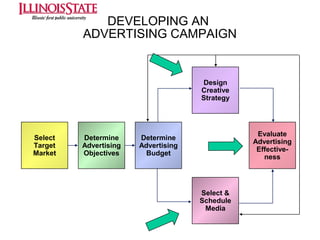
DEVELOPING AN
ADVERTISING CAMPAIGN

Design
Creative
Strategy

Select
Target
Market

Determine
Advertising
Objectives

Evaluate
Advertising
Effectiveness

Determine
Advertising
Budget

Select &
Schedule
Media
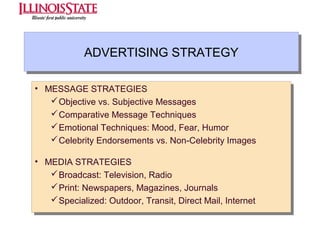
ADVERTISING STRATEGY
•• MESSAGE STRATEGIES
MESSAGE STRATEGIES
 Objective vs. Subjective Messages
 Comparative Message Techniques
 Emotional Techniques: Mood, Fear, Humor
 Celebrity Endorsements vs. Non-Celebrity Images
•• MEDIA STRATEGIES
MEDIA STRATEGIES
 Broadcast: Television, Radio
 Print: Newspapers, Magazines, Journals
 Specialized: Outdoor, Transit, Direct Mail, Internet
ADVERTISING STRATEGY
•• RELATIVE STRENGTHS AND WEAKNESSES OF
RELATIVE STRENGTHS AND WEAKNESSES OF
STRATEGIES
STRATEGIES
Effectiveness and Efficiency: Reach and
Frequency
Frequency
Target Capabilities
Cost
Cost
Believability
Believability
Appropriateness for Message (Image, Details)
Reach & Frequency
• Reach: number of different target consumers
who are exposed to a message at least once
during a specific period of time
• Frequency: number of times an individual is
exposed to a given message during a specific
period of time
• Cost per contact: cost of reaching one
member of the target market
– Allows comparison across advertising strategy
vehicles
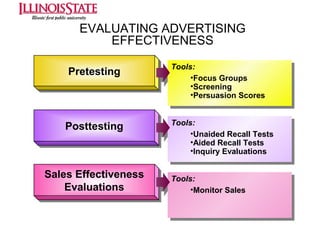
EVALUATING ADVERTISING
EFFECTIVENESS
Pretesting
Pretesting

Posttesting
Posttesting

Sales Effectiveness
Sales Effectiveness
Evaluations
Evaluations

Tools:
•Focus Groups
•Screening
•Persuasion Scores
Tools:
•Unaided Recall Tests
•Aided Recall Tests
•Inquiry Evaluations
Tools:
•Monitor Sales
PUBLIC RELATIONS
PUBLIC RELATIONS
•• EFFORTS TO IMPROVE AND MANAGE
EFFORTS TO IMPROVE AND MANAGE
RELATIONSHIPS WITH PUBLICS
Customers
Customers
Stock Holders
Stock Holders
Community
Community
Government
Government
News Media
News Media
•• PROACTIVE vs. REACTIVE
PROACTIVE vs. REACTIVE
DuPont vs. Exxon
DuPont vs. Exxon
•• PUBLICITY
PUBLICITY
Not Overtly Sponsored
High Credibility
High Credibility
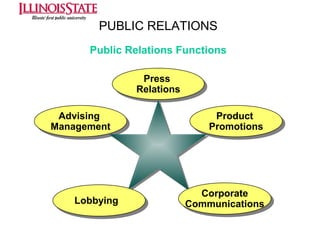
PUBLIC RELATIONS
Public Relations Functions
Press
Press
Relations
Relations
Advising
Advising
Management
Management

Lobbying
Lobbying

Product
Product
Promotions
Promotions

Corporate
Corporate
Communications
Communications
Personal Selling
• PERSONAL SELLING
– Oral presentation in a conversation with one or more
prospective purchasers for the purpose of making a
sale
– Personal selling represents the most popular
promotional effort in terms of financial expenditures
and number of people employed
– Personal Selling is:
• (1) Dyadic, (2) Flexible, (3) Focused (personalized), and (4)
Often results directly in a sale
• Other promotional elements move the customer toward the
sale, personal selling closes the sale
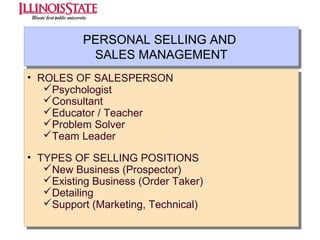
PERSONAL SELLING AND
SALES MANAGEMENT
SALES MANAGEMENT
•• FUNCTIONS AND CONTRIBUTIONS OF
FUNCTIONS AND CONTRIBUTIONS OF
PERSONAL SELLING
PERSONAL SELLING
“Boundary Spanner” Role, Relationship
Management (Trust)
Management (Trust)
Two-Way Information Channel (Diffusion
of Product and Market Information)
Facilitate Exchange
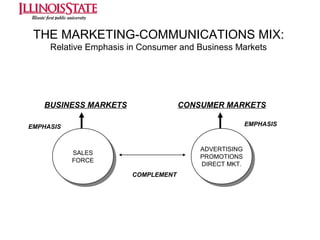
THE MARKETING-COMMUNICATIONS MIX:
Relative Emphasis in Consumer and Business Markets

BUSINESS MARKETS

CONSUMER MARKETS
EMPHASIS

EMPHASIS

ADVERTISING
ADVERTISING
PROMOTIONS
PROMOTIONS
DIRECT MKT.
DIRECT MKT.

SALES
SALES
FORCE
FORCE
COMPLEMENT
PERSONAL SELLING AND
SALES MANAGEMENT
SALES MANAGEMENT
•• ROLES OF SALESPERSON
ROLES OF SALESPERSON
Psychologist
Psychologist
Consultant
Consultant
Educator // Teacher
Educator Teacher
Problem Solver
Problem Solver
Team Leader
Team Leader
•• TYPES OF SELLING POSITIONS
TYPES OF SELLING POSITIONS
New Business (Prospector)
Existing Business (Order Taker)
Detailing
Detailing
Support (Marketing, Technical)
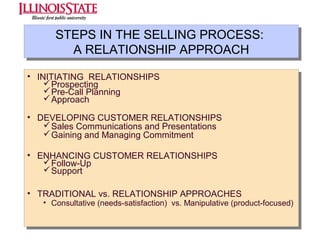
STEPS IN THE SELLING PROCESS:
A RELATIONSHIP APPROACH
•• INITIATING RELATIONSHIPS
INITIATING RELATIONSHIPS
 Prospecting
 Prospecting
 Pre-Call Planning
 Pre-Call
 ApproachPlanning
 Approach
•• DEVELOPING CUSTOMER RELATIONSHIPS
DEVELOPING CUSTOMER RELATIONSHIPS
 Sales Communications and Presentations
 Gaining and Managing Commitment
•• ENHANCING CUSTOMER RELATIONSHIPS
ENHANCING CUSTOMER RELATIONSHIPS
 Follow-Up
 Follow-Up
 Support
 Support
•• TRADITIONAL vs. RELATIONSHIP APPROACHES
TRADITIONAL vs. RELATIONSHIP APPROACHES

•• Consultative (needs-satisfaction) vs. Manipulative (product-focused)
Consultative (needs-satisfaction) vs. Manipulative (product-focused)
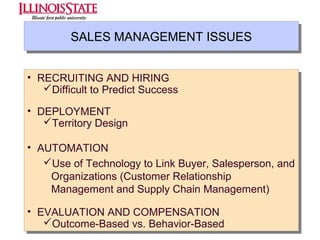
SALES MANAGEMENT ISSUES
•• RECRUITING AND HIRING
RECRUITING AND HIRING
Difficult to Predict Success
•• DEPLOYMENT
DEPLOYMENT
Territory Design
Territory Design
•• AUTOMATION
AUTOMATION
Use of Technology to Link Buyer, Salesperson, and
Organizations (Customer Relationship
Management and Supply Chain Management)
•• EVALUATION AND COMPENSATION
EVALUATION AND COMPENSATION
Outcome-Based vs. Behavior-Based
Sales Promotion
• SALES PROMOTION
– Those marketing activities - other than
advertising, public relations/publicity, and
personal selling - that stimulate consumer
purchasing and dealer effectiveness
• Displays, shows and exhibitions, coupons,
contests, samples
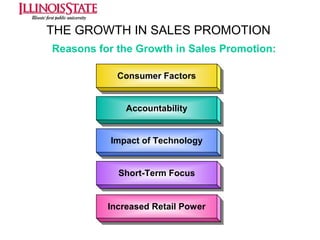
THE GROWTH IN SALES PROMOTION
Reasons for the Growth in Sales Promotion:
Consumer Factors
Consumer Factors
Accountability
Accountability
Impact of Technology
Short-Term Focus
Short-Term Focus
Increased Retail Power
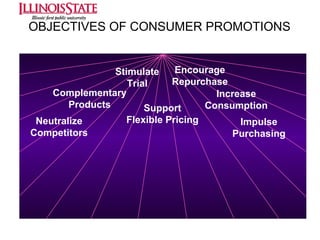
OBJECTIVES OF CONSUMER PROMOTIONS
Encourage
Stimulate
Repurchase
Trial
Complementary
Increase
Products
Consumption
Support
Flexible Pricing
Neutralize
Impulse
Competitors
Purchasing
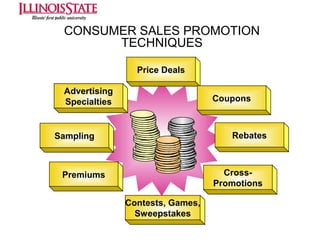
CONSUMER SALES PROMOTION
TECHNIQUES
Price Deals
Advertising
Specialties

Coupons

Rebates

Sampling

CrossPromotions

Premiums
Contests, Games,
Sweepstakes
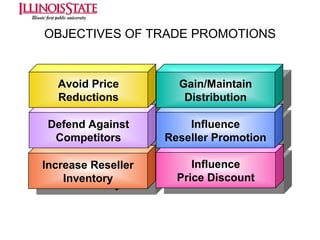
OBJECTIVES OF TRADE PROMOTIONS

Avoid Price
Avoid Price
Reductions
Reductions

Gain/Maintain
Gain/Maintain
Distribution
Distribution

Defend Against
Defend Against
Competitors
Competitors

Influence
Influence
Reseller Promotion
Reseller Promotion

Increase Reseller
Increase Reseller
Inventory
Inventory

Influence
Influence
Price Discount
Price Discount
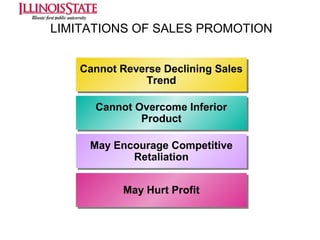
LIMITATIONS OF SALES PROMOTION
Cannot Reverse Declining Sales
Trend
Trend
Cannot Overcome Inferior
Product
Product
May Encourage Competitive
Retaliation
Retaliation
May Hurt Profit
May Hurt Profit
Direct Marketing
• Techniques used to get consumers to
make a purchase from their home,
office or other nonretail setting
– Direct mail, catalogs, mail order,
telemarketing, electronic retailing
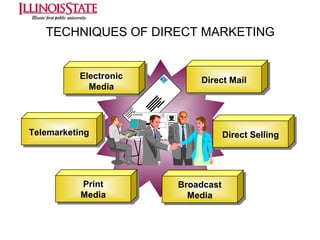
TECHNIQUES OF DIRECT MARKETING

Electronic
Electronic
Media
Media

Telemarketing
Telemarketing

Print
Print
Media
Media

Direct Mail
Direct Mail

Direct Selling
Direct Selling

Broadcast
Broadcast
Media
Media

Ronalyn correa

  • 1.
    Promotion and IntegratedMarketing Communication Advertising Public Relations/ Publicity Personal Selling Sales Promotion Direct Marketing Chapters 12, 13 & 14
  • 2.
    MARKETING COMMUNICATIONS MARKETING COMMUNICATIONS ••MARKETER INITIATED TECHNIQUES USED TO MARKETER INITIATED TECHNIQUES USED TO SET UP CHANNELS OF INFORMATION AND SET UP CHANNELS OF INFORMATION AND PERSUASION WITH TARGETED AUDIENCES PERSUASION WITH TARGETED AUDIENCES TO INFLUENCE ATTITUDES AND BEHAVIOR TO INFLUENCE ATTITUDES AND BEHAVIOR “Promotion” “Promotion”  Message and Media  Message and Media •• MARKETING COMMUNICATIONS MIX MARKETING COMMUNICATIONS MIX “Tool Box” of Media and Techniques “Tool Box” of Media and Techniques  Integration and Coordination  Integration and Coordination  Based on Communications Model  Based on Communications Model
  • 3.
    MAJOR OBJECTIVES OF MARKETINGCOMMUNICATIONS Informing Informing Persuading Persuading Reminding Reminding
  • 4.
    MARKETING COMMUNICATIONS OBJECTIVES • • • • • • • • • • • • • • • IncreaseMarket Penetration Develop Repeat Purchase Behavior Establish Customer Relationships Increase Rate of Consumption Encourage Product Trial Stimulate Impulse Buying Stimulate Demand Differentiate the Product Establish a Product Image Influence Sales Volume Establish, Modify, or Reinforce Attitudes Develop Sales Leads Stimulate Interest Establish Understanding Build Support & Acceptance
  • 5.
    ELEMENTS OF THE MARKETINGCOMMUNICATIONS MIX 1. Advertising 1. Advertising 5. Direct Marketing 5. Direct Marketing 4. Personal Selling 4. Personal Selling 2. Public Relations 2. Public Relations 3. Sales 3. Sales Promotion Promotion Integrated Marketing Communications (IMC) is the strategic integration of multiple means of communicating with target markets
  • 6.
    MARKETING COMMUNICATIONS PLANNING MarketingPlan Review Marketing Plan Review Situation Analysis Situation Analysis Communications Process Communications Process Analysis Analysis METHODS Budget Development Budget Development Program Development Program Development PUSH vs. PULL Integration & Implementation Integration & Implementation Monitoring, Evaluating, Monitoring, Evaluating, Controlling Controlling
  • 7.
    Push and PullStrategies • Push strategy is directed toward the channel members – Provide incentives for those in the distribution channels to buy the product • Pull strategy is directed toward the ultimate purchaser – The focus is on creating demand at the household or ultimate consumer level
  • 8.
    Approaches to Determiningthe Promotional Budget • Percentage of sales – A fixed amount of money per past or projected sales • Probably the most widely used as it is simple • But, what about cause and effect? • All available funds/All you can afford – Budget what is left over for promotional expenditures • New companies often put all available funds into promotion to penetrate the market • But, you can miss opportunities or overspend
  • 9.
    Approaches to Determiningthe Promotional Budget • Competitive parity/Follow the competition – Adopt the average ratio for promotional expenses to sales for the industry or main competitor; or the same absolute amount as a competitor • But, what if they do not know what they are doing and/or strategies and tactics are different? • Objective and task – 1) Determine objectives; 2) Determine relationship between expenditures and ability to achieve objective; 3) Set a budget that allows the achievement of these goals
  • 10.
    Psychological Processes • Thehigh involvement decision process Need -> search -> evaluation -> purchase -> outcomes • The adoption process Awareness -> interest -> evaluation -> trial -> adoption -> post-adoption confirmation • Buyer readiness states/Hierarchy of effects Awareness -> knowledge -> liking -> preference -> conviction -> purchase • AIDA Awareness -> Interest -> Desire -> Action
  • 11.
    Selection of thePromotional Mix • PRODUCT CHARACTERISTICS – Industrial good/technical good • Need personal selling; customers want to receive information, inspect and compare the products – Consumer package goods/frequently purchase items • Advertising and sales promotion to reach market – Unit value • Low cost must use mass media approaches, with high unit cost personal selling is effective – Customization • Customized often requires personal selling
  • 12.
    Selection of thePromotional Mix • CUSTOMER CHARACTERISTCS – Industrial versus consumer market • Consumers are easier to reach (decision maker) through media sources; industrial buyers typically have a more formal buying process, requiring personal selling – Number of customers • For a small number of customers, personal selling can play a much more important role – Geographical dispersion • Not only affects the type of promotional effort, but the media choices
  • 13.
    Advertising Defined • ADVERTISING –Any paid form of non-personal presentation and promotion of ideas, goods, or services by an identified sponsor • Magazines, newspaper, outdoor posters, direct mail, radio televisions, etc. • Key issues – The time or media space is paid for – The sponsor is identified and has control over the promotional activity
  • 14.
  • 15.
    ADVERTISING STRATEGY ADVERTISING STRATEGY ••MESSAGE STRATEGIES MESSAGE STRATEGIES  Objective vs. Subjective Messages  Objective vs. Subjective Messages  Comparative Message Techniques  Comparative Message Techniques  Emotional Techniques: Mood, Fear, Humor  Emotional Techniques: Mood, Fear, Humor  Celebrity Endorsements vs. Non-Celebrity Images  Celebrity Endorsements vs. Non-Celebrity Images •• MEDIA STRATEGIES MEDIA STRATEGIES  Broadcast: Television, Radio  Broadcast: Television, Radio  Print: Newspapers, Magazines, Journals  Print: Newspapers, Magazines, Journals  Specialized: Outdoor, Transit, Direct Mail, Internet  Specialized: Outdoor, Transit, Direct Mail, Internet
  • 16.
    ADVERTISING STRATEGY ADVERTISING STRATEGY ••RELATIVE STRENGTHS AND WEAKNESSES OF RELATIVE STRENGTHS AND WEAKNESSES OF STRATEGIES STRATEGIES Effectiveness and Efficiency: Reach and Effectiveness and Efficiency: Reach and Frequency Frequency Target Capabilities Target Capabilities Cost Cost Believability Believability Appropriateness for Message (Image, Details) Appropriateness for Message (Image, Details)
  • 17.
    Reach & Frequency •Reach: number of different target consumers who are exposed to a message at least once during a specific period of time • Frequency: number of times an individual is exposed to a given message during a specific period of time • Cost per contact: cost of reaching one member of the target market – Allows comparison across advertising strategy vehicles
  • 18.
    EVALUATING ADVERTISING EFFECTIVENESS Pretesting Pretesting Posttesting Posttesting Sales Effectiveness SalesEffectiveness Evaluations Evaluations Tools: •Focus Groups •Screening •Persuasion Scores Tools: •Unaided Recall Tests •Aided Recall Tests •Inquiry Evaluations Tools: •Monitor Sales
  • 19.
    PUBLIC RELATIONS PUBLIC RELATIONS ••EFFORTS TO IMPROVE AND MANAGE EFFORTS TO IMPROVE AND MANAGE RELATIONSHIPS WITH PUBLICS RELATIONSHIPS WITH PUBLICS Customers Customers Stock Holders Stock Holders Community Community Government Government News Media News Media •• PROACTIVE vs. REACTIVE PROACTIVE vs. REACTIVE DuPont vs. Exxon DuPont vs. Exxon •• PUBLICITY PUBLICITY Not Overtly Sponsored Not Overtly Sponsored High Credibility High Credibility
  • 20.
    PUBLIC RELATIONS Public RelationsFunctions Press Press Relations Relations Advising Advising Management Management Lobbying Lobbying Product Product Promotions Promotions Corporate Corporate Communications Communications
  • 21.
    Personal Selling • PERSONALSELLING – Oral presentation in a conversation with one or more prospective purchasers for the purpose of making a sale – Personal selling represents the most popular promotional effort in terms of financial expenditures and number of people employed – Personal Selling is: • (1) Dyadic, (2) Flexible, (3) Focused (personalized), and (4) Often results directly in a sale • Other promotional elements move the customer toward the sale, personal selling closes the sale
  • 22.
    PERSONAL SELLING AND PERSONALSELLING AND SALES MANAGEMENT SALES MANAGEMENT •• FUNCTIONS AND CONTRIBUTIONS OF FUNCTIONS AND CONTRIBUTIONS OF PERSONAL SELLING PERSONAL SELLING “Boundary Spanner” Role, Relationship “Boundary Spanner” Role, Relationship Management (Trust) Management (Trust) Two-Way Information Channel (Diffusion Two-Way Information Channel (Diffusion of Product and Market Information) of Product and Market Information) Facilitate Exchange Facilitate Exchange
  • 23.
    THE MARKETING-COMMUNICATIONS MIX: RelativeEmphasis in Consumer and Business Markets BUSINESS MARKETS CONSUMER MARKETS EMPHASIS EMPHASIS ADVERTISING ADVERTISING PROMOTIONS PROMOTIONS DIRECT MKT. DIRECT MKT. SALES SALES FORCE FORCE COMPLEMENT
  • 24.
    PERSONAL SELLING AND PERSONALSELLING AND SALES MANAGEMENT SALES MANAGEMENT •• ROLES OF SALESPERSON ROLES OF SALESPERSON Psychologist Psychologist Consultant Consultant Educator // Teacher Educator Teacher Problem Solver Problem Solver Team Leader Team Leader •• TYPES OF SELLING POSITIONS TYPES OF SELLING POSITIONS New Business (Prospector) New Business (Prospector) Existing Business (Order Taker) Existing Business (Order Taker) Detailing Detailing Support (Marketing, Technical) Support (Marketing, Technical)
  • 25.
    STEPS IN THESELLING PROCESS: STEPS IN THE SELLING PROCESS: A RELATIONSHIP APPROACH A RELATIONSHIP APPROACH •• INITIATING RELATIONSHIPS INITIATING RELATIONSHIPS  Prospecting  Prospecting  Pre-Call Planning  Pre-Call  ApproachPlanning  Approach •• DEVELOPING CUSTOMER RELATIONSHIPS DEVELOPING CUSTOMER RELATIONSHIPS  Sales Communications and Presentations  Sales Communications and Presentations  Gaining and Managing Commitment  Gaining and Managing Commitment •• ENHANCING CUSTOMER RELATIONSHIPS ENHANCING CUSTOMER RELATIONSHIPS  Follow-Up  Follow-Up  Support  Support •• TRADITIONAL vs. RELATIONSHIP APPROACHES TRADITIONAL vs. RELATIONSHIP APPROACHES •• Consultative (needs-satisfaction) vs. Manipulative (product-focused) Consultative (needs-satisfaction) vs. Manipulative (product-focused)
  • 26.
    SALES MANAGEMENT ISSUES SALESMANAGEMENT ISSUES •• RECRUITING AND HIRING RECRUITING AND HIRING Difficult to Predict Success Difficult to Predict Success •• DEPLOYMENT DEPLOYMENT Territory Design Territory Design •• AUTOMATION AUTOMATION Use of Technology to Link Buyer, Salesperson, and Use of Technology to Link Buyer, Salesperson, and Organizations (Customer Relationship Organizations (Customer Relationship Management and Supply Chain Management) Management and Supply Chain Management) •• EVALUATION AND COMPENSATION EVALUATION AND COMPENSATION Outcome-Based vs. Behavior-Based Outcome-Based vs. Behavior-Based
  • 27.
    Sales Promotion • SALESPROMOTION – Those marketing activities - other than advertising, public relations/publicity, and personal selling - that stimulate consumer purchasing and dealer effectiveness • Displays, shows and exhibitions, coupons, contests, samples
  • 28.
    THE GROWTH INSALES PROMOTION Reasons for the Growth in Sales Promotion: Consumer Factors Consumer Factors Accountability Accountability Impact of Technology Impact of Technology Short-Term Focus Short-Term Focus Increased Retail Power Increased Retail Power
  • 29.
    OBJECTIVES OF CONSUMERPROMOTIONS Encourage Stimulate Repurchase Trial Complementary Increase Products Consumption Support Flexible Pricing Neutralize Impulse Competitors Purchasing
  • 30.
    CONSUMER SALES PROMOTION TECHNIQUES PriceDeals Advertising Specialties Coupons Rebates Sampling CrossPromotions Premiums Contests, Games, Sweepstakes
  • 31.
    OBJECTIVES OF TRADEPROMOTIONS Avoid Price Avoid Price Reductions Reductions Gain/Maintain Gain/Maintain Distribution Distribution Defend Against Defend Against Competitors Competitors Influence Influence Reseller Promotion Reseller Promotion Increase Reseller Increase Reseller Inventory Inventory Influence Influence Price Discount Price Discount
  • 32.
    LIMITATIONS OF SALESPROMOTION Cannot Reverse Declining Sales Cannot Reverse Declining Sales Trend Trend Cannot Overcome Inferior Cannot Overcome Inferior Product Product May Encourage Competitive May Encourage Competitive Retaliation Retaliation May Hurt Profit May Hurt Profit
  • 33.
    Direct Marketing • Techniquesused to get consumers to make a purchase from their home, office or other nonretail setting – Direct mail, catalogs, mail order, telemarketing, electronic retailing
  • 34.
    TECHNIQUES OF DIRECTMARKETING Electronic Electronic Media Media Telemarketing Telemarketing Print Print Media Media Direct Mail Direct Mail Direct Selling Direct Selling Broadcast Broadcast Media Media

Editor's Notes