

Customer Needs
Assessment
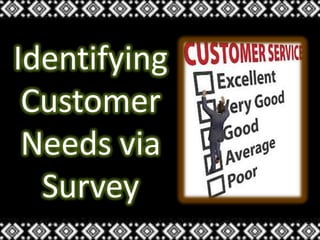
Identifying
Customer
Needs via
Survey
Types of Customer Survey
•Printed surveys
•Phone surveys
•In-person surveys
•Internet surveys
• What is the average revenue /income of
your customers?
• Where your customers geographically
based?
• What products or services are these
customers currently purchasing to fulfill
their needs?
By conducting a customer needs
survey, you can find answer to things like:
• What factors drive the decision-
making of these customers?
• How do these customers make
buying decisions?
• How likely are customers to re-
purchase products/services from
you?
The use
of each type of
customer
survey, depends
on what is the
best way to
reach your
customers.
Example
Survey Forms
Advantages
• Customer survey is an efficient
tool to judge customer loyalty.
• Point out the extent of
customer satisfaction.
• It is the modern tool of
effective communication.
•Up-to-date feedback
•Show that you care
Disadvantages
•Too many surveys, so little
time.
•Privacy issues
•Limited sampling and
respondent availability.
•No interviewer
THANK YOU
Who Conducts
Customer
Research?
• In-house Marketing Research
Department
• External Marketing Research
Firms
• Advertising Agencies
• Syndicated Data Services
• Government
THANK YOU 
Ethical Issues
in Customer
Research
The Positive Aspects
of
Customer Research
• Better Consumption Experiences
because customer research helps
marketers become more customers
focused, customers can get better
designed products, better customer
service, clearer usage instructions,
more information that helps them
make good decisions.
• Potential for Building Customer
Relationship
from the marketer
perspective, customer research is
helpful for identifying ways of
establishing and enhancing
relationships with customers.
The Negative
Aspects of
Customer Research
• Tracking Customer Behaviour in
Different Countries
marketers who want to
research customer behaviour in
other countries face special
challenges. For instance, focus
groups are not appropriate in all
countries or situations.
• Potentially High Marketing Cost -
some customers worry that
the process of researching
behaviour leads to higher
marketing costs, which in turn
translates into higher product
prices.
• Invasion of Customer Privacy
a potentially more serious
and widespread concern is
that marketers’ conduct and
use of research especially
database marketing may
invade customers’ privacy.
• Deceptive Research Practice -
finally unscrupulous researchers
may engage in deceptive
practices. One such practice is
lying about the sponsor of the
research.
THANK YOU 
How to
Summarize and
Display
Survey Data
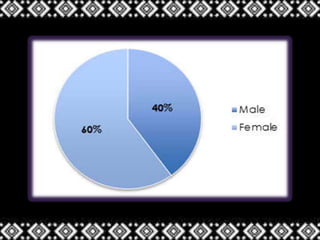
Binary Responses
If a question has only two possible
response options then it is a binary
response option. Both options, when
added, equal 100%. When summarizing
just the sample of respondents, such as
the percent of women who responded,
you can use the ubiquitous pie graph.
Single Select
If participants are asked to pick one
choice out of a number of alternatives,
then this is a single-select response
option. We summarize the proportion
that chose each category. If you just want
to summarize the responses in the
survey, such as with income, a pie graph
again will often suffice.
Multiple Select
If participants are allowed to
select "all that apply," the total
number of responses will add up to
more than 100%. We can still
summarize the proportion selecting
using the binary confidence intervals
used in the single-select method.
Net Promoter Questions
It is a rating scale, but is usually
presented as a difference
between two paired proportions
(the proportion of promoters
minus the proportion of
detractors).
You can also compare the proportion of
promoters, passives and neutrals separately to, say, an
earlier year using confidence intervals again.
Overall Ratings
The first part of your survey
will usually have an overall
question for each major customer
service aspects, and one or two
general open-ended questions
(text answers, as opposed to
multiple choices) at the end.
This is also the place for asking
customers to rate the importance of
various aspects of customer service,
and to ask reference-type questions,
such as 'How likely would you be to
recommend John Doe Company to a
friend or a colleague?', and 'How likely
would you be to use or buy [Product
Name] again?
THANK YOU 
Prepared by:
GROUP IV

Customer Needs Assessment

  • 1.
  • 2.
  • 3.
    Types of CustomerSurvey •Printed surveys •Phone surveys •In-person surveys •Internet surveys
  • 4.
    • What isthe average revenue /income of your customers? • Where your customers geographically based? • What products or services are these customers currently purchasing to fulfill their needs? By conducting a customer needs survey, you can find answer to things like:
  • 5.
    • What factorsdrive the decision- making of these customers? • How do these customers make buying decisions? • How likely are customers to re- purchase products/services from you?
  • 6.
    The use of eachtype of customer survey, depends on what is the best way to reach your customers.
  • 7.
  • 10.
  • 11.
    • Customer surveyis an efficient tool to judge customer loyalty. • Point out the extent of customer satisfaction. • It is the modern tool of effective communication.
  • 12.
  • 13.
  • 14.
    •Too many surveys,so little time. •Privacy issues •Limited sampling and respondent availability. •No interviewer
  • 15.
  • 16.
  • 17.
    • In-house MarketingResearch Department • External Marketing Research Firms • Advertising Agencies • Syndicated Data Services • Government
  • 18.
  • 19.
  • 20.
  • 21.
    • Better ConsumptionExperiences because customer research helps marketers become more customers focused, customers can get better designed products, better customer service, clearer usage instructions, more information that helps them make good decisions.
  • 22.
    • Potential forBuilding Customer Relationship from the marketer perspective, customer research is helpful for identifying ways of establishing and enhancing relationships with customers.
  • 23.
  • 24.
    • Tracking CustomerBehaviour in Different Countries marketers who want to research customer behaviour in other countries face special challenges. For instance, focus groups are not appropriate in all countries or situations.
  • 25.
    • Potentially HighMarketing Cost - some customers worry that the process of researching behaviour leads to higher marketing costs, which in turn translates into higher product prices.
  • 26.
    • Invasion ofCustomer Privacy a potentially more serious and widespread concern is that marketers’ conduct and use of research especially database marketing may invade customers’ privacy.
  • 27.
    • Deceptive ResearchPractice - finally unscrupulous researchers may engage in deceptive practices. One such practice is lying about the sponsor of the research.
  • 28.
  • 29.
  • 30.
    Binary Responses If aquestion has only two possible response options then it is a binary response option. Both options, when added, equal 100%. When summarizing just the sample of respondents, such as the percent of women who responded, you can use the ubiquitous pie graph.
  • 32.
    Single Select If participantsare asked to pick one choice out of a number of alternatives, then this is a single-select response option. We summarize the proportion that chose each category. If you just want to summarize the responses in the survey, such as with income, a pie graph again will often suffice.
  • 34.
    Multiple Select If participantsare allowed to select "all that apply," the total number of responses will add up to more than 100%. We can still summarize the proportion selecting using the binary confidence intervals used in the single-select method.
  • 36.
    Net Promoter Questions Itis a rating scale, but is usually presented as a difference between two paired proportions (the proportion of promoters minus the proportion of detractors).
  • 38.
    You can alsocompare the proportion of promoters, passives and neutrals separately to, say, an earlier year using confidence intervals again.
  • 39.
    Overall Ratings The firstpart of your survey will usually have an overall question for each major customer service aspects, and one or two general open-ended questions (text answers, as opposed to multiple choices) at the end.
  • 41.
    This is alsothe place for asking customers to rate the importance of various aspects of customer service, and to ask reference-type questions, such as 'How likely would you be to recommend John Doe Company to a friend or a colleague?', and 'How likely would you be to use or buy [Product Name] again?
  • 43.
  • 44.