Department of MBA
IMS Engineering College,
Ghaziabad
Marketing Management – II
UNIT 4
Promotion Management
Promotion - Introduction
• Promotion is all about how organizations
communicate and reach out to their target
markets
• Promotion is an important element of
marketing mix
• In marketing, promotion refers to any type of
marketing communication used to inform or
persuade target audiences of the relative merits
of a product, service, brand or issue.
Promotion
Importance & Objectives
• To create awareness: it is the primary objective of
promotion
• To stimulate demand
• To persuade customers: Through promotion,
organizations try to convince the consumers that
their product is better than others
• To promote a new product
• To face competition
• To create or improve image: Promotion is also an
image building exercise
Integrated
Marketing Communication (IMC)
• Integrated Marketing Communications (IMC) is a
concept under which a company carefully
integrates and coordinates its many
communication channels to deliver a clear and
consistent message. It aims to ensure the
consistency of the message and the
complementary use of media.
• IMC is an integration (unification) of all
marketing tools, approaches and resources within
a company which maximizes impact on the
consumer mind resulting in maximum profit at
minimum cost.
Integrated
Marketing Communication (IMC)
• IMC uses several innovative methods to
ensure that the customer gets the right message
at the right time and the right place.
• Thus IMC can be defined as ‘coordinating all
tools of marketing communication and
integrating them into a seamless programme so
that customers can get clarity about the brand
and company can generate a consistent
attitudinal and behavioural response and
maximize the communication impact’
Importance/Role of IMC
• IMC plays an important role in communicating
brand message to a larger audience (inform about
brand)
• IMC helps in brand recall
• IMC creates brand awareness at a minimal cost
• IMC scores over traditional ways of marketing as
it focuses on customer creation as well as
retention
• IMC saves time which is often lost in figuring out
the best marketing tool
IMC Tools
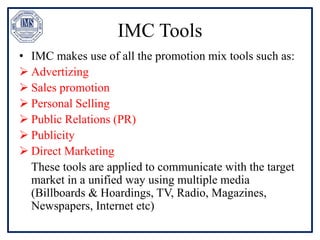
• IMC makes use of all the promotion mix tools such as:
 Advertizing
 Sales promotion
 Personal Selling
 Public Relations (PR)
 Publicity
 Direct Marketing
These tools are applied to communicate with the target
market in a unified way using multiple media
(Billboards & Hoardings, TV, Radio, Magazines,
Newspapers, Internet etc)
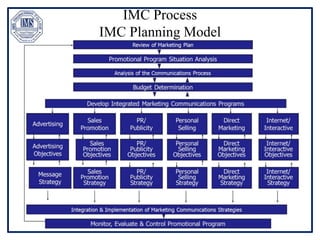
IMC Process
IMC Planning Model
Communication
Development Process
Process
Communication
Source
Message
Encoding
Media for
Communication
Message Decoding
by Receiver
Response
Factors
Influencing
Communication
Objective
Company’s
Perception
Media consumption
habits of audience
•Motives
•Beliefs
•Attitude
•Socio-cultural
•Experiences
Noise
Feedback
Noise
Organization’s
Activity
Consumer’s
Response
Communication
Development Process
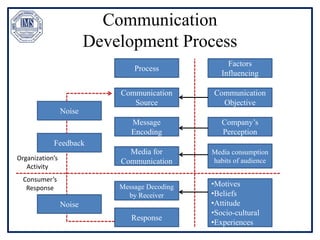
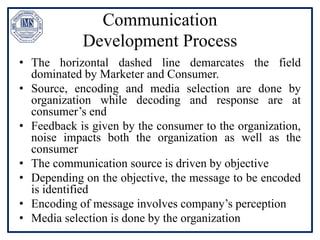
• The horizontal dashed line demarcates the field
dominated by Marketer and Consumer.
• Source, encoding and media selection are done by
organization while decoding and response are at
consumer’s end
• Feedback is given by the consumer to the organization,
noise impacts both the organization as well as the
consumer
• The communication source is driven by objective
• Depending on the objective, the message to be encoded
is identified
• Encoding of message involves company’s perception
• Media selection is done by the organization
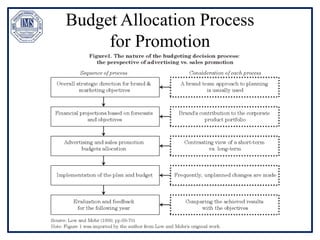
Budget Allocation Process
for Promotion
Methods of allocating budget
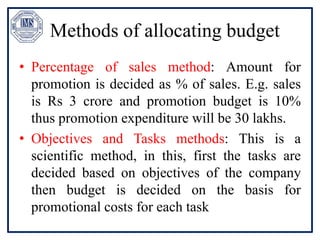
• Percentage of sales method: Amount for
promotion is decided as % of sales. E.g. sales
is Rs 3 crore and promotion budget is 10%
thus promotion expenditure will be 30 lakhs.
• Objectives and Tasks methods: This is a
scientific method, in this, first the tasks are
decided based on objectives of the company
then budget is decided on the basis for
promotional costs for each task
Methods of allocating budget
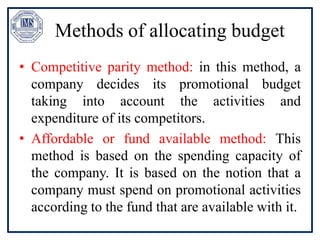
• Competitive parity method: in this method, a
company decides its promotional budget
taking into account the activities and
expenditure of its competitors.
• Affordable or fund available method: This
method is based on the spending capacity of
the company. It is based on the notion that a
company must spend on promotional activities
according to the fund that are available with it.
Methods of allocating budget
• Expert Opinion method: Both internal and
external experts are asked to estimate the
amount of money to be spent for promotion or
a given period.
• Sales force opinion method: In this method the
organization consults its sales force to decide
the expenditure amount for promotion.
• Other methods are – arbitrary allocation
method, profit maximization approach etc.
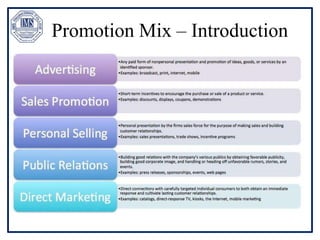
Promotion Mix – Introduction
Advertising
• Advertising is paid form of promotion
(communication) by the service provider with
its target audience.
• 5 Ms of advertising (Kotler & Keller, 2006):
Mission, Money, Message, Media and
Measurement (of effectiveness)
• Advertising can be done in an integrated way
by using a mix of media (TV, Print ads,
internet, hoardings and billboards etc)
Advertising Objectives
• Create Awareness
• Provide information and stimulate trial
• Position Brands (creating unique image in
minds of customers and potential customers)
• Remind and Reinforce the use of
product/service
• Provide support to sales force
• Encouraging customers to act
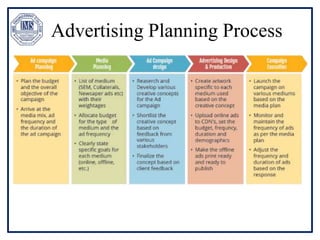
Advertising Planning Process
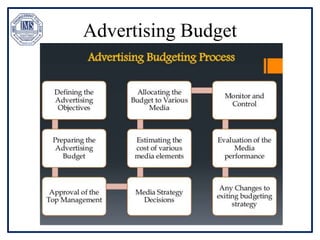
Advertising Budget
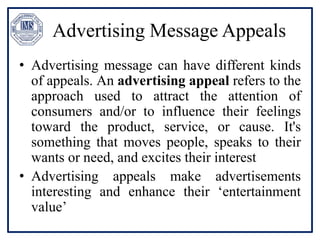
Advertising Message Appeals
• Advertising message can have different kinds
of appeals. An advertising appeal refers to the
approach used to attract the attention of
consumers and/or to influence their feelings
toward the product, service, or cause. It's
something that moves people, speaks to their
wants or need, and excites their interest
• Advertising appeals make advertisements
interesting and enhance their ‘entertainment
value’
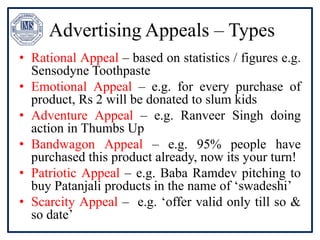
Advertising Appeals – Types
• Rational Appeal – based on statistics / figures e.g.
Sensodyne Toothpaste
• Emotional Appeal – e.g. for every purchase of
product, Rs 2 will be donated to slum kids
• Adventure Appeal – e.g. Ranveer Singh doing
action in Thumbs Up
• Bandwagon Appeal – e.g. 95% people have
purchased this product already, now its your turn!
• Patriotic Appeal – e.g. Baba Ramdev pitching to
buy Patanjali products in the name of ‘swadeshi’
• Scarcity Appeal – e.g. ‘offer valid only till so &
so date’
Personal Selling
• Personal selling involves sales of service
product through sales force. This involves
maintaining a sales force and hence a sales
department.
• Sales force performs the functions like:
prospecting, targeting, communicating, selling,
servicing, information gathering etc.
• Personal selling can be a challenging job.
Personal Selling
• Personal selling is most effective in building
buyer preference
• Is it interactive and can tailor presentations
according to buyer’s needs
• It is two way communication.
• The information provided to the customer is
current and updated
• Personal selling helps in relationship building
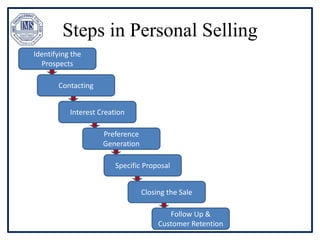
Steps in Personal Selling
Identifying the
Prospects
Contacting
Interest Creation
Preference
Generation
Specific Proposal
Closing the Sale
Follow Up &
Customer Retention
Sales Promotion
• Sales promotion consists of offering short term
incentives to encourage purchase or sale of
service (Kotler et al. 2006)
• Sales promotion can include – coupons,
rebates, price off (discounts), contests, lucky
draws etc.
• Sales promotion is most effective when used
along with other promotional techniques
Sales Promotion
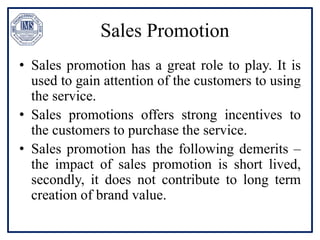
• Sales promotion has a great role to play. It is
used to gain attention of the customers to using
the service.
• Sales promotions offers strong incentives to
the customers to purchase the service.
• Sales promotion has the following demerits –
the impact of sales promotion is short lived,
secondly, it does not contribute to long term
creation of brand value.
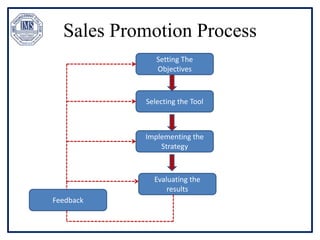
Sales Promotion Process
Setting The
Objectives
Selecting the Tool
Implementing the
Strategy
Evaluating the
results
Feedback
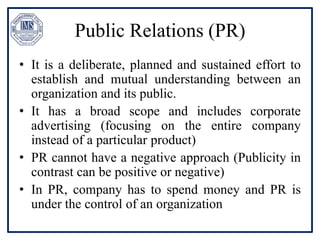
Public Relations (PR)
• It is a deliberate, planned and sustained effort to
establish and mutual understanding between an
organization and its public.
• It has a broad scope and includes corporate
advertising (focusing on the entire company
instead of a particular product)
• PR cannot have a negative approach (Publicity in
contrast can be positive or negative)
• In PR, company has to spend money and PR is
under the control of an organization
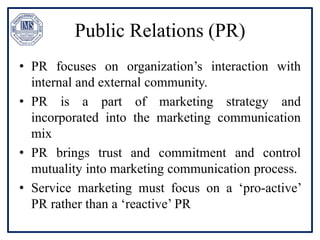
Public Relations (PR)
• PR focuses on organization’s interaction with
internal and external community.
• PR is a part of marketing strategy and
incorporated into the marketing communication
mix
• PR brings trust and commitment and control
mutuality into marketing communication process.
• Service marketing must focus on a ‘pro-active’
PR rather than a ‘reactive’ PR
Public Relations (PR) Tools
• The following are the tools for PR
 Press Releases
 Interviews
 Editorial
 Advertorial
 Corporate Films
 Company magazines / journals
 Reports and Brochures
 Events
 Sponsorships
 Donations
 Social Media
Public Relations (PR)
Objectives
• To generate interest among financial community
• To create brand image and positive brand equity
• To correct misconceptions
• To get good channel partners
• Generate goodwill among local community
• To motivate employees
• To inform consumers
Direct Marketing
• Direct marketing happens when companies
communicate with the target audience without
involving any intermediaries in between.
• According to American Marketing
Association, Direct Marketing is ‘A form of
non-store retailing in which customers are
exposed to merchandise (products) through an
impersonal medium (not involving a person)
and then purchase the merchandise by
telephone or email’
Direct Marketing
Characteristics
It is a non store activity, it is not done in retail
store or outlet
A medium is used such as email, telephone or
TV to reach the customer
Response can be made by customer via email,
telephone or in person
Response can be measured
E.g. Home shop channel, Naptol.com
Forms of Direct Marketing
• Direct email
• Telemarketing
• Home shopping (on TV following cash on
delivery model)
• Internet (E-commerce)
• Catalogue Marketing
• Newspaper inserts
Direct Selling
• This is an element of Direct Marketing
Programme.
• Direct selling is the process of selling products
and services through demonstrations and
personal presentations directly to consumers in
their homes, workplaces (away from a retail
outlet).

Promotion Management

  • 1.
    Department of MBA IMSEngineering College, Ghaziabad Marketing Management – II UNIT 4 Promotion Management
  • 2.
    Promotion - Introduction •Promotion is all about how organizations communicate and reach out to their target markets • Promotion is an important element of marketing mix • In marketing, promotion refers to any type of marketing communication used to inform or persuade target audiences of the relative merits of a product, service, brand or issue.
  • 3.
    Promotion Importance & Objectives •To create awareness: it is the primary objective of promotion • To stimulate demand • To persuade customers: Through promotion, organizations try to convince the consumers that their product is better than others • To promote a new product • To face competition • To create or improve image: Promotion is also an image building exercise
  • 4.
    Integrated Marketing Communication (IMC) •Integrated Marketing Communications (IMC) is a concept under which a company carefully integrates and coordinates its many communication channels to deliver a clear and consistent message. It aims to ensure the consistency of the message and the complementary use of media. • IMC is an integration (unification) of all marketing tools, approaches and resources within a company which maximizes impact on the consumer mind resulting in maximum profit at minimum cost.
  • 5.
    Integrated Marketing Communication (IMC) •IMC uses several innovative methods to ensure that the customer gets the right message at the right time and the right place. • Thus IMC can be defined as ‘coordinating all tools of marketing communication and integrating them into a seamless programme so that customers can get clarity about the brand and company can generate a consistent attitudinal and behavioural response and maximize the communication impact’
  • 6.
    Importance/Role of IMC •IMC plays an important role in communicating brand message to a larger audience (inform about brand) • IMC helps in brand recall • IMC creates brand awareness at a minimal cost • IMC scores over traditional ways of marketing as it focuses on customer creation as well as retention • IMC saves time which is often lost in figuring out the best marketing tool
  • 7.
    IMC Tools • IMCmakes use of all the promotion mix tools such as:  Advertizing  Sales promotion  Personal Selling  Public Relations (PR)  Publicity  Direct Marketing These tools are applied to communicate with the target market in a unified way using multiple media (Billboards & Hoardings, TV, Radio, Magazines, Newspapers, Internet etc)
  • 8.
  • 9.
    Communication Development Process Process Communication Source Message Encoding Media for Communication MessageDecoding by Receiver Response Factors Influencing Communication Objective Company’s Perception Media consumption habits of audience •Motives •Beliefs •Attitude •Socio-cultural •Experiences Noise Feedback Noise Organization’s Activity Consumer’s Response
  • 10.
    Communication Development Process • Thehorizontal dashed line demarcates the field dominated by Marketer and Consumer. • Source, encoding and media selection are done by organization while decoding and response are at consumer’s end • Feedback is given by the consumer to the organization, noise impacts both the organization as well as the consumer • The communication source is driven by objective • Depending on the objective, the message to be encoded is identified • Encoding of message involves company’s perception • Media selection is done by the organization
  • 11.
  • 12.
    Methods of allocatingbudget • Percentage of sales method: Amount for promotion is decided as % of sales. E.g. sales is Rs 3 crore and promotion budget is 10% thus promotion expenditure will be 30 lakhs. • Objectives and Tasks methods: This is a scientific method, in this, first the tasks are decided based on objectives of the company then budget is decided on the basis for promotional costs for each task
  • 13.
    Methods of allocatingbudget • Competitive parity method: in this method, a company decides its promotional budget taking into account the activities and expenditure of its competitors. • Affordable or fund available method: This method is based on the spending capacity of the company. It is based on the notion that a company must spend on promotional activities according to the fund that are available with it.
  • 14.
    Methods of allocatingbudget • Expert Opinion method: Both internal and external experts are asked to estimate the amount of money to be spent for promotion or a given period. • Sales force opinion method: In this method the organization consults its sales force to decide the expenditure amount for promotion. • Other methods are – arbitrary allocation method, profit maximization approach etc.
  • 15.
    Promotion Mix –Introduction
  • 16.
    Advertising • Advertising ispaid form of promotion (communication) by the service provider with its target audience. • 5 Ms of advertising (Kotler & Keller, 2006): Mission, Money, Message, Media and Measurement (of effectiveness) • Advertising can be done in an integrated way by using a mix of media (TV, Print ads, internet, hoardings and billboards etc)
  • 17.
    Advertising Objectives • CreateAwareness • Provide information and stimulate trial • Position Brands (creating unique image in minds of customers and potential customers) • Remind and Reinforce the use of product/service • Provide support to sales force • Encouraging customers to act
  • 18.
  • 19.
  • 20.
    Advertising Message Appeals •Advertising message can have different kinds of appeals. An advertising appeal refers to the approach used to attract the attention of consumers and/or to influence their feelings toward the product, service, or cause. It's something that moves people, speaks to their wants or need, and excites their interest • Advertising appeals make advertisements interesting and enhance their ‘entertainment value’
  • 21.
    Advertising Appeals –Types • Rational Appeal – based on statistics / figures e.g. Sensodyne Toothpaste • Emotional Appeal – e.g. for every purchase of product, Rs 2 will be donated to slum kids • Adventure Appeal – e.g. Ranveer Singh doing action in Thumbs Up • Bandwagon Appeal – e.g. 95% people have purchased this product already, now its your turn! • Patriotic Appeal – e.g. Baba Ramdev pitching to buy Patanjali products in the name of ‘swadeshi’ • Scarcity Appeal – e.g. ‘offer valid only till so & so date’
  • 22.
    Personal Selling • Personalselling involves sales of service product through sales force. This involves maintaining a sales force and hence a sales department. • Sales force performs the functions like: prospecting, targeting, communicating, selling, servicing, information gathering etc. • Personal selling can be a challenging job.
  • 23.
    Personal Selling • Personalselling is most effective in building buyer preference • Is it interactive and can tailor presentations according to buyer’s needs • It is two way communication. • The information provided to the customer is current and updated • Personal selling helps in relationship building
  • 24.
    Steps in PersonalSelling Identifying the Prospects Contacting Interest Creation Preference Generation Specific Proposal Closing the Sale Follow Up & Customer Retention
  • 25.
    Sales Promotion • Salespromotion consists of offering short term incentives to encourage purchase or sale of service (Kotler et al. 2006) • Sales promotion can include – coupons, rebates, price off (discounts), contests, lucky draws etc. • Sales promotion is most effective when used along with other promotional techniques
  • 26.
    Sales Promotion • Salespromotion has a great role to play. It is used to gain attention of the customers to using the service. • Sales promotions offers strong incentives to the customers to purchase the service. • Sales promotion has the following demerits – the impact of sales promotion is short lived, secondly, it does not contribute to long term creation of brand value.
  • 27.
    Sales Promotion Process SettingThe Objectives Selecting the Tool Implementing the Strategy Evaluating the results Feedback
  • 28.
    Public Relations (PR) •It is a deliberate, planned and sustained effort to establish and mutual understanding between an organization and its public. • It has a broad scope and includes corporate advertising (focusing on the entire company instead of a particular product) • PR cannot have a negative approach (Publicity in contrast can be positive or negative) • In PR, company has to spend money and PR is under the control of an organization
  • 29.
    Public Relations (PR) •PR focuses on organization’s interaction with internal and external community. • PR is a part of marketing strategy and incorporated into the marketing communication mix • PR brings trust and commitment and control mutuality into marketing communication process. • Service marketing must focus on a ‘pro-active’ PR rather than a ‘reactive’ PR
  • 30.
    Public Relations (PR)Tools • The following are the tools for PR  Press Releases  Interviews  Editorial  Advertorial  Corporate Films  Company magazines / journals  Reports and Brochures  Events  Sponsorships  Donations  Social Media
  • 31.
    Public Relations (PR) Objectives •To generate interest among financial community • To create brand image and positive brand equity • To correct misconceptions • To get good channel partners • Generate goodwill among local community • To motivate employees • To inform consumers
  • 32.
    Direct Marketing • Directmarketing happens when companies communicate with the target audience without involving any intermediaries in between. • According to American Marketing Association, Direct Marketing is ‘A form of non-store retailing in which customers are exposed to merchandise (products) through an impersonal medium (not involving a person) and then purchase the merchandise by telephone or email’
  • 33.
    Direct Marketing Characteristics It isa non store activity, it is not done in retail store or outlet A medium is used such as email, telephone or TV to reach the customer Response can be made by customer via email, telephone or in person Response can be measured E.g. Home shop channel, Naptol.com
  • 34.
    Forms of DirectMarketing • Direct email • Telemarketing • Home shopping (on TV following cash on delivery model) • Internet (E-commerce) • Catalogue Marketing • Newspaper inserts
  • 35.
    Direct Selling • Thisis an element of Direct Marketing Programme. • Direct selling is the process of selling products and services through demonstrations and personal presentations directly to consumers in their homes, workplaces (away from a retail outlet).