Mindfulness In Clinical Practice Northern California Psychiatric Society, Integrative Psychiatry Conference, 2011 Rick Hanson, Ph.D. The Wellspring Institute for Neuroscience and Contemplative Wisdom www.WiseBrain.org   www.RickHanson.net [email_address]
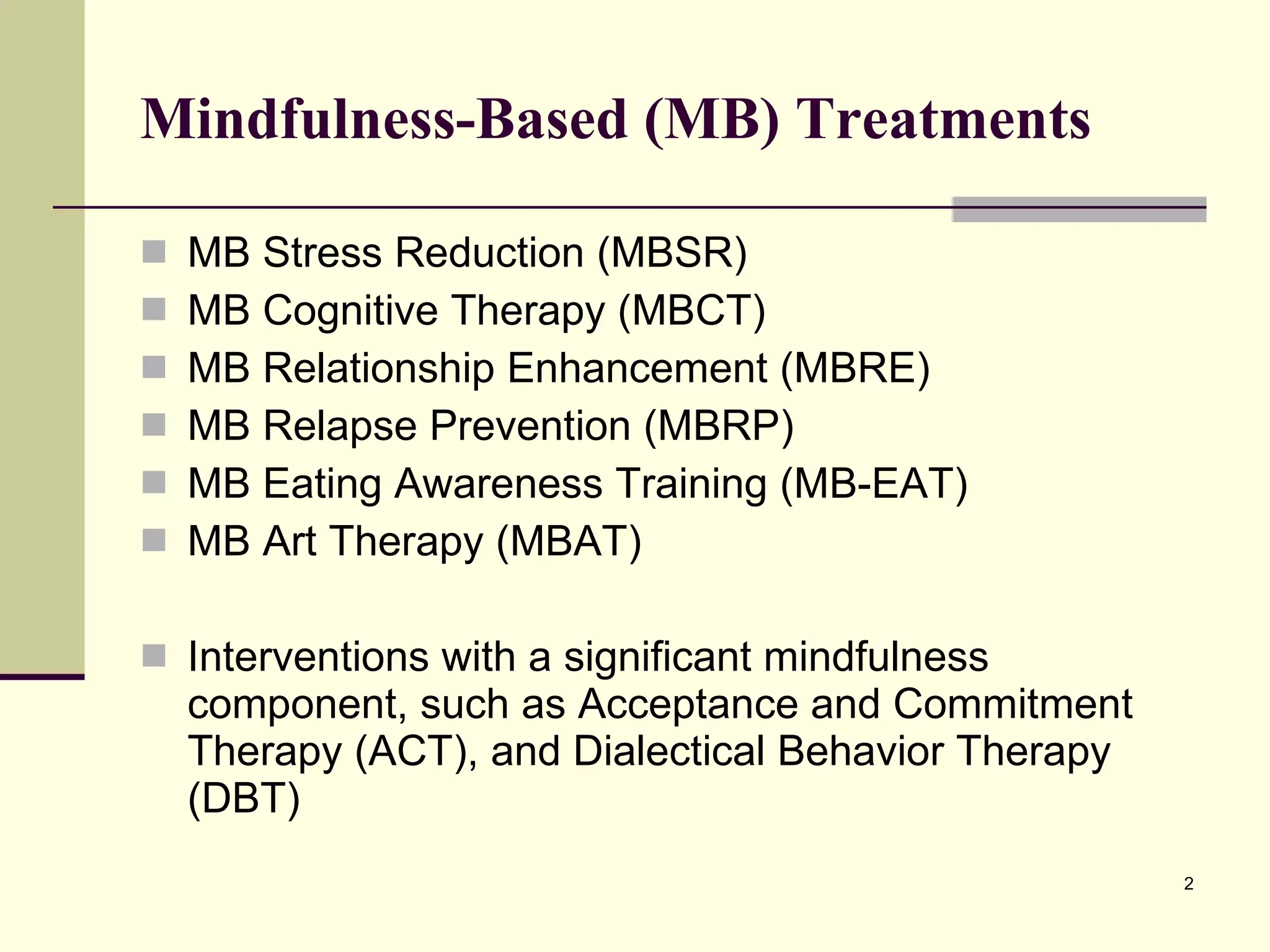
Mindfulness-Based (MB) Treatments MB Stress Reduction (MBSR) MB Cognitive Therapy (MBCT) MB Relationship Enhancement (MBRE) MB Relapse Prevention (MBRP) MB Eating Awareness Training (MB-EAT) MB Art Therapy (MBAT) Interventions with a significant mindfulness component, such as Acceptance and Commitment Therapy (ACT), and Dialectical Behavior Therapy (DBT)
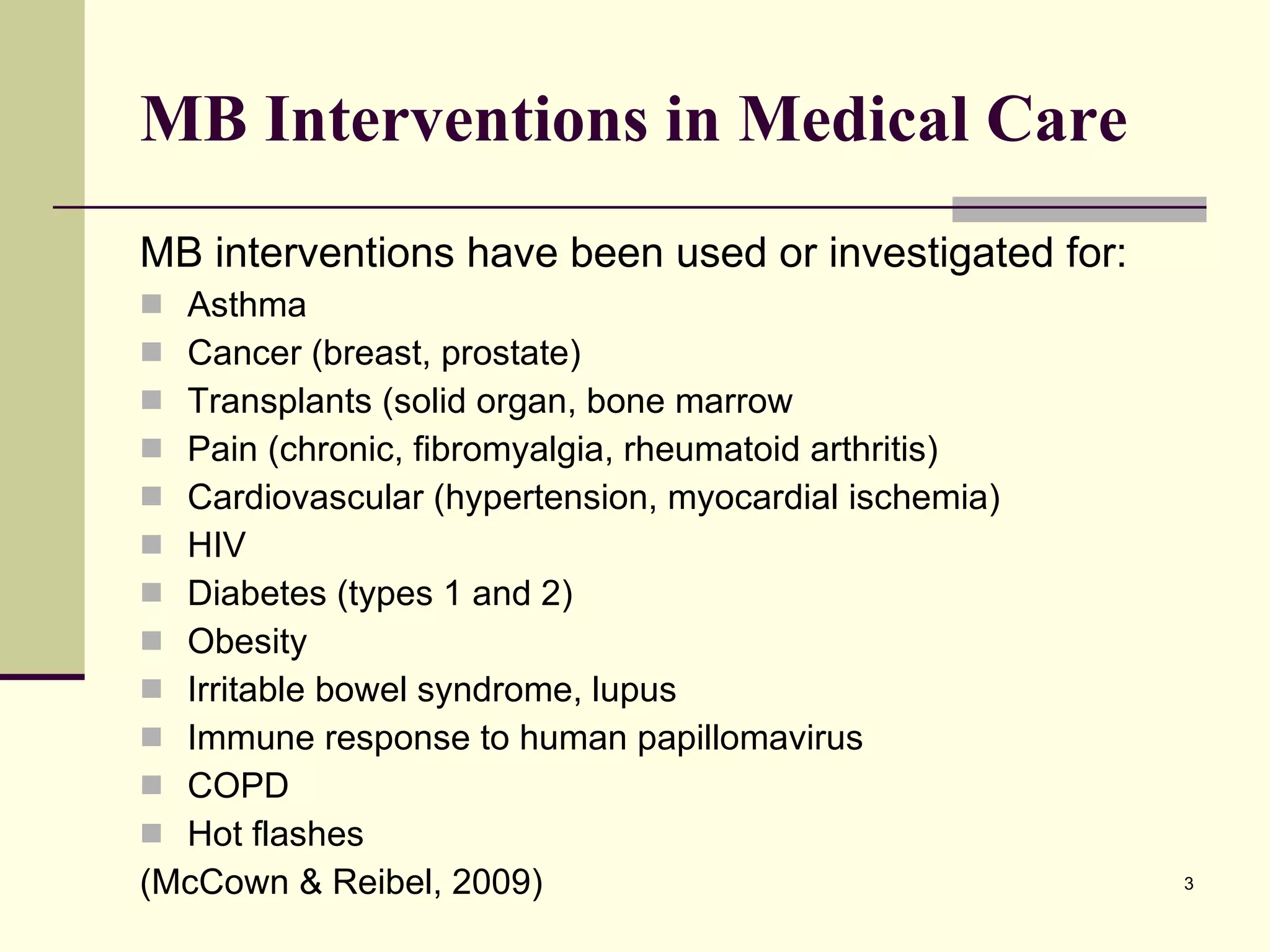
MB Interventions in Medical Care MB interventions have been used or investigated for: Asthma Cancer (breast, prostate) Transplants (solid organ, bone marrow Pain (chronic, fibromyalgia, rheumatoid arthritis) Cardiovascular (hypertension, myocardial ischemia) HIV Diabetes (types 1 and 2) Obesity Irritable bowel syndrome, lupus Immune response to human papillomavirus COPD Hot flashes (McCown & Reibel, 2009)
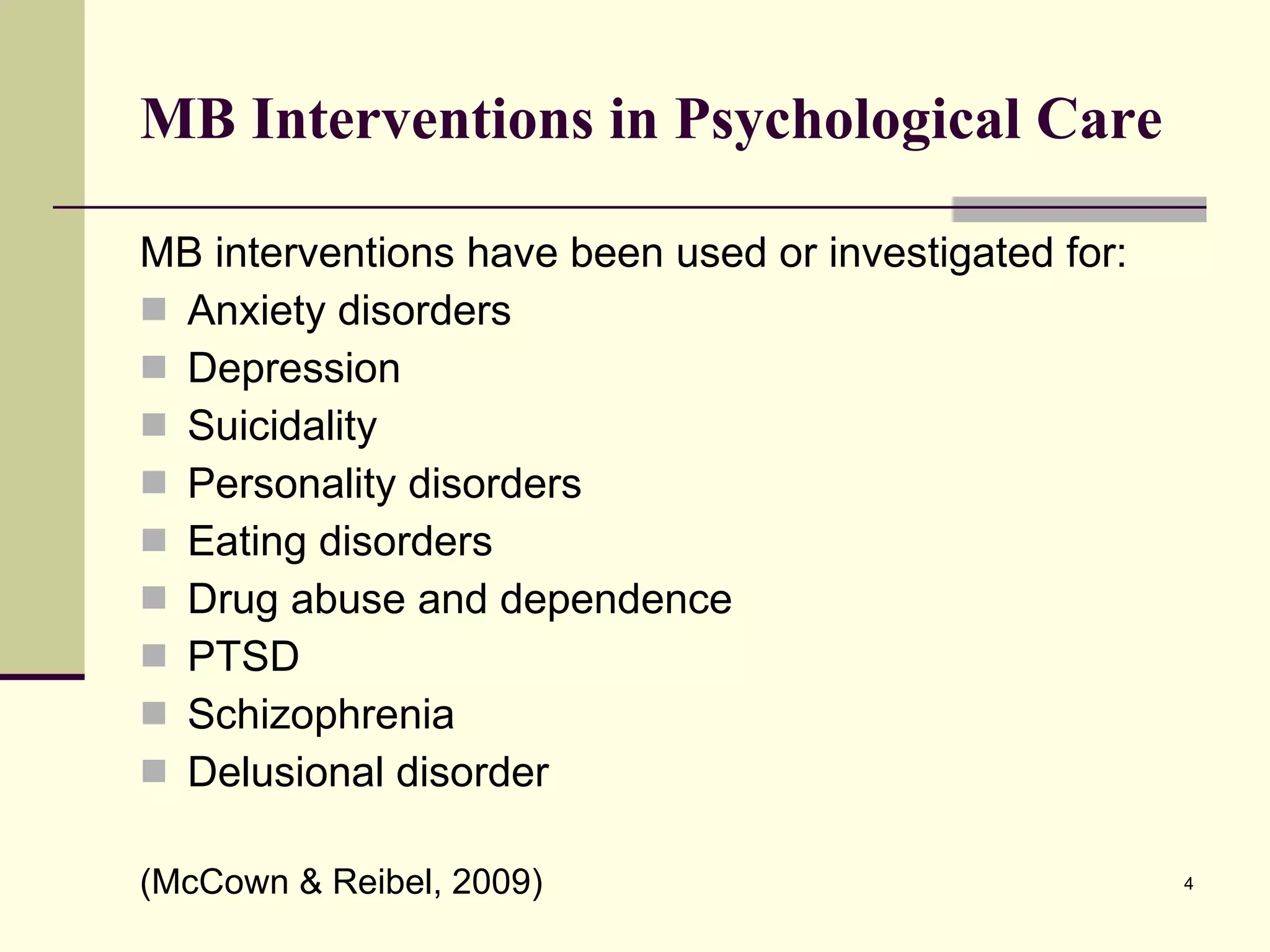
MB Interventions in Psychological Care MB interventions have been used or investigated for: Anxiety disorders Depression Suicidality Personality disorders Eating disorders Drug abuse and dependence PTSD Schizophrenia Delusional disorder (McCown & Reibel, 2009)
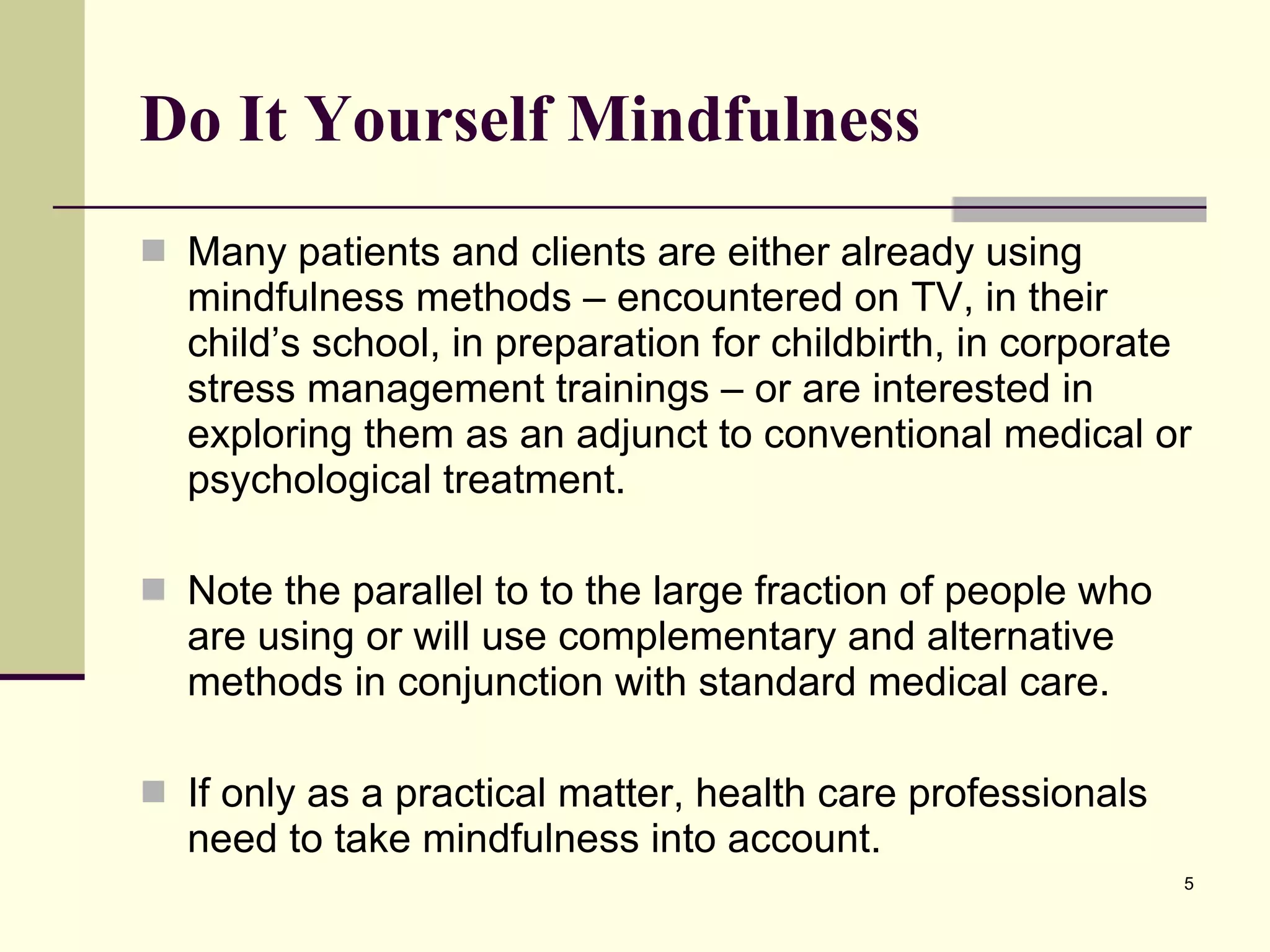
Do It Yourself Mindfulness Many patients and clients are either already using mindfulness methods – encountered on TV, in their child’s school, in preparation for childbirth, in corporate stress management trainings – or are interested in exploring them as an adjunct to conventional medical or psychological treatment.  Note the parallel to to the large fraction of people who are using or will use complementary and alternative methods in conjunction with standard medical care.  If only as a practical matter, health care professionals need to take mindfulness into account.
Topics Experience-dependent neuroplasticity Mindfulness: definitions and perspectives Uses and efficacy of mindfulness practices Stimulating neural substrates of mindfulness The mindful internalization of positive experience Mindfulness and self-care
Learning Objectives - 1  Define mindfulness Describe ways in which mindfulness has been incorporated into medical practice and psychotherapy Describe research findings regarding the application of mindfulness for clinical disorders such as anxiety, depression, addictions, or chronic pain
Learning Objectives - 2 Describe neural substrates of mindful awareness and its supporting factors  Describe specific mindfulness based techniques which can be useful in everyday clinical practice  Describe uses of mindfulness for clinician self-care Begin to cultivate mindfulness in life and clinical practice
Perspectives
The history of science is rich in the example  of the fruitfulness of bringing  two sets of techniques, two sets of ideas,  developed in separate contexts  for the pursuit of new truth,  into touch with one another.   J. Robert Oppenheimer
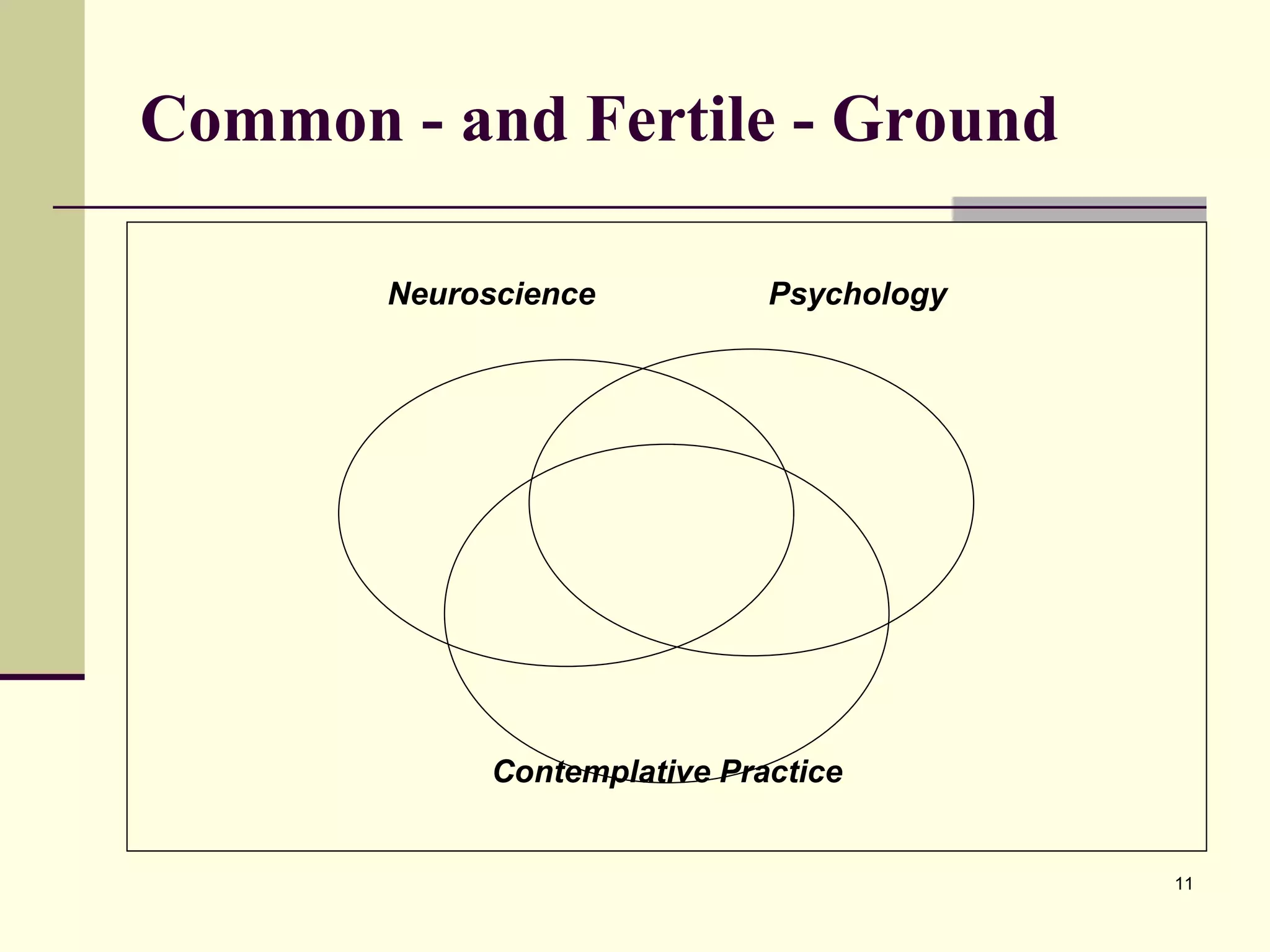
Common - and Fertile - Ground Neuroscience   Psychology Contemplative Practice
When the facts change,  I change my mind, sir. What do you do? John Maynard Keynes
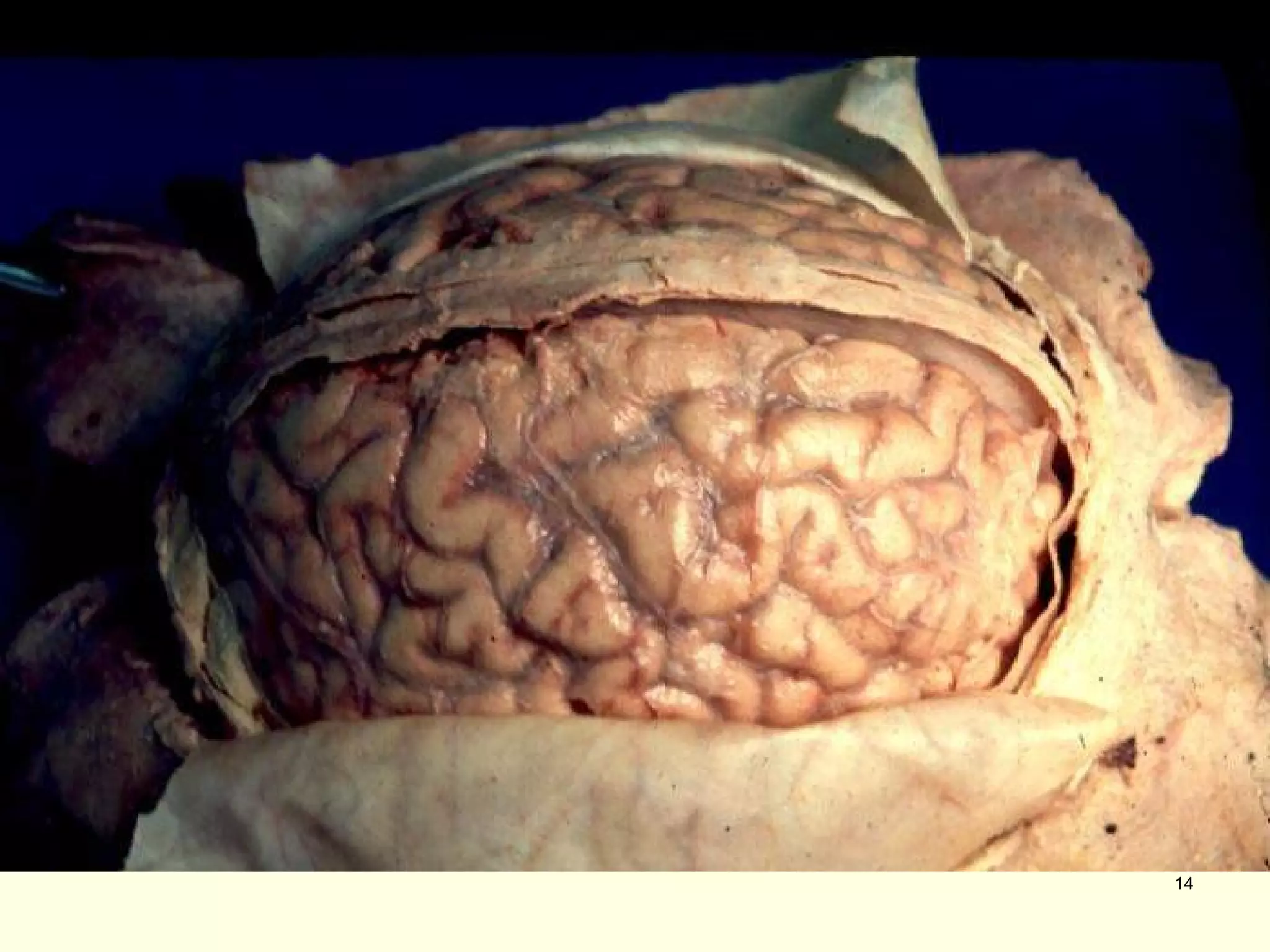
Experience-Dependent Neuroplasticity
 
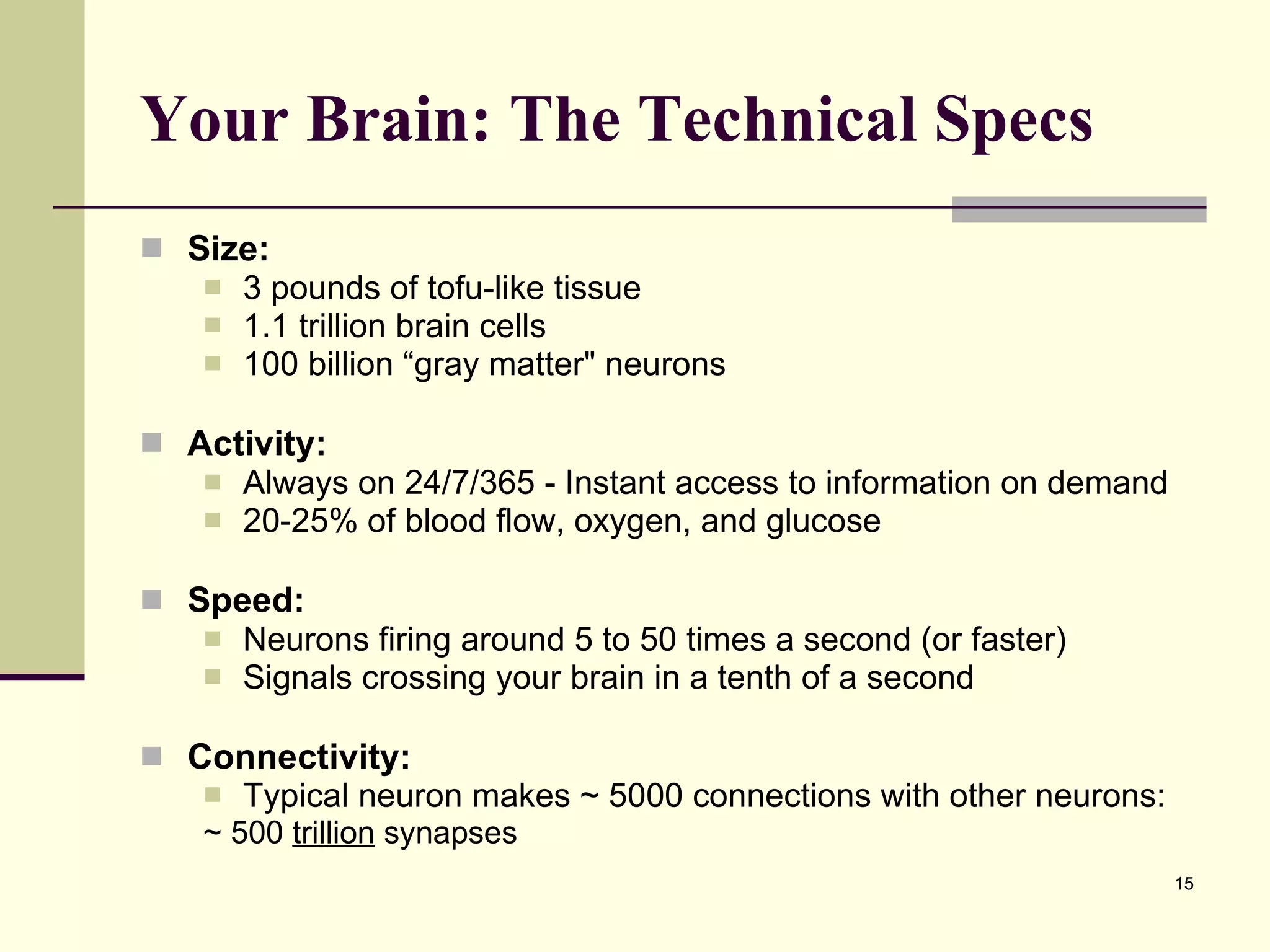
Your Brain: The Technical Specs Size: 3 pounds of tofu-like tissue 1.1 trillion brain cells 100 billion “gray matter" neurons Activity: Always on 24/7/365 - Instant access to information on demand 20-25% of blood flow, oxygen, and glucose Speed: Neurons firing around 5 to 50 times a second (or faster) Signals crossing your brain in a tenth of a second Connectivity: Typical neuron makes ~ 5000 connections with other neurons:   ~ 500  trillion  synapses
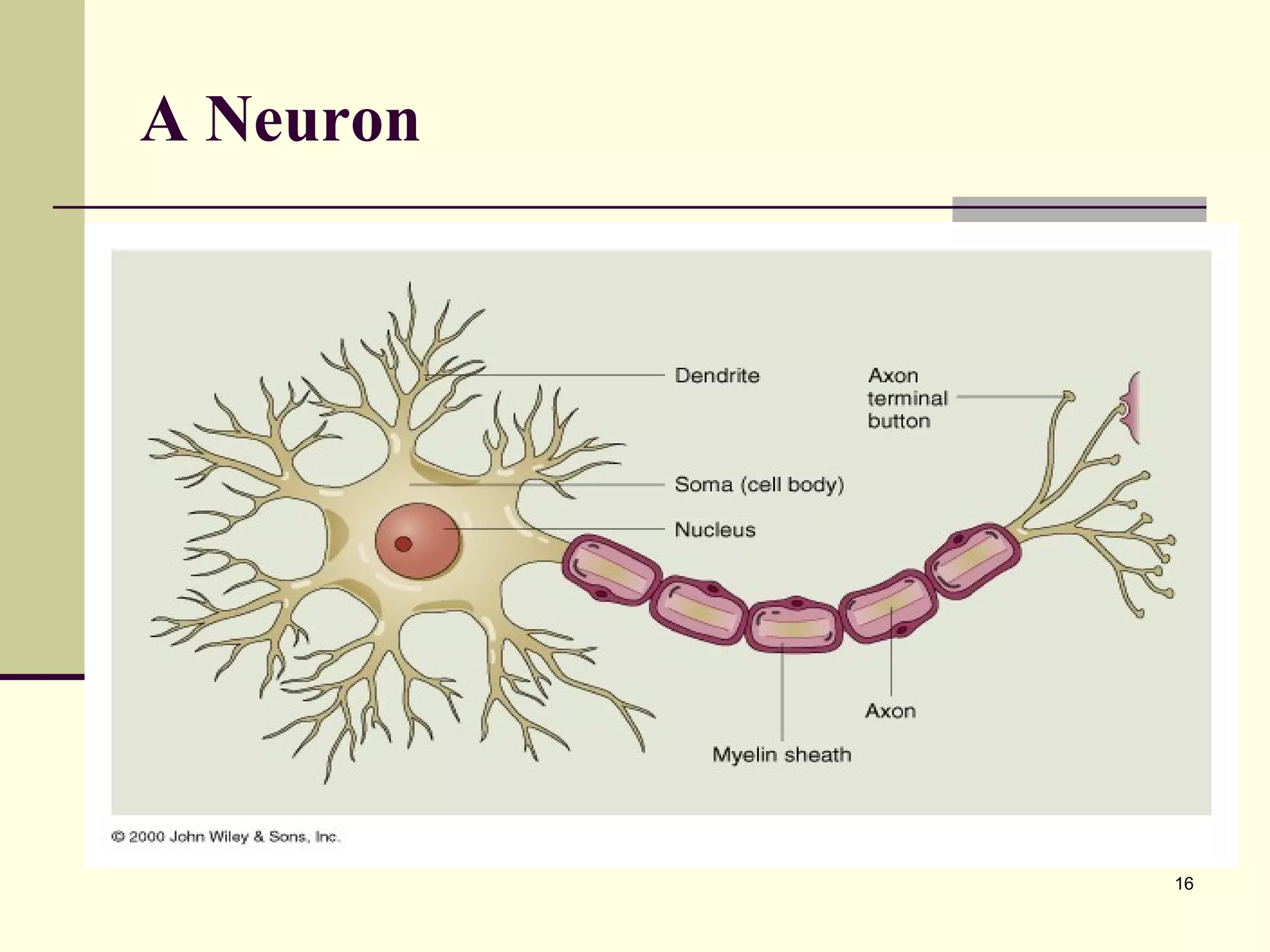
A Neuron
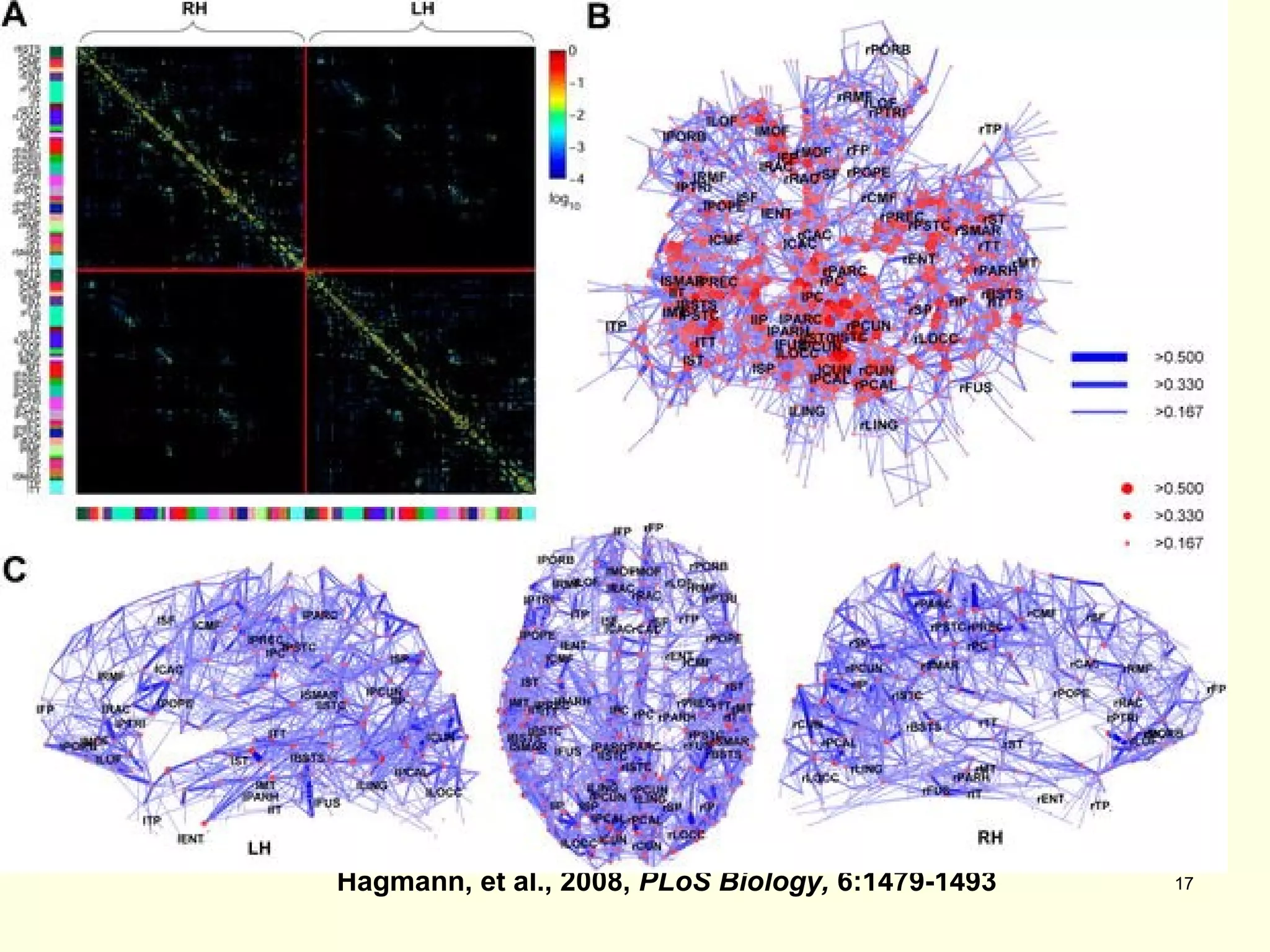
The Connectome - 2 Hagmann, et al., 2008,  PLoS Biology,  6:1479-1493
 
 
All cells have specialized functions. Brain cells have particular ways of processing information and communicating with each other. Nerve cells form complete circuits that carry and transform information.  Electrical signaling represents the language of mind, the means whereby nerve cells, the building blocks of the brain, communicate with one another over great distances. Nerve cells generate electricity as a means of producing messages.  All animals have some form of mental life that reflects the architecture of their nervous system.  Eric R. Kandel, 2006
The Mind/Brain System   “ Mind” = flow of information within the nervous system: Information is  represented  by the nervous system. Most mind is unconscious; awareness is an  aspect  of mind. The headquarters of the nervous system is the brain. In essence then, apart from hypothetical transcendental factors, the mind  is  what the brain  does .  Brain = necessary,  proximally  sufficient condition for mind:  The brain depends on the nervous system, which intertwines with and depends on other bodily systems. These systems in turn intertwine with and depend upon nature and culture, both presently and over time. And as we’ll see, the brain also depends on the mind.
Evolution is a tinkerer. In living organisms, new capabilities are achieved by modifying existing molecules slightly and adjusting their interaction with other existing molecules. Science has found surprisingly few proteins that are truly unique to the human brain and no signaling systems that are unique to it. All life, including the substrate of our thoughts and memories, is composed of the same building blocks.  Eric R. Kandel, 2006
We ask, “What is a thought?” We don't know,  yet we are thinking continually. Venerable Tenzin Palmo
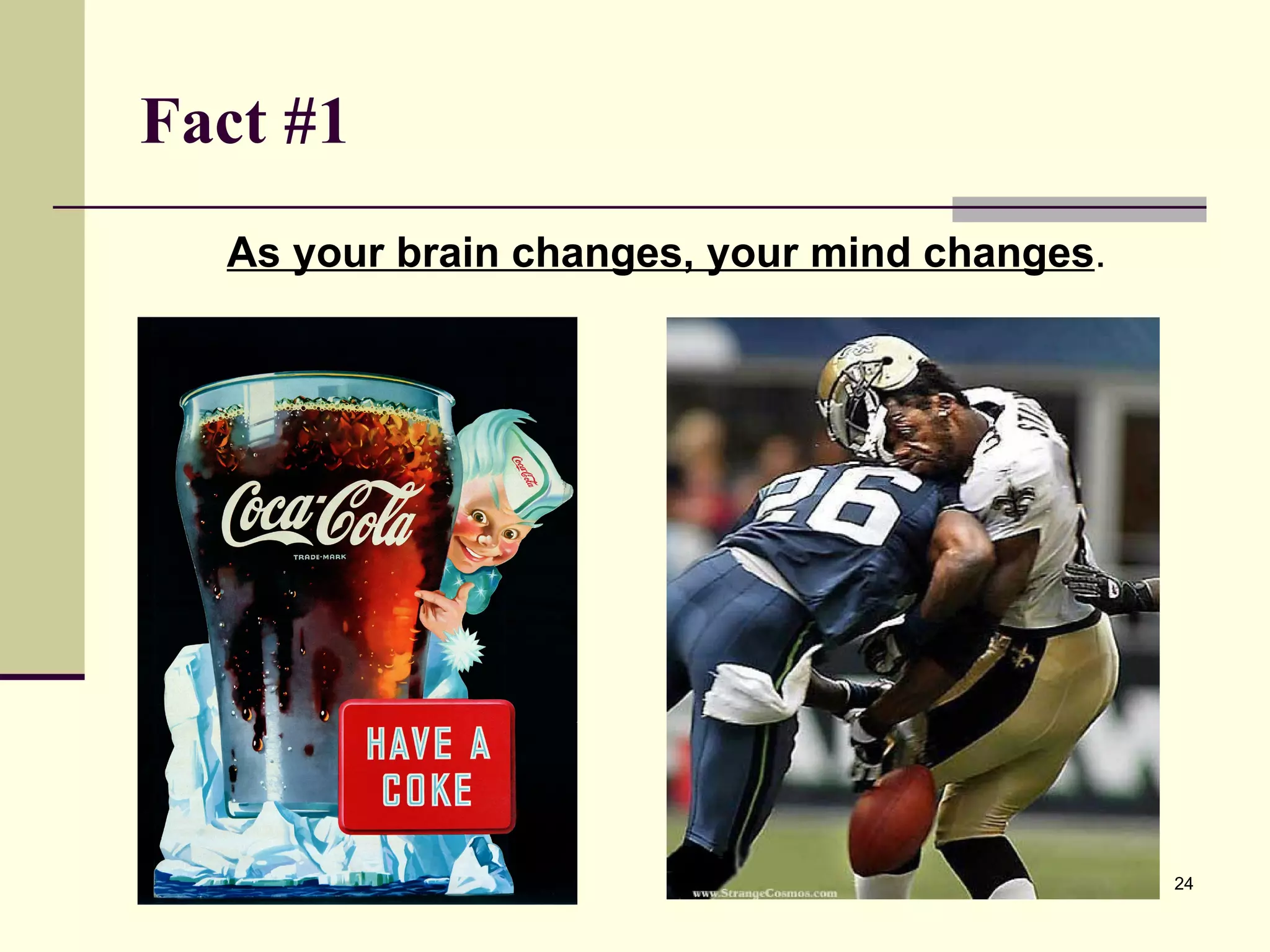
Fact #1   As your brain changes, your mind changes .
Ways That Brain Can Change Mind For better: A little caffeine: more alertness Thicker insula: more self-awareness, empathy More left prefrontal activation: more happiness For worse: Intoxication; imbalances in neurotransmitters Concussion, stroke, tumor, Alzheimer’s Cortisol-based shrinkage of hippocampus: less capacity for contextual memory
Fact #2   As your mind changes, your brain changes .  Immaterial mental activity co-occurs with, correlates with material neural activity. This produces  temporary  changes in your brain and  lasting  ones.  Temporary  changes include: Alterations in brainwaves (= changes in the firing patterns of synchronized neurons) Changing consumption of oxygen and glucose Ebbs and flows of neurochemicals
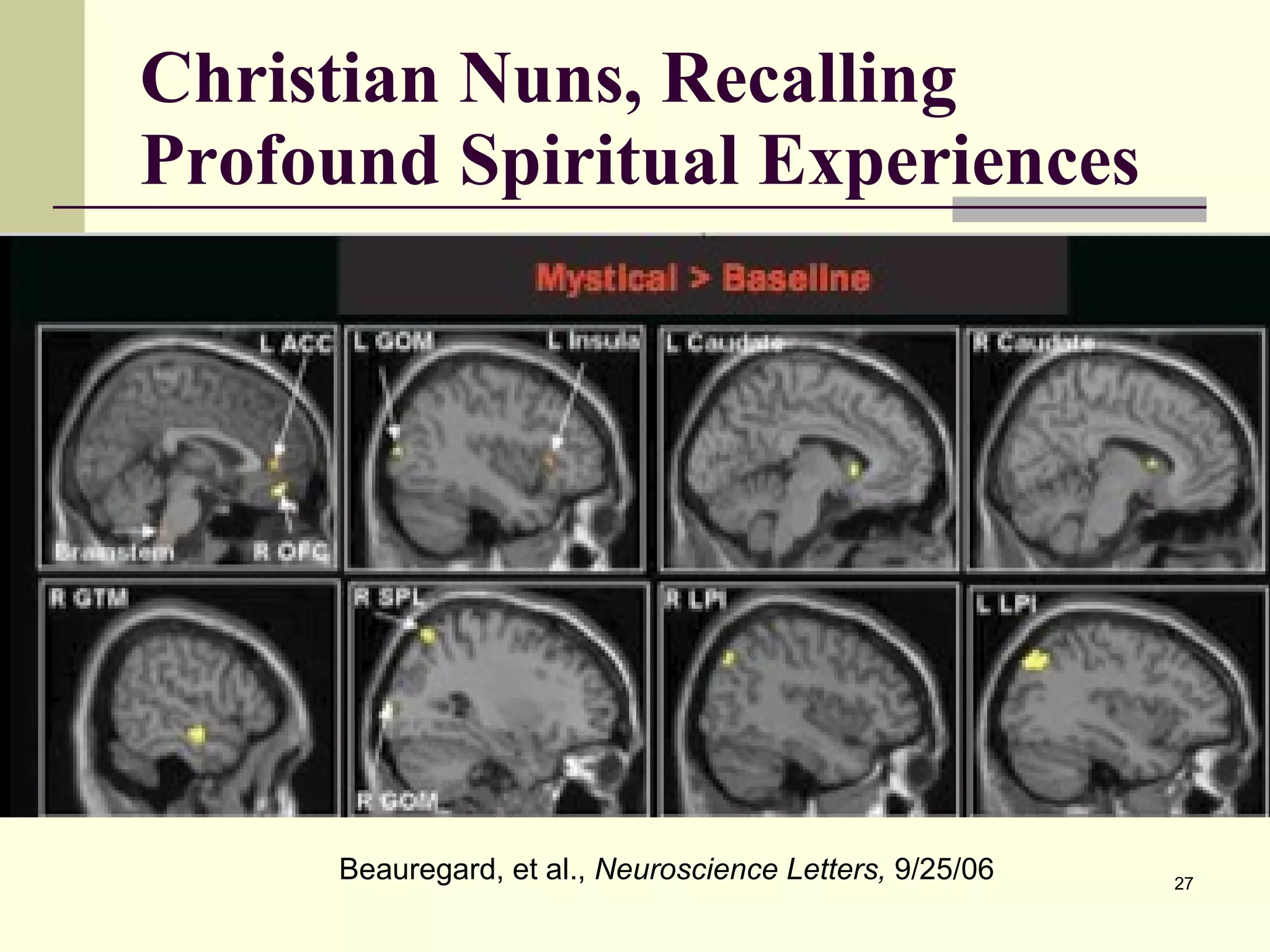
Christian Nuns, Recalling Profound Spiritual Experiences Beauregard, et al.,  Neuroscience Letters,  9/25/06
Mind Changes Brain in Lasting Ways   What flows through the mind sculpts your brain. Immaterial experience leaves material traces behind.  Increased blood/nutrient flow to active regions Altered epigenetics (gene expression) “ Neurons that fire together wire together.” Increasing excitability of active neurons Strengthening existing synapses Building new synapses; thickening cortex Neuronal “pruning” - “use it or lose it”
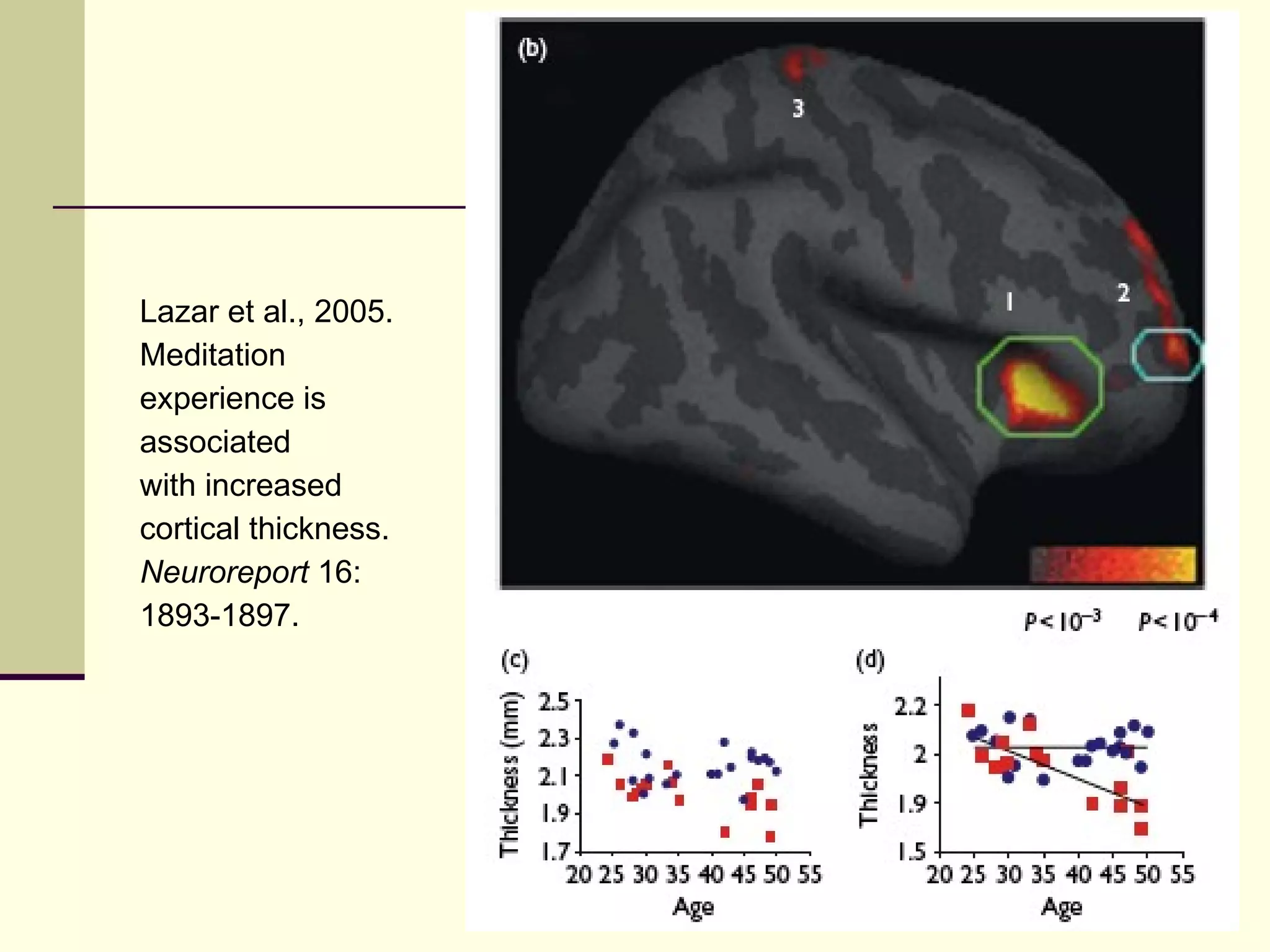
Lazar et al., 2005.  Meditation  experience is  associated with increased cortical thickness. Neuroreport  16: 1893-1897.
Honoring Experience   One’s experience  matters .  Both for how it feels in the moment  and for the lasting residues it leaves behind,  woven into the fabric of a person’s brain and being.
Fact #3 You can use your mind  to change your brain  to change your mind for the better . This is self-directed neuroplasticity.
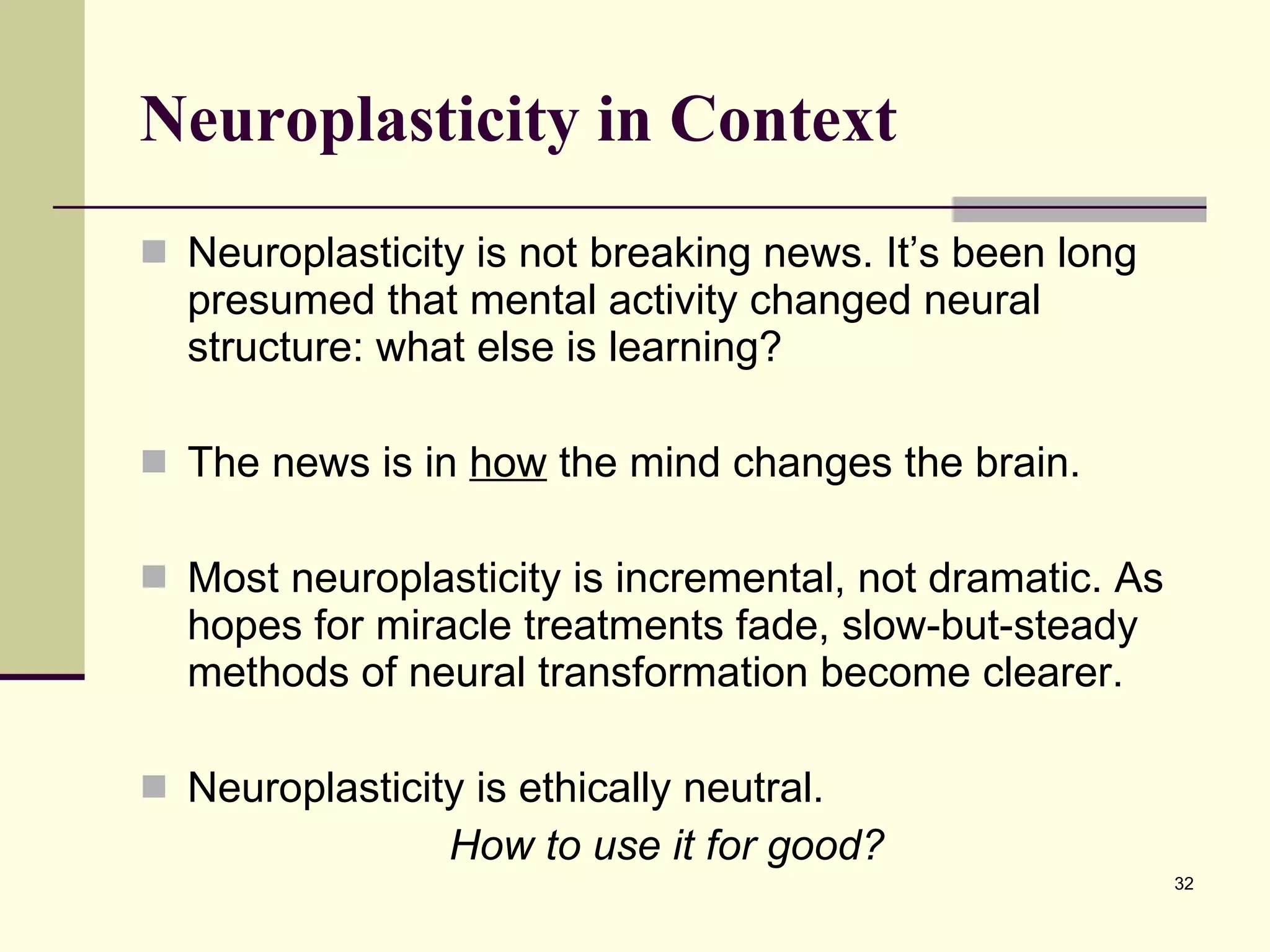
Neuroplasticity in Context Neuroplasticity is not breaking news. It’s been long presumed that mental activity changed neural structure: what else is learning?  The news is in  how  the mind changes the brain. Most neuroplasticity is incremental, not dramatic. As hopes for miracle treatments fade, slow-but-steady methods of neural transformation become clearer. Neuroplasticity is ethically neutral.  How to use it for good?
Mindfulness: Definitions and Perspectives
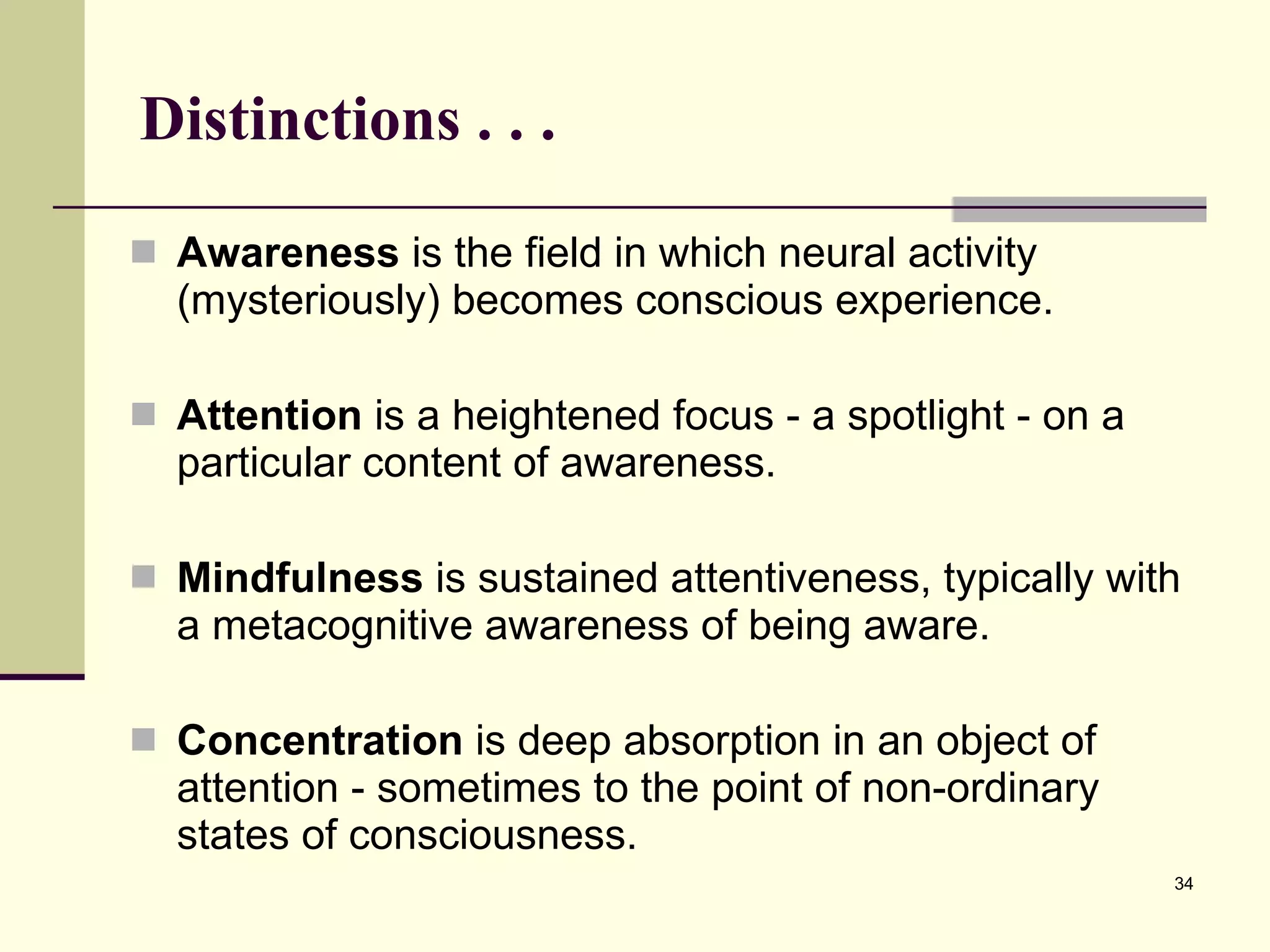
Distinctions . . .  Awareness  is the field in which neural activity (mysteriously) becomes conscious experience. Attention  is a heightened focus - a spotlight - on a particular content of awareness.  Mindfulness  is sustained attentiveness, typically with a metacognitive awareness of being aware.  Concentration  is deep absorption in an object of attention - sometimes to the point of non-ordinary states of consciousness.
Mindfulness As a Kind of Attention [Mindfulness is] the intentional cultivation of nonjudgmental moment-to-moment awareness .  (Kabat-Zinn, 1996) Intention  - meta-awareness, recollected, recursive Attention  - open, spacious, receptive, inclusive; sustained, continuous in the present moment Attitude  - accepting, nonjudgmental, kind; disengaged: not pursuing pleasant, resisting unpleasant, bored with neutral;  equanimity ; not trying to change mental material (unlike most therapies) (Shapiro et al., 2006)
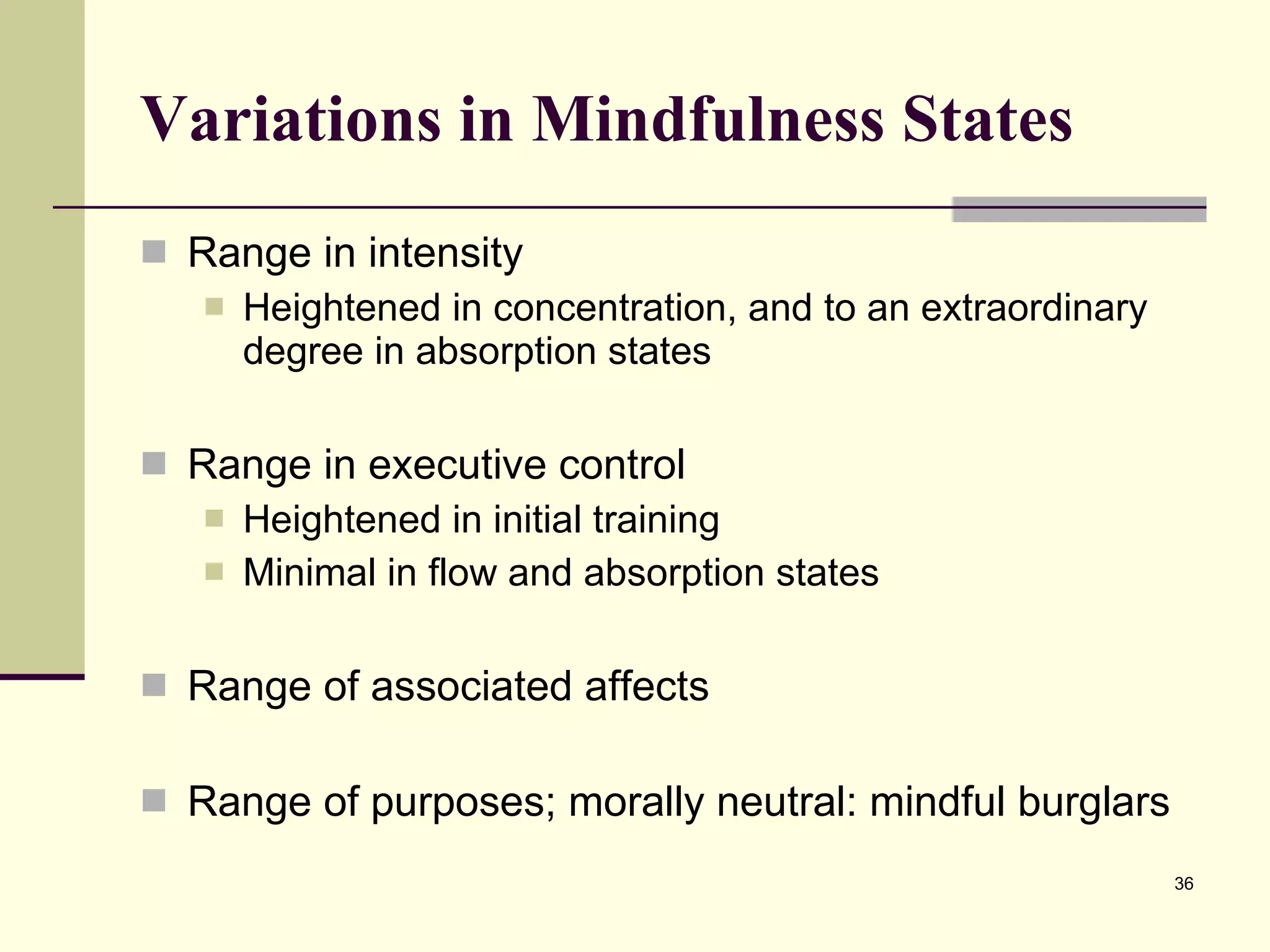
Variations in Mindfulness States Range in intensity  Heightened in concentration, and to an extraordinary degree in absorption states Range in executive control Heightened in initial training Minimal in flow and absorption states Range of associated affects Range of purposes; morally neutral: mindful burglars
Mindfulness As a Kind of Self-Awareness [Mindfulness is] a disciplined way  of learning to pay attention  to all that is arising within.  Saki Santorelli, 1999
Mindfulness As a Way of Life Mi ndfulness should not be thought of as a technique but rather as a way of being. It is practiced for its own sake, and cultivated  daily  regardless of circumstances.   John  Kabat-Zinn, 1996 Sometimes, the non-intervention in the mind that characterizes mindfulness as a kind of attention becomes central to mindfulness as a way of life, with overlaps and links to “nondual awareness” and related therapies.
Mindfulness Is Not . . .  Relaxation Hypnosis Insight Emotional release Impulse control Cultivation of positive qualities (other than mindfulness)
Being with, Releasing, Replacing There are three phases of psychological healing and personal growth (and spiritual practice): Be mindful of, release, replace. Let be, let go, let in. Mindfulness is key to the second and third phase, sometimes curative on its own, and always beneficial in strengthening its neural substrates. But often it is not enough by itself.  And sometimes you need to skip to the third phase to build resources for mindfulness.
Mindfulness is one factor among many in the mind/brain.  What are the benefits of this factor?
Mindfulness: Mechanisms of Action Reinforcing observing ego Disengagement from mental material; de-automaticization (Deikman, 1966); extinction through non-activation Fresh perspective; de-habituation (Kasamatsu & Hirai, 1973); field independence (Linden, 1973) Seeing the big picture; de-centering (Safran & Segal, 1990) Associating of neutral or positive perspective with negative material; extinction through counter-conditioning Recognizing the nature of experience: compounded, transient, interdependent; disenchantment; equanimity
Uses, Benefits of Mindfulness In its own right or as a general-purpose resource As a factor of: Virtue Insight, wisdom (concentration, absorption) To train attention Acute - decreasing distractibility Selective - decreasing rumination, OCD To cope with stress, distress, or pain To heighten the internalization of resources in implicit memory
Cautions with Mindfulness Papers are appearing about contraindications to meditation, such as dissociative tendencies or getting flooded by trauma. The Center for Mindfulness (trains MBSR) generally excludes people with active addiction or less than a year of recovery, suicidality, psychosis, PTSD (and any disorder obstructing group process).  Additional concerns: People vulnerable to loss of ego in open awareness People susceptible to self-criticism related to performance, wanting to please the clinician People who need more resources to bear their own experience
Effects of Meditation on the Brain
Heightening Neuroplastic Changes Attention  is like a spotlight, illuminating what it rests upon. Because neuroplasticity is heightened for what’s in the field of focused awareness, attention is also like a vacuum cleaner, sucking its contents into the brain. Directing attention skillfully - the essence of mindfulness - is therefore a fundamental way to shape the brain, and one’s life over time. The education of attention  would be an education  par   excellence . William James
Effects of Meditation on Brain - 1 Increased gray matter in the: Insula  - interoception; self-awareness; empathy for emotions (Holzel et al., 2008; Lazar et al., 2005) Hippocampus  - visual-spatial memory; establishing context; inhibiting amygdala and cortisol (Holzel et al., 2008; Luders et al., 2009)  Prefrontal cortext  (PFC) - executive functions; attention control (Lazar et al., 2005; Luders et al., 2009)  Reduced cortical thinning with aging in insula and PFC (Lazar et al., 2005)
Effects of Meditation on Brain - 2 Increased activation of left frontal regions (Davidson et al., 2003), which lifts mood (Davidson, 2004) Increased power and reach of gamma-range brainwaves (Cahn et al., 2010; Lutz et al., 2004) - may be associated with integration, “coming to singleness,” “unitary awareness” Preserved telomere length (Epel et al., 2009; Jacobs et al., 2011)
Mindfulness Based Stress Reduction (MBSR)
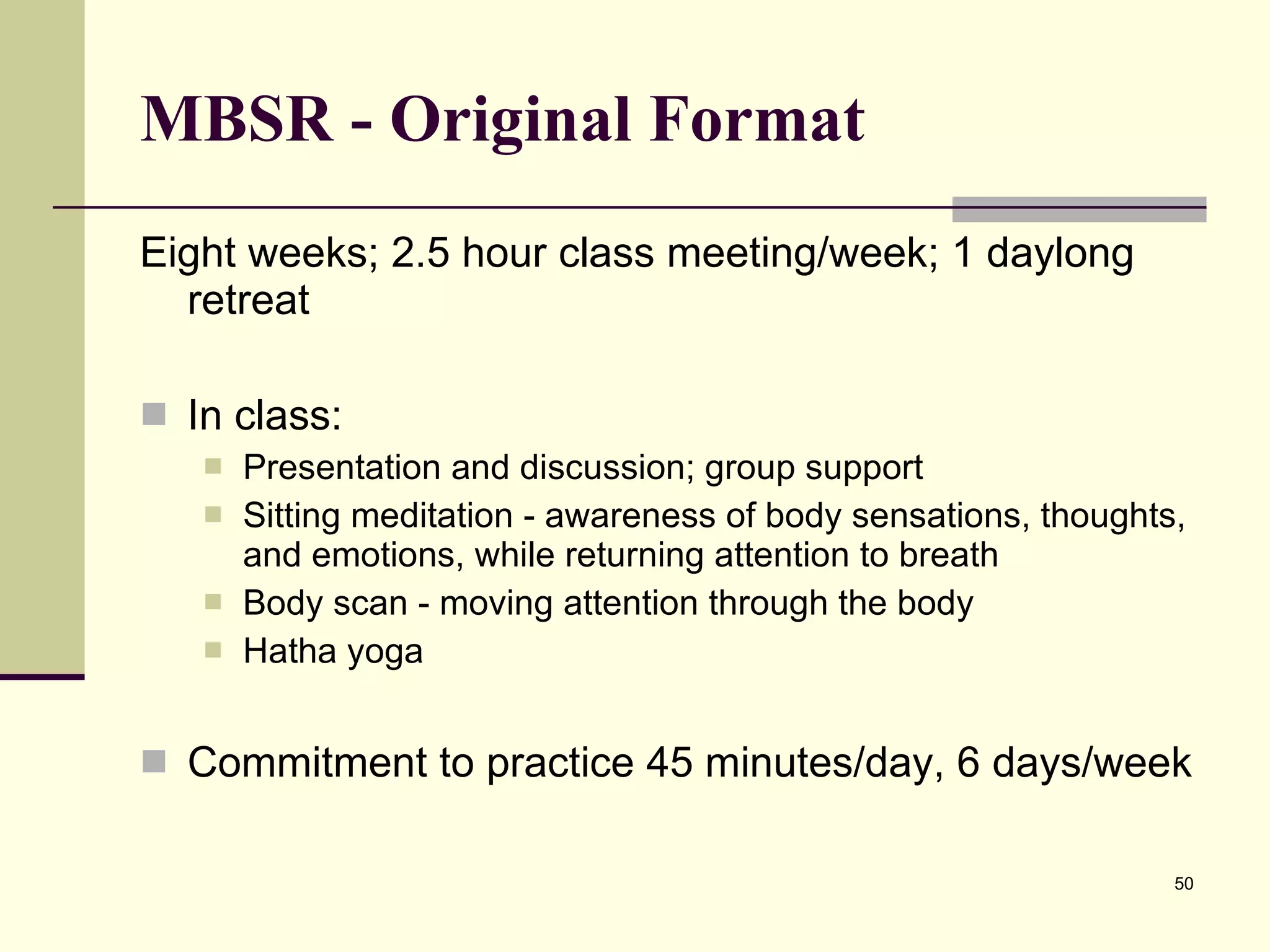
MBSR - Original Format Eight weeks; 2.5 hour class meeting/week; 1 daylong retreat  In class: Presentation and discussion; group support Sitting meditation - awareness of body sensations, thoughts, and emotions, while returning attention to breath Body scan - moving attention through the body Hatha yoga Commitment to practice 45 minutes/day, 6 days/week
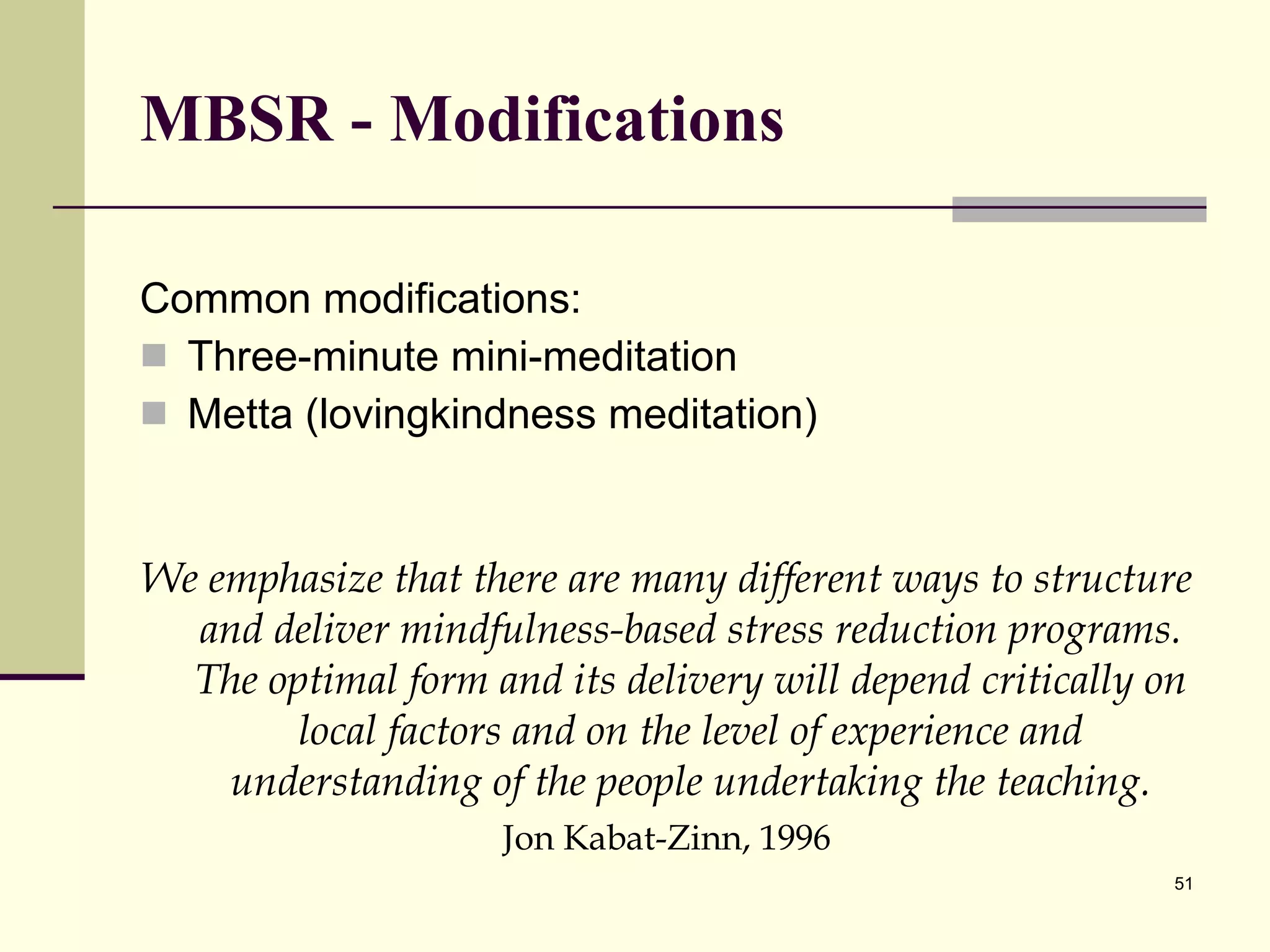
MBSR - Modifications Common modifications: Three-minute mini-meditation Metta (lovingkindness meditation) We emphasize that there are many different ways to structure and deliver mindfulness-based stress reduction programs. The optimal form and its delivery will depend critically on local factors and on the level of experience and understanding of the people undertaking the teaching. Jon Kabat-Zinn, 1996
Mindfulness As a General Factor
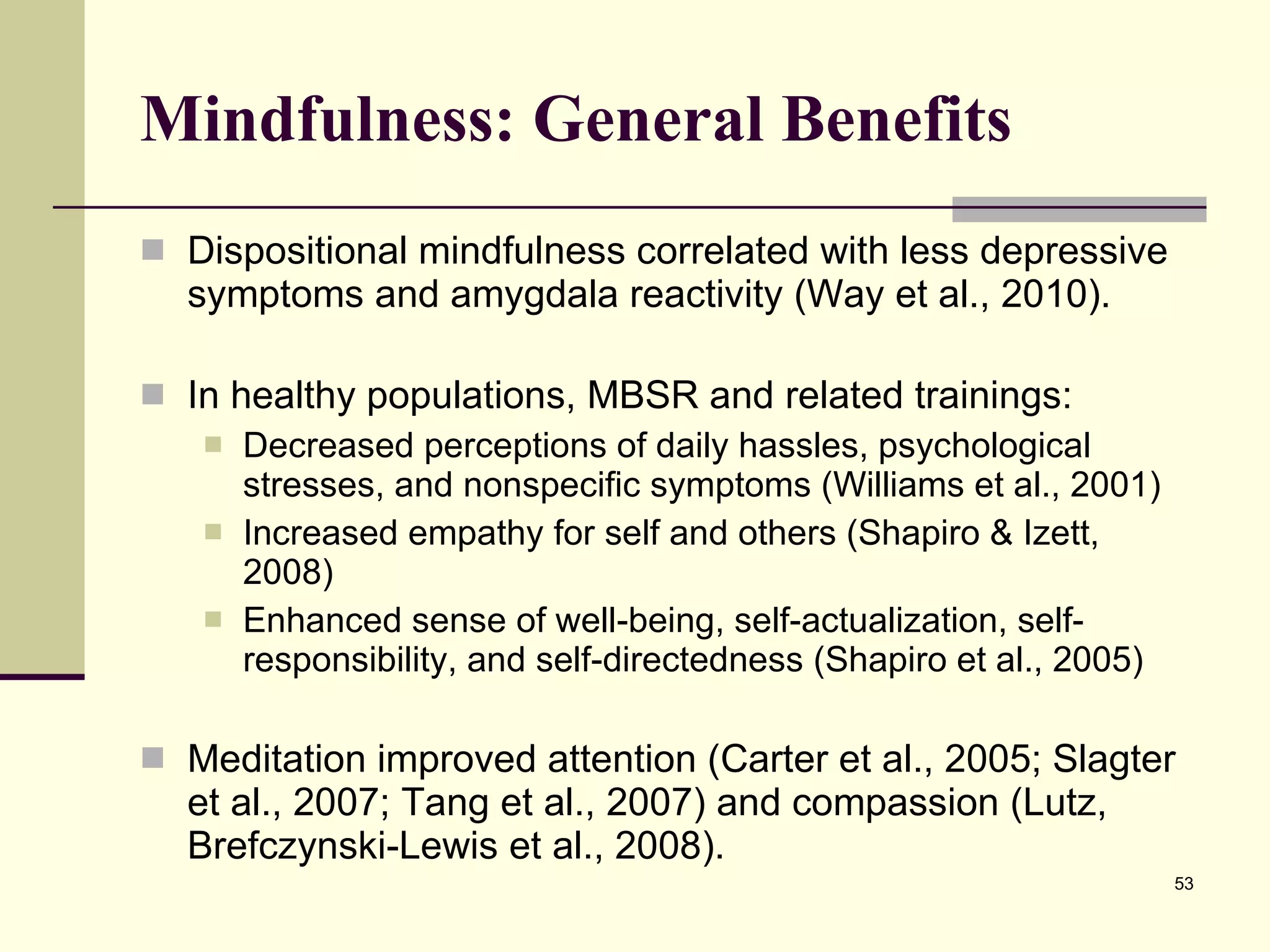
Mindfulness: General Benefits Dispositional mindfulness correlated with less depressive symptoms and amygdala reactivity (Way et al., 2010).  In healthy populations, MBSR and related trainings: Decreased perceptions of daily hassles, psychological stresses, and nonspecific symptoms (Williams et al., 2001) Increased empathy for self and others (Shapiro & Izett, 2008) Enhanced sense of well-being, self-actualization, self-responsibility, and self-directedness (Shapiro et al., 2005) Meditation improved attention (Carter et al., 2005; Slagter et al., 2007; Tang et al., 2007) and compassion (Lutz, Brefczynski-Lewis et al., 2008).
Mindfulness Interventions in Medical Care
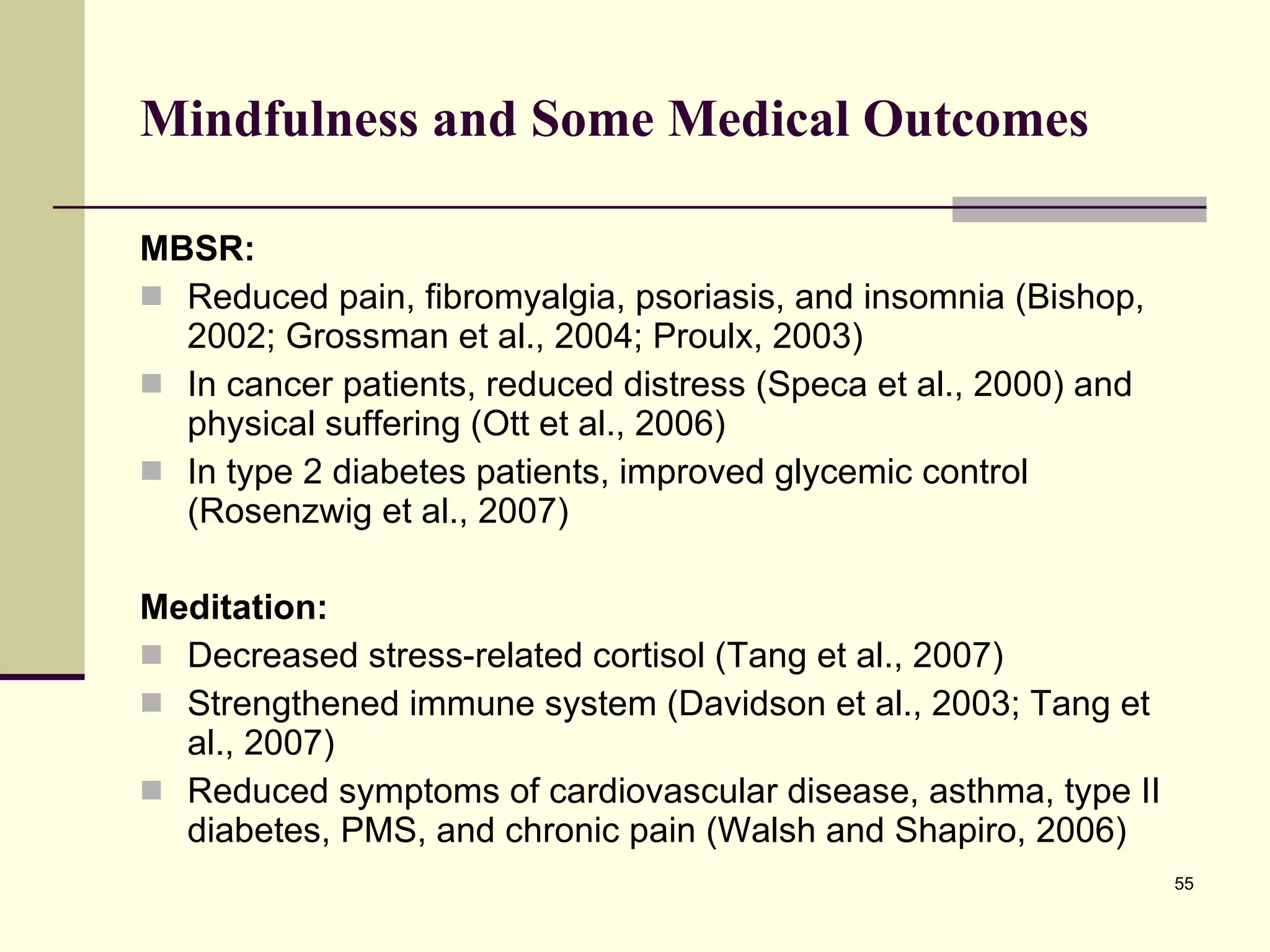
Mindfulness and Some Medical Outcomes MBSR: Reduced pain, fibromyalgia, psoriasis, and insomnia (Bishop, 2002; Grossman et al., 2004; Proulx, 2003) In cancer patients, reduced distress (Speca et al., 2000) and physical suffering (Ott et al., 2006)  In type 2 diabetes patients, improved glycemic control (Rosenzwig et al., 2007)  Meditation: Decreased stress-related cortisol (Tang et al., 2007) Strengthened immune system (Davidson et al., 2003; Tang et al., 2007) Reduced symptoms of cardiovascular disease, asthma, type II diabetes, PMS, and chronic pain (Walsh and Shapiro, 2006)
Mindfulness Interventions in  Psychological Treatments
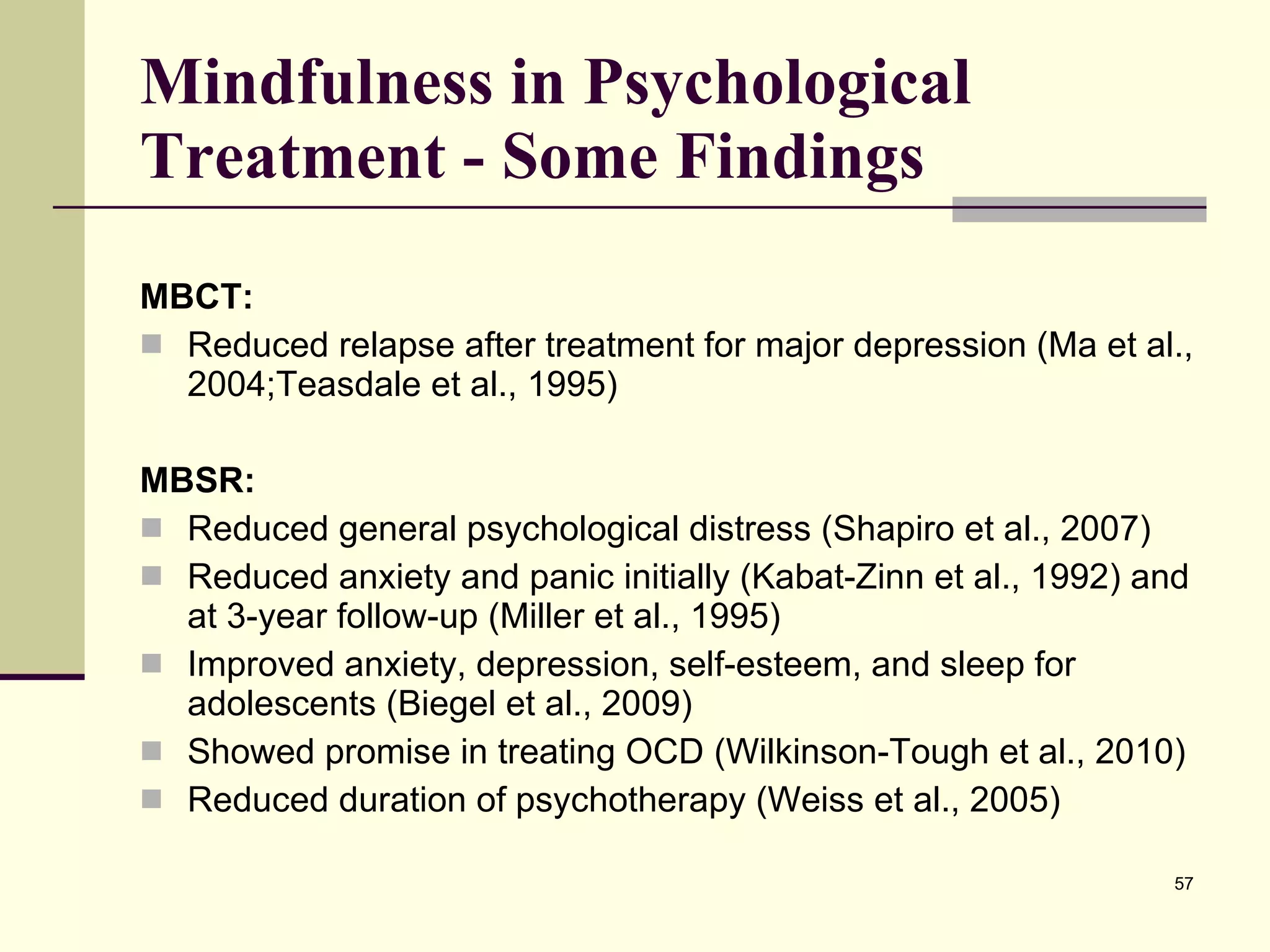
Mindfulness in Psychological Treatment - Some Findings MBCT: Reduced relapse after treatment for major depression (Ma et al., 2004;Teasdale et al., 1995) MBSR: Reduced general psychological distress (Shapiro et al., 2007) Reduced anxiety and panic initially (Kabat-Zinn et al., 1992) and at 3-year follow-up (Miller et al., 1995) Improved anxiety, depression, self-esteem, and sleep for adolescents (Biegel et al., 2009) Showed promise in treating OCD (Wilkinson-Tough et al., 2010) Reduced duration of psychotherapy (Weiss et al., 2005)
Effect Sizes For both physical and mental health conditions, effect sizes have been substantial (Grossman, et al. 2004; Hoffman et al., 2010).
Mindfulness for Health Professionals
Mindfulness for Health Professionals Stress and busyness reduce energy, motivation, impulse control, and attentional capacities – with well-known impacts on health professional effectiveness (Borell-Carrio & Epstein, 2004). For example, in one study, depressed residents made 6.2 times as many medication errors as residents who were not depressed (Fahrenkopf et al., 2008).  With health professionals, MBSR: Improved care by increased self-monitoring (Epstein et al., 2008)  Reduced depression, anxiety; increase empathy (Shapiro et al., 1998) Decreased burnout by combating emotional exhaustion and depersonalization (Cohen-Katz et al., 2005) Increased quality of life by reducing stress and increasing compassion for oneself (Shapiro et al., 2005)  Mindfulness may be a key to bridging evidence-based practice  and relationship-centered care.   Ronald Epstein, 1999
[M]any of us find ourselves struggling with fatigue, a sense of futility, frustration with forms and computers, inability to keep up with the rapid flow of new information, and the demands of our own lives.  There may be little we can do to quickly change the external factors in our lives and practices. But we can change our internal responses to these challenges.  Mindful presence invites us back into each moment as it happens, helping us compassionately set priorities, recognize our limits, and rediscover the meaning in our work. Karen Lawson, 2001
Some Neural Factors of Mindfulness
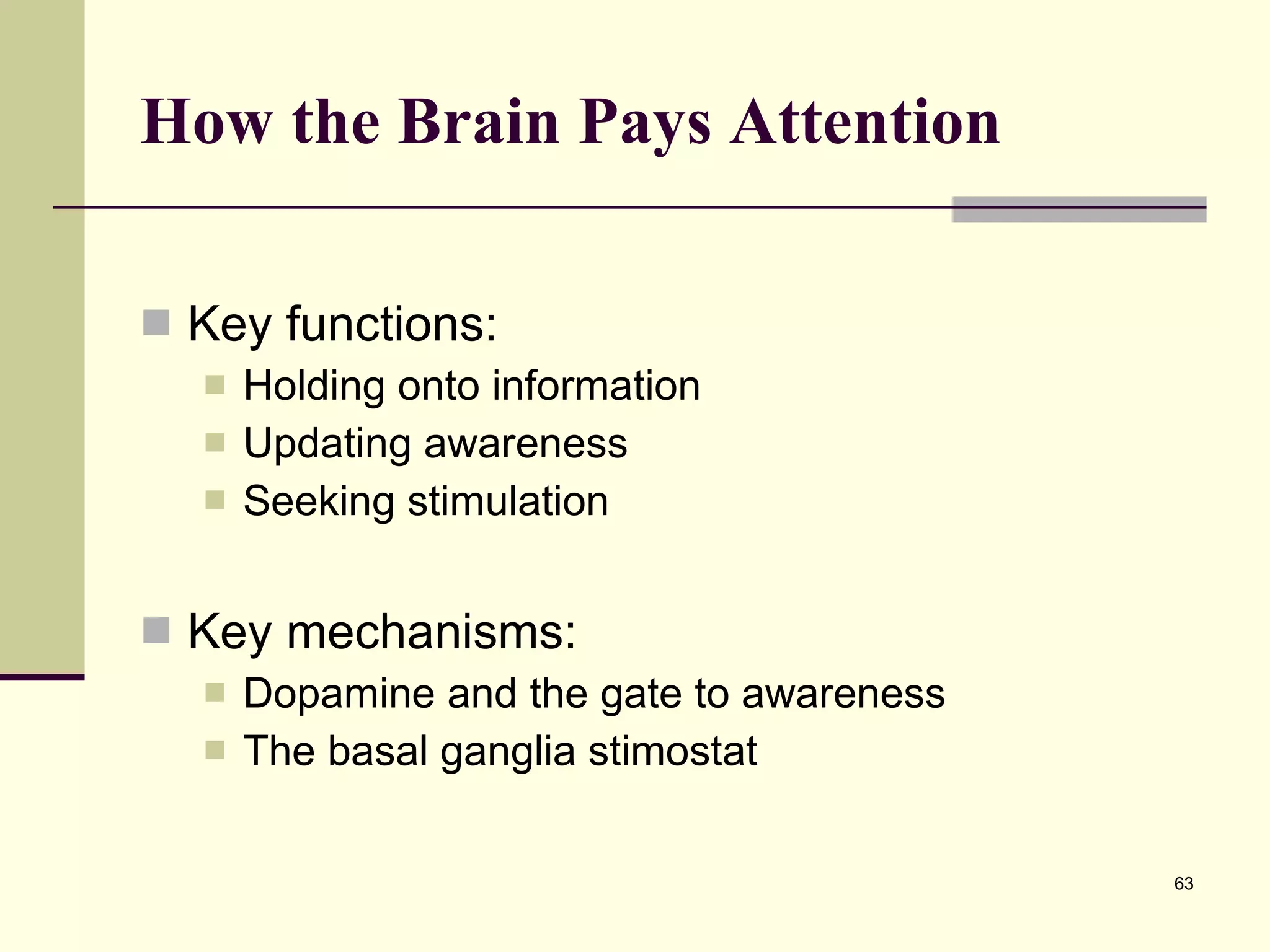
How the Brain Pays Attention   Key functions: Holding onto information Updating awareness Seeking stimulation Key mechanisms: Dopamine and the gate to awareness The basal ganglia stimostat
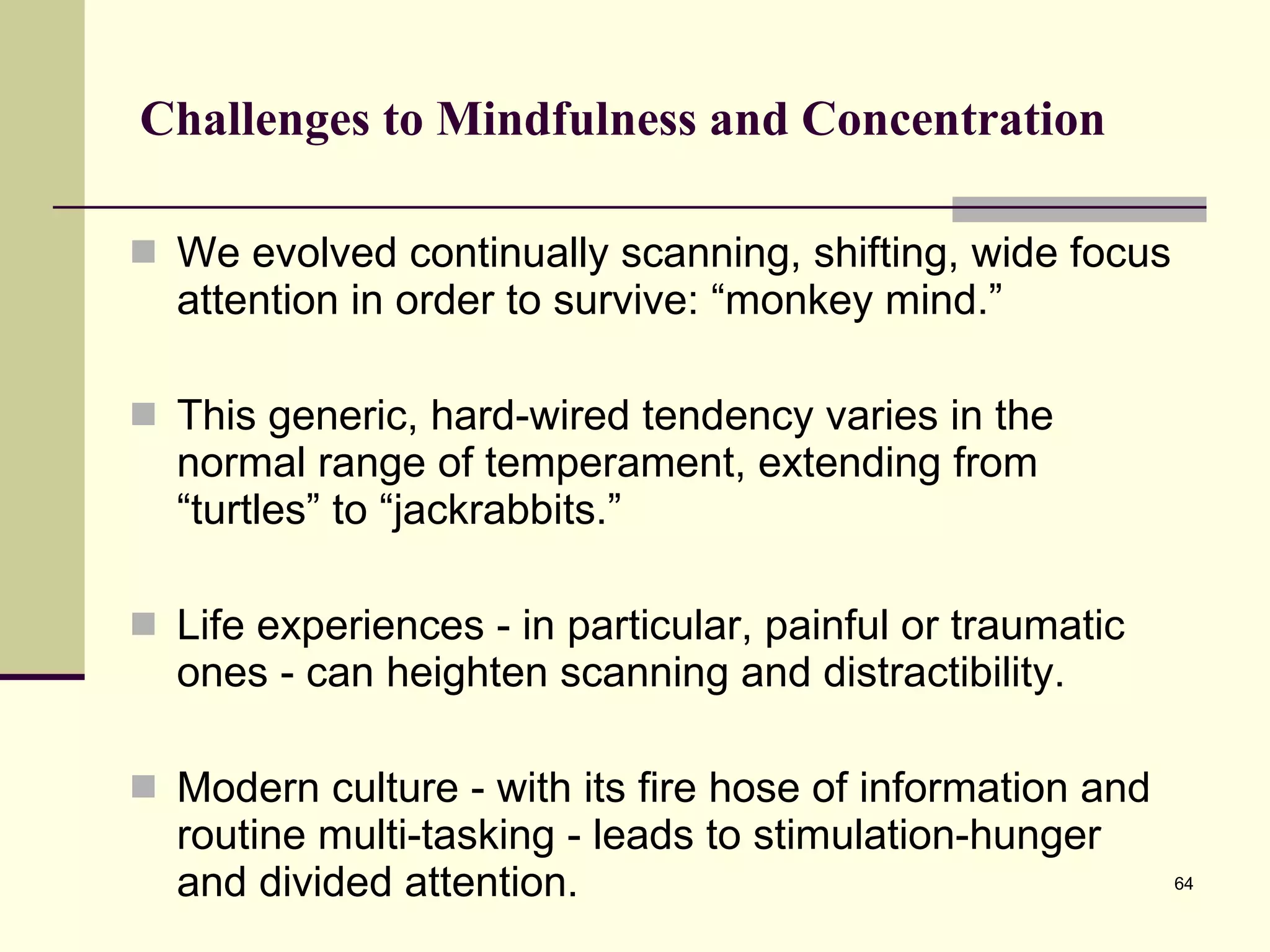
Challenges to Mindfulness and Concentration We evolved continually scanning, shifting, wide focus attention in order to survive: “monkey mind.” This generic, hard-wired tendency varies in the normal range of temperament, extending from “turtles” to “jackrabbits.” Life experiences - in particular, painful or traumatic ones - can heighten scanning and distractibility. Modern culture - with its fire hose of information and routine multi-tasking - leads to stimulation-hunger and divided attention.
More then anything, mindfulness is about cultivating an ability to be fully present in a single moment … [M]ost of us spend very little time "here and now." We instead tend to focus our attention on the … future or on the past... [I]n many ways our culture unintentionally "deprograms" us from being present in the moment by heavily rewarding us for not being here … Because being out of the moment is so useful, this style gets put into play much more th[a]n it needs to be, leading people to spend less and less time aware of the present. Phillippe Goldin, 2011
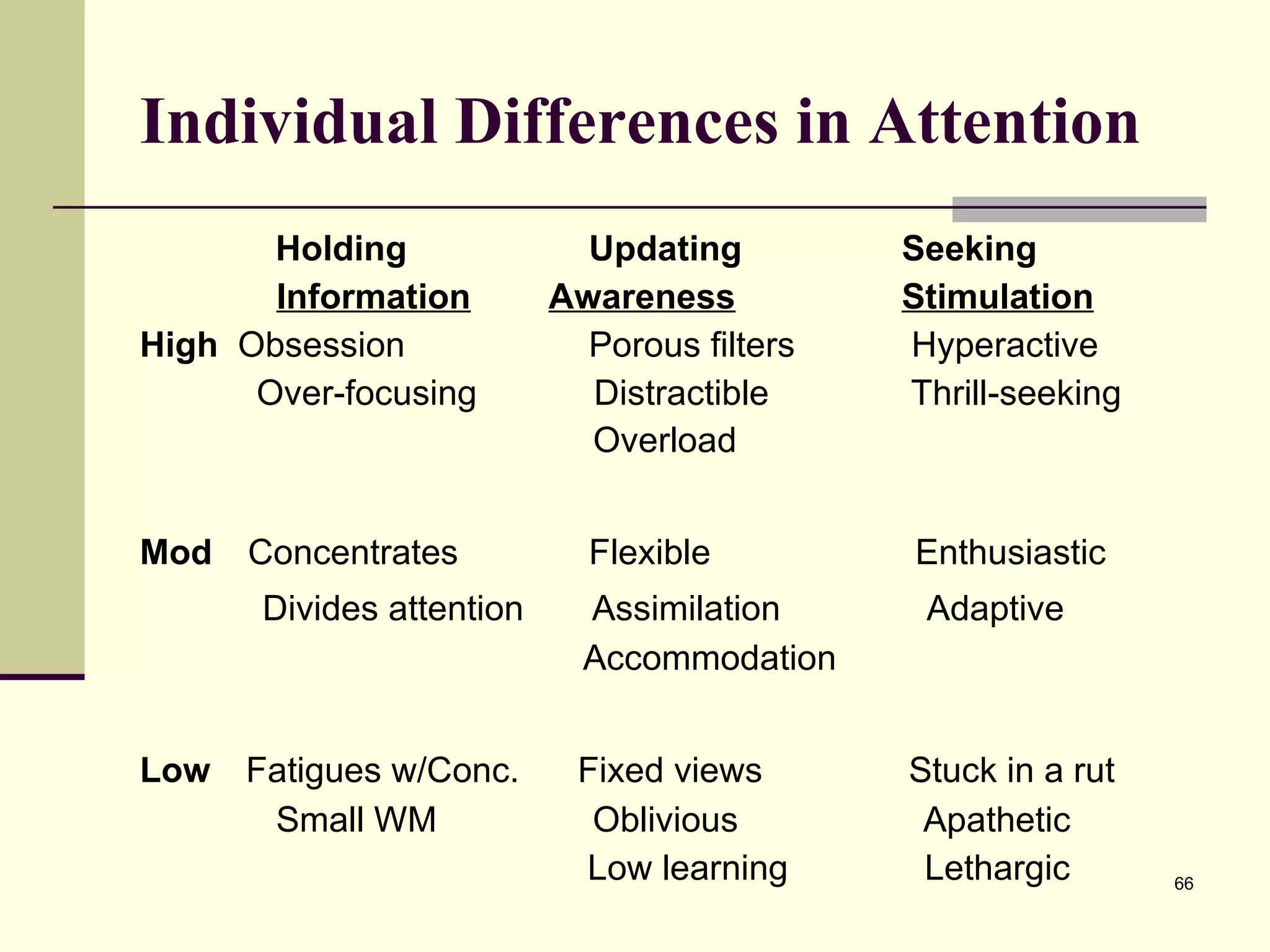
Individual Differences in Attention     Holding    Updating   Seeking   Information   Awareness   Stimulation High   Obsession   Porous filters  Hyperactive Over-focusing  Distractible   Thrill-seeking Overload   Mod   Concentrates   Flexible  Enthusiastic Divides attention  Assimilation  Adaptive Accommodation Low   Fatigues w/Conc.  Fixed views  Stuck in a rut Small WM  Oblivious  Apathetic Low learning  Lethargic
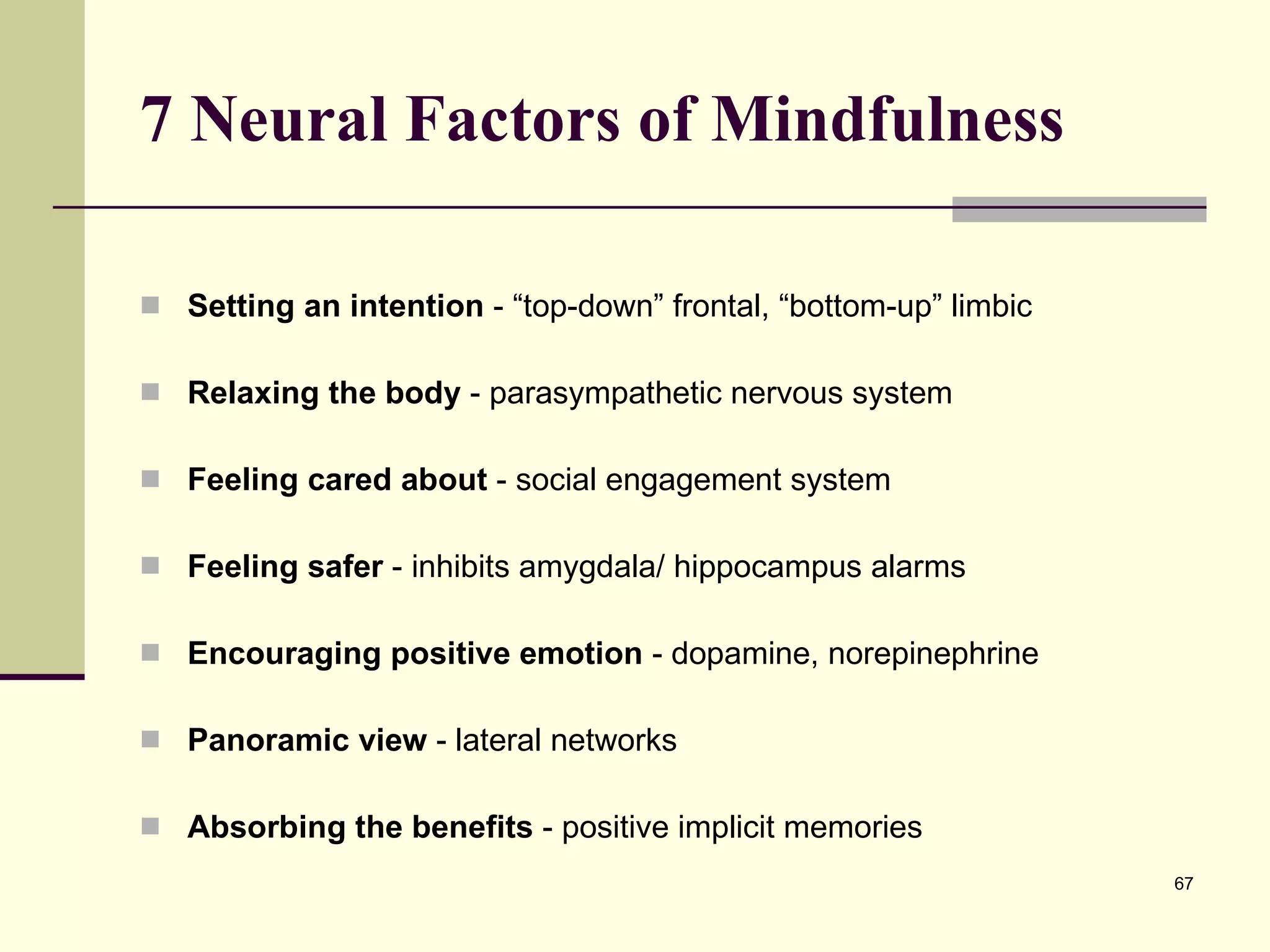
7 Neural Factors of Mindfulness Setting an intention  - “top-down” frontal, “bottom-up” limbic Relaxing the body  - parasympathetic nervous system  Feeling cared about  - social engagement system Feeling safer  - inhibits amygdala/ hippocampus alarms Encouraging positive emotion  - dopamine, norepinephrine Panoramic view  - lateral networks Absorbing the benefits  - positive implicit memories
Lateral Networks of Mindfulness
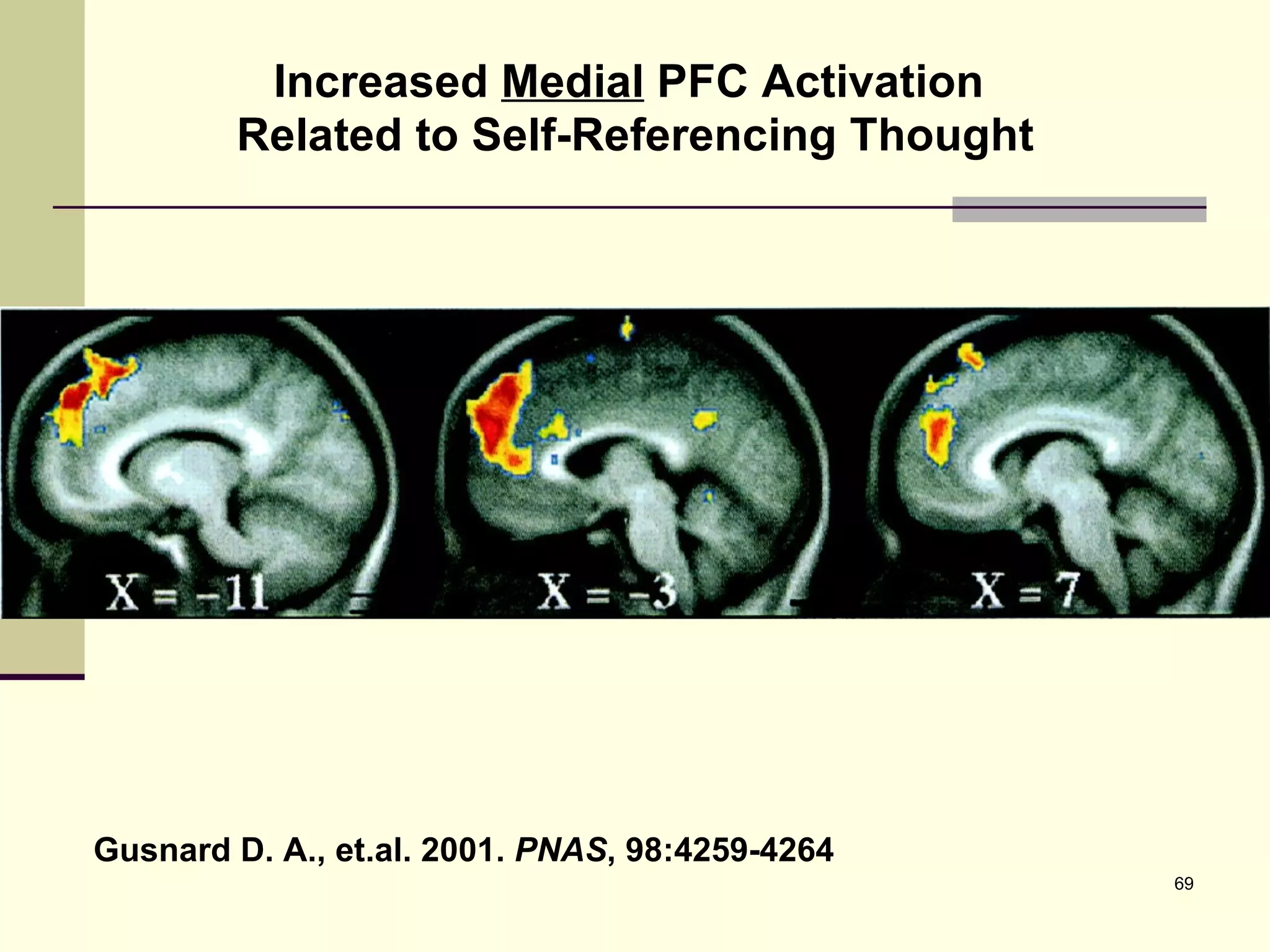
Increased  Medial  PFC Activation  Related to Self-Referencing Thought Gusnard D. A., et.al. 2001.  PNAS , 98:4259-4264
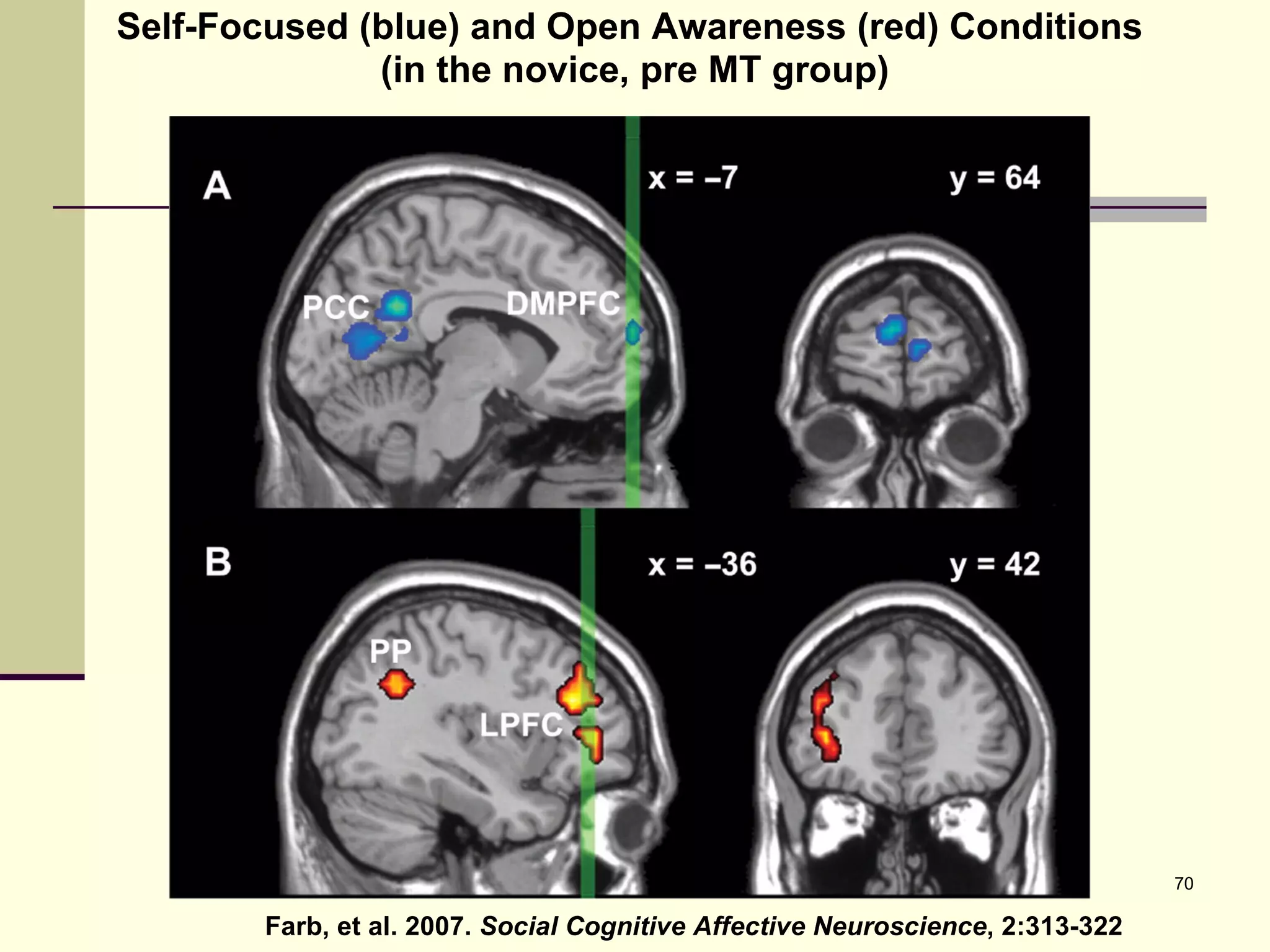
Farb, et al. 2007.  Social Cognitive Affective Neuroscience , 2:313-322 Self-Focused (blue) and Open Awareness (red) Conditions  (in the novice, pre MT group)
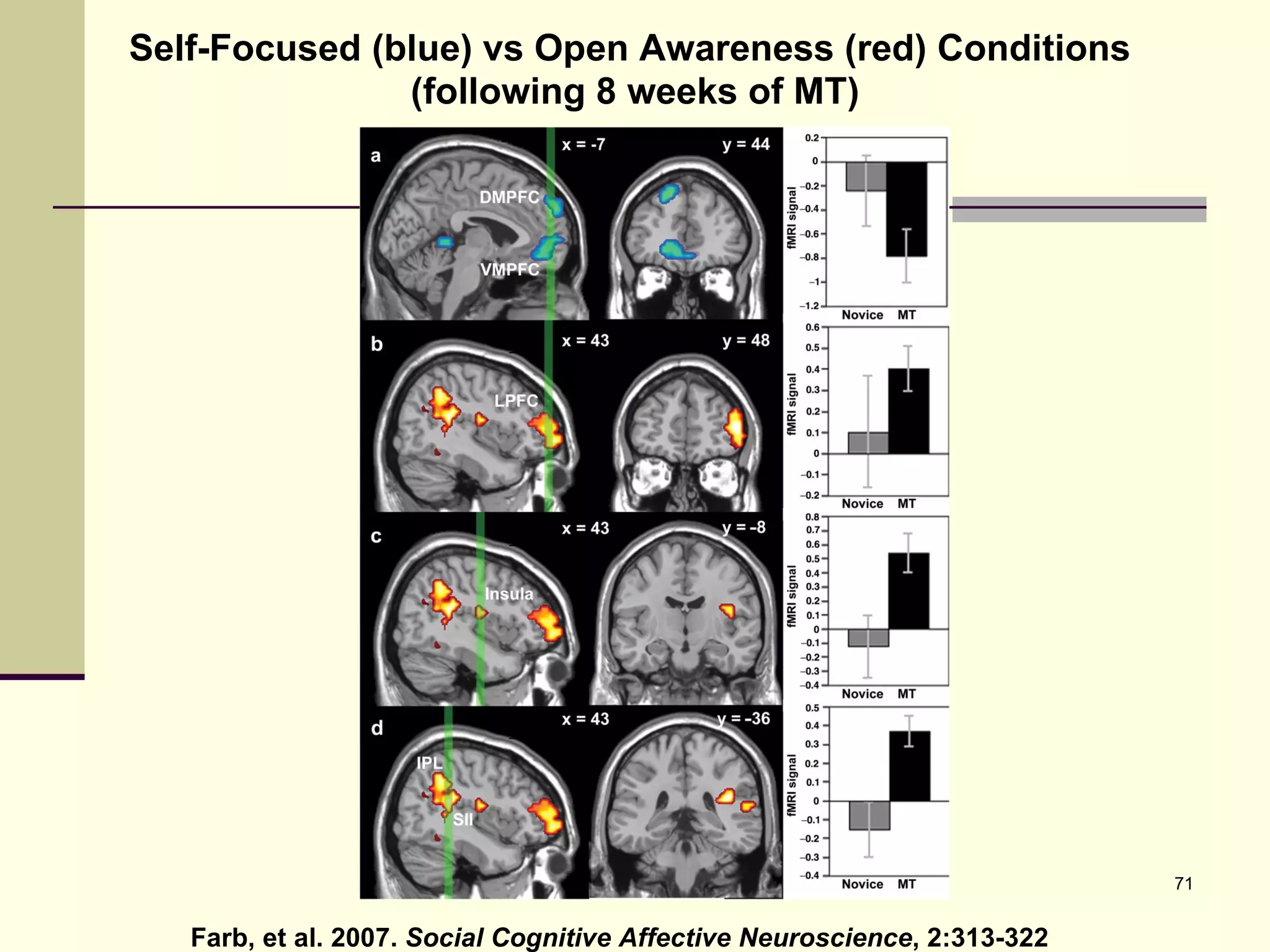
Farb, et al. 2007.  Social Cognitive Affective Neuroscience , 2:313-322 Self-Focused (blue) vs Open Awareness (red) Conditions  (following 8 weeks of MT)
Ways to Activate Lateral Networks Relax.  Focus on bare sensations and perceptions.  Sense the body as a whole.  Take a panoramic, “bird’s-eye” view.  Engage “d o n’t-know mind ”; release judgments.  Don’t try to connect mental contents together.  Let experience flow, staying here now.  Relax the sense of “I, me, and mine.”
Whole Body Awareness Sense the breath in one area (e.g., chest, upper lip).  Sense the breath as a whole: one gestalt, percept.  Sense the body as a whole, a whole body breathing.  Sense experience as a whole: sensations, sounds, thoughts . . . all arising together as one unified thing.  It’s natural for this sense of the whole to be present for a second or two, then crumble; just open up to it again and again.
Panoramic Awareness Recall a bird’s-eye view (e.g., mountain, airplane).  Be aware of sounds coming and going in an open space of awareness, without any edges: boundless.  Open to other contents of mind, coming and going like clouds moving across the sky.  Pleasant or unpleasant, no matter: just more clouds No cloud ever harms or taints the sky.
“ Bahiya, you should train yourself thus.” In reference to the seen, there will be only the seen. To the heard, only the heard. To the sensed, only the sensed. To the cognized, only the cognized.  When for you there will be only the seen in reference to the seen, only the heard in the heard, only the sensed in the sensed, only the cognized in the cognized, then, Bahiya, there’s no you in that.  When there’s no you in that, there’s no you there. When there’s no you there, you are neither here nor yonder nor between the two.  This, just this, is the end of all suffering.  The Buddha
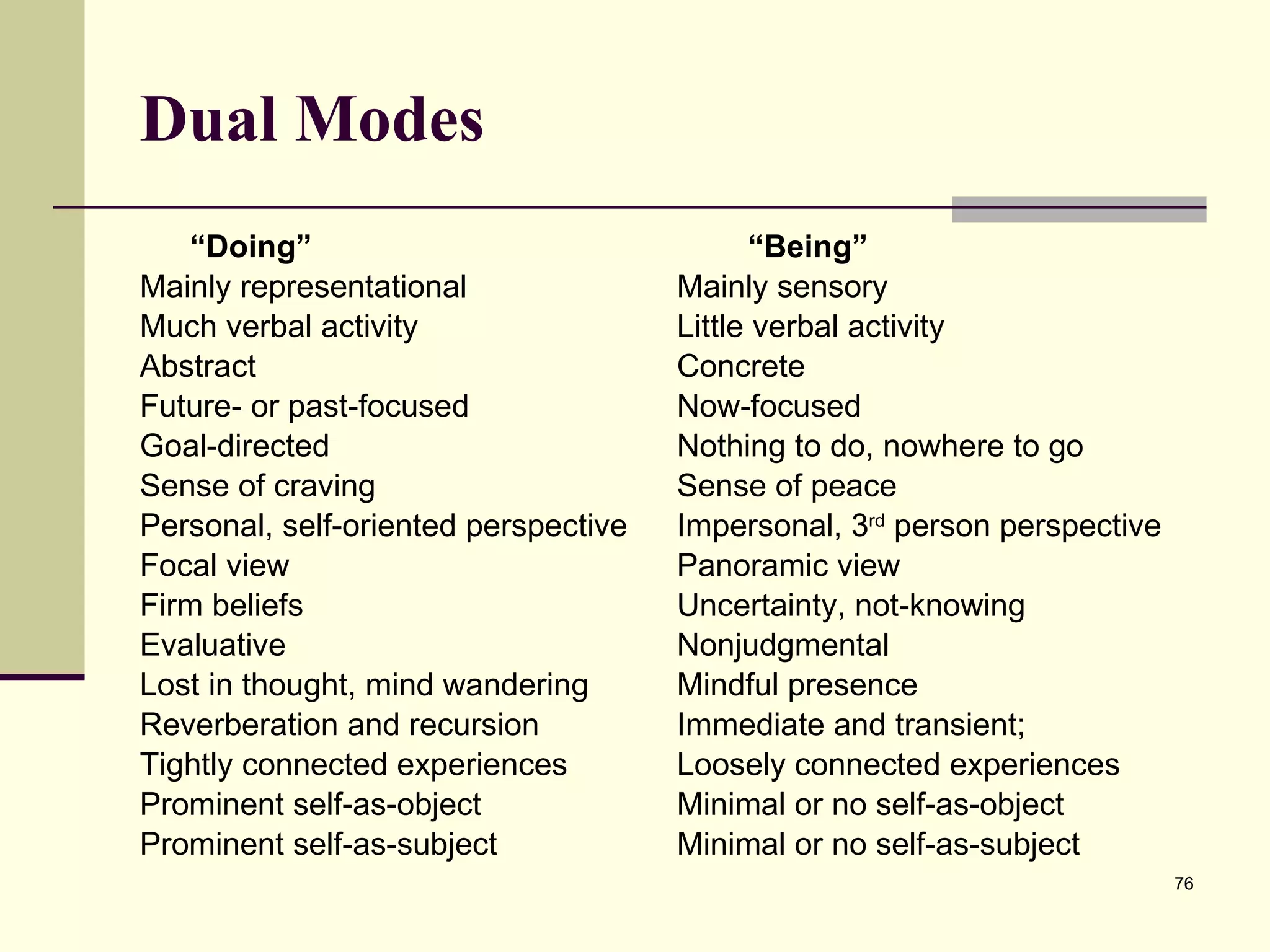
Dual Modes “ Doing”   “Being” Mainly representational Mainly sensory  Much verbal activity Little verbal activity Abstract Concrete Future- or past-focused Now-focused Goal-directed Nothing to do, nowhere to go Sense of craving Sense of peace Personal, self-oriented perspective Impersonal, 3 rd  person perspective Focal view Panoramic view Firm beliefs Uncertainty, not-knowing Evaluative Nonjudgmental Lost in thought, mind wandering Mindful presence Reverberation and recursion Immediate and transient; Tightly connected experiences Loosely connected experiences Prominent self-as-object Minimal or no self-as-object Prominent self-as-subject Minimal or no self-as-subject
Mindful Internalization of  Positive Experiences
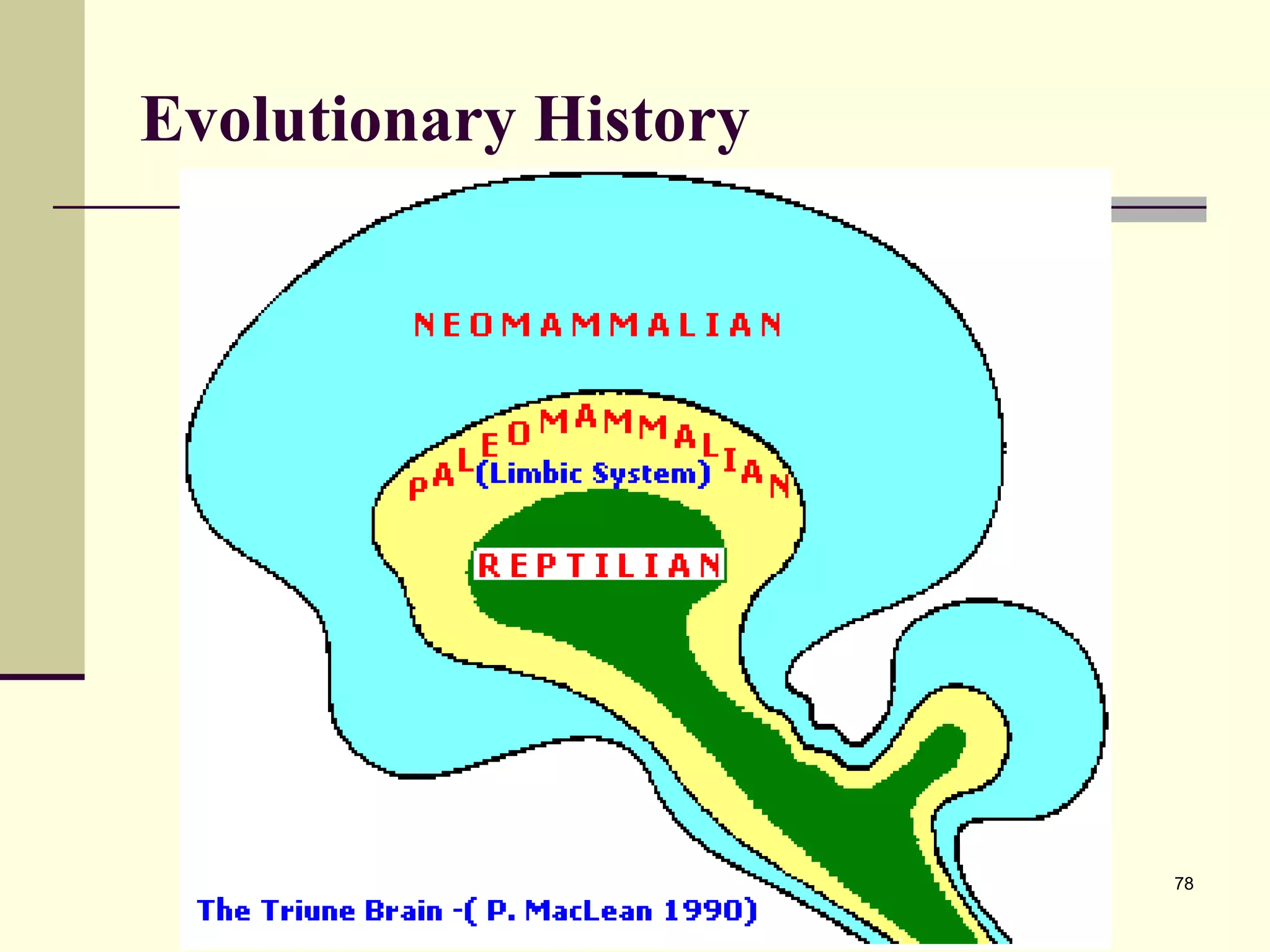
Evolutionary History The Triune Brain
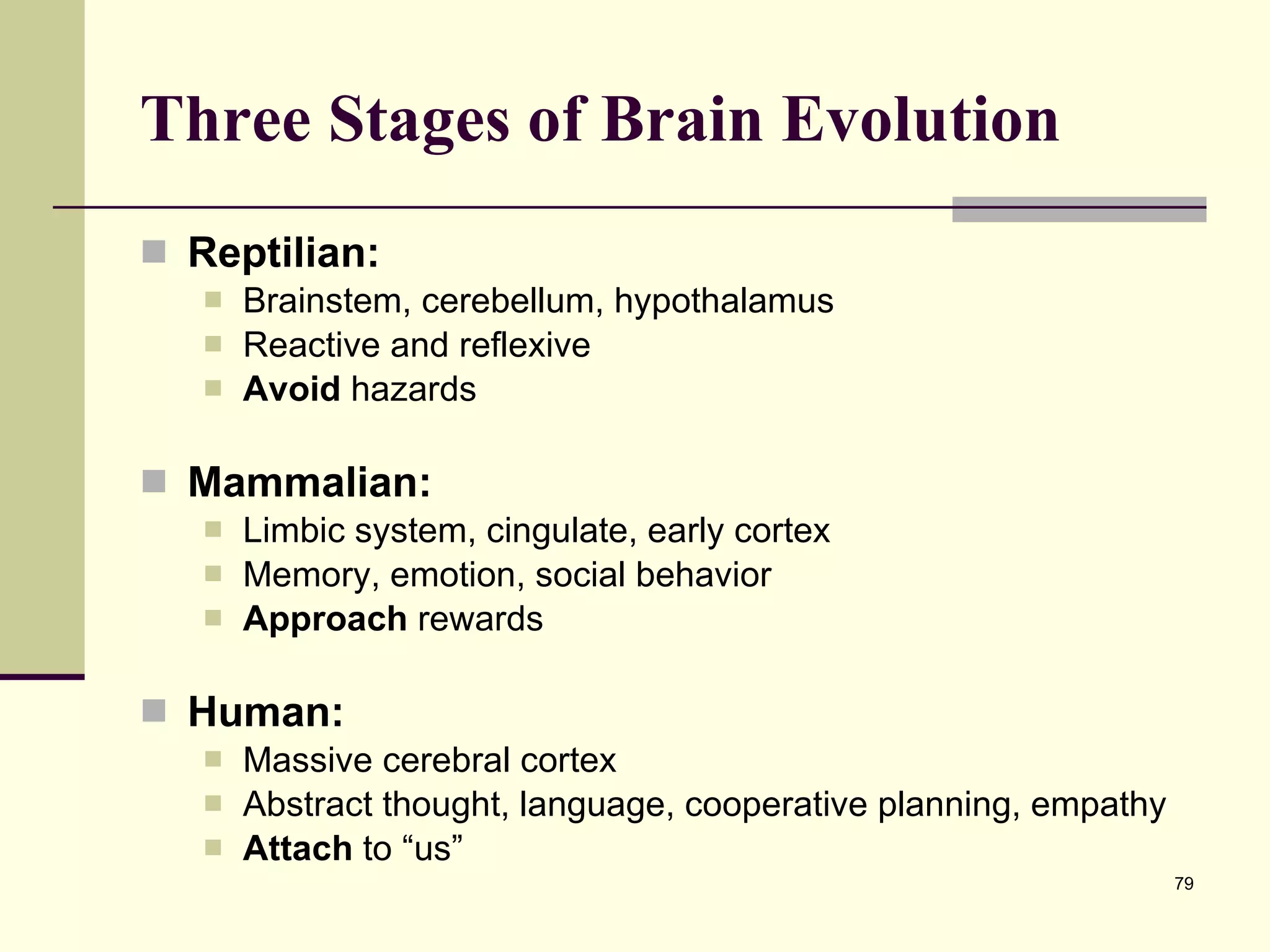
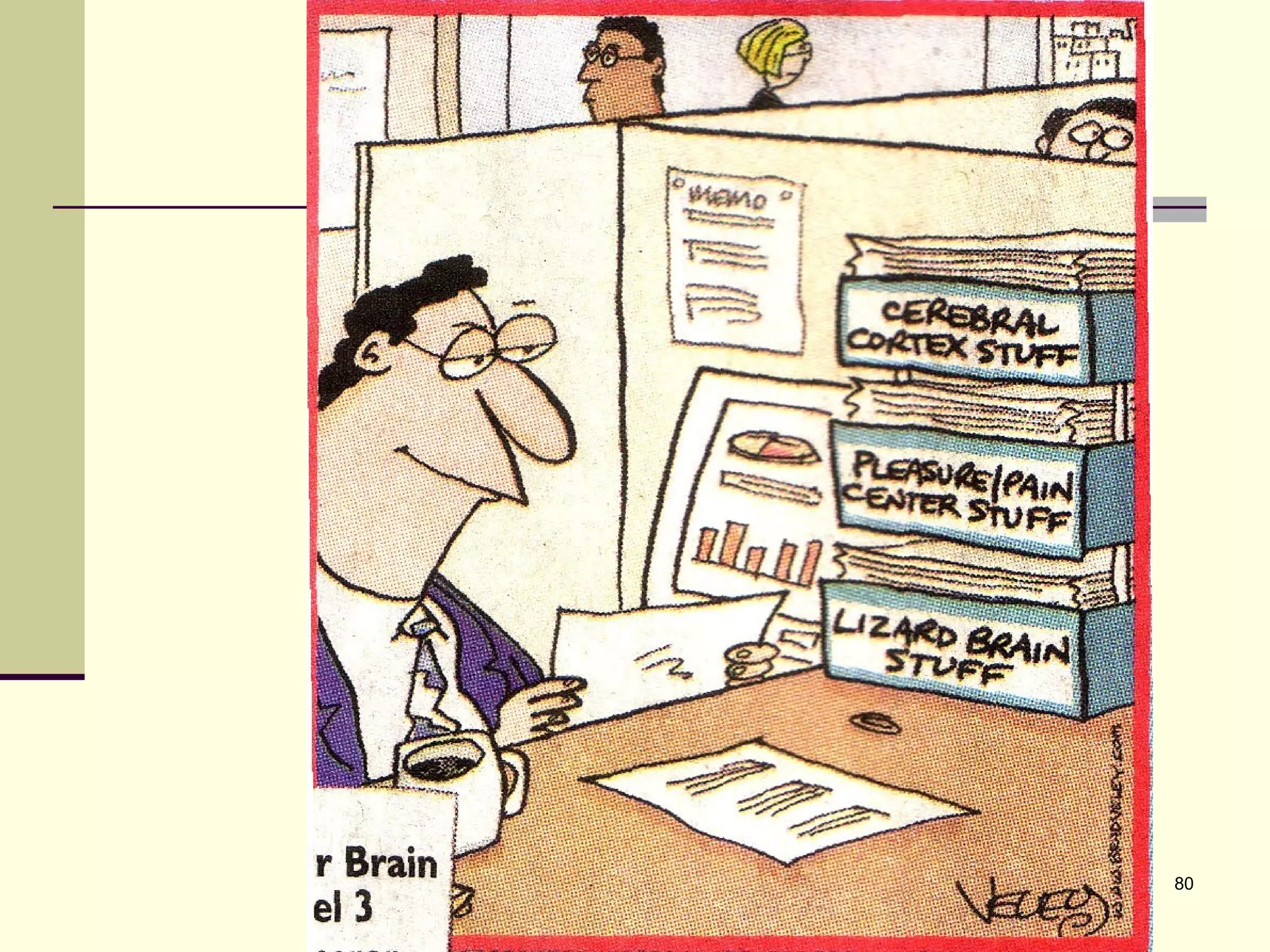
Three Stages of Brain Evolution Reptilian: Brainstem, cerebellum, hypothalamus Reactive and reflexive Avoid  hazards Mammalian: Limbic system, cingulate, early cortex Memory, emotion, social behavior Approach  rewards Human: Massive cerebral cortex Abstract thought, language, cooperative planning, empathy Attach  to “us”
 
Negativity Bias: Causes in Evolution “ Sticks” - Predators, natural hazards, social aggression, pain (physical and psychological) “ Carrots” - Food, sex, shelter, social support, pleasure (physical and psychological) During evolution, avoiding “sticks” usually had more effects on survival than approaching “carrots.” Urgency  - Usually, sticks must be dealt with immediately, while carrots allow a longer approach. Impact  - Sticks usually determine mortality, carrots not; if you fail to get a carrot today, you’ll likely have a chance at a carrot tomorrow; but if you fail to avoid a stick today - whap! - no more carrots forever.
Negativity Bias: Some Consequences Negative stimuli get more attention and processing. We generally learn faster from pain than pleasure. People work harder to avoid a loss than attain an equal gain (“endowment effect”).  Easy to create learned helplessness, hard to undo Negative interactions: more powerful than positive Negative experiences sift into implicit memory. (Baumeister et al., 2001; Rozin and Royzman, 2001)
The Importance of Inner Resources Examples: Freud’s “positive introjects” Internalization of “corrective emotional experiences” during psychotherapy “ Learned optimism” Benefits Increase positive emotions: many physical and mental health benefits Improve self-soothing Improve outlook on world, self, and future Increase resilience, determination
Just  having  positive experiences is not enough.  They pass through the brain like water through a sieve, while negative experiences are caught. We need to engage positive experiences actively to weave them into the brain.
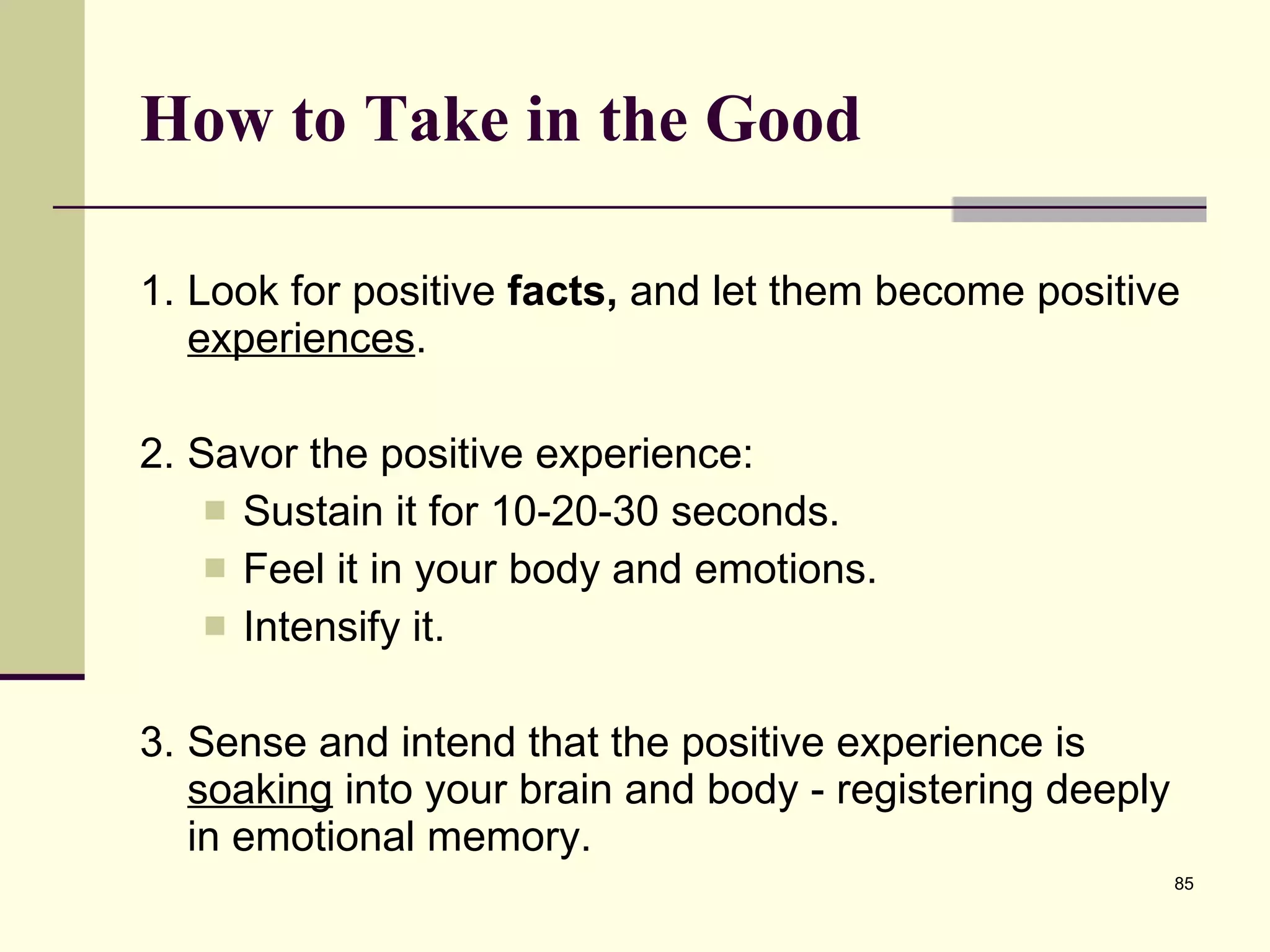
How to Take in the Good 1. Look for positive  facts,  and let them become positive  experiences .  2. Savor the positive experience: Sustain it for 10-20-30 seconds. Feel it in your body and emotions.  Intensify it.  3. Sense and intend that the positive experience is  soaking  into your brain and body - registering deeply in emotional memory.
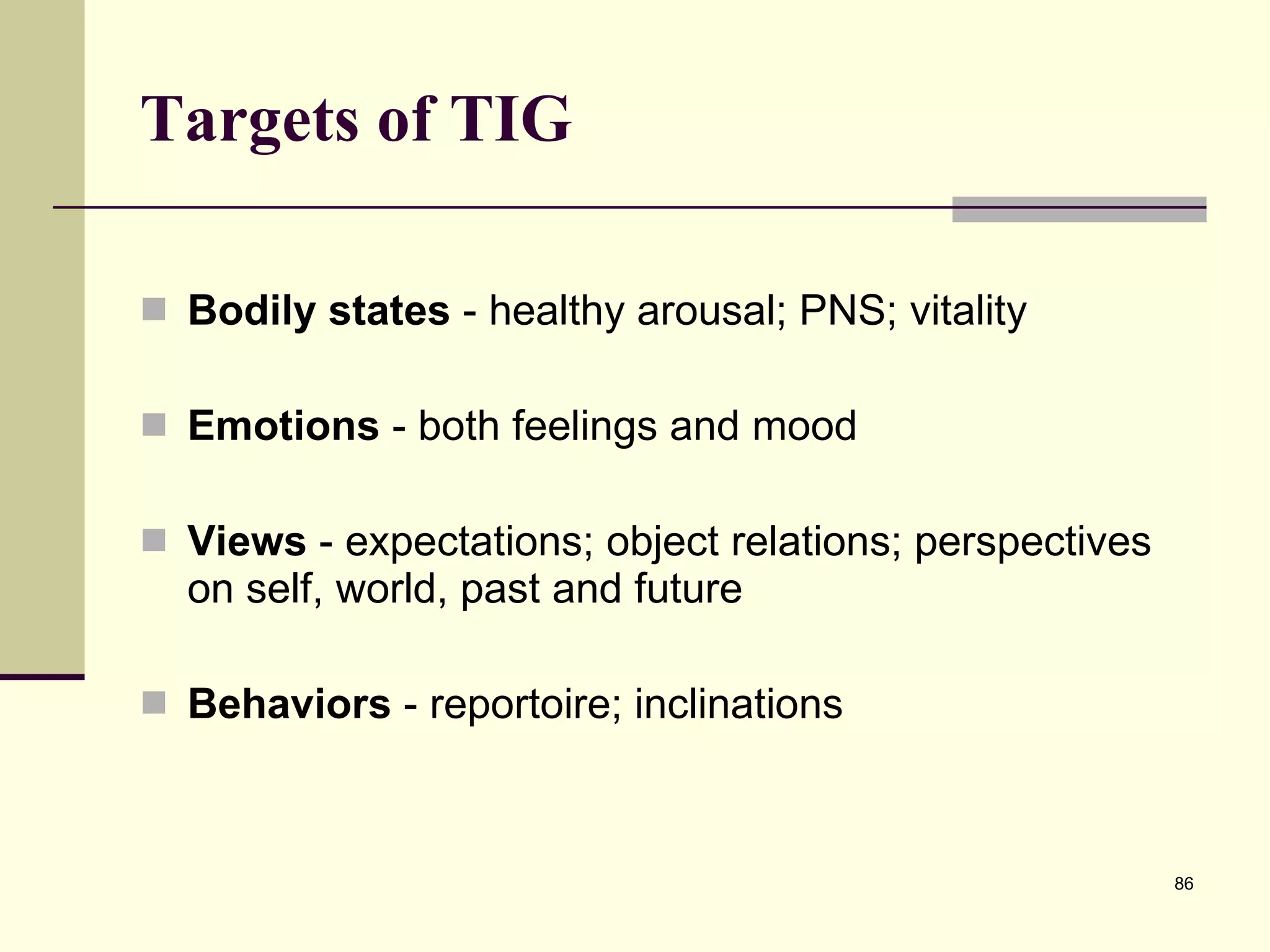
Targets of TIG Bodily states  - healthy arousal; PNS; vitality Emotions  - both feelings and mood Views  - expectations; object relations; perspectives on self, world, past and future Behaviors  - reportoire; inclinations
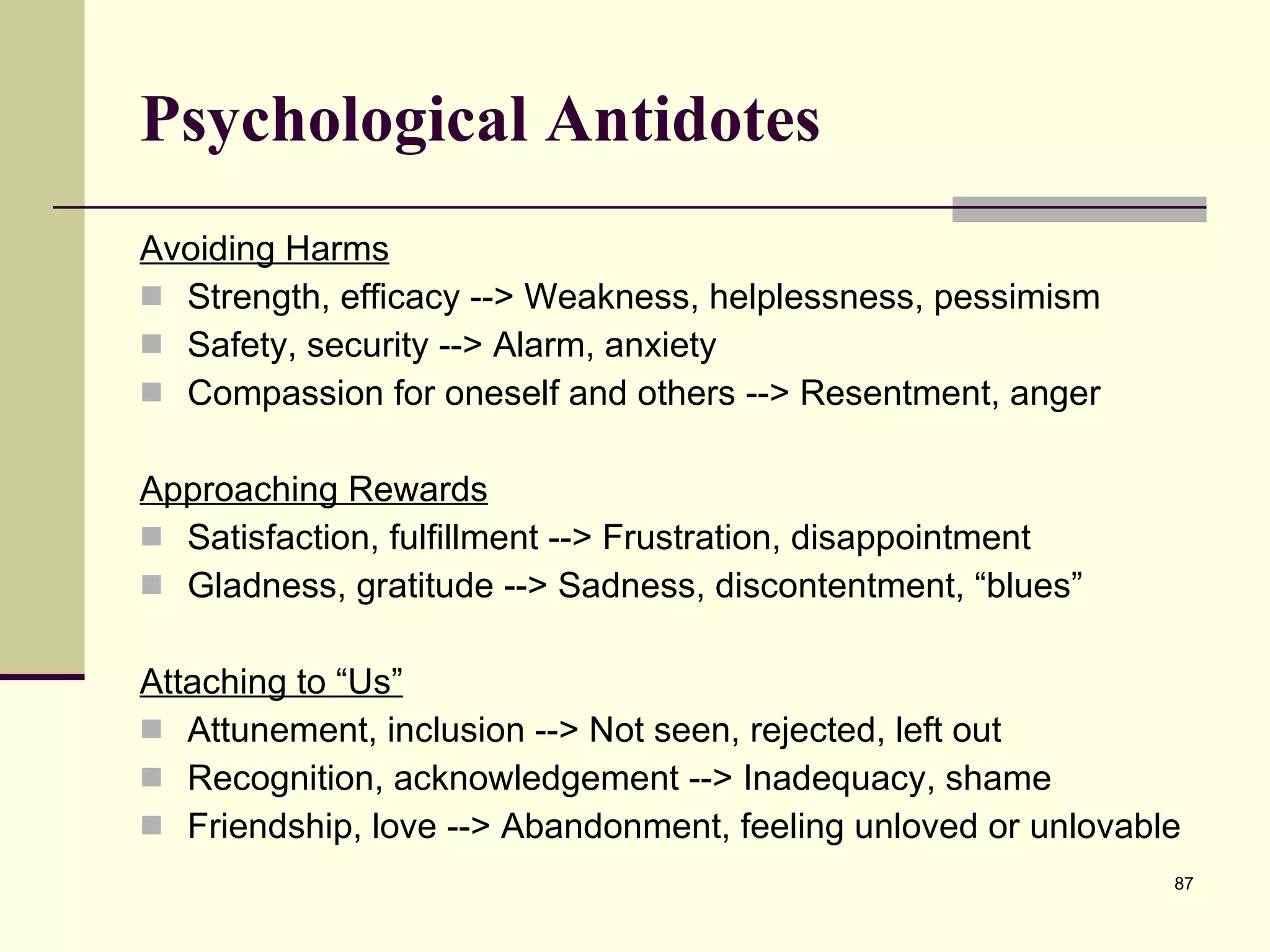
Psychological Antidotes Avoiding Harms Strength, efficacy --> Weakness, helplessness, pessimism Safety, security --> Alarm, anxiety Compassion for oneself and others --> Resentment, anger Approaching Rewards Satisfaction, fulfillment --> Frustration, disappointment Gladness, gratitude --> Sadness, discontentment, “blues” Attaching to “Us” Attunement, inclusion --> Not seen, rejected, left out Recognition, acknowledgement --> Inadequacy, shame Friendship, love --> Abandonment, feeling unloved or unlovable
Why It’s Good to Take in the Good Rights an unfair imbalance, given the negativity bias Gives oneself today the caring and support one should have received as a child, but perhaps didn’t get in full measure; an inherent, implicit benefit Increases positive resources, such as: Postive emotions Capacity to manage stress and negative experiences Can help bring in missing “supplies” (e.g., love, strength, worth) Can help painful, even traumatic experiences
The good life, as I conceive it, is a happy life.  I do not mean that if you are good you will be happy; I mean that if you are happy you will be good. Bertrand Russell
Benefits of Positive Emotions The benefits of positive emotions are a proxy for many of the benefits of TIG. Emotions organize the brain as a whole, so positive ones have far-reaching benefits, including: Promote exploratory, “approach” behaviors Lift mood; increase optimism, resilience Counteract trauma Strengthen immune and protect cardiovascular systems Overall: “ broaden and build ” Create positive cycles
Promoting Client Motivation During therapy, but mainly between sessions, notice: When learning from therapy works well New insights When things happen consistent with therapist’s realistic view of you, the world, the future Good qualities in yourself emphasized by therapist Then practice three, sometimes four, steps of TIG. Can be formalized in daily reflections, journaling In general: take appropriate risks of “dreaded experiences,” notice the (usually) good results, and then take those in.
Potential Synergies of TIG and MBSR Improved mindfulness from MBSR enhances TIG. TIG increases  general  resources for MBSR (e.g., heighten the PNS activation that promotes stable attention).  TIG increases  specific  factors of MBSR (e.g., self-acceptance, self-compassion, tolerance of negative affect).  TIG heightens internalization of key MBSR experiences: The sense of stable mindfulness itself Confidence that awareness itself is not in pain, upset, etc. Presence of supportive others (e.g., MBSR groups) Peacefulness of realizing that experiences come and go
Mindfulness and Self-Care
“ Heal thyself . . .”  Using mindfulness for personal well-being: “ Off-line,” draw on meditation and other mindfulness practices to increase resilience and well-being. When working: Staying present in this moment Self-monitoring, meta-cognition of stress, reactions Separation, disidentification from reactions Buying time, pausing Insight into reactions Awareness of the big picture (including empathy for others) Centering in awareness, beingness
Cultivating Mindfulness in Everyday Life
Supports for Everyday Mindfulness Do formal contemplative practice. Slow down. Talk less. Try to do one thing at a time; reduce multi-tasking. Focus on your breath during activities. Relax into a feeling of calm presence with others. Use routine events - e.g., phone ringing - as “temple bells” to return to centeredness. At meals, reflect where your food came from. Simplify life; give up lesser rewards for greater ones.
Penetrative insight  joined with calm abiding  utterly eradicates  afflicted states. Shantideva
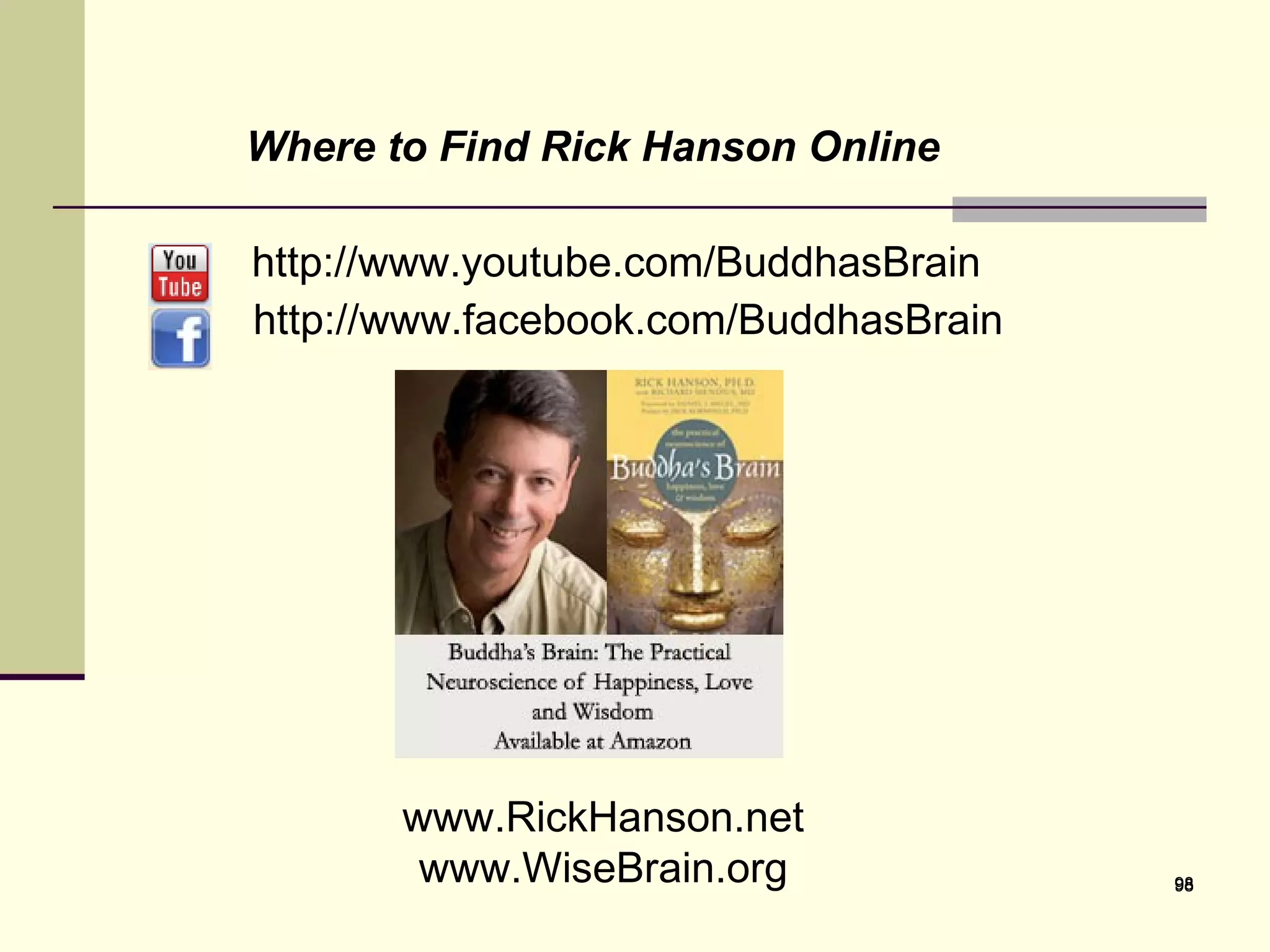
Where to Find Rick Hanson Online http://www.youtube.com/BuddhasBrain http://www.facebook.com/BuddhasBrain w www.RickHanson.net www.WiseBrain.org

Mindfulness in Clinical Practice - Rick Hanson, PhD

  • 1.
    Mindfulness In ClinicalPractice Northern California Psychiatric Society, Integrative Psychiatry Conference, 2011 Rick Hanson, Ph.D. The Wellspring Institute for Neuroscience and Contemplative Wisdom www.WiseBrain.org www.RickHanson.net [email_address]
  • 2.
    Mindfulness-Based (MB) TreatmentsMB Stress Reduction (MBSR) MB Cognitive Therapy (MBCT) MB Relationship Enhancement (MBRE) MB Relapse Prevention (MBRP) MB Eating Awareness Training (MB-EAT) MB Art Therapy (MBAT) Interventions with a significant mindfulness component, such as Acceptance and Commitment Therapy (ACT), and Dialectical Behavior Therapy (DBT)
  • 3.
    MB Interventions inMedical Care MB interventions have been used or investigated for: Asthma Cancer (breast, prostate) Transplants (solid organ, bone marrow Pain (chronic, fibromyalgia, rheumatoid arthritis) Cardiovascular (hypertension, myocardial ischemia) HIV Diabetes (types 1 and 2) Obesity Irritable bowel syndrome, lupus Immune response to human papillomavirus COPD Hot flashes (McCown & Reibel, 2009)
  • 4.
    MB Interventions inPsychological Care MB interventions have been used or investigated for: Anxiety disorders Depression Suicidality Personality disorders Eating disorders Drug abuse and dependence PTSD Schizophrenia Delusional disorder (McCown & Reibel, 2009)
  • 5.
    Do It YourselfMindfulness Many patients and clients are either already using mindfulness methods – encountered on TV, in their child’s school, in preparation for childbirth, in corporate stress management trainings – or are interested in exploring them as an adjunct to conventional medical or psychological treatment. Note the parallel to to the large fraction of people who are using or will use complementary and alternative methods in conjunction with standard medical care. If only as a practical matter, health care professionals need to take mindfulness into account.
  • 6.
    Topics Experience-dependent neuroplasticityMindfulness: definitions and perspectives Uses and efficacy of mindfulness practices Stimulating neural substrates of mindfulness The mindful internalization of positive experience Mindfulness and self-care
  • 7.
    Learning Objectives -1 Define mindfulness Describe ways in which mindfulness has been incorporated into medical practice and psychotherapy Describe research findings regarding the application of mindfulness for clinical disorders such as anxiety, depression, addictions, or chronic pain
  • 8.
    Learning Objectives -2 Describe neural substrates of mindful awareness and its supporting factors Describe specific mindfulness based techniques which can be useful in everyday clinical practice Describe uses of mindfulness for clinician self-care Begin to cultivate mindfulness in life and clinical practice
  • 9.
  • 10.
    The history ofscience is rich in the example of the fruitfulness of bringing two sets of techniques, two sets of ideas, developed in separate contexts for the pursuit of new truth, into touch with one another. J. Robert Oppenheimer
  • 11.
    Common - andFertile - Ground Neuroscience Psychology Contemplative Practice
  • 12.
    When the factschange, I change my mind, sir. What do you do? John Maynard Keynes
  • 13.
  • 14.
  • 15.
    Your Brain: TheTechnical Specs Size: 3 pounds of tofu-like tissue 1.1 trillion brain cells 100 billion “gray matter" neurons Activity: Always on 24/7/365 - Instant access to information on demand 20-25% of blood flow, oxygen, and glucose Speed: Neurons firing around 5 to 50 times a second (or faster) Signals crossing your brain in a tenth of a second Connectivity: Typical neuron makes ~ 5000 connections with other neurons: ~ 500 trillion synapses
  • 16.
  • 17.
    The Connectome -2 Hagmann, et al., 2008, PLoS Biology, 6:1479-1493
  • 18.
  • 19.
  • 20.
    All cells havespecialized functions. Brain cells have particular ways of processing information and communicating with each other. Nerve cells form complete circuits that carry and transform information. Electrical signaling represents the language of mind, the means whereby nerve cells, the building blocks of the brain, communicate with one another over great distances. Nerve cells generate electricity as a means of producing messages. All animals have some form of mental life that reflects the architecture of their nervous system. Eric R. Kandel, 2006
  • 21.
    The Mind/Brain System “ Mind” = flow of information within the nervous system: Information is represented by the nervous system. Most mind is unconscious; awareness is an aspect of mind. The headquarters of the nervous system is the brain. In essence then, apart from hypothetical transcendental factors, the mind is what the brain does . Brain = necessary, proximally sufficient condition for mind: The brain depends on the nervous system, which intertwines with and depends on other bodily systems. These systems in turn intertwine with and depend upon nature and culture, both presently and over time. And as we’ll see, the brain also depends on the mind.
  • 22.
    Evolution is atinkerer. In living organisms, new capabilities are achieved by modifying existing molecules slightly and adjusting their interaction with other existing molecules. Science has found surprisingly few proteins that are truly unique to the human brain and no signaling systems that are unique to it. All life, including the substrate of our thoughts and memories, is composed of the same building blocks. Eric R. Kandel, 2006
  • 23.
    We ask, “Whatis a thought?” We don't know, yet we are thinking continually. Venerable Tenzin Palmo
  • 24.
    Fact #1 As your brain changes, your mind changes .
  • 25.
    Ways That BrainCan Change Mind For better: A little caffeine: more alertness Thicker insula: more self-awareness, empathy More left prefrontal activation: more happiness For worse: Intoxication; imbalances in neurotransmitters Concussion, stroke, tumor, Alzheimer’s Cortisol-based shrinkage of hippocampus: less capacity for contextual memory
  • 26.
    Fact #2 As your mind changes, your brain changes . Immaterial mental activity co-occurs with, correlates with material neural activity. This produces temporary changes in your brain and lasting ones. Temporary changes include: Alterations in brainwaves (= changes in the firing patterns of synchronized neurons) Changing consumption of oxygen and glucose Ebbs and flows of neurochemicals
  • 27.
    Christian Nuns, RecallingProfound Spiritual Experiences Beauregard, et al., Neuroscience Letters, 9/25/06
  • 28.
    Mind Changes Brainin Lasting Ways What flows through the mind sculpts your brain. Immaterial experience leaves material traces behind. Increased blood/nutrient flow to active regions Altered epigenetics (gene expression) “ Neurons that fire together wire together.” Increasing excitability of active neurons Strengthening existing synapses Building new synapses; thickening cortex Neuronal “pruning” - “use it or lose it”
  • 29.
    Lazar et al.,2005. Meditation experience is associated with increased cortical thickness. Neuroreport 16: 1893-1897.
  • 30.
    Honoring Experience One’s experience matters . Both for how it feels in the moment and for the lasting residues it leaves behind, woven into the fabric of a person’s brain and being.
  • 31.
    Fact #3 Youcan use your mind to change your brain to change your mind for the better . This is self-directed neuroplasticity.
  • 32.
    Neuroplasticity in ContextNeuroplasticity is not breaking news. It’s been long presumed that mental activity changed neural structure: what else is learning? The news is in how the mind changes the brain. Most neuroplasticity is incremental, not dramatic. As hopes for miracle treatments fade, slow-but-steady methods of neural transformation become clearer. Neuroplasticity is ethically neutral. How to use it for good?
  • 33.
  • 34.
    Distinctions . .. Awareness is the field in which neural activity (mysteriously) becomes conscious experience. Attention is a heightened focus - a spotlight - on a particular content of awareness. Mindfulness is sustained attentiveness, typically with a metacognitive awareness of being aware. Concentration is deep absorption in an object of attention - sometimes to the point of non-ordinary states of consciousness.
  • 35.
    Mindfulness As aKind of Attention [Mindfulness is] the intentional cultivation of nonjudgmental moment-to-moment awareness . (Kabat-Zinn, 1996) Intention - meta-awareness, recollected, recursive Attention - open, spacious, receptive, inclusive; sustained, continuous in the present moment Attitude - accepting, nonjudgmental, kind; disengaged: not pursuing pleasant, resisting unpleasant, bored with neutral; equanimity ; not trying to change mental material (unlike most therapies) (Shapiro et al., 2006)
  • 36.
    Variations in MindfulnessStates Range in intensity Heightened in concentration, and to an extraordinary degree in absorption states Range in executive control Heightened in initial training Minimal in flow and absorption states Range of associated affects Range of purposes; morally neutral: mindful burglars
  • 37.
    Mindfulness As aKind of Self-Awareness [Mindfulness is] a disciplined way of learning to pay attention to all that is arising within. Saki Santorelli, 1999
  • 38.
    Mindfulness As aWay of Life Mi ndfulness should not be thought of as a technique but rather as a way of being. It is practiced for its own sake, and cultivated daily regardless of circumstances. John Kabat-Zinn, 1996 Sometimes, the non-intervention in the mind that characterizes mindfulness as a kind of attention becomes central to mindfulness as a way of life, with overlaps and links to “nondual awareness” and related therapies.
  • 39.
    Mindfulness Is Not. . . Relaxation Hypnosis Insight Emotional release Impulse control Cultivation of positive qualities (other than mindfulness)
  • 40.
    Being with, Releasing,Replacing There are three phases of psychological healing and personal growth (and spiritual practice): Be mindful of, release, replace. Let be, let go, let in. Mindfulness is key to the second and third phase, sometimes curative on its own, and always beneficial in strengthening its neural substrates. But often it is not enough by itself. And sometimes you need to skip to the third phase to build resources for mindfulness.
  • 41.
    Mindfulness is onefactor among many in the mind/brain. What are the benefits of this factor?
  • 42.
    Mindfulness: Mechanisms ofAction Reinforcing observing ego Disengagement from mental material; de-automaticization (Deikman, 1966); extinction through non-activation Fresh perspective; de-habituation (Kasamatsu & Hirai, 1973); field independence (Linden, 1973) Seeing the big picture; de-centering (Safran & Segal, 1990) Associating of neutral or positive perspective with negative material; extinction through counter-conditioning Recognizing the nature of experience: compounded, transient, interdependent; disenchantment; equanimity
  • 43.
    Uses, Benefits ofMindfulness In its own right or as a general-purpose resource As a factor of: Virtue Insight, wisdom (concentration, absorption) To train attention Acute - decreasing distractibility Selective - decreasing rumination, OCD To cope with stress, distress, or pain To heighten the internalization of resources in implicit memory
  • 44.
    Cautions with MindfulnessPapers are appearing about contraindications to meditation, such as dissociative tendencies or getting flooded by trauma. The Center for Mindfulness (trains MBSR) generally excludes people with active addiction or less than a year of recovery, suicidality, psychosis, PTSD (and any disorder obstructing group process). Additional concerns: People vulnerable to loss of ego in open awareness People susceptible to self-criticism related to performance, wanting to please the clinician People who need more resources to bear their own experience
  • 45.
  • 46.
    Heightening Neuroplastic ChangesAttention is like a spotlight, illuminating what it rests upon. Because neuroplasticity is heightened for what’s in the field of focused awareness, attention is also like a vacuum cleaner, sucking its contents into the brain. Directing attention skillfully - the essence of mindfulness - is therefore a fundamental way to shape the brain, and one’s life over time. The education of attention would be an education par excellence . William James
  • 47.
    Effects of Meditationon Brain - 1 Increased gray matter in the: Insula - interoception; self-awareness; empathy for emotions (Holzel et al., 2008; Lazar et al., 2005) Hippocampus - visual-spatial memory; establishing context; inhibiting amygdala and cortisol (Holzel et al., 2008; Luders et al., 2009) Prefrontal cortext (PFC) - executive functions; attention control (Lazar et al., 2005; Luders et al., 2009) Reduced cortical thinning with aging in insula and PFC (Lazar et al., 2005)
  • 48.
    Effects of Meditationon Brain - 2 Increased activation of left frontal regions (Davidson et al., 2003), which lifts mood (Davidson, 2004) Increased power and reach of gamma-range brainwaves (Cahn et al., 2010; Lutz et al., 2004) - may be associated with integration, “coming to singleness,” “unitary awareness” Preserved telomere length (Epel et al., 2009; Jacobs et al., 2011)
  • 49.
    Mindfulness Based StressReduction (MBSR)
  • 50.
    MBSR - OriginalFormat Eight weeks; 2.5 hour class meeting/week; 1 daylong retreat In class: Presentation and discussion; group support Sitting meditation - awareness of body sensations, thoughts, and emotions, while returning attention to breath Body scan - moving attention through the body Hatha yoga Commitment to practice 45 minutes/day, 6 days/week
  • 51.
    MBSR - ModificationsCommon modifications: Three-minute mini-meditation Metta (lovingkindness meditation) We emphasize that there are many different ways to structure and deliver mindfulness-based stress reduction programs. The optimal form and its delivery will depend critically on local factors and on the level of experience and understanding of the people undertaking the teaching. Jon Kabat-Zinn, 1996
  • 52.
    Mindfulness As aGeneral Factor
  • 53.
    Mindfulness: General BenefitsDispositional mindfulness correlated with less depressive symptoms and amygdala reactivity (Way et al., 2010). In healthy populations, MBSR and related trainings: Decreased perceptions of daily hassles, psychological stresses, and nonspecific symptoms (Williams et al., 2001) Increased empathy for self and others (Shapiro & Izett, 2008) Enhanced sense of well-being, self-actualization, self-responsibility, and self-directedness (Shapiro et al., 2005) Meditation improved attention (Carter et al., 2005; Slagter et al., 2007; Tang et al., 2007) and compassion (Lutz, Brefczynski-Lewis et al., 2008).
  • 54.
  • 55.
    Mindfulness and SomeMedical Outcomes MBSR: Reduced pain, fibromyalgia, psoriasis, and insomnia (Bishop, 2002; Grossman et al., 2004; Proulx, 2003) In cancer patients, reduced distress (Speca et al., 2000) and physical suffering (Ott et al., 2006) In type 2 diabetes patients, improved glycemic control (Rosenzwig et al., 2007) Meditation: Decreased stress-related cortisol (Tang et al., 2007) Strengthened immune system (Davidson et al., 2003; Tang et al., 2007) Reduced symptoms of cardiovascular disease, asthma, type II diabetes, PMS, and chronic pain (Walsh and Shapiro, 2006)
  • 56.
    Mindfulness Interventions in Psychological Treatments
  • 57.
    Mindfulness in PsychologicalTreatment - Some Findings MBCT: Reduced relapse after treatment for major depression (Ma et al., 2004;Teasdale et al., 1995) MBSR: Reduced general psychological distress (Shapiro et al., 2007) Reduced anxiety and panic initially (Kabat-Zinn et al., 1992) and at 3-year follow-up (Miller et al., 1995) Improved anxiety, depression, self-esteem, and sleep for adolescents (Biegel et al., 2009) Showed promise in treating OCD (Wilkinson-Tough et al., 2010) Reduced duration of psychotherapy (Weiss et al., 2005)
  • 58.
    Effect Sizes Forboth physical and mental health conditions, effect sizes have been substantial (Grossman, et al. 2004; Hoffman et al., 2010).
  • 59.
  • 60.
    Mindfulness for HealthProfessionals Stress and busyness reduce energy, motivation, impulse control, and attentional capacities – with well-known impacts on health professional effectiveness (Borell-Carrio & Epstein, 2004). For example, in one study, depressed residents made 6.2 times as many medication errors as residents who were not depressed (Fahrenkopf et al., 2008). With health professionals, MBSR: Improved care by increased self-monitoring (Epstein et al., 2008) Reduced depression, anxiety; increase empathy (Shapiro et al., 1998) Decreased burnout by combating emotional exhaustion and depersonalization (Cohen-Katz et al., 2005) Increased quality of life by reducing stress and increasing compassion for oneself (Shapiro et al., 2005) Mindfulness may be a key to bridging evidence-based practice and relationship-centered care. Ronald Epstein, 1999
  • 61.
    [M]any of usfind ourselves struggling with fatigue, a sense of futility, frustration with forms and computers, inability to keep up with the rapid flow of new information, and the demands of our own lives. There may be little we can do to quickly change the external factors in our lives and practices. But we can change our internal responses to these challenges. Mindful presence invites us back into each moment as it happens, helping us compassionately set priorities, recognize our limits, and rediscover the meaning in our work. Karen Lawson, 2001
  • 62.
    Some Neural Factorsof Mindfulness
  • 63.
    How the BrainPays Attention Key functions: Holding onto information Updating awareness Seeking stimulation Key mechanisms: Dopamine and the gate to awareness The basal ganglia stimostat
  • 64.
    Challenges to Mindfulnessand Concentration We evolved continually scanning, shifting, wide focus attention in order to survive: “monkey mind.” This generic, hard-wired tendency varies in the normal range of temperament, extending from “turtles” to “jackrabbits.” Life experiences - in particular, painful or traumatic ones - can heighten scanning and distractibility. Modern culture - with its fire hose of information and routine multi-tasking - leads to stimulation-hunger and divided attention.
  • 65.
    More then anything,mindfulness is about cultivating an ability to be fully present in a single moment … [M]ost of us spend very little time "here and now." We instead tend to focus our attention on the … future or on the past... [I]n many ways our culture unintentionally "deprograms" us from being present in the moment by heavily rewarding us for not being here … Because being out of the moment is so useful, this style gets put into play much more th[a]n it needs to be, leading people to spend less and less time aware of the present. Phillippe Goldin, 2011
  • 66.
    Individual Differences inAttention Holding Updating Seeking Information Awareness Stimulation High Obsession Porous filters Hyperactive Over-focusing Distractible Thrill-seeking Overload Mod Concentrates Flexible Enthusiastic Divides attention Assimilation Adaptive Accommodation Low Fatigues w/Conc. Fixed views Stuck in a rut Small WM Oblivious Apathetic Low learning Lethargic
  • 67.
    7 Neural Factorsof Mindfulness Setting an intention - “top-down” frontal, “bottom-up” limbic Relaxing the body - parasympathetic nervous system Feeling cared about - social engagement system Feeling safer - inhibits amygdala/ hippocampus alarms Encouraging positive emotion - dopamine, norepinephrine Panoramic view - lateral networks Absorbing the benefits - positive implicit memories
  • 68.
  • 69.
    Increased Medial PFC Activation Related to Self-Referencing Thought Gusnard D. A., et.al. 2001. PNAS , 98:4259-4264
  • 70.
    Farb, et al.2007. Social Cognitive Affective Neuroscience , 2:313-322 Self-Focused (blue) and Open Awareness (red) Conditions (in the novice, pre MT group)
  • 71.
    Farb, et al.2007. Social Cognitive Affective Neuroscience , 2:313-322 Self-Focused (blue) vs Open Awareness (red) Conditions (following 8 weeks of MT)
  • 72.
    Ways to ActivateLateral Networks Relax. Focus on bare sensations and perceptions. Sense the body as a whole. Take a panoramic, “bird’s-eye” view. Engage “d o n’t-know mind ”; release judgments. Don’t try to connect mental contents together. Let experience flow, staying here now. Relax the sense of “I, me, and mine.”
  • 73.
    Whole Body AwarenessSense the breath in one area (e.g., chest, upper lip). Sense the breath as a whole: one gestalt, percept. Sense the body as a whole, a whole body breathing. Sense experience as a whole: sensations, sounds, thoughts . . . all arising together as one unified thing. It’s natural for this sense of the whole to be present for a second or two, then crumble; just open up to it again and again.
  • 74.
    Panoramic Awareness Recalla bird’s-eye view (e.g., mountain, airplane). Be aware of sounds coming and going in an open space of awareness, without any edges: boundless. Open to other contents of mind, coming and going like clouds moving across the sky. Pleasant or unpleasant, no matter: just more clouds No cloud ever harms or taints the sky.
  • 75.
    “ Bahiya, youshould train yourself thus.” In reference to the seen, there will be only the seen. To the heard, only the heard. To the sensed, only the sensed. To the cognized, only the cognized. When for you there will be only the seen in reference to the seen, only the heard in the heard, only the sensed in the sensed, only the cognized in the cognized, then, Bahiya, there’s no you in that. When there’s no you in that, there’s no you there. When there’s no you there, you are neither here nor yonder nor between the two. This, just this, is the end of all suffering. The Buddha
  • 76.
    Dual Modes “Doing” “Being” Mainly representational Mainly sensory Much verbal activity Little verbal activity Abstract Concrete Future- or past-focused Now-focused Goal-directed Nothing to do, nowhere to go Sense of craving Sense of peace Personal, self-oriented perspective Impersonal, 3 rd person perspective Focal view Panoramic view Firm beliefs Uncertainty, not-knowing Evaluative Nonjudgmental Lost in thought, mind wandering Mindful presence Reverberation and recursion Immediate and transient; Tightly connected experiences Loosely connected experiences Prominent self-as-object Minimal or no self-as-object Prominent self-as-subject Minimal or no self-as-subject
  • 77.
    Mindful Internalization of Positive Experiences
  • 78.
  • 79.
    Three Stages ofBrain Evolution Reptilian: Brainstem, cerebellum, hypothalamus Reactive and reflexive Avoid hazards Mammalian: Limbic system, cingulate, early cortex Memory, emotion, social behavior Approach rewards Human: Massive cerebral cortex Abstract thought, language, cooperative planning, empathy Attach to “us”
  • 80.
  • 81.
    Negativity Bias: Causesin Evolution “ Sticks” - Predators, natural hazards, social aggression, pain (physical and psychological) “ Carrots” - Food, sex, shelter, social support, pleasure (physical and psychological) During evolution, avoiding “sticks” usually had more effects on survival than approaching “carrots.” Urgency - Usually, sticks must be dealt with immediately, while carrots allow a longer approach. Impact - Sticks usually determine mortality, carrots not; if you fail to get a carrot today, you’ll likely have a chance at a carrot tomorrow; but if you fail to avoid a stick today - whap! - no more carrots forever.
  • 82.
    Negativity Bias: SomeConsequences Negative stimuli get more attention and processing. We generally learn faster from pain than pleasure. People work harder to avoid a loss than attain an equal gain (“endowment effect”). Easy to create learned helplessness, hard to undo Negative interactions: more powerful than positive Negative experiences sift into implicit memory. (Baumeister et al., 2001; Rozin and Royzman, 2001)
  • 83.
    The Importance ofInner Resources Examples: Freud’s “positive introjects” Internalization of “corrective emotional experiences” during psychotherapy “ Learned optimism” Benefits Increase positive emotions: many physical and mental health benefits Improve self-soothing Improve outlook on world, self, and future Increase resilience, determination
  • 84.
    Just having positive experiences is not enough. They pass through the brain like water through a sieve, while negative experiences are caught. We need to engage positive experiences actively to weave them into the brain.
  • 85.
    How to Takein the Good 1. Look for positive facts, and let them become positive experiences . 2. Savor the positive experience: Sustain it for 10-20-30 seconds. Feel it in your body and emotions. Intensify it. 3. Sense and intend that the positive experience is soaking into your brain and body - registering deeply in emotional memory.
  • 86.
    Targets of TIGBodily states - healthy arousal; PNS; vitality Emotions - both feelings and mood Views - expectations; object relations; perspectives on self, world, past and future Behaviors - reportoire; inclinations
  • 87.
    Psychological Antidotes AvoidingHarms Strength, efficacy --> Weakness, helplessness, pessimism Safety, security --> Alarm, anxiety Compassion for oneself and others --> Resentment, anger Approaching Rewards Satisfaction, fulfillment --> Frustration, disappointment Gladness, gratitude --> Sadness, discontentment, “blues” Attaching to “Us” Attunement, inclusion --> Not seen, rejected, left out Recognition, acknowledgement --> Inadequacy, shame Friendship, love --> Abandonment, feeling unloved or unlovable
  • 88.
    Why It’s Goodto Take in the Good Rights an unfair imbalance, given the negativity bias Gives oneself today the caring and support one should have received as a child, but perhaps didn’t get in full measure; an inherent, implicit benefit Increases positive resources, such as: Postive emotions Capacity to manage stress and negative experiences Can help bring in missing “supplies” (e.g., love, strength, worth) Can help painful, even traumatic experiences
  • 89.
    The good life,as I conceive it, is a happy life. I do not mean that if you are good you will be happy; I mean that if you are happy you will be good. Bertrand Russell
  • 90.
    Benefits of PositiveEmotions The benefits of positive emotions are a proxy for many of the benefits of TIG. Emotions organize the brain as a whole, so positive ones have far-reaching benefits, including: Promote exploratory, “approach” behaviors Lift mood; increase optimism, resilience Counteract trauma Strengthen immune and protect cardiovascular systems Overall: “ broaden and build ” Create positive cycles
  • 91.
    Promoting Client MotivationDuring therapy, but mainly between sessions, notice: When learning from therapy works well New insights When things happen consistent with therapist’s realistic view of you, the world, the future Good qualities in yourself emphasized by therapist Then practice three, sometimes four, steps of TIG. Can be formalized in daily reflections, journaling In general: take appropriate risks of “dreaded experiences,” notice the (usually) good results, and then take those in.
  • 92.
    Potential Synergies ofTIG and MBSR Improved mindfulness from MBSR enhances TIG. TIG increases general resources for MBSR (e.g., heighten the PNS activation that promotes stable attention). TIG increases specific factors of MBSR (e.g., self-acceptance, self-compassion, tolerance of negative affect). TIG heightens internalization of key MBSR experiences: The sense of stable mindfulness itself Confidence that awareness itself is not in pain, upset, etc. Presence of supportive others (e.g., MBSR groups) Peacefulness of realizing that experiences come and go
  • 93.
  • 94.
    “ Heal thyself. . .” Using mindfulness for personal well-being: “ Off-line,” draw on meditation and other mindfulness practices to increase resilience and well-being. When working: Staying present in this moment Self-monitoring, meta-cognition of stress, reactions Separation, disidentification from reactions Buying time, pausing Insight into reactions Awareness of the big picture (including empathy for others) Centering in awareness, beingness
  • 95.
  • 96.
    Supports for EverydayMindfulness Do formal contemplative practice. Slow down. Talk less. Try to do one thing at a time; reduce multi-tasking. Focus on your breath during activities. Relax into a feeling of calm presence with others. Use routine events - e.g., phone ringing - as “temple bells” to return to centeredness. At meals, reflect where your food came from. Simplify life; give up lesser rewards for greater ones.
  • 97.
    Penetrative insight joined with calm abiding utterly eradicates afflicted states. Shantideva
  • 98.
    Where to FindRick Hanson Online http://www.youtube.com/BuddhasBrain http://www.facebook.com/BuddhasBrain w www.RickHanson.net www.WiseBrain.org