Whose Brain Is It, Anyway? Rick Hanson, Ph.D. The Wellspring Institute For Neuroscience and Contemplative Wisdom www.WiseBrain.org www.RickHanson.net [email_address]
About This Talk  How your brain works Why that matters What you can do about it
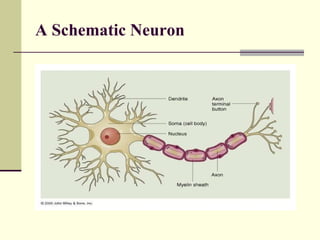
A Schematic Neuron
Your Amazing Brain   Major Features Size: 3 pounds of tofu-like tissue 1.1 trillion brain cells 100 billion "gray matter" neurons Activity: Always on 24/7/365 - Instant access to information on demand 20-25% of blood flow, oxygen, and glucose Speed: Neurons firing around 5 to 50 times a second (or faster) Signals crossing your brain in a tenth or hundredth of a second Connectivity: A typical neuron connects with about 5000 neurons,  giving you five hundred  trillion  synapses. During one breath, a quadrillion-plus signals coursed through your head.
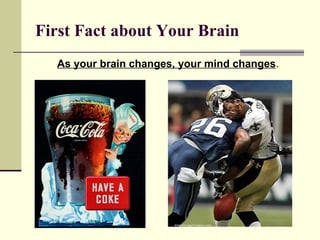
First Fact about Your Brain   As your brain changes, your mind changes .
Second Fact about Your Brain   As your mind changes, your brain changes .  Immaterial mental activity maps to material neural activity. This produces  temporary  changes in your brain and  lasting  ones.  Temporary  changes include: Alterations in brainwaves (= changes in the firing patterns of synchronized neurons) Increased or decreased use of oxygen and glucose Ebbs and flows of neurochemicals
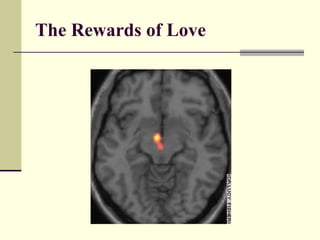
The Rewards of Love
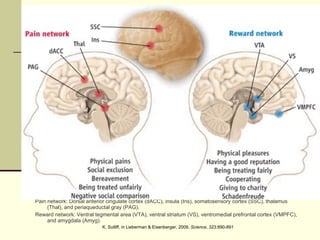
Pain network: Dorsal anterior cingulate cortex (dACC), insula (Ins), somatosensory cortex (SSC), thalamus (Thal), and periaqueductal gray (PAG).  Reward network: Ventral tegmental area (VTA), ventral striatum (VS), ventromedial prefrontal cortex (VMPFC), and amygdala (Amyg).  K. Sutliff, in Lieberman & Eisenberger, 2009,  Science , 323:890-891
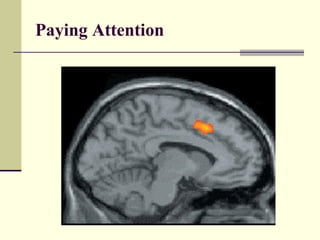
Paying Attention
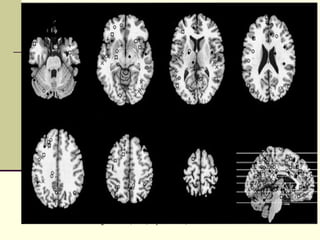
Brain activations of “selfing” - Gillihan, et al., Psych Bulletin, 1/2005
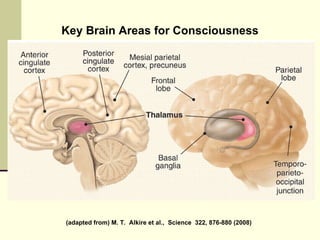
(adapted from) M. T.  Alkire et al.,  Science  322, 876-880 (2008)  Key Brain Areas for Consciousness
Mental Activity Shapes Neural Structure   What you think and feel changes your brain  in numerous ways:  Increased blood/nutrient flow to active regions “ Neurons that fire together wire together.” Increasing excitability of active neurons Strengthening existing synapses Building new synapses; thickening your cortex Neuronal “pruning” - “use it or lose it” What flows through your mind sculpts your brain.
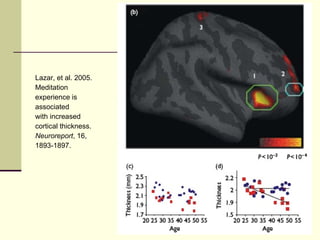
Lazar, et al. 2005.  Meditation  experience is  associated with increased cortical thickness. Neuroreport , 16, 1893-1897.
The education of attention  would be an education  par   excellence . William James
“ A Spotlight on Speed”  Attention: Like a spotlight: Illuminates what it shows. Like a vacuum cleaner: Sucks its contents into your brain. Controlling attention is a fundamental way to shape your brain - and therefore your life over time. Most people have poor control of their “spotlight.” Meditation is the preeminent training of attention. Benefits of attention training: Academic performance Sports and music Emotional well-being
Physical Effects of Chronic Stress  Elevated stress hormones, including cortisol and adrenaline Weakened immune function Impaired digestion Lowered reproductive hormones
Your experience  matters .  Both for how it feels in the moment and for the lasting residues it leaves behind, woven into the fabric of your brain and your self.
Third Fact about Your Brain   You can use your mind  to change your brain  to change your mind  for the better .
What about the Caveman Brain?
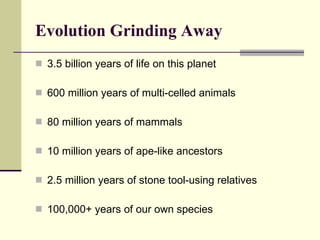
Evolution Grinding Away   3.5 billion years of life on this planet 600 million years of multi-celled animals 80 million years of mammals 10 million years of ape-like ancestors 2.5 million years of stone tool-using relatives 100,000+ years of our own species
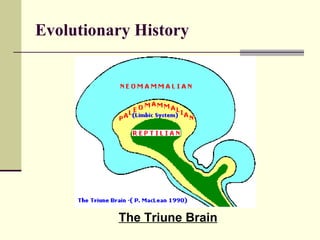
Evolutionary History The Triune Brain
The Negativity Bias   In evolution, threats had more impact on survival than opportunities.  --> Sticks count more than carrots. The brain is like Velcro for negative experiences and Teflon for positive ones. Consequently, negative trumps positive: People will do more to avoid a loss than get a gain. Takes five positive interactions to undo a negative one
How to Take in the Good 1. Look for positive  facts  and let them become positive  experiences .  2. Extend the experience in  time  and  space : Savor it.  Encourage it to expand in your body.  3. Sense that the positive experience is  soaking  into your brain and body - registering deeply in emotional memory.
Kinds of “Good” to Take in Things are alright; nothing is wrong; there is no threat The good feelings that come from being kind, fair, generous Small pleasures of ordinary life Accomplishments - especially small, everyday ones Feeling strong Being included, valued, liked, respected, loved by others Recognizing your positive character traits
The good life, as I conceive it, is a happy life.  I do not mean that if you are good you will be happy; I mean that if you are happy you will be good. Bertrand Russell
Being for Yourself Who is the one person in the world you have the greatest power over?  It’s your future self.  What it will be depends on how you care for it - in lots of little ways every day. So take good care of your brain.
How to Take Good Care of Your Brain Take in good experiences as the day goes on. Count your blessings at the end of every day. Remember: one drink kills 10,000 brain cells. Take regular exercise; it builds brain cells. Liquidate your brain: it needs lots of water. Pactice kindness and generosity: kind people live longer. Learn to meditate. If you’re having a hard time, talk to someone.
Great Books Begley. S. 2007.  Train Your Mind, Change Your Brain: How a New Science Reveals Our Extraordinary Potential to Transform Ourselves . Ballantine. Hanson, R. 2009.  Buddha’s Brain: The Practical Neuroscience of Happiness, Love, and Wisdom . New Harbinger. Johnson, S. 2005.  Mind Wide Open: Your Brain and the Neuroscience of Everyday Life . Scribner.  Kornfield, J. 2009.  The Wise Heart: A Guide to the Uiniversal Teachings of Buddhist Psychology . Bantam.  LeDoux, J. 2003.  Synaptic Self: How Our Brains Become Who We Are . Penguin Sapolsky, R. 2004.  Why Zebras Don’t Get Ulcers . Holt. Siegel, D. 2007.  The Mindful Brain: Reflection and Attunement in the Cultivation of Well-Being . W. W. Norton & Co.  Thompson, E. 2007.  Mind in Life: Biology, Phenomenology, and the Sciences of Mind . Belknap Press.

Whose Brain Is It, Anyway? Part I - Rick Hanson, PhD

  • 1.
    Whose Brain IsIt, Anyway? Rick Hanson, Ph.D. The Wellspring Institute For Neuroscience and Contemplative Wisdom www.WiseBrain.org www.RickHanson.net [email_address]
  • 2.
    About This Talk How your brain works Why that matters What you can do about it
  • 3.
  • 4.
    Your Amazing Brain Major Features Size: 3 pounds of tofu-like tissue 1.1 trillion brain cells 100 billion "gray matter" neurons Activity: Always on 24/7/365 - Instant access to information on demand 20-25% of blood flow, oxygen, and glucose Speed: Neurons firing around 5 to 50 times a second (or faster) Signals crossing your brain in a tenth or hundredth of a second Connectivity: A typical neuron connects with about 5000 neurons, giving you five hundred trillion synapses. During one breath, a quadrillion-plus signals coursed through your head.
  • 5.
    First Fact aboutYour Brain As your brain changes, your mind changes .
  • 6.
    Second Fact aboutYour Brain As your mind changes, your brain changes . Immaterial mental activity maps to material neural activity. This produces temporary changes in your brain and lasting ones. Temporary changes include: Alterations in brainwaves (= changes in the firing patterns of synchronized neurons) Increased or decreased use of oxygen and glucose Ebbs and flows of neurochemicals
  • 7.
  • 8.
    Pain network: Dorsalanterior cingulate cortex (dACC), insula (Ins), somatosensory cortex (SSC), thalamus (Thal), and periaqueductal gray (PAG). Reward network: Ventral tegmental area (VTA), ventral striatum (VS), ventromedial prefrontal cortex (VMPFC), and amygdala (Amyg). K. Sutliff, in Lieberman & Eisenberger, 2009, Science , 323:890-891
  • 9.
  • 10.
    Brain activations of“selfing” - Gillihan, et al., Psych Bulletin, 1/2005
  • 11.
    (adapted from) M.T. Alkire et al., Science 322, 876-880 (2008) Key Brain Areas for Consciousness
  • 12.
    Mental Activity ShapesNeural Structure What you think and feel changes your brain in numerous ways: Increased blood/nutrient flow to active regions “ Neurons that fire together wire together.” Increasing excitability of active neurons Strengthening existing synapses Building new synapses; thickening your cortex Neuronal “pruning” - “use it or lose it” What flows through your mind sculpts your brain.
  • 13.
    Lazar, et al.2005. Meditation experience is associated with increased cortical thickness. Neuroreport , 16, 1893-1897.
  • 14.
    The education ofattention would be an education par excellence . William James
  • 15.
    “ A Spotlighton Speed” Attention: Like a spotlight: Illuminates what it shows. Like a vacuum cleaner: Sucks its contents into your brain. Controlling attention is a fundamental way to shape your brain - and therefore your life over time. Most people have poor control of their “spotlight.” Meditation is the preeminent training of attention. Benefits of attention training: Academic performance Sports and music Emotional well-being
  • 16.
    Physical Effects ofChronic Stress Elevated stress hormones, including cortisol and adrenaline Weakened immune function Impaired digestion Lowered reproductive hormones
  • 17.
    Your experience matters . Both for how it feels in the moment and for the lasting residues it leaves behind, woven into the fabric of your brain and your self.
  • 18.
    Third Fact aboutYour Brain You can use your mind to change your brain to change your mind for the better .
  • 19.
    What about theCaveman Brain?
  • 20.
    Evolution Grinding Away 3.5 billion years of life on this planet 600 million years of multi-celled animals 80 million years of mammals 10 million years of ape-like ancestors 2.5 million years of stone tool-using relatives 100,000+ years of our own species
  • 21.
  • 22.
    The Negativity Bias In evolution, threats had more impact on survival than opportunities. --> Sticks count more than carrots. The brain is like Velcro for negative experiences and Teflon for positive ones. Consequently, negative trumps positive: People will do more to avoid a loss than get a gain. Takes five positive interactions to undo a negative one
  • 23.
    How to Takein the Good 1. Look for positive facts and let them become positive experiences . 2. Extend the experience in time and space : Savor it. Encourage it to expand in your body. 3. Sense that the positive experience is soaking into your brain and body - registering deeply in emotional memory.
  • 24.
    Kinds of “Good”to Take in Things are alright; nothing is wrong; there is no threat The good feelings that come from being kind, fair, generous Small pleasures of ordinary life Accomplishments - especially small, everyday ones Feeling strong Being included, valued, liked, respected, loved by others Recognizing your positive character traits
  • 25.
    The good life,as I conceive it, is a happy life. I do not mean that if you are good you will be happy; I mean that if you are happy you will be good. Bertrand Russell
  • 26.
    Being for YourselfWho is the one person in the world you have the greatest power over? It’s your future self. What it will be depends on how you care for it - in lots of little ways every day. So take good care of your brain.
  • 27.
    How to TakeGood Care of Your Brain Take in good experiences as the day goes on. Count your blessings at the end of every day. Remember: one drink kills 10,000 brain cells. Take regular exercise; it builds brain cells. Liquidate your brain: it needs lots of water. Pactice kindness and generosity: kind people live longer. Learn to meditate. If you’re having a hard time, talk to someone.
  • 28.
    Great Books Begley.S. 2007. Train Your Mind, Change Your Brain: How a New Science Reveals Our Extraordinary Potential to Transform Ourselves . Ballantine. Hanson, R. 2009. Buddha’s Brain: The Practical Neuroscience of Happiness, Love, and Wisdom . New Harbinger. Johnson, S. 2005. Mind Wide Open: Your Brain and the Neuroscience of Everyday Life . Scribner. Kornfield, J. 2009. The Wise Heart: A Guide to the Uiniversal Teachings of Buddhist Psychology . Bantam. LeDoux, J. 2003. Synaptic Self: How Our Brains Become Who We Are . Penguin Sapolsky, R. 2004. Why Zebras Don’t Get Ulcers . Holt. Siegel, D. 2007. The Mindful Brain: Reflection and Attunement in the Cultivation of Well-Being . W. W. Norton & Co. Thompson, E. 2007. Mind in Life: Biology, Phenomenology, and the Sciences of Mind . Belknap Press.