Paper Tiger Paranoia Networker Symposium March 25, 2011 Rick Hanson, Ph.D. The Wellspring Institute for Neuroscience and Contemplative Wisdom www.WiseBrain.org   www.RickHanson.net [email_address]
Topics Perspectives Self-directed neuroplasticity The evolution of fear Threat reactivity Taking in the good Internalizing safety Neural networks of inner peace
Perspectives
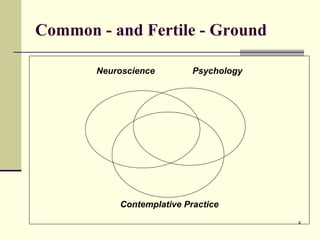
Common - and Fertile - Ground Neuroscience   Psychology Contemplative Practice
The history of science is rich in the example  of the fruitfulness of bringing  two sets of techniques, two sets of ideas,  developed in separate contexts  for the pursuit of new truth,  into touch with one another.   J. Robert Oppenheimer
When the facts change,  I change my mind, sir. What do you do? John Maynard Keynes
We ask, “What is a thought?” We don't know,  yet we are thinking continually. Venerable Tenzin Palmo
Self-Directed Neuroplasticity
 
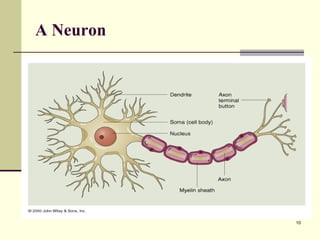
A Neuron
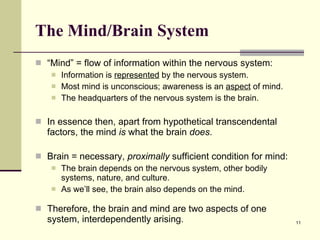
The Mind/Brain System   “ Mind” = flow of information within the nervous system: Information is  represented  by the nervous system. Most mind is unconscious; awareness is an  aspect  of mind. The headquarters of the nervous system is the brain. In essence then, apart from hypothetical transcendental factors, the mind  is  what the brain  does .  Brain = necessary,  proximally  sufficient condition for mind:  The brain depends on the nervous system, other bodily systems, nature, and culture. As we’ll see, the brain also depends on the mind.  Therefore, the brain and mind are two aspects of one system, interdependently arising.
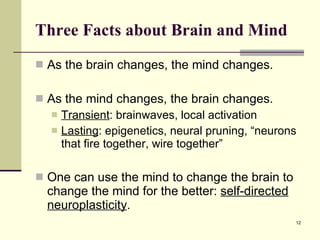
Three Facts about Brain and Mind As the brain changes, the mind changes. As the mind changes, the brain changes. Transient : brainwaves, local activation Lasting : epigenetics, neural pruning, “neurons that fire together, wire together” One can use the mind to change the brain to change the mind for the better:  self-directed neuroplasticity .
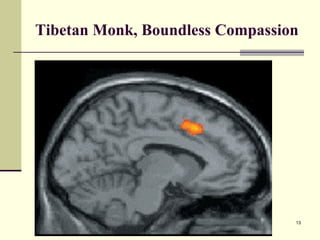
Tibetan Monk, Boundless Compassion
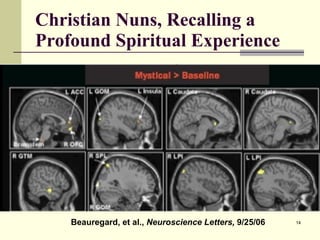
Christian Nuns, Recalling a Profound Spiritual Experience Beauregard, et al.,  Neuroscience Letters,  9/25/06
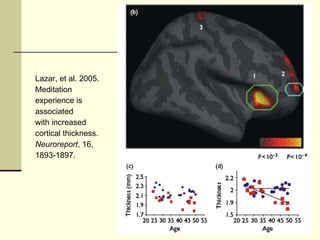
Lazar, et al. 2005.  Meditation  experience is  associated with increased cortical thickness. Neuroreport , 16, 1893-1897.
The Evolution of Fear
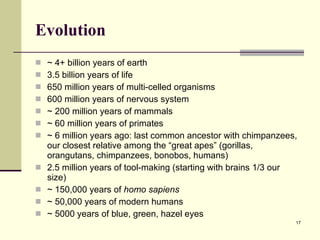
Evolution ~ 4+ billion years of earth 3.5 billion years of life 650 million years of multi-celled organisms 600 million years of nervous system ~ 200 million years of mammals ~ 60 million years of primates ~ 6 million years ago: last common ancestor with chimpanzees, our closest relative among the “great apes” (gorillas, orangutans, chimpanzees, bonobos, humans) 2.5 million years of tool-making (starting with brains 1/3 our size) ~ 150,000 years of  homo sapiens ~ 50,000 years of modern humans ~ 5000 years of blue, green, hazel eyes
Evolutionary History The Triune Brain
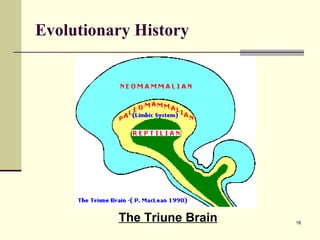
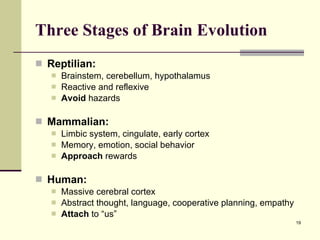
Three Stages of Brain Evolution Reptilian: Brainstem, cerebellum, hypothalamus Reactive and reflexive Avoid  hazards Mammalian: Limbic system, cingulate, early cortex Memory, emotion, social behavior Approach  rewards Human: Massive cerebral cortex Abstract thought, language, cooperative planning, empathy Attach  to “us”
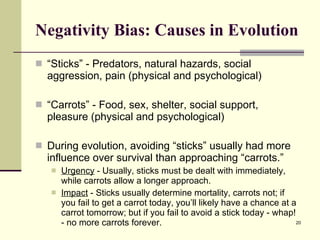
Negativity Bias: Causes in Evolution “ Sticks” - Predators, natural hazards, social aggression, pain (physical and psychological) “ Carrots” - Food, sex, shelter, social support, pleasure (physical and psychological) During evolution, avoiding “sticks” usually had more influence over survival than approaching “carrots.” Urgency  - Usually, sticks must be dealt with immediately, while carrots allow a longer approach. Impact  - Sticks usually determine mortality, carrots not; if you fail to get a carrot today, you’ll likely have a chance at a carrot tomorrow; but if you fail to avoid a stick today - whap! - no more carrots forever.
With the negativity bias, the Avoid system  hijacks the Approach and Attach systems,  inhibiting them or using them for its ends.
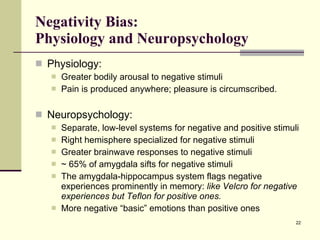
Negativity Bias:  Physiology and Neuropsychology Physiology: Greater bodily arousal to negative stimuli Pain is produced anywhere; pleasure is circumscribed. Neuropsychology: Separate, low-level systems for negative and positive stimuli Right hemisphere specialized for negative stimuli Greater brainwave responses to negative stimuli ~ 65% of amygdala sifts for negative stimuli The amygdala-hippocampus system flags negative experiences prominently in memory:  like Velcro for negative experiences but Teflon for positive ones. More negative “basic” emotions than positive ones
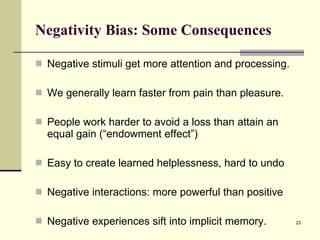
Negativity Bias: Some Consequences Negative stimuli get more attention and processing. We generally learn faster from pain than pleasure. People work harder to avoid a loss than attain an equal gain (“endowment effect”) Easy to create learned helplessness, hard to undo Negative interactions: more powerful than positive Negative experiences sift into implicit memory.
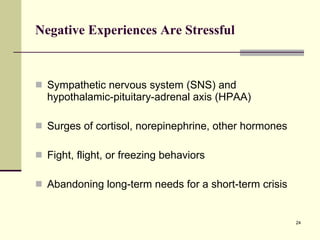
Negative Experiences Are Stressful Sympathetic nervous system (SNS) and hypothalamic-pituitary-adrenal axis (HPAA) Surges of cortisol, norepinephrine, other hormones Fight, flight, or freezing behaviors Abandoning long-term needs for a short-term crisis
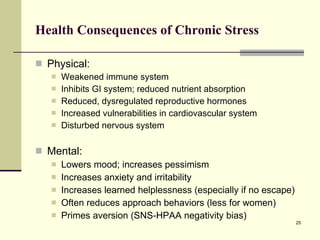
Health Consequences of Chronic Stress Physical: Weakened immune system Inhibits GI system; reduced nutrient absorption Reduced, dysregulated reproductive hormones Increased vulnerabilities in cardiovascular system Disturbed nervous system Mental: Lowers mood; increases pessimism Increases anxiety and irritability Increases learned helplessness (especially if no escape) Often reduces approach behaviors (less for women) Primes aversion (SNS-HPAA negativity bias)
Threat Reactivity
A Major Result of the Negativity Bias: Threat Reactivity Two mistakes: Thinking there is a tiger in the bushes when there isn’t one. Thinking there is no tiger in the bushes when there is one. We evolved to make the first mistake a hundred times to avoid making the second mistake even once.  This evolutionary tendency is intensified by temperament, personal history, culture, and politics. Threat reactivity affects individuals, couples, families, organizations, nations, and the world as a whole.
Results of Threat Reactivity  (Personal, Organizational, National) Our initial appraisals are mistaken: Overestimating threats Underestimating opportunities Underestimating inner and outer resources We update these appraisals with information that confirms them; we ignore, devalue, or alter information that doesn’t. Thus we end up with views of ourselves, others, and the world that are ignorant, selective, and distorted.
Costs of Threat Reactivity  (Personal, Organizational, National) Feeling threatened feels bad, and triggers stress consequences. We over-invest in threat protection.  The boy who cried tiger: flooding with paper tigers makes it harder to see the real ones.  Acting while feeling threatened leads to over-reactions, makes others feel threatened, and creates vicious cycles.  The Approach system is inhibited, so we don’t pursue opportunities, play small, or give up too soon. In the Attach system, we bond tighter to “us,” with more fear and anger toward “them.”
A Poignant Truth Mother Nature is tilted toward producing gene copies. But tilted against personal quality of life. And at the societal level, we have caveman/cavewoman brains armed with nuclear weapons. What shall we do?
We can deliberately use the mind  to change the brain for the better.
Taking in the Good
Just  having  positive experiences is not enough.  They pass through the brain like water through a sieve, while negative experiences are caught. We need to engage positive experiences actively to weave them into the brain.
How to Take in the Good 1. Look for positive  facts,  and let them become positive  experiences .  2. Savor the positive experience: Sustain it for 10-20-30 seconds. Feel it in your body and emotions.  Intensify it.  3. Sense and intend that the positive experience is  soaking  into your brain and body - registering deeply in emotional memory.
Kinds of “Good” to Take in The small pleasures of ordinary life The satisfaction of attaining goals or recognizing accomplishments - especially small, everyday ones Feeling grateful, contented, and fulfilled Things are alright; nothing is wrong; there is no threat Feeling safe and strong The peace and relief of forgiveness Being included, valued, liked, respected, loved by others The good feelings that come from being kind, fair, generous Feeling loving Recognizing your positive character traits Spiritual or existential realizations
Benefits of Positive Emotions The benefits of positive emotions are a proxy for many of the benefits of TIG. Emotions organize the brain as a whole, so positive ones have far-reaching benefits, including: Promote exploratory, “approach” behaviors Lift mood; increase optimism, resilience Counteract trauma Strengthen immune and protect cardiovascular systems Overall: “broaden and build” Create positive cycles
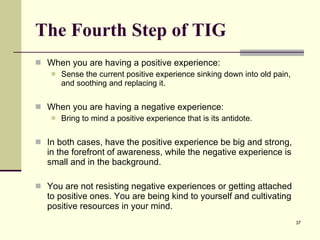
The Fourth Step of TIG When you are having a positive experience: Sense the current positive experience sinking down into old pain, and soothing and replacing it. When you are having a negative experience: Bring to mind a positive experience that is its antidote. In both cases, have the positive experience be big and strong, in the forefront of awareness, while the negative experience is small and in the background. You are not resisting negative experiences or getting attached to positive ones. You are being kind to yourself and cultivating positive resources in your mind.
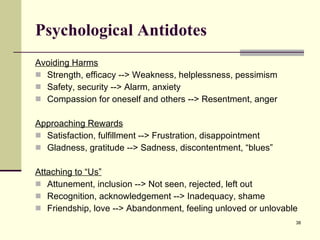
Psychological Antidotes Avoiding Harms Strength, efficacy --> Weakness, helplessness, pessimism Safety, security --> Alarm, anxiety Compassion for oneself and others --> Resentment, anger Approaching Rewards Satisfaction, fulfillment --> Frustration, disappointment Gladness, gratitude --> Sadness, discontentment, “blues” Attaching to “Us” Attunement, inclusion --> Not seen, rejected, left out Recognition, acknowledgement --> Inadequacy, shame Friendship, love --> Abandonment, feeling unloved or unlovable
Internalizing Safety
Parasympathetic Nervous System The “rest-and-digest” parasympathetic nervous system (PNS) balances and dials down the “fight-or-flight” sympathetic nervous system It soothes, resets, renews the body-mind. Though the SNS gets more press, the PNS is more primary.
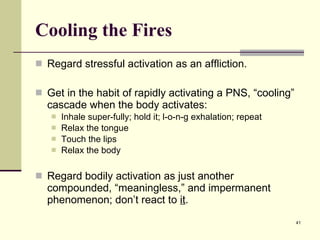
Cooling the Fires Regard stressful activation as an affliction. Get in the habit of rapidly activating a PNS, “cooling” cascade when the body activates: Inhale super-fully; hold it; l-o-n-g exhalation; repeat Relax the tongue Touch the lips Relax the body Regard bodily activation as just another compounded, “meaningless,” and impermanent phenomenon; don’t react to  it .
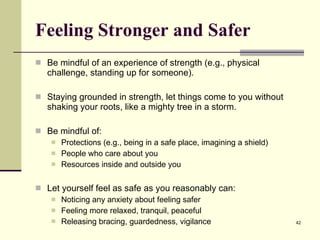
Feeling Stronger and Safer Be mindful of an experience of strength (e.g., physical challenge, standing up for someone).  Staying grounded in strength, let things come to you without shaking your roots, like a mighty tree in a storm. Be mindful of: Protections (e.g., being in a safe place, imagining a shield) People who care about you Resources inside and outside you Let yourself feel as safe as you reasonably can: Noticing any anxiety about feeling safer Feeling more relaxed, tranquil, peaceful Releasing bracing, guardedness, vigilance
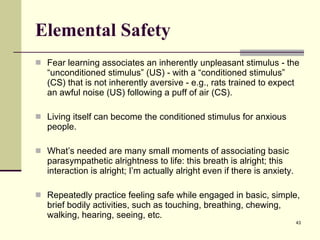
Elemental Safety Fear learning associates an inherently unpleasant stimulus - the “unconditioned stimulus” (US) - with a “conditioned stimulus” (CS) that is not inherently aversive - e.g., rats trained to expect an awful noise (US) following a puff of air (CS).  Living itself can become the conditioned stimulus for anxious people.  What’s needed are many small moments of associating basic parasympathetic alrightness to life: this breath is alright; this interaction is alright; I’m actually alright even if there is anxiety. Repeatedly practice feeling safe while engaged in basic, simple, brief bodily activities, such as touching, breathing, chewing, walking, hearing, seeing, etc.
Neural Networks of Inner Peace
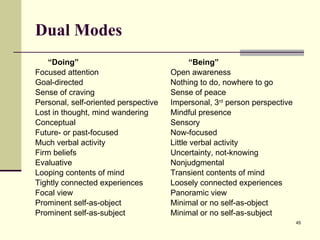
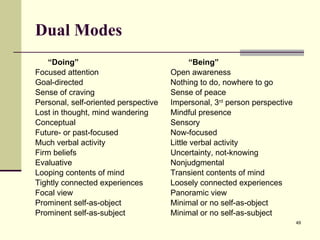
Dual Modes “ Doing”   “Being” Focused attention Open awareness Goal-directed Nothing to do, nowhere to go Sense of craving Sense of peace Personal, self-oriented perspective Impersonal, 3 rd  person perspective Lost in thought, mind wandering Mindful presence Conceptual Sensory Future- or past-focused Now-focused Much verbal activity Little verbal activity Firm beliefs Uncertainty, not-knowing Evaluative Nonjudgmental Looping contents of mind Transient contents of mind Tightly connected experiences Loosely connected experiences Focal view Panoramic view Prominent self-as-object Minimal or no self-as-object Prominent self-as-subject Minimal or no self-as-subject
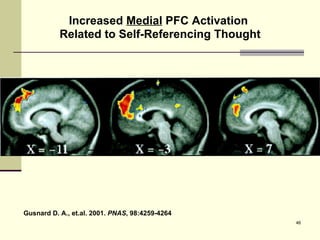
Increased  Medial  PFC Activation  Related to Self-Referencing Thought Gusnard D. A., et.al. 2001.  PNAS , 98:4259-4264
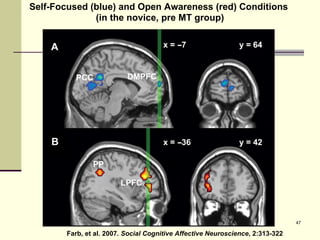
Farb, et al. 2007.  Social Cognitive Affective Neuroscience , 2:313-322 Self-Focused (blue) and Open Awareness (red) Conditions  (in the novice, pre MT group)
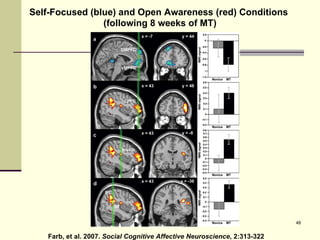
Farb, et al. 2007.  Social Cognitive Affective Neuroscience , 2:313-322 Self-Focused (blue) and Open Awareness (red) Conditions  (following 8 weeks of MT)
Dual Modes “ Doing”   “Being” Focused attention Open awareness Goal-directed Nothing to do, nowhere to go Sense of craving Sense of peace Personal, self-oriented perspective Impersonal, 3 rd  person perspective Lost in thought, mind wandering Mindful presence Conceptual Sensory Future- or past-focused Now-focused Much verbal activity Little verbal activity Firm beliefs Uncertainty, not-knowing Evaluative Nonjudgmental Looping contents of mind Transient contents of mind Tightly connected experiences Loosely connected experiences Focal view Panoramic view Prominent self-as-object Minimal or no self-as-object Prominent self-as-subject Minimal or no self-as-subject
Ways to Activate “Being” Mode Relax.  Focus on bare sensations and perceptions.  Sense the body as a whole.  Take a panoramic, “bird’s-eye” view.  Engage “d o n’t-know mind ”; release judgments.  Don’t try to connect mental contents together.  Let experience flow, staying here now. Relax the sense of “I, me, and mine.”
Whole Body Awareness Involves insula and mesial (middle) parietal lobes, which integrate sensory maps of the body, plus right hemisphere, for holistic (gestalt) perception Practice Sense the breath in one area (e.g., chest, upper lip) Sense the breath as a whole: one gestalt, percept Sense the body as a whole, a whole body breathing Sense experience as a whole: sensations, sounds, thoughts . . . all arising together as one unified thing This sense of the whole may be present for a second or two, then crumble; just open up to it again.
Panoramic Awareness Recall a bird’s-eye view (e.g., mountain, airplane).  Be aware of sounds coming and going in an open space of awareness, without any edges: boundless.  Open to other contents of mind, coming and going like clouds moving across the sky.  Pleasant or unpleasant, no matter: just more clouds No cloud ever harms or taints the sky.  Trust in awareness, in being awake,  rather than in transient and unstable conditions. Ajahn Sumedho
Be wisdom itself,  rather than a person who isn't wise  trying to become wise. Trust in awareness, in being awake,  rather than in transient and unstable conditions.   Ajahn Sumedho
Penetrative insight  joined with calm abiding  utterly eradicates  afflicted states. Shantideva
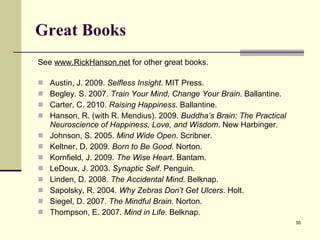
Great Books See  www.RickHanson.net  for other great books.  Austin, J. 2009.  Selfless Insight . MIT Press. Begley. S. 2007.  Train Your Mind, Change Your Brain . Ballantine. Carter, C. 2010.  Raising Happiness . Ballantine.  Hanson, R. (with R. Mendius). 2009.  Buddha’s Brain: The Practical Neuroscience of Happiness, Love, and Wisdom . New Harbinger. Johnson, S. 2005.  Mind Wide Open . Scribner.  Keltner, D. 2009.  Born to Be Good . Norton.  Kornfield, J. 2009.  The Wise Heart . Bantam.  LeDoux, J. 2003.  Synaptic Self . Penguin. Linden, D. 2008.  The Accidental Mind . Belknap.  Sapolsky, R. 2004.  Why Zebras Don’t Get Ulcers . Holt. Siegel, D. 2007.  The Mindful Brain . Norton. Thompson, E. 2007.  Mind in Life . Belknap.
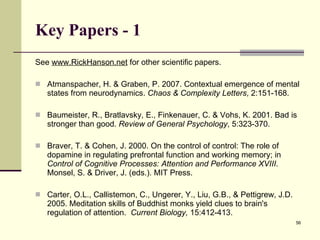
Key Papers - 1 See  www.RickHanson.net  for other scientific papers.  Atmanspacher, H. & Graben, P. 2007. Contextual emergence of mental states from neurodynamics.  Chaos & Complexity Letters , 2:151-168. Baumeister, R., Bratlavsky, E., Finkenauer, C. & Vohs, K. 2001. Bad is stronger than good.  Review of General Psychology , 5:323-370. Braver, T. & Cohen, J. 2000. On the control of control: The role of dopamine in regulating prefrontal function and working memory; in  Control of Cognitive Processes: Attention and Performance XVIII . Monsel, S. & Driver, J. (eds.). MIT Press. Carter, O.L., Callistemon, C., Ungerer, Y., Liu, G.B., & Pettigrew, J.D. 2005. Meditation skills of Buddhist monks yield clues to brain's regulation of attention.  Current Biology,  15:412-413.
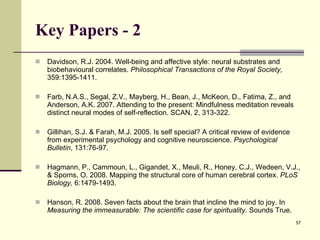
Key Papers - 2 Davidson, R.J. 2004. Well-being and affective style: neural substrates and biobehavioural correlates.  Philosophical Transactions of the Royal Society,  359:1395-1411. Farb, N.A.S., Segal, Z.V., Mayberg, H., Bean, J., McKeon, D., Fatima, Z., and Anderson, A.K. 2007. Attending to the present: Mindfulness meditation reveals distinct neural modes of self-reflection. SCAN, 2, 313-322. Gillihan, S.J. & Farah, M.J. 2005. Is self special? A critical review of evidence from experimental psychology and cognitive neuroscience.  Psychological Bulletin , 131:76-97.  Hagmann, P., Cammoun, L., Gigandet, X., Meuli, R., Honey, C.J., Wedeen, V.J., & Sporns, O. 2008.  Mapping the structural core of human cerebral cortex .  PLoS Biology ,  6:1479-1493.  Hanson, R. 2008. Seven facts about the brain that incline the mind to joy.   In  Measuring the immeasurable: The scientific case for spirituality.  Sounds True.
Key Papers - 3 Lazar, S., Kerr, C., Wasserman, R., Gray, J., Greve, D., Treadway, M., McGarvey, M., Quinn, B., Dusek, J., Benson, H., Rauch, S., Moore, C., & Fischl, B. 2005. Meditation experience is associated with increased cortical thickness.  Neuroreport , 16:1893-1897. Lewis, M.D. & Todd, R.M. 2007. The self-regulating brain: Cortical-subcortical feedback and the development of intelligent action.  Cognitive Development,  22:406-430. Lieberman, M.D. & Eisenberger, N.I. 2009. Pains and pleasures of social life.  Science , 323:890-891.  Lutz, A., Greischar, L., Rawlings, N., Ricard, M. and Davidson, R. 2004. Long-term meditators self-induce high-amplitude gamma synchrony during mental practice.  PNAS,  101:16369-16373. Lutz, A., Slager, H.A., Dunne, J.D., & Davidson, R. J. 2008. Attention regulation and monitoring in meditation.  Trends in Cognitive Sciences,  12:163-169.
Key Papers - 4 Rozin, P. & Royzman, E.B. 2001. Negativity bias, negativity dominance, and contagion.  Personality and Social Psychology Review , 5:296-320. Takahashi, H., Kato, M., Matsuura, M., Mobbs, D., Suhara, T., & Okubo, Y. 2009. When your gain is my pain and your pain is my gain: Neural correlates of envy and schadenfreude.  Science , 323:937-939.  Tang, Y.-Y., Ma, Y., Wang, J., Fan, Y., Feng, S., Lu, Q., Yu, Q., Sui, D., Rothbart, M.K., Fan, M., & Posner, M. 2007. Short-term meditation training improves attention and self-regulation.   PNAS , 104:17152-17156.  Thompson, E. & Varela F.J. 2001. Radical embodiment: Neural dynamics and consciousness.  Trends in Cognitive Sciences,  5:418-425. Walsh, R. & Shapiro, S. L. 2006. The meeting of meditative disciplines and Western psychology: A mutually enriching dialogue.  American Psychologist,  61:227-239.
Where to Find Rick Hanson Online http://www.youtube.com/BuddhasBrain http://www.facebook.com/BuddhasBrain w www.RickHanson.net www.WiseBrain.org

Paper Tiger Paranoia - Rick Hanson, PhD

  • 1.
    Paper Tiger ParanoiaNetworker Symposium March 25, 2011 Rick Hanson, Ph.D. The Wellspring Institute for Neuroscience and Contemplative Wisdom www.WiseBrain.org www.RickHanson.net [email_address]
  • 2.
    Topics Perspectives Self-directedneuroplasticity The evolution of fear Threat reactivity Taking in the good Internalizing safety Neural networks of inner peace
  • 3.
  • 4.
    Common - andFertile - Ground Neuroscience Psychology Contemplative Practice
  • 5.
    The history ofscience is rich in the example of the fruitfulness of bringing two sets of techniques, two sets of ideas, developed in separate contexts for the pursuit of new truth, into touch with one another. J. Robert Oppenheimer
  • 6.
    When the factschange, I change my mind, sir. What do you do? John Maynard Keynes
  • 7.
    We ask, “Whatis a thought?” We don't know, yet we are thinking continually. Venerable Tenzin Palmo
  • 8.
  • 9.
  • 10.
  • 11.
    The Mind/Brain System “ Mind” = flow of information within the nervous system: Information is represented by the nervous system. Most mind is unconscious; awareness is an aspect of mind. The headquarters of the nervous system is the brain. In essence then, apart from hypothetical transcendental factors, the mind is what the brain does . Brain = necessary, proximally sufficient condition for mind: The brain depends on the nervous system, other bodily systems, nature, and culture. As we’ll see, the brain also depends on the mind. Therefore, the brain and mind are two aspects of one system, interdependently arising.
  • 12.
    Three Facts aboutBrain and Mind As the brain changes, the mind changes. As the mind changes, the brain changes. Transient : brainwaves, local activation Lasting : epigenetics, neural pruning, “neurons that fire together, wire together” One can use the mind to change the brain to change the mind for the better: self-directed neuroplasticity .
  • 13.
  • 14.
    Christian Nuns, Recallinga Profound Spiritual Experience Beauregard, et al., Neuroscience Letters, 9/25/06
  • 15.
    Lazar, et al.2005. Meditation experience is associated with increased cortical thickness. Neuroreport , 16, 1893-1897.
  • 16.
  • 17.
    Evolution ~ 4+billion years of earth 3.5 billion years of life 650 million years of multi-celled organisms 600 million years of nervous system ~ 200 million years of mammals ~ 60 million years of primates ~ 6 million years ago: last common ancestor with chimpanzees, our closest relative among the “great apes” (gorillas, orangutans, chimpanzees, bonobos, humans) 2.5 million years of tool-making (starting with brains 1/3 our size) ~ 150,000 years of homo sapiens ~ 50,000 years of modern humans ~ 5000 years of blue, green, hazel eyes
  • 18.
  • 19.
    Three Stages ofBrain Evolution Reptilian: Brainstem, cerebellum, hypothalamus Reactive and reflexive Avoid hazards Mammalian: Limbic system, cingulate, early cortex Memory, emotion, social behavior Approach rewards Human: Massive cerebral cortex Abstract thought, language, cooperative planning, empathy Attach to “us”
  • 20.
    Negativity Bias: Causesin Evolution “ Sticks” - Predators, natural hazards, social aggression, pain (physical and psychological) “ Carrots” - Food, sex, shelter, social support, pleasure (physical and psychological) During evolution, avoiding “sticks” usually had more influence over survival than approaching “carrots.” Urgency - Usually, sticks must be dealt with immediately, while carrots allow a longer approach. Impact - Sticks usually determine mortality, carrots not; if you fail to get a carrot today, you’ll likely have a chance at a carrot tomorrow; but if you fail to avoid a stick today - whap! - no more carrots forever.
  • 21.
    With the negativitybias, the Avoid system hijacks the Approach and Attach systems, inhibiting them or using them for its ends.
  • 22.
    Negativity Bias: Physiology and Neuropsychology Physiology: Greater bodily arousal to negative stimuli Pain is produced anywhere; pleasure is circumscribed. Neuropsychology: Separate, low-level systems for negative and positive stimuli Right hemisphere specialized for negative stimuli Greater brainwave responses to negative stimuli ~ 65% of amygdala sifts for negative stimuli The amygdala-hippocampus system flags negative experiences prominently in memory: like Velcro for negative experiences but Teflon for positive ones. More negative “basic” emotions than positive ones
  • 23.
    Negativity Bias: SomeConsequences Negative stimuli get more attention and processing. We generally learn faster from pain than pleasure. People work harder to avoid a loss than attain an equal gain (“endowment effect”) Easy to create learned helplessness, hard to undo Negative interactions: more powerful than positive Negative experiences sift into implicit memory.
  • 24.
    Negative Experiences AreStressful Sympathetic nervous system (SNS) and hypothalamic-pituitary-adrenal axis (HPAA) Surges of cortisol, norepinephrine, other hormones Fight, flight, or freezing behaviors Abandoning long-term needs for a short-term crisis
  • 25.
    Health Consequences ofChronic Stress Physical: Weakened immune system Inhibits GI system; reduced nutrient absorption Reduced, dysregulated reproductive hormones Increased vulnerabilities in cardiovascular system Disturbed nervous system Mental: Lowers mood; increases pessimism Increases anxiety and irritability Increases learned helplessness (especially if no escape) Often reduces approach behaviors (less for women) Primes aversion (SNS-HPAA negativity bias)
  • 26.
  • 27.
    A Major Resultof the Negativity Bias: Threat Reactivity Two mistakes: Thinking there is a tiger in the bushes when there isn’t one. Thinking there is no tiger in the bushes when there is one. We evolved to make the first mistake a hundred times to avoid making the second mistake even once. This evolutionary tendency is intensified by temperament, personal history, culture, and politics. Threat reactivity affects individuals, couples, families, organizations, nations, and the world as a whole.
  • 28.
    Results of ThreatReactivity (Personal, Organizational, National) Our initial appraisals are mistaken: Overestimating threats Underestimating opportunities Underestimating inner and outer resources We update these appraisals with information that confirms them; we ignore, devalue, or alter information that doesn’t. Thus we end up with views of ourselves, others, and the world that are ignorant, selective, and distorted.
  • 29.
    Costs of ThreatReactivity (Personal, Organizational, National) Feeling threatened feels bad, and triggers stress consequences. We over-invest in threat protection. The boy who cried tiger: flooding with paper tigers makes it harder to see the real ones. Acting while feeling threatened leads to over-reactions, makes others feel threatened, and creates vicious cycles. The Approach system is inhibited, so we don’t pursue opportunities, play small, or give up too soon. In the Attach system, we bond tighter to “us,” with more fear and anger toward “them.”
  • 30.
    A Poignant TruthMother Nature is tilted toward producing gene copies. But tilted against personal quality of life. And at the societal level, we have caveman/cavewoman brains armed with nuclear weapons. What shall we do?
  • 31.
    We can deliberatelyuse the mind to change the brain for the better.
  • 32.
  • 33.
    Just having positive experiences is not enough. They pass through the brain like water through a sieve, while negative experiences are caught. We need to engage positive experiences actively to weave them into the brain.
  • 34.
    How to Takein the Good 1. Look for positive facts, and let them become positive experiences . 2. Savor the positive experience: Sustain it for 10-20-30 seconds. Feel it in your body and emotions. Intensify it. 3. Sense and intend that the positive experience is soaking into your brain and body - registering deeply in emotional memory.
  • 35.
    Kinds of “Good”to Take in The small pleasures of ordinary life The satisfaction of attaining goals or recognizing accomplishments - especially small, everyday ones Feeling grateful, contented, and fulfilled Things are alright; nothing is wrong; there is no threat Feeling safe and strong The peace and relief of forgiveness Being included, valued, liked, respected, loved by others The good feelings that come from being kind, fair, generous Feeling loving Recognizing your positive character traits Spiritual or existential realizations
  • 36.
    Benefits of PositiveEmotions The benefits of positive emotions are a proxy for many of the benefits of TIG. Emotions organize the brain as a whole, so positive ones have far-reaching benefits, including: Promote exploratory, “approach” behaviors Lift mood; increase optimism, resilience Counteract trauma Strengthen immune and protect cardiovascular systems Overall: “broaden and build” Create positive cycles
  • 37.
    The Fourth Stepof TIG When you are having a positive experience: Sense the current positive experience sinking down into old pain, and soothing and replacing it. When you are having a negative experience: Bring to mind a positive experience that is its antidote. In both cases, have the positive experience be big and strong, in the forefront of awareness, while the negative experience is small and in the background. You are not resisting negative experiences or getting attached to positive ones. You are being kind to yourself and cultivating positive resources in your mind.
  • 38.
    Psychological Antidotes AvoidingHarms Strength, efficacy --> Weakness, helplessness, pessimism Safety, security --> Alarm, anxiety Compassion for oneself and others --> Resentment, anger Approaching Rewards Satisfaction, fulfillment --> Frustration, disappointment Gladness, gratitude --> Sadness, discontentment, “blues” Attaching to “Us” Attunement, inclusion --> Not seen, rejected, left out Recognition, acknowledgement --> Inadequacy, shame Friendship, love --> Abandonment, feeling unloved or unlovable
  • 39.
  • 40.
    Parasympathetic Nervous SystemThe “rest-and-digest” parasympathetic nervous system (PNS) balances and dials down the “fight-or-flight” sympathetic nervous system It soothes, resets, renews the body-mind. Though the SNS gets more press, the PNS is more primary.
  • 41.
    Cooling the FiresRegard stressful activation as an affliction. Get in the habit of rapidly activating a PNS, “cooling” cascade when the body activates: Inhale super-fully; hold it; l-o-n-g exhalation; repeat Relax the tongue Touch the lips Relax the body Regard bodily activation as just another compounded, “meaningless,” and impermanent phenomenon; don’t react to it .
  • 42.
    Feeling Stronger andSafer Be mindful of an experience of strength (e.g., physical challenge, standing up for someone). Staying grounded in strength, let things come to you without shaking your roots, like a mighty tree in a storm. Be mindful of: Protections (e.g., being in a safe place, imagining a shield) People who care about you Resources inside and outside you Let yourself feel as safe as you reasonably can: Noticing any anxiety about feeling safer Feeling more relaxed, tranquil, peaceful Releasing bracing, guardedness, vigilance
  • 43.
    Elemental Safety Fearlearning associates an inherently unpleasant stimulus - the “unconditioned stimulus” (US) - with a “conditioned stimulus” (CS) that is not inherently aversive - e.g., rats trained to expect an awful noise (US) following a puff of air (CS). Living itself can become the conditioned stimulus for anxious people. What’s needed are many small moments of associating basic parasympathetic alrightness to life: this breath is alright; this interaction is alright; I’m actually alright even if there is anxiety. Repeatedly practice feeling safe while engaged in basic, simple, brief bodily activities, such as touching, breathing, chewing, walking, hearing, seeing, etc.
  • 44.
    Neural Networks ofInner Peace
  • 45.
    Dual Modes “Doing” “Being” Focused attention Open awareness Goal-directed Nothing to do, nowhere to go Sense of craving Sense of peace Personal, self-oriented perspective Impersonal, 3 rd person perspective Lost in thought, mind wandering Mindful presence Conceptual Sensory Future- or past-focused Now-focused Much verbal activity Little verbal activity Firm beliefs Uncertainty, not-knowing Evaluative Nonjudgmental Looping contents of mind Transient contents of mind Tightly connected experiences Loosely connected experiences Focal view Panoramic view Prominent self-as-object Minimal or no self-as-object Prominent self-as-subject Minimal or no self-as-subject
  • 46.
    Increased Medial PFC Activation Related to Self-Referencing Thought Gusnard D. A., et.al. 2001. PNAS , 98:4259-4264
  • 47.
    Farb, et al.2007. Social Cognitive Affective Neuroscience , 2:313-322 Self-Focused (blue) and Open Awareness (red) Conditions (in the novice, pre MT group)
  • 48.
    Farb, et al.2007. Social Cognitive Affective Neuroscience , 2:313-322 Self-Focused (blue) and Open Awareness (red) Conditions (following 8 weeks of MT)
  • 49.
    Dual Modes “Doing” “Being” Focused attention Open awareness Goal-directed Nothing to do, nowhere to go Sense of craving Sense of peace Personal, self-oriented perspective Impersonal, 3 rd person perspective Lost in thought, mind wandering Mindful presence Conceptual Sensory Future- or past-focused Now-focused Much verbal activity Little verbal activity Firm beliefs Uncertainty, not-knowing Evaluative Nonjudgmental Looping contents of mind Transient contents of mind Tightly connected experiences Loosely connected experiences Focal view Panoramic view Prominent self-as-object Minimal or no self-as-object Prominent self-as-subject Minimal or no self-as-subject
  • 50.
    Ways to Activate“Being” Mode Relax. Focus on bare sensations and perceptions. Sense the body as a whole. Take a panoramic, “bird’s-eye” view. Engage “d o n’t-know mind ”; release judgments. Don’t try to connect mental contents together. Let experience flow, staying here now. Relax the sense of “I, me, and mine.”
  • 51.
    Whole Body AwarenessInvolves insula and mesial (middle) parietal lobes, which integrate sensory maps of the body, plus right hemisphere, for holistic (gestalt) perception Practice Sense the breath in one area (e.g., chest, upper lip) Sense the breath as a whole: one gestalt, percept Sense the body as a whole, a whole body breathing Sense experience as a whole: sensations, sounds, thoughts . . . all arising together as one unified thing This sense of the whole may be present for a second or two, then crumble; just open up to it again.
  • 52.
    Panoramic Awareness Recalla bird’s-eye view (e.g., mountain, airplane). Be aware of sounds coming and going in an open space of awareness, without any edges: boundless. Open to other contents of mind, coming and going like clouds moving across the sky. Pleasant or unpleasant, no matter: just more clouds No cloud ever harms or taints the sky. Trust in awareness, in being awake, rather than in transient and unstable conditions. Ajahn Sumedho
  • 53.
    Be wisdom itself, rather than a person who isn't wise trying to become wise. Trust in awareness, in being awake, rather than in transient and unstable conditions. Ajahn Sumedho
  • 54.
    Penetrative insight joined with calm abiding utterly eradicates afflicted states. Shantideva
  • 55.
    Great Books See www.RickHanson.net for other great books. Austin, J. 2009. Selfless Insight . MIT Press. Begley. S. 2007. Train Your Mind, Change Your Brain . Ballantine. Carter, C. 2010. Raising Happiness . Ballantine. Hanson, R. (with R. Mendius). 2009. Buddha’s Brain: The Practical Neuroscience of Happiness, Love, and Wisdom . New Harbinger. Johnson, S. 2005. Mind Wide Open . Scribner. Keltner, D. 2009. Born to Be Good . Norton. Kornfield, J. 2009. The Wise Heart . Bantam. LeDoux, J. 2003. Synaptic Self . Penguin. Linden, D. 2008. The Accidental Mind . Belknap. Sapolsky, R. 2004. Why Zebras Don’t Get Ulcers . Holt. Siegel, D. 2007. The Mindful Brain . Norton. Thompson, E. 2007. Mind in Life . Belknap.
  • 56.
    Key Papers -1 See www.RickHanson.net for other scientific papers. Atmanspacher, H. & Graben, P. 2007. Contextual emergence of mental states from neurodynamics. Chaos & Complexity Letters , 2:151-168. Baumeister, R., Bratlavsky, E., Finkenauer, C. & Vohs, K. 2001. Bad is stronger than good. Review of General Psychology , 5:323-370. Braver, T. & Cohen, J. 2000. On the control of control: The role of dopamine in regulating prefrontal function and working memory; in Control of Cognitive Processes: Attention and Performance XVIII . Monsel, S. & Driver, J. (eds.). MIT Press. Carter, O.L., Callistemon, C., Ungerer, Y., Liu, G.B., & Pettigrew, J.D. 2005. Meditation skills of Buddhist monks yield clues to brain's regulation of attention. Current Biology, 15:412-413.
  • 57.
    Key Papers -2 Davidson, R.J. 2004. Well-being and affective style: neural substrates and biobehavioural correlates. Philosophical Transactions of the Royal Society, 359:1395-1411. Farb, N.A.S., Segal, Z.V., Mayberg, H., Bean, J., McKeon, D., Fatima, Z., and Anderson, A.K. 2007. Attending to the present: Mindfulness meditation reveals distinct neural modes of self-reflection. SCAN, 2, 313-322. Gillihan, S.J. & Farah, M.J. 2005. Is self special? A critical review of evidence from experimental psychology and cognitive neuroscience. Psychological Bulletin , 131:76-97. Hagmann, P., Cammoun, L., Gigandet, X., Meuli, R., Honey, C.J., Wedeen, V.J., & Sporns, O. 2008. Mapping the structural core of human cerebral cortex . PLoS Biology , 6:1479-1493. Hanson, R. 2008. Seven facts about the brain that incline the mind to joy. In Measuring the immeasurable: The scientific case for spirituality. Sounds True.
  • 58.
    Key Papers -3 Lazar, S., Kerr, C., Wasserman, R., Gray, J., Greve, D., Treadway, M., McGarvey, M., Quinn, B., Dusek, J., Benson, H., Rauch, S., Moore, C., & Fischl, B. 2005. Meditation experience is associated with increased cortical thickness. Neuroreport , 16:1893-1897. Lewis, M.D. & Todd, R.M. 2007. The self-regulating brain: Cortical-subcortical feedback and the development of intelligent action. Cognitive Development, 22:406-430. Lieberman, M.D. & Eisenberger, N.I. 2009. Pains and pleasures of social life. Science , 323:890-891. Lutz, A., Greischar, L., Rawlings, N., Ricard, M. and Davidson, R. 2004. Long-term meditators self-induce high-amplitude gamma synchrony during mental practice. PNAS, 101:16369-16373. Lutz, A., Slager, H.A., Dunne, J.D., & Davidson, R. J. 2008. Attention regulation and monitoring in meditation. Trends in Cognitive Sciences, 12:163-169.
  • 59.
    Key Papers -4 Rozin, P. & Royzman, E.B. 2001. Negativity bias, negativity dominance, and contagion. Personality and Social Psychology Review , 5:296-320. Takahashi, H., Kato, M., Matsuura, M., Mobbs, D., Suhara, T., & Okubo, Y. 2009. When your gain is my pain and your pain is my gain: Neural correlates of envy and schadenfreude. Science , 323:937-939. Tang, Y.-Y., Ma, Y., Wang, J., Fan, Y., Feng, S., Lu, Q., Yu, Q., Sui, D., Rothbart, M.K., Fan, M., & Posner, M. 2007. Short-term meditation training improves attention and self-regulation. PNAS , 104:17152-17156. Thompson, E. & Varela F.J. 2001. Radical embodiment: Neural dynamics and consciousness. Trends in Cognitive Sciences, 5:418-425. Walsh, R. & Shapiro, S. L. 2006. The meeting of meditative disciplines and Western psychology: A mutually enriching dialogue. American Psychologist, 61:227-239.
  • 60.
    Where to FindRick Hanson Online http://www.youtube.com/BuddhasBrain http://www.facebook.com/BuddhasBrain w www.RickHanson.net www.WiseBrain.org