Steadying the Mind

            Australian Association of
   Buddhist Counsellors and Psychotherapists
                       August 13, 2011


                     Rick Hanson, Ph.D.
The Wellspring Institute for Neuroscience and Contemplative Wisdom
           www.WiseBrain.org         www.RickHanson.net
                         drrh@comcast.net

                                                                     1
Topics


! Foundations


! Challenges to a steady mind


! Neural factors of mindfulness


                                  2
Foundations


              3
Distinctions . . .

! Awareness is the field in which neural activity
  (mysteriously) becomes conscious experience.

! Attention is a heightened focus - a spotlight - on a
  particular content of awareness.

! Mindfulness is sustained attentiveness, typically with
  a metacognitive awareness of being aware.

! Concentration is deep absorption in an object of
  attention - sometimes to the point of non-ordinary
  states of consciousness.                                 4
Concentration is
       the proximate cause of wisdom.

Without concentration, one cannot even secure
one’s own welfare, much less the lofty goal of
     providing for the welfare of others.

            Acariya Dhammapala
                                                 5
Heartwood

This spiritual life does not have gain, honor, and
  renown for its benefit, or the attainment of moral
  discipline for its benefit, or the attainment of
  concentration for its benefit, or knowledge and
  vision for its benefit.

But it is this unshakable liberation of mind that is
  the goal of this spiritual life, its heartwood,
  and its end.

                     The Buddha                        6
Challenges to a Steady Mind


                              7
Challenges to a Steady Mind
! We evolved continually scanning, shifting, wide focus
  attention in order to survive: “monkey mind.”

! This general tendency varies due to the adaptive
  value of neurological diversity in temperament, from
  “turtles” to “jackrabbits.”

! Life experiences - in particular, painful or traumatic
  ones - can heighten vigilance and distractibility.

! Modern culture - with its fire hose of information and
  routine multi-tasking - leads to stimulation-hunger      8

  and divided attention.
How the Brain Pays Attention

! Key functions:
   ! Holding onto information
   ! Updating awareness
   ! Seeking stimulation


! Key mechanisms:
   ! Dopamine and the gate to awareness
   ! The basal ganglia stimostat


                                          9
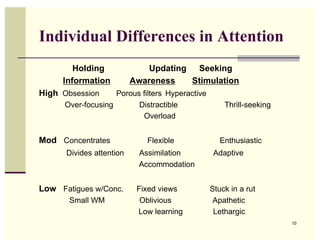
Individual Differences in Attention
        Holding               Updating Seeking
     Information          Awareness   Stimulation
High Obsession      Porous filters Hyperactive
      Over-focusing       Distractible               Thrill-seeking
                           Overload


Mod Concentrates             Flexible               Enthusiastic
      Divides attention    Assimilation           Adaptive
                           Accommodation


Low Fatigues w/Conc.       Fixed views           Stuck in a rut
       Small WM             Oblivious             Apathetic
                           Low learning           Lethargic
                                                                      10
Thus the importance of training the mind - and thus
  the brain - over time to become increasingly
  mindful and concentrated.


                                                  11
Neural Factors of Mindfulness


                                12
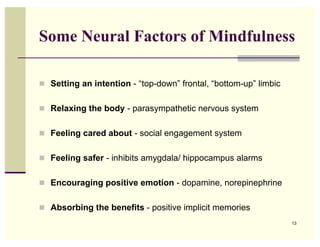
Some Neural Factors of Mindfulness

! Setting an intention - “top-down” frontal, “bottom-up” limbic


! Relaxing the body - parasympathetic nervous system


! Feeling cared about - social engagement system


! Feeling safer - inhibits amygdala/ hippocampus alarms


! Encouraging positive emotion - dopamine, norepinephrine


! Absorbing the benefits - positive implicit memories
                                                                  13
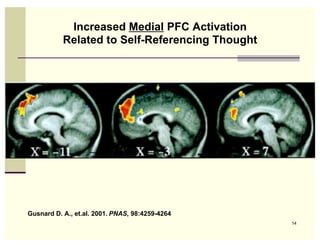
Increased Medial PFC Activation
           Related to Self-Referencing Thought


Gusnard D. A., et.al. 2001. PNAS, 98:4259-4264
                                                 14
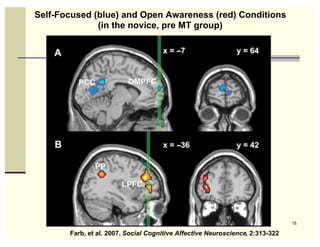
Self-Focused (blue) and Open Awareness (red) Conditions
              (in the novice, pre MT group)


                                                                               15

       Farb, et al. 2007. Social Cognitive Affective Neuroscience, 2:313-322
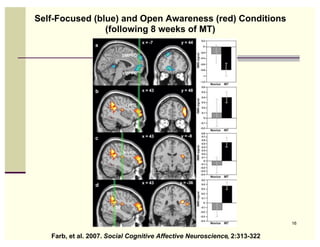
Self-Focused (blue) and Open Awareness (red) Conditions
                (following 8 weeks of MT)


                                                                           16


   Farb, et al. 2007. Social Cognitive Affective Neuroscience, 2:313-322
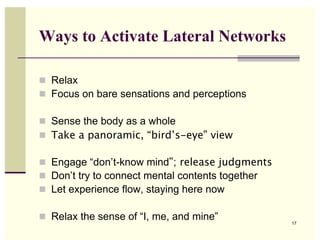
Ways to Activate Lateral Networks

! Relax
! Focus on bare sensations and perceptions

! Sense the body as a whole
! Take a panoramic, “bird’s-eye” view

! Engage “don’t-know mind”; release judgments
! Don’t try to connect mental contents together
! Let experience flow, staying here now

! Relax the sense of “I, me, and mine”
                                                  17
Whole Body Awareness
! Sense the breath in one area (e.g., chest, upper lip)


! Sense the breath as a whole: one gestalt, percept


! Sense the body as a whole, a whole body breathing


! Sense experience as a whole: sensations, sounds,
  thoughts . . . all arising together as one unified thing

! It’s natural for this sense of the whole to be present
  for a second or two, then crumble; just open up to it
  again and again.                                           18
Panoramic Awareness
! Recall a bird’s-eye view (e.g., mountain, airplane)


! Be aware of sounds coming and going in an open space of
   awareness, without any edges: boundless

! Open to other contents of mind, coming and going like clouds
   moving across the sky.

! Pleasant or unpleasant, no matter: just more clouds


! No cloud ever harms or taints the sky.


                  Trust in awareness, in being awake,
           rather than in transient and unstable conditions.     19


                             Ajahn Sumedho
Concentration
“And what, friends, is right concentration? Here, quite secluded from sensual
   pleasures, secluded from unwholesome states, a person enters upon and
   abides in the first jhana, which is accompanied by applied and sustained
   thought, with rapture and pleasure born of seclusion.

With the stilling of applied and sustained thought, the person enters upon and
   abides in the second jhana, which has self-confidence and singleness of
   mind without applied and sustained thought, with rapture and pleasure born
   of concentration.

With the fading away as well of rapture, the person abides in equanimity, and
   mindful and fully aware, still feeling pleasure with the body, enters upon and
   abides in the third jhana, on account of which noble ones announce: 'He or
   she has a pleasant abiding who has equanimity and is mindful.’

With the abandoning of pleasure and pain, and with the previous
   disappearance of joy and grief, he or she enters upon and abides in the
   fourth jhana, which has neither-pain-nor-pleasure and purity of mindfulness
   due to equanimity. This is called right concentration.”

                                 - The Buddha                                   20
For one who clings motion exists, but for one who does not
  cling there is no motion.
Where no motion is, there is stillness.
Where stillness is, there is no craving.
Where no craving is, there is neither coming nor going.
Where no coming or going is there is neither arising nor
  passing away.
Where neither arising nor passing away is, there is neither
  this world, nor a world beyond nor a state between.
This verily, is the end of suffering.

                     The Buddha, Udana 8:3                    21
Great Books
See www.RickHanson.net for other great books.

! Austin, J. 2009. Selfless Insight. MIT Press.
! Begley. S. 2007. Train Your Mind, Change Your Brain. Ballantine.
! Carter, C. 2010. Raising Happiness. Ballantine.
! Hanson, R. (with R. Mendius). 2009. Buddha’s Brain: The Practical
    Neuroscience of Happiness, Love, and Wisdom. New Harbinger.
!   Johnson, S. 2005. Mind Wide Open. Scribner.
!   Keltner, D. 2009. Born to Be Good. Norton.
!   Kornfield, J. 2009. The Wise Heart. Bantam.
!   LeDoux, J. 2003. Synaptic Self. Penguin.
!   Linden, D. 2008. The Accidental Mind. Belknap.
!   Sapolsky, R. 2004. Why Zebras Don’t Get Ulcers. Holt.
!   Siegel, D. 2007. The Mindful Brain. Norton.
!   Thompson, E. 2007. Mind in Life. Belknap.                         22
Key Papers - 1
See www.RickHanson.net for other scientific papers.

! Atmanspacher, H. & Graben, P. 2007. Contextual emergence of mental
   states from neurodynamics. Chaos & Complexity Letters, 2:151-168.

! Baumeister, R., Bratlavsky, E., Finkenauer, C. & Vohs, K. 2001. Bad is
   stronger than good. Review of General Psychology, 5:323-370.

! Braver, T. & Cohen, J. 2000. On the control of control: The role of
   dopamine in regulating prefrontal function and working memory; in
   Control of Cognitive Processes: Attention and Performance XVIII.
   Monsel, S. & Driver, J. (eds.). MIT Press.

! Carter, O.L., Callistemon, C., Ungerer, Y., Liu, G.B., & Pettigrew, J.D.
   2005. Meditation skills of Buddhist monks yield clues to brain's
   regulation of attention. Current Biology. 15:412-413.                     23
Key Papers - 2
!   Davidson, R.J. 2004. Well-being and affective style: neural substrates and
    biobehavioural correlates. Philosophical Transactions of the Royal Society.
    359:1395-1411.

!   Farb, N.A.S., Segal, Z.V., Mayberg, H., Bean, J., McKeon, D., Fatima, Z., and
    Anderson, A.K. 2007. Attending to the present: Mindfulness meditation reveals
    distinct neural modes of self-reflection. SCAN, 2, 313-322.

!   Gillihan, S.J. & Farah, M.J. 2005. Is self special? A critical review of evidence
    from experimental psychology and cognitive neuroscience. Psychological
    Bulletin, 131:76-97.

!   Hagmann, P., Cammoun, L., Gigandet, X., Meuli, R., Honey, C.J., Wedeen, V.J.,
    & Sporns, O. 2008. Mapping the structural core of human cerebral cortex. PLoS
    Biology. 6:1479-1493.

!   Hanson, R. 2008. Seven facts about the brain that incline the mind to joy. In
    Measuring the immeasurable: The scientific case for spirituality. Sounds True.      24
Key Papers - 3
!   Lazar, S., Kerr, C., Wasserman, R., Gray, J., Greve, D., Treadway, M.,
    McGarvey, M., Quinn, B., Dusek, J., Benson, H., Rauch, S., Moore, C., & Fischl,
    B. 2005. Meditation experience is associated with increased cortical thickness.
    Neuroreport. 16:1893-1897.

!   Lewis, M.D. & Todd, R.M. 2007. The self-regulating brain: Cortical-subcortical
    feedback and the development of intelligent action. Cognitive Development,
    22:406-430.

!   Lieberman, M.D. & Eisenberger, N.I. 2009. Pains and pleasures of social life.
    Science. 323:890-891.

!   Lutz, A., Greischar, L., Rawlings, N., Ricard, M. and Davidson, R. 2004. Long-
    term meditators self-induce high-amplitude gamma synchrony during mental
    practice. PNAS. 101:16369-16373.

!   Lutz, A., Slager, H.A., Dunne, J.D., & Davidson, R. J. 2008. Attention regulation
    and monitoring in meditation. Trends in Cognitive Sciences. 12:163-169.          25
Key Papers - 4
!   Rozin, P. & Royzman, E.B. 2001. Negativity bias, negativity dominance, and
    contagion. Personality and Social Psychology Review, 5:296-320.

!   Takahashi, H., Kato, M., Matsuura, M., Mobbs, D., Suhara, T., & Okubo, Y.
    2009. When your gain is my pain and your pain is my gain: Neural correlates of
    envy and schadenfreude. Science, 323:937-939.

!   Tang, Y.-Y., Ma, Y., Wang, J., Fan, Y., Feng, S., Lu, Q., Yu, Q., Sui, D.,
    Rothbart, M.K., Fan, M., & Posner, M. 2007. Short-term meditation training
    improves attention and self-regulation. PNAS, 104:17152-17156.

!   Thompson, E. & Varela F.J. 2001. Radical embodiment: Neural dynamics and
    consciousness. Trends in Cognitive Sciences, 5:418-425.

!   Walsh, R. & Shapiro, S. L. 2006. The meeting of meditative disciplines and
    Western psychology: A mutually enriching dialogue. American Psychologist,
    61:227-239.
                                                                                     26
Where to Find Rick Hanson Online

http://www.youtube.com/BuddhasBrain
http://www.facebook.com/BuddhasBrain


               w


       www.RickHanson.net
        www.WiseBrain.org              27

Steadying the Mind

  • 1.
    Steadying the Mind Australian Association of Buddhist Counsellors and Psychotherapists August 13, 2011 Rick Hanson, Ph.D. The Wellspring Institute for Neuroscience and Contemplative Wisdom www.WiseBrain.org www.RickHanson.net drrh@comcast.net 1
  • 2.
    Topics ! Foundations ! Challengesto a steady mind ! Neural factors of mindfulness 2
  • 3.
  • 4.
    Distinctions . .. ! Awareness is the field in which neural activity (mysteriously) becomes conscious experience. ! Attention is a heightened focus - a spotlight - on a particular content of awareness. ! Mindfulness is sustained attentiveness, typically with a metacognitive awareness of being aware. ! Concentration is deep absorption in an object of attention - sometimes to the point of non-ordinary states of consciousness. 4
  • 5.
    Concentration is the proximate cause of wisdom. Without concentration, one cannot even secure one’s own welfare, much less the lofty goal of providing for the welfare of others. Acariya Dhammapala 5
  • 6.
    Heartwood This spiritual lifedoes not have gain, honor, and renown for its benefit, or the attainment of moral discipline for its benefit, or the attainment of concentration for its benefit, or knowledge and vision for its benefit. But it is this unshakable liberation of mind that is the goal of this spiritual life, its heartwood, and its end. The Buddha 6
  • 7.
    Challenges to aSteady Mind 7
  • 8.
    Challenges to aSteady Mind ! We evolved continually scanning, shifting, wide focus attention in order to survive: “monkey mind.” ! This general tendency varies due to the adaptive value of neurological diversity in temperament, from “turtles” to “jackrabbits.” ! Life experiences - in particular, painful or traumatic ones - can heighten vigilance and distractibility. ! Modern culture - with its fire hose of information and routine multi-tasking - leads to stimulation-hunger 8 and divided attention.
  • 9.
    How the BrainPays Attention ! Key functions: ! Holding onto information ! Updating awareness ! Seeking stimulation ! Key mechanisms: ! Dopamine and the gate to awareness ! The basal ganglia stimostat 9
  • 10.
    Individual Differences inAttention Holding Updating Seeking Information Awareness Stimulation High Obsession Porous filters Hyperactive Over-focusing Distractible Thrill-seeking Overload Mod Concentrates Flexible Enthusiastic Divides attention Assimilation Adaptive Accommodation Low Fatigues w/Conc. Fixed views Stuck in a rut Small WM Oblivious Apathetic Low learning Lethargic 10
  • 11.
    Thus the importanceof training the mind - and thus the brain - over time to become increasingly mindful and concentrated. 11
  • 12.
    Neural Factors ofMindfulness 12
  • 13.
    Some Neural Factorsof Mindfulness ! Setting an intention - “top-down” frontal, “bottom-up” limbic ! Relaxing the body - parasympathetic nervous system ! Feeling cared about - social engagement system ! Feeling safer - inhibits amygdala/ hippocampus alarms ! Encouraging positive emotion - dopamine, norepinephrine ! Absorbing the benefits - positive implicit memories 13
  • 14.
    Increased Medial PFCActivation Related to Self-Referencing Thought Gusnard D. A., et.al. 2001. PNAS, 98:4259-4264 14
  • 15.
    Self-Focused (blue) andOpen Awareness (red) Conditions (in the novice, pre MT group) 15 Farb, et al. 2007. Social Cognitive Affective Neuroscience, 2:313-322
  • 16.
    Self-Focused (blue) andOpen Awareness (red) Conditions (following 8 weeks of MT) 16 Farb, et al. 2007. Social Cognitive Affective Neuroscience, 2:313-322
  • 17.
    Ways to ActivateLateral Networks ! Relax ! Focus on bare sensations and perceptions ! Sense the body as a whole ! Take a panoramic, “bird’s-eye” view ! Engage “don’t-know mind”; release judgments ! Don’t try to connect mental contents together ! Let experience flow, staying here now ! Relax the sense of “I, me, and mine” 17
  • 18.
    Whole Body Awareness !Sense the breath in one area (e.g., chest, upper lip) ! Sense the breath as a whole: one gestalt, percept ! Sense the body as a whole, a whole body breathing ! Sense experience as a whole: sensations, sounds, thoughts . . . all arising together as one unified thing ! It’s natural for this sense of the whole to be present for a second or two, then crumble; just open up to it again and again. 18
  • 19.
    Panoramic Awareness ! Recalla bird’s-eye view (e.g., mountain, airplane) ! Be aware of sounds coming and going in an open space of awareness, without any edges: boundless ! Open to other contents of mind, coming and going like clouds moving across the sky. ! Pleasant or unpleasant, no matter: just more clouds ! No cloud ever harms or taints the sky. Trust in awareness, in being awake, rather than in transient and unstable conditions. 19 Ajahn Sumedho
  • 20.
    Concentration “And what, friends,is right concentration? Here, quite secluded from sensual pleasures, secluded from unwholesome states, a person enters upon and abides in the first jhana, which is accompanied by applied and sustained thought, with rapture and pleasure born of seclusion. With the stilling of applied and sustained thought, the person enters upon and abides in the second jhana, which has self-confidence and singleness of mind without applied and sustained thought, with rapture and pleasure born of concentration. With the fading away as well of rapture, the person abides in equanimity, and mindful and fully aware, still feeling pleasure with the body, enters upon and abides in the third jhana, on account of which noble ones announce: 'He or she has a pleasant abiding who has equanimity and is mindful.’ With the abandoning of pleasure and pain, and with the previous disappearance of joy and grief, he or she enters upon and abides in the fourth jhana, which has neither-pain-nor-pleasure and purity of mindfulness due to equanimity. This is called right concentration.” - The Buddha 20
  • 21.
    For one whoclings motion exists, but for one who does not cling there is no motion. Where no motion is, there is stillness. Where stillness is, there is no craving. Where no craving is, there is neither coming nor going. Where no coming or going is there is neither arising nor passing away. Where neither arising nor passing away is, there is neither this world, nor a world beyond nor a state between. This verily, is the end of suffering. The Buddha, Udana 8:3 21
  • 22.
    Great Books See www.RickHanson.netfor other great books. ! Austin, J. 2009. Selfless Insight. MIT Press. ! Begley. S. 2007. Train Your Mind, Change Your Brain. Ballantine. ! Carter, C. 2010. Raising Happiness. Ballantine. ! Hanson, R. (with R. Mendius). 2009. Buddha’s Brain: The Practical Neuroscience of Happiness, Love, and Wisdom. New Harbinger. ! Johnson, S. 2005. Mind Wide Open. Scribner. ! Keltner, D. 2009. Born to Be Good. Norton. ! Kornfield, J. 2009. The Wise Heart. Bantam. ! LeDoux, J. 2003. Synaptic Self. Penguin. ! Linden, D. 2008. The Accidental Mind. Belknap. ! Sapolsky, R. 2004. Why Zebras Don’t Get Ulcers. Holt. ! Siegel, D. 2007. The Mindful Brain. Norton. ! Thompson, E. 2007. Mind in Life. Belknap. 22
  • 23.
    Key Papers -1 See www.RickHanson.net for other scientific papers. ! Atmanspacher, H. & Graben, P. 2007. Contextual emergence of mental states from neurodynamics. Chaos & Complexity Letters, 2:151-168. ! Baumeister, R., Bratlavsky, E., Finkenauer, C. & Vohs, K. 2001. Bad is stronger than good. Review of General Psychology, 5:323-370. ! Braver, T. & Cohen, J. 2000. On the control of control: The role of dopamine in regulating prefrontal function and working memory; in Control of Cognitive Processes: Attention and Performance XVIII. Monsel, S. & Driver, J. (eds.). MIT Press. ! Carter, O.L., Callistemon, C., Ungerer, Y., Liu, G.B., & Pettigrew, J.D. 2005. Meditation skills of Buddhist monks yield clues to brain's regulation of attention. Current Biology. 15:412-413. 23
  • 24.
    Key Papers -2 ! Davidson, R.J. 2004. Well-being and affective style: neural substrates and biobehavioural correlates. Philosophical Transactions of the Royal Society. 359:1395-1411. ! Farb, N.A.S., Segal, Z.V., Mayberg, H., Bean, J., McKeon, D., Fatima, Z., and Anderson, A.K. 2007. Attending to the present: Mindfulness meditation reveals distinct neural modes of self-reflection. SCAN, 2, 313-322. ! Gillihan, S.J. & Farah, M.J. 2005. Is self special? A critical review of evidence from experimental psychology and cognitive neuroscience. Psychological Bulletin, 131:76-97. ! Hagmann, P., Cammoun, L., Gigandet, X., Meuli, R., Honey, C.J., Wedeen, V.J., & Sporns, O. 2008. Mapping the structural core of human cerebral cortex. PLoS Biology. 6:1479-1493. ! Hanson, R. 2008. Seven facts about the brain that incline the mind to joy. In Measuring the immeasurable: The scientific case for spirituality. Sounds True. 24
  • 25.
    Key Papers -3 ! Lazar, S., Kerr, C., Wasserman, R., Gray, J., Greve, D., Treadway, M., McGarvey, M., Quinn, B., Dusek, J., Benson, H., Rauch, S., Moore, C., & Fischl, B. 2005. Meditation experience is associated with increased cortical thickness. Neuroreport. 16:1893-1897. ! Lewis, M.D. & Todd, R.M. 2007. The self-regulating brain: Cortical-subcortical feedback and the development of intelligent action. Cognitive Development, 22:406-430. ! Lieberman, M.D. & Eisenberger, N.I. 2009. Pains and pleasures of social life. Science. 323:890-891. ! Lutz, A., Greischar, L., Rawlings, N., Ricard, M. and Davidson, R. 2004. Long- term meditators self-induce high-amplitude gamma synchrony during mental practice. PNAS. 101:16369-16373. ! Lutz, A., Slager, H.A., Dunne, J.D., & Davidson, R. J. 2008. Attention regulation and monitoring in meditation. Trends in Cognitive Sciences. 12:163-169. 25
  • 26.
    Key Papers -4 ! Rozin, P. & Royzman, E.B. 2001. Negativity bias, negativity dominance, and contagion. Personality and Social Psychology Review, 5:296-320. ! Takahashi, H., Kato, M., Matsuura, M., Mobbs, D., Suhara, T., & Okubo, Y. 2009. When your gain is my pain and your pain is my gain: Neural correlates of envy and schadenfreude. Science, 323:937-939. ! Tang, Y.-Y., Ma, Y., Wang, J., Fan, Y., Feng, S., Lu, Q., Yu, Q., Sui, D., Rothbart, M.K., Fan, M., & Posner, M. 2007. Short-term meditation training improves attention and self-regulation. PNAS, 104:17152-17156. ! Thompson, E. & Varela F.J. 2001. Radical embodiment: Neural dynamics and consciousness. Trends in Cognitive Sciences, 5:418-425. ! Walsh, R. & Shapiro, S. L. 2006. The meeting of meditative disciplines and Western psychology: A mutually enriching dialogue. American Psychologist, 61:227-239. 26
  • 27.
    Where to FindRick Hanson Online http://www.youtube.com/BuddhasBrain http://www.facebook.com/BuddhasBrain w www.RickHanson.net www.WiseBrain.org 27