Managing the Caveman/Cavewoman
     Brain in the 21st Century

Bridging the Hearts and Minds of Youth Conference
      UCSD Center for Mindfulness, February 4, 2012


                         Rick Hanson, Ph.D.
    The Wellspring Institute for Neuroscience and Contemplative Wisdom
                      WiseBrain.org RickHanson.net                       1
                             drrh@comcast.net
Topics

 Perspectives


 The evolving brain


 The negativity bias


 Self-directed neuroplasticity


 Coming home
                                  2
Perspectives


               3
The history of science is rich in the example
       of the fruitfulness of bringing
 two sets of techniques, two sets of ideas,
      developed in separate contexts
        for the pursuit of new truth,
        into touch with one another.

            J. Robert Oppenheimer
                                                4
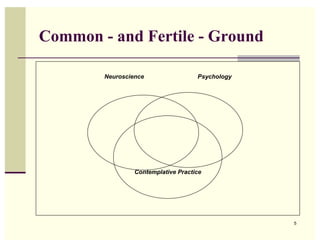
Common - and Fertile - Ground

        Neuroscience                 Psychology


                 Contemplative Practice


                                                  5
When the facts change,
I change my mind, sir.

  What do you do?


John Maynard Keynes

                         6
The Evolving Brain


                     7
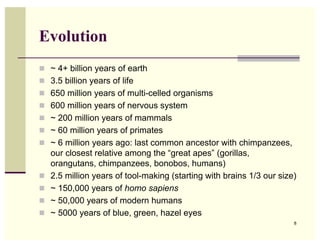
Evolution
 ~ 4+ billion years of earth
 3.5 billion years of life
 650 million years of multi-celled organisms
 600 million years of nervous system
 ~ 200 million years of mammals
 ~ 60 million years of primates
 ~ 6 million years ago: last common ancestor with chimpanzees,
    our closest relative among the “great apes” (gorillas,
    orangutans, chimpanzees, bonobos, humans)
   2.5 million years of tool-making (starting with brains 1/3 our size)
   ~ 150,000 years of homo sapiens
   ~ 50,000 years of modern humans
   ~ 5000 years of blue, green, hazel eyes
                                                                       8
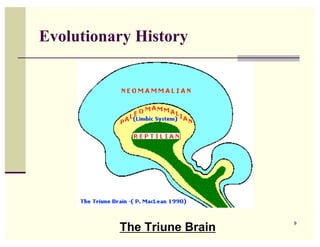
Evolutionary History


          The Triune Brain
                             9
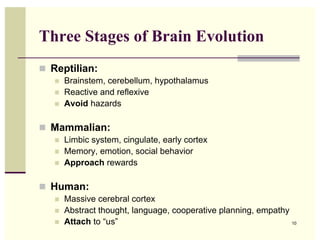
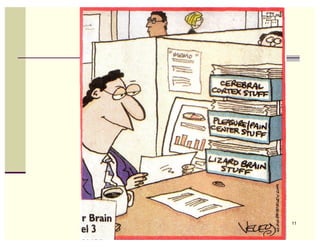
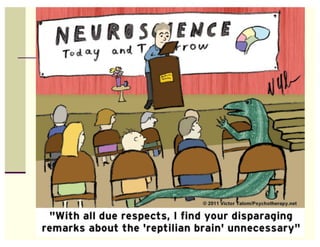
Three Stages of Brain Evolution
 Reptilian:
      Brainstem, cerebellum, hypothalamus
      Reactive and reflexive
      Avoid hazards

 Mammalian:
      Limbic system, cingulate, early cortex
      Memory, emotion, social behavior
      Approach rewards

 Human:
      Massive cerebral cortex
      Abstract thought, language, cooperative planning, empathy
      Attach to “us”                                            10
11
12
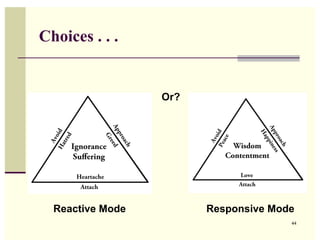
Home Base of the Human Brain
When not threatened, ill, in pain, hungry, upset, or
 chemically disturbed, most people settle into being:

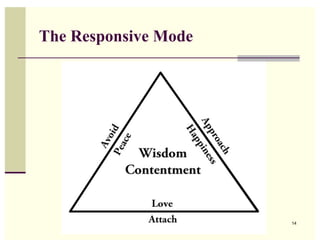
 Peaceful (the Avoid system)


 Happy (the Approach system)


 Loving (the Attach system)


   This is the brain in its natural, responsive mode.
                                                        13
The Responsive Mode


                      14
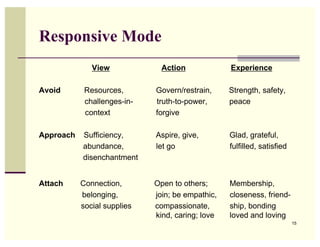
Responsive Mode
              View             Action             Experience

Avoid       Resources,       Govern/restrain,     Strength, safety,
            challenges-in-   truth-to-power,      peace
            context          forgive

Approach   Sufficiency,      Aspire, give,        Glad, grateful,
           abundance,        let go               fulfilled, satisfied
           disenchantment


Attach     Connection,       Open to others;      Membership,
           belonging,        join; be empathic,   closeness, friend-
           social supplies   compassionate,       ship, bonding
                             kind, caring; love   loved and loving
                                                                         15
Key Benefits of Responsive Mode
 Fueling for Reactive mobilizations; recovery after


 Positive emotions, cognitions, and behaviors


 Positive cycles


 Promotes virtue and benevolence


        The good life, as I conceive it, is a happy life.
    I do not mean that if you are good you will be happy;
        I mean that if you are happy you will be good.      16

                       Bertrand Russell
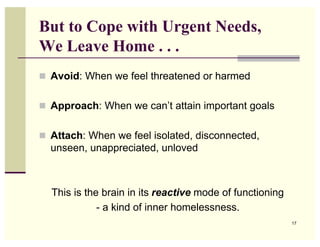
But to Cope with Urgent Needs,
We Leave Home . . .
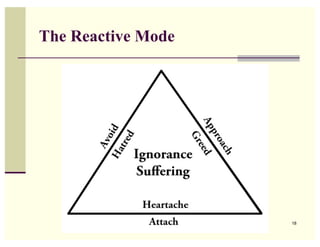
 Avoid: When we feel threatened or harmed


 Approach: When we can’t attain important goals


 Attach: When we feel isolated, disconnected,
  unseen, unappreciated, unloved


  This is the brain in its reactive mode of functioning
             - a kind of inner homelessness.
                                                          17
The Reactive Mode


                    18
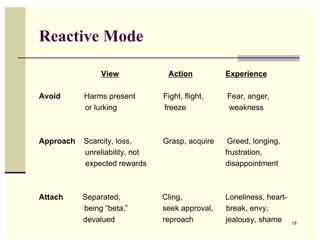
Reactive Mode

                View             Action          Experience

Avoid      Harms present        Fight, flight,   Fear, anger,
           or lurking           freeze           weakness


Approach   Scarcity, loss,      Grasp, acquire    Greed, longing,
           unreliability, not                    frustration,
           expected rewards                      disappointment


Attach     Separated,           Cling,           Loneliness, heart-
           being “beta,”        seek approval,   break, envy,
           devalued             reproach         jealousy, shame      19
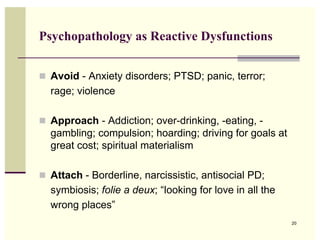
Psychopathology as Reactive Dysfunctions


 Avoid - Anxiety disorders; PTSD; panic, terror;
  rage; violence

 Approach - Addiction; over-drinking, -eating, -
  gambling; compulsion; hoarding; driving for goals at
  great cost; spiritual materialism

 Attach - Borderline, narcissistic, antisocial PD;
  symbiosis; folie a deux; “looking for love in all the
  wrong places”
                                                          20
The Negativity Bias


                      21
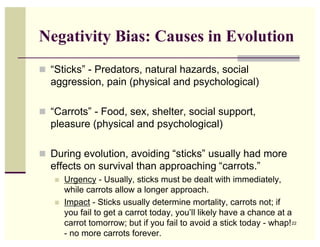
Negativity Bias: Causes in Evolution
 “Sticks” - Predators, natural hazards, social
  aggression, pain (physical and psychological)

 “Carrots” - Food, sex, shelter, social support,
  pleasure (physical and psychological)

 During evolution, avoiding “sticks” usually had more
  effects on survival than approaching “carrots.”
      Urgency - Usually, sticks must be dealt with immediately,
       while carrots allow a longer approach.
      Impact - Sticks usually determine mortality, carrots not; if
       you fail to get a carrot today, you’ll likely have a chance at a
       carrot tomorrow; but if you fail to avoid a stick today - whap! 22
       - no more carrots forever.
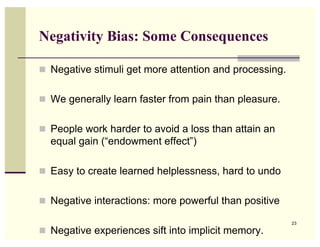
Negativity Bias: Some Consequences

 Negative stimuli get more attention and processing.


 We generally learn faster from pain than pleasure.


 People work harder to avoid a loss than attain an
  equal gain (“endowment effect”)

 Easy to create learned helplessness, hard to undo


 Negative interactions: more powerful than positive

                                                        23

 Negative experiences sift into implicit memory.
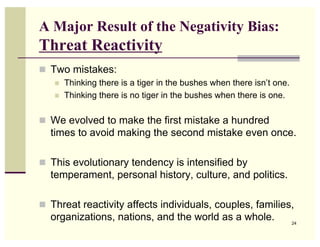
A Major Result of the Negativity Bias:
Threat Reactivity
 Two mistakes:
      Thinking there is a tiger in the bushes when there isn’t one.
      Thinking there is no tiger in the bushes when there is one.

 We evolved to make the first mistake a hundred
  times to avoid making the second mistake even once.

 This evolutionary tendency is intensified by
  temperament, personal history, culture, and politics.

 Threat reactivity affects individuals, couples, families,
  organizations, nations, and the world as a whole.                    24
Results of Threat Reactivity
(Personal, Organizational, National)

 Our initial appraisals are mistaken:
      Overestimating threats
      Underestimating opportunities
      Underestimating inner and outer resources

 We update these appraisals with information that
  confirms them; we ignore, devalue, or alter
  information that doesn’t.

 Thus we end up with views of ourselves, others, and
  the world that are ignorant, selective, and distorted.   25
Costs of Threat Reactivity
(Personal, Organizational, National)
 Feeling threatened feels bad, and triggers stress consequences.


 We over-invest in threat protection.


 The boy who cried tiger: flooding with paper tigers makes it
   harder to see the real ones.

 Acting while feeling threatened leads to over-reactions, makes
   others feel threatened, and creates vicious cycles.

 The Approach system is inhibited, so we don’t pursue
   opportunities, play small, or give up too soon.

 In the Attach system, we bond tighter to “us,” with more fear and
                                                                  26

   anger toward “them.”
A Poignant Truth

Mother Nature is tilted toward producing gene copies.

But tilted against personal quality of life.

And at the societal level, we have caveman/cavewoman
  brains armed with nuclear weapons.


What shall we do?

                                                        27
We can deliberately use the mind

to change the brain for the better.


                                      28
Mindfulness and Neuroplasticity


                                  29
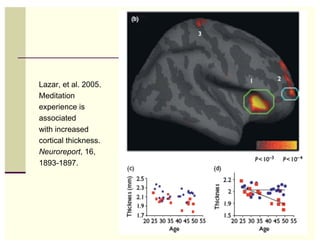
Lazar, et al. 2005.
Meditation
experience is
associated
with increased
cortical thickness.
Neuroreport, 16,
1893-1897.


                      30
Learning and Memory
 The sculpting of the brain by experience is memory:
      Explicit - Personal recollections; semantic memory
      Implicit - Bodily states; emotional tendencies; “views”
       (expectations, object relations, perspectives); behavioral
       repertoire and inclinations; what it feels like to be “me”


 Implicit memory is much larger than explicit memory.
  Resources are embedded mainly in implicit memory.

 Therefore, the key target is implicit memory. What
  matters most are not recollections of positive events
  but implicit residues of positive experiences.
                                                                    31
In essence, how can we actively internalize
   resources in implicit memory - making the brain
   like Velcro for positive experiences, but Teflon for
   negative ones?


                                                      32
The Power of Mindfulness

 Attention is like a spotlight, illuminating what it rests upon.


 Because neuroplasticity is heightened for what’s in the
  field of focused awareness, attention is also like a vacuum
  cleaner, sucking its contents into the brain.

 Directing attention skillfully is therefore a fundamental way
  to shape the brain - and one’s life over time.

                   The education of attention
              would be an education par excellence.
                         William James                          33
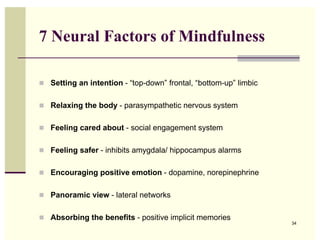
7 Neural Factors of Mindfulness

 Setting an intention - “top-down” frontal, “bottom-up” limbic


 Relaxing the body - parasympathetic nervous system


 Feeling cared about - social engagement system


 Feeling safer - inhibits amygdala/ hippocampus alarms


 Encouraging positive emotion - dopamine, norepinephrine


 Panoramic view - lateral networks


 Absorbing the benefits - positive implicit memories
                                                                  34
Being with, Releasing, Replacing

 There are three phases of psychological healing and
  personal growth (and spiritual practice):
      Be mindful of, release, replace.
      Let be, let go, let in.


 Mindfulness is key to the second and third phase,
  sometimes curative on its own, and always beneficial
  in strengthening its neural substrates. But often it is
  not enough by itself.

 And sometimes you need to skip to the third phase to
  build resources for mindfulness.                      35
Resourcing Youth


                   36
Just having positive experiences is not enough.

They pass through the brain like water through a
  sieve, while negative experiences are caught.

We need to engage positive experiences actively to
 weave them into the brain.


                                                     37
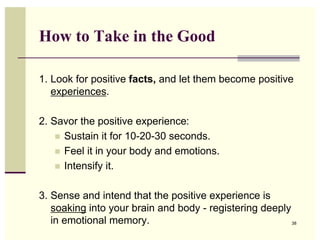
How to Take in the Good

1. Look for positive facts, and let them become positive
   experiences.

2. Savor the positive experience:
     Sustain it for 10-20-30 seconds.
     Feel it in your body and emotions.
     Intensify it.


3. Sense and intend that the positive experience is
   soaking into your brain and body - registering deeply
   in emotional memory.                                  38
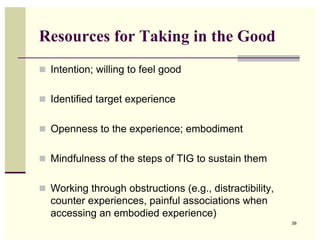
Resources for Taking in the Good
 Intention; willing to feel good


 Identified target experience


 Openness to the experience; embodiment


 Mindfulness of the steps of TIG to sustain them


 Working through obstructions (e.g., distractibility,
  counter experiences, painful associations when
  accessing an embodied experience)
                                                         39
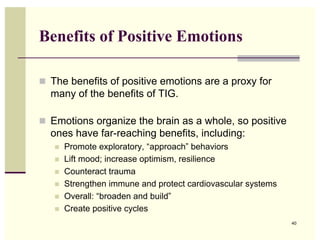
Benefits of Positive Emotions

 The benefits of positive emotions are a proxy for
  many of the benefits of TIG.

 Emotions organize the brain as a whole, so positive
  ones have far-reaching benefits, including:
      Promote exploratory, “approach” behaviors
      Lift mood; increase optimism, resilience
      Counteract trauma
      Strengthen immune and protect cardiovascular systems
      Overall: “broaden and build”
      Create positive cycles
                                                              40
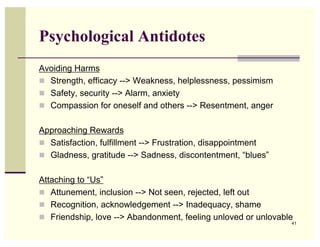
Psychological Antidotes
Avoiding Harms
 Strength, efficacy --> Weakness, helplessness, pessimism
 Safety, security --> Alarm, anxiety
 Compassion for oneself and others --> Resentment, anger


Approaching Rewards
 Satisfaction, fulfillment --> Frustration, disappointment
 Gladness, gratitude --> Sadness, discontentment, “blues”


Attaching to “Us”
 Attunement, inclusion --> Not seen, rejected, left out
 Recognition, acknowledgement --> Inadequacy, shame
 Friendship, love --> Abandonment, feeling unloved or unlovable
                                                               41
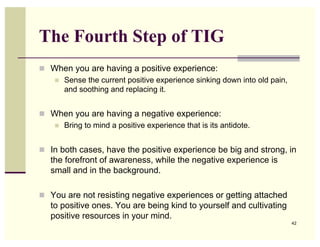
The Fourth Step of TIG
 When you are having a positive experience:
   Sense the current positive experience sinking down into old pain,
    and soothing and replacing it.


 When you are having a negative experience:
   Bring to mind a positive experience that is its antidote.


 In both cases, have the positive experience be big and strong, in
   the forefront of awareness, while the negative experience is
   small and in the background.

 You are not resisting negative experiences or getting attached
   to positive ones. You are being kind to yourself and cultivating
   positive resources in your mind.
                                                                        42
Coming Home


              43
Choices . . .


                  Or?


  Reactive Mode         Responsive Mode
                                      44
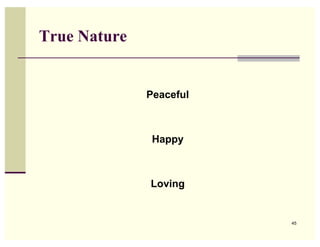
True Nature


              Peaceful


               Happy


              Loving


                         45
Ways to “Take the Fruit as the Path”

General factors: See clearly. Have compassion for yourself. Take life
   less personally. Take in the good. Deepen equanimity.

Avoid system
 Cool the fires.
 Recognize paper tigers.
 Tolerate risking the dreaded experience.
Approach system
 Be glad.
 Appreciate your resources.
 Give over to your best purposes.
Attach system
 Sense the suffering in others.
 Be kind.
                                                                        46
 Act with unilateral virtue.
Penetrative insight

joined with calm abiding

   utterly eradicates

    afflicted states.

       Shantideva          47
Great Books
See www.RickHanson.net for other great books.

   Austin, J. 2009. Selfless Insight. MIT Press.
   Begley. S. 2007. Train Your Mind, Change Your Brain. Ballantine.
   Carter, C. 2010. Raising Happiness. Ballantine.
   Hanson, R. (with R. Mendius). 2009. Buddha’s Brain: The Practical
    Neuroscience of Happiness, Love, and Wisdom. New Harbinger.
   Johnson, S. 2005. Mind Wide Open. Scribner.
   Keltner, D. 2009. Born to Be Good. Norton.
   Kornfield, J. 2009. The Wise Heart. Bantam.
   LeDoux, J. 2003. Synaptic Self. Penguin.
   Linden, D. 2008. The Accidental Mind. Belknap.
   Sapolsky, R. 2004. Why Zebras Don’t Get Ulcers. Holt.
   Siegel, D. 2007. The Mindful Brain. Norton.
   Thompson, E. 2007. Mind in Life. Belknap.

                                                                        48
Key Papers - 1
See www.RickHanson.net for other scientific papers.

   Atmanspacher, H. & Graben, P. 2007. Contextual emergence of mental states
    from neurodynamics. Chaos & Complexity Letters, 2:151-168.

   Baumeister, R., Bratlavsky, E., Finkenauer, C. & Vohs, K. 2001. Bad is stronger
    than good. Review of General Psychology, 5:323-370.

   Braver, T. & Cohen, J. 2000. On the control of control: The role of dopamine in
    regulating prefrontal function and working memory; in Control of Cognitive
    Processes: Attention and Performance XVIII. Monsel, S. & Driver, J. (eds.). MIT
    Press.

   Carter, O.L., Callistemon, C., Ungerer, Y., Liu, G.B., & Pettigrew, J.D. 2005.
    Meditation skills of Buddhist monks yield clues to brain's regulation of attention.
    Current Biology. 15:412-413.

                                                                                      49
Key Papers - 2
   Davidson, R.J. 2004. Well-being and affective style: neural substrates and
    biobehavioural correlates. Philosophical Transactions of the Royal Society.
    359:1395-1411.

   Farb, N.A.S., Segal, Z.V., Mayberg, H., Bean, J., McKeon, D., Fatima, Z., and
    Anderson, A.K. 2007. Attending to the present: Mindfulness meditation reveals
    distinct neural modes of self-reflection. SCAN, 2, 313-322.

   Gillihan, S.J. & Farah, M.J. 2005. Is self special? A critical review of evidence
    from experimental psychology and cognitive neuroscience. Psychological
    Bulletin, 131:76-97.

   Hagmann, P., Cammoun, L., Gigandet, X., Meuli, R., Honey, C.J., Wedeen, V.J.,
    & Sporns, O. 2008. Mapping the structural core of human cerebral cortex. PLoS
    Biology. 6:1479-1493.

   Hanson, R. 2008. Seven facts about the brain that incline the mind to joy. In
    Measuring the immeasurable: The scientific case for spirituality. Sounds True.      50
Key Papers - 3
   Lazar, S., Kerr, C., Wasserman, R., Gray, J., Greve, D., Treadway, M.,
    McGarvey, M., Quinn, B., Dusek, J., Benson, H., Rauch, S., Moore, C., & Fischl,
    B. 2005. Meditation experience is associated with increased cortical thickness.
    Neuroreport. 16:1893-1897.

   Lewis, M.D. & Todd, R.M. 2007. The self-regulating brain: Cortical-subcortical
    feedback and the development of intelligent action. Cognitive Development,
    22:406-430.

   Lieberman, M.D. & Eisenberger, N.I. 2009. Pains and pleasures of social life.
    Science. 323:890-891.

   Lutz, A., Greischar, L., Rawlings, N., Ricard, M. and Davidson, R. 2004. Long-
    term meditators self-induce high-amplitude gamma synchrony during mental
    practice. PNAS. 101:16369-16373.

   Lutz, A., Slager, H.A., Dunne, J.D., & Davidson, R. J. 2008. Attention regulation
    and monitoring in meditation. Trends in Cognitive Sciences. 12:163-169.          51
Key Papers - 4

   Rozin, P. & Royzman, E.B. 2001. Negativity bias, negativity dominance, and
    contagion. Personality and Social Psychology Review, 5:296-320.

   Takahashi, H., Kato, M., Matsuura, M., Mobbs, D., Suhara, T., & Okubo, Y.
    2009. When your gain is my pain and your pain is my gain: Neural correlates of
    envy and schadenfreude. Science, 323:937-939.

   Tang, Y.-Y., Ma, Y., Wang, J., Fan, Y., Feng, S., Lu, Q., Yu, Q., Sui, D.,
    Rothbart, M.K., Fan, M., & Posner, M. 2007. Short-term meditation training
    improves attention and self-regulation. PNAS, 104:17152-17156.

   Thompson, E. & Varela F.J. 2001. Radical embodiment: Neural dynamics and
    consciousness. Trends in Cognitive Sciences, 5:418-425.

   Walsh, R. & Shapiro, S. L. 2006. The meeting of meditative disciplines and
    Western psychology: A mutually enriching dialogue. American Psychologist,
    61:227-239.
                                                                                     52
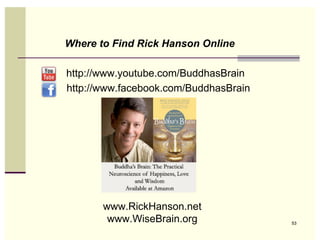
Where to Find Rick Hanson Online

http://www.youtube.com/BuddhasBrain
http://www.facebook.com/BuddhasBrain


               w


       www.RickHanson.net
        www.WiseBrain.org              53

Managing the Caveman Brain in the 21st Century

  • 1.
    Managing the Caveman/Cavewoman Brain in the 21st Century Bridging the Hearts and Minds of Youth Conference UCSD Center for Mindfulness, February 4, 2012 Rick Hanson, Ph.D. The Wellspring Institute for Neuroscience and Contemplative Wisdom WiseBrain.org RickHanson.net 1 drrh@comcast.net
  • 2.
    Topics  Perspectives  Theevolving brain  The negativity bias  Self-directed neuroplasticity  Coming home 2
  • 3.
  • 4.
    The history ofscience is rich in the example of the fruitfulness of bringing two sets of techniques, two sets of ideas, developed in separate contexts for the pursuit of new truth, into touch with one another. J. Robert Oppenheimer 4
  • 5.
    Common - andFertile - Ground Neuroscience Psychology Contemplative Practice 5
  • 6.
    When the factschange, I change my mind, sir. What do you do? John Maynard Keynes 6
  • 7.
  • 8.
    Evolution  ~ 4+billion years of earth  3.5 billion years of life  650 million years of multi-celled organisms  600 million years of nervous system  ~ 200 million years of mammals  ~ 60 million years of primates  ~ 6 million years ago: last common ancestor with chimpanzees, our closest relative among the “great apes” (gorillas, orangutans, chimpanzees, bonobos, humans)  2.5 million years of tool-making (starting with brains 1/3 our size)  ~ 150,000 years of homo sapiens  ~ 50,000 years of modern humans  ~ 5000 years of blue, green, hazel eyes 8
  • 9.
    Evolutionary History The Triune Brain 9
  • 10.
    Three Stages ofBrain Evolution  Reptilian:  Brainstem, cerebellum, hypothalamus  Reactive and reflexive  Avoid hazards  Mammalian:  Limbic system, cingulate, early cortex  Memory, emotion, social behavior  Approach rewards  Human:  Massive cerebral cortex  Abstract thought, language, cooperative planning, empathy  Attach to “us” 10
  • 11.
  • 12.
  • 13.
    Home Base ofthe Human Brain When not threatened, ill, in pain, hungry, upset, or chemically disturbed, most people settle into being:  Peaceful (the Avoid system)  Happy (the Approach system)  Loving (the Attach system) This is the brain in its natural, responsive mode. 13
  • 14.
  • 15.
    Responsive Mode View Action Experience Avoid Resources, Govern/restrain, Strength, safety, challenges-in- truth-to-power, peace context forgive Approach Sufficiency, Aspire, give, Glad, grateful, abundance, let go fulfilled, satisfied disenchantment Attach Connection, Open to others; Membership, belonging, join; be empathic, closeness, friend- social supplies compassionate, ship, bonding kind, caring; love loved and loving 15
  • 16.
    Key Benefits ofResponsive Mode  Fueling for Reactive mobilizations; recovery after  Positive emotions, cognitions, and behaviors  Positive cycles  Promotes virtue and benevolence The good life, as I conceive it, is a happy life. I do not mean that if you are good you will be happy; I mean that if you are happy you will be good. 16 Bertrand Russell
  • 17.
    But to Copewith Urgent Needs, We Leave Home . . .  Avoid: When we feel threatened or harmed  Approach: When we can’t attain important goals  Attach: When we feel isolated, disconnected, unseen, unappreciated, unloved This is the brain in its reactive mode of functioning - a kind of inner homelessness. 17
  • 18.
  • 19.
    Reactive Mode View Action Experience Avoid Harms present Fight, flight, Fear, anger, or lurking freeze weakness Approach Scarcity, loss, Grasp, acquire Greed, longing, unreliability, not frustration, expected rewards disappointment Attach Separated, Cling, Loneliness, heart- being “beta,” seek approval, break, envy, devalued reproach jealousy, shame 19
  • 20.
    Psychopathology as ReactiveDysfunctions  Avoid - Anxiety disorders; PTSD; panic, terror; rage; violence  Approach - Addiction; over-drinking, -eating, - gambling; compulsion; hoarding; driving for goals at great cost; spiritual materialism  Attach - Borderline, narcissistic, antisocial PD; symbiosis; folie a deux; “looking for love in all the wrong places” 20
  • 21.
  • 22.
    Negativity Bias: Causesin Evolution  “Sticks” - Predators, natural hazards, social aggression, pain (physical and psychological)  “Carrots” - Food, sex, shelter, social support, pleasure (physical and psychological)  During evolution, avoiding “sticks” usually had more effects on survival than approaching “carrots.”  Urgency - Usually, sticks must be dealt with immediately, while carrots allow a longer approach.  Impact - Sticks usually determine mortality, carrots not; if you fail to get a carrot today, you’ll likely have a chance at a carrot tomorrow; but if you fail to avoid a stick today - whap! 22 - no more carrots forever.
  • 23.
    Negativity Bias: SomeConsequences  Negative stimuli get more attention and processing.  We generally learn faster from pain than pleasure.  People work harder to avoid a loss than attain an equal gain (“endowment effect”)  Easy to create learned helplessness, hard to undo  Negative interactions: more powerful than positive 23  Negative experiences sift into implicit memory.
  • 24.
    A Major Resultof the Negativity Bias: Threat Reactivity  Two mistakes:  Thinking there is a tiger in the bushes when there isn’t one.  Thinking there is no tiger in the bushes when there is one.  We evolved to make the first mistake a hundred times to avoid making the second mistake even once.  This evolutionary tendency is intensified by temperament, personal history, culture, and politics.  Threat reactivity affects individuals, couples, families, organizations, nations, and the world as a whole. 24
  • 25.
    Results of ThreatReactivity (Personal, Organizational, National)  Our initial appraisals are mistaken:  Overestimating threats  Underestimating opportunities  Underestimating inner and outer resources  We update these appraisals with information that confirms them; we ignore, devalue, or alter information that doesn’t.  Thus we end up with views of ourselves, others, and the world that are ignorant, selective, and distorted. 25
  • 26.
    Costs of ThreatReactivity (Personal, Organizational, National)  Feeling threatened feels bad, and triggers stress consequences.  We over-invest in threat protection.  The boy who cried tiger: flooding with paper tigers makes it harder to see the real ones.  Acting while feeling threatened leads to over-reactions, makes others feel threatened, and creates vicious cycles.  The Approach system is inhibited, so we don’t pursue opportunities, play small, or give up too soon.  In the Attach system, we bond tighter to “us,” with more fear and 26 anger toward “them.”
  • 27.
    A Poignant Truth MotherNature is tilted toward producing gene copies. But tilted against personal quality of life. And at the societal level, we have caveman/cavewoman brains armed with nuclear weapons. What shall we do? 27
  • 28.
    We can deliberatelyuse the mind to change the brain for the better. 28
  • 29.
  • 30.
    Lazar, et al.2005. Meditation experience is associated with increased cortical thickness. Neuroreport, 16, 1893-1897. 30
  • 31.
    Learning and Memory The sculpting of the brain by experience is memory:  Explicit - Personal recollections; semantic memory  Implicit - Bodily states; emotional tendencies; “views” (expectations, object relations, perspectives); behavioral repertoire and inclinations; what it feels like to be “me”  Implicit memory is much larger than explicit memory. Resources are embedded mainly in implicit memory.  Therefore, the key target is implicit memory. What matters most are not recollections of positive events but implicit residues of positive experiences. 31
  • 32.
    In essence, howcan we actively internalize resources in implicit memory - making the brain like Velcro for positive experiences, but Teflon for negative ones? 32
  • 33.
    The Power ofMindfulness  Attention is like a spotlight, illuminating what it rests upon.  Because neuroplasticity is heightened for what’s in the field of focused awareness, attention is also like a vacuum cleaner, sucking its contents into the brain.  Directing attention skillfully is therefore a fundamental way to shape the brain - and one’s life over time. The education of attention would be an education par excellence. William James 33
  • 34.
    7 Neural Factorsof Mindfulness  Setting an intention - “top-down” frontal, “bottom-up” limbic  Relaxing the body - parasympathetic nervous system  Feeling cared about - social engagement system  Feeling safer - inhibits amygdala/ hippocampus alarms  Encouraging positive emotion - dopamine, norepinephrine  Panoramic view - lateral networks  Absorbing the benefits - positive implicit memories 34
  • 35.
    Being with, Releasing,Replacing  There are three phases of psychological healing and personal growth (and spiritual practice):  Be mindful of, release, replace.  Let be, let go, let in.  Mindfulness is key to the second and third phase, sometimes curative on its own, and always beneficial in strengthening its neural substrates. But often it is not enough by itself.  And sometimes you need to skip to the third phase to build resources for mindfulness. 35
  • 36.
  • 37.
    Just having positiveexperiences is not enough. They pass through the brain like water through a sieve, while negative experiences are caught. We need to engage positive experiences actively to weave them into the brain. 37
  • 38.
    How to Takein the Good 1. Look for positive facts, and let them become positive experiences. 2. Savor the positive experience:  Sustain it for 10-20-30 seconds.  Feel it in your body and emotions.  Intensify it. 3. Sense and intend that the positive experience is soaking into your brain and body - registering deeply in emotional memory. 38
  • 39.
    Resources for Takingin the Good  Intention; willing to feel good  Identified target experience  Openness to the experience; embodiment  Mindfulness of the steps of TIG to sustain them  Working through obstructions (e.g., distractibility, counter experiences, painful associations when accessing an embodied experience) 39
  • 40.
    Benefits of PositiveEmotions  The benefits of positive emotions are a proxy for many of the benefits of TIG.  Emotions organize the brain as a whole, so positive ones have far-reaching benefits, including:  Promote exploratory, “approach” behaviors  Lift mood; increase optimism, resilience  Counteract trauma  Strengthen immune and protect cardiovascular systems  Overall: “broaden and build”  Create positive cycles 40
  • 41.
    Psychological Antidotes Avoiding Harms Strength, efficacy --> Weakness, helplessness, pessimism  Safety, security --> Alarm, anxiety  Compassion for oneself and others --> Resentment, anger Approaching Rewards  Satisfaction, fulfillment --> Frustration, disappointment  Gladness, gratitude --> Sadness, discontentment, “blues” Attaching to “Us”  Attunement, inclusion --> Not seen, rejected, left out  Recognition, acknowledgement --> Inadequacy, shame  Friendship, love --> Abandonment, feeling unloved or unlovable 41
  • 42.
    The Fourth Stepof TIG  When you are having a positive experience:  Sense the current positive experience sinking down into old pain, and soothing and replacing it.  When you are having a negative experience:  Bring to mind a positive experience that is its antidote.  In both cases, have the positive experience be big and strong, in the forefront of awareness, while the negative experience is small and in the background.  You are not resisting negative experiences or getting attached to positive ones. You are being kind to yourself and cultivating positive resources in your mind. 42
  • 43.
  • 44.
    Choices . .. Or? Reactive Mode Responsive Mode 44
  • 45.
    True Nature Peaceful Happy Loving 45
  • 46.
    Ways to “Takethe Fruit as the Path” General factors: See clearly. Have compassion for yourself. Take life less personally. Take in the good. Deepen equanimity. Avoid system  Cool the fires.  Recognize paper tigers.  Tolerate risking the dreaded experience. Approach system  Be glad.  Appreciate your resources.  Give over to your best purposes. Attach system  Sense the suffering in others.  Be kind. 46  Act with unilateral virtue.
  • 47.
    Penetrative insight joined withcalm abiding utterly eradicates afflicted states. Shantideva 47
  • 48.
    Great Books See www.RickHanson.netfor other great books.  Austin, J. 2009. Selfless Insight. MIT Press.  Begley. S. 2007. Train Your Mind, Change Your Brain. Ballantine.  Carter, C. 2010. Raising Happiness. Ballantine.  Hanson, R. (with R. Mendius). 2009. Buddha’s Brain: The Practical Neuroscience of Happiness, Love, and Wisdom. New Harbinger.  Johnson, S. 2005. Mind Wide Open. Scribner.  Keltner, D. 2009. Born to Be Good. Norton.  Kornfield, J. 2009. The Wise Heart. Bantam.  LeDoux, J. 2003. Synaptic Self. Penguin.  Linden, D. 2008. The Accidental Mind. Belknap.  Sapolsky, R. 2004. Why Zebras Don’t Get Ulcers. Holt.  Siegel, D. 2007. The Mindful Brain. Norton.  Thompson, E. 2007. Mind in Life. Belknap. 48
  • 49.
    Key Papers -1 See www.RickHanson.net for other scientific papers.  Atmanspacher, H. & Graben, P. 2007. Contextual emergence of mental states from neurodynamics. Chaos & Complexity Letters, 2:151-168.  Baumeister, R., Bratlavsky, E., Finkenauer, C. & Vohs, K. 2001. Bad is stronger than good. Review of General Psychology, 5:323-370.  Braver, T. & Cohen, J. 2000. On the control of control: The role of dopamine in regulating prefrontal function and working memory; in Control of Cognitive Processes: Attention and Performance XVIII. Monsel, S. & Driver, J. (eds.). MIT Press.  Carter, O.L., Callistemon, C., Ungerer, Y., Liu, G.B., & Pettigrew, J.D. 2005. Meditation skills of Buddhist monks yield clues to brain's regulation of attention. Current Biology. 15:412-413. 49
  • 50.
    Key Papers -2  Davidson, R.J. 2004. Well-being and affective style: neural substrates and biobehavioural correlates. Philosophical Transactions of the Royal Society. 359:1395-1411.  Farb, N.A.S., Segal, Z.V., Mayberg, H., Bean, J., McKeon, D., Fatima, Z., and Anderson, A.K. 2007. Attending to the present: Mindfulness meditation reveals distinct neural modes of self-reflection. SCAN, 2, 313-322.  Gillihan, S.J. & Farah, M.J. 2005. Is self special? A critical review of evidence from experimental psychology and cognitive neuroscience. Psychological Bulletin, 131:76-97.  Hagmann, P., Cammoun, L., Gigandet, X., Meuli, R., Honey, C.J., Wedeen, V.J., & Sporns, O. 2008. Mapping the structural core of human cerebral cortex. PLoS Biology. 6:1479-1493.  Hanson, R. 2008. Seven facts about the brain that incline the mind to joy. In Measuring the immeasurable: The scientific case for spirituality. Sounds True. 50
  • 51.
    Key Papers -3  Lazar, S., Kerr, C., Wasserman, R., Gray, J., Greve, D., Treadway, M., McGarvey, M., Quinn, B., Dusek, J., Benson, H., Rauch, S., Moore, C., & Fischl, B. 2005. Meditation experience is associated with increased cortical thickness. Neuroreport. 16:1893-1897.  Lewis, M.D. & Todd, R.M. 2007. The self-regulating brain: Cortical-subcortical feedback and the development of intelligent action. Cognitive Development, 22:406-430.  Lieberman, M.D. & Eisenberger, N.I. 2009. Pains and pleasures of social life. Science. 323:890-891.  Lutz, A., Greischar, L., Rawlings, N., Ricard, M. and Davidson, R. 2004. Long- term meditators self-induce high-amplitude gamma synchrony during mental practice. PNAS. 101:16369-16373.  Lutz, A., Slager, H.A., Dunne, J.D., & Davidson, R. J. 2008. Attention regulation and monitoring in meditation. Trends in Cognitive Sciences. 12:163-169. 51
  • 52.
    Key Papers -4  Rozin, P. & Royzman, E.B. 2001. Negativity bias, negativity dominance, and contagion. Personality and Social Psychology Review, 5:296-320.  Takahashi, H., Kato, M., Matsuura, M., Mobbs, D., Suhara, T., & Okubo, Y. 2009. When your gain is my pain and your pain is my gain: Neural correlates of envy and schadenfreude. Science, 323:937-939.  Tang, Y.-Y., Ma, Y., Wang, J., Fan, Y., Feng, S., Lu, Q., Yu, Q., Sui, D., Rothbart, M.K., Fan, M., & Posner, M. 2007. Short-term meditation training improves attention and self-regulation. PNAS, 104:17152-17156.  Thompson, E. & Varela F.J. 2001. Radical embodiment: Neural dynamics and consciousness. Trends in Cognitive Sciences, 5:418-425.  Walsh, R. & Shapiro, S. L. 2006. The meeting of meditative disciplines and Western psychology: A mutually enriching dialogue. American Psychologist, 61:227-239. 52
  • 53.
    Where to FindRick Hanson Online http://www.youtube.com/BuddhasBrain http://www.facebook.com/BuddhasBrain w www.RickHanson.net www.WiseBrain.org 53