Bible as Mirror and Window Bible : the Word of God
Bible I.Q How many books are in the Old Testament? What is the first book of the Old Testament? Which book in the O.T is the shortest? What is the last book of the Bible? Which book in the New Testament is the longest?  What about the shortest in the New Testament? Which book comes after Psalm? Which book in the Old Testament is also called Canticles of canticles? What is the other name of Ecclesiastes? Which book in the New Testament was also authored by Luke aside from the Gospel according to Luke?
Bible
What is the Bible?
Bible Scripture “ writings&quot; (<Latin  scriptus  = &quot;written&quot;; cf. Greek  grafe , Hebrew  mikra ),  religious writings   authoritative,  foundational,  sacred  by some religious group
Bible  Greek ta biblia (&quot; ta biblia &quot;), “the books“ refers to the whole sacred volume a compilation of many different books of various literary genres. Latin “biblia” , “The Book” eminence of the Bible
THE BIBLE The Bible is a collection of sacred writings which the Church solemnly recognized as the: Word of God written by men through the inspiration of the Holy Spirit.
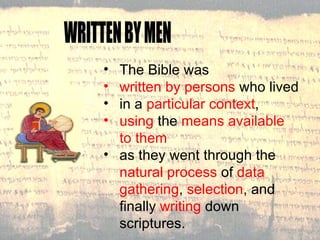
WRITTEN BY MEN The Bible was  written by persons  who lived  in a  particular context ,  using  the  means available to them  as they went through the  natural process  of  data gathering ,  selection , and finally  writing  down scriptures.
&quot;All scripture, inspired of God, is profitable to teach, to reprove, to correct to instruct in justice&quot;   2 Timothy 3:16
INSPIRATION Lt.  “in spirare ”  – to breathe into “ By supernatural power  God so moved and impelled the human authors to write .  Providentissimus Deus, Pope Leo XIII INSPIRATION  IS THE  SPECIAL INFLUENCE OF THE HOLY SPIRIT ON THE HUMAN AUTHORS . THROUGH THE INSPIRATION OF THE HOLY SPIRIT
INERRANCY Inerrancy means  freedom from error .  is a consequence of its  inspiration .   Because  God is the  principal  author of the Bible , then  it cannot but contain the truth .
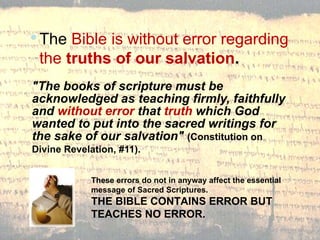
&quot;The books of scripture must be acknowledged as teaching firmly, faithfully and  without error  that  truth  which God wanted to put into the sacred writings for the sake of our salvation&quot;  (Constitution on Divine Revelation, #11).   The  Bible is without error regarding the  truths of our salvation . These errors do not in anyway affect the essential message of Sacred Scriptures. THE BIBLE CONTAINS ERROR BUT TEACHES NO ERROR.
CANONICITY Gk.  “kanon ”  ( kanon )–  a stick; measuring rod   -the word implies “norms” or “standards” CANONICITY IS THE CHURCH’S OFFICIAL DECLARATION THAT A BOOK IS INSPIRED, AND IS THEREFORE A WORTHY BASIS OF FAITH AND MORALS. A BOOK HAS TO  PASS CERTAIN STANDARDS .  IT BECOMES A STANDARD ITSELF. N.B. Canonicity is a  formal recognition of  the inspiration which the book has always possessed .
CRITERIA FOR CANONICITY  FOR THE OLD TESTAMENT: Adherence to the TORAH (five books of Moses).  Constant use in liturgy. Language  Recognized Sacred Scriptures are  stored in the temple chests , available for public reading.
FOR THE NEW TESTAMENT: Apostolic origin Coherence with the essential Gospel Message Constant use in the liturgy Universal Acceptance   CRITERIA FOR CANONICITY
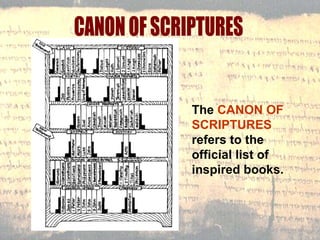
CANON OF SCRIPTURES The  CANON OF SCRIPTURES  refers to the official list of inspired books.
Hebrew Bible A collection of 24 &quot;books&quot; (or large &quot;scrolls&quot;), traditionally called the  Mikra  in Hebrew (or  Miqra , lit. &quot;writings“ &quot;TaNaK&quot; or &quot;Tanakh&quot;  Torah   &quot;Law,&quot;  &quot;Teaching&quot; or &quot;Instruction&quot;  Nevi'im  &quot;Prophets“ Former Prophets &quot; (Joshua, Judges, Samuel, Kings) &quot; Latter Prophets &quot; (Isaiah, Jeremiah, Ezekiel, and &quot;The Twelve&quot; Minor Prophets) Khetuvim Writings&quot;
Septuagint (LXX) Greek translation of the Hebrew Bible A collection of up to 53 books of ancient Jewish Scriptures written in Greek. translations of all 24 books of the HB seven or more additional books (the &quot; Deuterocanonical Books &quot;) that are not found in the HB.
Tobit Judith Wisdom of Solomon Ecclesiasticus (Ben Sirach) Baruch 1 Maccabees 2 Maccabees THE DEUTEROCANONICALS seven (or more) books that are in the LXX but not in the HB are  considered part of the biblical canon by Orthodox and Catholic Christians (although recognized as later additions, and thus called &quot; Deuterocanonical ,&quot; meaning a &quot; second canon &quot;) are  not  considered canonical by Jews and most Protestant Christians today (who call them &quot; Apocryphal &quot;)
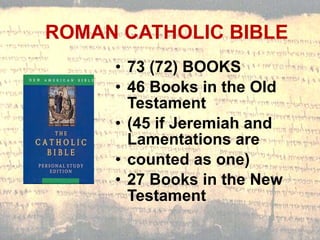
ROMAN CATHOLIC BIBLE 73 (72) BOOKS 46 Books in the Old Testament (45 if Jeremiah and Lamentations are  counted as one) 27 Books in the New Testament
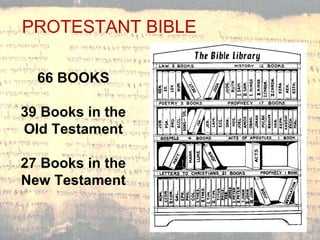
PROTESTANT BIBLE 66 BOOKS 39 Books in the Old Testament 27 Books in the New Testament
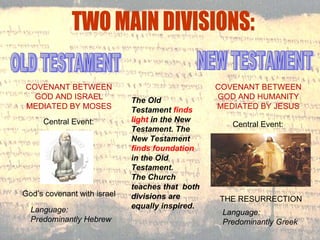
TWO MAIN DIVISIONS: OLD TESTAMENT NEW TESTAMENT COVENANT BETWEEN GOD AND ISRAEL MEDIATED BY MOSES COVENANT BETWEEN GOD AND HUMANITY MEDIATED BY JESUS The Old Testament  finds light  in the New Testament. The New Testament  finds foundation  in the Old Testament. The Church teaches that  both divisions are equally inspired .  Central Event: Central Event: God’s covenant with israel THE RESURRECTION Language:  Predominantly Hebrew Language: Predominantly Greek
Old Testament division Pentateuch/Torah/Law Historical Books Writings/Wisdom books Prophets
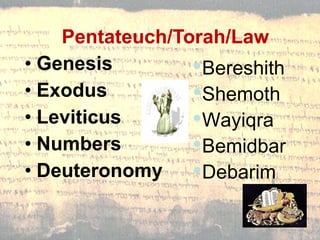
Pentateuch/Torah/Law Genesis Exodus Leviticus Numbers Deuteronomy  Bereshith Shemoth  Wayiqra  Bemidbar  Debarim
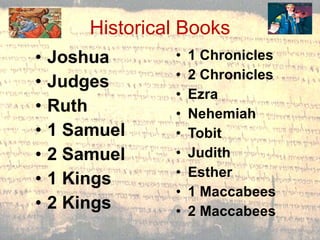
Historical Books Joshua Judges Ruth 1 Samuel 2 Samuel 1 Kings 2 Kings 1 Chronicles 2 Chronicles Ezra Nehemiah Tobit Judith Esther 1 Maccabees 2 Maccabees
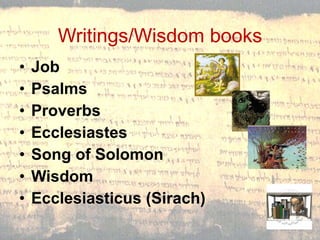
Writings/Wisdom books Job Psalms Proverbs Ecclesiastes Song of Solomon Wisdom Ecclesiasticus (Sirach)
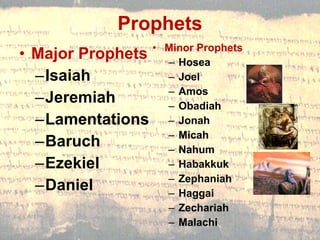
Prophets Major Prophets Isaiah Jeremiah Lamentations Baruch Ezekiel Daniel Minor Prophets Hosea Joel  Amos Obadiah Jonah Micah Nahum Habakkuk Zephaniah Haggai Zechariah Malachi
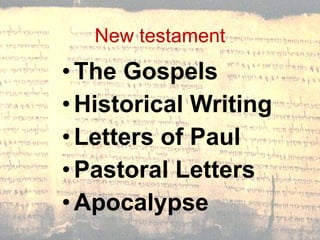
New testament The Gospels Historical Writing Letters of Paul  Pastoral Letters Apocalypse
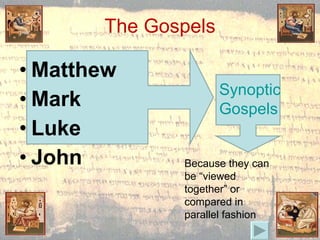
The Gospels Matthew  Mark Luke John Synoptic  Gospels Because they can be “viewed together” or compared in parallel fashion
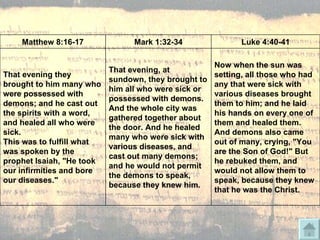
Matthew 8:16-17 Mark 1:32-34 Luke 4:40-41 That evening they brought to him many who were possessed with demons; and he cast out the spirits with a word, and healed all who were sick.  This was to fulfill what was spoken by the prophet Isaiah, &quot;He took our infirmities and bore our diseases.&quot; That evening, at sundown, they brought to him all who were sick or possessed with demons. And the whole city was gathered together about the door. And he healed many who were sick with various diseases, and cast out many demons; and he would not permit the demons to speak, because they knew him. Now when the sun was setting, all those who had any that were sick with various diseases brought them to him; and he laid his hands on every one of them and healed them. And demons also came out of many, crying, &quot;You are the Son of God!&quot; But he rebuked them, and would not allow them to speak, because they knew that he was the Christ.
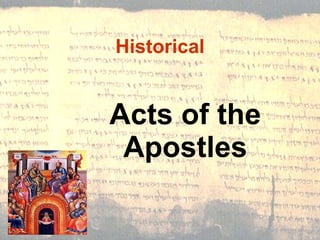
Acts of the Apostles Historical
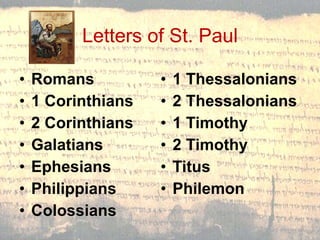
Letters of St. Paul Romans 1 Corinthians 2 Corinthians Galatians Ephesians Philippians Colossians 1 Thessalonians 2 Thessalonians 1 Timothy 2 Timothy Titus Philemon
Pastoral Letters Hebrews James  1 Peter 2 Peter 1 John 2 John 3 John Jude
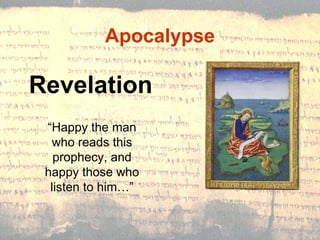
Revelation Apocalypse   “ Happy the man who reads this prophecy, and happy those who listen to him…”
Why Read the Bible? We read the Bible because it tells us about….
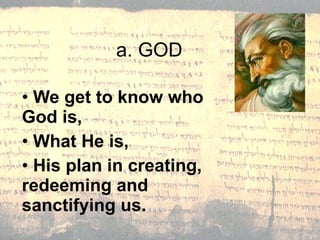
a. GOD We get to know who God is, What He is, His plan in creating, redeeming and sanctifying us.
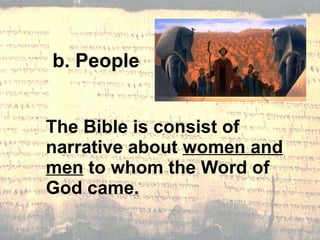
b. People The Bible is consist of narrative about  women and men  to whom the Word of God came.
c. Salvation History The purpose of the Bible is to give  spiritual and religious significance of the events  and to glorify God. The Bible leads us in  reflecting on the role that God is playing in our lives . The Bible is the story of God’s plan of salvation
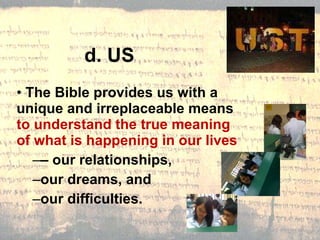
d. US The Bible provides us with a unique and irreplaceable means  to understand the true meaning of what is happening in our lives  –  our relationships,  our dreams, and  our difficulties.
As WORD OF GOD The Scripture fulfills a… FOUNDATIONAL, SUSTAINING, and CRITICAL ROLE  for the Church , for theology, for preaching and for catechesis. The Scripture is a source of the life of faith, hope and love of the People of God and a light for all humanity.

6.bible

  • 1.
    Bible as Mirrorand Window Bible : the Word of God
  • 2.
    Bible I.Q Howmany books are in the Old Testament? What is the first book of the Old Testament? Which book in the O.T is the shortest? What is the last book of the Bible? Which book in the New Testament is the longest? What about the shortest in the New Testament? Which book comes after Psalm? Which book in the Old Testament is also called Canticles of canticles? What is the other name of Ecclesiastes? Which book in the New Testament was also authored by Luke aside from the Gospel according to Luke?
  • 3.
  • 4.
  • 5.
    Bible Scripture “writings&quot; (<Latin scriptus = &quot;written&quot;; cf. Greek grafe , Hebrew mikra ), religious writings authoritative, foundational, sacred by some religious group
  • 6.
    Bible Greekta biblia (&quot; ta biblia &quot;), “the books“ refers to the whole sacred volume a compilation of many different books of various literary genres. Latin “biblia” , “The Book” eminence of the Bible
  • 7.
    THE BIBLE TheBible is a collection of sacred writings which the Church solemnly recognized as the: Word of God written by men through the inspiration of the Holy Spirit.
  • 8.
    WRITTEN BY MENThe Bible was written by persons who lived in a particular context , using the means available to them as they went through the natural process of data gathering , selection , and finally writing down scriptures.
  • 9.
    &quot;All scripture, inspiredof God, is profitable to teach, to reprove, to correct to instruct in justice&quot; 2 Timothy 3:16
  • 10.
    INSPIRATION Lt. “in spirare ” – to breathe into “ By supernatural power God so moved and impelled the human authors to write . Providentissimus Deus, Pope Leo XIII INSPIRATION IS THE SPECIAL INFLUENCE OF THE HOLY SPIRIT ON THE HUMAN AUTHORS . THROUGH THE INSPIRATION OF THE HOLY SPIRIT
  • 11.
    INERRANCY Inerrancy means freedom from error . is a consequence of its inspiration . Because God is the principal author of the Bible , then it cannot but contain the truth .
  • 12.
    &quot;The books ofscripture must be acknowledged as teaching firmly, faithfully and without error that truth which God wanted to put into the sacred writings for the sake of our salvation&quot; (Constitution on Divine Revelation, #11). The Bible is without error regarding the truths of our salvation . These errors do not in anyway affect the essential message of Sacred Scriptures. THE BIBLE CONTAINS ERROR BUT TEACHES NO ERROR.
  • 13.
    CANONICITY Gk. “kanon ” ( kanon )– a stick; measuring rod -the word implies “norms” or “standards” CANONICITY IS THE CHURCH’S OFFICIAL DECLARATION THAT A BOOK IS INSPIRED, AND IS THEREFORE A WORTHY BASIS OF FAITH AND MORALS. A BOOK HAS TO PASS CERTAIN STANDARDS . IT BECOMES A STANDARD ITSELF. N.B. Canonicity is a formal recognition of the inspiration which the book has always possessed .
  • 14.
    CRITERIA FOR CANONICITY FOR THE OLD TESTAMENT: Adherence to the TORAH (five books of Moses). Constant use in liturgy. Language Recognized Sacred Scriptures are stored in the temple chests , available for public reading.
  • 15.
    FOR THE NEWTESTAMENT: Apostolic origin Coherence with the essential Gospel Message Constant use in the liturgy Universal Acceptance CRITERIA FOR CANONICITY
  • 16.
    CANON OF SCRIPTURESThe CANON OF SCRIPTURES refers to the official list of inspired books.
  • 17.
    Hebrew Bible Acollection of 24 &quot;books&quot; (or large &quot;scrolls&quot;), traditionally called the Mikra in Hebrew (or Miqra , lit. &quot;writings“ &quot;TaNaK&quot; or &quot;Tanakh&quot; Torah &quot;Law,&quot; &quot;Teaching&quot; or &quot;Instruction&quot; Nevi'im &quot;Prophets“ Former Prophets &quot; (Joshua, Judges, Samuel, Kings) &quot; Latter Prophets &quot; (Isaiah, Jeremiah, Ezekiel, and &quot;The Twelve&quot; Minor Prophets) Khetuvim Writings&quot;
  • 18.
    Septuagint (LXX) Greektranslation of the Hebrew Bible A collection of up to 53 books of ancient Jewish Scriptures written in Greek. translations of all 24 books of the HB seven or more additional books (the &quot; Deuterocanonical Books &quot;) that are not found in the HB.
  • 19.
    Tobit Judith Wisdomof Solomon Ecclesiasticus (Ben Sirach) Baruch 1 Maccabees 2 Maccabees THE DEUTEROCANONICALS seven (or more) books that are in the LXX but not in the HB are considered part of the biblical canon by Orthodox and Catholic Christians (although recognized as later additions, and thus called &quot; Deuterocanonical ,&quot; meaning a &quot; second canon &quot;) are not considered canonical by Jews and most Protestant Christians today (who call them &quot; Apocryphal &quot;)
  • 20.
    ROMAN CATHOLIC BIBLE73 (72) BOOKS 46 Books in the Old Testament (45 if Jeremiah and Lamentations are counted as one) 27 Books in the New Testament
  • 21.
    PROTESTANT BIBLE 66BOOKS 39 Books in the Old Testament 27 Books in the New Testament
  • 22.
    TWO MAIN DIVISIONS:OLD TESTAMENT NEW TESTAMENT COVENANT BETWEEN GOD AND ISRAEL MEDIATED BY MOSES COVENANT BETWEEN GOD AND HUMANITY MEDIATED BY JESUS The Old Testament finds light in the New Testament. The New Testament finds foundation in the Old Testament. The Church teaches that both divisions are equally inspired . Central Event: Central Event: God’s covenant with israel THE RESURRECTION Language: Predominantly Hebrew Language: Predominantly Greek
  • 23.
    Old Testament divisionPentateuch/Torah/Law Historical Books Writings/Wisdom books Prophets
  • 24.
    Pentateuch/Torah/Law Genesis ExodusLeviticus Numbers Deuteronomy Bereshith Shemoth Wayiqra Bemidbar Debarim
  • 25.
    Historical Books JoshuaJudges Ruth 1 Samuel 2 Samuel 1 Kings 2 Kings 1 Chronicles 2 Chronicles Ezra Nehemiah Tobit Judith Esther 1 Maccabees 2 Maccabees
  • 26.
    Writings/Wisdom books JobPsalms Proverbs Ecclesiastes Song of Solomon Wisdom Ecclesiasticus (Sirach)
  • 27.
    Prophets Major ProphetsIsaiah Jeremiah Lamentations Baruch Ezekiel Daniel Minor Prophets Hosea Joel Amos Obadiah Jonah Micah Nahum Habakkuk Zephaniah Haggai Zechariah Malachi
  • 28.
    New testament TheGospels Historical Writing Letters of Paul Pastoral Letters Apocalypse
  • 29.
    The Gospels Matthew Mark Luke John Synoptic Gospels Because they can be “viewed together” or compared in parallel fashion
  • 30.
    Matthew 8:16-17 Mark1:32-34 Luke 4:40-41 That evening they brought to him many who were possessed with demons; and he cast out the spirits with a word, and healed all who were sick. This was to fulfill what was spoken by the prophet Isaiah, &quot;He took our infirmities and bore our diseases.&quot; That evening, at sundown, they brought to him all who were sick or possessed with demons. And the whole city was gathered together about the door. And he healed many who were sick with various diseases, and cast out many demons; and he would not permit the demons to speak, because they knew him. Now when the sun was setting, all those who had any that were sick with various diseases brought them to him; and he laid his hands on every one of them and healed them. And demons also came out of many, crying, &quot;You are the Son of God!&quot; But he rebuked them, and would not allow them to speak, because they knew that he was the Christ.
  • 31.
    Acts of theApostles Historical
  • 32.
    Letters of St.Paul Romans 1 Corinthians 2 Corinthians Galatians Ephesians Philippians Colossians 1 Thessalonians 2 Thessalonians 1 Timothy 2 Timothy Titus Philemon
  • 33.
    Pastoral Letters HebrewsJames 1 Peter 2 Peter 1 John 2 John 3 John Jude
  • 34.
    Revelation Apocalypse “ Happy the man who reads this prophecy, and happy those who listen to him…”
  • 35.
    Why Read theBible? We read the Bible because it tells us about….
  • 36.
    a. GOD Weget to know who God is, What He is, His plan in creating, redeeming and sanctifying us.
  • 37.
    b. People TheBible is consist of narrative about women and men to whom the Word of God came.
  • 38.
    c. Salvation HistoryThe purpose of the Bible is to give spiritual and religious significance of the events and to glorify God. The Bible leads us in reflecting on the role that God is playing in our lives . The Bible is the story of God’s plan of salvation
  • 39.
    d. US TheBible provides us with a unique and irreplaceable means to understand the true meaning of what is happening in our lives – our relationships, our dreams, and our difficulties.
  • 40.
    As WORD OFGOD The Scripture fulfills a… FOUNDATIONAL, SUSTAINING, and CRITICAL ROLE for the Church , for theology, for preaching and for catechesis. The Scripture is a source of the life of faith, hope and love of the People of God and a light for all humanity.