INFORMATION
AND
COMMUNICATION TECHNOLOGY
IN EDUCATION
M.Vijayalakshmi
Guest Lecturer
INFORMATION
AND
COMMUNICATION TECHNOLOGY
IN EDUCATION
Unit I
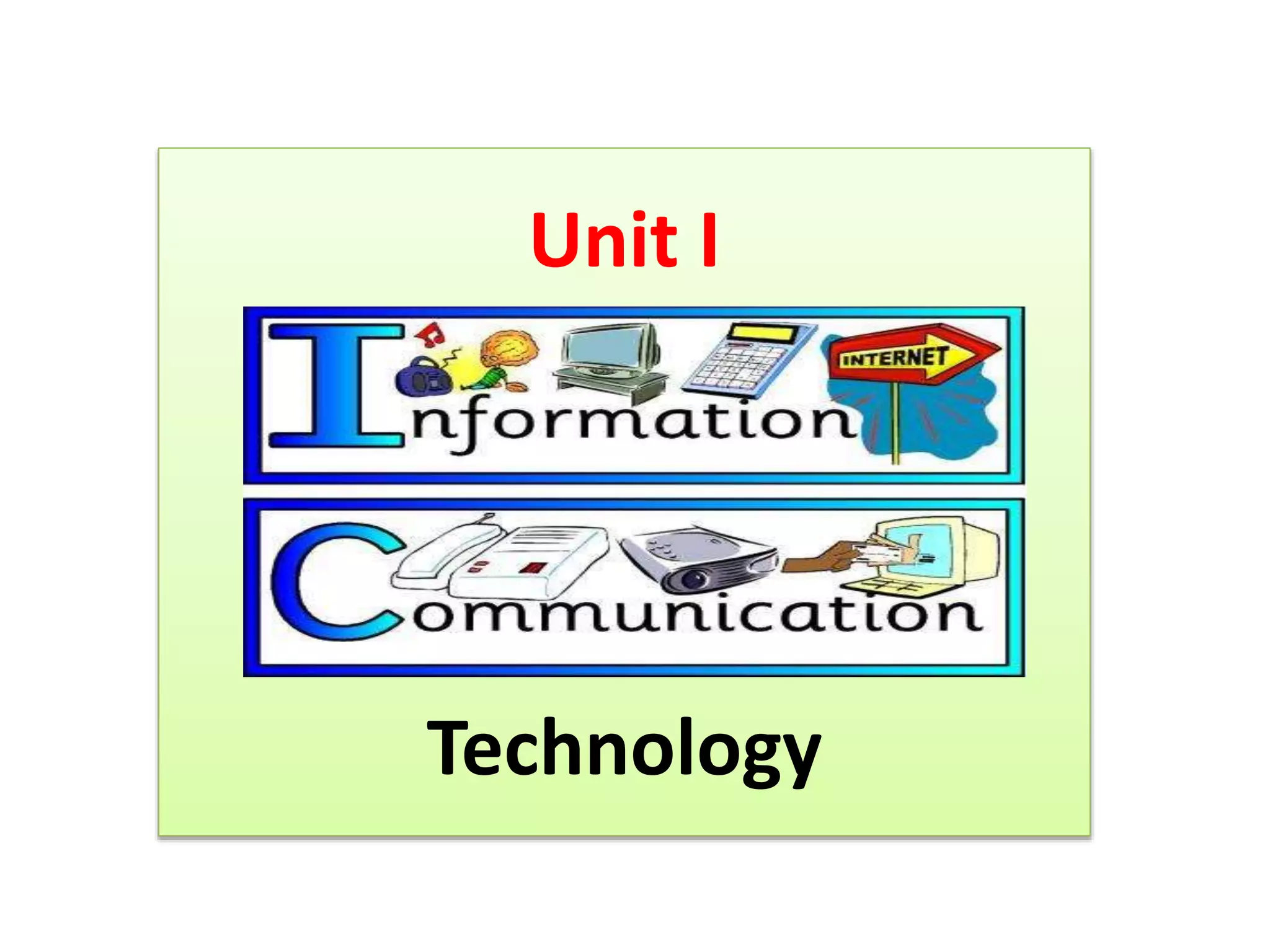
Information
and
Communication
Technology
ICT: Concept, Objectives,
Need and Importance of ICT
– Characteristics and Scope
of Information and
Communication Technology
Meaning
• The term “Information” refers to “any
communication or representation of
knowledge such as facts, data or opinions in
any medium or for, including textual,
numerical, graphic Cartographic, narrative or
audiovisual forms.
• Technology is the practical form of scientific
knowledge or the science of application of
knowledge to practical.
Definition
1/22/2016 Prof. Priya Kale 6
• "ICT stand for information and communication
technologies and is defined, as a "diverse set of
technological tools and resources used to
communicate, and to create, disseminate, store,
and manage information."
• "ICT implies the technology which consists of
electronic devices and associated human
interactive materials that enable the user to
employ them for a wide range of teaching -
learning processes in addition to personal use."
Concept of ICT
• Information technology (IT) that can help in
coping with the information explosion
• Information technology (IT) is the acquisition,
processing, storage and dissemination of
vocal, pictorial, textual and numerical
information by a micro-electronics - based
combination of computing and
telecommunication.
• Anything that renders data,
information or perceived knowledge in
any visual format whatsoever, via any
multimedia distribution mechanism, is
considered part of the domains space
known as Information Technology
• Communication technology is the
activity of designing and constructing
and maintaining communication
systems.
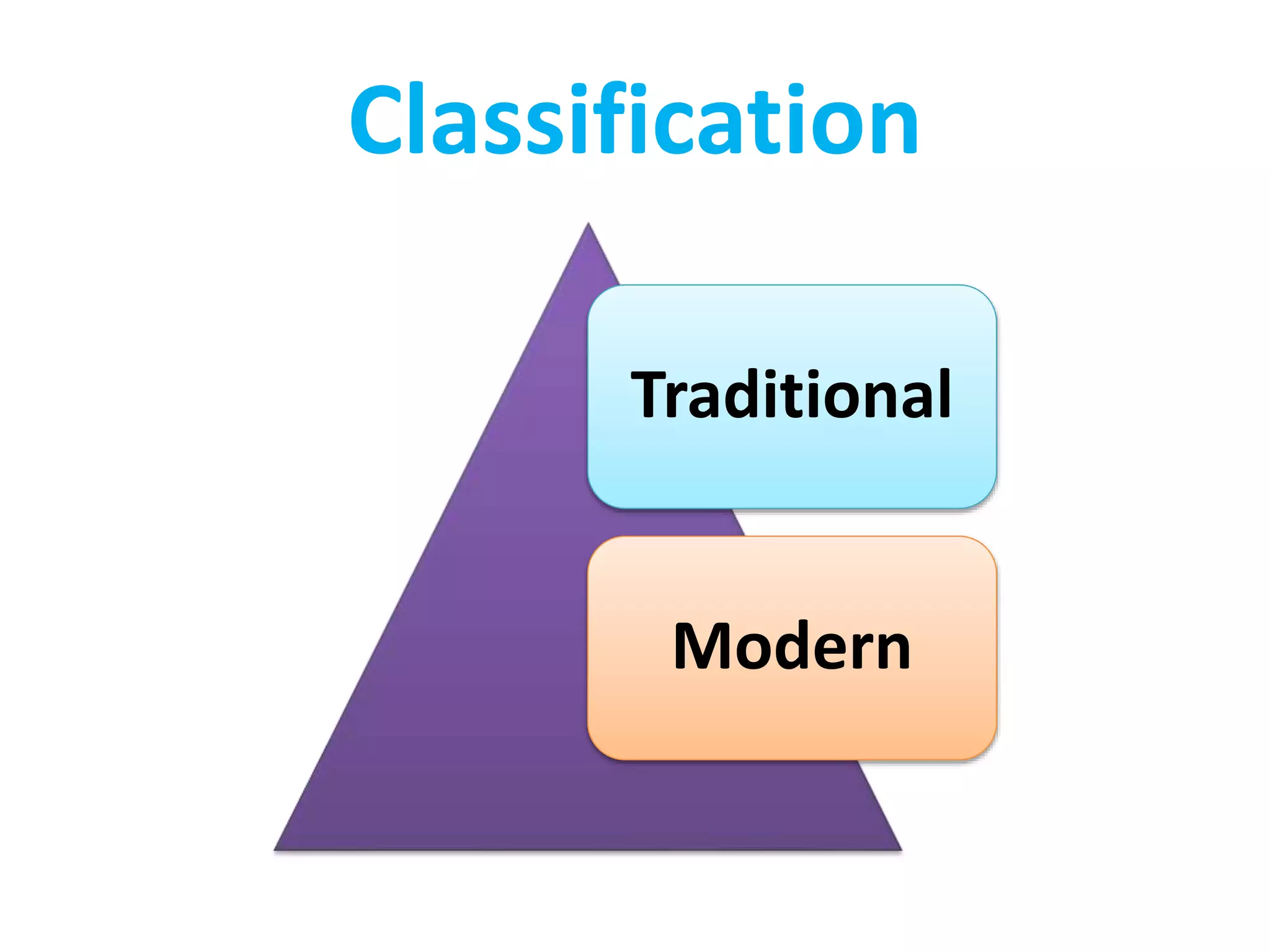
Classification
Traditional
Modern
NEED of ICT
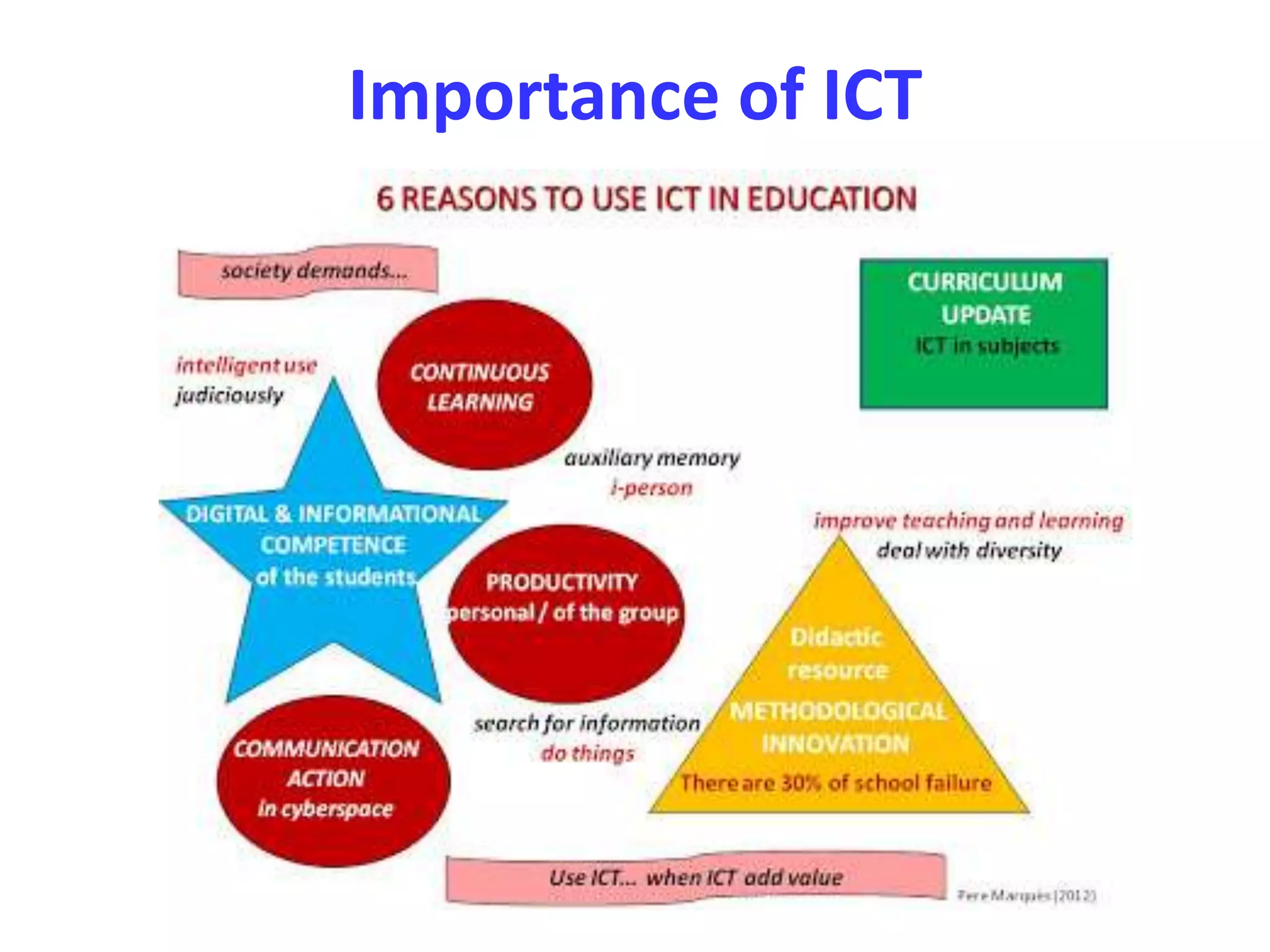
Importance of ICT
Characteristics of Information Technology
* Acquisition, Storage, manipulation,
management, transmission or reception of
data or information.
* Real time access to information.
* Easy availability of updated data.
* Connecting Geographically dispersed regions.
* Wider range of communication media.
Unique Characteristics of ICT
ICT is pervasive and cross-cutting
 From personal use to business and Govt.
 Can be tailored to meet personal, local, diverse
needs.
 ICT creates networks
 Those connected benefit from the network
 The Network externalities increases as it
grows
20
Characteristics cont’
ICT disseminates information and
knowledge
Separates content from its physical location
Makes knowledge available to remote
communities
ICT allows for zero or declining marginal
costs
Replication of content is free
Distribution of marginal cost is near zero
ICT reduces transaction costs
21
Characteristics cont’
ICT enhances efficiency
 Has power to store, retrieve, sorts, filter and
distribute information
 Makes processes and transactions leaner and
more effective
ICT reduces the need for intermediaries
 Links consumers directly to producers
 Allows users to acquire products and
services directly
22
Characteristics cont’
ICT is global
 Transcends cultural and linguistic
barriers
 Allows local communities to be part of
the global network
Summary
These characteristics suggest that ICT can be a
powerful enabler of development
23
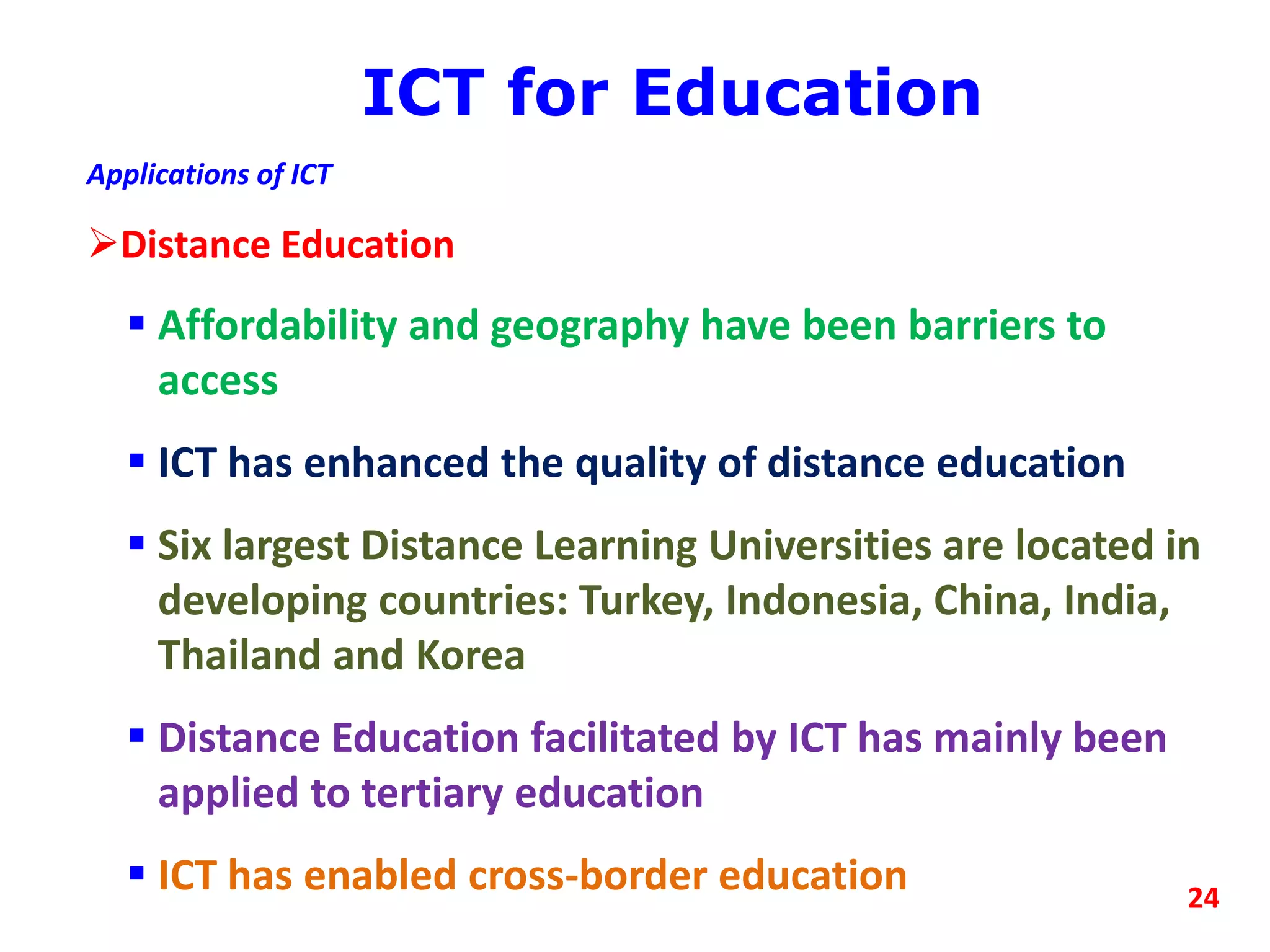
ICT for Education
Applications of ICT
Distance Education
 Affordability and geography have been barriers to
access
 ICT has enhanced the quality of distance education
 Six largest Distance Learning Universities are located in
developing countries: Turkey, Indonesia, China, India,
Thailand and Korea
 Distance Education facilitated by ICT has mainly been
applied to tertiary education
 ICT has enabled cross-border education 24
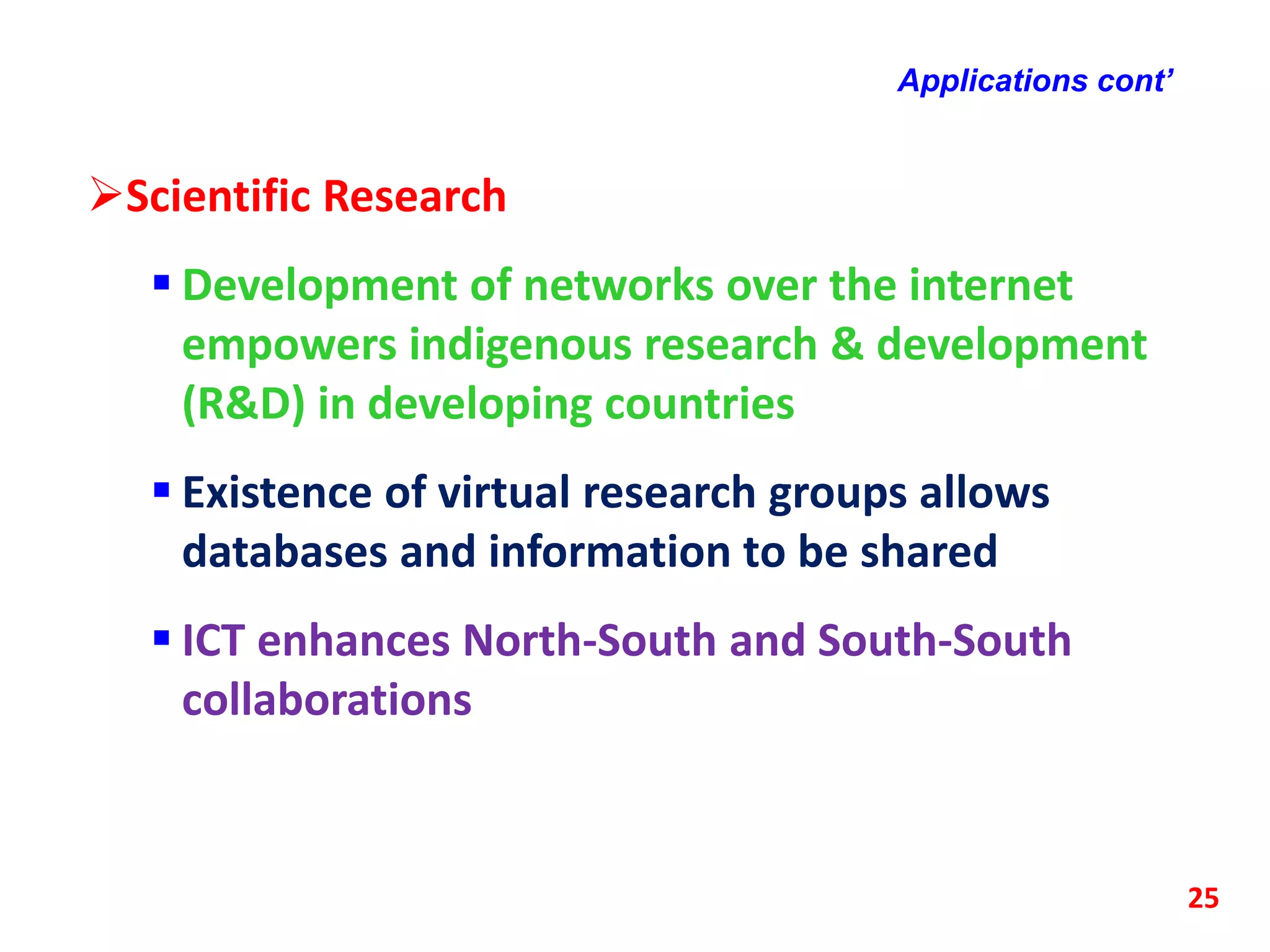
Applications cont’
Scientific Research
 Development of networks over the internet
empowers indigenous research & development
(R&D) in developing countries
 Existence of virtual research groups allows
databases and information to be shared
 ICT enhances North-South and South-South
collaborations
25
Applications cont’
 Technical and vocational training
 ICT is being employed to train workers in many
functional areas e.g Health care,IT services,
teachers
26
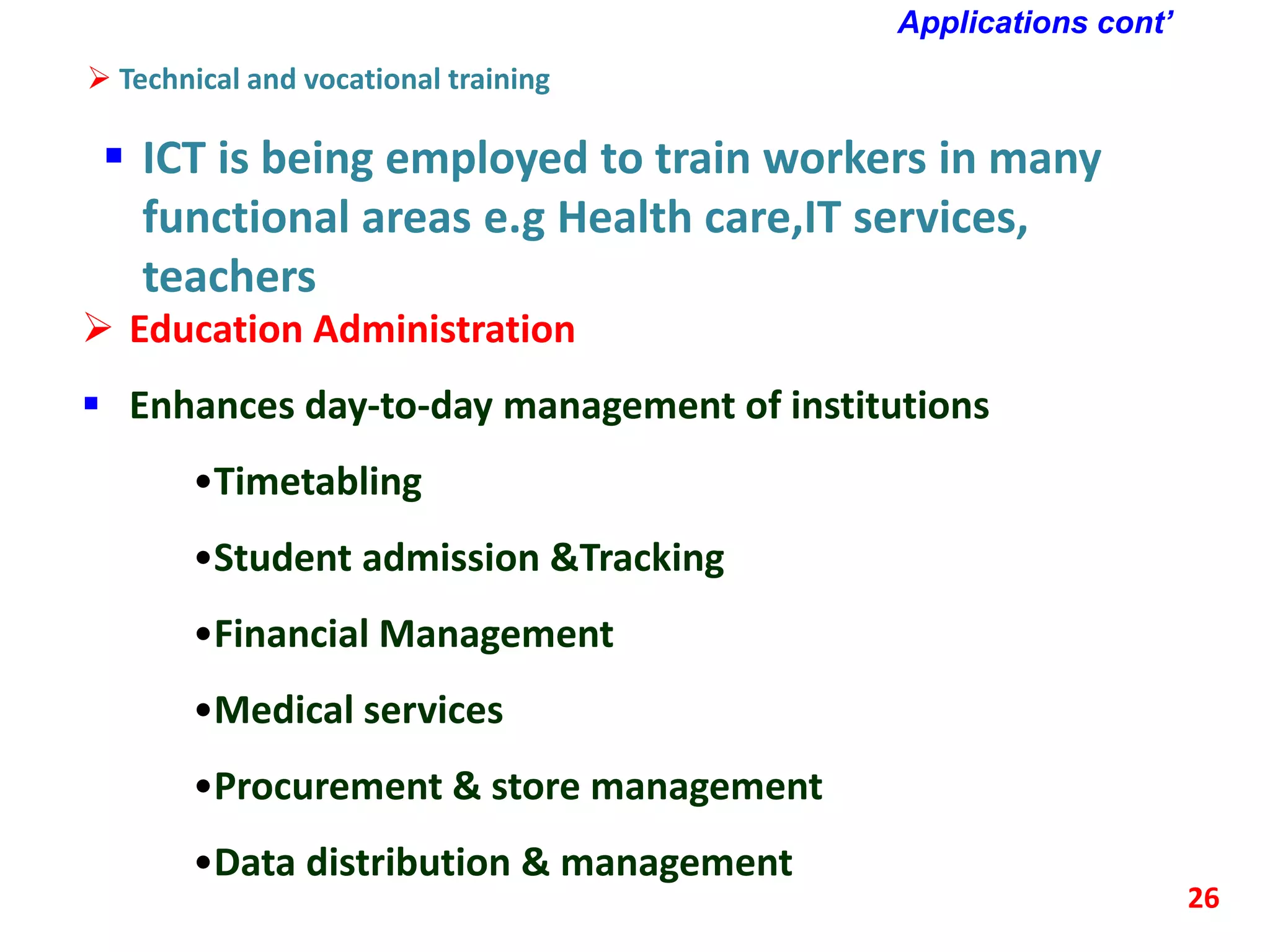
 Education Administration
 Enhances day-to-day management of institutions
•Timetabling
•Student admission &Tracking
•Financial Management
•Medical services
•Procurement & store management
•Data distribution & management
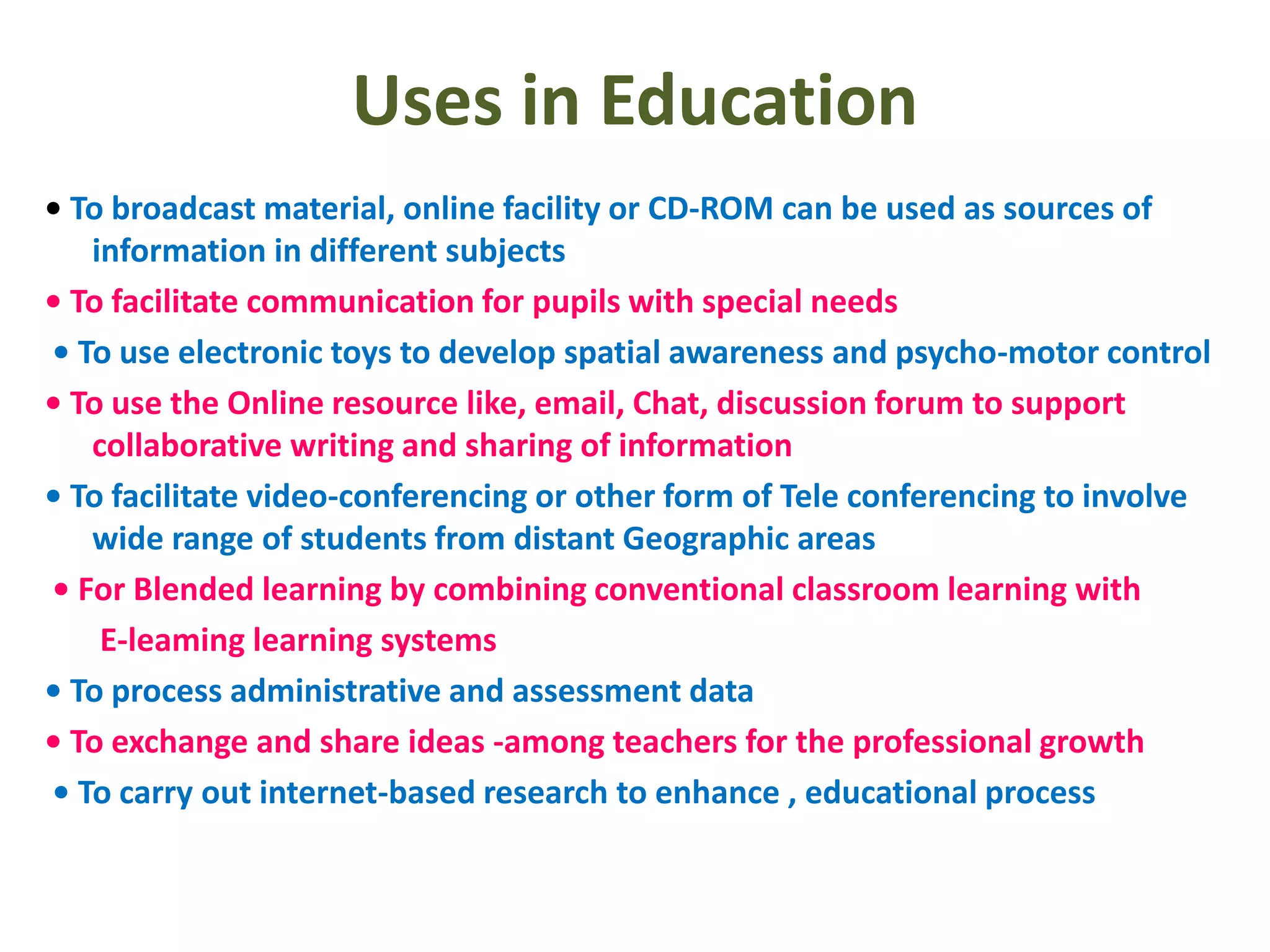
Uses in Education
• To broadcast material, online facility or CD-ROM can be used as sources of
information in different subjects
• To facilitate communication for pupils with special needs
• To use electronic toys to develop spatial awareness and psycho-motor control
• To use the Online resource like, email, Chat, discussion forum to support
collaborative writing and sharing of information
• To facilitate video-conferencing or other form of Tele conferencing to involve
wide range of students from distant Geographic areas
• For Blended learning by combining conventional classroom learning with
E-leaming learning systems
• To process administrative and assessment data
• To exchange and share ideas -among teachers for the professional growth
• To carry out internet-based research to enhance , educational process
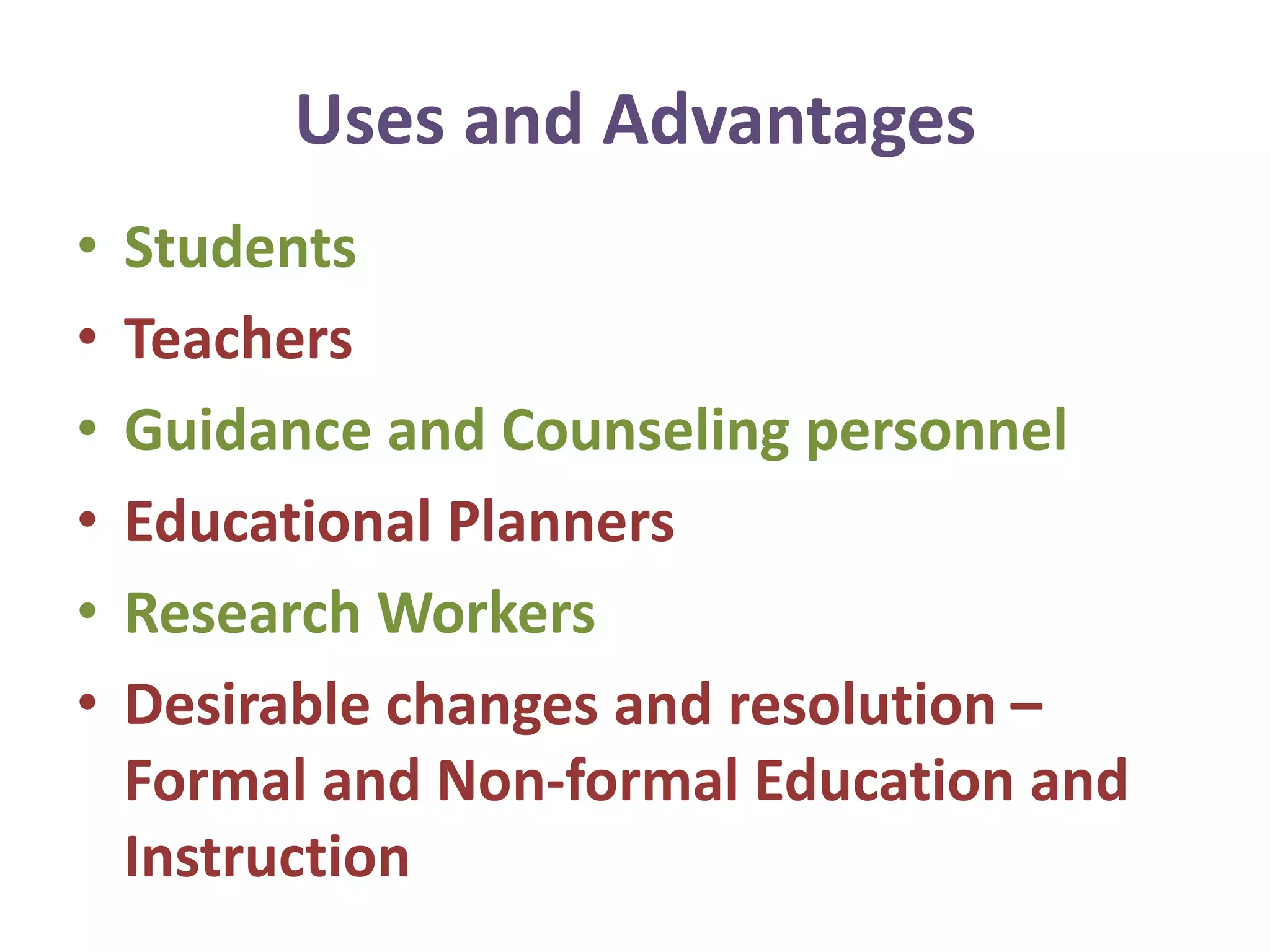
Uses and Advantages
• Students
• Teachers
• Guidance and Counseling personnel
• Educational Planners
• Research Workers
• Desirable changes and resolution –
Formal and Non-formal Education and
Instruction
Limitations and Drawbacks
• Lack of needed facilities , material and
equipment and favourable conditions for the
use of ICT
• Widespread ignorance
• Resistance – attachment to old ways and fear
– adoption of the new
• Lack of provision – in pre-service stage nor in-
service stage
Scope of ICT
Scope
TL process Publication Evaluation Research Administration
1/22/2016 32Prof. Priya Kale
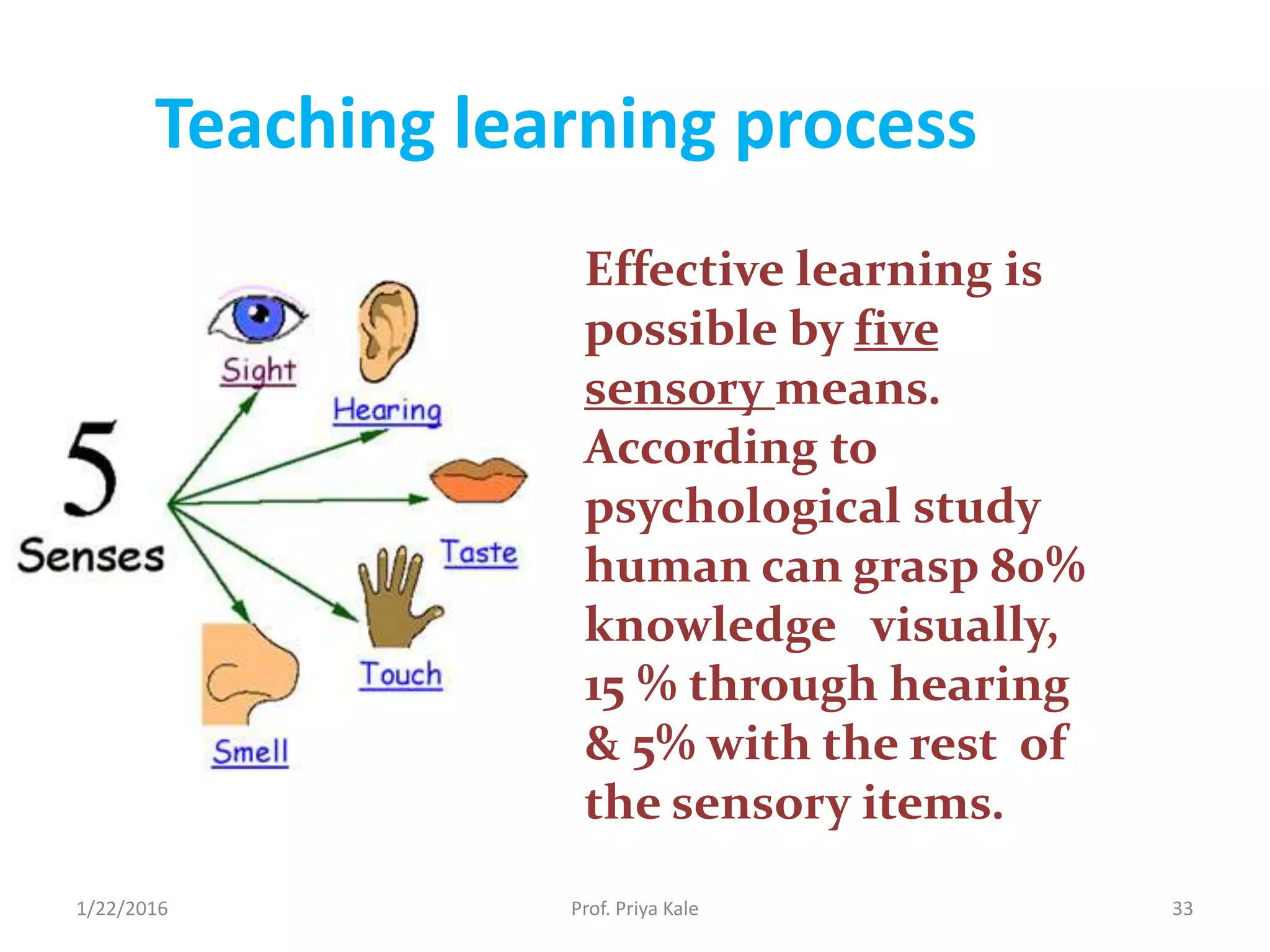
Teaching learning process
Effective learning is
possible by five
sensory means.
According to
psychological study
human can grasp 80%
knowledge visually,
15 % through hearing
& 5% with the rest of
the sensory items.
1/22/2016 33Prof. Priya Kale
• So it becomes necessary to present the
content by attractive means. Computer
technology helps us to provide rich
presentation.
• To provide rich presentation, it is necessary to
use the various components like:-
1. Text matter presentation
2. Animation presentation
3. Graphic presentation
4. Audio presentation
5. Video presentation
Computer Aided Teaching has become popular now
a days.
1/22/2016 34Prof. Priya Kale
SCOPE OF ICT IN EDUCATION
 A person from village also can refer the latest
information and research everyday.
Television broadcast is one of the best
communication media to educate students, farmers,
sportsman.
The difficult experiments, advance surgery for
medical students etc. can be viewed.
LCD projectors can be used for effective training.
The man power problem, the human mistakes can
be avoided by on-line examination.
In online tutoring, the student logs into his or her tutor
through the use of internet at home. The student asks the
question and teacher replies it by writing on smart board
or using powerpoint presentation.
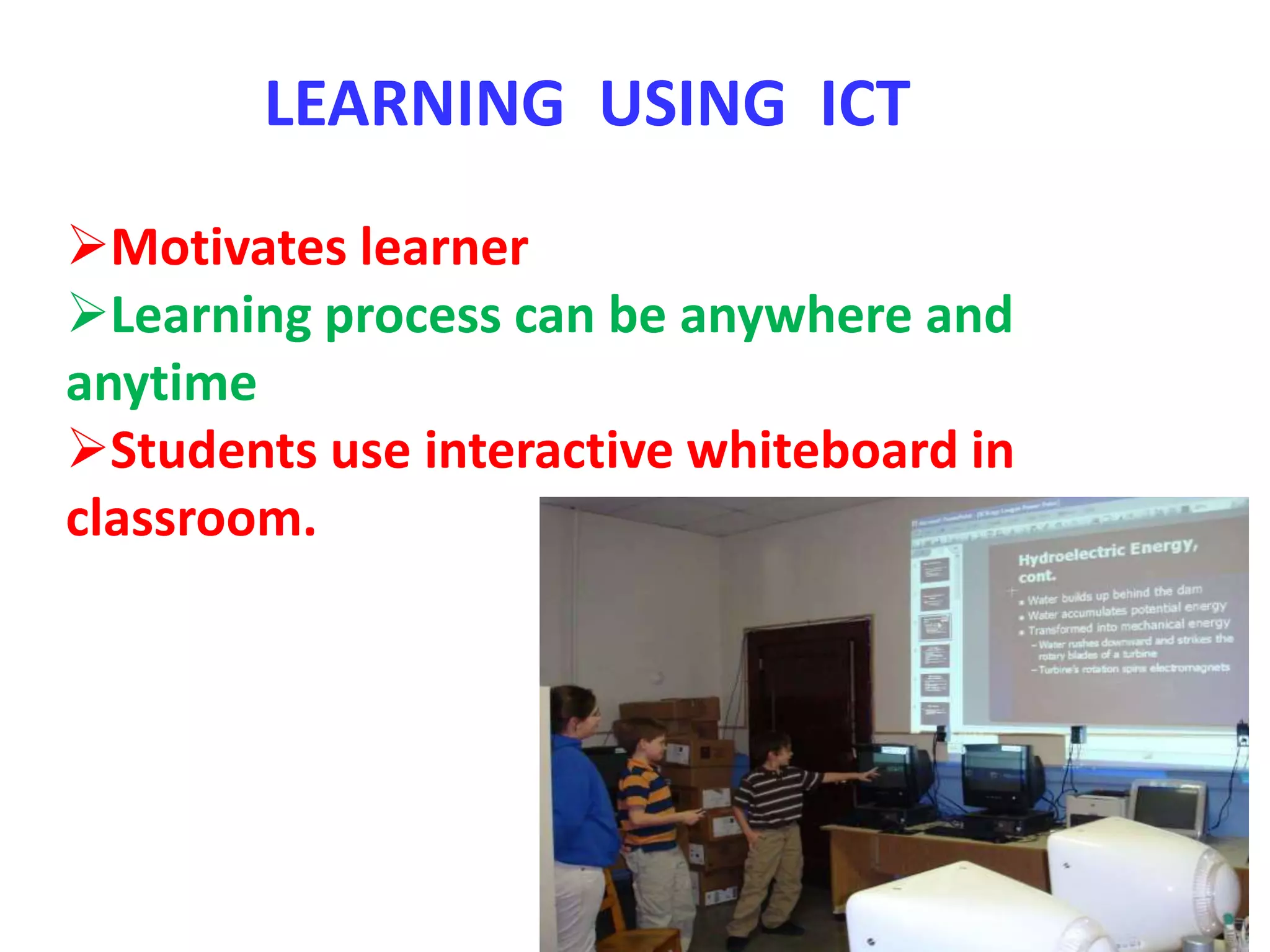
LEARNING USING ICT
Motivates learner
Learning process can be anywhere and
anytime
Students use interactive whiteboard in
classroom.
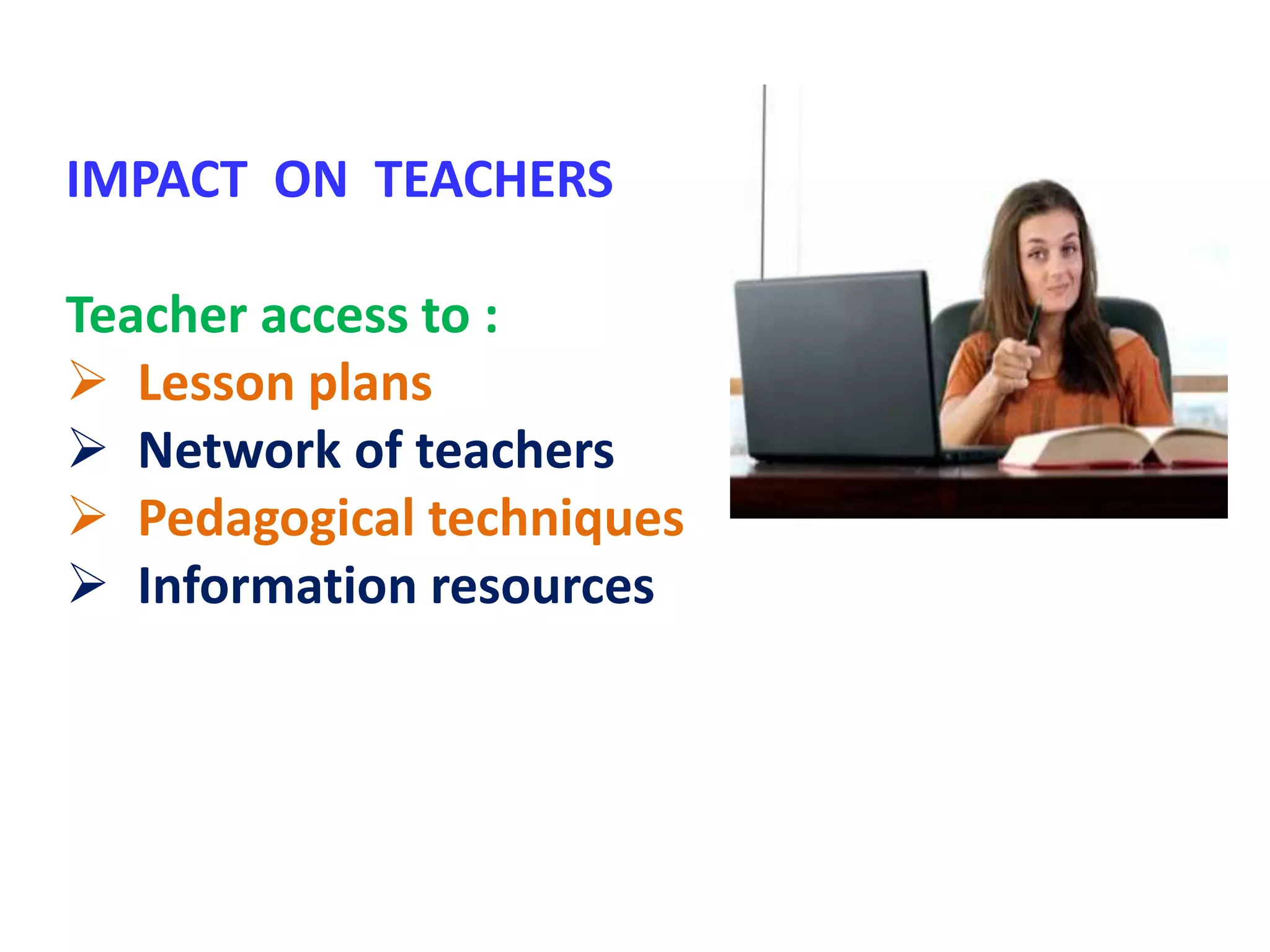
IMPACT ON TEACHERS
Teacher access to :
 Lesson plans
 Network of teachers
 Pedagogical techniques
 Information resources
Publication
• The notes, printed text books can be digitized
with the help of computer technology.
• Many e-books are available on websites
developed by different publishers.
• Encyclopedia is also available on internet.
1/22/2016 42Prof. Priya Kale
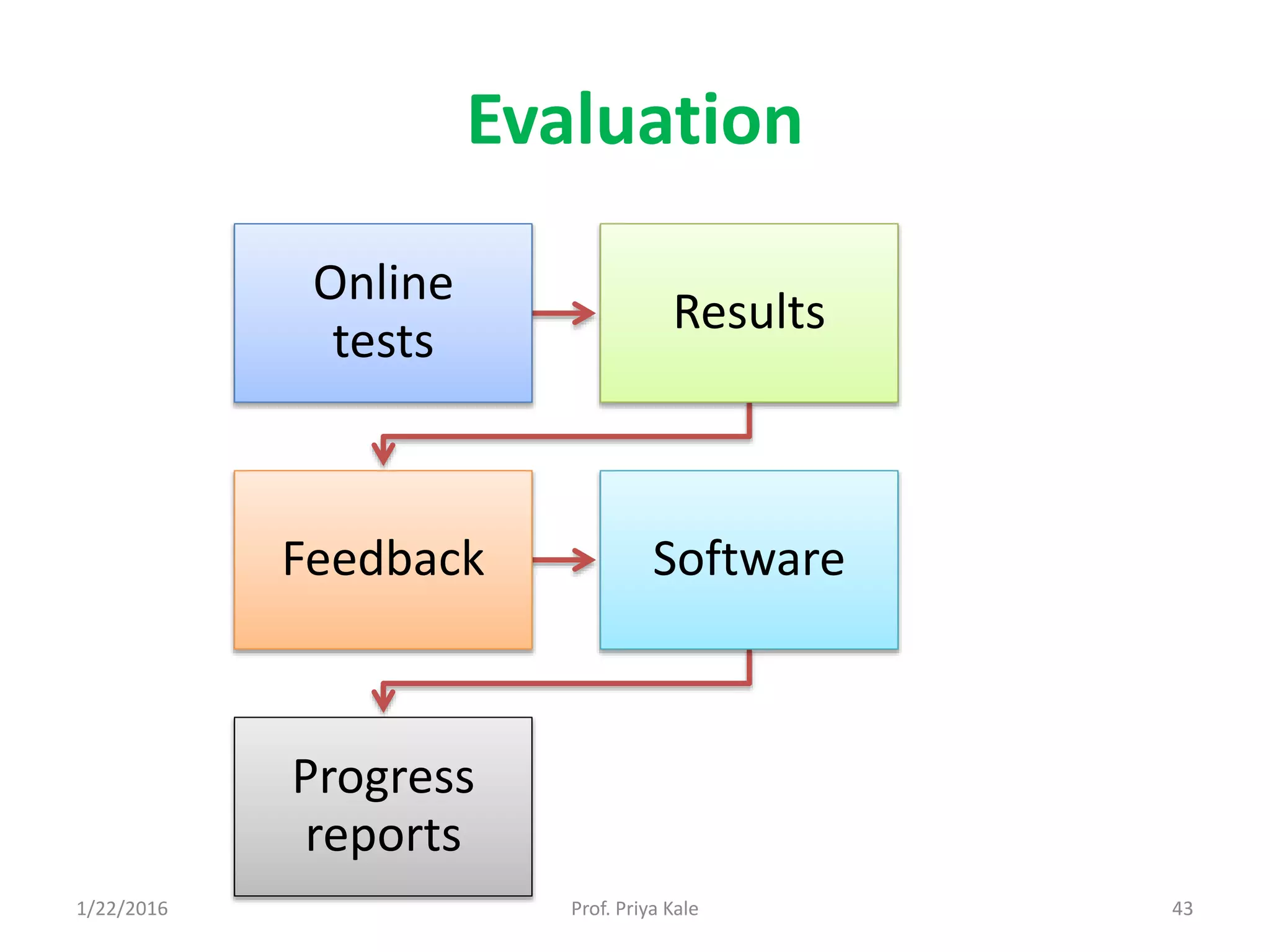
Evaluation
Online
tests
Results
Feedback Software
Progress
reports
1/22/2016 43Prof. Priya Kale
ADVANTAGES OF ICT FOR EVALUATION
Student accept more responsibility for their own
learning and its assessment, developing expertise in
the process.
Teacher application of curriculum can be
monitored by analyzing test results. This can be used
by teachers for assessing and improving their own
performance meeting state and national standards.
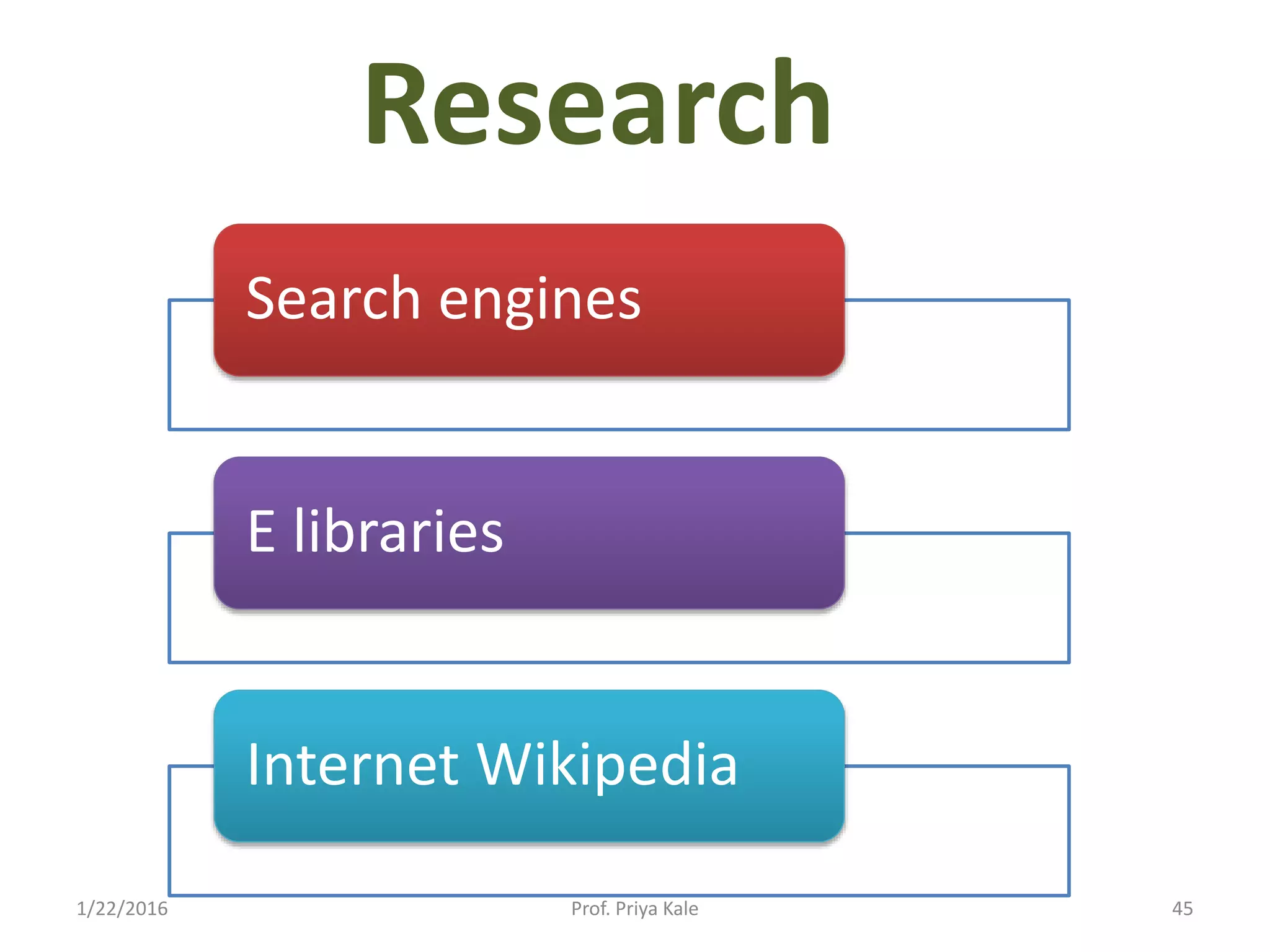
Research
Search engines
E libraries
Internet Wikipedia
1/22/2016 45Prof. Priya Kale
USE OF ICT IN DAY TO DAY LIFE OF
STUDENTS AND TEACHERS
• Students use ICT as reference tool. They use
computers to browse the internet to look
information, project information and literature
survey.
• Teachers use ICT in research for preparing teaching
material ,participate in online forums and online
conference.
• Researchers use ICT tool to collect ,process and
analyze data.
• School administrators use ICT tool for administrative
purpose to make sure that the entire operation runs
smoothly. E.g. to get student details at the click of a
button.
Administration
• Employees register
• Library record
• Progress reports
• Students register
• Placement cell
• Alumni record
• School campus record
• Finance & accounts
• Timetable
1/22/2016 47Prof. Priya Kale
How ICT is being used very effectively
Broadening horizons with more opportunities
for creative expression
Flexibility to study where, when and how best
suits individual needs and preferences
Increased motivation through learning that
stimulates and stretches
Wider access to learning and participation
Sensible choices about when, when not and
how to use new technology to enhance, enrich
and extend learning
Advantages of using ICT in lessons
 Increased commitment to learning works
 Enhanced enjoyment and interest in learning and the subject
 Increase in self-directed learning and independence
 Getting a lot of information and ideas
 Learning computer skills
 Analyzing information
 Increased motivation to stay on-work, behave better and
produce higher Quality output
 Produce higher quality work
 Learn more independently and at their own pace
 Do things they cannot do using traditional methods and
resources
 Do more work and work more quickly
A Framework for ICT in
Teacher Education
Leadership & Vision
Content & Pedagogy
Planning &
Management
of Change
Collaborating
&
Networking
Teacher
Education
Technical
Issues
Life Long
Learning
Social Issues
Context & Culture
Four Themes
Context and
Culture
Leadership
and Vision
Lifelong
Learning
Planning and
Management
of Change
Four Competencies
Pedagogy
Collaboration
and Networking
Technical Issues
Social Issues
Technological Options in Teaching
• Voice - one-way, two-way audio tools
• Video – still images, pre-recorded moving
images, real-time moving images
• Data -
i. Teaching Machine
ii. CAI
iii. CMI
iv. CME
• Print
ADVANTAGES OF THE USE OF
ICT IN EDUCATION
• Quick access to information
• Easy availability of updated data
• Connecting Geographically dispersed regions
• Catering to the Individual differences
• Wider range of communication media
• Wider learning opportunities for pupils
Recommendation
• Deep impact
• Respond to change – much faster
• Urgent to realign the curriculum framework
• Training and Orientation – immediate requirement
• Teachers in profession – continual professional
development
• Teacher educators – plan to introduce – to ensure
high quality and appropriate learning
• Teacher educators, educational authorities and
stakeholders - Enjoy the maximum benefits
• Building appropriate information systems
• Redefining the processes – transparency
Credit Sources
Images are taken from
INTERNET Sources
Information and Communication Technology in Education

Information and Communication Technology in Education

  • 1.
  • 2.
  • 3.
  • 4.
    ICT: Concept, Objectives, Needand Importance of ICT – Characteristics and Scope of Information and Communication Technology
  • 5.
    Meaning • The term“Information” refers to “any communication or representation of knowledge such as facts, data or opinions in any medium or for, including textual, numerical, graphic Cartographic, narrative or audiovisual forms. • Technology is the practical form of scientific knowledge or the science of application of knowledge to practical.
  • 6.
    Definition 1/22/2016 Prof. PriyaKale 6 • "ICT stand for information and communication technologies and is defined, as a "diverse set of technological tools and resources used to communicate, and to create, disseminate, store, and manage information." • "ICT implies the technology which consists of electronic devices and associated human interactive materials that enable the user to employ them for a wide range of teaching - learning processes in addition to personal use."
  • 7.
    Concept of ICT •Information technology (IT) that can help in coping with the information explosion • Information technology (IT) is the acquisition, processing, storage and dissemination of vocal, pictorial, textual and numerical information by a micro-electronics - based combination of computing and telecommunication.
  • 8.
    • Anything thatrenders data, information or perceived knowledge in any visual format whatsoever, via any multimedia distribution mechanism, is considered part of the domains space known as Information Technology • Communication technology is the activity of designing and constructing and maintaining communication systems.
  • 9.
  • 11.
  • 13.
  • 17.
    Characteristics of InformationTechnology * Acquisition, Storage, manipulation, management, transmission or reception of data or information. * Real time access to information. * Easy availability of updated data. * Connecting Geographically dispersed regions. * Wider range of communication media.
  • 20.
    Unique Characteristics ofICT ICT is pervasive and cross-cutting  From personal use to business and Govt.  Can be tailored to meet personal, local, diverse needs.  ICT creates networks  Those connected benefit from the network  The Network externalities increases as it grows 20
  • 21.
    Characteristics cont’ ICT disseminatesinformation and knowledge Separates content from its physical location Makes knowledge available to remote communities ICT allows for zero or declining marginal costs Replication of content is free Distribution of marginal cost is near zero ICT reduces transaction costs 21
  • 22.
    Characteristics cont’ ICT enhancesefficiency  Has power to store, retrieve, sorts, filter and distribute information  Makes processes and transactions leaner and more effective ICT reduces the need for intermediaries  Links consumers directly to producers  Allows users to acquire products and services directly 22
  • 23.
    Characteristics cont’ ICT isglobal  Transcends cultural and linguistic barriers  Allows local communities to be part of the global network Summary These characteristics suggest that ICT can be a powerful enabler of development 23
  • 24.
    ICT for Education Applicationsof ICT Distance Education  Affordability and geography have been barriers to access  ICT has enhanced the quality of distance education  Six largest Distance Learning Universities are located in developing countries: Turkey, Indonesia, China, India, Thailand and Korea  Distance Education facilitated by ICT has mainly been applied to tertiary education  ICT has enabled cross-border education 24
  • 25.
    Applications cont’ Scientific Research Development of networks over the internet empowers indigenous research & development (R&D) in developing countries  Existence of virtual research groups allows databases and information to be shared  ICT enhances North-South and South-South collaborations 25
  • 26.
    Applications cont’  Technicaland vocational training  ICT is being employed to train workers in many functional areas e.g Health care,IT services, teachers 26  Education Administration  Enhances day-to-day management of institutions •Timetabling •Student admission &Tracking •Financial Management •Medical services •Procurement & store management •Data distribution & management
  • 27.
    Uses in Education •To broadcast material, online facility or CD-ROM can be used as sources of information in different subjects • To facilitate communication for pupils with special needs • To use electronic toys to develop spatial awareness and psycho-motor control • To use the Online resource like, email, Chat, discussion forum to support collaborative writing and sharing of information • To facilitate video-conferencing or other form of Tele conferencing to involve wide range of students from distant Geographic areas • For Blended learning by combining conventional classroom learning with E-leaming learning systems • To process administrative and assessment data • To exchange and share ideas -among teachers for the professional growth • To carry out internet-based research to enhance , educational process
  • 28.
    Uses and Advantages •Students • Teachers • Guidance and Counseling personnel • Educational Planners • Research Workers • Desirable changes and resolution – Formal and Non-formal Education and Instruction
  • 30.
    Limitations and Drawbacks •Lack of needed facilities , material and equipment and favourable conditions for the use of ICT • Widespread ignorance • Resistance – attachment to old ways and fear – adoption of the new • Lack of provision – in pre-service stage nor in- service stage
  • 31.
  • 32.
    Scope TL process PublicationEvaluation Research Administration 1/22/2016 32Prof. Priya Kale
  • 33.
    Teaching learning process Effectivelearning is possible by five sensory means. According to psychological study human can grasp 80% knowledge visually, 15 % through hearing & 5% with the rest of the sensory items. 1/22/2016 33Prof. Priya Kale
  • 34.
    • So itbecomes necessary to present the content by attractive means. Computer technology helps us to provide rich presentation. • To provide rich presentation, it is necessary to use the various components like:- 1. Text matter presentation 2. Animation presentation 3. Graphic presentation 4. Audio presentation 5. Video presentation Computer Aided Teaching has become popular now a days. 1/22/2016 34Prof. Priya Kale
  • 35.
    SCOPE OF ICTIN EDUCATION  A person from village also can refer the latest information and research everyday. Television broadcast is one of the best communication media to educate students, farmers, sportsman. The difficult experiments, advance surgery for medical students etc. can be viewed. LCD projectors can be used for effective training. The man power problem, the human mistakes can be avoided by on-line examination.
  • 37.
    In online tutoring,the student logs into his or her tutor through the use of internet at home. The student asks the question and teacher replies it by writing on smart board or using powerpoint presentation.
  • 39.
    LEARNING USING ICT Motivateslearner Learning process can be anywhere and anytime Students use interactive whiteboard in classroom.
  • 41.
    IMPACT ON TEACHERS Teacheraccess to :  Lesson plans  Network of teachers  Pedagogical techniques  Information resources
  • 42.
    Publication • The notes,printed text books can be digitized with the help of computer technology. • Many e-books are available on websites developed by different publishers. • Encyclopedia is also available on internet. 1/22/2016 42Prof. Priya Kale
  • 43.
  • 44.
    ADVANTAGES OF ICTFOR EVALUATION Student accept more responsibility for their own learning and its assessment, developing expertise in the process. Teacher application of curriculum can be monitored by analyzing test results. This can be used by teachers for assessing and improving their own performance meeting state and national standards.
  • 45.
    Research Search engines E libraries InternetWikipedia 1/22/2016 45Prof. Priya Kale
  • 46.
    USE OF ICTIN DAY TO DAY LIFE OF STUDENTS AND TEACHERS • Students use ICT as reference tool. They use computers to browse the internet to look information, project information and literature survey. • Teachers use ICT in research for preparing teaching material ,participate in online forums and online conference. • Researchers use ICT tool to collect ,process and analyze data. • School administrators use ICT tool for administrative purpose to make sure that the entire operation runs smoothly. E.g. to get student details at the click of a button.
  • 47.
    Administration • Employees register •Library record • Progress reports • Students register • Placement cell • Alumni record • School campus record • Finance & accounts • Timetable 1/22/2016 47Prof. Priya Kale
  • 48.
    How ICT isbeing used very effectively Broadening horizons with more opportunities for creative expression Flexibility to study where, when and how best suits individual needs and preferences Increased motivation through learning that stimulates and stretches Wider access to learning and participation Sensible choices about when, when not and how to use new technology to enhance, enrich and extend learning
  • 49.
    Advantages of usingICT in lessons  Increased commitment to learning works  Enhanced enjoyment and interest in learning and the subject  Increase in self-directed learning and independence  Getting a lot of information and ideas  Learning computer skills  Analyzing information  Increased motivation to stay on-work, behave better and produce higher Quality output  Produce higher quality work  Learn more independently and at their own pace  Do things they cannot do using traditional methods and resources  Do more work and work more quickly
  • 52.
    A Framework forICT in Teacher Education Leadership & Vision Content & Pedagogy Planning & Management of Change Collaborating & Networking Teacher Education Technical Issues Life Long Learning Social Issues Context & Culture
  • 53.
    Four Themes Context and Culture Leadership andVision Lifelong Learning Planning and Management of Change
  • 54.
  • 55.
    Technological Options inTeaching • Voice - one-way, two-way audio tools • Video – still images, pre-recorded moving images, real-time moving images • Data - i. Teaching Machine ii. CAI iii. CMI iv. CME • Print
  • 56.
    ADVANTAGES OF THEUSE OF ICT IN EDUCATION • Quick access to information • Easy availability of updated data • Connecting Geographically dispersed regions • Catering to the Individual differences • Wider range of communication media • Wider learning opportunities for pupils
  • 57.
    Recommendation • Deep impact •Respond to change – much faster • Urgent to realign the curriculum framework • Training and Orientation – immediate requirement • Teachers in profession – continual professional development • Teacher educators – plan to introduce – to ensure high quality and appropriate learning • Teacher educators, educational authorities and stakeholders - Enjoy the maximum benefits • Building appropriate information systems • Redefining the processes – transparency
  • 58.
    Credit Sources Images aretaken from INTERNET Sources