INSTITUTIONS
DEFINITION, CHARACTERISTICS AND TYPE OF INSTITUTIONS
THE CONCEPT OF INSTITUTION
• There are several ideas that can be used to define the term
‘institution’. These include:
• an established law, custom or public practice,
• an organisation established for social, political, economic,
educational or religious
• purposes,
• an organized pattern of group behaviour established and generally
accepted as a
• fundamental part of culture and
• practices and established ways of doing things.
CHARACTERISTICS OF INSTITUTIONS
• Each of the institutions within society has the following
characteristics;
• specific functions to perform,
• a clear organised structure ,
• has written rules,
• serves a particular need of society,
• fixed sanctions such as rewards and punishment and
• endures over time.
TYPES OF INSTITUTIONS
• Institutions are based on the customs and practices of a
people. They not only control or regulate human behaviour
but provide for the needs of mankind. To accomplish
these goals, institutions are divided into types. There are
Universalistic institutions and Particularistic institutions.
The particularistic institutions emerge from the
Universalistic Institutions.
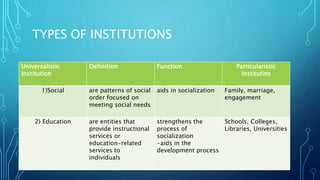
TYPES OF INSTITUTIONS
Universalistic
Institution
Definition Function Particularistic
Institutins
1)Social are patterns of social
order focused on
meeting social needs
aids in socialization Family, marriage,
engagement
2) Education are entities that
provide instructional
services or
education-related
services to
individuals
strengthens the
process of
socialization
-aids in the
development process
Schools, Colleges,
Libraries, Universities
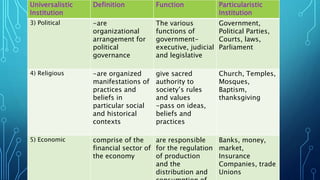
Universalistic
Institution
Definition Function Particularistic
Institution
3) Political -are
organizational
arrangement for
political
governance
The various
functions of
government-
executive, judicial
and legislative
Government,
Political Parties,
Courts, laws,
Parliament
4) Religious -are organized
manifestations of
practices and
beliefs in
particular social
and historical
contexts
give sacred
authority to
society’s rules
and values
-pass on ideas,
beliefs and
practices
Church, Temples,
Mosques,
Baptism,
thanksgiving
5) Economic comprise of the
financial sector of
the economy
are responsible
for the regulation
of production
and the
distribution and
Banks, money,
market,
Insurance
Companies, trade
Unions
6) Recreational refer to places
or activities that
relax one’s
mind or act as a
source of
renewal of
energy
-assist in the
transmission of
skills and
knowledge -
encourage in
members a
sense of
fulfilment
-develop
competitiveness
and cooperation
Cricket,
Cinemas, Arts
clubs

Institutions.pptx

  • 1.
  • 2.
    THE CONCEPT OFINSTITUTION • There are several ideas that can be used to define the term ‘institution’. These include: • an established law, custom or public practice, • an organisation established for social, political, economic, educational or religious • purposes, • an organized pattern of group behaviour established and generally accepted as a • fundamental part of culture and • practices and established ways of doing things.
  • 3.
    CHARACTERISTICS OF INSTITUTIONS •Each of the institutions within society has the following characteristics; • specific functions to perform, • a clear organised structure , • has written rules, • serves a particular need of society, • fixed sanctions such as rewards and punishment and • endures over time.
  • 4.
    TYPES OF INSTITUTIONS •Institutions are based on the customs and practices of a people. They not only control or regulate human behaviour but provide for the needs of mankind. To accomplish these goals, institutions are divided into types. There are Universalistic institutions and Particularistic institutions. The particularistic institutions emerge from the Universalistic Institutions.
  • 5.
    TYPES OF INSTITUTIONS Universalistic Institution DefinitionFunction Particularistic Institutins 1)Social are patterns of social order focused on meeting social needs aids in socialization Family, marriage, engagement 2) Education are entities that provide instructional services or education-related services to individuals strengthens the process of socialization -aids in the development process Schools, Colleges, Libraries, Universities
  • 6.
    Universalistic Institution Definition Function Particularistic Institution 3)Political -are organizational arrangement for political governance The various functions of government- executive, judicial and legislative Government, Political Parties, Courts, laws, Parliament 4) Religious -are organized manifestations of practices and beliefs in particular social and historical contexts give sacred authority to society’s rules and values -pass on ideas, beliefs and practices Church, Temples, Mosques, Baptism, thanksgiving 5) Economic comprise of the financial sector of the economy are responsible for the regulation of production and the distribution and Banks, money, market, Insurance Companies, trade Unions
  • 7.
    6) Recreational referto places or activities that relax one’s mind or act as a source of renewal of energy -assist in the transmission of skills and knowledge - encourage in members a sense of fulfilment -develop competitiveness and cooperation Cricket, Cinemas, Arts clubs