Downloaded 20 times


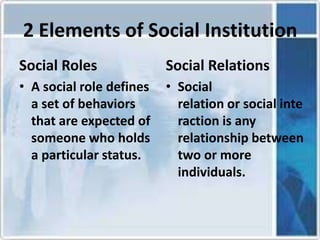



















Social institutions are configurations of shared behavior patterns that satisfy basic group needs. They have social roles that define expected behaviors and social relations between individuals. Institutions are purposeful, relatively permanent, structured, and value-laden. Major institutions involve large numbers and are essential to society, while subsidiary institutions are minor and variable within major institutions. Examples of social institutions include familial institutions that fulfill functions like reproduction and socialization of children, educational institutions that provide primary education, political institutions based on functionalist theories, and religious institutions that unite groups with shared spiritual beliefs.


