UNIT 4 Social Institutions
INYRODUCTION
 As we group up there are many different influences which affect our behaviour. When we are very
young, it is the family, especially mother and father who affect us the most.
 After a certain age, we begin to go to school. School has a major impact on our behavior and in shaping
our personality. In addition, the community of which we are a part also affects us and guides our
actions.
 All of us belong to a particular religious group; each religion also has guidelines about right behaviour. In
today’s world, T.V and mass media also exert a very strong influence on our thoughts and activities.
 Social Institutions focuses on the systematic understanding of social interaction, social organization, and
social change.
 Each society has its own social institutions; these are not buildings or places, but structures of
relationship, obligation, role and function.
DEFINITIOMS
 An institution is a mechanism of social cooperation that governs the behavior of a set of individuals
within a given human community.
 Institutions are identified with a social purpose and stability that helps individuals to excel in their lives
and intentions. Every society has structures which provide a common social framework.
 These structures can be broadly referred to as social institutions and are distinct from any organization
that results from the political realm.
 The term "institution" is commonly applied to customs and behavior patterns important to a society, as
well as to particular formal organizations of government and public service.
Definition of Social Institutions
Characteristics of Social Institutions
 An institution is not anyone or anything that is established and traditional. An
institution is not limited to specific organizations, such as a school or a prison
or a hospital. An institution is much broader in scope and importance than a
person, a custom, or a social organization.
 Institutions are social arrangements that channel behavior in prescribed ways
in the important areas of social life. They are interrelated sets of normative
elements/norms, values, and role expectations that the people making up the
society have devised and passed on to succeeding generations in order to
provide permanent solutions to society’s perpetually unfinished business.
Institutions are cultural imperatives.
Institutions and Societal Problems
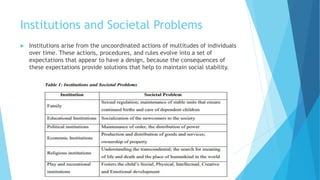
 Institutions arise from the uncoordinated actions of multitudes of individuals
over time. These actions, procedures, and rules evolve into a set of
expectations that appear to have a design, because the consequences of
these expectations provide solutions that help to maintain social stability.
Cont…
 Institutions are, by definition, conservative. They are the answer of custom
and tradition to questions of survival.
 Although absolutely necessary for unity and stability, institutions in
contemporary society are often outmoded, inefficient, and unresponsive to
the incredibly swift changes brought about by technological advances,
population shifts, and increasing worldwide interdependence.
General Functions of Social Institutions
 Economic Functions: economic institutions fulfill the economic needs of the
society. These needs are provided under the system of production,
Distribution of Wealth, Expenditures and Services.
 Political Functions: the main function of political institution is to deep the
human character in an organize form. The further objective of this institution
is to maintain social organization. This done through the governments and
related bodies.
 Familial Functions: The main responsibility of social institution is to increase
the human race. Similarly the social institutions are supposed to bring up the
new generation this is done through the family and marriage.
Cont…
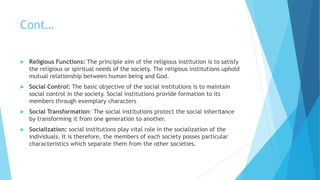
 Religious Functions: The principle aim of the religious institution is to satisfy
the religious or spiritual needs of the society. The religious institutions uphold
mutual relationship between human being and God.
 Social Control: The basic objective of the social institutions is to maintain
social control in the society. Social institutions provide formation to its
members through exemplary characters
 Social Transformation: The social institutions protect the social inheritance
by transforming it from one generation to another.
 Socialization: social institutions play vital role in the socialization of the
individuals. It is therefore, the members of each society posses particular
characteristics which separate them from the other societies.
Types of Social Institutions
 One distinguishing characteristic of societies is the existence of a set of
institutions.
 The popular usages of this term are imprecise and omit some important
sociological considerations.
 An institution is not anyone or anything that is established and An institution
is not limited to specific organizations, such as a school or a prison or a
hospital.
 An institution is much broader in scope and importance than a person, a
custom, or a social organization.
Cont…
 The Family
 The Specific Functions of the Family
The control and regulation of sexual behavior.
To provide for new members of society (children)
To provide for the economic and emotional maintenance of individuals.
To provide for primary socialization of children.
Economic Institutions
 Sociologists understand the economy as the set of arrangements by which a
society produces, distributes, and consumes goods, services, and other
resources.
 Economic Institutions involve the production of goods and the organization of
labor, the provision of care and similar factors, not just money, buying and
selling. Every society has systems of provision or procurement.
 According to Diana Kendall, “economy is the social institution that ensures
the maintenance of society through the production, distribution, and
consumption of goods and services”.
Cont…
Capitalism
 Capitalism is a system of economics defined by a market owned and control
by private citizens. The advantages of capitalism are the private ownership of
property that produces income and competition to keep prices in check. The
disadvantage, however, is the lack of government intervention which is what
makes capitalism work best
Socialism
 The alternative economic theory to capitalism is socialism. Socialism is the
act by which all goods are publically owned and operated. The three features
that make up the socialist theory are 18 public ownership of the means of
production, pursuit of collective goals, and centralized decision making.
Specific Functions of Economical
Institutions
 Provide methods for the production of goods and services.
 Provide methods for the distribution of goods and services.
 Enable society’s members to consume goods and services which are produced
Religious Institutions
 Another topic that has about as much diversity as today’s educational system
is that of religion. Diana Kendall states “Religion is a system of beliefs,
symbols, and rituals, based on some sacred or supernatural realm, that guides
human behavior, gives meaning to life, and unites believers into a
community”.
 Our religion is a way of life. If we follow above tenets we will play a positive
role in every share of life. We have to learn to use religion in a positive way.
The Specific Function of Religious
Institutions
 Providing solutions for unexplained natural, phenomena.
 Supplying a means for controlling the natural world.
 Religion tends to support the normative structure of the society.
 Furnishing a psychological diversion from unwanted life situations.
 Sustaining the existing class structure.
 Religion serves as an instrument of socialization.
 Religious institutes may both promote and retard social change.
 Religion may both reduce and encourage conflict in groups.
Political Institutions
 Politics is the social institution through which power is acquired and exercised
by some people and groups.
 Politics is present in every society today in the form of a government or
state.
 Political sociology is the process in which politics is studied in its relation to
other factors such as the economy, education, or media (Kendall, 2006).
 Every society has an organizational principle, with authority figures, with
defined roles and obligations.
The Specific Functions of Political
Institutions
 The Institutionalization of norms (Laws).
 The enforcement of laws.
 The adjudication of conflict (Court).
 Provide for the welfare of members of society.
 Protection of Society from external threat.
Educational Institutions
 Education and religion have both been important factors in many societies
around the world.
 Both shape how our societies interact within our own society and with other
societies around us.
 The shaping of our societies begins we are young with our families and friends
shaping how our lives will take place. This is when formal education and
religion are brought about.
The Impact of School
 These are the most formative years of a child’s life. As the child grows he/she
go to school. In the child’s development school plays the second most
important role.
 Its role is almost as important as family. A school and a college are called
Alma Mater. It is derived from a Latin word meaning nourishing (dear) mother.
 Books are store houses of knowledge, and knowledge is power. Knowledge
gives self-confidence and maturity and helps to develop a person fully.
The Specific Functions of Educational
Institutions
 Transmitting culture.
 Preparation for occupational roles
 Evaluating and selecting competent individuals
 Transmitting functional skills for functioning in society.
Play and Recreational Institutions
 There is a dearth of similar material and definitions on recreation. As an
institution play and recreation plays important role, it is important to
emphasize the need for co-operation and networking to ensure both that the
best quality of service is provided and that resources are not duplicated.
 Play & recreation are regarded as broadly similar activities and are
considered together under the general term ‘play’.
 Every child has the right to play and to participate fully in recreational
activities. T
Benefits of Sports and Recreational
Institutions
 A safe environment
 Opportunities to develop and display competence
 Social networks
 Moral and economic support
 Autonomy and control in the structures in which their experiences occur
 Hope for the future
Importance of Social Institutions of
Society
 Social institution can play an important role in making any country stronger. If
the country has weak institutions than it will be very hard for the nation to
survive without any problems and difficulties.
 Instead of strong institutions, we have strong Persons. The only way Pakistan
can progress is my making its institutions strong by converting it truly into
welfare state.
 Strong institutions means end of corruption, rule of law all problems
mentioned below are by product of weak institutions.

8606 Unit 4 CECE.pptx

  • 2.
    UNIT 4 SocialInstitutions INYRODUCTION  As we group up there are many different influences which affect our behaviour. When we are very young, it is the family, especially mother and father who affect us the most.  After a certain age, we begin to go to school. School has a major impact on our behavior and in shaping our personality. In addition, the community of which we are a part also affects us and guides our actions.  All of us belong to a particular religious group; each religion also has guidelines about right behaviour. In today’s world, T.V and mass media also exert a very strong influence on our thoughts and activities.  Social Institutions focuses on the systematic understanding of social interaction, social organization, and social change.  Each society has its own social institutions; these are not buildings or places, but structures of relationship, obligation, role and function. DEFINITIOMS  An institution is a mechanism of social cooperation that governs the behavior of a set of individuals within a given human community.  Institutions are identified with a social purpose and stability that helps individuals to excel in their lives and intentions. Every society has structures which provide a common social framework.  These structures can be broadly referred to as social institutions and are distinct from any organization that results from the political realm.  The term "institution" is commonly applied to customs and behavior patterns important to a society, as well as to particular formal organizations of government and public service.
  • 3.
  • 4.
    Characteristics of SocialInstitutions  An institution is not anyone or anything that is established and traditional. An institution is not limited to specific organizations, such as a school or a prison or a hospital. An institution is much broader in scope and importance than a person, a custom, or a social organization.  Institutions are social arrangements that channel behavior in prescribed ways in the important areas of social life. They are interrelated sets of normative elements/norms, values, and role expectations that the people making up the society have devised and passed on to succeeding generations in order to provide permanent solutions to society’s perpetually unfinished business. Institutions are cultural imperatives.
  • 5.
    Institutions and SocietalProblems  Institutions arise from the uncoordinated actions of multitudes of individuals over time. These actions, procedures, and rules evolve into a set of expectations that appear to have a design, because the consequences of these expectations provide solutions that help to maintain social stability.
  • 6.
    Cont…  Institutions are,by definition, conservative. They are the answer of custom and tradition to questions of survival.  Although absolutely necessary for unity and stability, institutions in contemporary society are often outmoded, inefficient, and unresponsive to the incredibly swift changes brought about by technological advances, population shifts, and increasing worldwide interdependence.
  • 7.
    General Functions ofSocial Institutions  Economic Functions: economic institutions fulfill the economic needs of the society. These needs are provided under the system of production, Distribution of Wealth, Expenditures and Services.  Political Functions: the main function of political institution is to deep the human character in an organize form. The further objective of this institution is to maintain social organization. This done through the governments and related bodies.  Familial Functions: The main responsibility of social institution is to increase the human race. Similarly the social institutions are supposed to bring up the new generation this is done through the family and marriage.
  • 8.
    Cont…  Religious Functions:The principle aim of the religious institution is to satisfy the religious or spiritual needs of the society. The religious institutions uphold mutual relationship between human being and God.  Social Control: The basic objective of the social institutions is to maintain social control in the society. Social institutions provide formation to its members through exemplary characters  Social Transformation: The social institutions protect the social inheritance by transforming it from one generation to another.  Socialization: social institutions play vital role in the socialization of the individuals. It is therefore, the members of each society posses particular characteristics which separate them from the other societies.
  • 9.
    Types of SocialInstitutions  One distinguishing characteristic of societies is the existence of a set of institutions.  The popular usages of this term are imprecise and omit some important sociological considerations.  An institution is not anyone or anything that is established and An institution is not limited to specific organizations, such as a school or a prison or a hospital.  An institution is much broader in scope and importance than a person, a custom, or a social organization.
  • 10.
    Cont…  The Family The Specific Functions of the Family The control and regulation of sexual behavior. To provide for new members of society (children) To provide for the economic and emotional maintenance of individuals. To provide for primary socialization of children.
  • 11.
    Economic Institutions  Sociologistsunderstand the economy as the set of arrangements by which a society produces, distributes, and consumes goods, services, and other resources.  Economic Institutions involve the production of goods and the organization of labor, the provision of care and similar factors, not just money, buying and selling. Every society has systems of provision or procurement.  According to Diana Kendall, “economy is the social institution that ensures the maintenance of society through the production, distribution, and consumption of goods and services”.
  • 12.
    Cont… Capitalism  Capitalism isa system of economics defined by a market owned and control by private citizens. The advantages of capitalism are the private ownership of property that produces income and competition to keep prices in check. The disadvantage, however, is the lack of government intervention which is what makes capitalism work best Socialism  The alternative economic theory to capitalism is socialism. Socialism is the act by which all goods are publically owned and operated. The three features that make up the socialist theory are 18 public ownership of the means of production, pursuit of collective goals, and centralized decision making.
  • 13.
    Specific Functions ofEconomical Institutions  Provide methods for the production of goods and services.  Provide methods for the distribution of goods and services.  Enable society’s members to consume goods and services which are produced
  • 14.
    Religious Institutions  Anothertopic that has about as much diversity as today’s educational system is that of religion. Diana Kendall states “Religion is a system of beliefs, symbols, and rituals, based on some sacred or supernatural realm, that guides human behavior, gives meaning to life, and unites believers into a community”.  Our religion is a way of life. If we follow above tenets we will play a positive role in every share of life. We have to learn to use religion in a positive way.
  • 15.
    The Specific Functionof Religious Institutions  Providing solutions for unexplained natural, phenomena.  Supplying a means for controlling the natural world.  Religion tends to support the normative structure of the society.  Furnishing a psychological diversion from unwanted life situations.  Sustaining the existing class structure.  Religion serves as an instrument of socialization.  Religious institutes may both promote and retard social change.  Religion may both reduce and encourage conflict in groups.
  • 16.
    Political Institutions  Politicsis the social institution through which power is acquired and exercised by some people and groups.  Politics is present in every society today in the form of a government or state.  Political sociology is the process in which politics is studied in its relation to other factors such as the economy, education, or media (Kendall, 2006).  Every society has an organizational principle, with authority figures, with defined roles and obligations.
  • 17.
    The Specific Functionsof Political Institutions  The Institutionalization of norms (Laws).  The enforcement of laws.  The adjudication of conflict (Court).  Provide for the welfare of members of society.  Protection of Society from external threat.
  • 18.
    Educational Institutions  Educationand religion have both been important factors in many societies around the world.  Both shape how our societies interact within our own society and with other societies around us.  The shaping of our societies begins we are young with our families and friends shaping how our lives will take place. This is when formal education and religion are brought about.
  • 19.
    The Impact ofSchool  These are the most formative years of a child’s life. As the child grows he/she go to school. In the child’s development school plays the second most important role.  Its role is almost as important as family. A school and a college are called Alma Mater. It is derived from a Latin word meaning nourishing (dear) mother.  Books are store houses of knowledge, and knowledge is power. Knowledge gives self-confidence and maturity and helps to develop a person fully.
  • 20.
    The Specific Functionsof Educational Institutions  Transmitting culture.  Preparation for occupational roles  Evaluating and selecting competent individuals  Transmitting functional skills for functioning in society.
  • 21.
    Play and RecreationalInstitutions  There is a dearth of similar material and definitions on recreation. As an institution play and recreation plays important role, it is important to emphasize the need for co-operation and networking to ensure both that the best quality of service is provided and that resources are not duplicated.  Play & recreation are regarded as broadly similar activities and are considered together under the general term ‘play’.  Every child has the right to play and to participate fully in recreational activities. T
  • 22.
    Benefits of Sportsand Recreational Institutions  A safe environment  Opportunities to develop and display competence  Social networks  Moral and economic support  Autonomy and control in the structures in which their experiences occur  Hope for the future
  • 23.
    Importance of SocialInstitutions of Society  Social institution can play an important role in making any country stronger. If the country has weak institutions than it will be very hard for the nation to survive without any problems and difficulties.  Instead of strong institutions, we have strong Persons. The only way Pakistan can progress is my making its institutions strong by converting it truly into welfare state.  Strong institutions means end of corruption, rule of law all problems mentioned below are by product of weak institutions.