Loynie Labo
June Marie Tagam
Erikson’s Psychosocial Theory
comprehensive psychoanalytic
theory that identifies a series of
eight stages that a healthy
developing individual should
pass through from infancy to
late adulthood.
Erikson’s Psychosocial Theory
 All stages are present at birth, but only
begin to unfold according to both a
natural scheme and one's ecological and
cultural upbringing. In each stage, the
person confronts, and hopefully masters,
new challenges. Each stage builds upon
the successful completion of earlier
stages. The challenges of stages not
successfully completed may be expected
to return as problems in the future.
Erikson’s Psychosocial Theory
However, mastery of a stage is
not required to advance to the
next stage. The outcome of one
stage is not permanent and can
be modified by later
experiences.
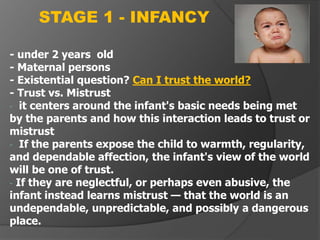
- under 2 years old
- Maternal persons
- Existential question? Can I trust the world?
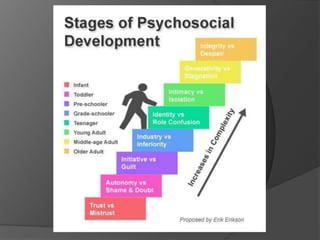
- Trust vs. Mistrust
- it centers around the infant's basic needs being met
by the parents and how this interaction leads to trust or
mistrust
- If the parents expose the child to warmth, regularity,
and dependable affection, the infant's view of the world
will be one of trust.
- If they are neglectful, or perhaps even abusive, the
infant instead learns mistrust — that the world is an
undependable, unpredictable, and possibly a dangerous
place.
STAGE 1 - INFANCY
- 2-4 years old
- Parents
- Existential question: Is it okay to be me?
- Autonomy vs. Shame and doubt
- the child begin to explore their surroundings.
- Parents still provide a strong base of security from which
the child can venture out to assert their will. The parents'
patience and encouragement helps foster autonomy in the
child.
-- At this age children develop their first interests.
-- If caregivers encourage self-sufficient behaviour, toddlers
develop a sense of autonomy—a sense of being able to
handle many problems on their own.
-- But if caregivers refuse to let children perform tasks of
which they are capable, children may instead develop shame
and doubt about their ability to handle problems.
STAGE 2 - TODDLERHOOD
- 4-5 years old
- Family
- Existential question: Is it okay for me to do, move, and act?
- Initiative vs. guilt
- The child is learning to master the world around them, learning basic
skills and principles of physics.
-- At this stage, the child wants to begin and complete their own
actions for a purpose. Guilt is a confusing new emotion. They may feel
guilty over things that logically should not cause guilt. They may feel
guilt when this initiative does not produce desired results.
-- If parents and preschool teachers encourage and support children's
efforts, while also helping them make realistic and appropriate
choices, children develop initiative—independence in planning and
undertaking activities. But if, instead, adults discourage the pursuit of
independent activities or dismiss them as silly and bothersome,
children develop guilt about their needs and desires.
STAGE 3 – EARLY
CHILDHOOD
- 5-12 years old
- Neighborhood, school
- Existential question: Can I make it in the world of people and things?
- Industry vs. Inferiority
- Children at this age are becoming more aware of themselves as
individuals
-At this stage, children might express their independence by talking
back and being disobedient and rebellious.
-- Erikson viewed the elementary school years as critical for the
development of self-confidence.
-At this age, children start recognizing their special talents and
continue to discover interests as their education improves. They may
begin to choose to do more activities to pursue that interest, such as
joining a sport if they know they have athletic ability, or joining the
band if they are good at music.
- If not allowed to discover their own talents in their own time, they will
develop a sense of lack of motivation, low self-esteem, and lethargy.
They may become "couch potatoes" if they are not allowed to develop
interests.
STAGE 4 – MIDDLE
CHILDHOOD
- 12-19 years old
- Peer
- Existential question:
Who am I? Who can I be?
- Identity vs. role
- The adolescent is newly concerned with how they appear to
others. Superego identity is the accrued confidence that the outer
sameness and continuity prepared in the future are matched by the
sameness and continuity of one's meaning for oneself, as
evidenced in the promise of a career.
-In later stages of adolescence, the child develops a sense
of sexual identity.
-- they are apt to experience some role confusion—mixed ideas and
feelings about the specific ways in which they will fit into society—
and may experiment with a variety of behaviors and activities (e.g.
tinkering with cars, baby-sitting for neighbors, affiliating with
certain political or religious groups). Eventually, Erikson proposed,
most adolescents achieve a sense of identity regarding who they
are and where their lives are headed.
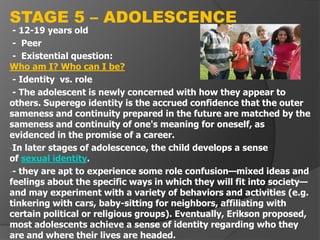
STAGE 5 – ADOLESCENCE
- 19-35 years old
- Friends, co-workers, sexual partners
- Existential question: Can I love?
- Intimacy vs. isolation
-At the start of this stage, identity vs. role confusion is coming to
an end, though it still lingers at the foundation of the stage. Young
adults are still eager to blend their identities with friends. They
want to fit in. Erikson believes we are sometimes isolated due to
intimacy. We are afraid of rejections such as being turned down or
our partners breaking up with us. We are familiar with pain and to
some of us rejection is so painful that our egos cannot bear it.
- Once people have established their identities, they are ready to
make long-term commitments to others. They become capable of
forming intimate, reciprocal relationships (e.g. through close
friendships or marriage) and willingly make the sacrifices and
compromises that such relationships require. If people cannot form
these intimate relationships—perhaps because of their own
needs—a sense of isolation may result; arousing feelings of
darkness and angst.
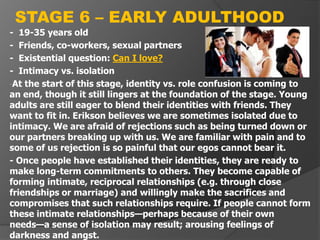
STAGE 6 – EARLY ADULTHOOD
- 35-65 years old
-Family (partner, children), community
- Existential question: Can I make my life count?
- Generosity vs. self absorption
- During middle age the primary developmental task is
one of contributing to society and helping to guide
future generations. When a person makes a
contribution during this period, perhaps by raising a
family or working toward the betterment of society,
- a sense of generativity—a sense of productivity and
accomplishment—results. In contrast, a person who is
self-centered and unable or unwilling to help society
move forward develops a feeling of stagnation—a
dissatisfaction with the relative lack of productivity.
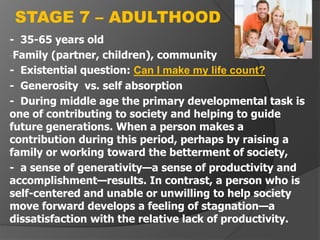
STAGE 7 – ADULTHOOD
- 65+
- Society, the world community
- Existential question: Is it okay to have been me?
- Integrity vs. despair
- As we grow older and become senior citizens we tend to slow
down our productivity and explore life as a retired person. It is
during this time that we contemplate our accomplishments and are
able to develop integrity if we see ourselves as leading a successful
life. If we see our life as unproductive, or feel that we did not
accomplish our life goals, we become dissatisfied with life and
develop despair, often leading to depression and hopelessness.
- The final developmental task is retrospection: people look back
on their lives and accomplishments. They develop feelings of
contentment and integrity if they believe that they have led a
happy, productive life. They may instead develop a sense of
despair if they look back on a life of disappointments and
unachieved goals.
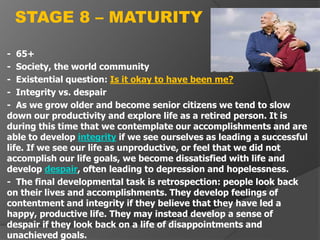
STAGE 8 – MATURITY
hhttps://www.slideshare.net/drburwell/erik-erikson-
312257?from_action=save
http://www.alanchapman.com/erik_erikson_psychosocial_theo
ry.htm
http://www.childdevelopmentinfo.com/development/erickson.s
html http://childstudy.net/erikson.php
http://webspace.ship.edu/cgboer/erikson.html
http://www.nndb.com/people/151/000097857/
http://www.nytimes.com/books/99/08/22/specials/erikson-
obit.html
http://www.phillwebb.net/History/TwentiethCentury/Continental/
Psychoanalysis/Erikson/Erickson.htm
http://www.nytimes.com/books/99/08/22/specials/erikson.html
http://education.stateuniversity.com/pages/1960/Erikson-Erik-
1902-1994.html Educational Psychology: Theory and Practice

psychosocialtheoryofintelligence-facilitatelearning-180910071224.pdf

  • 2.
  • 3.
    Erikson’s Psychosocial Theory comprehensivepsychoanalytic theory that identifies a series of eight stages that a healthy developing individual should pass through from infancy to late adulthood.
  • 4.
    Erikson’s Psychosocial Theory All stages are present at birth, but only begin to unfold according to both a natural scheme and one's ecological and cultural upbringing. In each stage, the person confronts, and hopefully masters, new challenges. Each stage builds upon the successful completion of earlier stages. The challenges of stages not successfully completed may be expected to return as problems in the future.
  • 5.
    Erikson’s Psychosocial Theory However,mastery of a stage is not required to advance to the next stage. The outcome of one stage is not permanent and can be modified by later experiences.
  • 8.
    - under 2years old - Maternal persons - Existential question? Can I trust the world? - Trust vs. Mistrust - it centers around the infant's basic needs being met by the parents and how this interaction leads to trust or mistrust - If the parents expose the child to warmth, regularity, and dependable affection, the infant's view of the world will be one of trust. - If they are neglectful, or perhaps even abusive, the infant instead learns mistrust — that the world is an undependable, unpredictable, and possibly a dangerous place. STAGE 1 - INFANCY
  • 9.
    - 2-4 yearsold - Parents - Existential question: Is it okay to be me? - Autonomy vs. Shame and doubt - the child begin to explore their surroundings. - Parents still provide a strong base of security from which the child can venture out to assert their will. The parents' patience and encouragement helps foster autonomy in the child. -- At this age children develop their first interests. -- If caregivers encourage self-sufficient behaviour, toddlers develop a sense of autonomy—a sense of being able to handle many problems on their own. -- But if caregivers refuse to let children perform tasks of which they are capable, children may instead develop shame and doubt about their ability to handle problems. STAGE 2 - TODDLERHOOD
  • 10.
    - 4-5 yearsold - Family - Existential question: Is it okay for me to do, move, and act? - Initiative vs. guilt - The child is learning to master the world around them, learning basic skills and principles of physics. -- At this stage, the child wants to begin and complete their own actions for a purpose. Guilt is a confusing new emotion. They may feel guilty over things that logically should not cause guilt. They may feel guilt when this initiative does not produce desired results. -- If parents and preschool teachers encourage and support children's efforts, while also helping them make realistic and appropriate choices, children develop initiative—independence in planning and undertaking activities. But if, instead, adults discourage the pursuit of independent activities or dismiss them as silly and bothersome, children develop guilt about their needs and desires. STAGE 3 – EARLY CHILDHOOD
  • 11.
    - 5-12 yearsold - Neighborhood, school - Existential question: Can I make it in the world of people and things? - Industry vs. Inferiority - Children at this age are becoming more aware of themselves as individuals -At this stage, children might express their independence by talking back and being disobedient and rebellious. -- Erikson viewed the elementary school years as critical for the development of self-confidence. -At this age, children start recognizing their special talents and continue to discover interests as their education improves. They may begin to choose to do more activities to pursue that interest, such as joining a sport if they know they have athletic ability, or joining the band if they are good at music. - If not allowed to discover their own talents in their own time, they will develop a sense of lack of motivation, low self-esteem, and lethargy. They may become "couch potatoes" if they are not allowed to develop interests. STAGE 4 – MIDDLE CHILDHOOD
  • 12.
    - 12-19 yearsold - Peer - Existential question: Who am I? Who can I be? - Identity vs. role - The adolescent is newly concerned with how they appear to others. Superego identity is the accrued confidence that the outer sameness and continuity prepared in the future are matched by the sameness and continuity of one's meaning for oneself, as evidenced in the promise of a career. -In later stages of adolescence, the child develops a sense of sexual identity. -- they are apt to experience some role confusion—mixed ideas and feelings about the specific ways in which they will fit into society— and may experiment with a variety of behaviors and activities (e.g. tinkering with cars, baby-sitting for neighbors, affiliating with certain political or religious groups). Eventually, Erikson proposed, most adolescents achieve a sense of identity regarding who they are and where their lives are headed. STAGE 5 – ADOLESCENCE
  • 13.
    - 19-35 yearsold - Friends, co-workers, sexual partners - Existential question: Can I love? - Intimacy vs. isolation -At the start of this stage, identity vs. role confusion is coming to an end, though it still lingers at the foundation of the stage. Young adults are still eager to blend their identities with friends. They want to fit in. Erikson believes we are sometimes isolated due to intimacy. We are afraid of rejections such as being turned down or our partners breaking up with us. We are familiar with pain and to some of us rejection is so painful that our egos cannot bear it. - Once people have established their identities, they are ready to make long-term commitments to others. They become capable of forming intimate, reciprocal relationships (e.g. through close friendships or marriage) and willingly make the sacrifices and compromises that such relationships require. If people cannot form these intimate relationships—perhaps because of their own needs—a sense of isolation may result; arousing feelings of darkness and angst. STAGE 6 – EARLY ADULTHOOD
  • 14.
    - 35-65 yearsold -Family (partner, children), community - Existential question: Can I make my life count? - Generosity vs. self absorption - During middle age the primary developmental task is one of contributing to society and helping to guide future generations. When a person makes a contribution during this period, perhaps by raising a family or working toward the betterment of society, - a sense of generativity—a sense of productivity and accomplishment—results. In contrast, a person who is self-centered and unable or unwilling to help society move forward develops a feeling of stagnation—a dissatisfaction with the relative lack of productivity. STAGE 7 – ADULTHOOD
  • 15.
    - 65+ - Society,the world community - Existential question: Is it okay to have been me? - Integrity vs. despair - As we grow older and become senior citizens we tend to slow down our productivity and explore life as a retired person. It is during this time that we contemplate our accomplishments and are able to develop integrity if we see ourselves as leading a successful life. If we see our life as unproductive, or feel that we did not accomplish our life goals, we become dissatisfied with life and develop despair, often leading to depression and hopelessness. - The final developmental task is retrospection: people look back on their lives and accomplishments. They develop feelings of contentment and integrity if they believe that they have led a happy, productive life. They may instead develop a sense of despair if they look back on a life of disappointments and unachieved goals. STAGE 8 – MATURITY
  • 16.