SOCIAL
INSTITUTIONS
WHAT IS A
SOCIAL
INSTITUTION?
SOCIAL INSTITUTIONS
- is a group of social
positions, connected by social
relations, performing a social role.
- it can also be defined in a
narrow sense as any institution in a
society that works to socialize the
groups of people in it.
Social Institutions
Examples:
Universities
Governments
Families
and any people or groups
that you have social interactions
with.
CHARACTERISTIC and FUNCTIONS of
an INSTITUTION
1.Institutions are purposive.
2.They are relatively permanent in
their content.
3.Institutions are structured.
4.Institutions are a unified.
5. institutions are necessary
value-laden.
Institutions have various
functions as follows:
1.Institutions simplify social behavior for the
individual person. The ways of thinking
and even acting have become largely
regularized and prearranged for the
individual before he enters in society .
Social institutions provide every child with
all the needed social and cultural
mechanisms through which he can grow
socially.
Institutions have various functions
as follows:
2. Institution, therefore, provide ready- made
forms of social relations and social roles for
the individual. The principal roles are not
invented by the individuals, they are provided
by the institutions.
3. Institutions also act as agencies of
coordination and stability for the total culture.
The ways of thinking and behaving that are
institutionalized “MAKE SENSE” to people.
Institutions have various functions as
follows:
4. Institutions tend to control behavior. They
contain the systematic expectations of the
society. Group behavior is often
subconsciously fixed through constant
repetition an where there is a need for
planning, the group can easily ascertain from
its institutions the normal modes, trends and
procedures.
Five major social institutions:
 Family
 Education
 Religion
 Economics
 Government
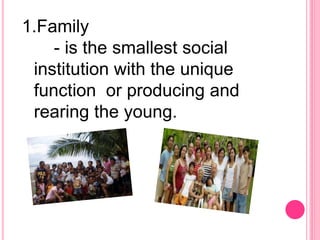
1.Family
- is the smallest social
institution with the unique
function or producing and
rearing the young.
Characteristics of the Filipino Family
 The family is closely knit and strong family
ties.
 The Filipino family is usually an extended
one and therefore, big.
In the Filipino family , kinship ties are
extended to include the “COMPADRE” or
SPONSORS.
 In the Asian family, a great difference exists
in the roles of man and woman. A woman’s
position is in the home and society is much
lower than that of man
What are the
functions of the
FAMILY?
Functions of the FAMILY
1.Reproduction of the race and rearing of the
young
2. Cultural transmission or enculturation
3.Socialization of the child
4.Providing affection and a sense of security
5.Providing the environment for personality
development and the growth of self-concept
in relation to others.
6. Providing social status
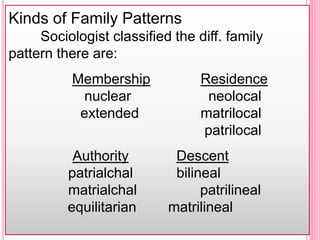
Kinds of Family Patterns
Sociologist classified the diff. family
pattern there are:
Membership Residence
nuclear neolocal
extended matrilocal
patrilocal
Authority Descent
patrialchal bilineal
matrialchal patrilineal
equilitarian matrilineal
The family may be classified in diff.
ways;
Accg. to structure:
* Conjugal or nuclear family
-is the primary or elementary family
consisting of husband , wife and children.
* Consanguine or extended family
- it consist of married couple. Their
parents, siblings, grandparents, uncles,
aunts and cousins.
Accg. to terms of marriage, there is
monogamy and polygamy
3 types of polygamy
* Polyandry
- where one woman is married to two
or more men at the same time.
* Polygamy
- where one man is married to two or
more women at the same time.
* Cenogamy
- where two or more men mate with
two or more women in group marriage.
As to line in Descent;
* Patrilineal
- when the descent is recognized
through the father’s line.
* Matrilineal
- when the descent is recognized
through the mother’s
line.
* Bilineal
- when the descent is recognized
through father’s and mother’s line.
Accg. to place of residence;
* Patrilocal
- when the newly married couple lives
with the parents of husband.
*Matrilocal
- when the newly married couple lives
with the parents of wife.
*Neolocal
- when the newly married pair maintains
a separate household and live by themselves.
With reference to authority (who is
considered head);
* Patrialchal
-when the father is considered the head
and plays a dominant role.
*Matrialchal
- when the mother or female is the head
and makes the major decisions.
*Equilitarian
-when both father and mother share in
making decisions and are equal in authority.
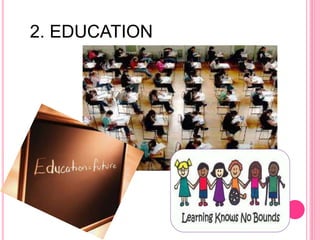
2. EDUCATION
EDUCATION
-the basic purpose of education is
the transmission of knowledge. While
before education was a family
responsibility, along with the
community and the church,
industrialization changed dramatically.
What are the
functions of
SCHOOL?
McNergney and Herbert(2001)
described the SCHOOL as the first and
foremost a social institution, that is an
established organization having an
identifiable structure and a set of
functions meant o preserve and extend
social order. As such its primary
function is to move young people in
the mainstream of society.
The currricula, teaching ,process of
evaluation and relationships among people
reinforce a public image to which young
people are expected to aspire. His image is
concerned with preserving our heritage,
adapting to social change and making change
happen where it is needed.
The school is a place for the
contemplation of reality, and our task as
teachers in simplest terms is to show this
reality to our students, who are naturally
eager about them.
At home, we teach reality to
children in a profound personal,
informal and unstructured way.
In school , we teach reality in
professional, formal and structured
way. Hence, in school there is a set of
curriculum which includes knowledge
subjects, skills subjects and enabling
subjects
There are teachers who facilitate
learning, who teach children and youth
certain types of acceptable behavior and
sees to it that children develop in all
aspects:
 physically
Emotionally
Socially and
Academically
The INTELLECTUAL purposes of
schooling include the ff.:
 to teach basic cognitive skills such as
reading, writing and mathematics;
 to transmit specific knowledge and
 to help students acquire higher –order
thinking skills such as analysis, evaluation
and synthesis.
The POLITICAL purposes of
schooling are:
to inculcate allegiance to the existing
political order (patriotism);
 to prepare citizens who will participate in
the political order ;
to help assimilate diverse cultural
groups into a common political order and
to teach children basic laws of society.
The SOCIAL purposes of schooling are:
 to socialize children into the various
roles, behavior and values of society
 to help solve social problems.
The ECONOMIC purposes of schooling
are:
 to prepare students for their later
occupational roles;
 to select train and allocate individuals
into the division of labor,
In a paper “Multiplicity of School
Functions in the New Century”
presented at the conference jointly
organized by Educational Research
Association Singapore and Australian
Association for Research in Education,
Yin Cheong Cheng (1996) suggested
that there are multiple school functions
including technical/ economic functions,
human/social, political, cultural,
educational functions
TECHNICAL/ ECONOMIC FUNCTIONS
☺At the individual level, school can help students to
acquire knowledge and skills necessary to survive and
compete in a modern society or a competitive economy
and provide staff job training and opportunity.
☺ At the institutional level, schools are service
organizations providing quality service, also they serve as
a life place or a work place of society for clients,
employers and all those concerned.
☺At the community and society level, school serve the
economic or instrumental needs of the local community,
supply quality labors forces to the economic system,
modify or shape economic behaviors or students.
☺ At the international level, school education supplies the
high quality forces necessary in international competitions,
economic cooperation, earth protection, tech. and
information exchange.
HUMAN/ SOCIAL FUNCTIONS
☺At the individual level, schools help develop students to
develop themselves psychologically, socially and physically,
and help them develop their potential as fully as possible.
☺At the institutional level, a school is a social entity or
social system composed of diff. human relationships.
Therefore one of the important school functions is to
provide the environment of quality.
☺ At the community and society, accg. to the perspective
of functionalism, school serve the social needs or functions
of the local community, support social integration of multiple
and diverse constituencies of society.
☺At the international level, such that both the local and
international community can benefit in the long run.
POLITICAL FUNCTIONS
☺ At the individual level, schools help students to
develop positive civic attitudes and skills to exercise the
rights and responsibilities of citizenship.
☺At the international level, schools act as a place for
systematically socializing students into a set of political
norms, values and beliefs or for critically discussing and
reflecting on the existing political events.
☺ At the community and society level, schools play an
important role to serve the political needs to the local
community, maintain the stability of the political structure,
promote awareness and movement of democracy, and
facilitate the planned political dev. changes.
CULTURAL FUNCTIONS
☺ At the individual level, schools help students to
develop their creativity and aesthetic awareness and to
be socialized w/ the successful norms, values and beliefs
of society.
☺ At the institutional level, schools act as a place for
systematic cultural transmission to and reproduction of
the next generation.
☺At the community and society level, schools often
serve as cultural unit carrying the explicit norms and
expectations of the local community.
☺At the international level, schools can encourage
appreciation of cultural diversity and acceptance of diff.
norms, traditions, values and belies in diff. countries and
regions and finally contribute to the dev. of global culture
through integration of diff. cultures.
EDUCATION FUNCTIONS
☺ At the individual level, it is important for schools to
help students to learn how to learn and help teachers to
learn how to teach. Also, facilitating teachers’
professional dev. is one of the key functions of this level.
☺ At the institutional level, schools serve as a systematic
place for systematic learning, teaching, and
disseminating knowledge, and as a center for
systematically experimenting and implementing
educational changes and dev.
☺ At the community and society, schools provide service
for diff. educational needs of the local community.
☺ At the international, school can make an important
contribution to education for the whole world
Are you aware of
the manifest
and latent
functions of
education?
The manifest functions of education are
defined as the open an intended goals or
consequences of activities w/in an organization
or institution. There are six major manifest
functions of education in society :
1. Socialization
2. Social control
3. Social placement
4. Transmitting culture
5. Promoting social and political integration
6. Agent of change
In addition to manifest functions all social
institutions, including education , have some
latent functions, the hidden, unstated and
sometimes unintended consequences of
activities w/in an organization or institution.
These LATENT FUNCTIONS are:
1. Restricting some activities
2. Matchmaking and production of social
networks
3. Creation of generation gap
The functions of schools as stated by
CALDERON(1998) are as follows:
1. Conservation function
2. Instructional function
3. Research function
4. Social service function
3. RELIGION
- is the socially defined patterns of beliefs
concerning the ultimate meaning of life; it assumes
the existence of the supernatural (STARK)
Social dimension

Social dimension

  • 1.
  • 2.
  • 3.
    SOCIAL INSTITUTIONS - isa group of social positions, connected by social relations, performing a social role. - it can also be defined in a narrow sense as any institution in a society that works to socialize the groups of people in it.
  • 4.
    Social Institutions Examples: Universities Governments Families and anypeople or groups that you have social interactions with.
  • 5.
    CHARACTERISTIC and FUNCTIONSof an INSTITUTION 1.Institutions are purposive. 2.They are relatively permanent in their content. 3.Institutions are structured. 4.Institutions are a unified. 5. institutions are necessary value-laden.
  • 6.
    Institutions have various functionsas follows: 1.Institutions simplify social behavior for the individual person. The ways of thinking and even acting have become largely regularized and prearranged for the individual before he enters in society . Social institutions provide every child with all the needed social and cultural mechanisms through which he can grow socially.
  • 7.
    Institutions have variousfunctions as follows: 2. Institution, therefore, provide ready- made forms of social relations and social roles for the individual. The principal roles are not invented by the individuals, they are provided by the institutions. 3. Institutions also act as agencies of coordination and stability for the total culture. The ways of thinking and behaving that are institutionalized “MAKE SENSE” to people.
  • 8.
    Institutions have variousfunctions as follows: 4. Institutions tend to control behavior. They contain the systematic expectations of the society. Group behavior is often subconsciously fixed through constant repetition an where there is a need for planning, the group can easily ascertain from its institutions the normal modes, trends and procedures.
  • 9.
    Five major socialinstitutions:  Family  Education  Religion  Economics  Government
  • 10.
    1.Family - is thesmallest social institution with the unique function or producing and rearing the young.
  • 11.
    Characteristics of theFilipino Family  The family is closely knit and strong family ties.  The Filipino family is usually an extended one and therefore, big. In the Filipino family , kinship ties are extended to include the “COMPADRE” or SPONSORS.  In the Asian family, a great difference exists in the roles of man and woman. A woman’s position is in the home and society is much lower than that of man
  • 12.
    What are the functionsof the FAMILY?
  • 13.
    Functions of theFAMILY 1.Reproduction of the race and rearing of the young 2. Cultural transmission or enculturation 3.Socialization of the child 4.Providing affection and a sense of security 5.Providing the environment for personality development and the growth of self-concept in relation to others. 6. Providing social status
  • 14.
    Kinds of FamilyPatterns Sociologist classified the diff. family pattern there are: Membership Residence nuclear neolocal extended matrilocal patrilocal Authority Descent patrialchal bilineal matrialchal patrilineal equilitarian matrilineal
  • 15.
    The family maybe classified in diff. ways; Accg. to structure: * Conjugal or nuclear family -is the primary or elementary family consisting of husband , wife and children. * Consanguine or extended family - it consist of married couple. Their parents, siblings, grandparents, uncles, aunts and cousins.
  • 16.
    Accg. to termsof marriage, there is monogamy and polygamy 3 types of polygamy * Polyandry - where one woman is married to two or more men at the same time. * Polygamy - where one man is married to two or more women at the same time. * Cenogamy - where two or more men mate with two or more women in group marriage.
  • 17.
    As to linein Descent; * Patrilineal - when the descent is recognized through the father’s line. * Matrilineal - when the descent is recognized through the mother’s line. * Bilineal - when the descent is recognized through father’s and mother’s line.
  • 18.
    Accg. to placeof residence; * Patrilocal - when the newly married couple lives with the parents of husband. *Matrilocal - when the newly married couple lives with the parents of wife. *Neolocal - when the newly married pair maintains a separate household and live by themselves.
  • 19.
    With reference toauthority (who is considered head); * Patrialchal -when the father is considered the head and plays a dominant role. *Matrialchal - when the mother or female is the head and makes the major decisions. *Equilitarian -when both father and mother share in making decisions and are equal in authority.
  • 20.
  • 21.
    EDUCATION -the basic purposeof education is the transmission of knowledge. While before education was a family responsibility, along with the community and the church, industrialization changed dramatically.
  • 22.
  • 23.
    McNergney and Herbert(2001) describedthe SCHOOL as the first and foremost a social institution, that is an established organization having an identifiable structure and a set of functions meant o preserve and extend social order. As such its primary function is to move young people in the mainstream of society.
  • 24.
    The currricula, teaching,process of evaluation and relationships among people reinforce a public image to which young people are expected to aspire. His image is concerned with preserving our heritage, adapting to social change and making change happen where it is needed. The school is a place for the contemplation of reality, and our task as teachers in simplest terms is to show this reality to our students, who are naturally eager about them.
  • 25.
    At home, weteach reality to children in a profound personal, informal and unstructured way. In school , we teach reality in professional, formal and structured way. Hence, in school there is a set of curriculum which includes knowledge subjects, skills subjects and enabling subjects
  • 26.
    There are teacherswho facilitate learning, who teach children and youth certain types of acceptable behavior and sees to it that children develop in all aspects:  physically Emotionally Socially and Academically
  • 27.
    The INTELLECTUAL purposesof schooling include the ff.:  to teach basic cognitive skills such as reading, writing and mathematics;  to transmit specific knowledge and  to help students acquire higher –order thinking skills such as analysis, evaluation and synthesis.
  • 28.
    The POLITICAL purposesof schooling are: to inculcate allegiance to the existing political order (patriotism);  to prepare citizens who will participate in the political order ; to help assimilate diverse cultural groups into a common political order and to teach children basic laws of society.
  • 29.
    The SOCIAL purposesof schooling are:  to socialize children into the various roles, behavior and values of society  to help solve social problems. The ECONOMIC purposes of schooling are:  to prepare students for their later occupational roles;  to select train and allocate individuals into the division of labor,
  • 30.
    In a paper“Multiplicity of School Functions in the New Century” presented at the conference jointly organized by Educational Research Association Singapore and Australian Association for Research in Education, Yin Cheong Cheng (1996) suggested that there are multiple school functions including technical/ economic functions, human/social, political, cultural, educational functions
  • 31.
    TECHNICAL/ ECONOMIC FUNCTIONS ☺Atthe individual level, school can help students to acquire knowledge and skills necessary to survive and compete in a modern society or a competitive economy and provide staff job training and opportunity. ☺ At the institutional level, schools are service organizations providing quality service, also they serve as a life place or a work place of society for clients, employers and all those concerned. ☺At the community and society level, school serve the economic or instrumental needs of the local community, supply quality labors forces to the economic system, modify or shape economic behaviors or students. ☺ At the international level, school education supplies the high quality forces necessary in international competitions, economic cooperation, earth protection, tech. and information exchange.
  • 32.
    HUMAN/ SOCIAL FUNCTIONS ☺Atthe individual level, schools help develop students to develop themselves psychologically, socially and physically, and help them develop their potential as fully as possible. ☺At the institutional level, a school is a social entity or social system composed of diff. human relationships. Therefore one of the important school functions is to provide the environment of quality. ☺ At the community and society, accg. to the perspective of functionalism, school serve the social needs or functions of the local community, support social integration of multiple and diverse constituencies of society. ☺At the international level, such that both the local and international community can benefit in the long run.
  • 33.
    POLITICAL FUNCTIONS ☺ Atthe individual level, schools help students to develop positive civic attitudes and skills to exercise the rights and responsibilities of citizenship. ☺At the international level, schools act as a place for systematically socializing students into a set of political norms, values and beliefs or for critically discussing and reflecting on the existing political events. ☺ At the community and society level, schools play an important role to serve the political needs to the local community, maintain the stability of the political structure, promote awareness and movement of democracy, and facilitate the planned political dev. changes.
  • 34.
    CULTURAL FUNCTIONS ☺ Atthe individual level, schools help students to develop their creativity and aesthetic awareness and to be socialized w/ the successful norms, values and beliefs of society. ☺ At the institutional level, schools act as a place for systematic cultural transmission to and reproduction of the next generation. ☺At the community and society level, schools often serve as cultural unit carrying the explicit norms and expectations of the local community. ☺At the international level, schools can encourage appreciation of cultural diversity and acceptance of diff. norms, traditions, values and belies in diff. countries and regions and finally contribute to the dev. of global culture through integration of diff. cultures.
  • 35.
    EDUCATION FUNCTIONS ☺ Atthe individual level, it is important for schools to help students to learn how to learn and help teachers to learn how to teach. Also, facilitating teachers’ professional dev. is one of the key functions of this level. ☺ At the institutional level, schools serve as a systematic place for systematic learning, teaching, and disseminating knowledge, and as a center for systematically experimenting and implementing educational changes and dev. ☺ At the community and society, schools provide service for diff. educational needs of the local community. ☺ At the international, school can make an important contribution to education for the whole world
  • 36.
    Are you awareof the manifest and latent functions of education?
  • 37.
    The manifest functionsof education are defined as the open an intended goals or consequences of activities w/in an organization or institution. There are six major manifest functions of education in society : 1. Socialization 2. Social control 3. Social placement 4. Transmitting culture 5. Promoting social and political integration 6. Agent of change
  • 38.
    In addition tomanifest functions all social institutions, including education , have some latent functions, the hidden, unstated and sometimes unintended consequences of activities w/in an organization or institution. These LATENT FUNCTIONS are: 1. Restricting some activities 2. Matchmaking and production of social networks 3. Creation of generation gap
  • 39.
    The functions ofschools as stated by CALDERON(1998) are as follows: 1. Conservation function 2. Instructional function 3. Research function 4. Social service function
  • 40.
    3. RELIGION - isthe socially defined patterns of beliefs concerning the ultimate meaning of life; it assumes the existence of the supernatural (STARK)