SOCIAL
INSTITUTIONS
CHAPTER VI
Learning Outcomes

 Identify and describe the characteristics
and functions of different social
institutions
 Explain and illustrate the various types

of governments

 Discuss the relationships between
economy and education
 Show the interrelationships among the
social institutions
Characteristics and Functions of
an institution
1.Institutions are purposive .
2.They are relatively permanent in
their content.
3.Institutions are structured .
4.Institutions are unified structure.
5.Institutions are necessary value-
laden.
.
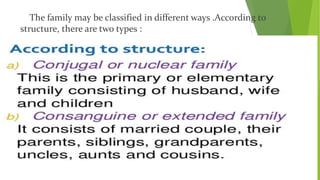
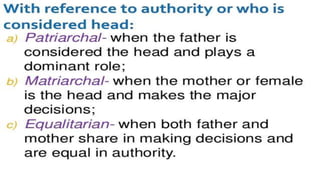
The family may be classified in different ways .According to
structure, there are two types :
Summary
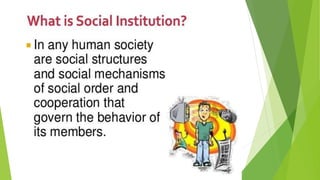
In the human society there are social structures and social mechanisms of
social order and cooperation that govern the behavior of its members. These are
called social institutions and according to functions and according to functional
theorist, they perform five essential task namely: 1) replacing members or
precreation; 2) teaching new members;3)producing ,distributing , and consuming
goods and services ;4)preserving orders and 5)providing and maintaining a sense
of purpose.
Institutions tend to appear to people in society as part of the natural ,
unchanging landscape of their lives .Sociology traditionally analyzed social
institutions such as family ,education ,religion ,economic and government , in
terms of interlocking social roles and expectations. They are created and are
composed of groups of roles or expected behaviors.
The social function of the institutions is determined by the fulfillment of its roles
and functions in society.
Social Institutions Chapter VI

Social Institutions Chapter VI

  • 1.
  • 2.
    Learning Outcomes  Identifyand describe the characteristics and functions of different social institutions  Explain and illustrate the various types of governments  Discuss the relationships between economy and education  Show the interrelationships among the social institutions
  • 5.
    Characteristics and Functionsof an institution 1.Institutions are purposive . 2.They are relatively permanent in their content. 3.Institutions are structured . 4.Institutions are unified structure. 5.Institutions are necessary value- laden.
  • 10.
  • 17.
    The family maybe classified in different ways .According to structure, there are two types :
  • 80.
    Summary In the humansociety there are social structures and social mechanisms of social order and cooperation that govern the behavior of its members. These are called social institutions and according to functions and according to functional theorist, they perform five essential task namely: 1) replacing members or precreation; 2) teaching new members;3)producing ,distributing , and consuming goods and services ;4)preserving orders and 5)providing and maintaining a sense of purpose. Institutions tend to appear to people in society as part of the natural , unchanging landscape of their lives .Sociology traditionally analyzed social institutions such as family ,education ,religion ,economic and government , in terms of interlocking social roles and expectations. They are created and are composed of groups of roles or expected behaviors. The social function of the institutions is determined by the fulfillment of its roles and functions in society.