
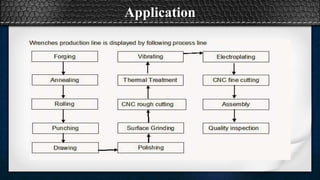
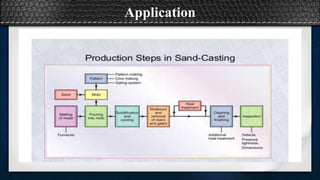
Application
Application
Inspection
• Inspection is the most common method of attaining standardization,
uniformity and quality of workmanship.
• It is the cost art of controlling the product quality after comparison
with the established standards and specifications.
• It is the function of quality control.
• If the said item does not fall within the zone of acceptability it will
be rejected and corrective measure will be applied to see that the
items in future conform to specified standards.
• Inspection is an indispensable tool of modern manufacturing
process. It helps to control quality, reduces manufacturing costs,
eliminate scrap losses and assignable causes of defective work.
Objectives of Inspection
1. To collect information regarding the performance of the
product with established standards for the use of engineering
production, purchasing and quality control etc.
2. To sort out poor quality of manufactured product and thus to
maintain standards.
3. To establish and increase the reputation by protecting
customers from receiving poor quality products.
4. Detect source of weakness and failure in the finished products
and thus check the work of designer.
Purpose of Inspection
1. To distinguish good lots from bad lots
2. To distinguish good pieces from bad pieces.
3. To determine if the process is changing.
4. To determine if the process is approaching the specification limits.
5. To rate quality of product.
6. To rate accuracy of inspectors.
7. To measure the precision of the measuring instrument.
8. To secure products – design information.
9. To measure process capability.
Methods of Inspection
There are two methods of inspection.
1. 100% Inspection:
– This type will involve careful inspection in detail of quality at each
strategic point or stage of manufacture where the test involved is non-
destructive and every piece is separately inspected. It requires more
number of inspectors and hence it is a costly method.
– There is no sampling error. This is subjected to inspection error arising out
of fatigue, negligence, difficulty of supervision etc. Hence complete
accuracy of
– It is suitable only when a small number of pieces are there or a very high
degree of quality is required.
– Example: Jet engines, Aircraft, Medical and Scientific equipment.
Methods of Inspection
2. Sampling Inspection:
– In this method randomly selected samples are inspected.
Samples taken from different batches of products are
representatives.
– If the sample prove defective.
– The entire concerned is to be rejected or recovered.
– Sampling inspection is cheaper and quicker.
– It requires less number of Inspectors.
Methods of Inspection
2.Sampling Inspection:
– In the case of destructive test, random or sampling
inspection is desirable.
– which have less precision importance and are less costly.
– Example: Electrical bulbs, washing machine etc.
– Destructive tests conducted for the products whose
endurance or ultimate strength properties are required.
Drawbacks of Inspection
1. Inspection adds to the cost of the product but not for its value.
2. It is partially subjective, often the inspector has to judge whether a
product passes or not.
3. Example: Inspector discovering a slight burnish on a surface must
decide whether it is bad enough to justify rejection even with
micrometers a tight or loose fit change measurement by say 0.0006
inches. The inspectors design is important as he enforces quality
standards.
4. Fatigue and Monotony may affect any inspection judgment.
5. Inspection merely separates good and bad items. It is no way to
prevent the production of bad items.

Inspection

  • 2.
  • 3.
  • 4.
    Inspection • Inspection isthe most common method of attaining standardization, uniformity and quality of workmanship. • It is the cost art of controlling the product quality after comparison with the established standards and specifications. • It is the function of quality control. • If the said item does not fall within the zone of acceptability it will be rejected and corrective measure will be applied to see that the items in future conform to specified standards. • Inspection is an indispensable tool of modern manufacturing process. It helps to control quality, reduces manufacturing costs, eliminate scrap losses and assignable causes of defective work.
  • 5.
    Objectives of Inspection 1.To collect information regarding the performance of the product with established standards for the use of engineering production, purchasing and quality control etc. 2. To sort out poor quality of manufactured product and thus to maintain standards. 3. To establish and increase the reputation by protecting customers from receiving poor quality products. 4. Detect source of weakness and failure in the finished products and thus check the work of designer.
  • 6.
    Purpose of Inspection 1.To distinguish good lots from bad lots 2. To distinguish good pieces from bad pieces. 3. To determine if the process is changing. 4. To determine if the process is approaching the specification limits. 5. To rate quality of product. 6. To rate accuracy of inspectors. 7. To measure the precision of the measuring instrument. 8. To secure products – design information. 9. To measure process capability.
  • 7.
    Methods of Inspection Thereare two methods of inspection. 1. 100% Inspection: – This type will involve careful inspection in detail of quality at each strategic point or stage of manufacture where the test involved is non- destructive and every piece is separately inspected. It requires more number of inspectors and hence it is a costly method. – There is no sampling error. This is subjected to inspection error arising out of fatigue, negligence, difficulty of supervision etc. Hence complete accuracy of – It is suitable only when a small number of pieces are there or a very high degree of quality is required. – Example: Jet engines, Aircraft, Medical and Scientific equipment.
  • 8.
    Methods of Inspection 2.Sampling Inspection: – In this method randomly selected samples are inspected. Samples taken from different batches of products are representatives. – If the sample prove defective. – The entire concerned is to be rejected or recovered. – Sampling inspection is cheaper and quicker. – It requires less number of Inspectors.
  • 9.
    Methods of Inspection 2.SamplingInspection: – In the case of destructive test, random or sampling inspection is desirable. – which have less precision importance and are less costly. – Example: Electrical bulbs, washing machine etc. – Destructive tests conducted for the products whose endurance or ultimate strength properties are required.
  • 10.
    Drawbacks of Inspection 1.Inspection adds to the cost of the product but not for its value. 2. It is partially subjective, often the inspector has to judge whether a product passes or not. 3. Example: Inspector discovering a slight burnish on a surface must decide whether it is bad enough to justify rejection even with micrometers a tight or loose fit change measurement by say 0.0006 inches. The inspectors design is important as he enforces quality standards. 4. Fatigue and Monotony may affect any inspection judgment. 5. Inspection merely separates good and bad items. It is no way to prevent the production of bad items.