IPQCIn-Process Quality Control
M K Printpack Pvt. Ltd.
“QUALITY IS NOT AN
ACCIDENT, BUT IT IS THE
RESULT OF INTELLIGENT
EFFORTS”
WHAT IS QUALITY?
“The totality of features and characteristics of a product or service that
bear on its ability to satisfy a given need.”
“Quality is fitness for use. ”
“Quality involves meeting customers need, preferences and exceeding it.”
“Quality also encompasses people, process and environment.”
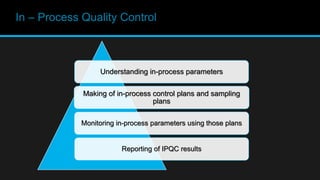
In – Process Quality Control
Understanding in-process parameters
Making of in-process control plans and sampling
plans
Monitoring in-process parameters using those plans
Reporting of IPQC results
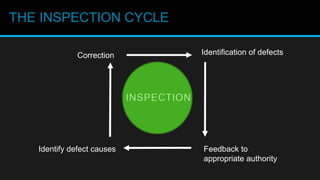
Identification of defects
Feedback to
appropriate authority
Identify defect causes
Correction
THE INSPECTION CYCLE
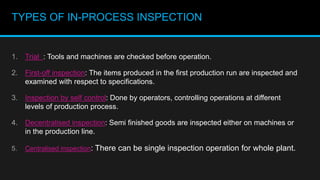
TYPES OF IN-PROCESS INSPECTION
1. Trial : Tools and machines are checked before operation.
2. First-off inspection: The items produced in the first production run are inspected and
examined with respect to specifications.
3. Inspection by self control: Done by operators, controlling operations at different
levels of production process.
4. Decentralised inspection: Semi finished goods are inspected either on machines or
in the production line.
5. Centralised inspection: There can be single inspection operation for whole plant.
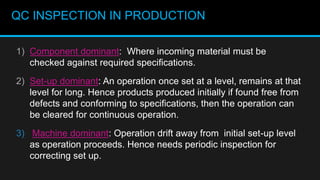
QC INSPECTION IN PRODUCTION
1) Component dominant: Where incoming material must be
checked against required specifications.
2) Set-up dominant: An operation once set at a level, remains at that
level for long. Hence products produced initially if found free from
defects and conforming to specifications, then the operation can
be cleared for continuous operation.
3) Machine dominant: Operation drift away from initial set-up level
as operation proceeds. Hence needs periodic inspection for
correcting set up.
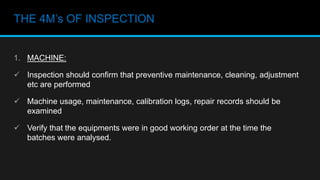
THE 4M’s OF INSPECTION
1. MACHINE:
 Inspection should confirm that preventive maintenance, cleaning, adjustment
etc are performed
 Machine usage, maintenance, calibration logs, repair records should be
examined
 Verify that the equipments were in good working order at the time the
batches were analysed.
INSPECTION - the 4M’s
2. METHOD / PROCESS:
Information regarding validation of methods should be carefully evaluated
All processes that may cause deviation to a device’s specification and all
validated process must be monitored and controlled
If the process is software controlled, confirm that the software was validated
INSPECTION - the 4M’s
3. MATERIALS:
 Raw material testing is of utmost importance as it directly affects the quality of
final product
 Hence inspection should examine the analysis of materials including purity test,
quality, charts etc
 Inspect if the methods for analysing the purity were validated
 The QC personnel must have complete knowledge of manufacturing process and
the potential impurities that may appear in materials.
 These impurities cannot be evaluated by without a suitable method and one that
has been validated.
INSPECTION - the 4M’s
4. MAN:
 Verify that personnel have been qualified to implement validated processes or
 appropriately trained to implement processes which yield results that can be fully
verified
 Confirm that the employees have complete knowledge of the devices &
processes
 Confirm that employees are aware of the device defects that may occur as a
result of improper performances
 Confirm that the employees conducting QC tests are aware of the defects and
errors that may be encountered while performing their responsibilities
FINAL INSPECTION
• It is also sometimes known as “pre-shipment” inspection.
• This is the most popular type of QC inspection in manufacturing
industry.
• It takes place once production is over and the products are ready
for shipment in their final form.
• The samples are drawn in a random manner and thus can be said
to be representative of the whole batch.
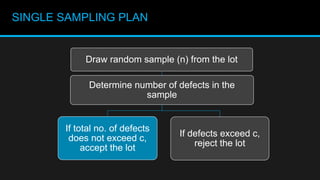
SINGLE SAMPLING PLAN
Draw random sample (n) from the lot
Determine number of defects in the
sample
If total no. of defects
does not exceed c,
accept the lot
If defects exceed c,
reject the lot
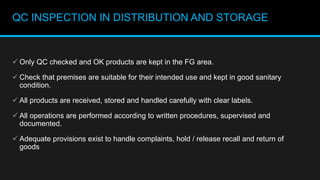
QC INSPECTION IN DISTRIBUTION AND STORAGE
 Only QC checked and OK products are kept in the FG area.
 Check that premises are suitable for their intended use and kept in good sanitary
condition.
 All products are received, stored and handled carefully with clear labels.
 All operations are performed according to written procedures, supervised and
documented.
 Adequate provisions exist to handle complaints, hold / release recall and return of
goods
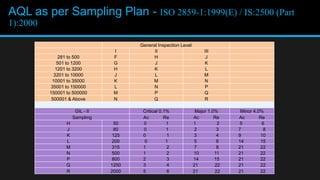
AQL as per Sampling Plan - ISO 2859-1:1999(E) / IS:2500 (Part
1):2000
General Inspection Level
I II III
281 to 500 F H J
501 to 1200 G J K
1201 to 3200 H K L
3201 to 10000 J L M
10001 to 35000 K M N
35001 to 150000 L N P
150001 to 500000 M P Q
500001 & Above N Q R
GIL - II Critical 0.1% Major 1.0% Minor 4.0%
Sampling Ac Re Ac Re Ac Re
H 50 0 1 1 2 5 6
J 80 0 1 2 3 7 8
K 125 0 1 3 4 9 10
L 200 0 1 5 6 14 15
M 315 1 2 7 8 21 22
N 500 1 2 10 11 21 22
P 800 2 3 14 15 21 22
Q 1250 3 4 21 22 21 22
R 2000 5 6 21 22 21 22
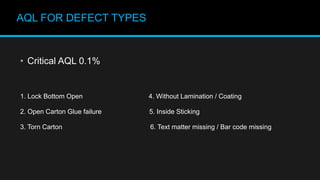
AQL FOR DEFECT TYPES
• Critical AQL 0.1%
1. Lock Bottom Open 4. Without Lamination / Coating
2. Open Carton Glue failure 5. Inside Sticking
3. Torn Carton 6. Text matter missing / Bar code missing
AQL FOR DEFECT TYPES
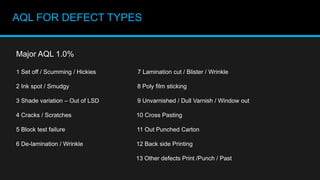
Major AQL 1.0%
1 Set off / Scumming / Hickies 7 Lamination cut / Blister / Wrinkle
2 Ink spot / Smudgy 8 Poly film sticking
3 Shade variation – Out of LSD 9 Unvarnished / Dull Varnish / Window out
4 Cracks / Scratches 10 Cross Pasting
5 Block test failure 11 Out Punched Carton
6 De-lamination / Wrinkle 12 Back side Printing
13 Other defects Print /Punch / Past
AQL FOR DEFECT TYPES
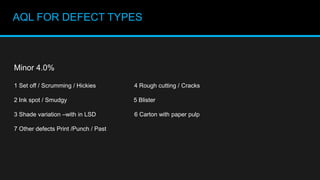
Minor 4.0%
1 Set off / Scrumming / Hickies 4 Rough cutting / Cracks
2 Ink spot / Smudgy 5 Blister
3 Shade variation –with in LSD 6 Carton with paper pulp
7 Other defects Print /Punch / Past
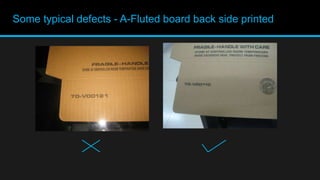
Some typical defects - A-Fluted board back side printed
Some typical defects – Shade variation
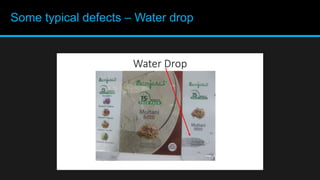
Some typical defects – Water drop
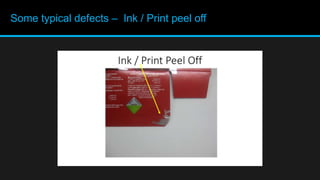
Some typical defects – Ink / Print peel off
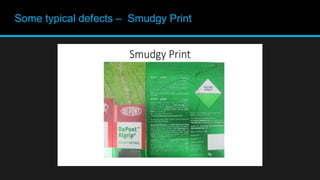
Some typical defects – Smudgy Print
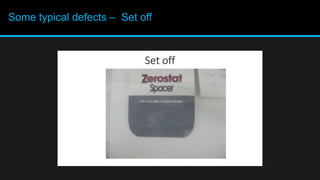
Some typical defects – Set off
CONCLUSION
• Quality is a never ending journey.....
• Quality control is a strategic component of our business.
• That is why quality inspection forms a critical part of company’s
strategic objective.
THANK YOU

Inspection and Quality Control.pptx

  • 1.
    IPQCIn-Process Quality Control MK Printpack Pvt. Ltd.
  • 2.
    “QUALITY IS NOTAN ACCIDENT, BUT IT IS THE RESULT OF INTELLIGENT EFFORTS”
  • 3.
    WHAT IS QUALITY? “Thetotality of features and characteristics of a product or service that bear on its ability to satisfy a given need.” “Quality is fitness for use. ” “Quality involves meeting customers need, preferences and exceeding it.” “Quality also encompasses people, process and environment.”
  • 4.
    In – ProcessQuality Control Understanding in-process parameters Making of in-process control plans and sampling plans Monitoring in-process parameters using those plans Reporting of IPQC results
  • 5.
    Identification of defects Feedbackto appropriate authority Identify defect causes Correction THE INSPECTION CYCLE
  • 6.
    TYPES OF IN-PROCESSINSPECTION 1. Trial : Tools and machines are checked before operation. 2. First-off inspection: The items produced in the first production run are inspected and examined with respect to specifications. 3. Inspection by self control: Done by operators, controlling operations at different levels of production process. 4. Decentralised inspection: Semi finished goods are inspected either on machines or in the production line. 5. Centralised inspection: There can be single inspection operation for whole plant.
  • 7.
    QC INSPECTION INPRODUCTION 1) Component dominant: Where incoming material must be checked against required specifications. 2) Set-up dominant: An operation once set at a level, remains at that level for long. Hence products produced initially if found free from defects and conforming to specifications, then the operation can be cleared for continuous operation. 3) Machine dominant: Operation drift away from initial set-up level as operation proceeds. Hence needs periodic inspection for correcting set up.
  • 8.
    THE 4M’s OFINSPECTION 1. MACHINE:  Inspection should confirm that preventive maintenance, cleaning, adjustment etc are performed  Machine usage, maintenance, calibration logs, repair records should be examined  Verify that the equipments were in good working order at the time the batches were analysed.
  • 9.
    INSPECTION - the4M’s 2. METHOD / PROCESS: Information regarding validation of methods should be carefully evaluated All processes that may cause deviation to a device’s specification and all validated process must be monitored and controlled If the process is software controlled, confirm that the software was validated
  • 10.
    INSPECTION - the4M’s 3. MATERIALS:  Raw material testing is of utmost importance as it directly affects the quality of final product  Hence inspection should examine the analysis of materials including purity test, quality, charts etc  Inspect if the methods for analysing the purity were validated  The QC personnel must have complete knowledge of manufacturing process and the potential impurities that may appear in materials.  These impurities cannot be evaluated by without a suitable method and one that has been validated.
  • 11.
    INSPECTION - the4M’s 4. MAN:  Verify that personnel have been qualified to implement validated processes or  appropriately trained to implement processes which yield results that can be fully verified  Confirm that the employees have complete knowledge of the devices & processes  Confirm that employees are aware of the device defects that may occur as a result of improper performances  Confirm that the employees conducting QC tests are aware of the defects and errors that may be encountered while performing their responsibilities
  • 12.
    FINAL INSPECTION • Itis also sometimes known as “pre-shipment” inspection. • This is the most popular type of QC inspection in manufacturing industry. • It takes place once production is over and the products are ready for shipment in their final form. • The samples are drawn in a random manner and thus can be said to be representative of the whole batch.
  • 13.
    SINGLE SAMPLING PLAN Drawrandom sample (n) from the lot Determine number of defects in the sample If total no. of defects does not exceed c, accept the lot If defects exceed c, reject the lot
  • 14.
    QC INSPECTION INDISTRIBUTION AND STORAGE  Only QC checked and OK products are kept in the FG area.  Check that premises are suitable for their intended use and kept in good sanitary condition.  All products are received, stored and handled carefully with clear labels.  All operations are performed according to written procedures, supervised and documented.  Adequate provisions exist to handle complaints, hold / release recall and return of goods
  • 15.
    AQL as perSampling Plan - ISO 2859-1:1999(E) / IS:2500 (Part 1):2000 General Inspection Level I II III 281 to 500 F H J 501 to 1200 G J K 1201 to 3200 H K L 3201 to 10000 J L M 10001 to 35000 K M N 35001 to 150000 L N P 150001 to 500000 M P Q 500001 & Above N Q R GIL - II Critical 0.1% Major 1.0% Minor 4.0% Sampling Ac Re Ac Re Ac Re H 50 0 1 1 2 5 6 J 80 0 1 2 3 7 8 K 125 0 1 3 4 9 10 L 200 0 1 5 6 14 15 M 315 1 2 7 8 21 22 N 500 1 2 10 11 21 22 P 800 2 3 14 15 21 22 Q 1250 3 4 21 22 21 22 R 2000 5 6 21 22 21 22
  • 16.
    AQL FOR DEFECTTYPES • Critical AQL 0.1% 1. Lock Bottom Open 4. Without Lamination / Coating 2. Open Carton Glue failure 5. Inside Sticking 3. Torn Carton 6. Text matter missing / Bar code missing
  • 17.
    AQL FOR DEFECTTYPES Major AQL 1.0% 1 Set off / Scumming / Hickies 7 Lamination cut / Blister / Wrinkle 2 Ink spot / Smudgy 8 Poly film sticking 3 Shade variation – Out of LSD 9 Unvarnished / Dull Varnish / Window out 4 Cracks / Scratches 10 Cross Pasting 5 Block test failure 11 Out Punched Carton 6 De-lamination / Wrinkle 12 Back side Printing 13 Other defects Print /Punch / Past
  • 18.
    AQL FOR DEFECTTYPES Minor 4.0% 1 Set off / Scrumming / Hickies 4 Rough cutting / Cracks 2 Ink spot / Smudgy 5 Blister 3 Shade variation –with in LSD 6 Carton with paper pulp 7 Other defects Print /Punch / Past
  • 19.
    Some typical defects- A-Fluted board back side printed
  • 20.
    Some typical defects– Shade variation
  • 21.
    Some typical defects– Water drop
  • 22.
    Some typical defects– Ink / Print peel off
  • 23.
    Some typical defects– Smudgy Print
  • 24.
  • 25.
    CONCLUSION • Quality isa never ending journey..... • Quality control is a strategic component of our business. • That is why quality inspection forms a critical part of company’s strategic objective.
  • 26.