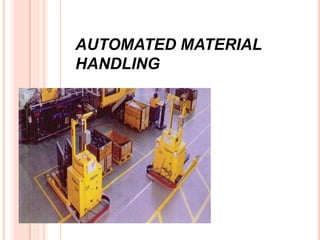
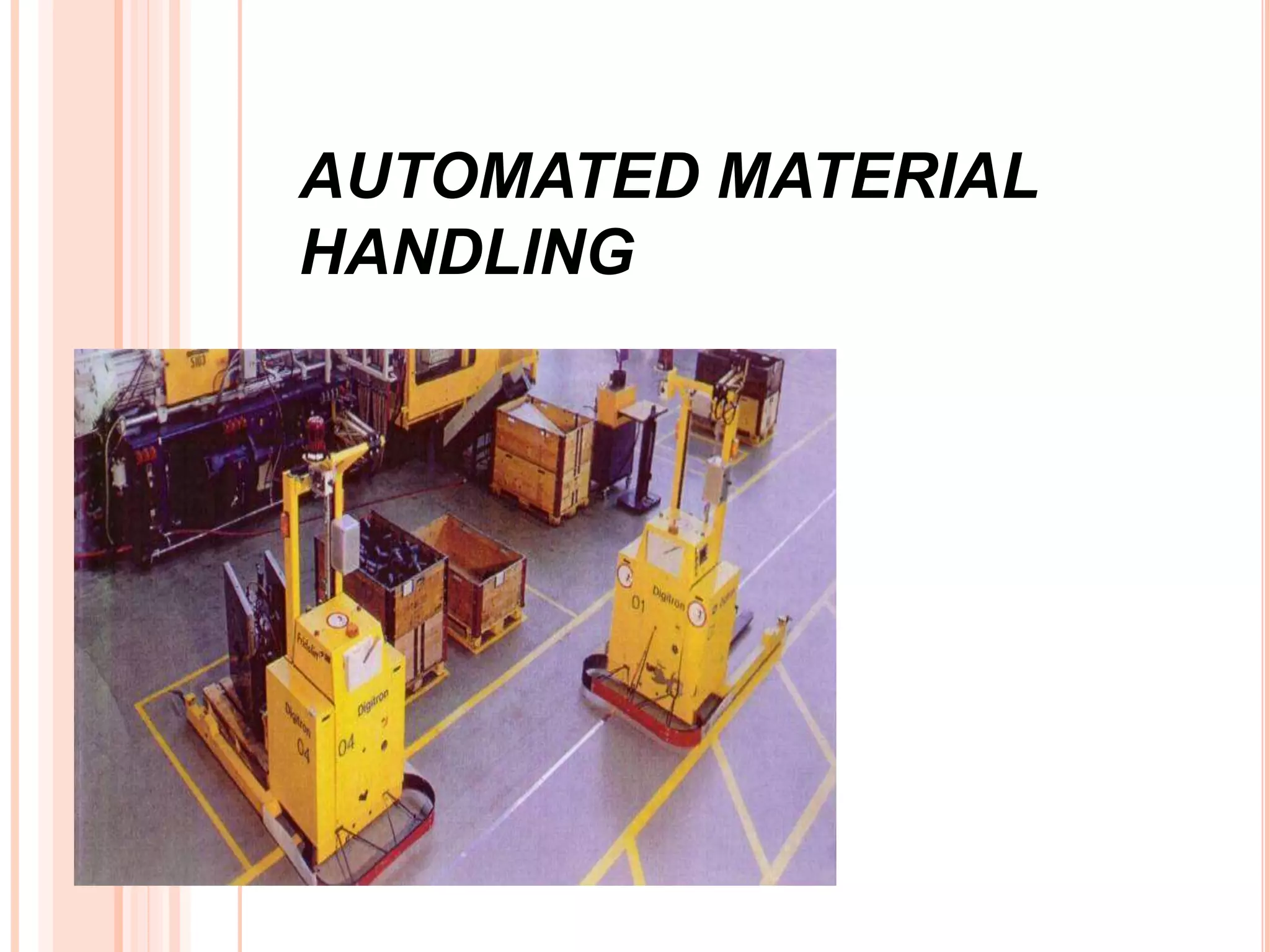
AUTOMATED MATERIAL
HANDLING
CONTENT OF PRESENTATION
 Material handling
 Material handling equipment
 Automation in Material handling
 Automated guided vehicles (AGV)
 Conveyors
WHAT IS MATERIAL HANDLING
 Material handling is the art and science of moving,
storing, protecting, and controlling material
–Moving: Required to create time and place utility.
The value of having the material at the right time and
the right place.
–Storing: Provides a buffer between operations,
facilitates the efficient use of people and machines.
–Protecting: Includes the packaging, packing against
damage and theft.
–Controlling: Physical Orientation, sequence and space
between material.
CATEGORIES OF
MATERIAL HANDLING EQUIPMENT
1. Material transport equipment - to move
materials inside a factory, warehouse, or other
facility
2. Storage - to store materials and provide access
to those materials when required
3. Unitizing equipment - refers to
(1) containers to hold materials, and
(2) equipment used to load and package the
containers
4. Identification and tracking systems - to identify
and keep track of the materials being moved and
stored
MATERIAL TRANSPORT EQUIPMENT
 Industrial trucks
AGVs
 Robots
 Monorails and other rail guided vehicles
 Conveyors
 Cranes and hoists
AUTOMATION IN
MATERIAL HANDLING
WHY USE AUTOMATION IN
MATERIAL HANDLING???
WHY USE AUTOMATION IN MATERIAL
HANDLING
1. To increase labor productivity
2. To reduce labor cost
3. To mitigate the effects of labor shortages
4. To reduce or remove routine manual and clerical
tasks
5. To improve worker safety
6. To improve product quality
7. To reduce manufacturing lead time
8. To accomplish what cannot be done manually
AUTOMATED GUIDED
VEHICLES
1. AUTOMATED GUIDED VEHICLE
 What is AGV ?
Material handling system that uses independently
operated, Self-propelled vehicles, Guided along
defined pathways.
 Increase efficiency and reduce costs by helping to
automate a manufacturing facility or warehouse.
 AGVs are employed in nearly every industry,
including, paper, metals, newspaper and general
manufacturing.
 They follow guidance circuits connecting various
workstations in the warehouse
COMPONENTS OF AGV
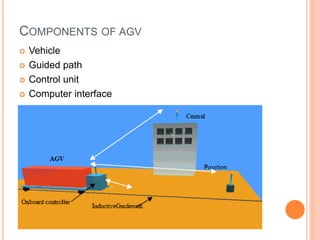
COMPONENTS OF AGV
 Vehicle
 Guided path
 Control unit
 Computer interface
AGV TYPES
 Driver less trains
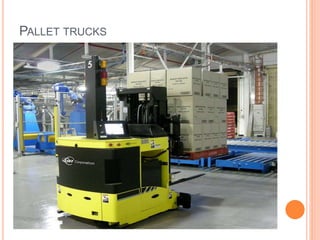
 Pallet trucks
 Unit load carriers
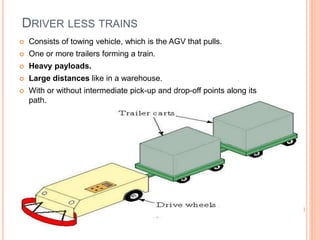
DRIVER LESS TRAINS
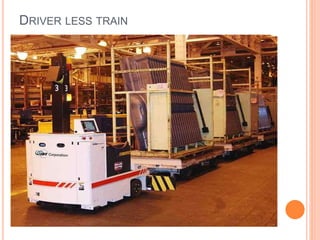
 Consists of towing vehicle, which is the AGV that pulls.
 One or more trailers forming a train.
 Heavy payloads.
 Large distances like in a warehouse.
 With or without intermediate pick-up and drop-off points along its
path.
DRIVER LESS TRAIN
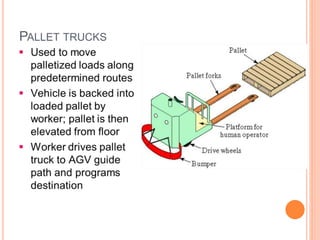
PALLET TRUCKS
PALLET TRUCKS
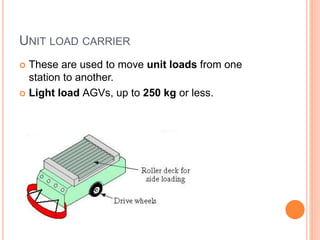
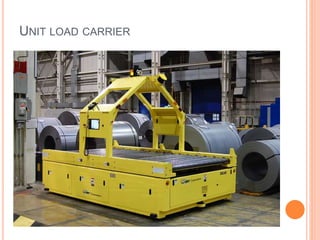
UNIT LOAD CARRIER
 These are used to move unit loads from one
station to another.
 Light load AGVs, up to 250 kg or less.
UNIT LOAD CARRIER
VEHICLE GUIDANCE TECHNOLOGY
 Imbedded guide wires
 Paint strips (Optical navigation system)
 Magnetic Tape Guidance
 Self guided vehicles (Laser triangulation navigation
system)
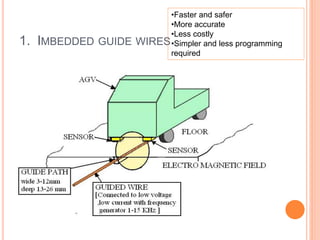
1. IMBEDDED GUIDE WIRES
•Faster and safer
•More accurate
•Less costly
•Simpler and less programming
required
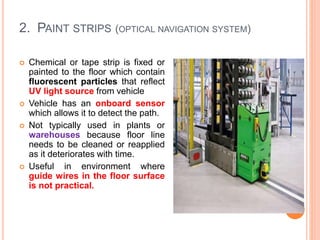
2. PAINT STRIPS (OPTICAL NAVIGATION SYSTEM)
 Chemical or tape strip is fixed or
painted to the floor which contain
fluorescent particles that reflect
UV light source from vehicle
 Vehicle has an onboard sensor
which allows it to detect the path.
 Not typically used in plants or
warehouses because floor line
needs to be cleaned or reapplied
as it deteriorates with time.
 Useful in environment where
guide wires in the floor surface
is not practical.
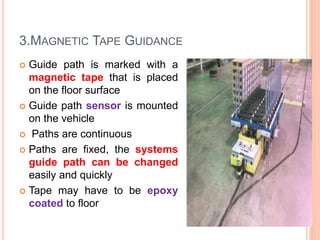
3.MAGNETIC TAPE GUIDANCE
 Guide path is marked with a
magnetic tape that is placed
on the floor surface
 Guide path sensor is mounted
on the vehicle
 Paths are continuous
 Paths are fixed, the systems
guide path can be changed
easily and quickly
 Tape may have to be epoxy
coated to floor
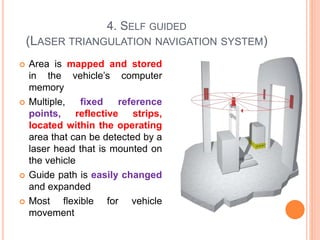
4. SELF GUIDED
(LASER TRIANGULATION NAVIGATION SYSTEM)
 Area is mapped and stored
in the vehicle’s computer
memory
 Multiple, fixed reference
points, reflective strips,
located within the operating
area that can be detected by a
laser head that is mounted on
the vehicle
 Guide path is easily changed
and expanded
 Most flexible for vehicle
movement
CONVEYORS
CONVEYOR SYSTEMS
Large family of material transport equipment
designed to move materials over fixed paths,
usually in large quantities or volumes
1. Non - powered
 Materials moved by human workers or by gravity
2. Powered
 Power mechanism for transporting materials is
contained in the fixed path, using chains, belts, rollers
or other mechanical devices
CONVEYOR TYPES
1. Roller
2. Skate - wheel
3. Belt
4. In- floor towline
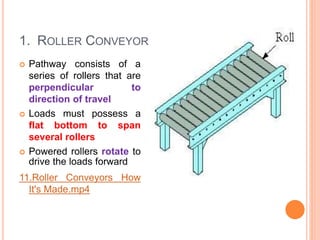
1. ROLLER CONVEYOR
 Pathway consists of a
series of rollers that are
perpendicular to
direction of travel
 Loads must possess a
flat bottom to span
several rollers
 Powered rollers rotate to
drive the loads forward
11.Roller Conveyors How
It's Made.mp4
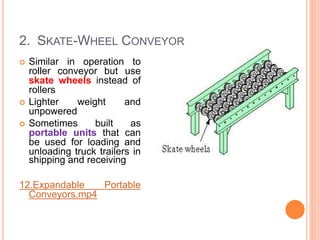
2. SKATE-WHEEL CONVEYOR
 Similar in operation to
roller conveyor but use
skate wheels instead of
rollers
 Lighter weight and
unpowered
 Sometimes built as
portable units that can
be used for loading and
unloading truck trailers in
shipping and receiving
12.Expandable Portable
Conveyors.mp4
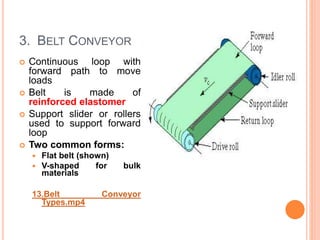
3. BELT CONVEYOR
 Continuous loop with
forward path to move
loads
 Belt is made of
reinforced elastomer
 Support slider or rollers
used to support forward
loop
 Two common forms:
 Flat belt (shown)
 V-shaped for bulk
materials
13.Belt Conveyor
Types.mp4
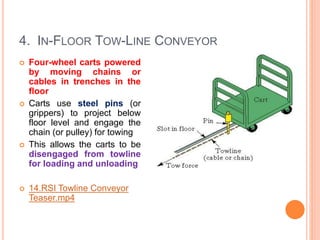
4. IN-FLOOR TOW-LINE CONVEYOR
 Four-wheel carts powered
by moving chains or
cables in trenches in the
floor
 Carts use steel pins (or
grippers) to project below
floor level and engage the
chain (or pulley) for towing
 This allows the carts to be
disengaged from towline
for loading and unloading
 14.RSI Towline Conveyor
Teaser.mp4
LIMITATIONS OF AUTOMATED
MATERIAL HANDLING SYSTEMS
 Additional investment
 Vulnerability to downtime whenever there is
breakdown
 Additional maintenance staff and cost
 Cost of auxiliary equipment.
 Space and other requirements

Automated Material Handling

  • 1.
  • 2.
    CONTENT OF PRESENTATION Material handling  Material handling equipment  Automation in Material handling  Automated guided vehicles (AGV)  Conveyors
  • 4.
    WHAT IS MATERIALHANDLING  Material handling is the art and science of moving, storing, protecting, and controlling material –Moving: Required to create time and place utility. The value of having the material at the right time and the right place. –Storing: Provides a buffer between operations, facilitates the efficient use of people and machines. –Protecting: Includes the packaging, packing against damage and theft. –Controlling: Physical Orientation, sequence and space between material.
  • 5.
    CATEGORIES OF MATERIAL HANDLINGEQUIPMENT 1. Material transport equipment - to move materials inside a factory, warehouse, or other facility 2. Storage - to store materials and provide access to those materials when required 3. Unitizing equipment - refers to (1) containers to hold materials, and (2) equipment used to load and package the containers 4. Identification and tracking systems - to identify and keep track of the materials being moved and stored
  • 6.
    MATERIAL TRANSPORT EQUIPMENT Industrial trucks AGVs  Robots  Monorails and other rail guided vehicles  Conveyors  Cranes and hoists
  • 7.
  • 8.
    WHY USE AUTOMATIONIN MATERIAL HANDLING???
  • 9.
    WHY USE AUTOMATIONIN MATERIAL HANDLING 1. To increase labor productivity 2. To reduce labor cost 3. To mitigate the effects of labor shortages 4. To reduce or remove routine manual and clerical tasks 5. To improve worker safety 6. To improve product quality 7. To reduce manufacturing lead time 8. To accomplish what cannot be done manually
  • 10.
  • 11.
    1. AUTOMATED GUIDEDVEHICLE  What is AGV ? Material handling system that uses independently operated, Self-propelled vehicles, Guided along defined pathways.  Increase efficiency and reduce costs by helping to automate a manufacturing facility or warehouse.  AGVs are employed in nearly every industry, including, paper, metals, newspaper and general manufacturing.  They follow guidance circuits connecting various workstations in the warehouse
  • 12.
  • 13.
    COMPONENTS OF AGV Vehicle  Guided path  Control unit  Computer interface
  • 14.
    AGV TYPES  Driverless trains  Pallet trucks  Unit load carriers
  • 15.
    DRIVER LESS TRAINS Consists of towing vehicle, which is the AGV that pulls.  One or more trailers forming a train.  Heavy payloads.  Large distances like in a warehouse.  With or without intermediate pick-up and drop-off points along its path.
  • 16.
  • 17.
  • 18.
  • 19.
    UNIT LOAD CARRIER These are used to move unit loads from one station to another.  Light load AGVs, up to 250 kg or less.
  • 20.
  • 21.
    VEHICLE GUIDANCE TECHNOLOGY Imbedded guide wires  Paint strips (Optical navigation system)  Magnetic Tape Guidance  Self guided vehicles (Laser triangulation navigation system)
  • 22.
    1. IMBEDDED GUIDEWIRES •Faster and safer •More accurate •Less costly •Simpler and less programming required
  • 23.
    2. PAINT STRIPS(OPTICAL NAVIGATION SYSTEM)  Chemical or tape strip is fixed or painted to the floor which contain fluorescent particles that reflect UV light source from vehicle  Vehicle has an onboard sensor which allows it to detect the path.  Not typically used in plants or warehouses because floor line needs to be cleaned or reapplied as it deteriorates with time.  Useful in environment where guide wires in the floor surface is not practical.
  • 24.
    3.MAGNETIC TAPE GUIDANCE Guide path is marked with a magnetic tape that is placed on the floor surface  Guide path sensor is mounted on the vehicle  Paths are continuous  Paths are fixed, the systems guide path can be changed easily and quickly  Tape may have to be epoxy coated to floor
  • 25.
    4. SELF GUIDED (LASERTRIANGULATION NAVIGATION SYSTEM)  Area is mapped and stored in the vehicle’s computer memory  Multiple, fixed reference points, reflective strips, located within the operating area that can be detected by a laser head that is mounted on the vehicle  Guide path is easily changed and expanded  Most flexible for vehicle movement
  • 26.
  • 27.
    CONVEYOR SYSTEMS Large familyof material transport equipment designed to move materials over fixed paths, usually in large quantities or volumes 1. Non - powered  Materials moved by human workers or by gravity 2. Powered  Power mechanism for transporting materials is contained in the fixed path, using chains, belts, rollers or other mechanical devices
  • 28.
    CONVEYOR TYPES 1. Roller 2.Skate - wheel 3. Belt 4. In- floor towline
  • 29.
    1. ROLLER CONVEYOR Pathway consists of a series of rollers that are perpendicular to direction of travel  Loads must possess a flat bottom to span several rollers  Powered rollers rotate to drive the loads forward 11.Roller Conveyors How It's Made.mp4
  • 30.
    2. SKATE-WHEEL CONVEYOR Similar in operation to roller conveyor but use skate wheels instead of rollers  Lighter weight and unpowered  Sometimes built as portable units that can be used for loading and unloading truck trailers in shipping and receiving 12.Expandable Portable Conveyors.mp4
  • 31.
    3. BELT CONVEYOR Continuous loop with forward path to move loads  Belt is made of reinforced elastomer  Support slider or rollers used to support forward loop  Two common forms:  Flat belt (shown)  V-shaped for bulk materials 13.Belt Conveyor Types.mp4
  • 32.
    4. IN-FLOOR TOW-LINECONVEYOR  Four-wheel carts powered by moving chains or cables in trenches in the floor  Carts use steel pins (or grippers) to project below floor level and engage the chain (or pulley) for towing  This allows the carts to be disengaged from towline for loading and unloading  14.RSI Towline Conveyor Teaser.mp4
  • 33.
    LIMITATIONS OF AUTOMATED MATERIALHANDLING SYSTEMS  Additional investment  Vulnerability to downtime whenever there is breakdown  Additional maintenance staff and cost  Cost of auxiliary equipment.  Space and other requirements