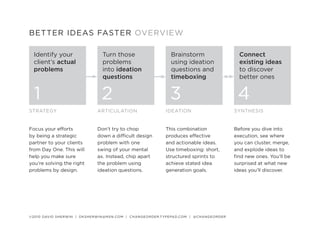
BETTER IDEAS FASTER OVERVIEW

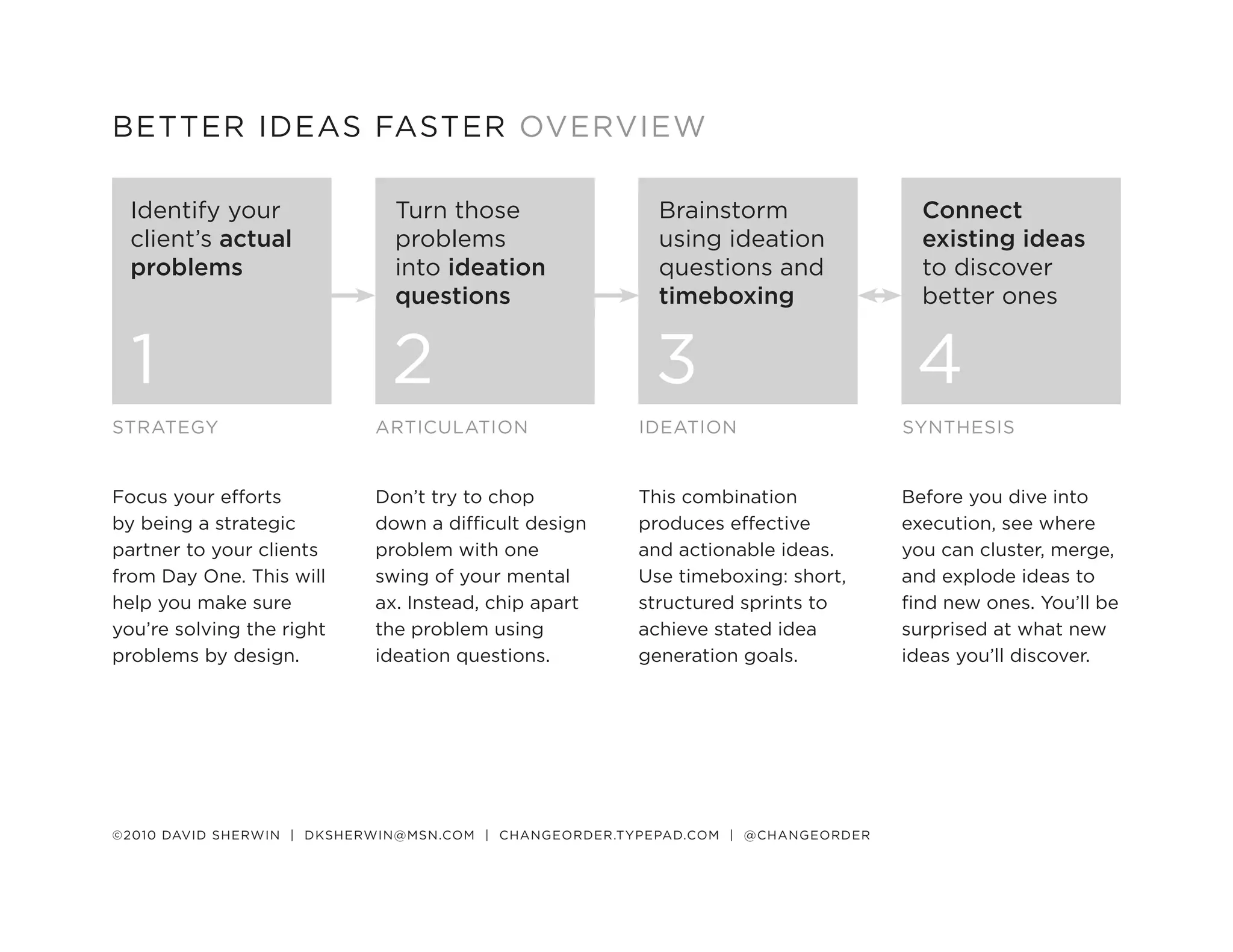
  Identify your              Turn those                  Brainstorm                  Connect
  client’s actual            problems                    using ideation              existing ideas
  problems                   into ideation               questions and               to discover
                             questions                   timeboxing                  better ones


  1                          2                           3                          4
STRATEGY                   ARTICULATION                IDEATION                    SYNTHESIS


Focus your efforts         Don’t try to chop           This combination            Before you dive into
by being a strategic       down a difficult design     produces effective          execution, see where
partner to your clients    problem with one            and actionable ideas.       you can cluster, merge,
from Day One. This will    swing of your mental        Use timeboxing: short,      and explode ideas to
help you make sure         ax. Instead, chip apart     structured sprints to       find new ones. You’ll be
you’re solving the right   the problem using           achieve stated idea         surprised at what new
problems by design.        ideation questions.         generation goals.           ideas you’ll discover.


©2010 DAVID SHERWIN | DKSHERWIN@MSN.COM | CHANGEORDER.TYPEPAD.COM | @CHANGEORDER
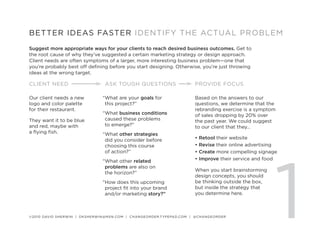
BETTER IDEAS FASTER IDENTIFY THE ACTUAL PROBLEM
Suggest more appropriate ways for your clients to reach desired business outcomes. Get to
the root cause of why they’ve suggested a certain marketing strategy or design approach.
Client needs are often symptoms of a larger, more interesting business problem—one that
you’re probably best off defining before you start designing. Otherwise, you’re just throwing
ideas at the wrong target.

CLIENT NEED                    ASK TOUGH QUESTIONS                   PROVIDE FOCUS

Our client needs a new        “What are your goals for               Based on the answers to our
logo and color palette         this project?”                        questions, we determine that the
for their restaurant.                                                rebranding exercise is a symptom
                              “What business conditions              of sales dropping by 20% over
They want it to be blue        caused these problems                 the past year. We could suggest
and red, maybe with            to emerge?”                           to our client that they…
a flying fish.                “What other strategies
                               did you consider before               •   Retool their website
                               choosing this course                  •   Revise their online advertising


                                                                                                      1
                               of action?”                           •   Create more compelling signage
                              “What other related                    •   Improve their service and food
                               problems are also on
                                                                     When you start brainstorming
                               the horizon?”
                                                                     design concepts, you should
                              “How does this upcoming                be thinking outside the box,
                               project fit into your brand           but inside the strategy that
                               and/or marketing story?”              you determine here.


©2010 DAVID SHERWIN | DKSHERWIN@MSN.COM | CHANGEORDER.TYPEPAD.COM | @CHANGEORDER
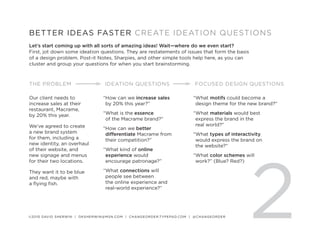
BETTER IDEAS FASTER CREATE IDEATION QUESTIONS
Let’s start coming up with all sorts of amazing ideas! Wait—where do we even start?
First, jot down some ideation questions. They are restatements of issues that form the basis
of a design problem. Post-it Notes, Sharpies, and other simple tools help here, as you can
cluster and group your questions for when you start brainstorming.


THE PROBLEM                    IDEATION QUESTIONS                    FOCUSED DESIGN QUESTIONS

Our client needs to            “How can we increase sales           “What motifs could become a
increase sales at their         by 20% this year?”                   design theme for the new brand?”
restaurant, Macrame,
by 20% this year.              “What is the essence                 “What materials would best
                                of the Macrame brand?”               express the brand in the
We’ve agreed to create                                               real world?”
                               “How can we better
a new brand system              differentiate Macrame from          “What types of interactivity
for them, including a           their competition?”                  would express the brand on
new identity, an overhaul                                            the website?”
of their website, and          “What kind of online


                                                                                               2
new signage and menus           experience would                    “What color schemes will
for their two locations.        encourage patronage?”                work?” (Blue? Red?)

They want it to be blue        “What connections will
and red, maybe with             people see between
a flying fish.                  the online experience and
                                real-world experience?”


©2010 DAVID SHERWIN | DKSHERWIN@MSN.COM | CHANGEORDER.TYPEPAD.COM | @CHANGEORDER
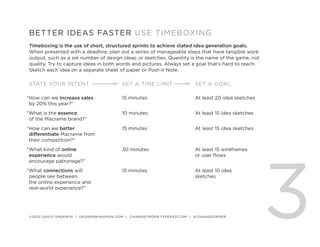
BETTER IDEAS FASTER USE TIMEBOXING
Timeboxing is the use of short, structured sprints to achieve stated idea generation goals.
When presented with a deadline, plan out a series of manageable steps that have tangible work
output, such as a set number of design ideas or sketches. Quantity is the name of the game, not
quality. Try to capture ideas in both words and pictures. Always set a goal that’s hard to reach.
Sketch each idea on a separate sheet of paper or Post-it Note.

STATE YOUR INTENT                      SET A TIME LIMIT              SET A GOAL

“How can we increase sales             15 minutes                    At least 20 idea sketches
 by 20% this year?”
“What is the essence                   10 minutes                    At least 15 idea sketches
 of the Macrame brand?”
“How can we better                     15 minutes                    At least 15 idea sketches
 differentiate Macrame from
 their competition?”
“What kind of online                   30 minutes                    At least 15 wireframes


                                                                                                    3
 experience would                                                    or user flows
 encourage patronage?”
“What connections will                 15 minutes                    At least 10 idea
 people see between                                                  sketches
 the online experience and
 real-world experience?”


©2010 DAVID SHERWIN | DKSHERWIN@MSN.COM | CHANGEORDER.TYPEPAD.COM | @CHANGEORDER
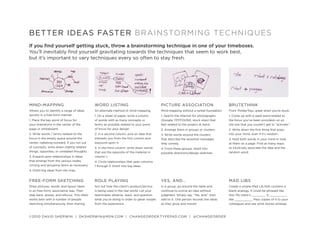
BETTER IDEAS FASTER BRAINSTORMING TECHNIQUES
If you find yourself getting stuck, throw a brainstorming technique in one of your timeboxes.
You’ll inevitably find yourself gravitating towards the techniques that seem to work best,
but it’s important to vary techniques every so often to stay fresh.


MIND-MAPPING                                 WORD LISTING                                  PICTURE ASSOCIATION                         BRUTETHINK
Allows you to identify a range of ideas      An alternate method of mind-mapping.          Mind-mapping without a verbal foundation.   From ThinkerToys, great when you’re stuck.
quickly in a free-form manner.               1. On a sheet of paper, write a column        1. Search the Internet for photographs      1. Come up with a seed word related to
1. Place the key point of focus for          of words with as many concepts or             (Google, FFFFOUND, stock sites) that        the focus you’ve been provided—or an
your brainstorm in the center of the         terms as possible related to your point       feel related to the project at hand.        old one that you couldn’t get to “activate.”
page or whiteboard.                          of focus for your design.                     2. Arrange them in groups or clusters.      2. Write down the first thing that pops
2. Write words / terms related to the        2. In a second column, pick an idea that      3. Write words around the clusters          into your mind, even if it’s random.
focus in the empty space around the          interests you from the first column and       that describe the essential messages        3. Hold both words in your mind or look
center, radiating outward. If you run out    expound upon it.                              they convey.                                at them on a page. Find as many ways
of concepts, write down slightly related     3. In the third column, write down words                                                  to intuitively associate the idea and the
                                                                                           4. From these groups, distill into
things, opposites, or unrelated thoughts.    that are the opposite of the material in                                                  random word.
                                                                                           possible directions/design sketches.
3. Expand upon relationships in ideas        column 1.
that emerge from the various nodes,          4. Circle relationships that span columns
circling and grouping items as necessary.    1 through 3. Distill into big ideas.
4. Distill big ideas from the map.


FREE-FORM SKETCHING                          ROLE PLAYING                                  YES, AND…                                   MAD LIBS
Draw pictures, words, and layout ideas       Act out how the client’s product/service      In a group, go around the table and         Create a simple Mad Lib that contains a
in an free-form, associative way. Then       is being used in the real world. Let your     continue to evolve an idea without          blank analogy. It could be phrased like
step back, assess, and refocus. This often   teammates observe, react, and question        judgment. Simply say, “Yes, and,” then      this: My client’s ________ is __________
works best with a number of people           what you’re doing in order to glean insight   add to it. One person records the ideas     like __________. Pass copies of it to your
sketching simultaneously, then sharing.      from the experience.                          as they grow and morph.                     colleagues and see what stories emerge.


©2010 DAVID SHERWIN | DKSHERWIN@MSN.COM | CHANGEORDER.TYPEPAD.COM | @CHANGEORDER
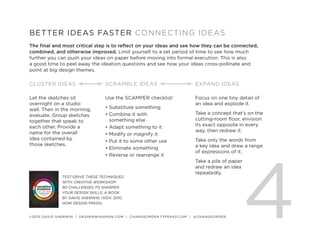
BETTER IDEAS FASTER CONNECTING IDEAS
The final and most critical step is to reflect on your ideas and see how they can be connected,
combined, and otherwise improved. Limit yourself to a set period of time to see how much
further you can push your ideas on paper before moving into formal execution. This is also
a good time to peel away the ideation questions and see how your ideas cross-pollinate and
point at big design themes.

CLUSTER IDEAS                    SCRAMBLE IDEAS                     EXPAND IDEAS

Let the sketches sit             Use the SCAMPER checklist:         Focus on one tiny detail of
overnight on a studio                                               an idea and explode it.
wall. Then in the morning,       • Substitute something
evaluate. Group sketches         • Combine it with                  Take a concept that’s on the
together that speak to             something else                   cutting-room floor, envision
each other. Provide a            • Adapt something to it            its exact opposite in every
name for the overall                                                way, then redraw it.
                                 • Modify or magnify it
idea contained by                                                   Take only the words from
                                 • Put it to some other use
those sketches.                                                     a key idea and draw a range
                                 • Eliminate something


                                                                                           4
                                                                    of expressions of it.
                                 • Reverse or rearrange it
                                                                    Take a pile of paper
                                                                    and redraw an idea
                                                                    repeatedly.
             TEST-DRIVE THESE TECHNIQUES
             WITH CREATIVE WORKSHOP:
             80 CHALLENGES TO SHARPEN
             YOUR DESIGN SKILLS, A BOOK
             BY DAVID SHERWIN. (NOV. 2010,
             HOW DESIGN PRESS)


©2010 DAVID SHERWIN | DKSHERWIN@MSN.COM | CHANGEORDER.TYPEPAD.COM | @CHANGEORDER

Better Ideas Faster: Handouts

  • 1.
    BETTER IDEAS FASTEROVERVIEW Identify your Turn those Brainstorm Connect client’s actual problems using ideation existing ideas problems into ideation questions and to discover questions timeboxing better ones 1 2 3 4 STRATEGY ARTICULATION IDEATION SYNTHESIS Focus your efforts Don’t try to chop This combination Before you dive into by being a strategic down a difficult design produces effective execution, see where partner to your clients problem with one and actionable ideas. you can cluster, merge, from Day One. This will swing of your mental Use timeboxing: short, and explode ideas to help you make sure ax. Instead, chip apart structured sprints to find new ones. You’ll be you’re solving the right the problem using achieve stated idea surprised at what new problems by design. ideation questions. generation goals. ideas you’ll discover. ©2010 DAVID SHERWIN | DKSHERWIN@MSN.COM | CHANGEORDER.TYPEPAD.COM | @CHANGEORDER
  • 2.
    BETTER IDEAS FASTERIDENTIFY THE ACTUAL PROBLEM Suggest more appropriate ways for your clients to reach desired business outcomes. Get to the root cause of why they’ve suggested a certain marketing strategy or design approach. Client needs are often symptoms of a larger, more interesting business problem—one that you’re probably best off defining before you start designing. Otherwise, you’re just throwing ideas at the wrong target. CLIENT NEED ASK TOUGH QUESTIONS PROVIDE FOCUS Our client needs a new “What are your goals for Based on the answers to our logo and color palette this project?” questions, we determine that the for their restaurant. rebranding exercise is a symptom “What business conditions of sales dropping by 20% over They want it to be blue caused these problems the past year. We could suggest and red, maybe with to emerge?” to our client that they… a flying fish. “What other strategies did you consider before • Retool their website choosing this course • Revise their online advertising 1 of action?” • Create more compelling signage “What other related • Improve their service and food problems are also on When you start brainstorming the horizon?” design concepts, you should “How does this upcoming be thinking outside the box, project fit into your brand but inside the strategy that and/or marketing story?” you determine here. ©2010 DAVID SHERWIN | DKSHERWIN@MSN.COM | CHANGEORDER.TYPEPAD.COM | @CHANGEORDER
  • 3.
    BETTER IDEAS FASTERCREATE IDEATION QUESTIONS Let’s start coming up with all sorts of amazing ideas! Wait—where do we even start? First, jot down some ideation questions. They are restatements of issues that form the basis of a design problem. Post-it Notes, Sharpies, and other simple tools help here, as you can cluster and group your questions for when you start brainstorming. THE PROBLEM IDEATION QUESTIONS FOCUSED DESIGN QUESTIONS Our client needs to “How can we increase sales “What motifs could become a increase sales at their by 20% this year?” design theme for the new brand?” restaurant, Macrame, by 20% this year. “What is the essence “What materials would best of the Macrame brand?” express the brand in the We’ve agreed to create real world?” “How can we better a new brand system differentiate Macrame from “What types of interactivity for them, including a their competition?” would express the brand on new identity, an overhaul the website?” of their website, and “What kind of online 2 new signage and menus experience would “What color schemes will for their two locations. encourage patronage?” work?” (Blue? Red?) They want it to be blue “What connections will and red, maybe with people see between a flying fish. the online experience and real-world experience?” ©2010 DAVID SHERWIN | DKSHERWIN@MSN.COM | CHANGEORDER.TYPEPAD.COM | @CHANGEORDER
  • 4.
    BETTER IDEAS FASTERUSE TIMEBOXING Timeboxing is the use of short, structured sprints to achieve stated idea generation goals. When presented with a deadline, plan out a series of manageable steps that have tangible work output, such as a set number of design ideas or sketches. Quantity is the name of the game, not quality. Try to capture ideas in both words and pictures. Always set a goal that’s hard to reach. Sketch each idea on a separate sheet of paper or Post-it Note. STATE YOUR INTENT SET A TIME LIMIT SET A GOAL “How can we increase sales 15 minutes At least 20 idea sketches by 20% this year?” “What is the essence 10 minutes At least 15 idea sketches of the Macrame brand?” “How can we better 15 minutes At least 15 idea sketches differentiate Macrame from their competition?” “What kind of online 30 minutes At least 15 wireframes 3 experience would or user flows encourage patronage?” “What connections will 15 minutes At least 10 idea people see between sketches the online experience and real-world experience?” ©2010 DAVID SHERWIN | DKSHERWIN@MSN.COM | CHANGEORDER.TYPEPAD.COM | @CHANGEORDER
  • 5.
    BETTER IDEAS FASTERBRAINSTORMING TECHNIQUES If you find yourself getting stuck, throw a brainstorming technique in one of your timeboxes. You’ll inevitably find yourself gravitating towards the techniques that seem to work best, but it’s important to vary techniques every so often to stay fresh. MIND-MAPPING WORD LISTING PICTURE ASSOCIATION BRUTETHINK Allows you to identify a range of ideas An alternate method of mind-mapping. Mind-mapping without a verbal foundation. From ThinkerToys, great when you’re stuck. quickly in a free-form manner. 1. On a sheet of paper, write a column 1. Search the Internet for photographs 1. Come up with a seed word related to 1. Place the key point of focus for of words with as many concepts or (Google, FFFFOUND, stock sites) that the focus you’ve been provided—or an your brainstorm in the center of the terms as possible related to your point feel related to the project at hand. old one that you couldn’t get to “activate.” page or whiteboard. of focus for your design. 2. Arrange them in groups or clusters. 2. Write down the first thing that pops 2. Write words / terms related to the 2. In a second column, pick an idea that 3. Write words around the clusters into your mind, even if it’s random. focus in the empty space around the interests you from the first column and that describe the essential messages 3. Hold both words in your mind or look center, radiating outward. If you run out expound upon it. they convey. at them on a page. Find as many ways of concepts, write down slightly related 3. In the third column, write down words to intuitively associate the idea and the 4. From these groups, distill into things, opposites, or unrelated thoughts. that are the opposite of the material in random word. possible directions/design sketches. 3. Expand upon relationships in ideas column 1. that emerge from the various nodes, 4. Circle relationships that span columns circling and grouping items as necessary. 1 through 3. Distill into big ideas. 4. Distill big ideas from the map. FREE-FORM SKETCHING ROLE PLAYING YES, AND… MAD LIBS Draw pictures, words, and layout ideas Act out how the client’s product/service In a group, go around the table and Create a simple Mad Lib that contains a in an free-form, associative way. Then is being used in the real world. Let your continue to evolve an idea without blank analogy. It could be phrased like step back, assess, and refocus. This often teammates observe, react, and question judgment. Simply say, “Yes, and,” then this: My client’s ________ is __________ works best with a number of people what you’re doing in order to glean insight add to it. One person records the ideas like __________. Pass copies of it to your sketching simultaneously, then sharing. from the experience. as they grow and morph. colleagues and see what stories emerge. ©2010 DAVID SHERWIN | DKSHERWIN@MSN.COM | CHANGEORDER.TYPEPAD.COM | @CHANGEORDER
  • 6.
    BETTER IDEAS FASTERCONNECTING IDEAS The final and most critical step is to reflect on your ideas and see how they can be connected, combined, and otherwise improved. Limit yourself to a set period of time to see how much further you can push your ideas on paper before moving into formal execution. This is also a good time to peel away the ideation questions and see how your ideas cross-pollinate and point at big design themes. CLUSTER IDEAS SCRAMBLE IDEAS EXPAND IDEAS Let the sketches sit Use the SCAMPER checklist: Focus on one tiny detail of overnight on a studio an idea and explode it. wall. Then in the morning, • Substitute something evaluate. Group sketches • Combine it with Take a concept that’s on the together that speak to something else cutting-room floor, envision each other. Provide a • Adapt something to it its exact opposite in every name for the overall way, then redraw it. • Modify or magnify it idea contained by Take only the words from • Put it to some other use those sketches. a key idea and draw a range • Eliminate something 4 of expressions of it. • Reverse or rearrange it Take a pile of paper and redraw an idea repeatedly. TEST-DRIVE THESE TECHNIQUES WITH CREATIVE WORKSHOP: 80 CHALLENGES TO SHARPEN YOUR DESIGN SKILLS, A BOOK BY DAVID SHERWIN. (NOV. 2010, HOW DESIGN PRESS) ©2010 DAVID SHERWIN | DKSHERWIN@MSN.COM | CHANGEORDER.TYPEPAD.COM | @CHANGEORDER