







Measuring what we value:
21st Century Assessments for Independent
                Schools

  Douglas Lyons, Executive Director, CAIS-CT
   Andrew Niblock, Lower School Head, Hamden Hall
                        (CT)
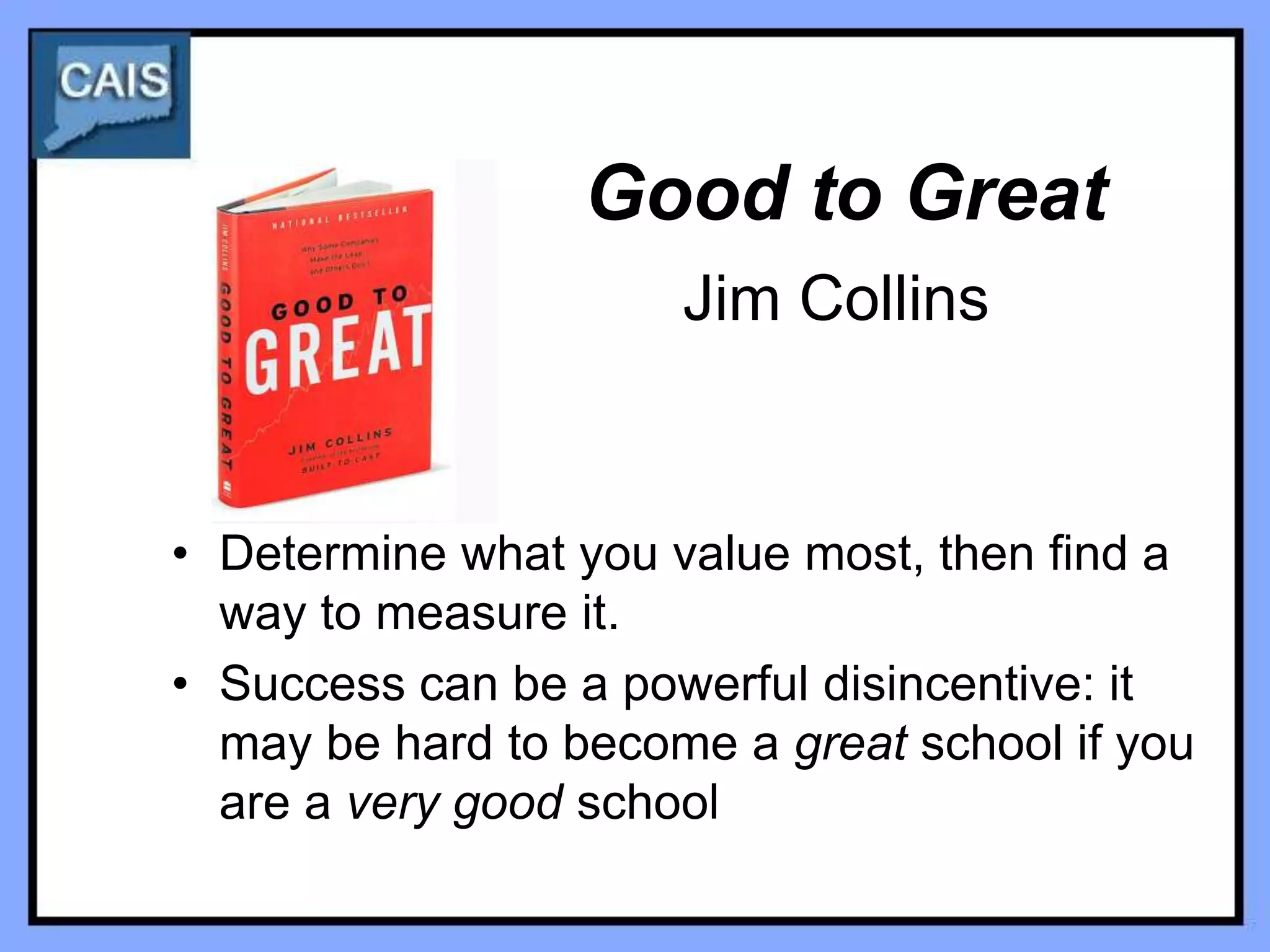
Good to Great
                      Jim Collins


• Determine what you value most, then find a
  way to measure it.
• Success can be a powerful disincentive: it
  may be hard to become a great school if you
  are a very good school
Goals of this workshop
1. Identify measures of school quality that have
   historically been valued by educators and/or
   the public.
2. Suggest new ways to report achievement in
   those measures.
          Why?
• To better tell our story (the Value Proposition)
• To make certain that these measures have
  stature appropriate to their significance
Goals, cont.
  3. Provide a quick preview of new and
emerging assessment tools –instruments
designed to measure skills that are increasing
in demand in the new century

4. Describe the assessment practices in a
select group of schools that define themselves
– and are recognized by others – as “Schools of
the Future”
Criterion 13:
The Standards require a school to provide evidence of
a thoughtful process, respectful of its mission, for the
collection and use in school decision making of data
(both external and internal) about student learning.
“Not everything that can be counted,
counts, and not everything that counts
           can be counted”
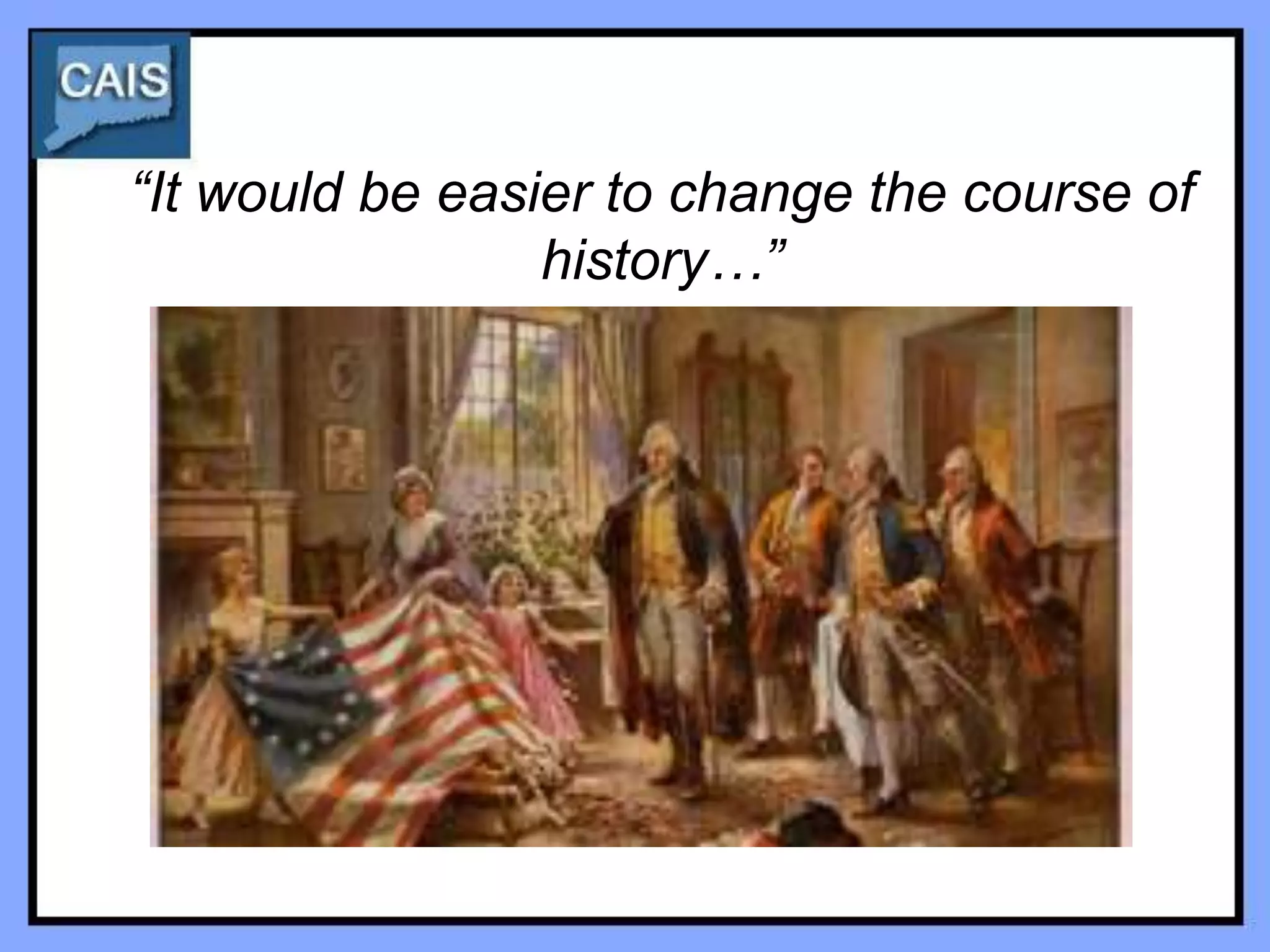
“It would be easier to change the course of
                 history…”
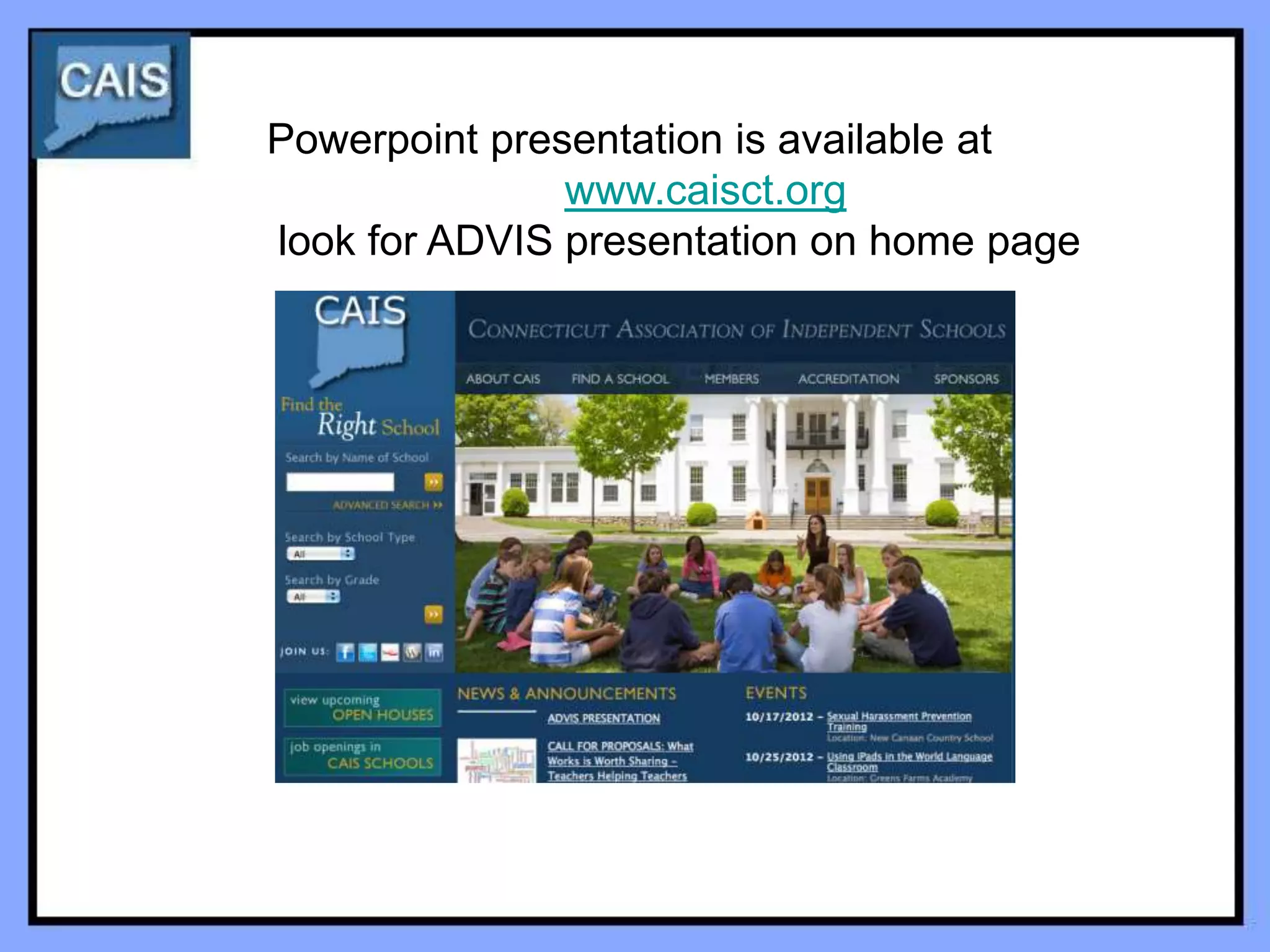
Powerpoint presentation is available at
               www.caisct.org
look for ADVIS presentation on home page
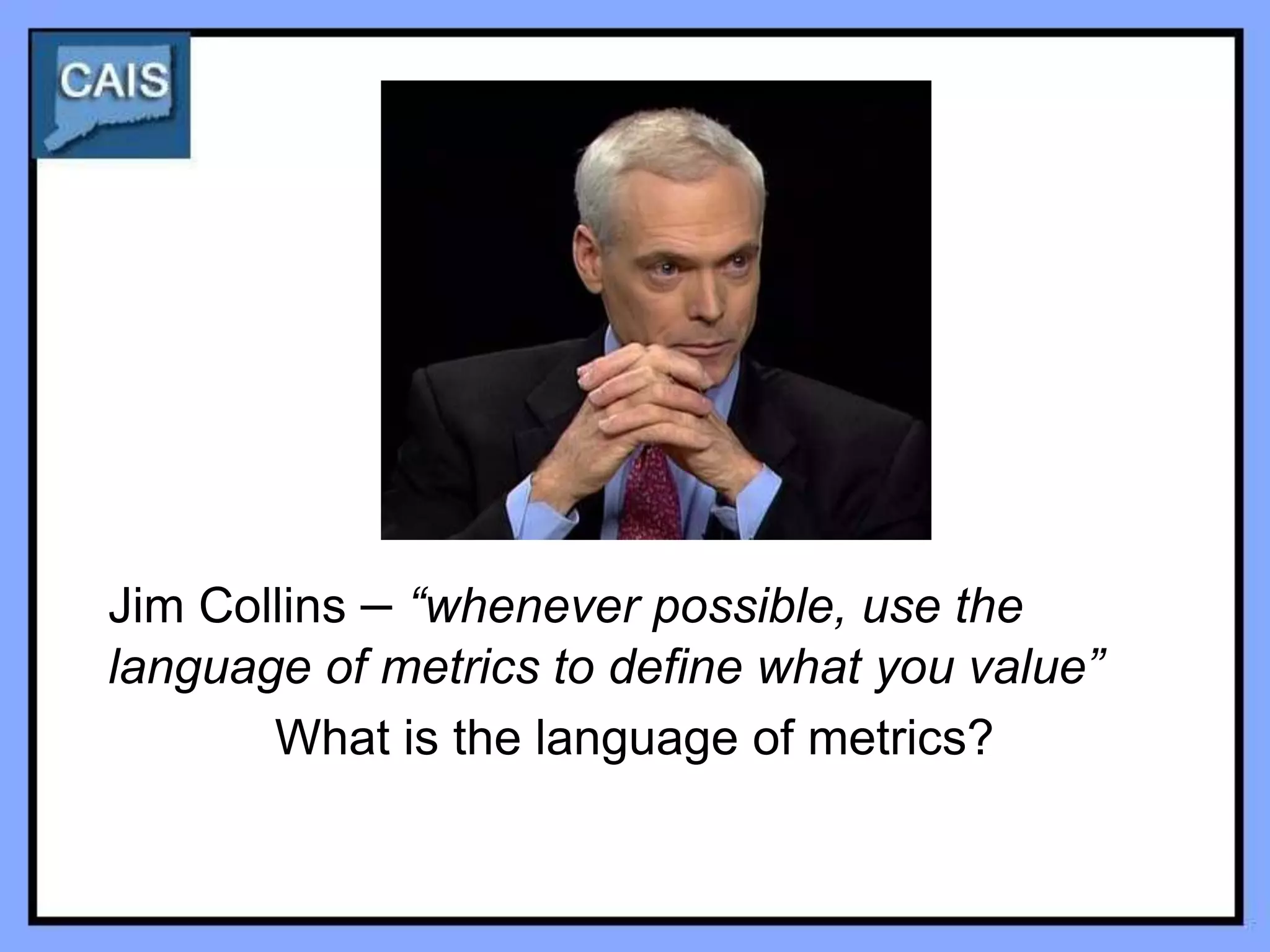
Jim Collins – “whenever possible, use the
language of metrics to define what you value”
       What is the language of metrics?
4 “ways of knowing”

• Data: raw input, no context, facts, figures,
  symbols
• Information: organized, processed, analyzed
  data
• Knowledge: information with higher context -
  accurate, relevant, current
• Wisdom: evaluated knowledge; merged with
  life experience
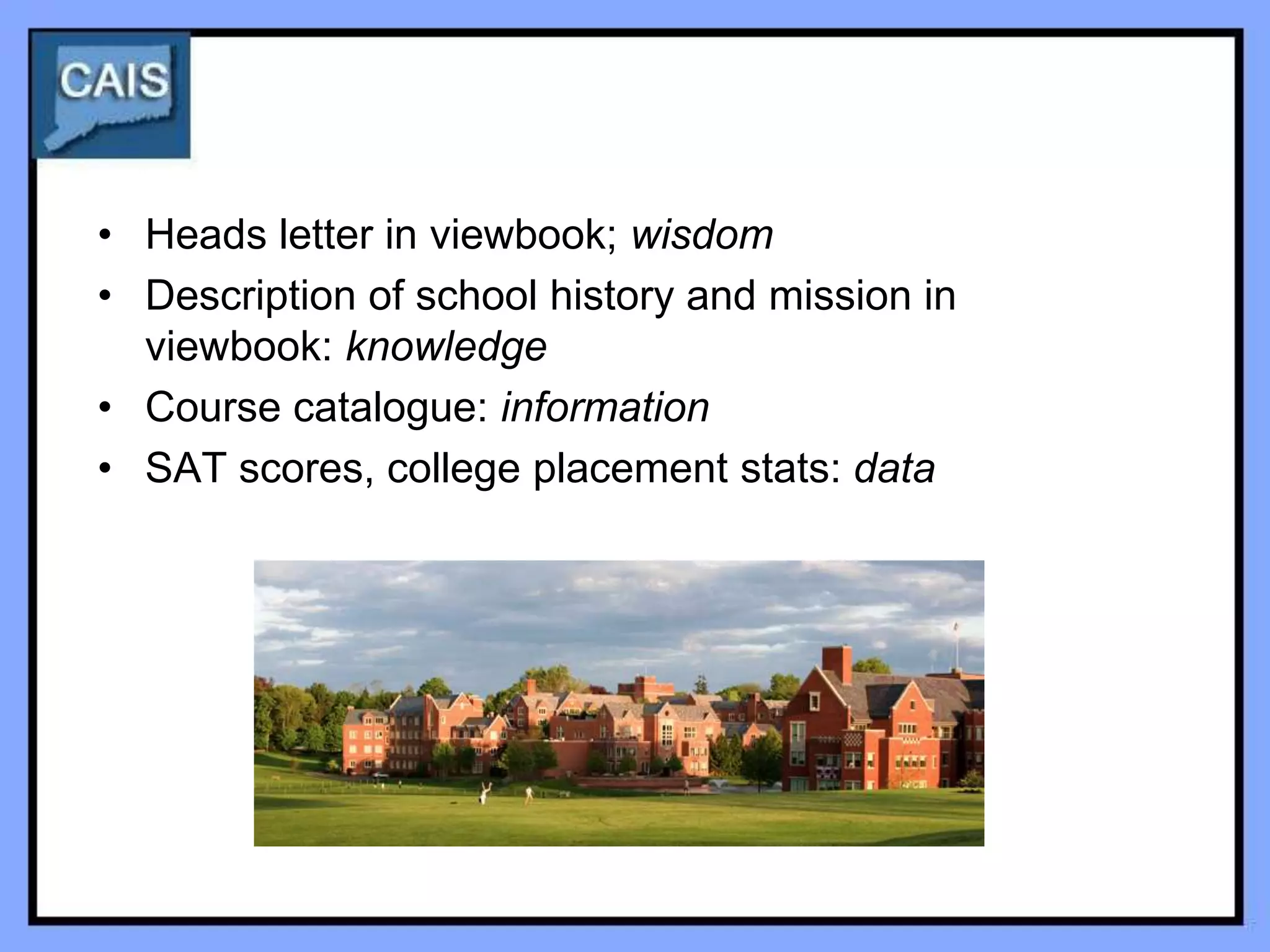
• Heads letter in viewbook; wisdom
• Description of school history and mission in
  viewbook: knowledge
• Course catalogue: information
• SAT scores, college placement stats: data
What are people most interested
                 in ?
                   Data!
• conveys a lot of information - quickly
• Is viewed as objective, “no spin”
• Can be benchmarked, used for
  comparison

      Data is the language of metrics
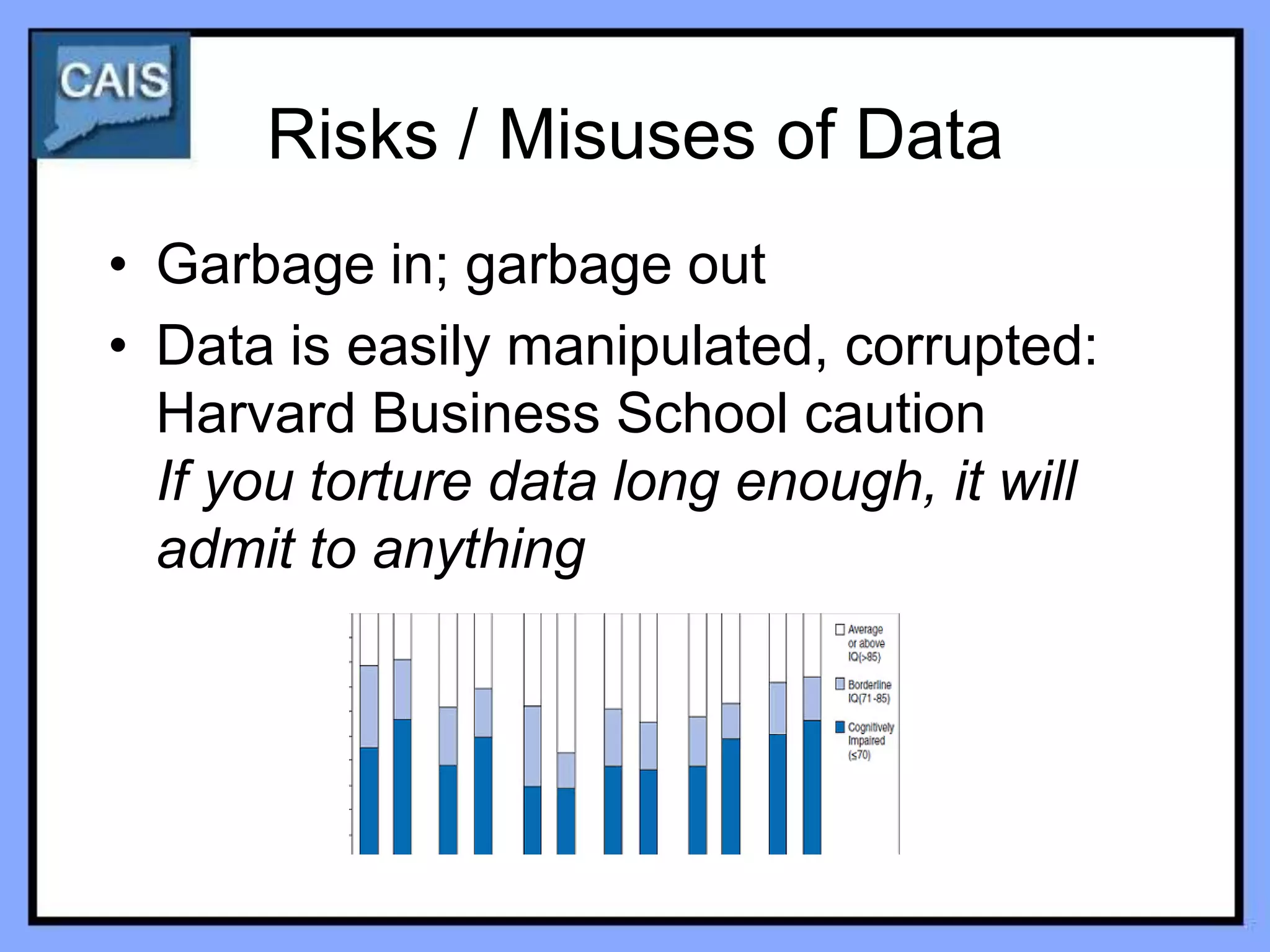
Risks / Misuses of Data
• Garbage in; garbage out
• Data is easily manipulated, corrupted:
  Harvard Business School caution
  If you torture data long enough, it will
  admit to anything
Data Management / Data Creation in
    the independent school community
The Challenge:
• To frame the data that define us, or have
  defined us in the past, in ways that do not
  elevate modestly valuable information
• To gather and/or to present new data that is
  beneficial to educators in our planning for the
  future and is data that measures performance
  in relation to the achievement of our highest
  goals.
The S.A.T.

• Decreasing in stature, but still powerful
• Has poor validity statistics
• Does not measure 21st century Skills
• Historically, did not provide faculty with
  instructionally useful information
• Consider giving the School Day SAT with
  Enhanced Scoring
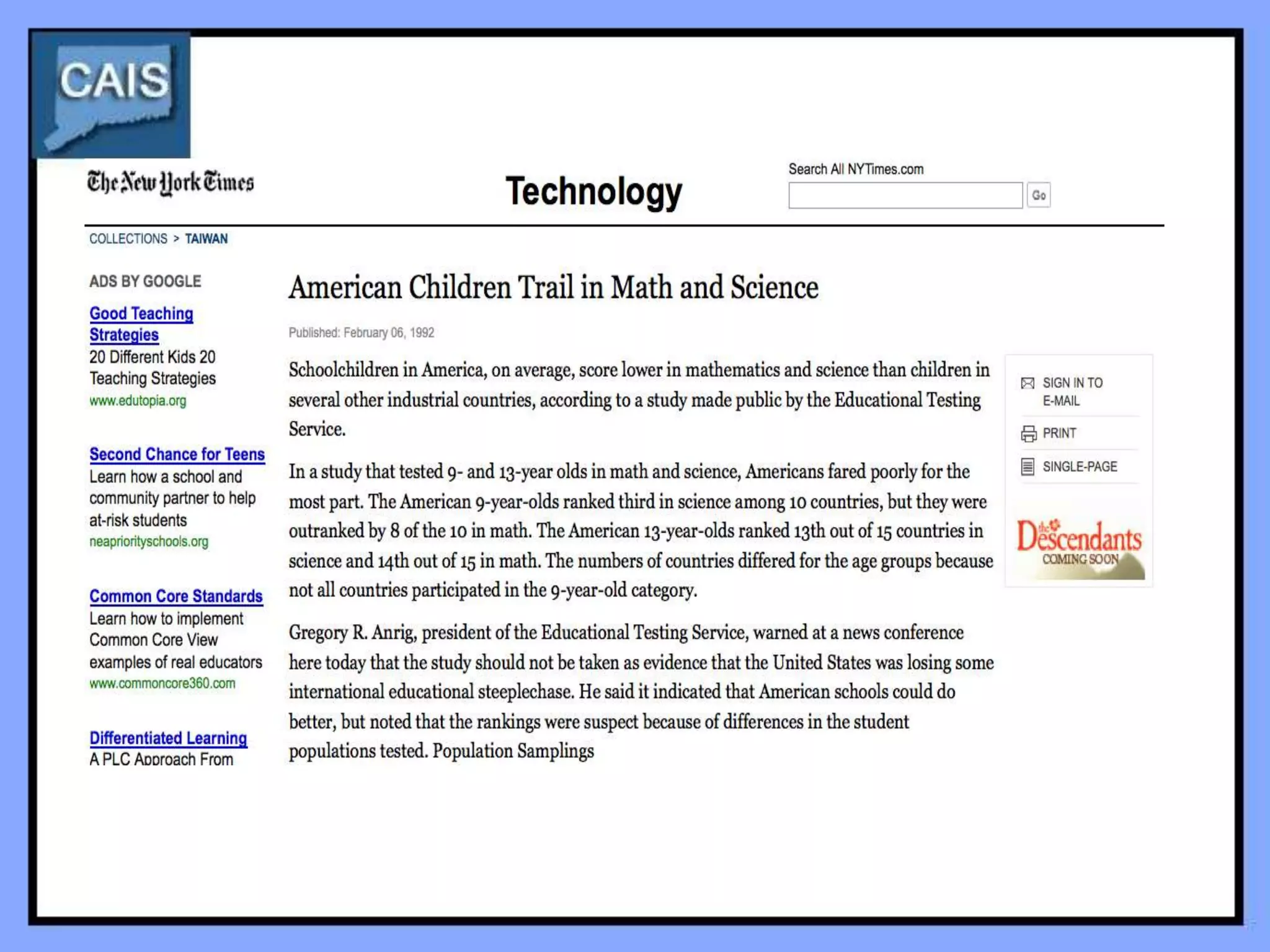
Standardized Achievement Tests

       These test are increasing in stature

What happened to elevate these tests above all other
 forms of data, in public education and to a lesser
 degree, in independent schools?
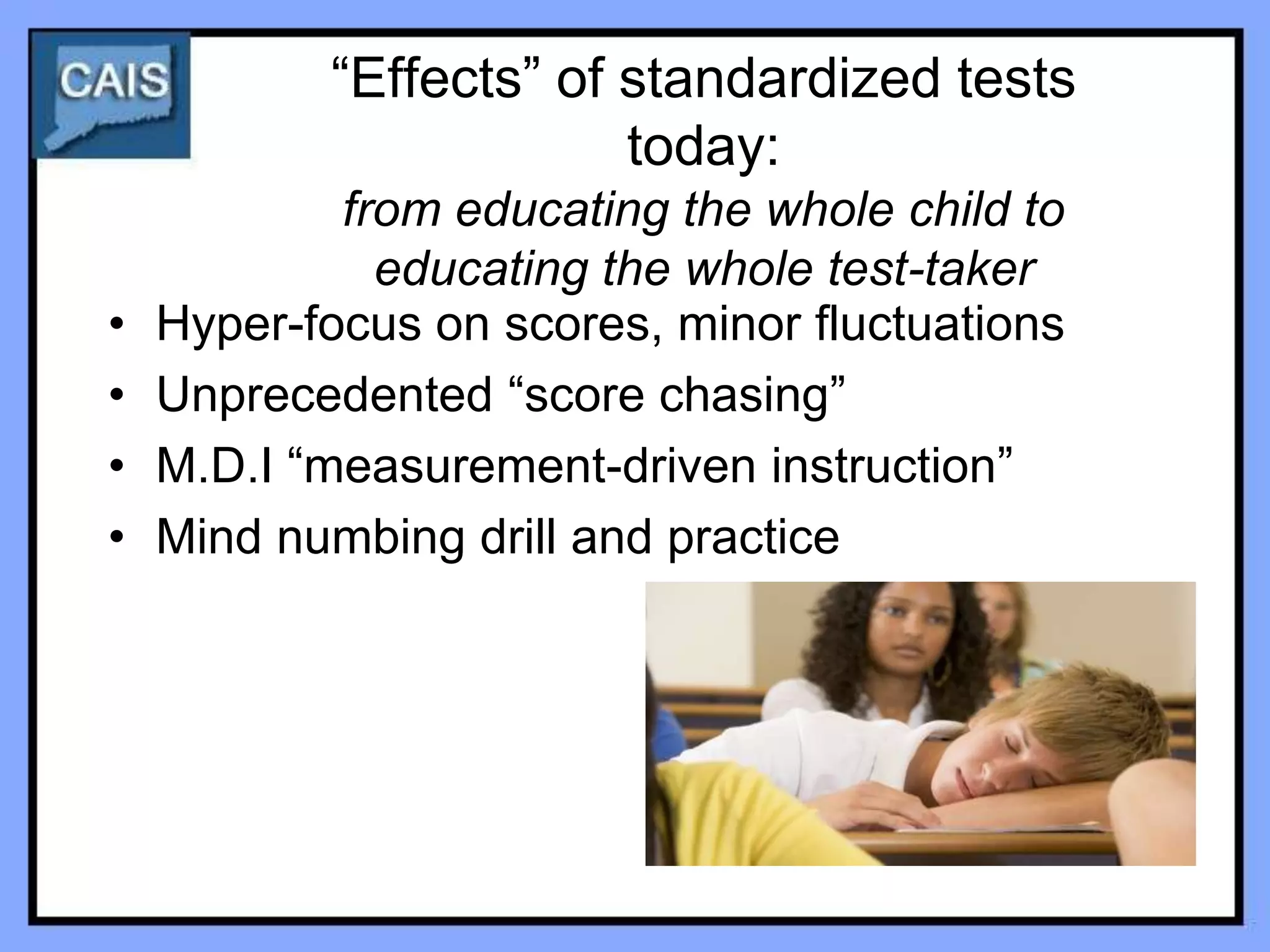
“Effects” of standardized tests
                        today:
            from educating the whole child to
              educating the whole test-taker
•   Hyper-focus on scores, minor fluctuations
•   Unprecedented “score chasing”
•   M.D.I “measurement-driven instruction”
•   Mind numbing drill and practice
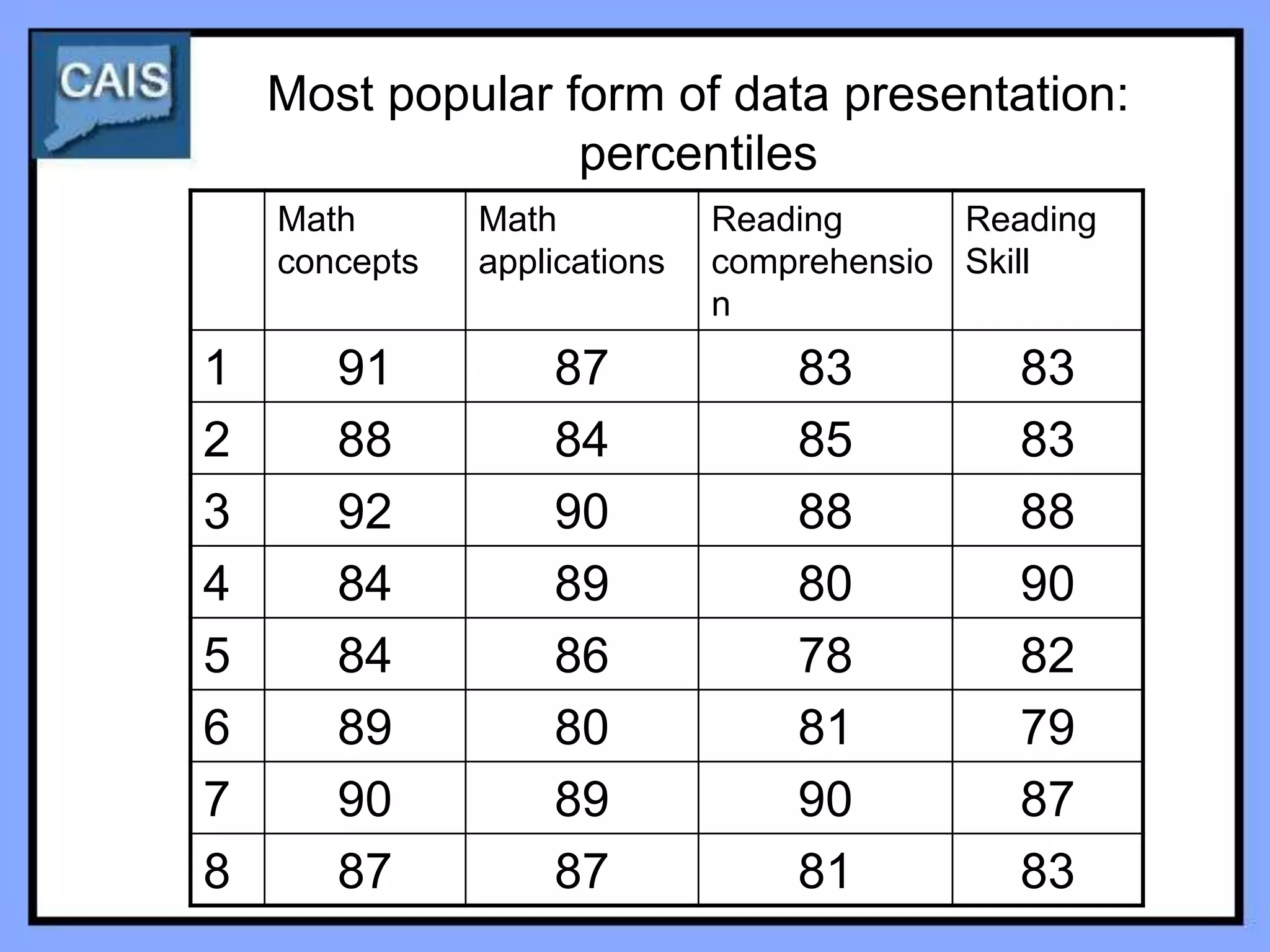
Most popular form of data presentation:
                  percentiles
    Math       Math           Reading      Reading
    concepts   applications   comprehensio Skill
                              n
1      91          87             83          83
2      88          84             85          83
3      92          90             88          88
4      84          89             80          90
5      84          86             78          82
6      89          80             81          79
7      90          89             90          87
8      87          87             81          83
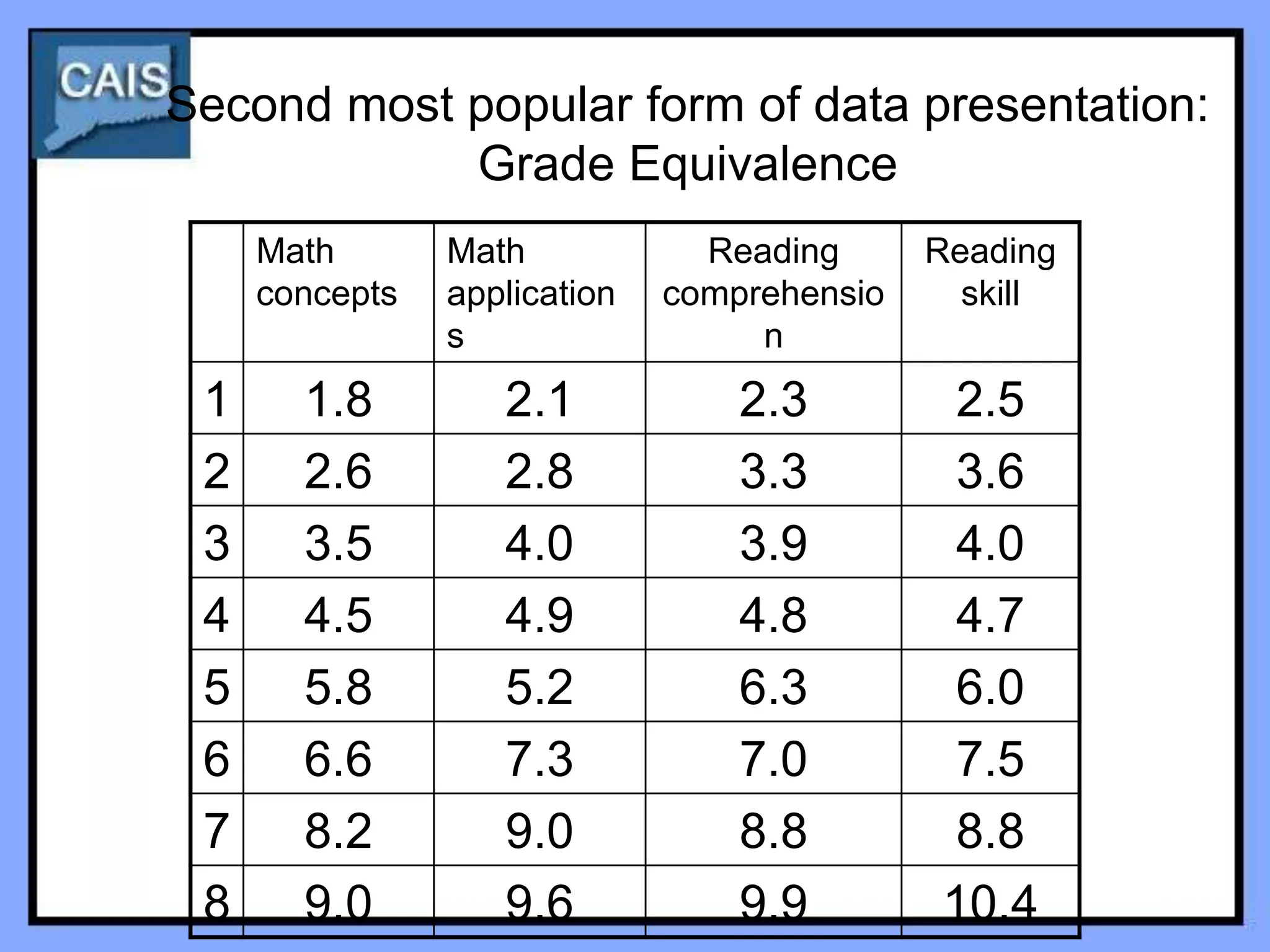
Second most popular form of data presentation:
            Grade Equivalence
     Math       Math            Reading      Reading
     concepts   application   comprehensio     skill
                s                  n
 1     1.8         2.1            2.3         2.5
 2     2.6         2.8            3.3         3.6
 3     3.5         4.0            3.9         4.0
 4     4.5         4.9            4.8         4.7
 5     5.8         5.2            6.3         6.0
 6     6.6         7.3            7.0         7.5
 7     8.2         9.0            8.8         8.8
 8     9.0         9.6            9.9        10.4
A better way to present achievement
                data


• Determine and defend your norming
  group
• Determine a worthy and realistic goal
  within the norming group
• Publish data relative to the goal
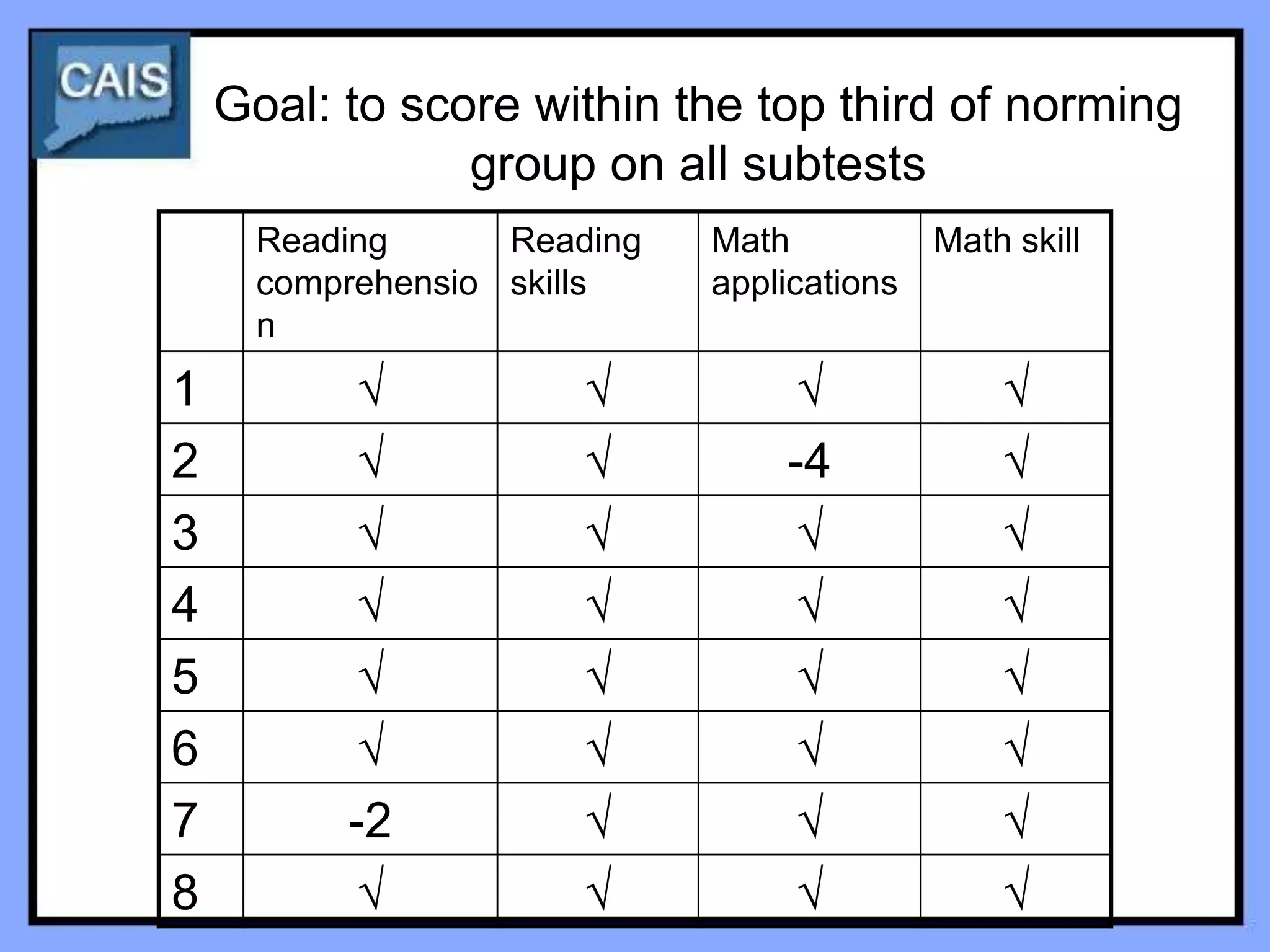
Goal: to score within the top third of norming
                group on all subtests
      Reading      Reading   Math           Math skill
      comprehensio skills    applications
      n
1          √           √          √             √
2          √           √         -4             √
3          √           √          √             √
4          √           √          √             √
5          √           √          √             √
6          √           √          √             √
7         -2           √          √             √
8          √           √          √             √
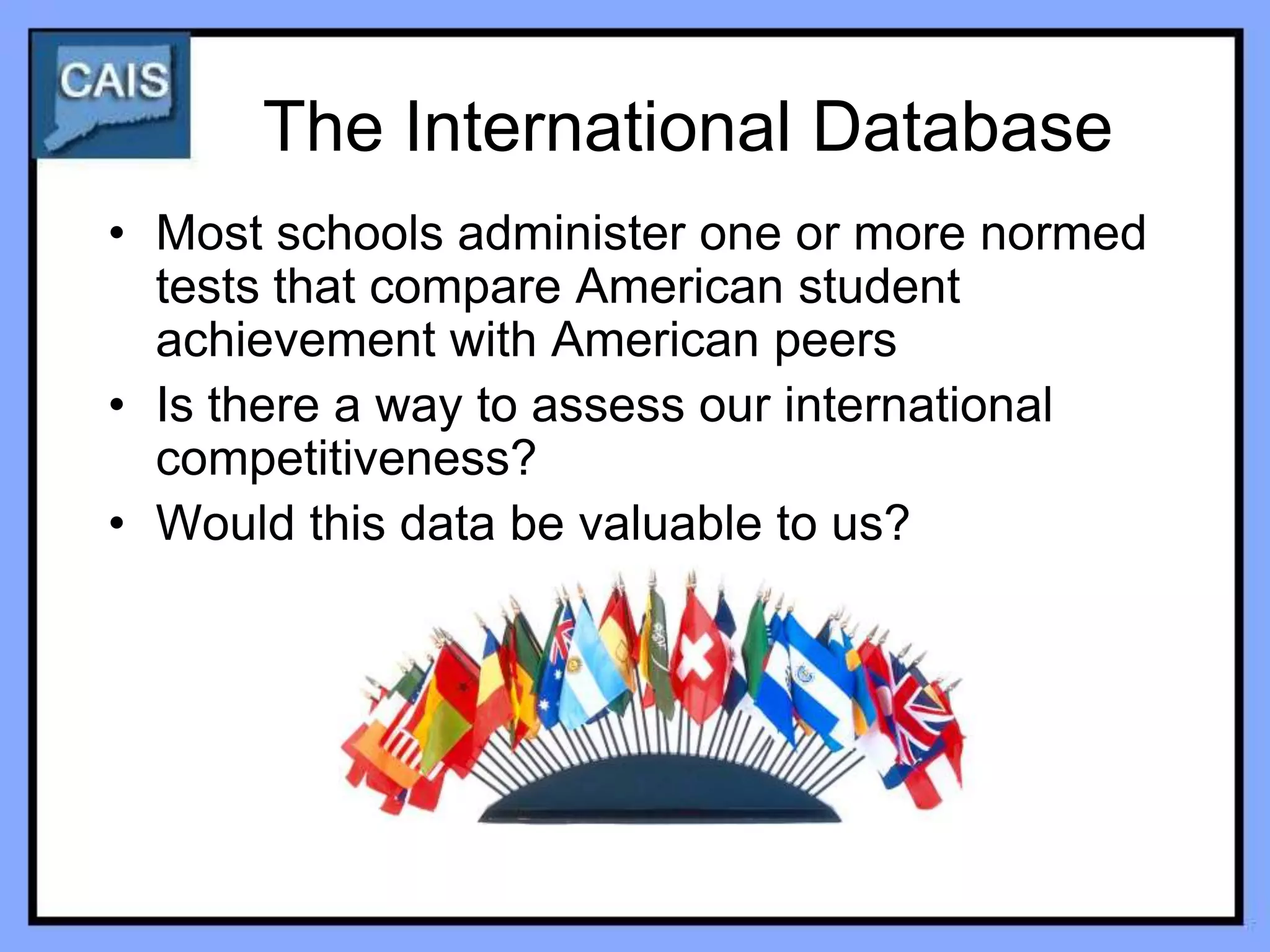
The International Database
• Most schools administer one or more normed
  tests that compare American student
  achievement with American peers
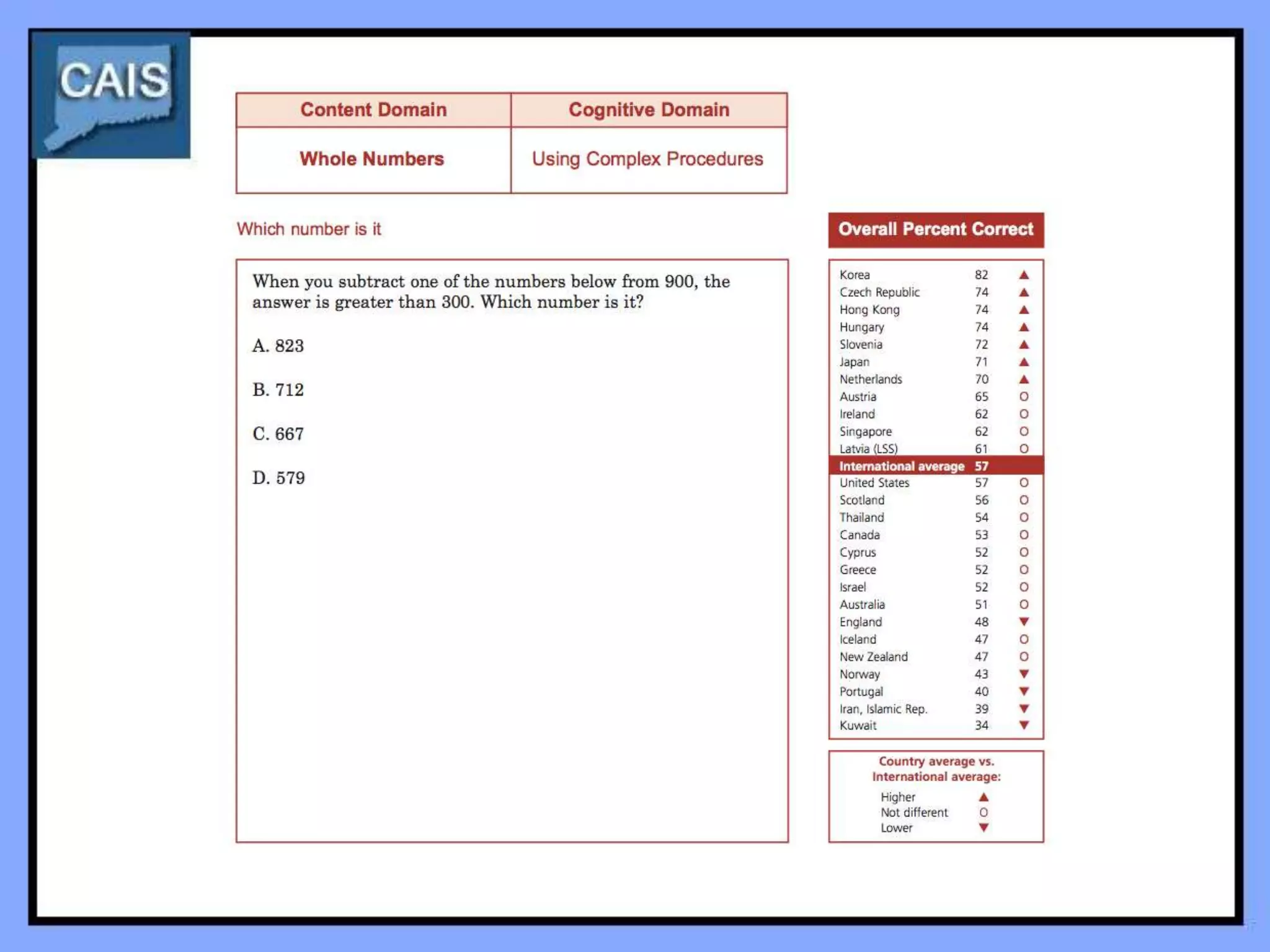
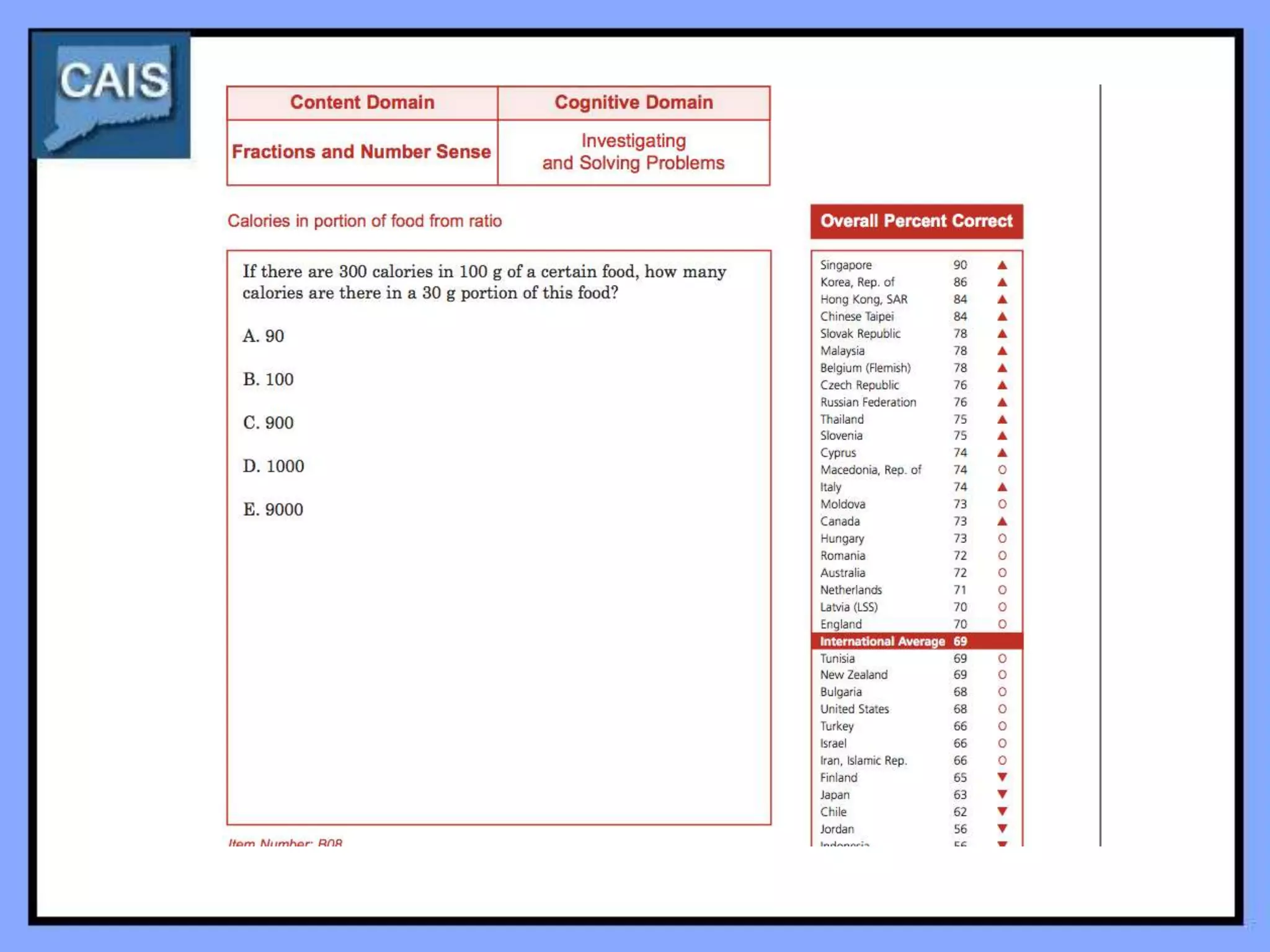
• Is there a way to assess our international
  competitiveness?
• Would this data be valuable to us?
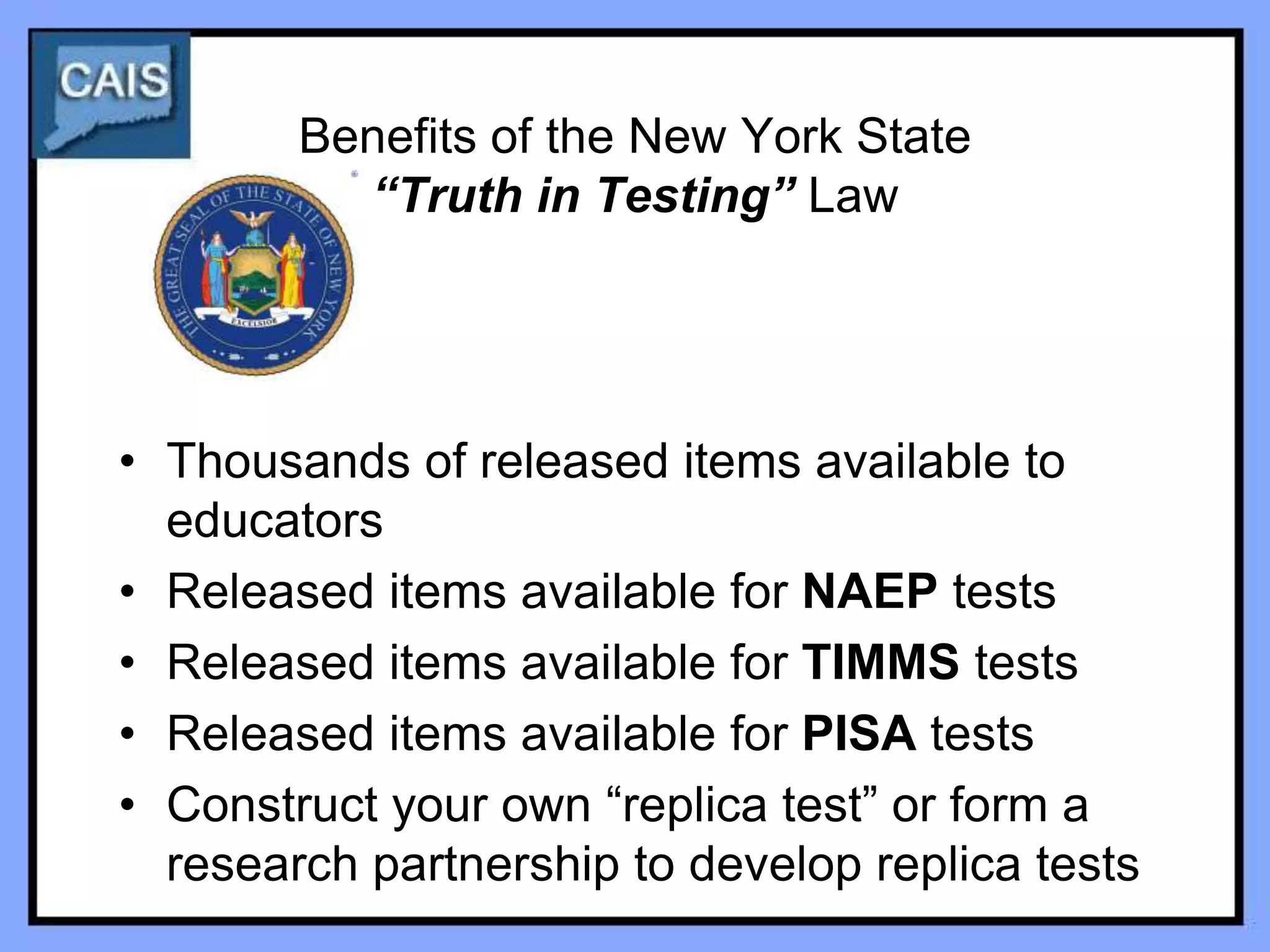
Benefits of the New York State
          “Truth in Testing” Law


• Thousands of released items available to
  educators
• Released items available for NAEP tests
• Released items available for TIMMS tests
• Released items available for PISA tests
• Construct your own “replica test” or form a
  research partnership to develop replica tests
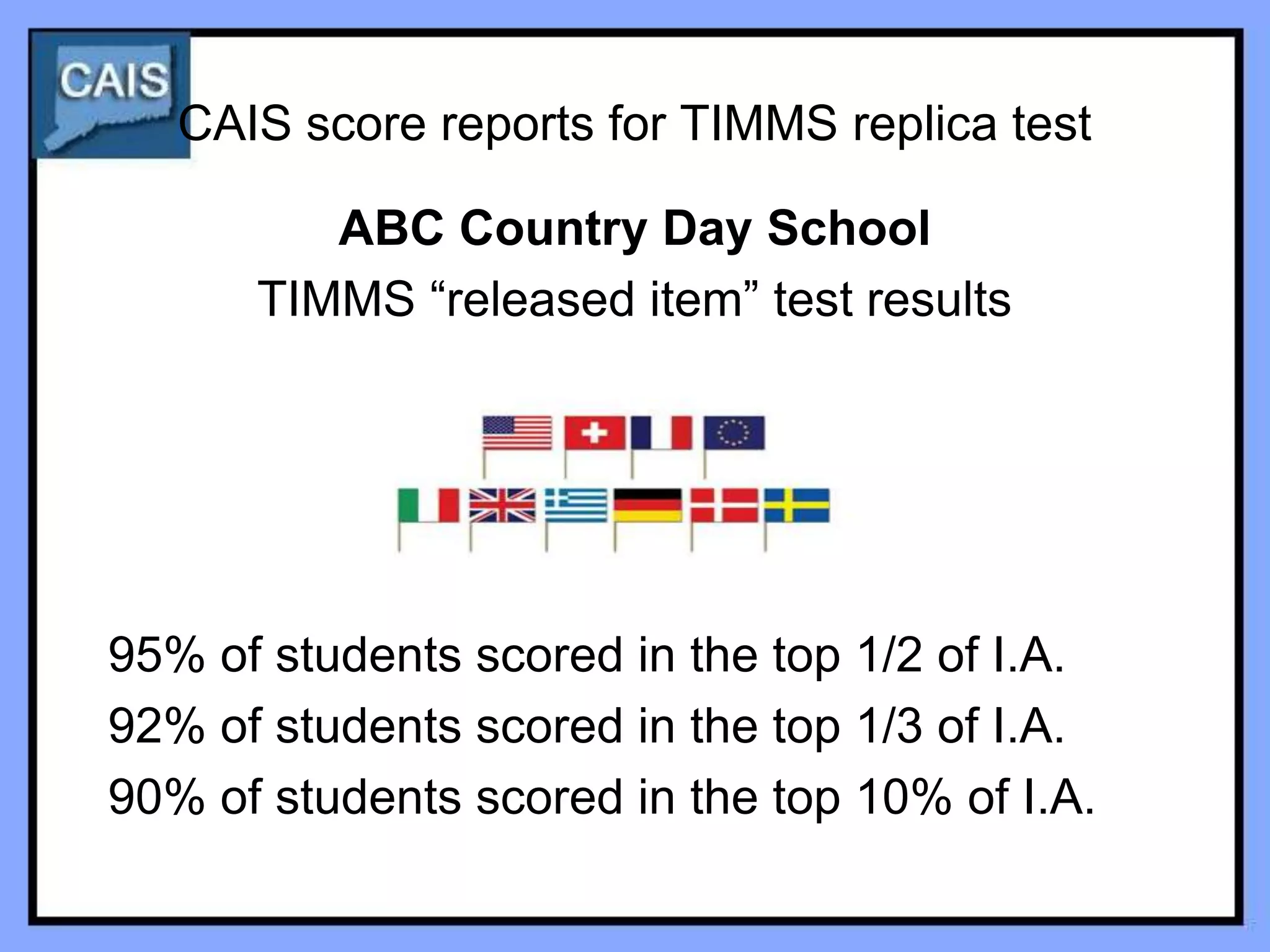
CAIS score reports for TIMMS replica test

         ABC Country Day School
      TIMMS “released item” test results


95% of students scored in the top 1/2 of I.A.
92% of students scored in the top 1/3 of I.A.
90% of students scored in the top 10% of I.A.
Course of study guides: how we describe
               our program

         US HISTORY HONORS
       GREENWICH HIGH SCHOOL
 This course addresses the events and experiences
that comprise American history from the period of
European colonial settlement through the Civil War
(1st semester) And from the period of Reconstruction
through the advent of the Second World War. The
goal of the course is to provide for our students
substantial opportunity to develop the ability to make
informed and reasoned decisions as citizens
concerned with the public good. (More text follows)
US HISTORY HONORS
A study of the events and critical changes
that took place from the first American
settlement to the present day.We will focus
on these events in the context of larger
themes; including the shift from an
agricultural to an industrial society, the
recognition and cultural identification of
different groups of people, the transition to a
stronger national government, immense
territorial expansion, technological change
and globalization.
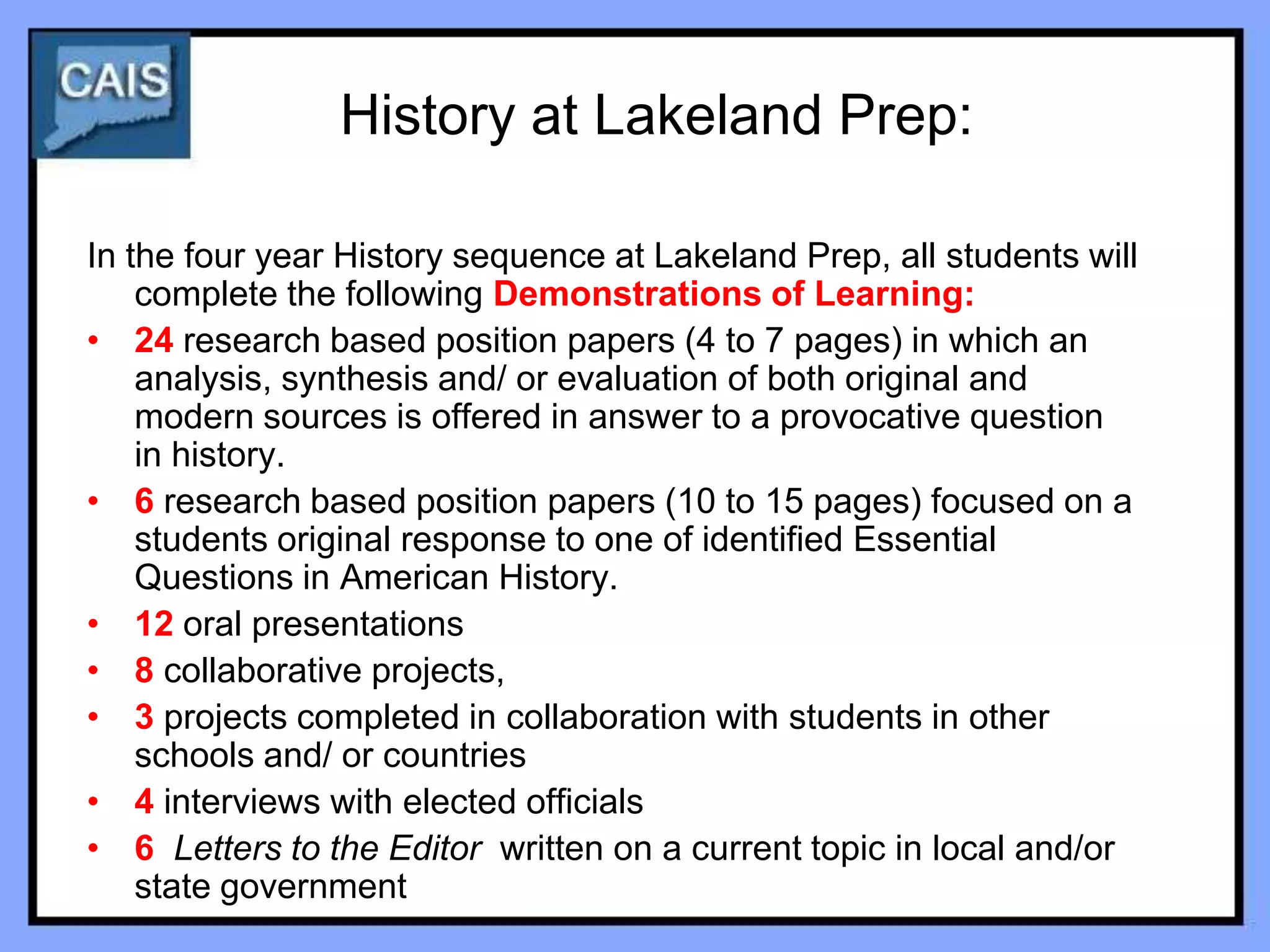
History at Lakeland Prep:

In the four year History sequence at Lakeland Prep, all students will
    complete the following Demonstrations of Learning:
• 24 research based position papers (4 to 7 pages) in which an
    analysis, synthesis and/ or evaluation of both original and
    modern sources is offered in answer to a provocative question
    in history.
• 6 research based position papers (10 to 15 pages) focused on a
    students original response to one of identified Essential
    Questions in American History.
• 12 oral presentations
• 8 collaborative projects,
• 3 projects completed in collaboration with students in other
    schools and/ or countries
• 4 interviews with elected officials
• 6 Letters to the Editor written on a current topic in local and/or
    state government
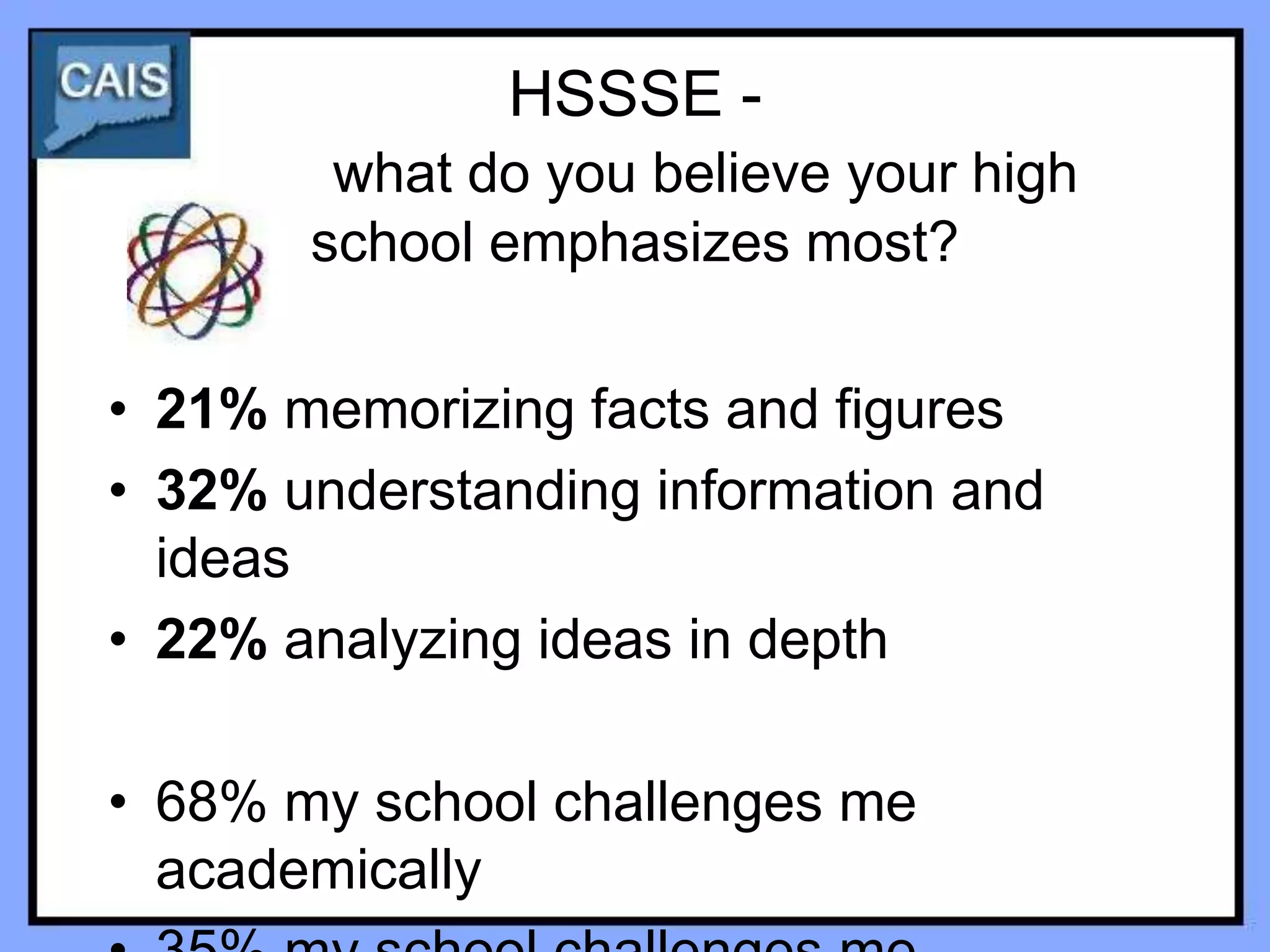
HSSSE -
        what do you believe your high
       school emphasizes most?

• 21% memorizing facts and figures
• 32% understanding information and
  ideas
• 22% analyzing ideas in depth

• 68% my school challenges me
  academically
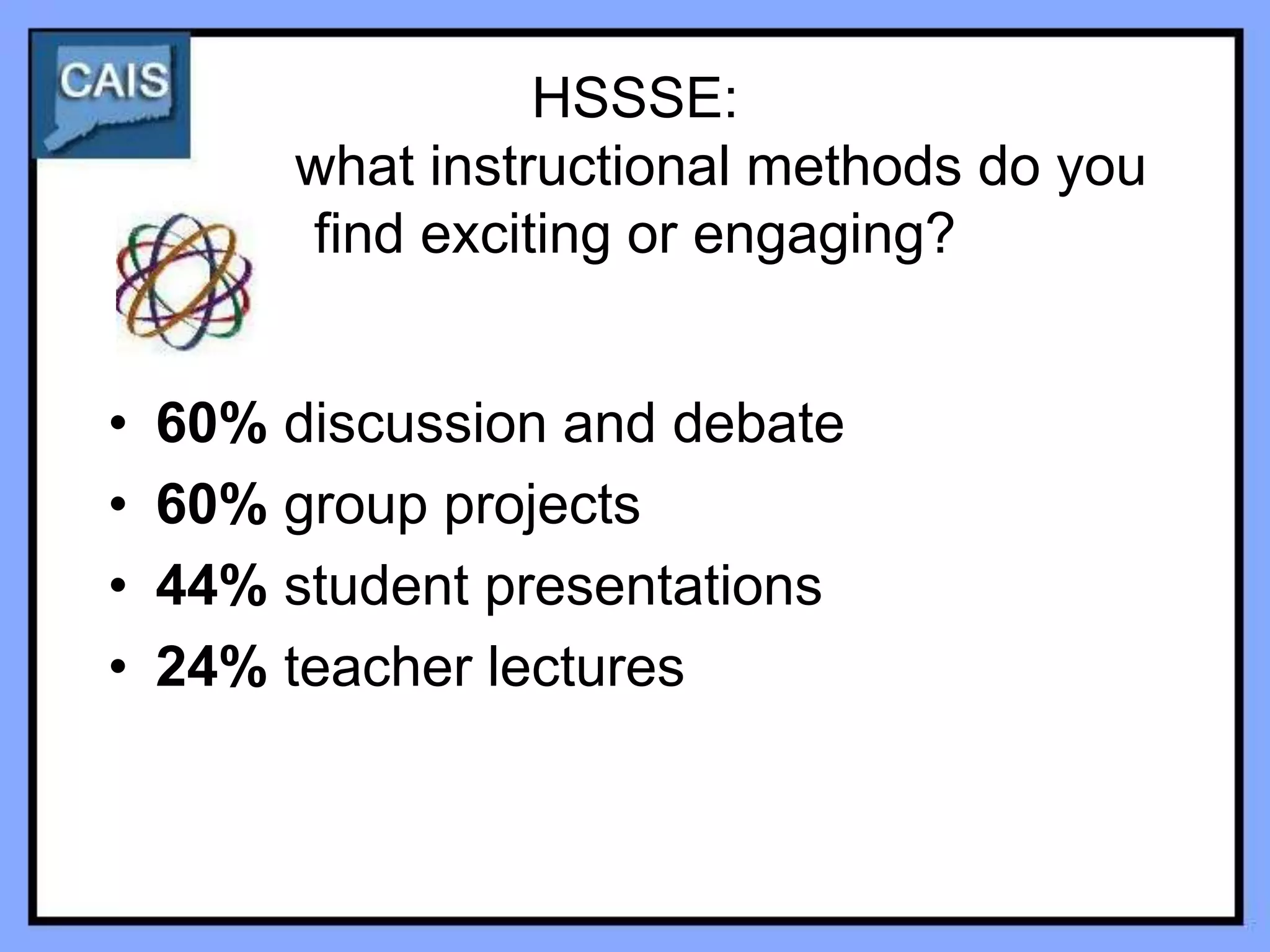
HSSSE:
         what instructional methods do you
         find exciting or engaging?


•   60% discussion and debate
•   60% group projects
•   44% student presentations
•   24% teacher lectures
Using an Engagement
            Survey
• Use the HSSSE and contribute your
  school data for national benchmarking;
• Or, create your own survey, then
  compare your results to the national
  HSSSE 2009 data, where applicable .
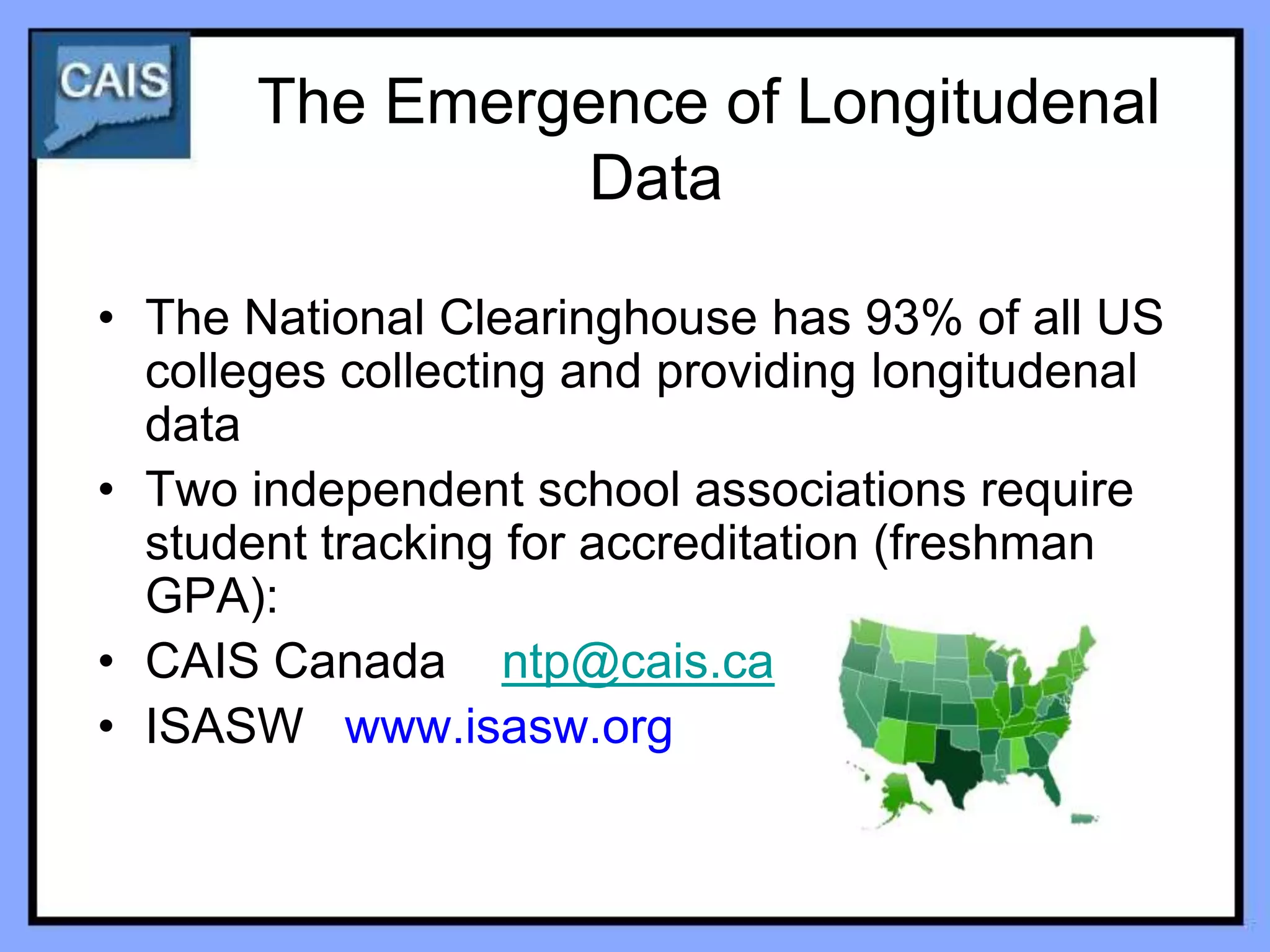
The Emergence of Longitudenal
                 Data

• The National Clearinghouse has 93% of all US
  colleges collecting and providing longitudenal
  data
• Two independent school associations require
  student tracking for accreditation (freshman
  GPA):
• CAIS Canada ntp@cais.ca
• ISASW www.isasw.org
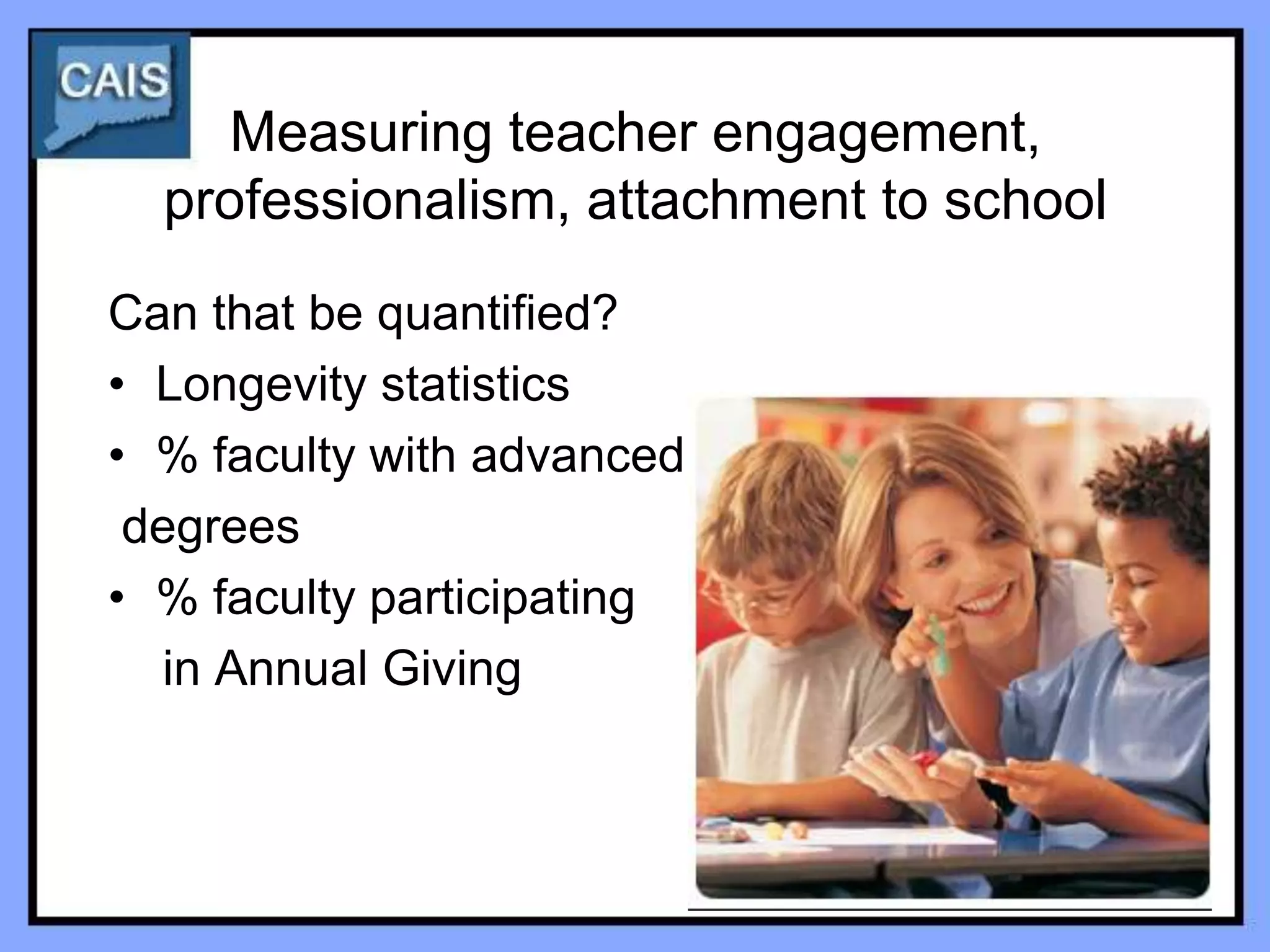
Measuring teacher engagement,
  professionalism, attachment to school
Can that be quantified?
• Longevity statistics
• % faculty with advanced
 degrees
• % faculty participating
  in Annual Giving
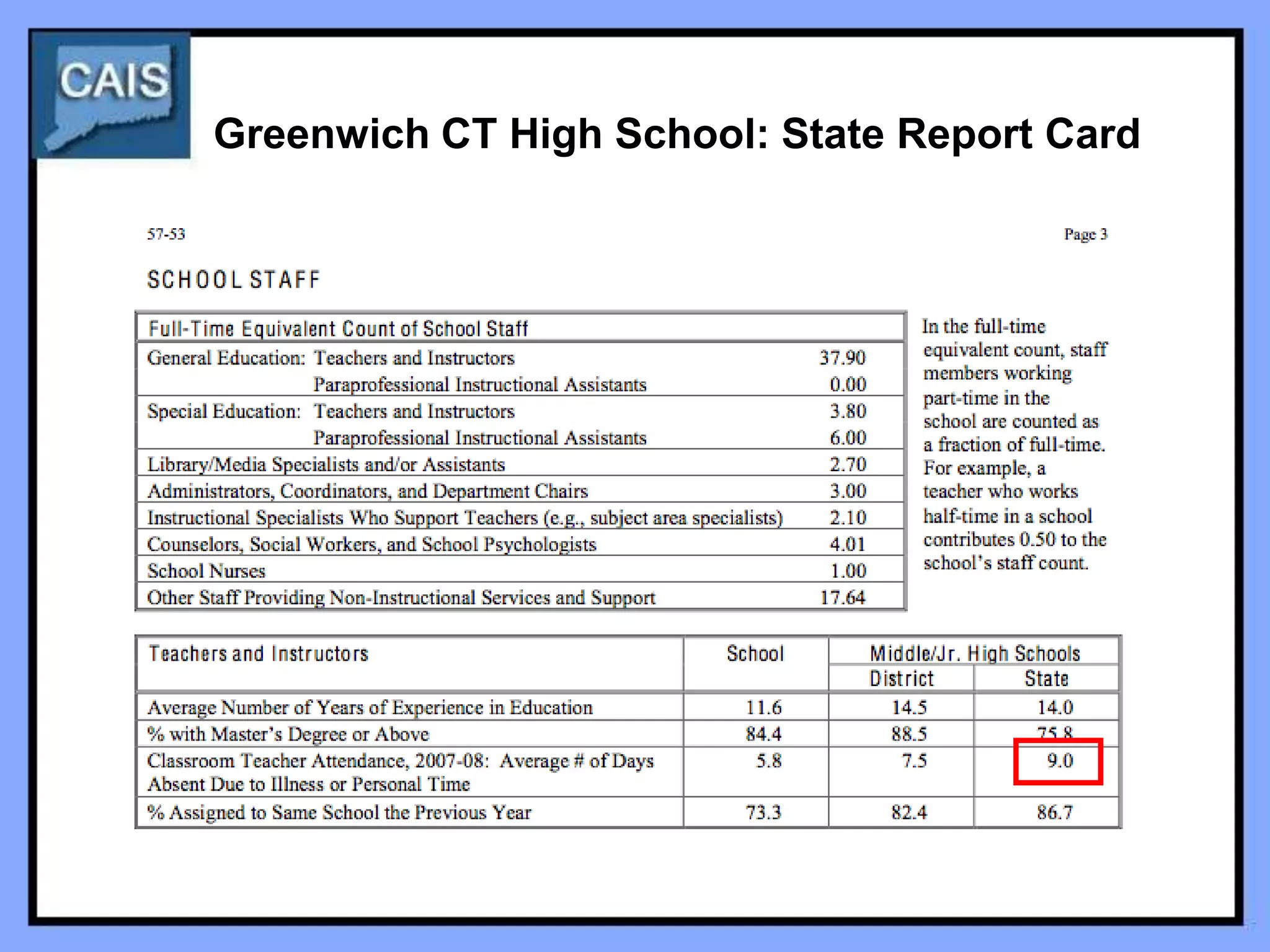
Occasional Teacher Absenteeism

• Reported in “school district report cards”
• Measures only consecutive days absent, less
  than 5, 7 or 10 days. After the threshold,
  absence considered “long term illness”,
  removed from calculation
• O.C.A considered an indicator of faculty
  commitment, professionalism, attachment
Greenwich CT High School: State Report Card
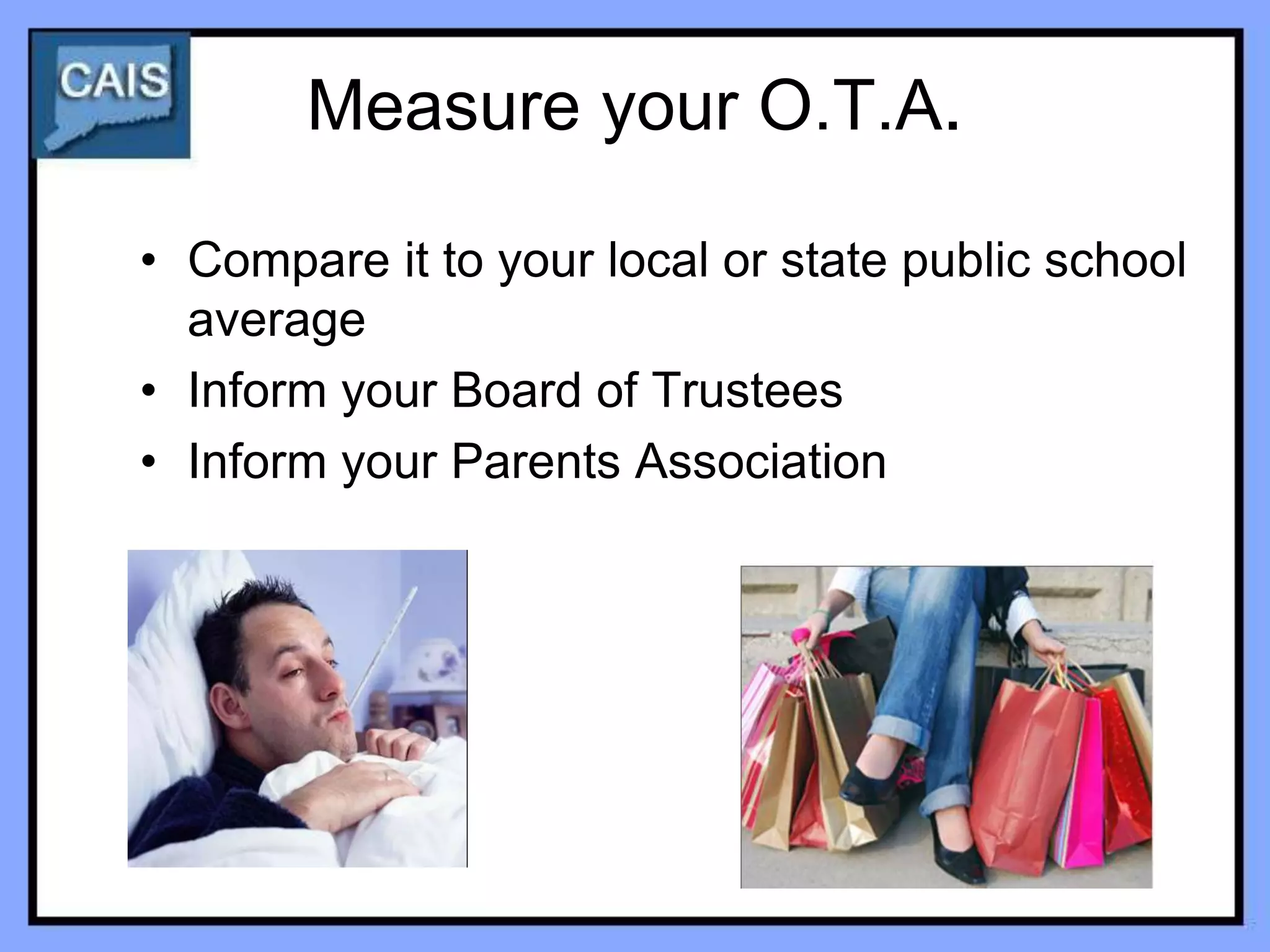
Measure your O.T.A.

• Compare it to your local or state public school
  average
• Inform your Board of Trustees
• Inform your Parents Association
Measuring teacher effectiveness: in the
    best public schools, teacher evaluation is
       an informed, professional process

   How can independent school leaders
become more skilled in the clinical
observation and evaluation of teaching?
    How can we measure what we value in
teaching practice?

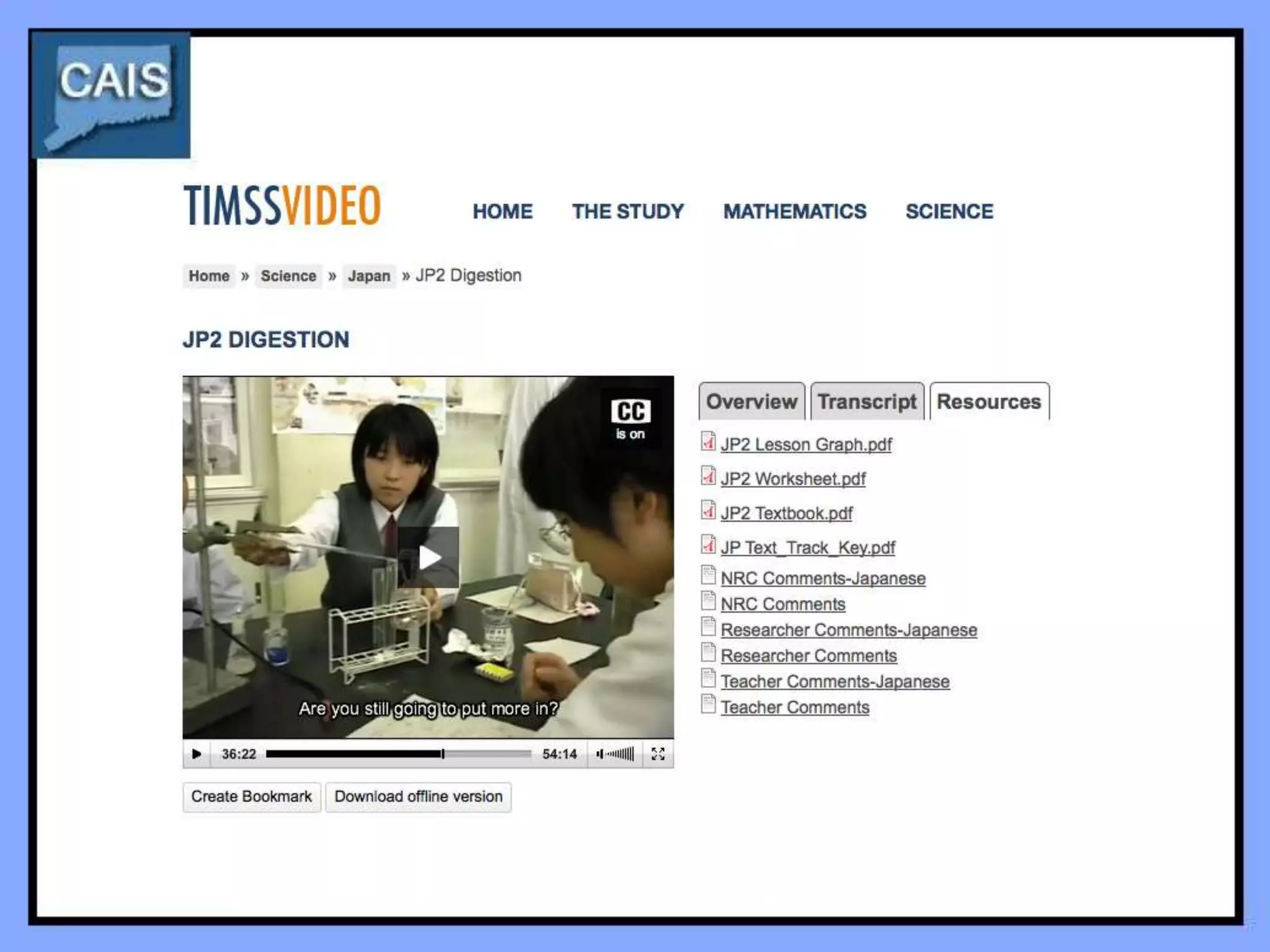
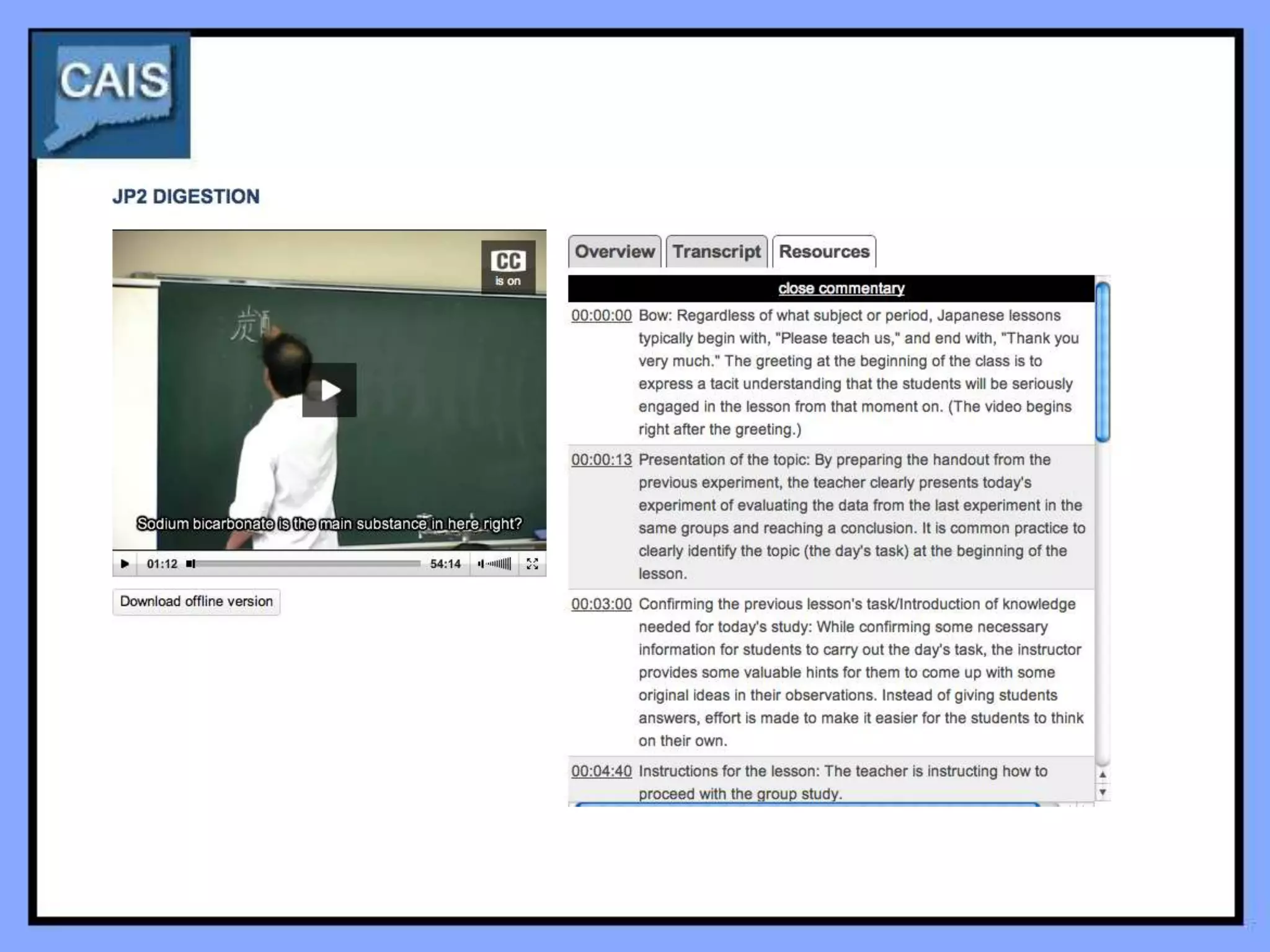
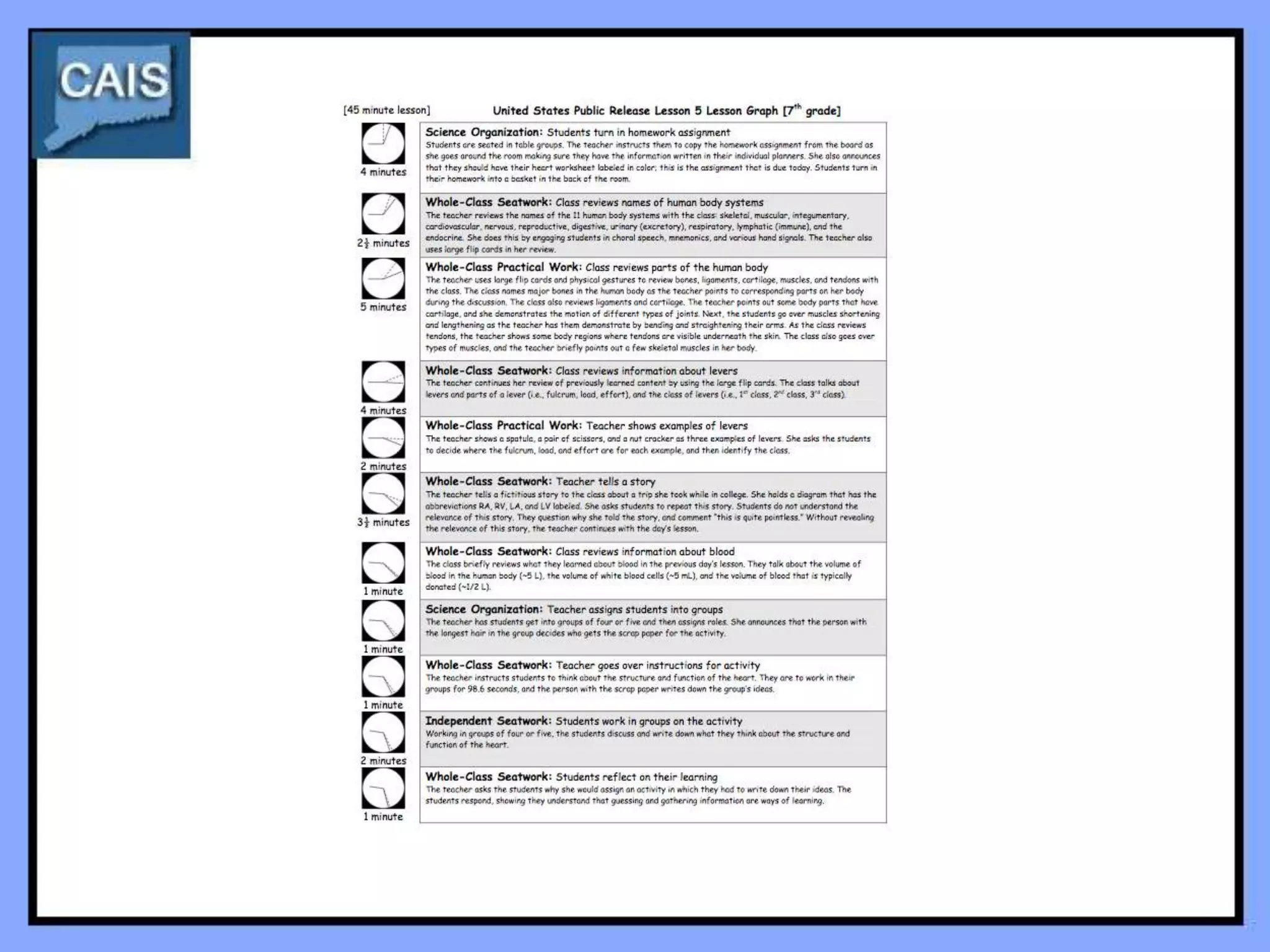
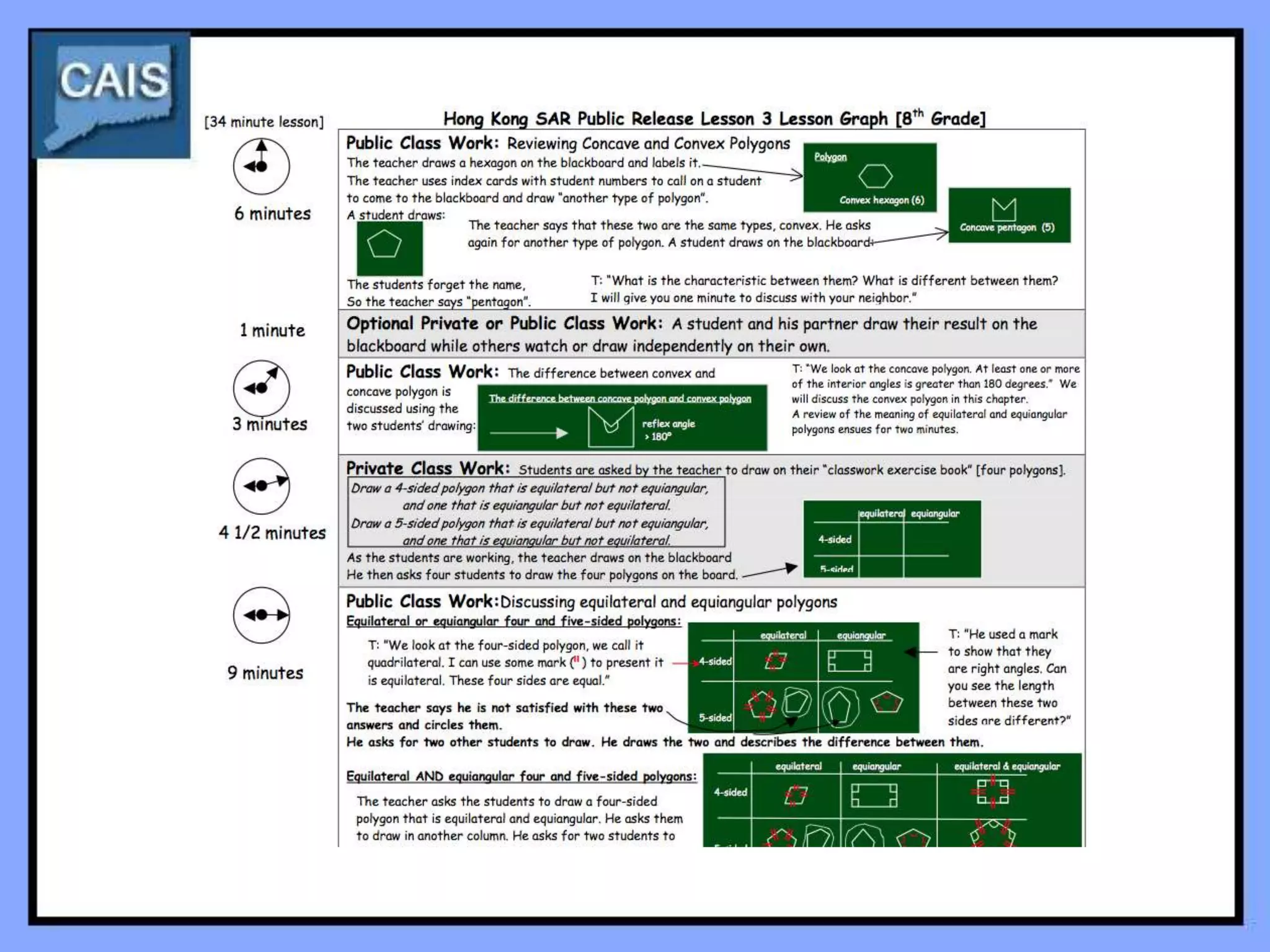
 The TIMSS video study – teaching
 practices in 7 select countries
New and emerging assessment
      instruments – workshop goal 3
• We have just reviewed ideas for improving
  the use of existing data
• What about new tools and techniques?
• Are the assessment instruments and
  practices of earlier generations obsolete or
  incomplete?
• If so, why is that true?
Did something occur on January 1, 2001 that
           changed everything?
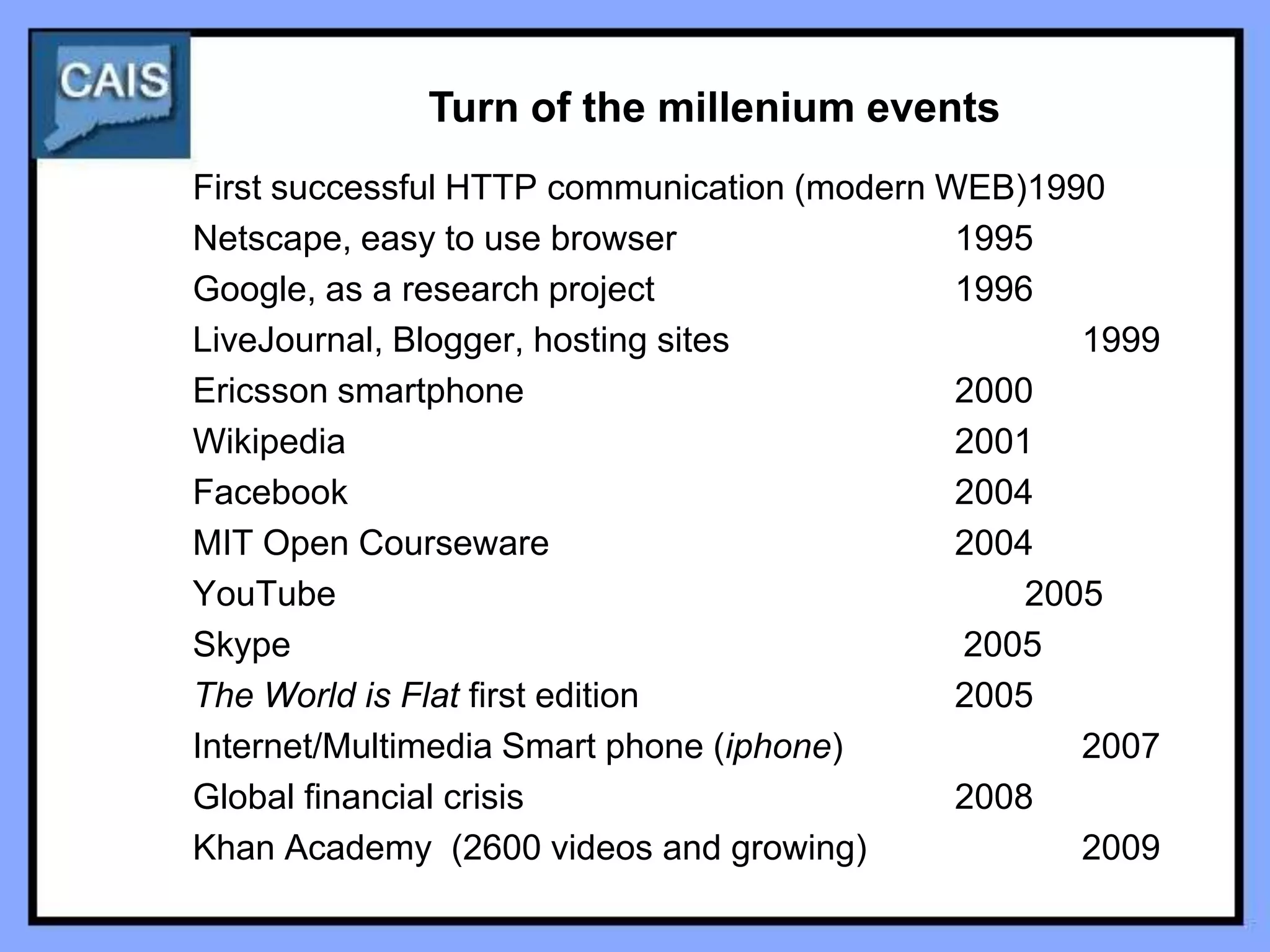
Turn of the millenium events
First successful HTTP communication (modern WEB)1990
Netscape, easy to use browser                1995
Google, as a research project                1996
LiveJournal, Blogger, hosting sites                 1999
Ericsson smartphone                          2000
Wikipedia                                    2001
Facebook                                     2004
MIT Open Courseware                          2004
YouTube                                          2005
Skype                                        2005
The World is Flat first edition              2005
Internet/Multimedia Smart phone (iphone)            2007
Global financial crisis                      2008
Khan Academy (2600 videos and growing)              2009
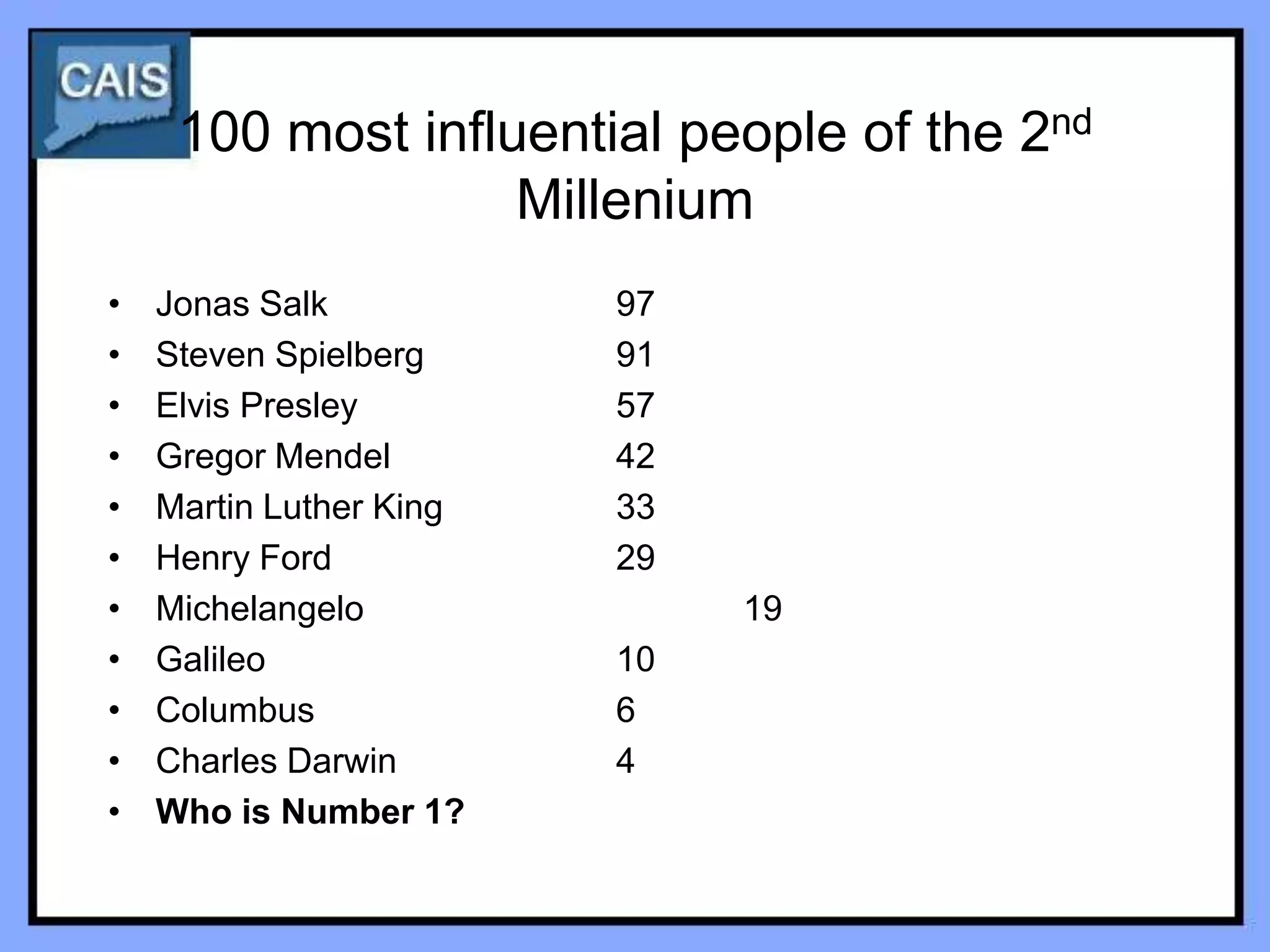
100 most influential people of the 2nd
                   Millenium
•   Jonas Salk           97
•   Steven Spielberg     91
•   Elvis Presley        57
•   Gregor Mendel        42
•   Martin Luther King   33
•   Henry Ford           29
•   Michelangelo              19
•   Galileo              10
•   Columbus             6
•   Charles Darwin       4
•   Who is Number 1?
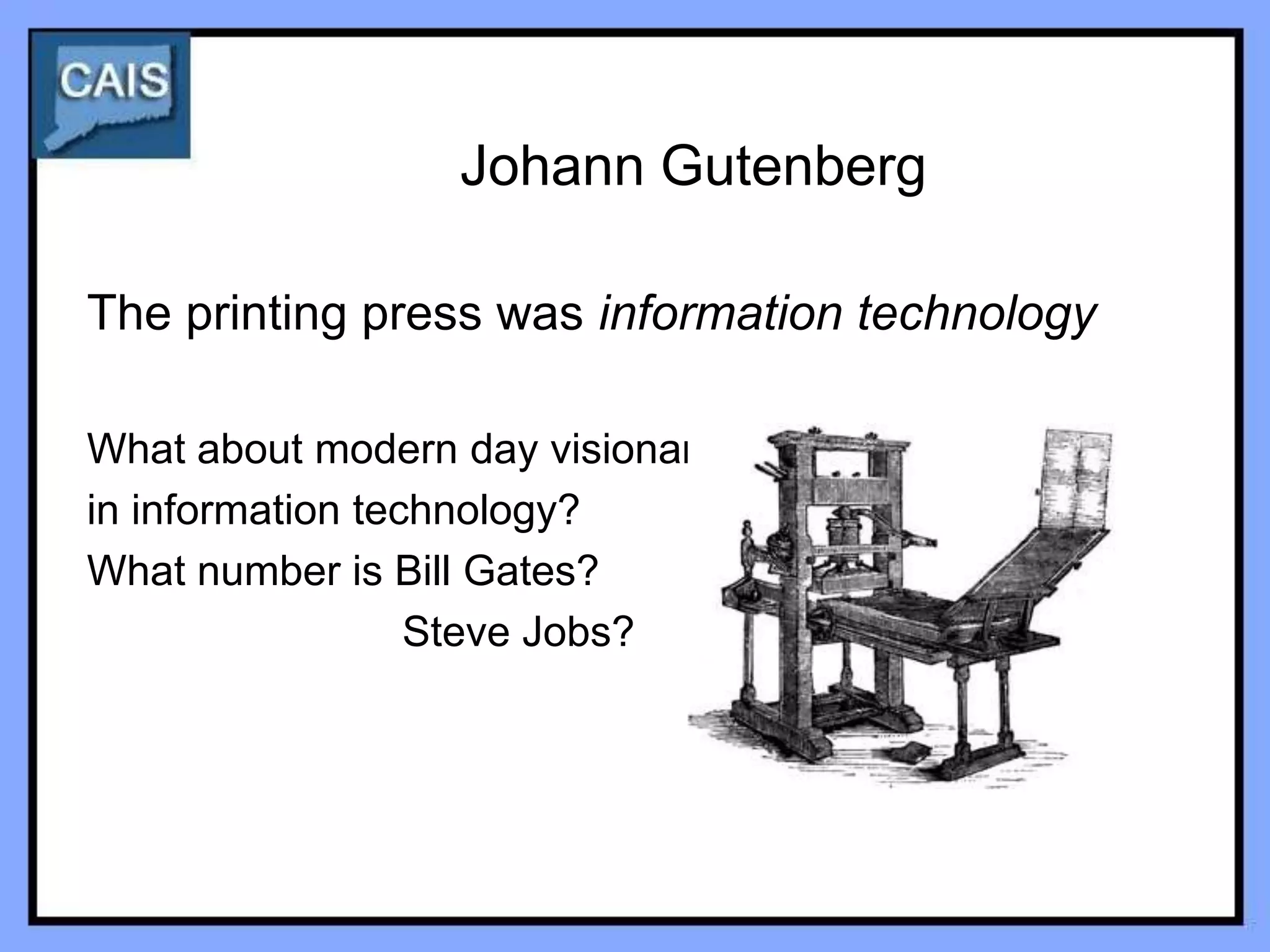
Johann Gutenberg

The printing press was information technology

What about modern day visionaries
in information technology?
What number is Bill Gates?
                  Steve Jobs?
What’s Past is Prologue
vs The Future is Not What it Used
           to Be
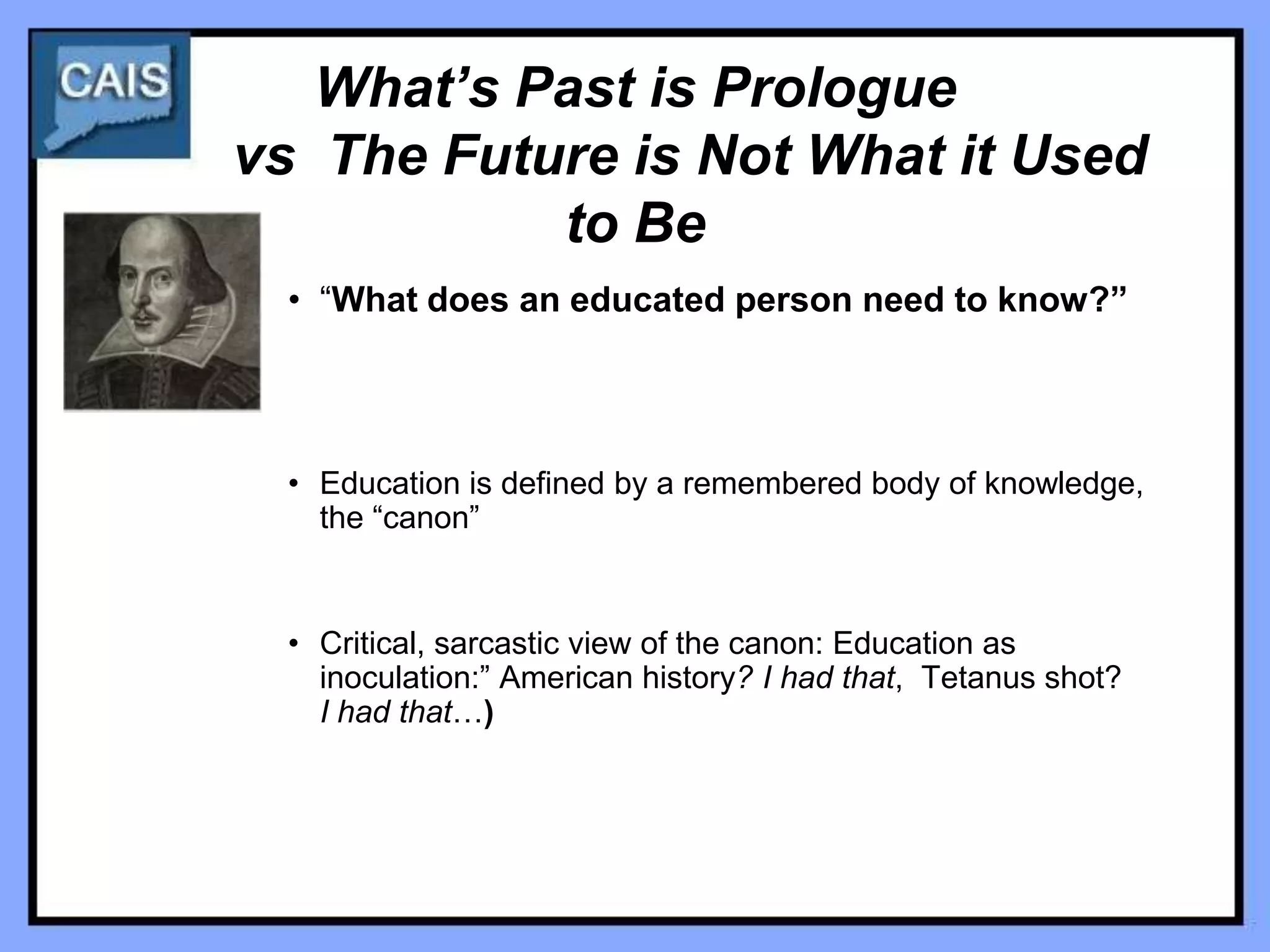
 • “What does an educated person need to know?”


 • Education is defined by a remembered body of knowledge,
   the “canon”


 • Critical, sarcastic view of the canon: Education as
   inoculation:” American history? I had that, Tetanus shot?
   I had that…)
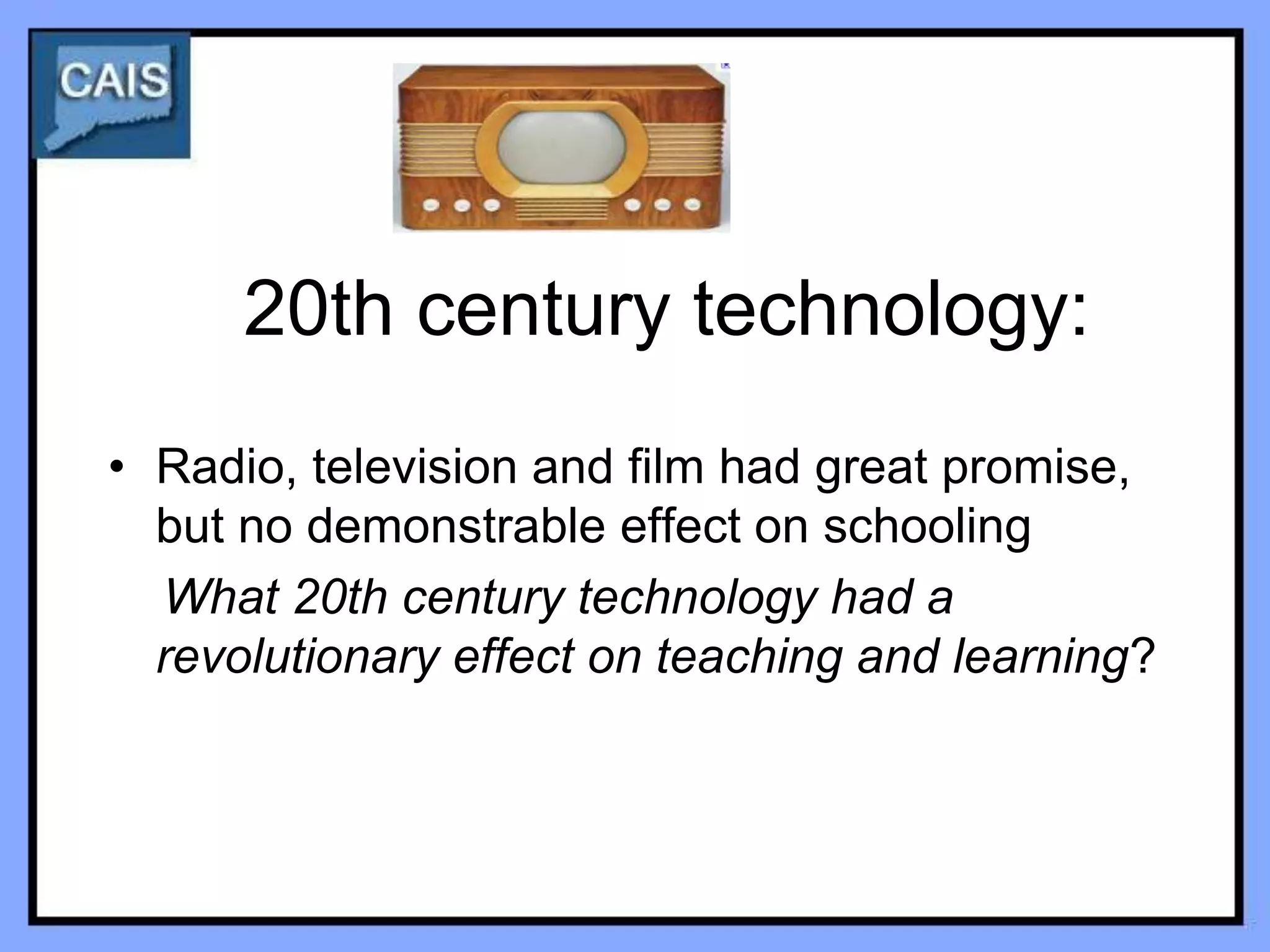
20th century technology:
• Radio, television and film had great promise,
  but no demonstrable effect on schooling
  What 20th century technology had a
  revolutionary effect on teaching and learning?
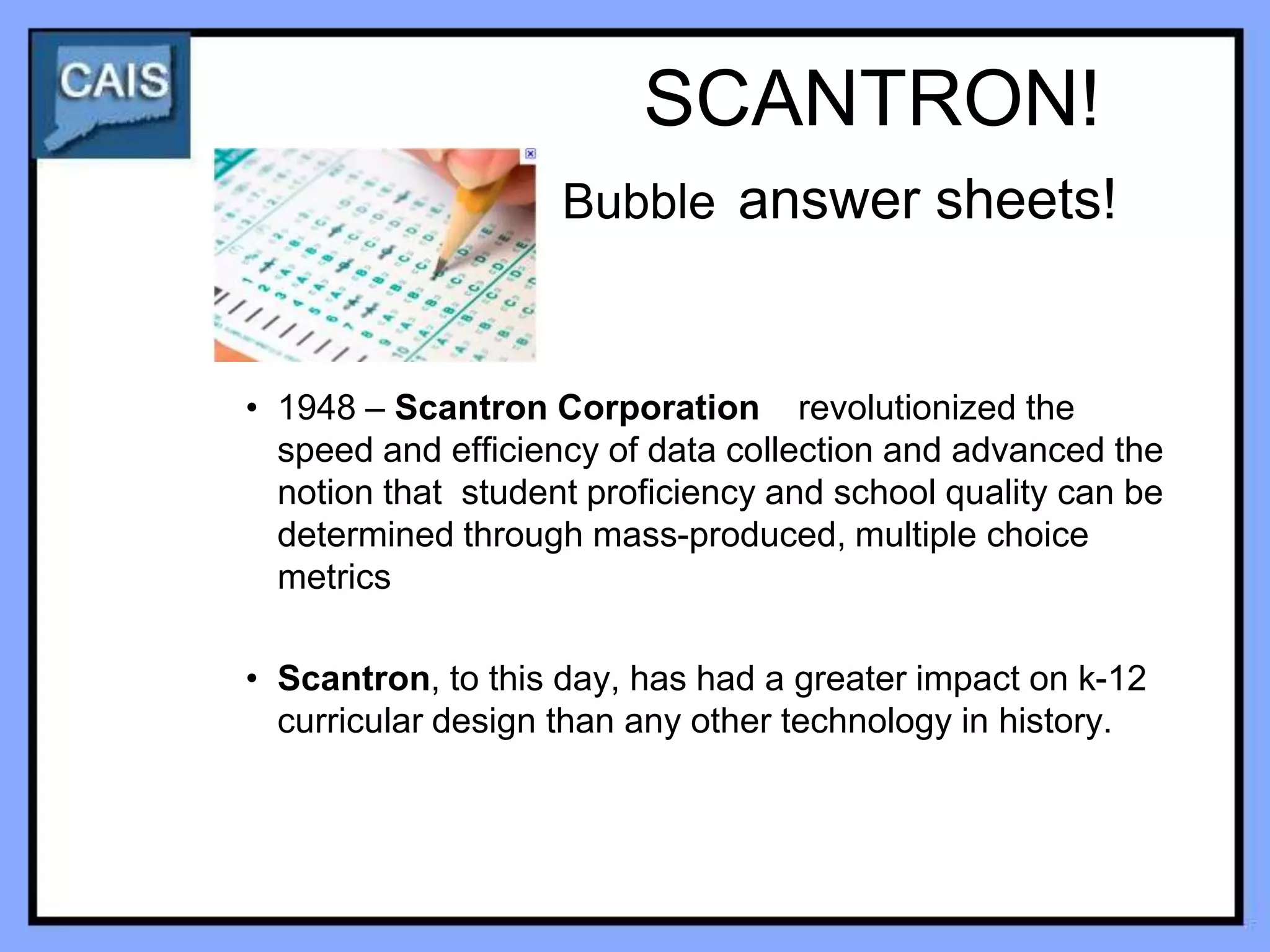
SCANTRON!
                    Bubble answer sheets!


• 1948 – Scantron Corporation revolutionized the
  speed and efficiency of data collection and advanced the
  notion that student proficiency and school quality can be
  determined through mass-produced, multiple choice
  metrics

• Scantron, to this day, has had a greater impact on k-12
  curricular design than any other technology in history.
in post scantron decades:
                “What gets measured is what
                        gets taught”.


• Tests “drive” instruction in ways that mimic
  both the content and format of the test.
• What gets measured is almost exclusively
  content
• In the Information Age, we measured recall of
  information
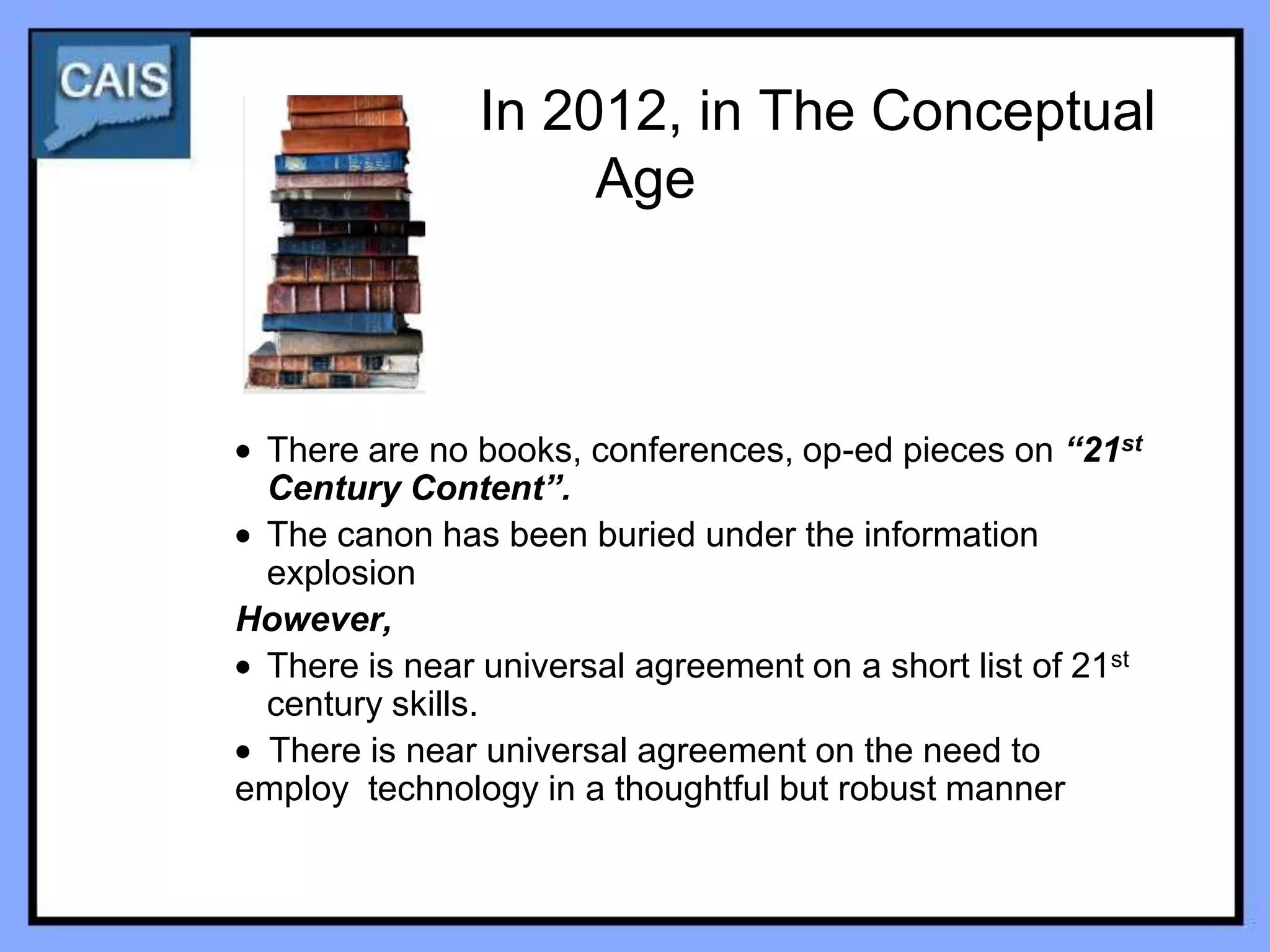
In 2012, in The Conceptual
                    Age


 There are no books, conferences, op-ed pieces on “21st
 Century Content”.
 The canon has been buried under the information
 explosion
However,
 There is near universal agreement on a short list of 21st
 century skills.
 There is near universal agreement on the need to
employ technology in a thoughtful but robust manner
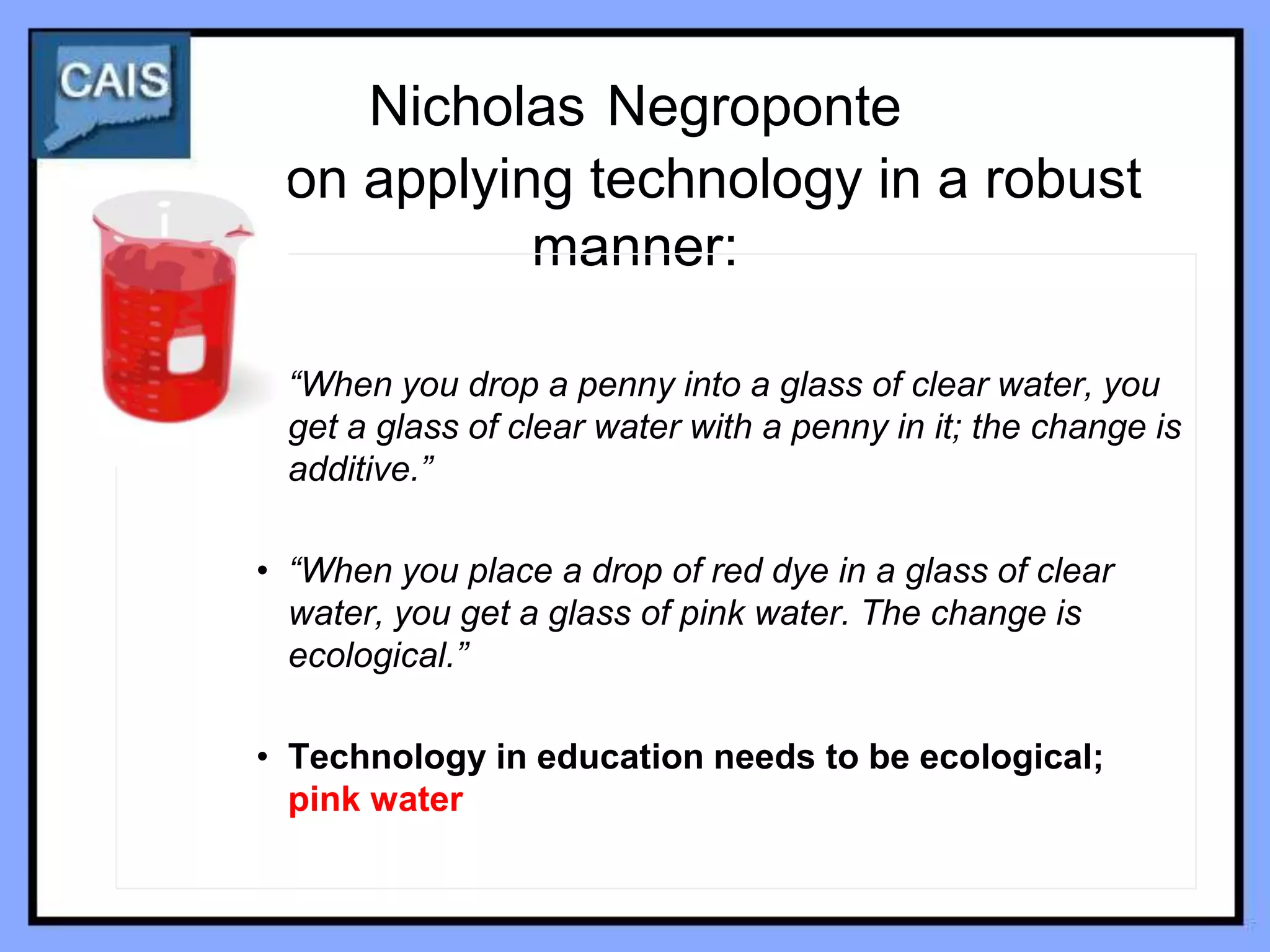
Nicholas Negroponte
 on applying technology in a robust
           manner:

• “When you drop a penny into a glass of clear water, you
  get a glass of clear water with a penny in it; the change is
  additive.”

• “When you place a drop of red dye in a glass of clear
  water, you get a glass of pink water. The change is
  ecological.”

• Technology in education needs to be ecological;
  pink water
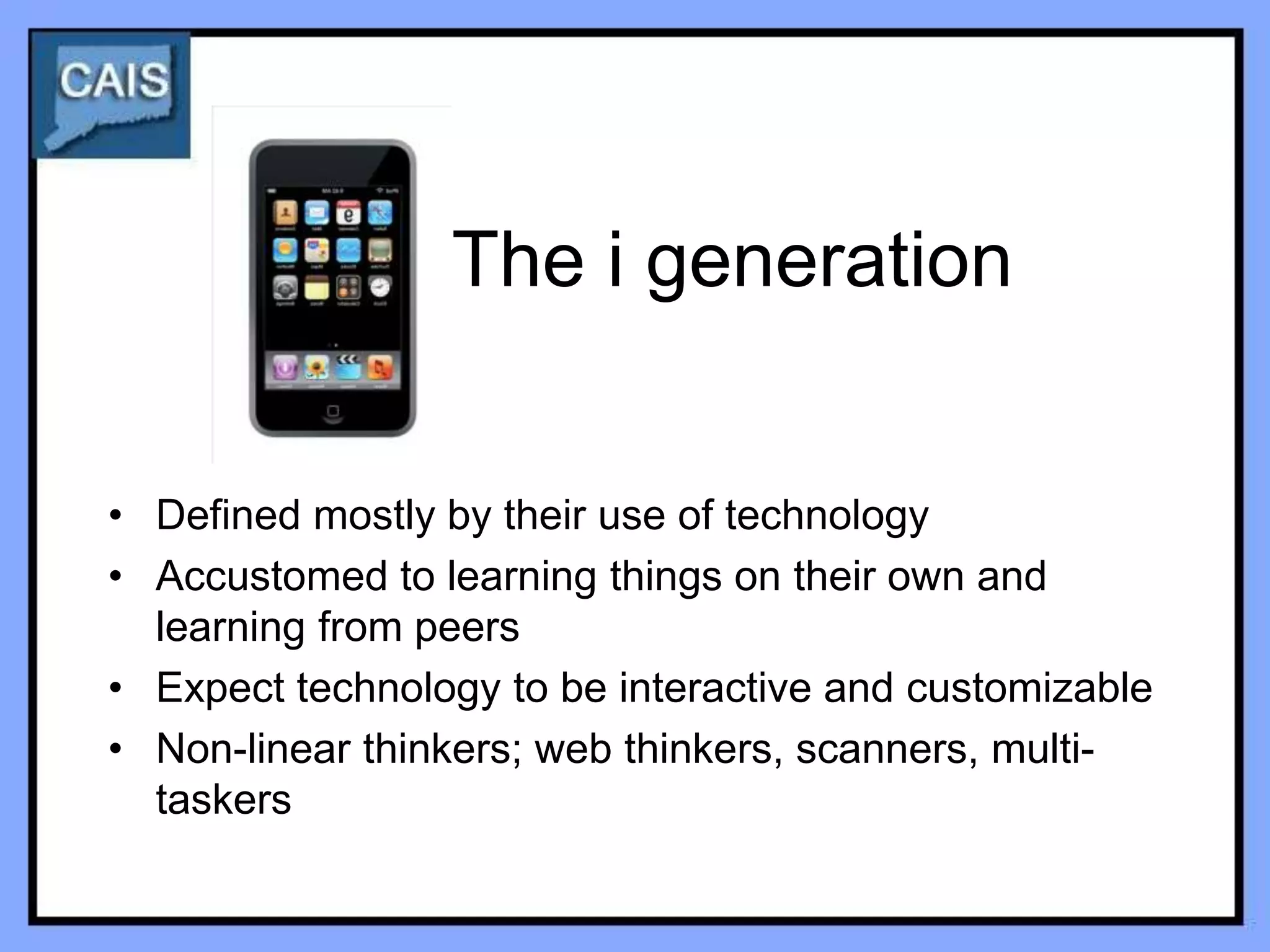
The i generation


• Defined mostly by their use of technology
• Accustomed to learning things on their own and
  learning from peers
• Expect technology to be interactive and customizable
• Non-linear thinkers; web thinkers, scanners, multi-
  taskers
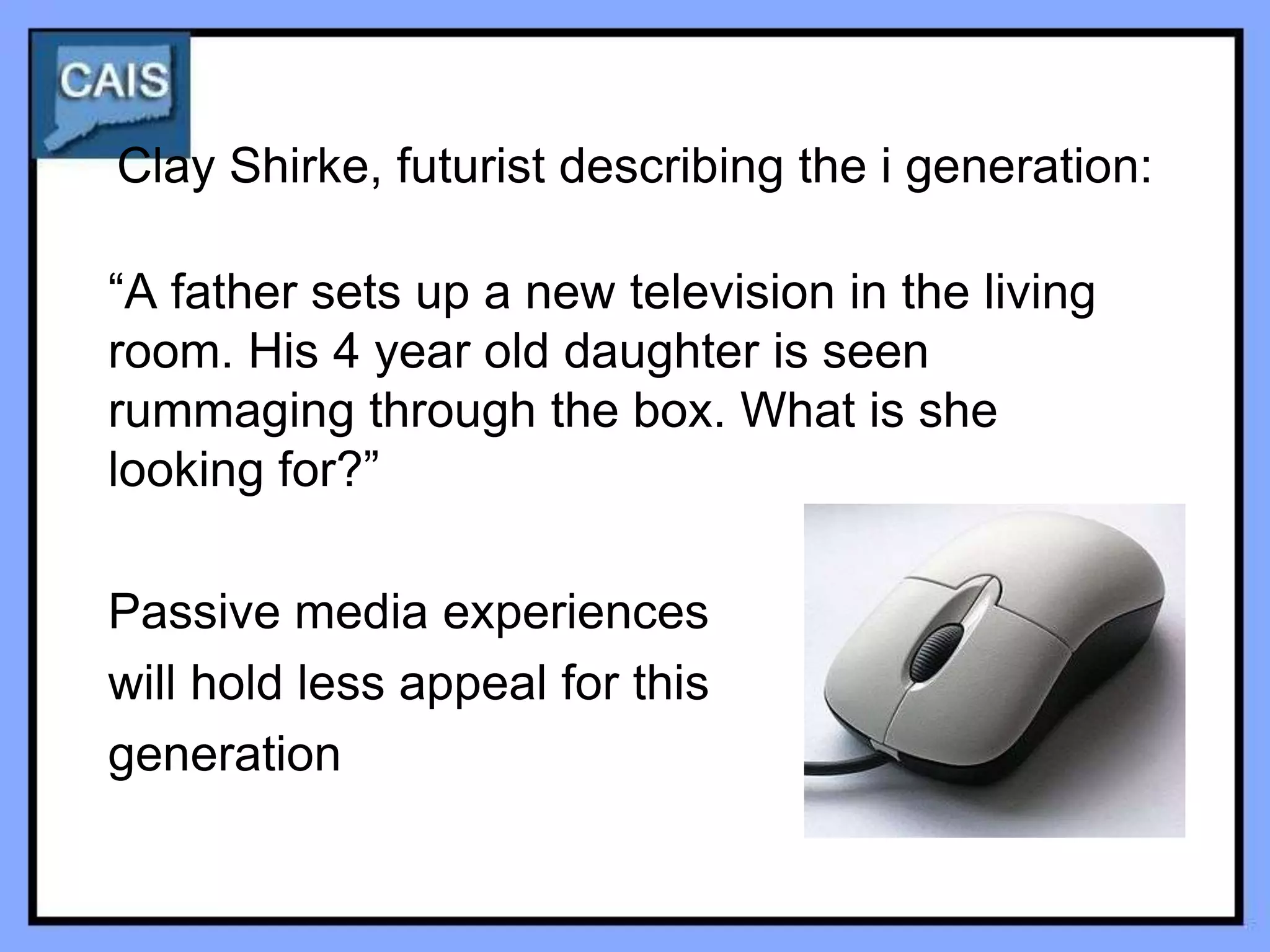
Clay Shirke, futurist describing the i generation:

“A father sets up a new television in the living
room. His 4 year old daughter is seen
rummaging through the box. What is she
looking for?”

Passive media experiences
will hold less appeal for this
generation
The 21st century skills movement,
the Schools of the Future movement, focus on
        the development of these skills:

      Communication
      Collaboration
      Critical/Analytical Thinking
      Creativity
      Problem-solving

    Content is still important; but content in these areas will
     need to be acquired through active exploration as well as
     through instruction.
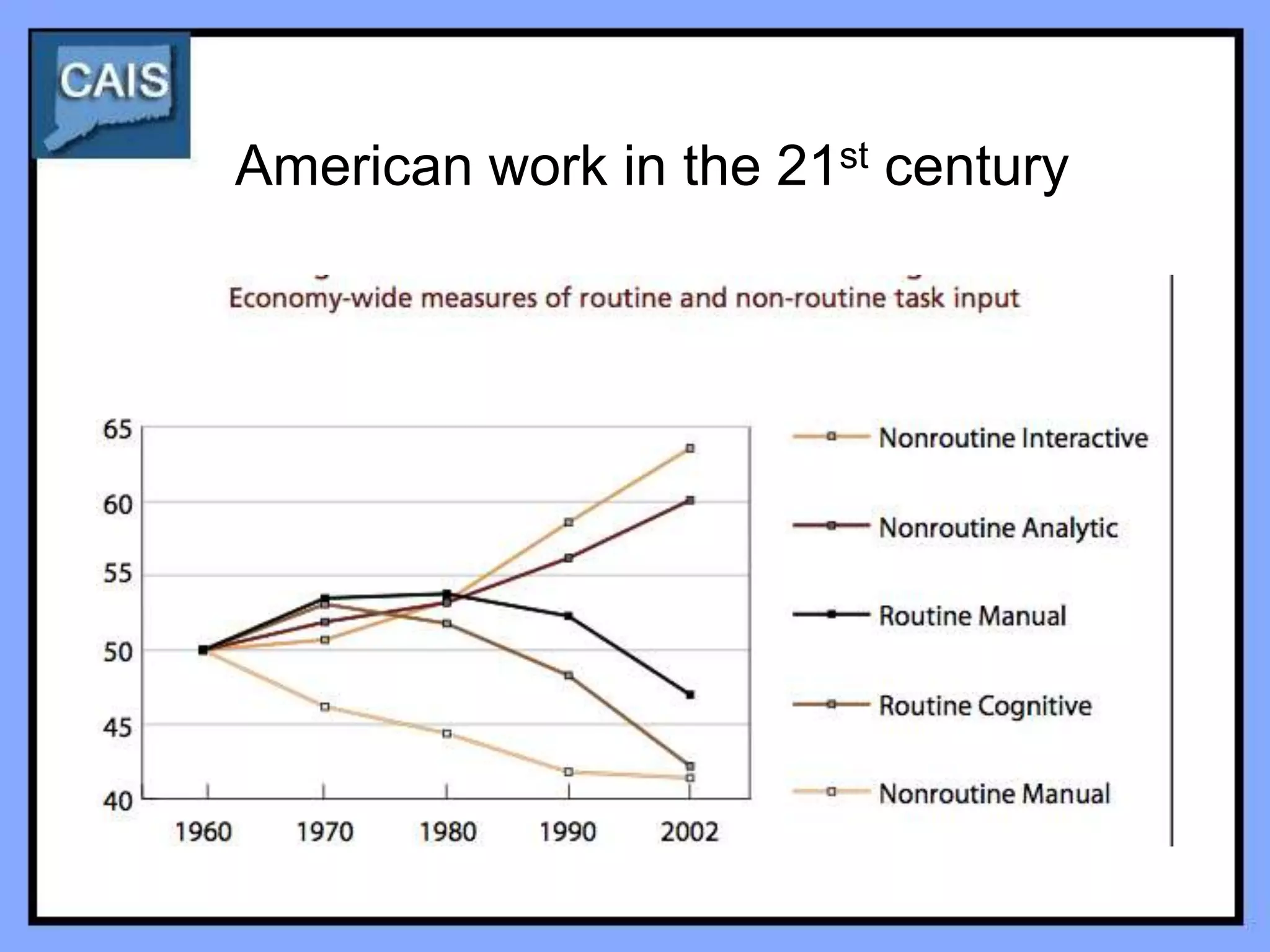
American work in the 21st century
Non–Routine Tasks
    defined in the Journal of Economics, volume
                       118
• Gathering, synthesizing, and analyzing information.
• Working autonomously to a high standard with
  minimal supervision.
• Leading other autonomous workers through
  influence.
• Being creative and turning that creativity into action.
• Thinking critically and asking the right questions.
• Striving to understand others’ perspectives and to
  understand the entirety of an issue. Communicating
  effectively, often using technology.
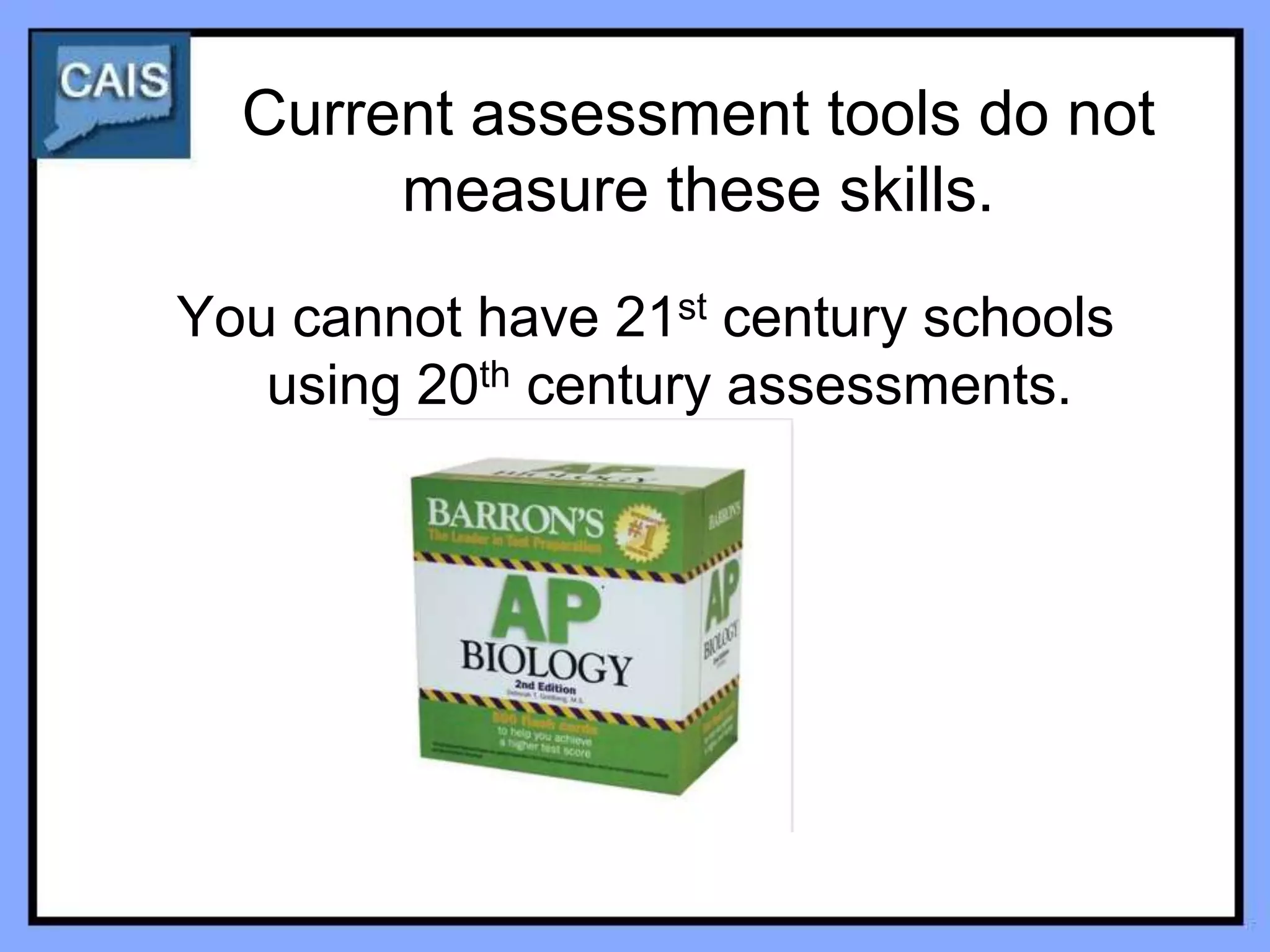
Current assessment tools do not
       measure these skills.
You cannot have 21st century schools
   using 20th century assessments.
Ideal Assessment:


Provides accurate demonstration of student
proficiency
Yields information for faculty planning
Is valid as a learning experience in and of itself

An assessment of, for and as learning
What is a performance task?

Students assume roles in a
scenario that is based in the
"real world" and contains the
types of problems they might
need to solve in the future. The
task requires critical thinking,
analytical reasoning and
problem solving.
Communication skills are used
in describing the solution.
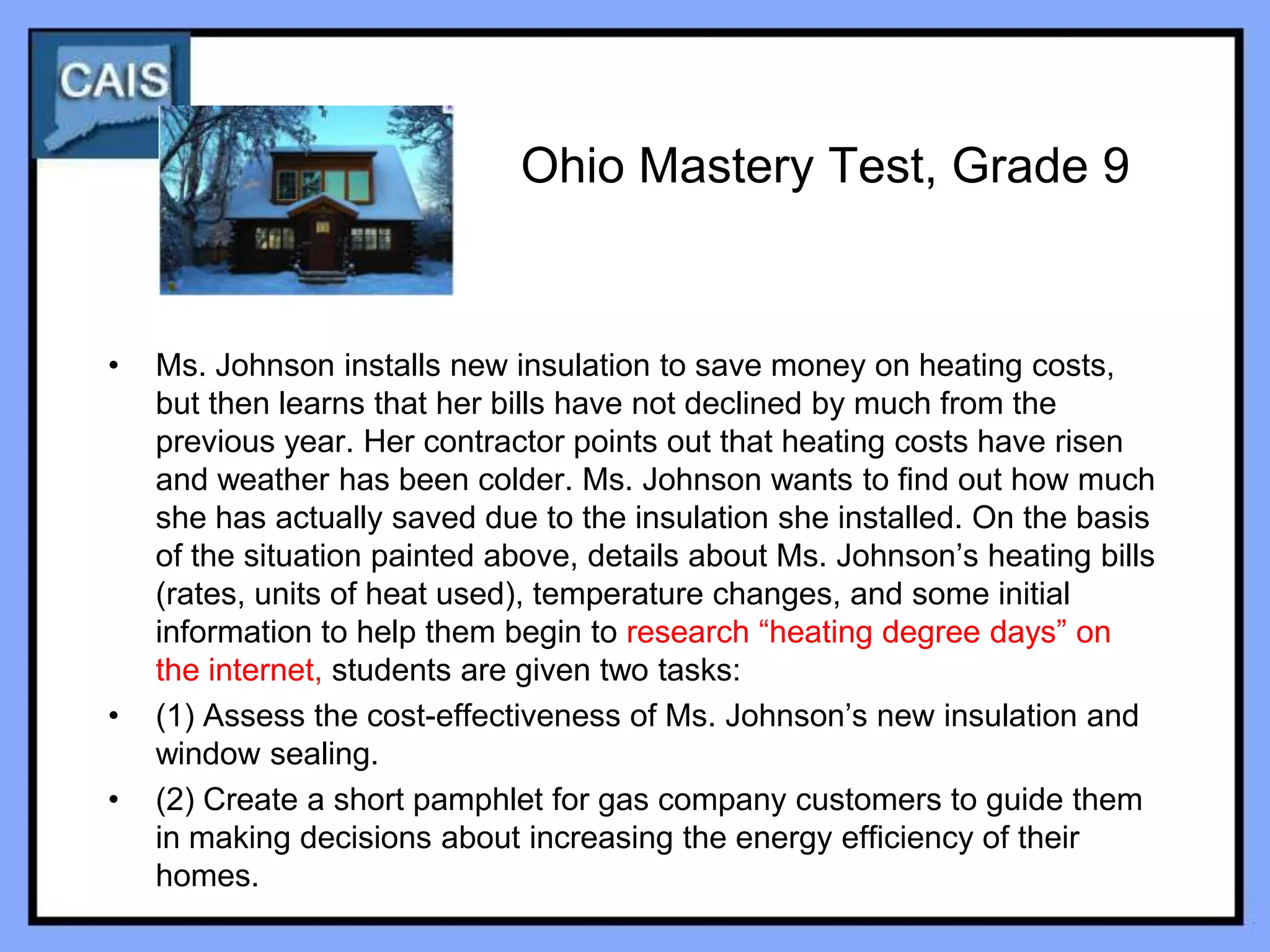
Ohio Mastery Test, Grade 9


•   Ms. Johnson installs new insulation to save money on heating costs,
    but then learns that her bills have not declined by much from the
    previous year. Her contractor points out that heating costs have risen
    and weather has been colder. Ms. Johnson wants to find out how much
    she has actually saved due to the insulation she installed. On the basis
    of the situation painted above, details about Ms. Johnson’s heating bills
    (rates, units of heat used), temperature changes, and some initial
    information to help them begin to research “heating degree days” on
    the internet, students are given two tasks:
•   (1) Assess the cost-effectiveness of Ms. Johnson’s new insulation and
    window sealing.
•   (2) Create a short pamphlet for gas company customers to guide them
    in making decisions about increasing the energy efficiency of their
    homes.
Students get answers to
      questions THEY ask
• For example
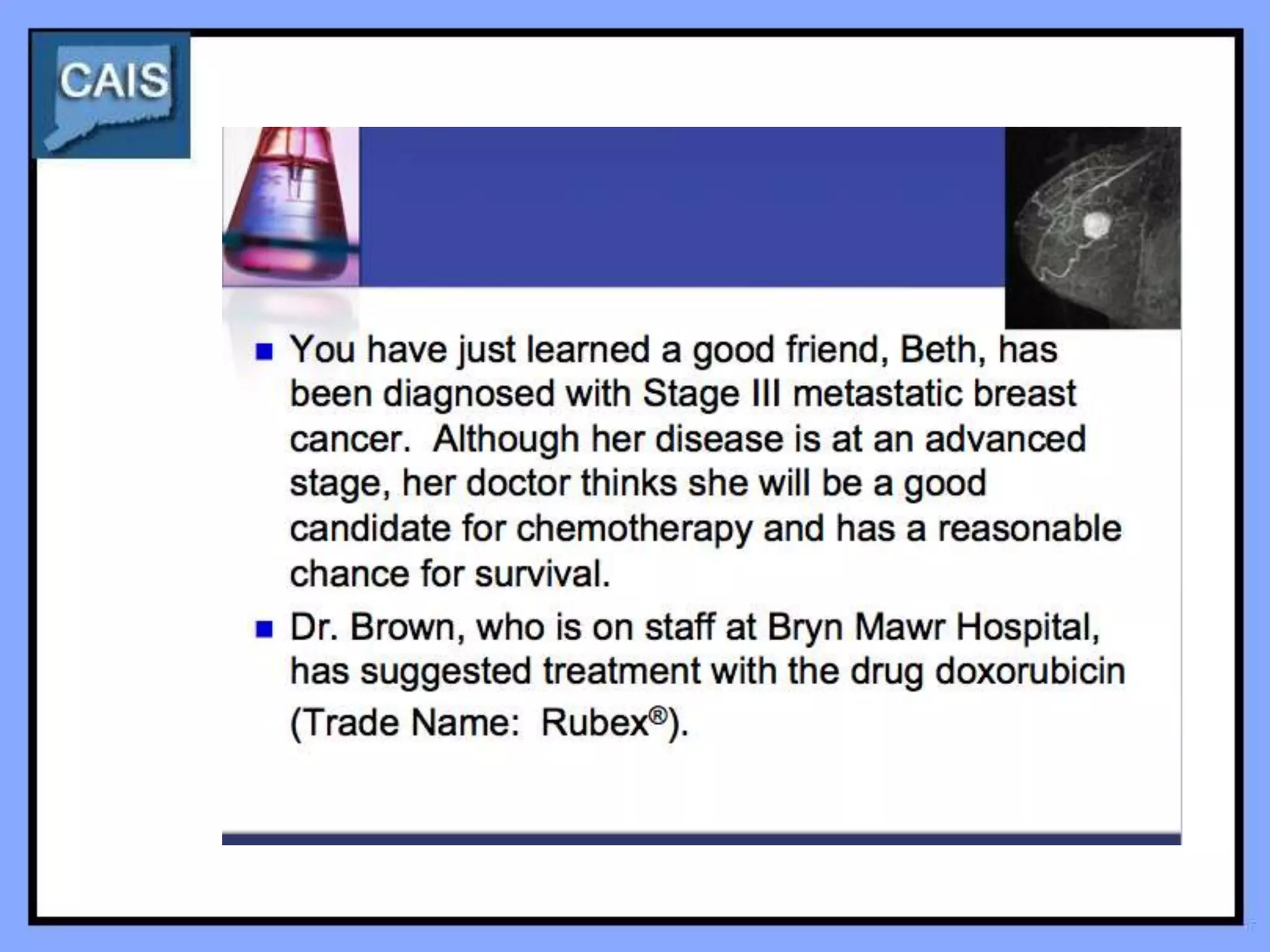
  – Family history – Is this breast cancer
    possibly caused by abnormal oncogene
    expression? If so, certain types of
    hormonal therapy or receptor antagonists
    are more effective treatments.
  – What level of stage III cancer, A, B or C?
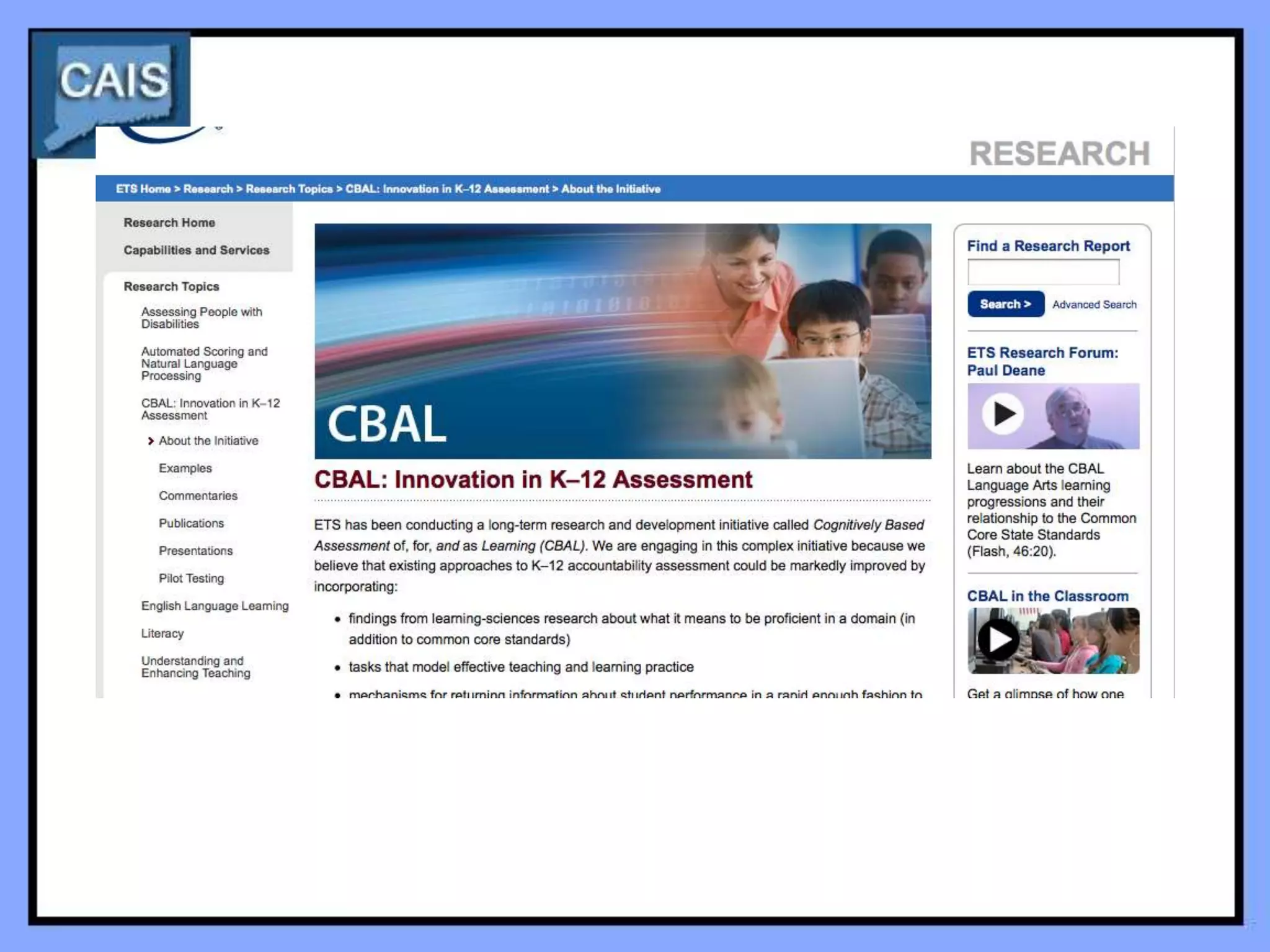
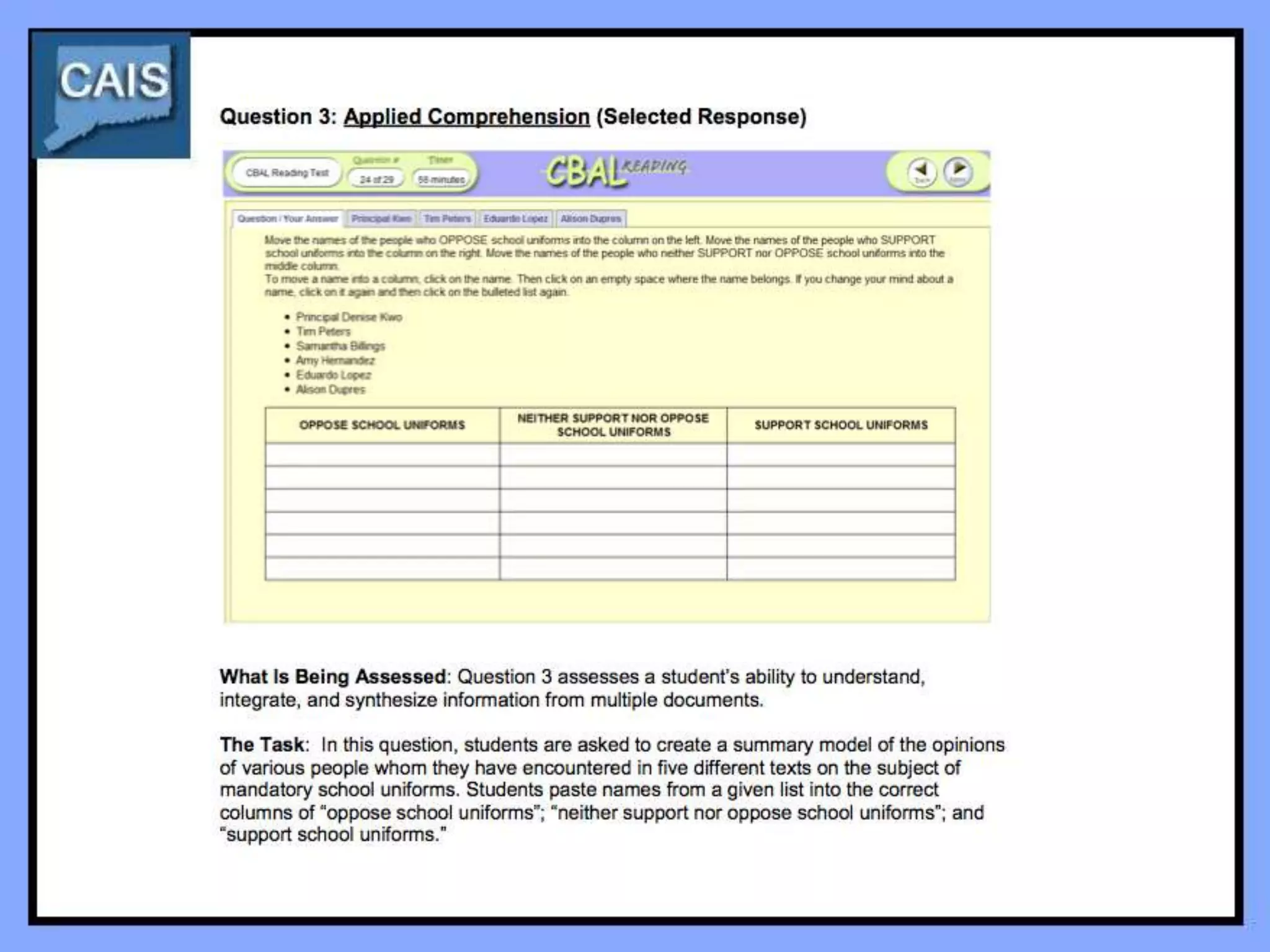
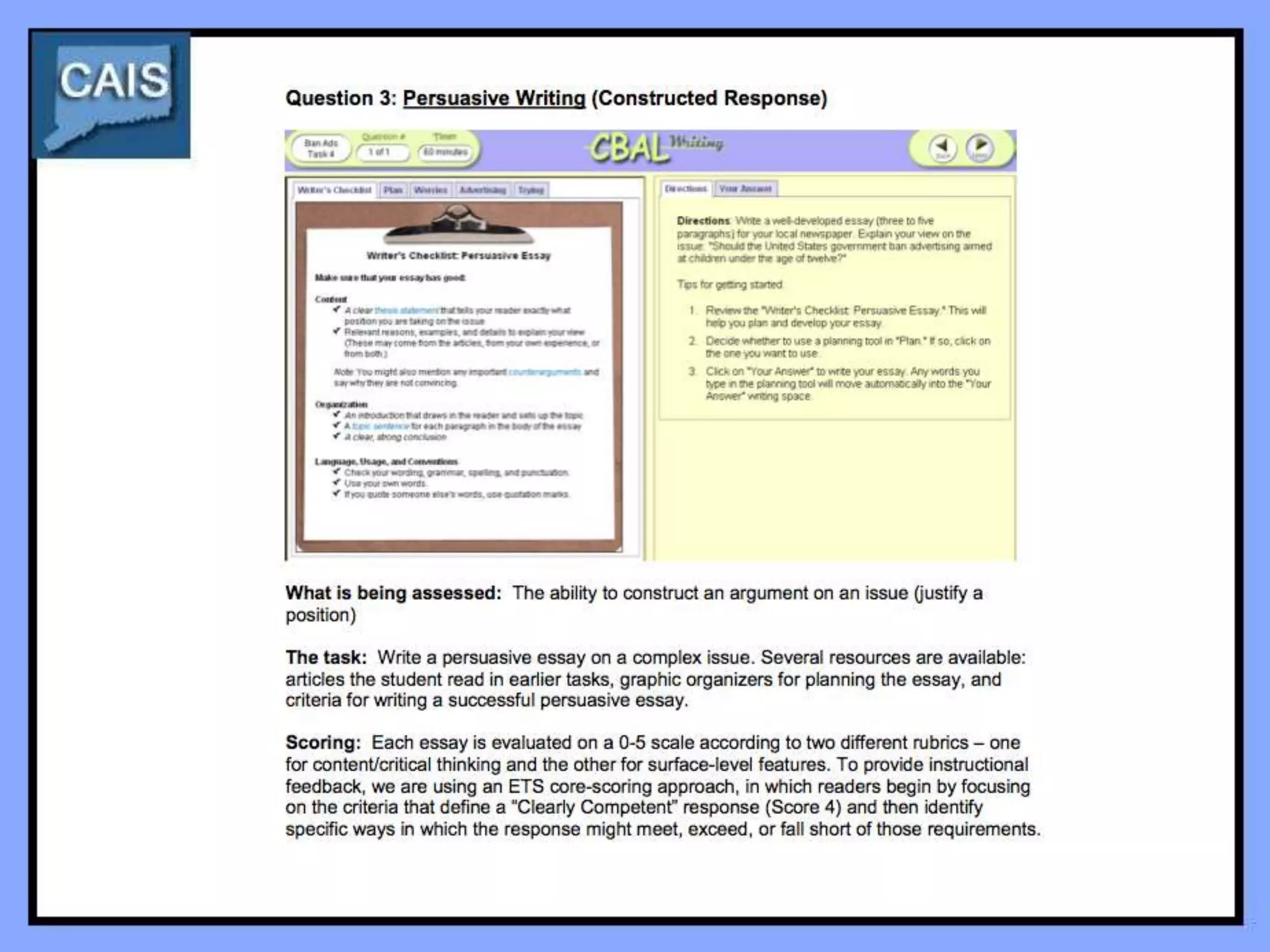
CBAL

• Extended, constructed-response tasks that are
  delivered by computer and automatically scored.
• Pilot testing occurred in 2010 and 2011, spring of
  2012.
• Tests should be available for use in 2012.
• Sample tests available online

          Website information is in your folders.
features real-time, scenario-based tasks that
measure an individual's ability to navigate,
critically evaluate and understand the wealth
of information available through digital
technology
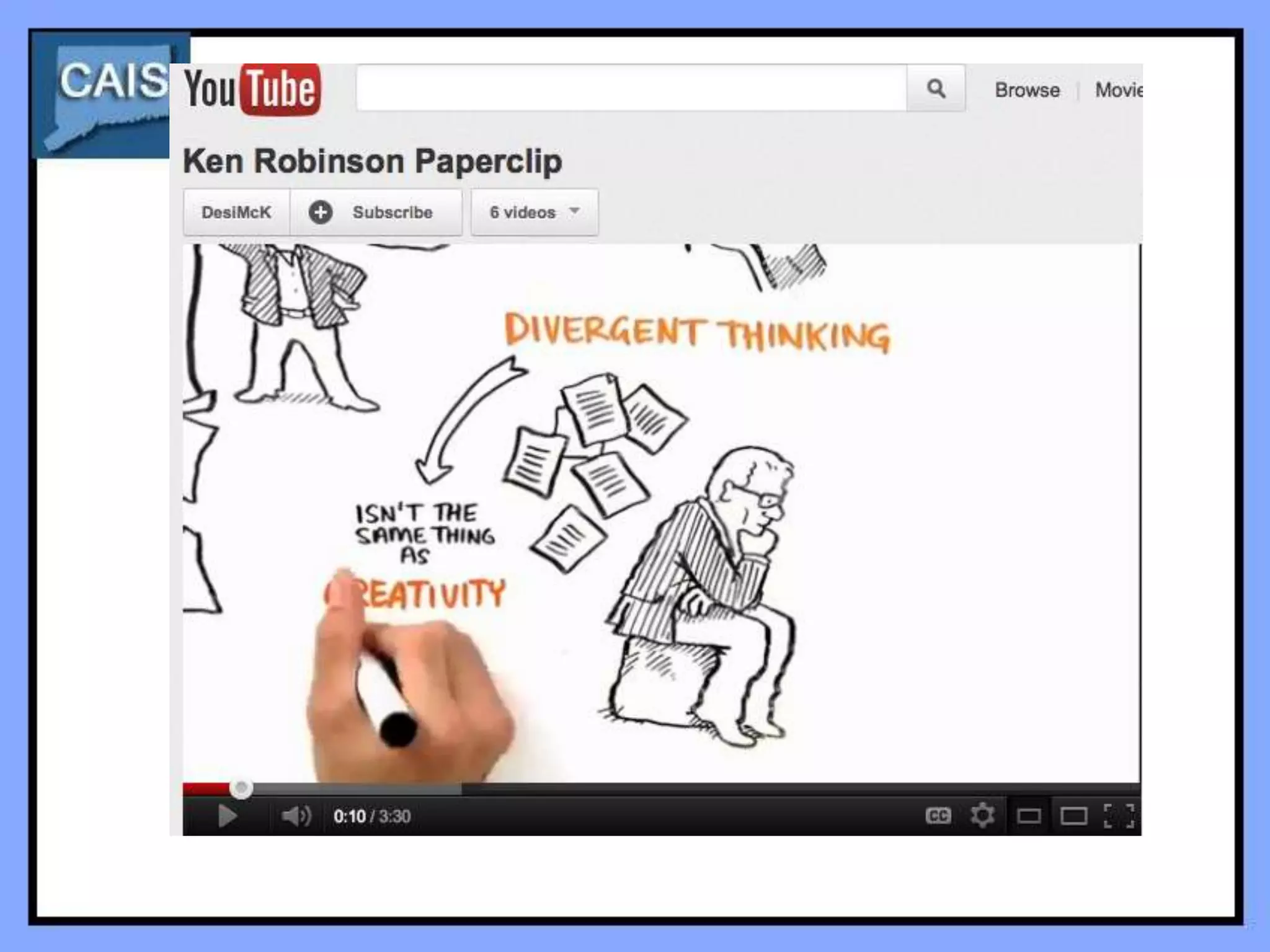
Ken Robinson

    Age and education:

• Increase routines of behavior and habits of
  thought (left brain logical thinking )
• Decrease divergent thinking (free association
  of ideas. Right brain, creative thinking)
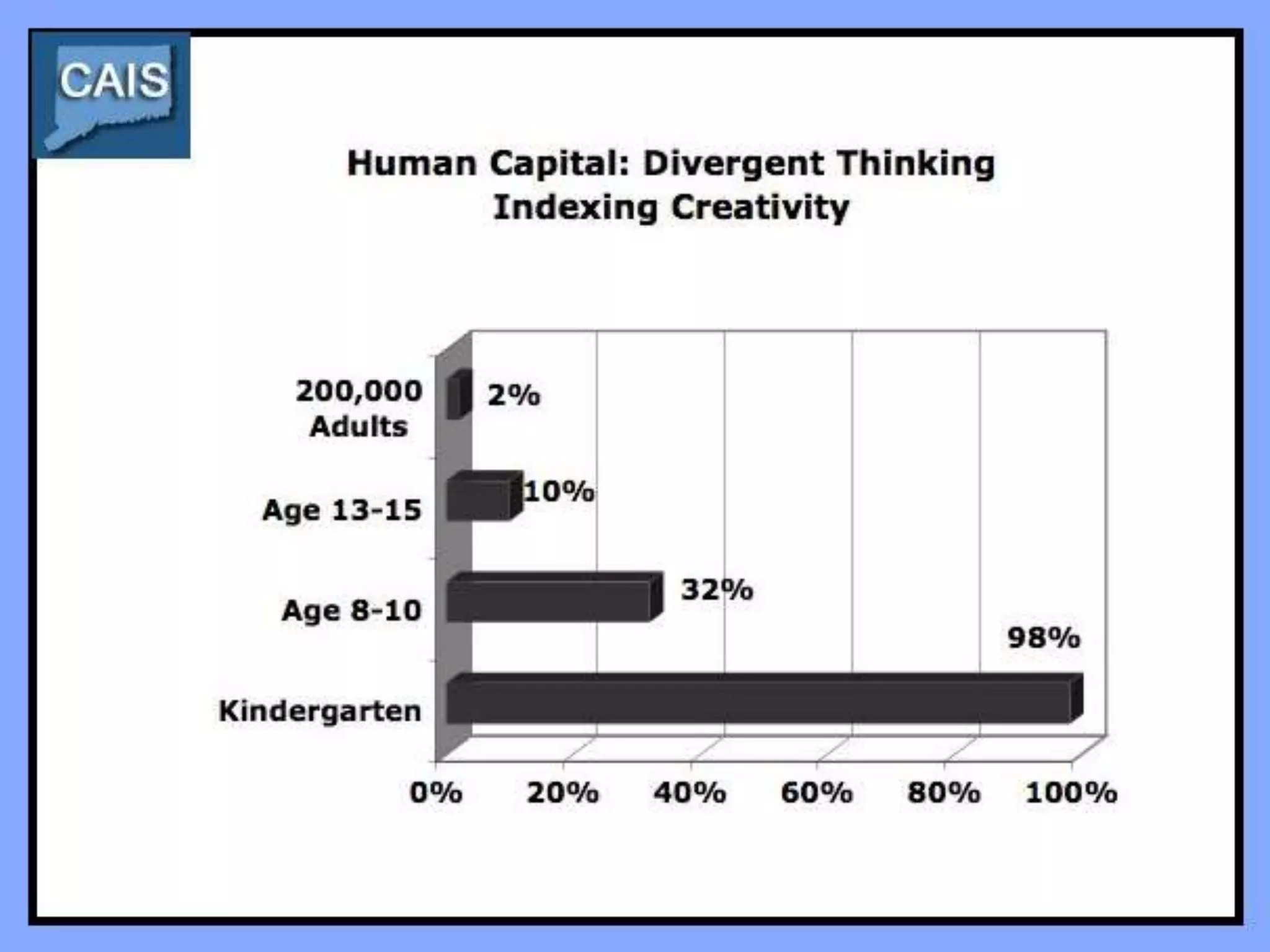
Creativity Index: the new
             state mandate?

• Gov. Deval Patrick has made Massachusetts
  the first state in the country to call for the
  formation of a creativity index aimed at rating
  public schools statewide based on their ability
  to teach, encourage and foster creativity in
  students.
• Similar legislation is pending in California and
  Oklahoma
Torrence Test of Creative Thinking

               Verbal Activity 4: Product
Improvement
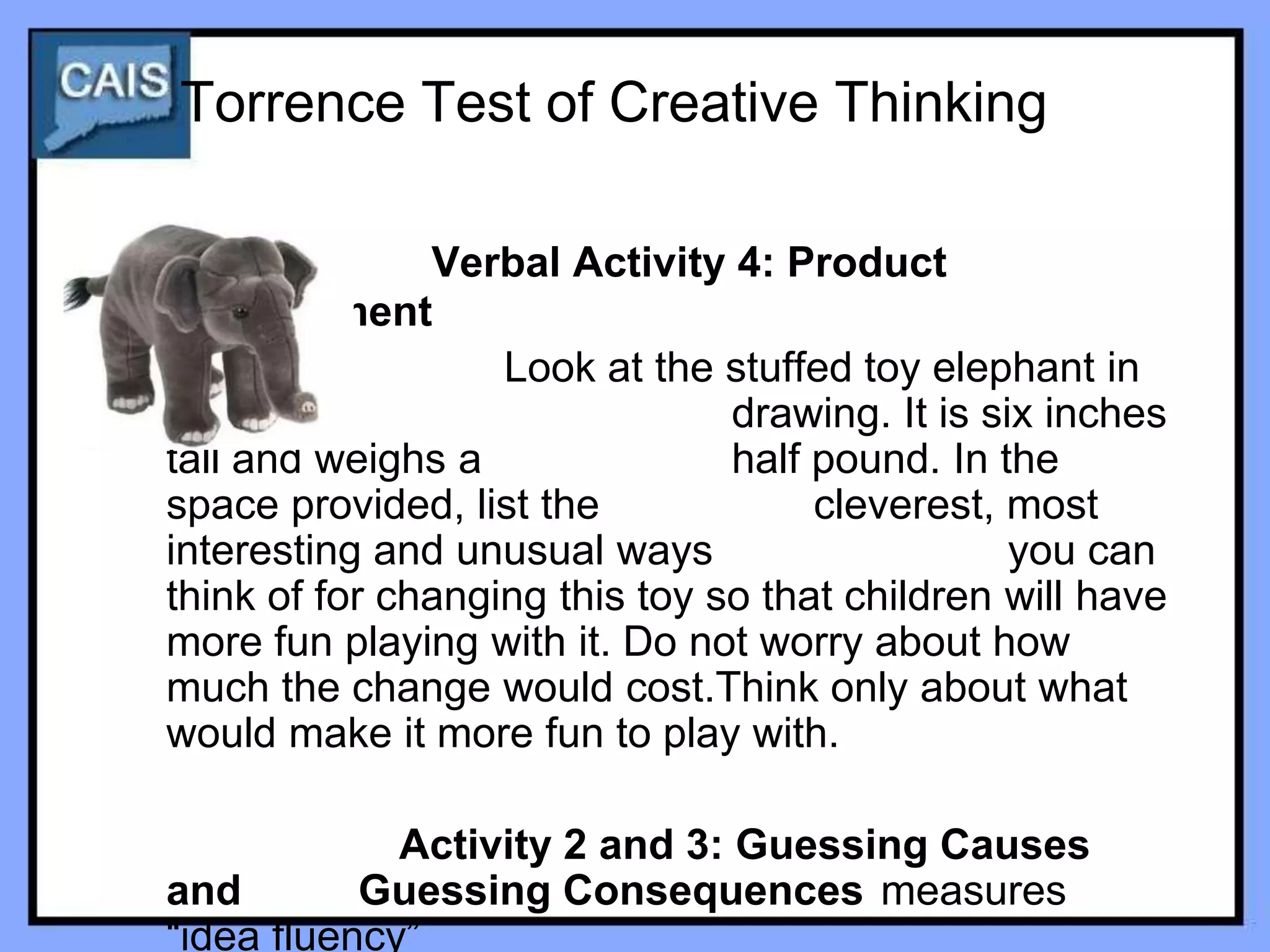
                   Look at the stuffed toy elephant in
the                             drawing. It is six inches
tall and weighs a               half pound. In the
space provided, list the             cleverest, most
interesting and unusual ways                     you can
think of for changing this toy so that children will have
more fun playing with it. Do not worry about how
much the change would cost.Think only about what
would make it more fun to play with.

             Activity 2 and 3: Guessing Causes
and        Guessing Consequences measures
“idea fluency”
What do you get if you solve this problem and
            visit the website?
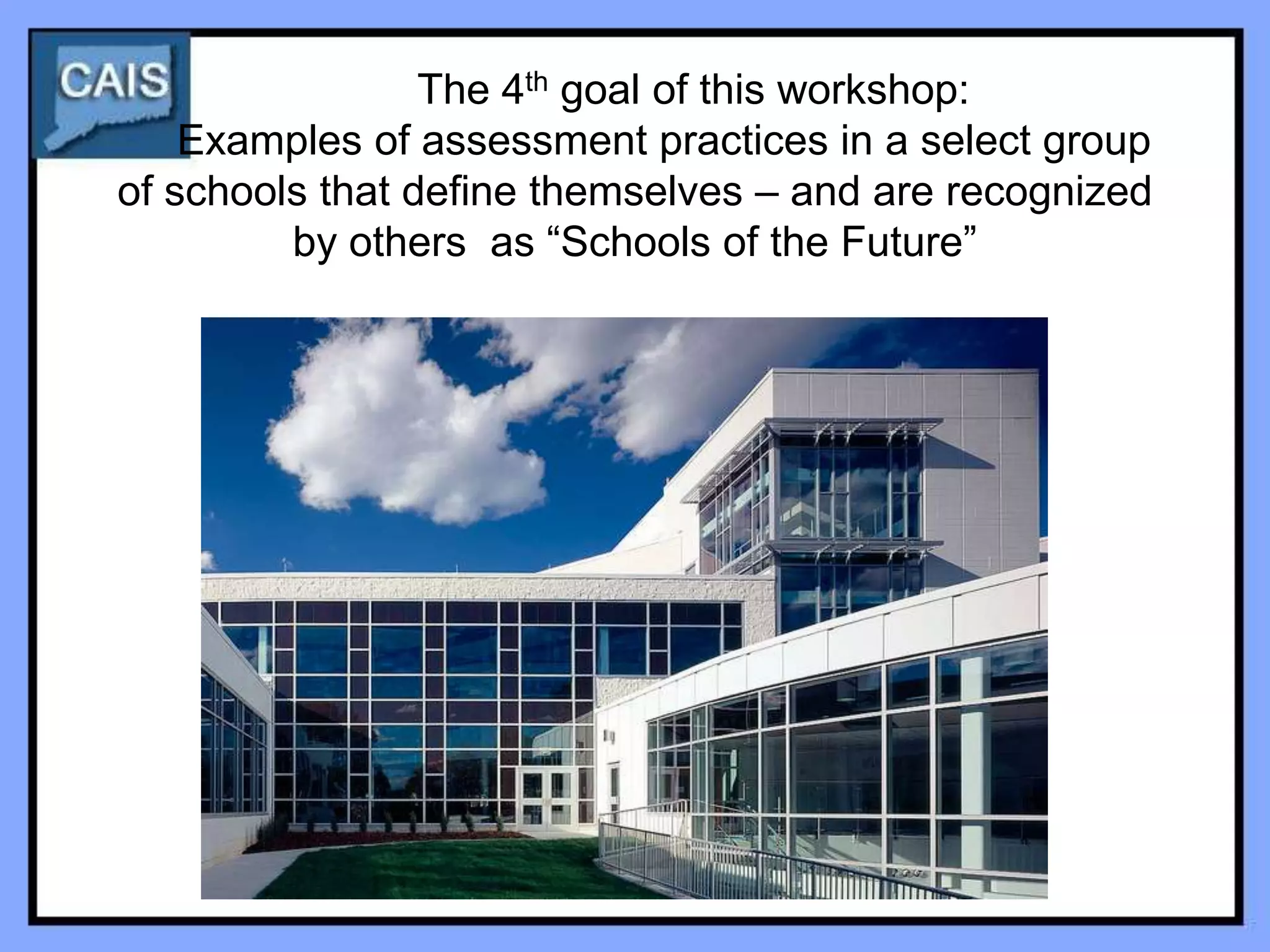
The 4th goal of this workshop:
    Examples of assessment practices in a select group
of schools that define themselves – and are recognized
         by others as “Schools of the Future”
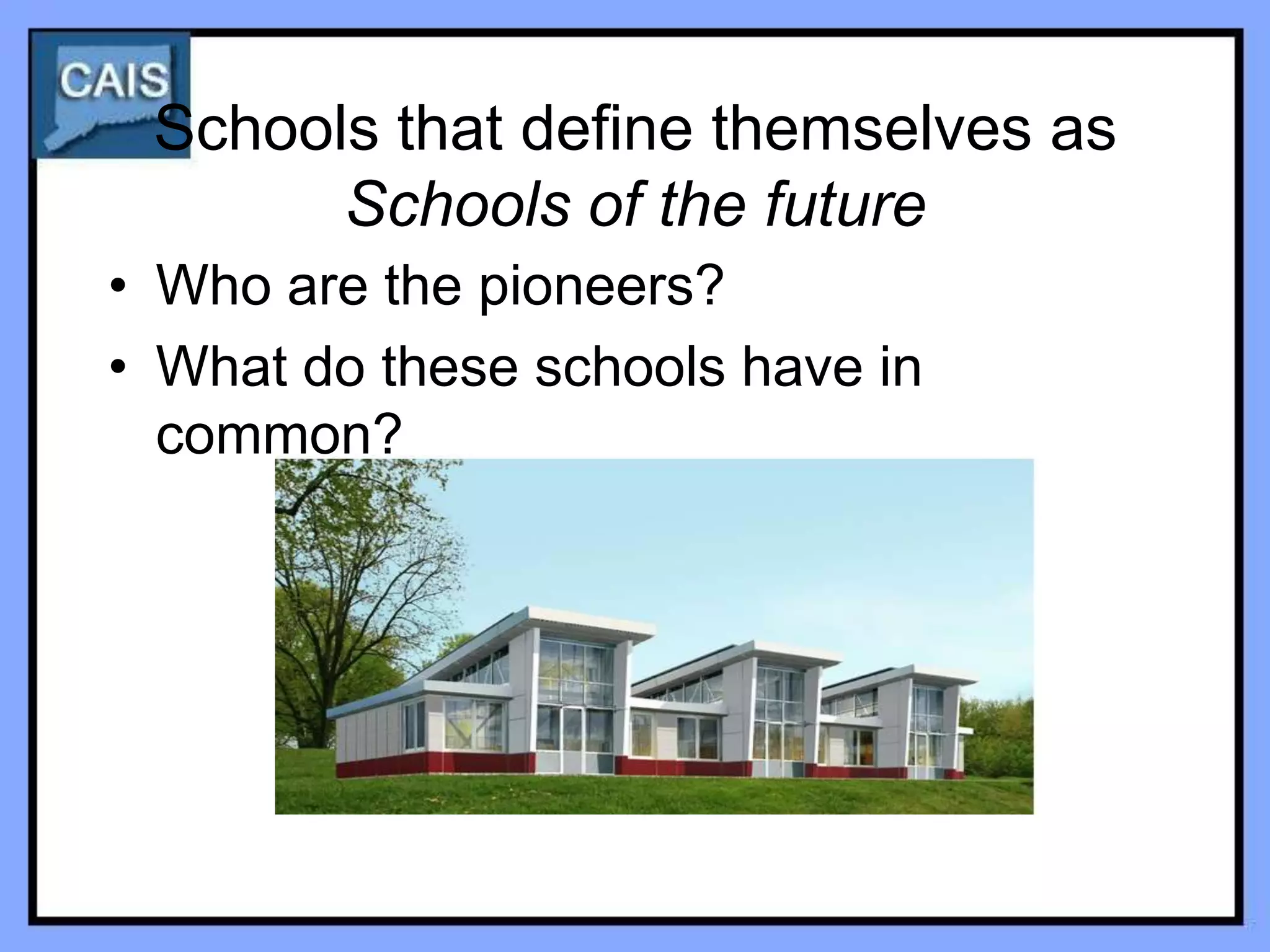
Schools that define themselves as
       Schools of the future
• Who are the pioneers?
• What do these schools have in
  common?
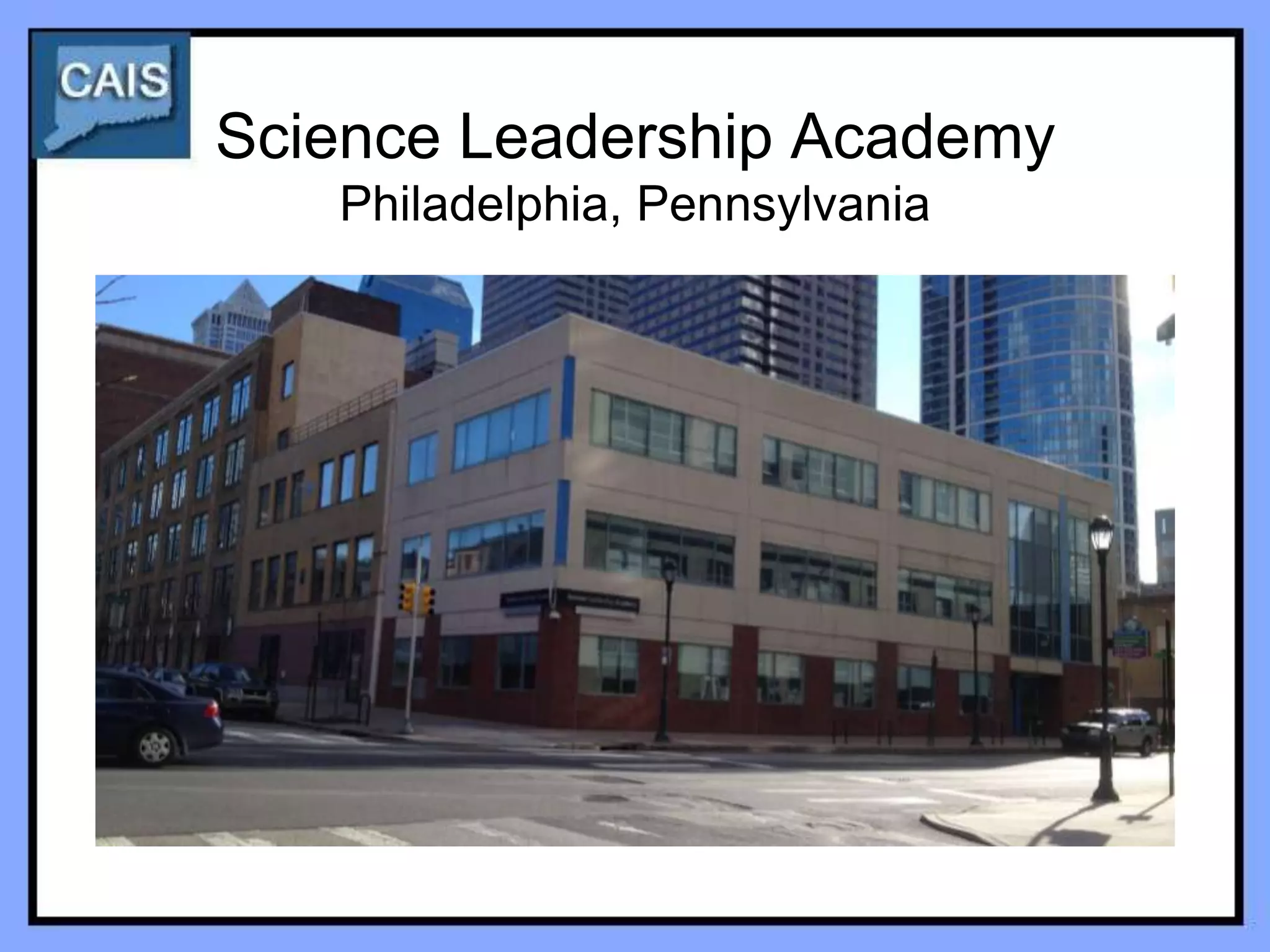
Science Leadership Academy
   Philadelphia, Pennsylvania
All of these schools have 2 common
               characteristics
• urban public charter schools.

• experimenting with a dramatically different
  view of teaching and learning; A
  Collaborative, Conceptual Model
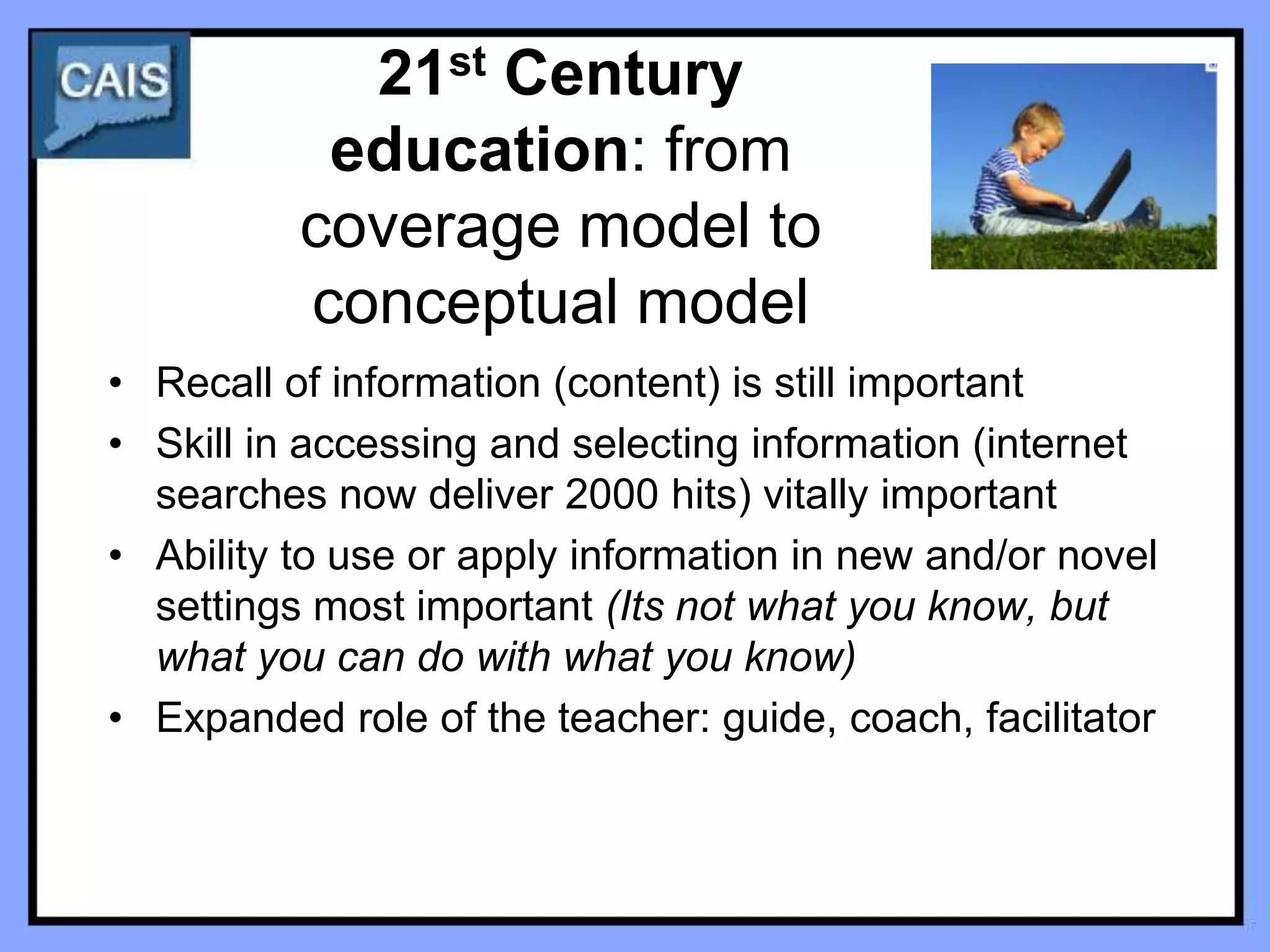
21st Century
           education: from
          coverage model to
          conceptual model
• Recall of information (content) is still important
• Skill in accessing and selecting information (internet
  searches now deliver 2000 hits) vitally important
• Ability to use or apply information in new and/or novel
  settings most important (Its not what you know, but
  what you can do with what you know)
• Expanded role of the teacher: guide, coach, facilitator
Schools of the Future:
                characteristics
• Performance tasks
• Project-based learning, individually and in groups
• Capstone projects, individually and in groups
• Independent study
• Online learning, online tools (courseware, Skype,
  You Tube, Ning, Moodle, Web 2.0 etc…)
• Students given choices in assignments and in
  demonstrations of mastery
Schools of the future, cont.
• Extensive use of essential questions relating to
  content area
         why, how and what if questions
• Computer-adaptive learning (program adjusts to
  student skill level)
• E-portfolios, published within the community or on the
  web – seeking Facebook-type conversations in the
  academic community, on academic topics
• Flipped classroom strategies – routinely or
  occasionally
• Partnerships, learning experiences beyond the
  school campus
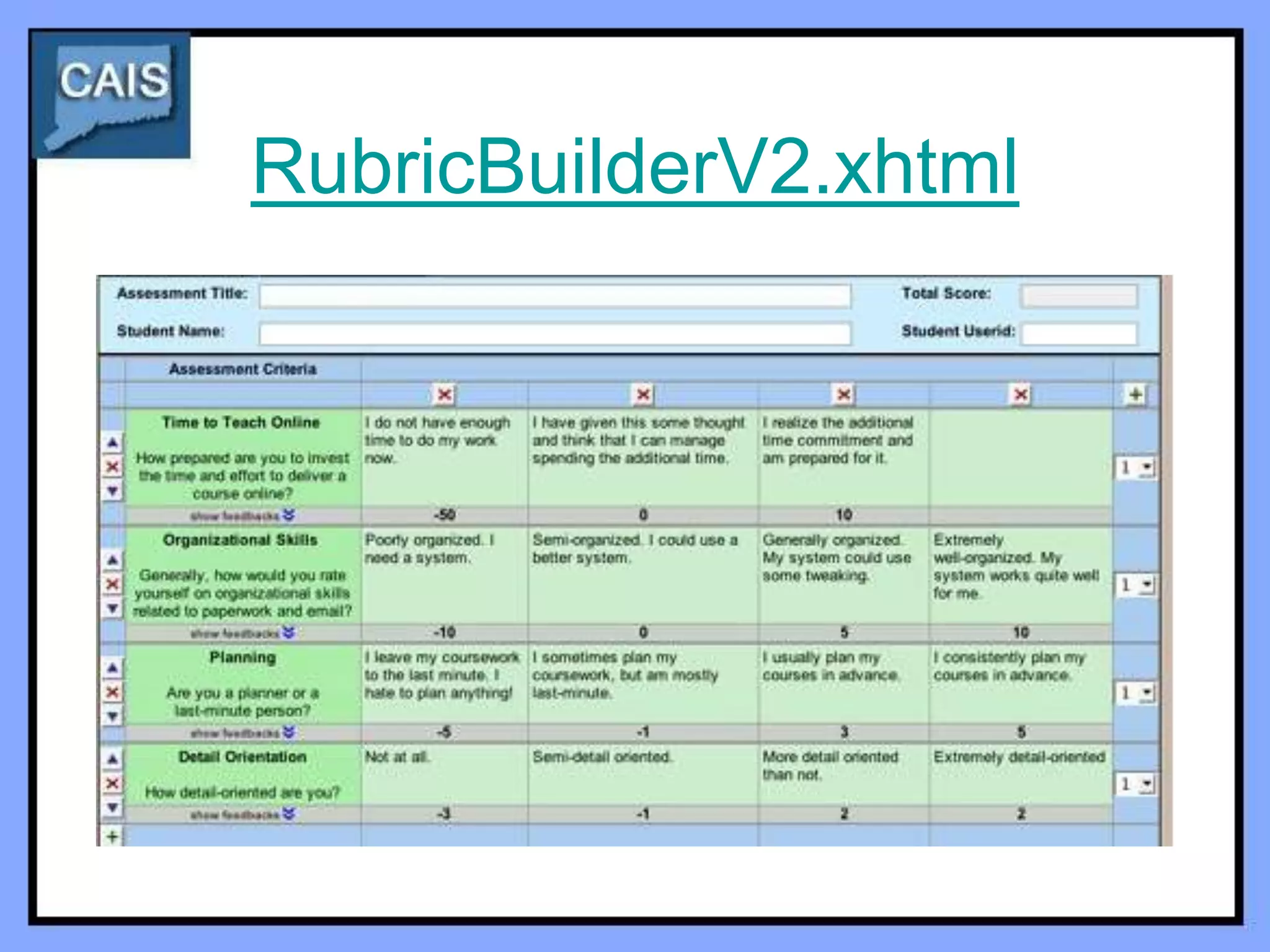
• RUBRICS used to assess performance
RubricBuilderV2.xhtml
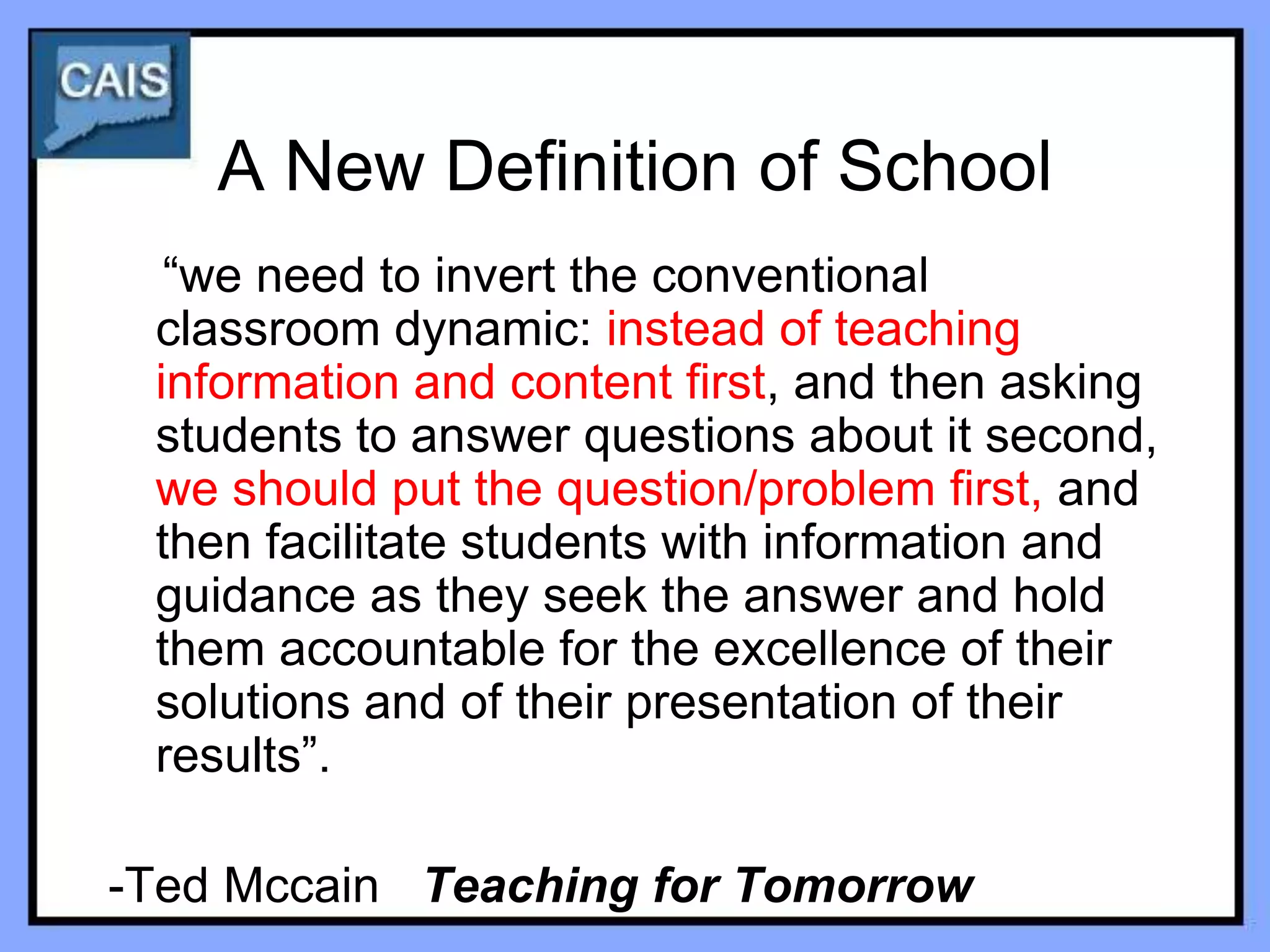
A New Definition of School
  “we need to invert the conventional
 classroom dynamic: instead of teaching
 information and content first, and then asking
 students to answer questions about it second,
 we should put the question/problem first, and
 then facilitate students with information and
 guidance as they seek the answer and hold
 them accountable for the excellence of their
 solutions and of their presentation of their
 results”.

-Ted Mccain Teaching for Tomorrow
What about independent
       schools?
Independent schools

• lead the nation in communication skills; writing,
  speaking, the performing arts
• Engagement has been supported by very strong
  student-faculty relationships
• An incremental approach to the challenges of the
  future; preserving strong, successful, traditional
  programs while expanding collaborative learning,
  online learning, project-based assessments,
  exhibitions of learning and use of digital portfolios
• Growing interest in “Essential Questions” theory of
  learning
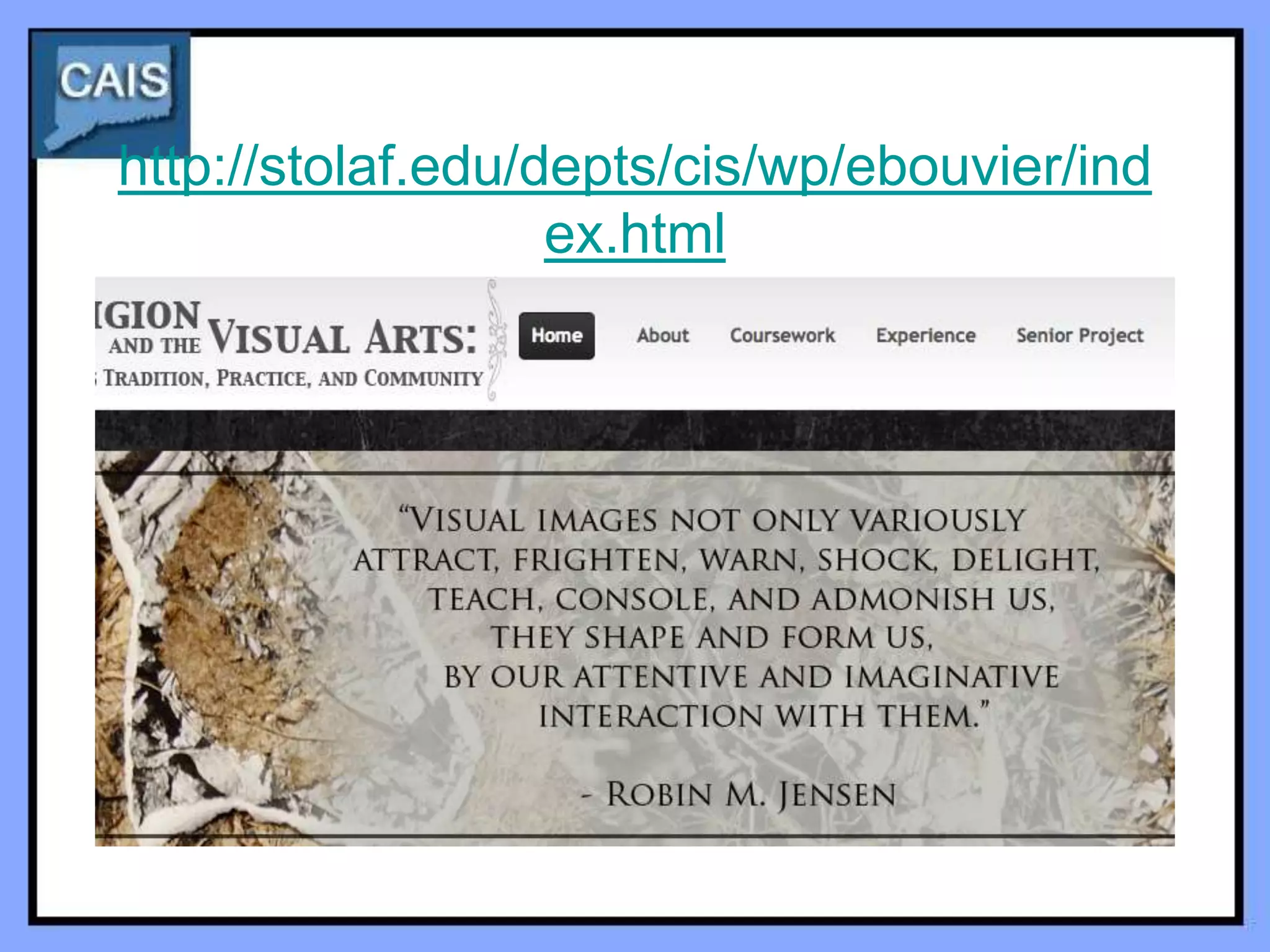
http://stolaf.edu/depts/cis/wp/ebouvier/ind
                   ex.html
Lessons from our
research:

Schools in the 21st century will
define success in much broader
terms


Great Schools in the 21st century
will include some that have far fewer
resources than independent
schools. What they have is the
freedom to take big risks in
designing innovative cultures
“Measuring What We Value”
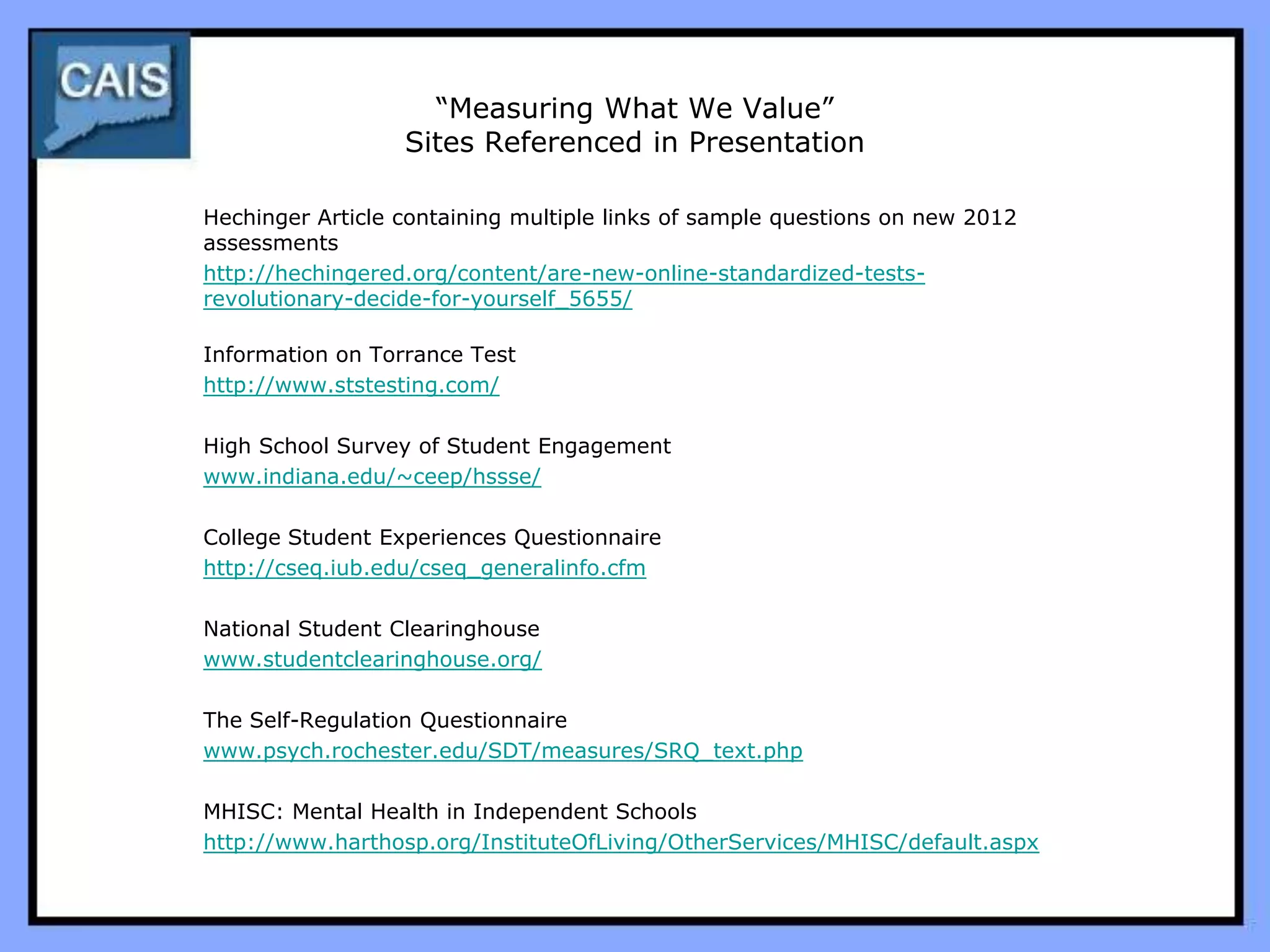
                  Sites Referenced in Presentation

Hechinger Article containing multiple links of sample questions on new 2012
assessments
http://hechingered.org/content/are-new-online-standardized-tests-
revolutionary-decide-for-yourself_5655/

Information on Torrance Test
http://www.ststesting.com/

High School Survey of Student Engagement
www.indiana.edu/~ceep/hssse/

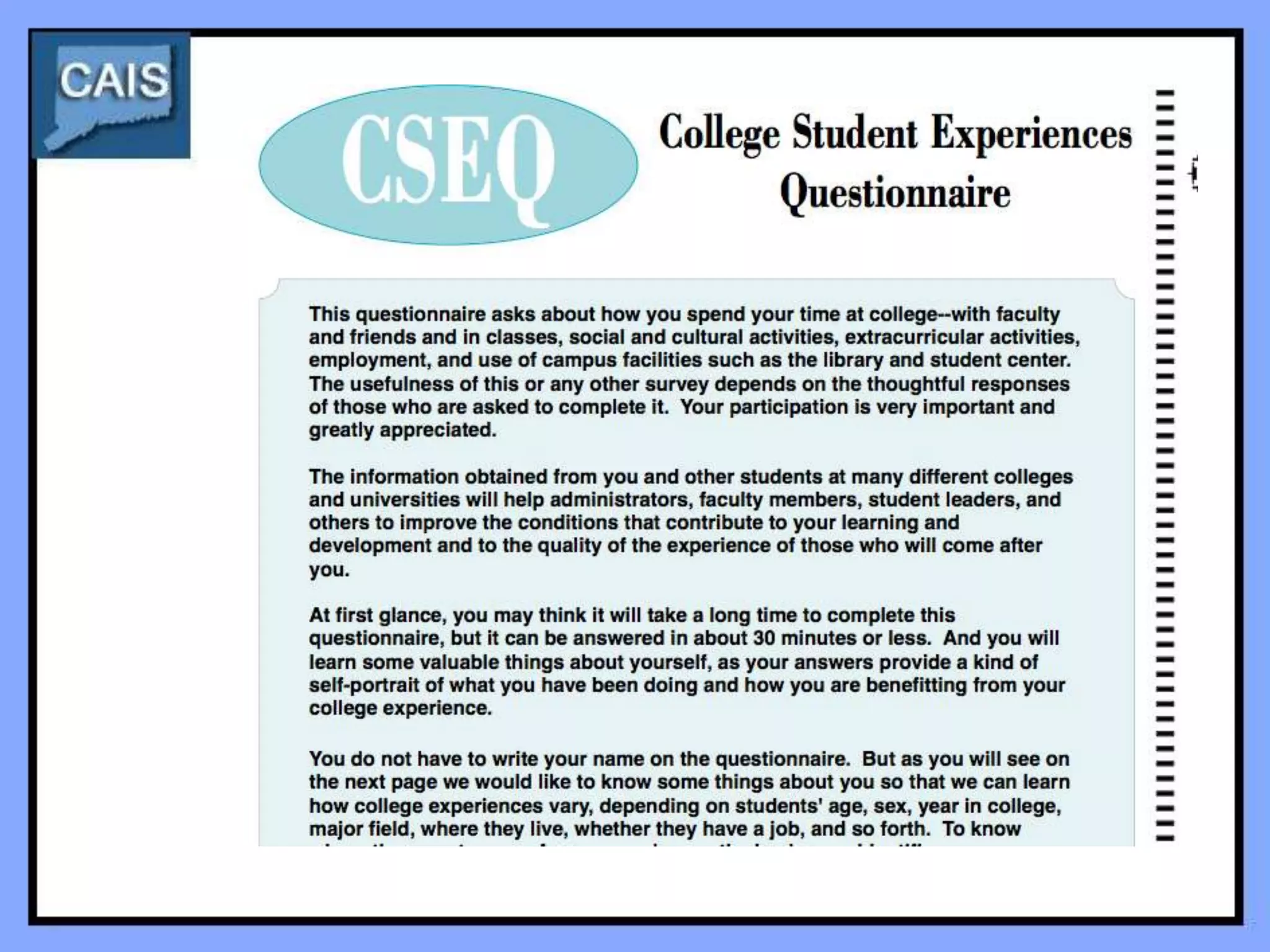
College Student Experiences Questionnaire
http://cseq.iub.edu/cseq_generalinfo.cfm

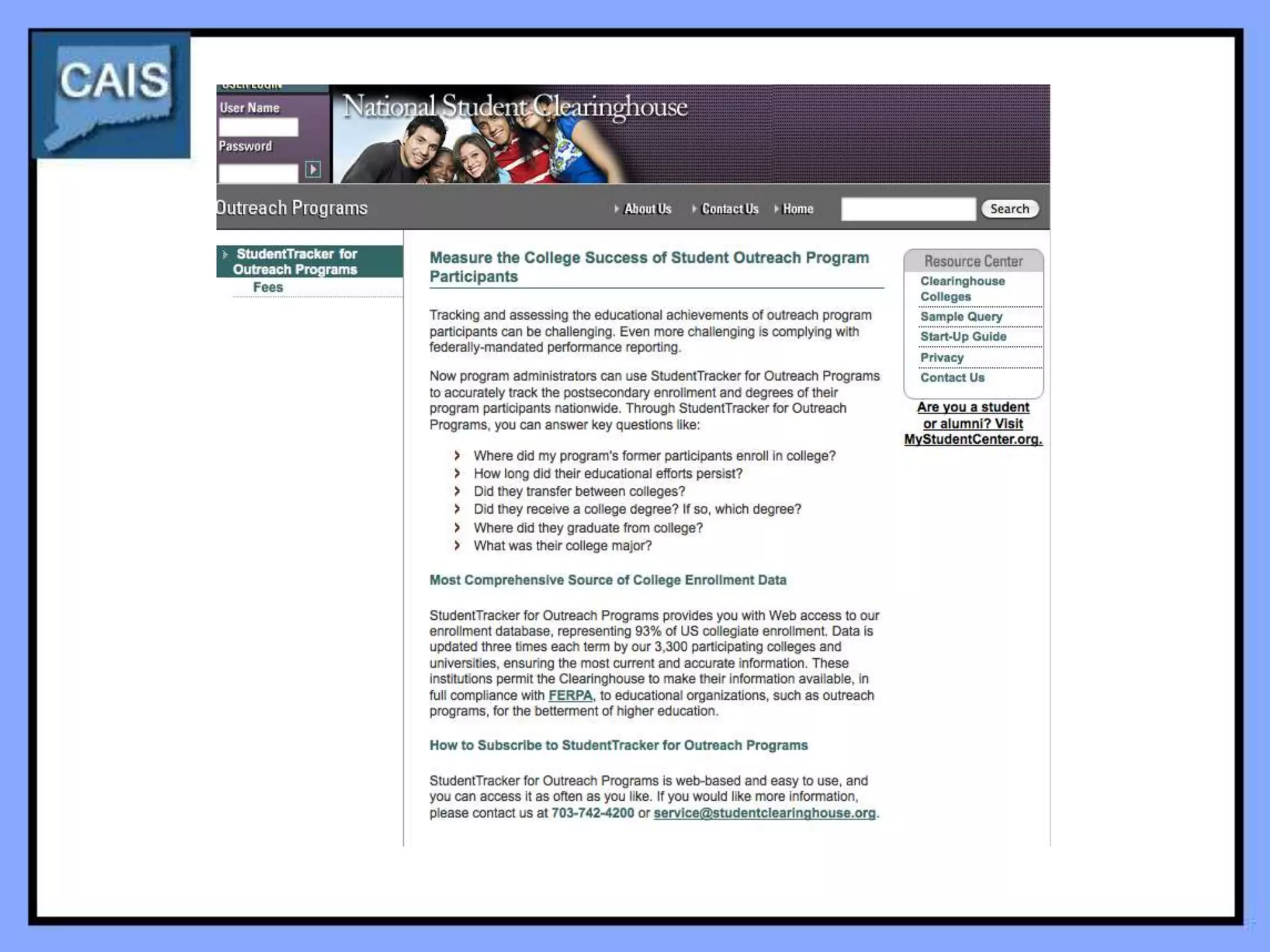
National Student Clearinghouse
www.studentclearinghouse.org/

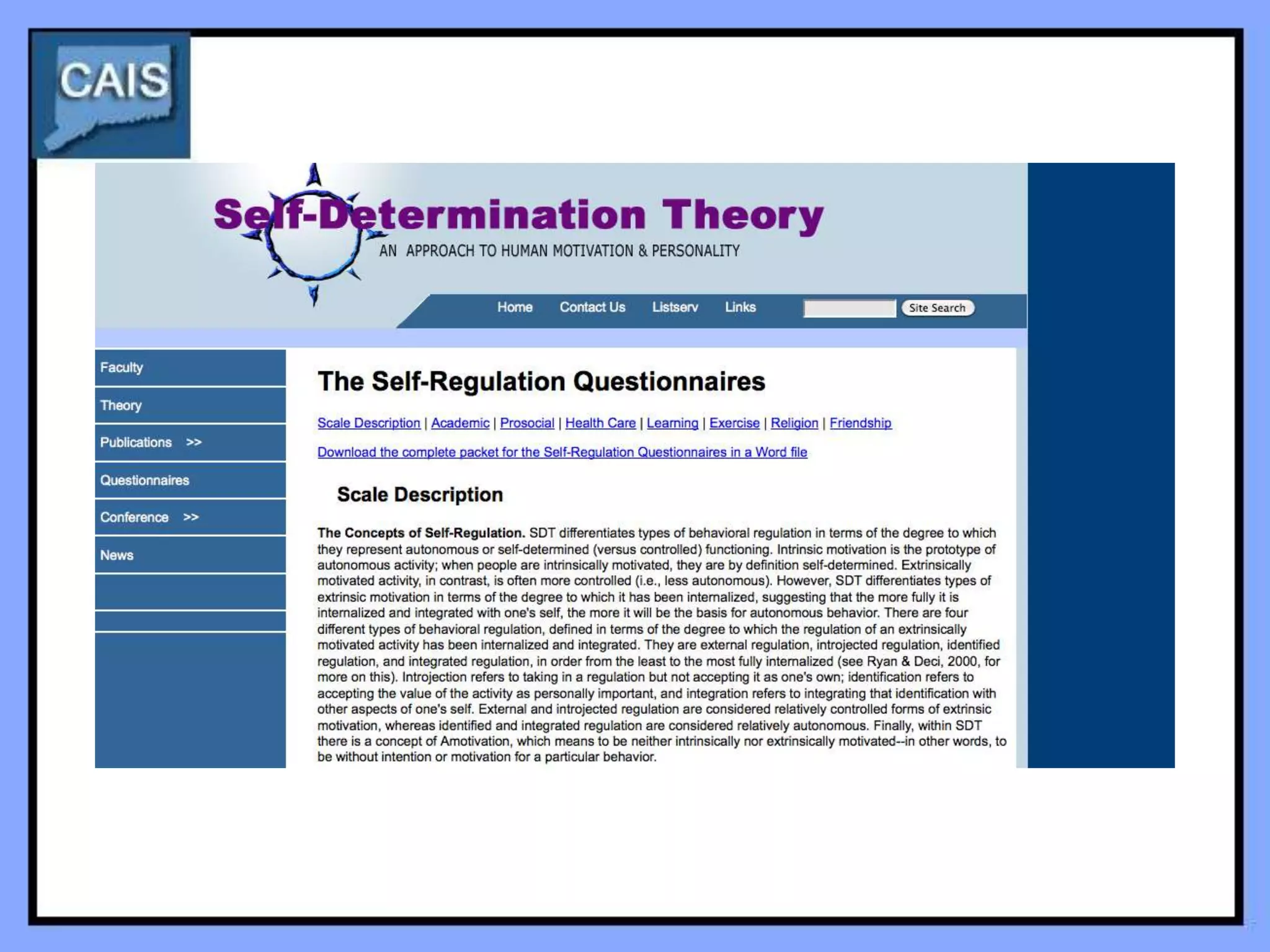
The Self-Regulation Questionnaire
www.psych.rochester.edu/SDT/measures/SRQ_text.php

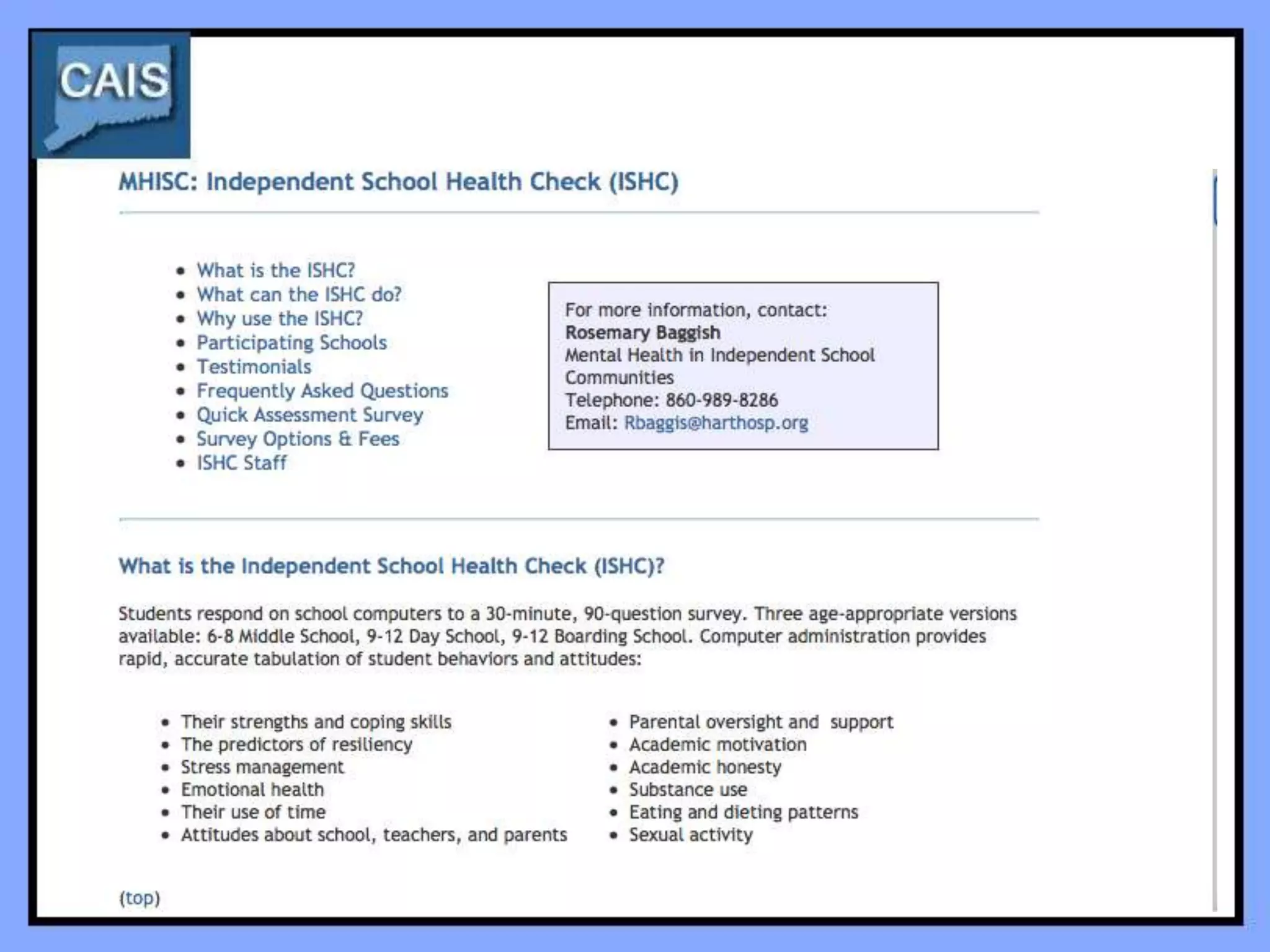
MHISC: Mental Health in Independent Schools
http://www.harthosp.org/InstituteOfLiving/OtherServices/MHISC/default.aspx
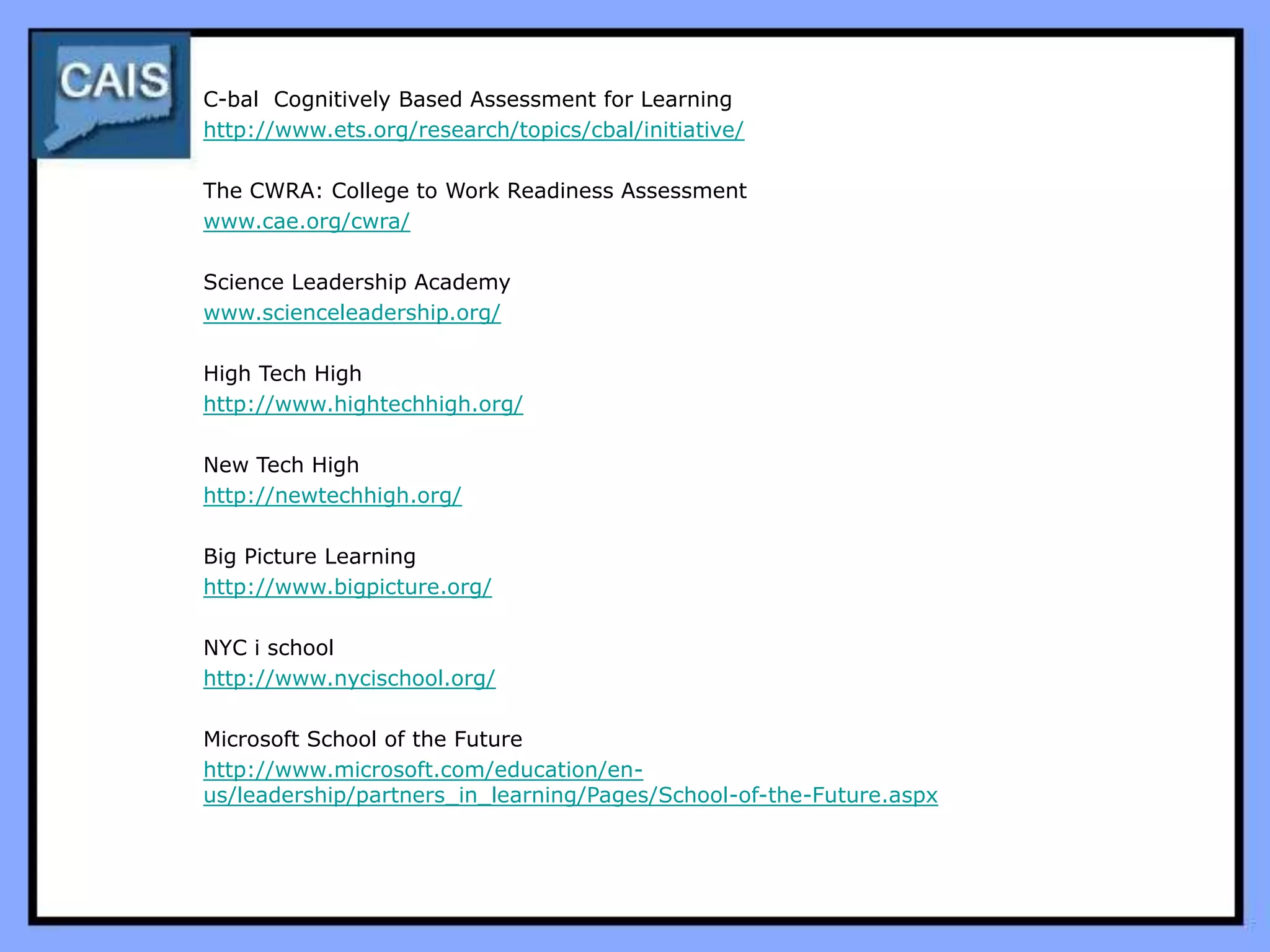
C-bal Cognitively Based Assessment for Learning
http://www.ets.org/research/topics/cbal/initiative/

The CWRA: College to Work Readiness Assessment
www.cae.org/cwra/

Science Leadership Academy
www.scienceleadership.org/

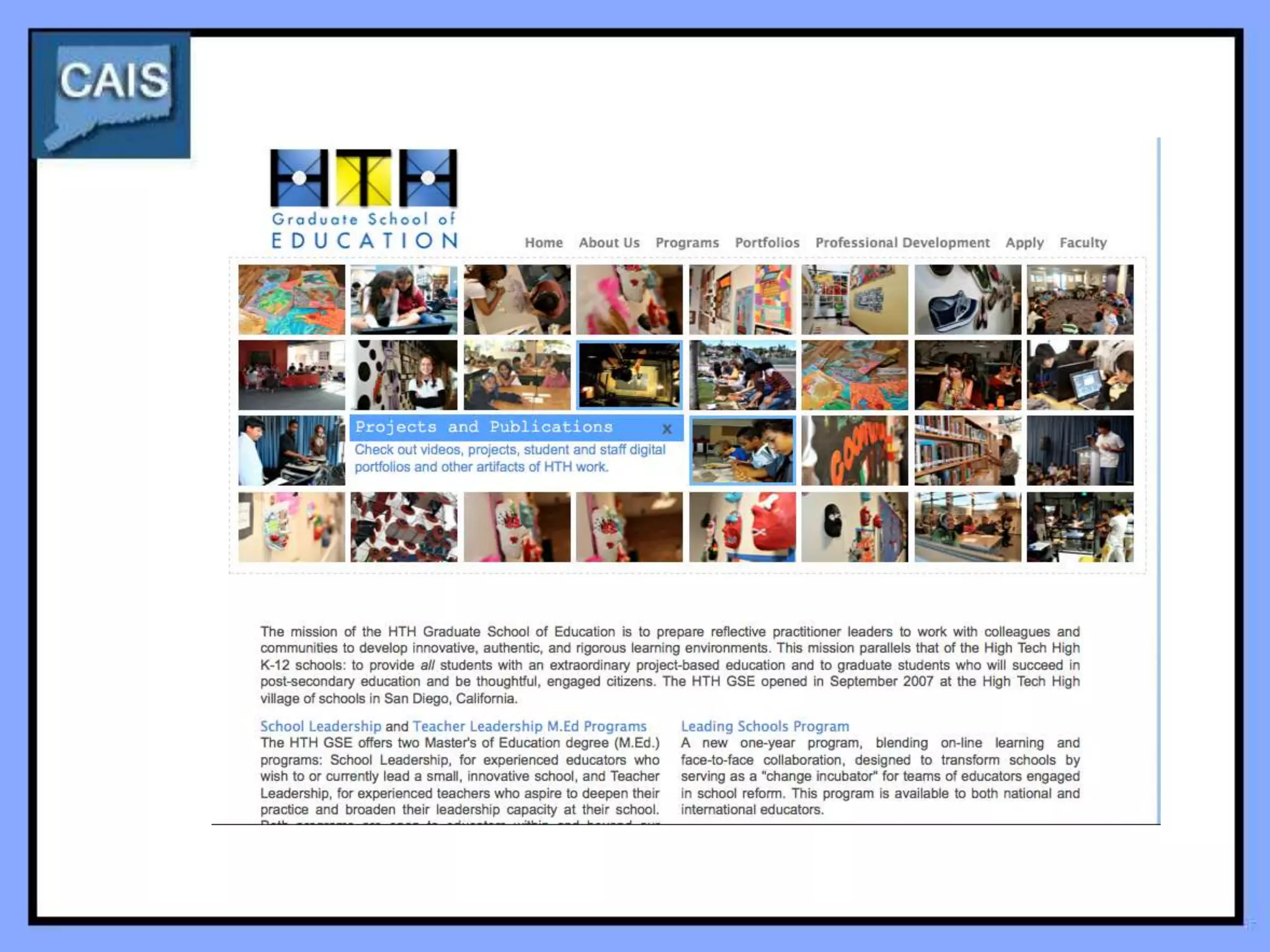
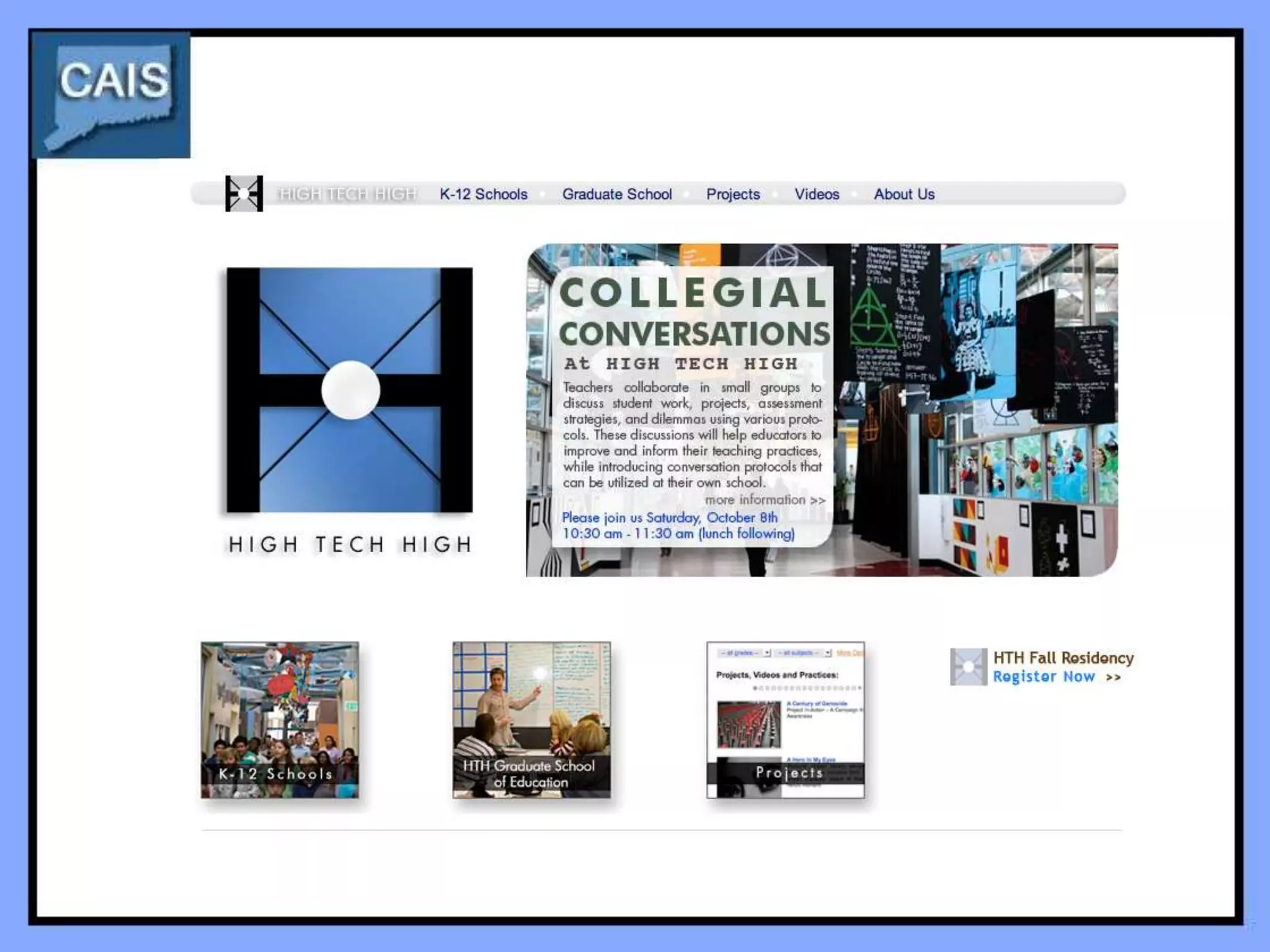
High Tech High
http://www.hightechhigh.org/

New Tech High
http://newtechhigh.org/

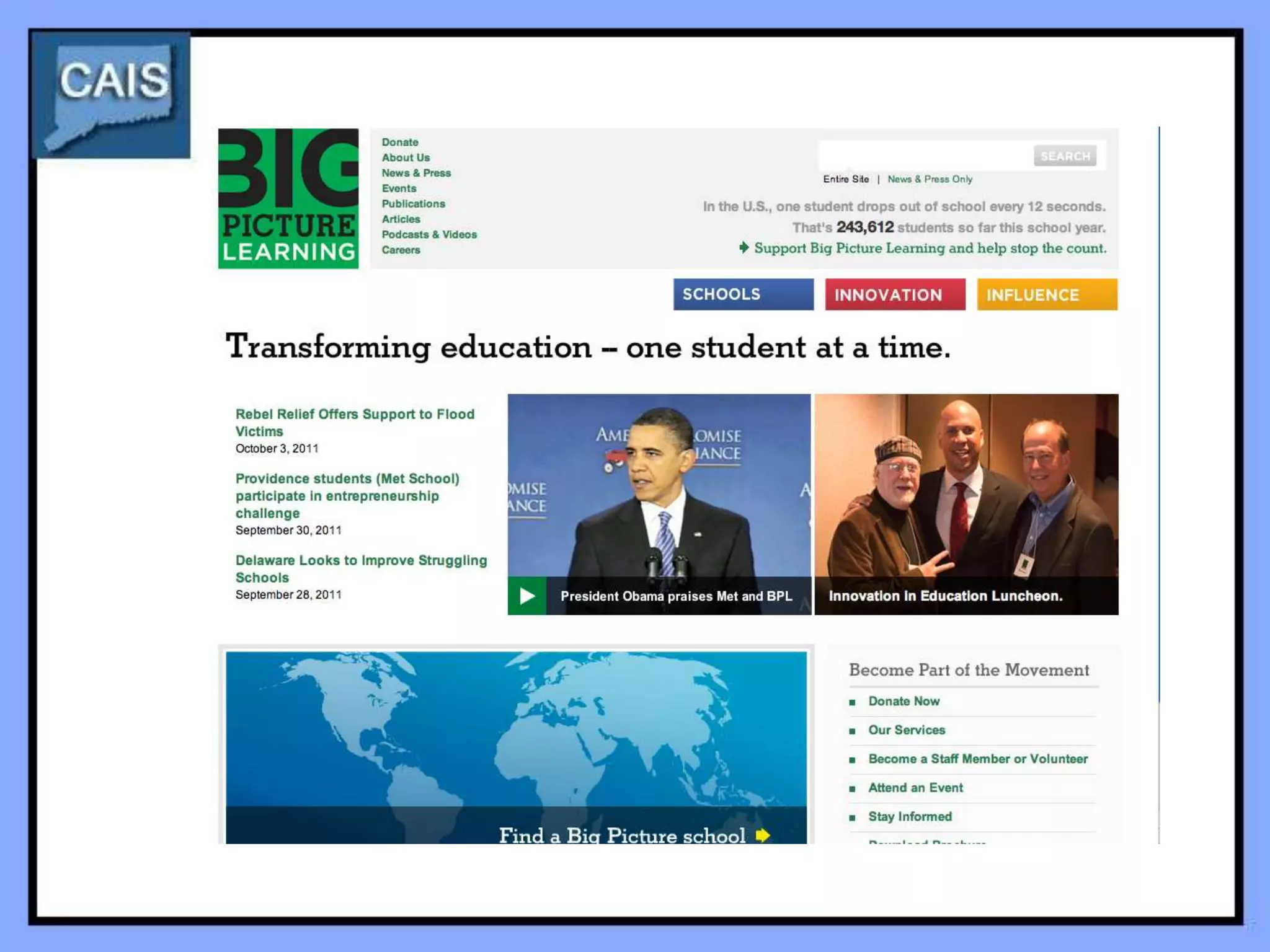
Big Picture Learning
http://www.bigpicture.org/

NYC i school
http://www.nycischool.org/

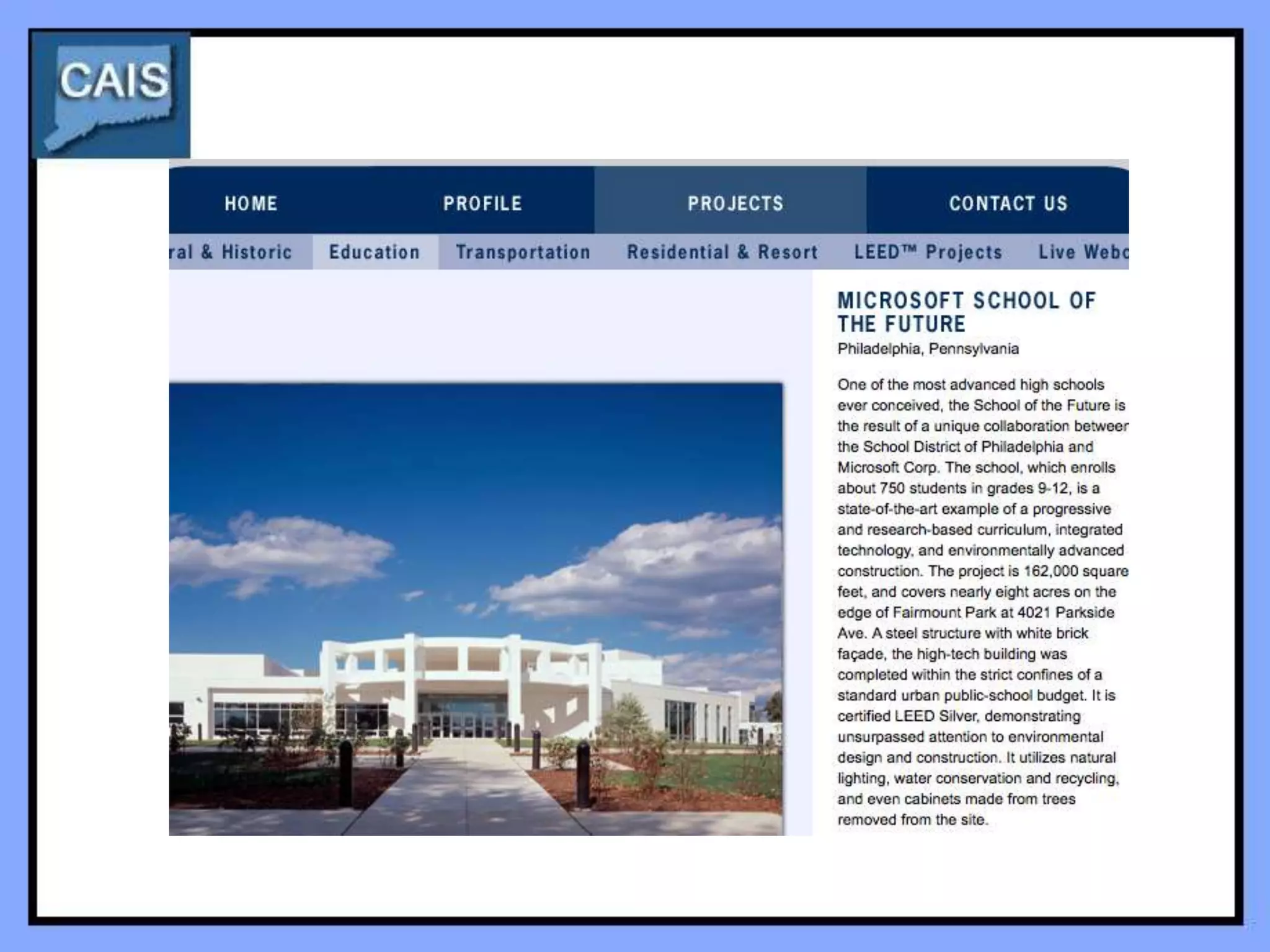
Microsoft School of the Future
http://www.microsoft.com/education/en-
us/leadership/partners_in_learning/Pages/School-of-the-Future.aspx
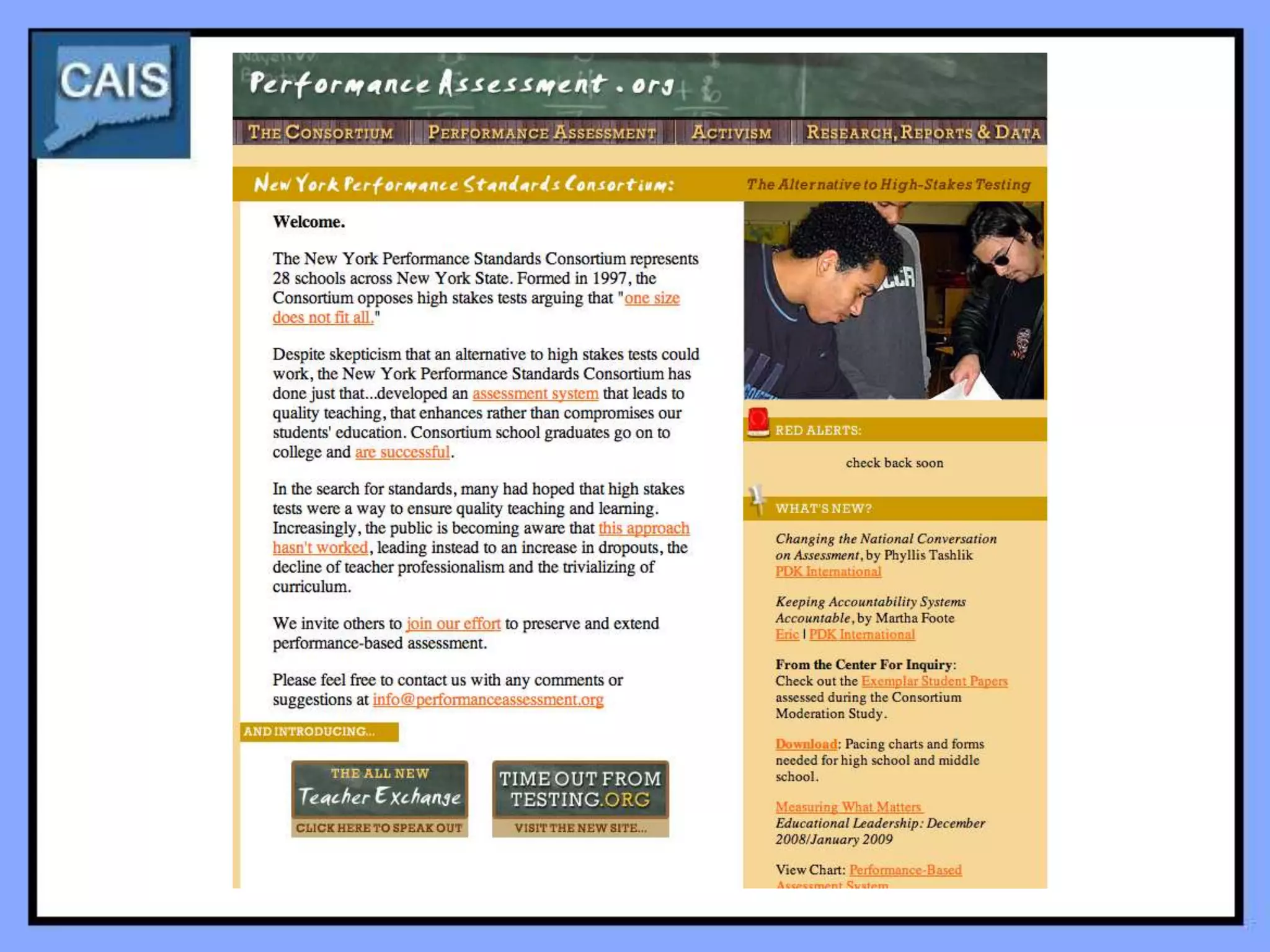
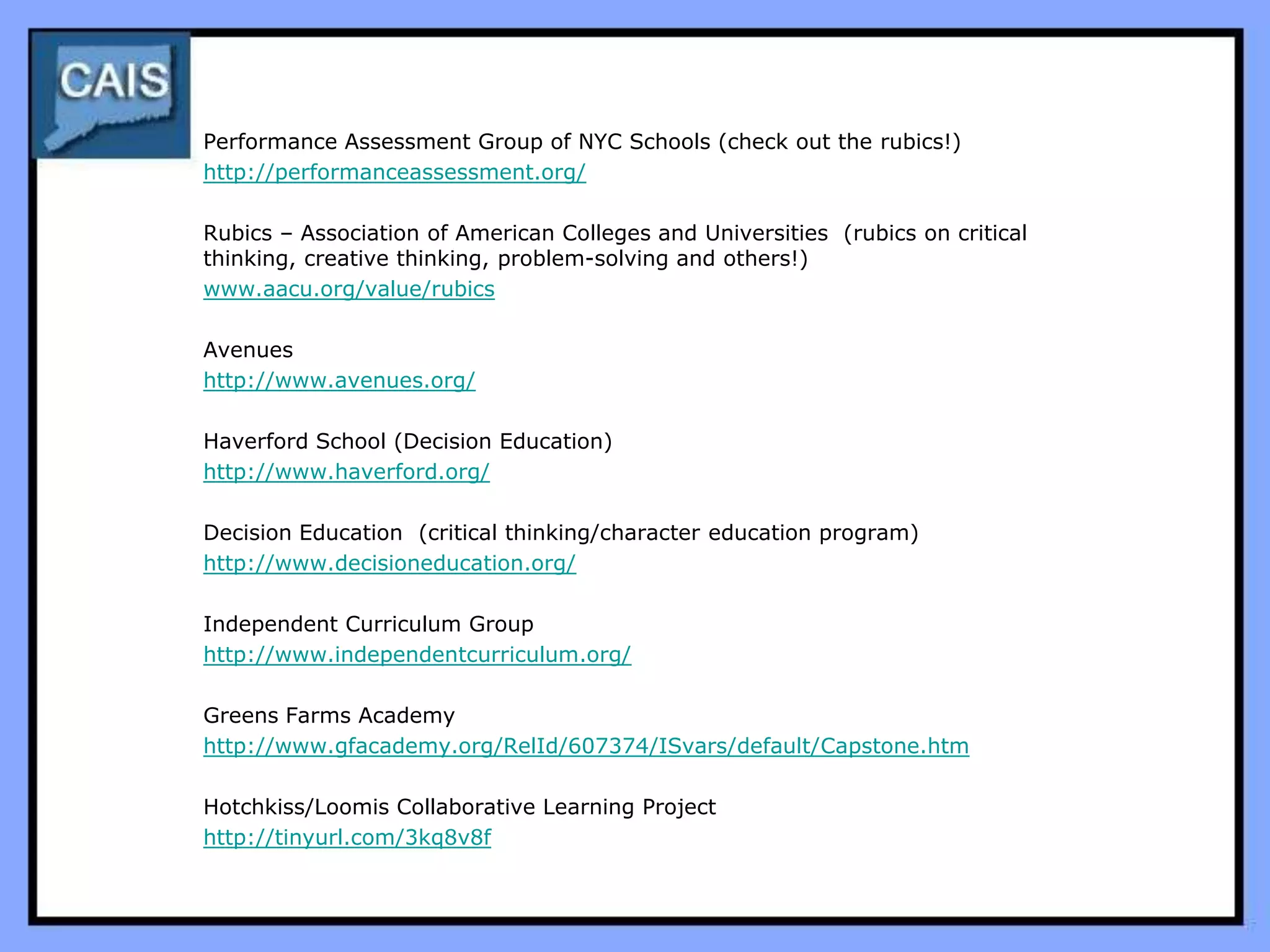
Performance Assessment Group of NYC Schools (check out the rubics!)
http://performanceassessment.org/

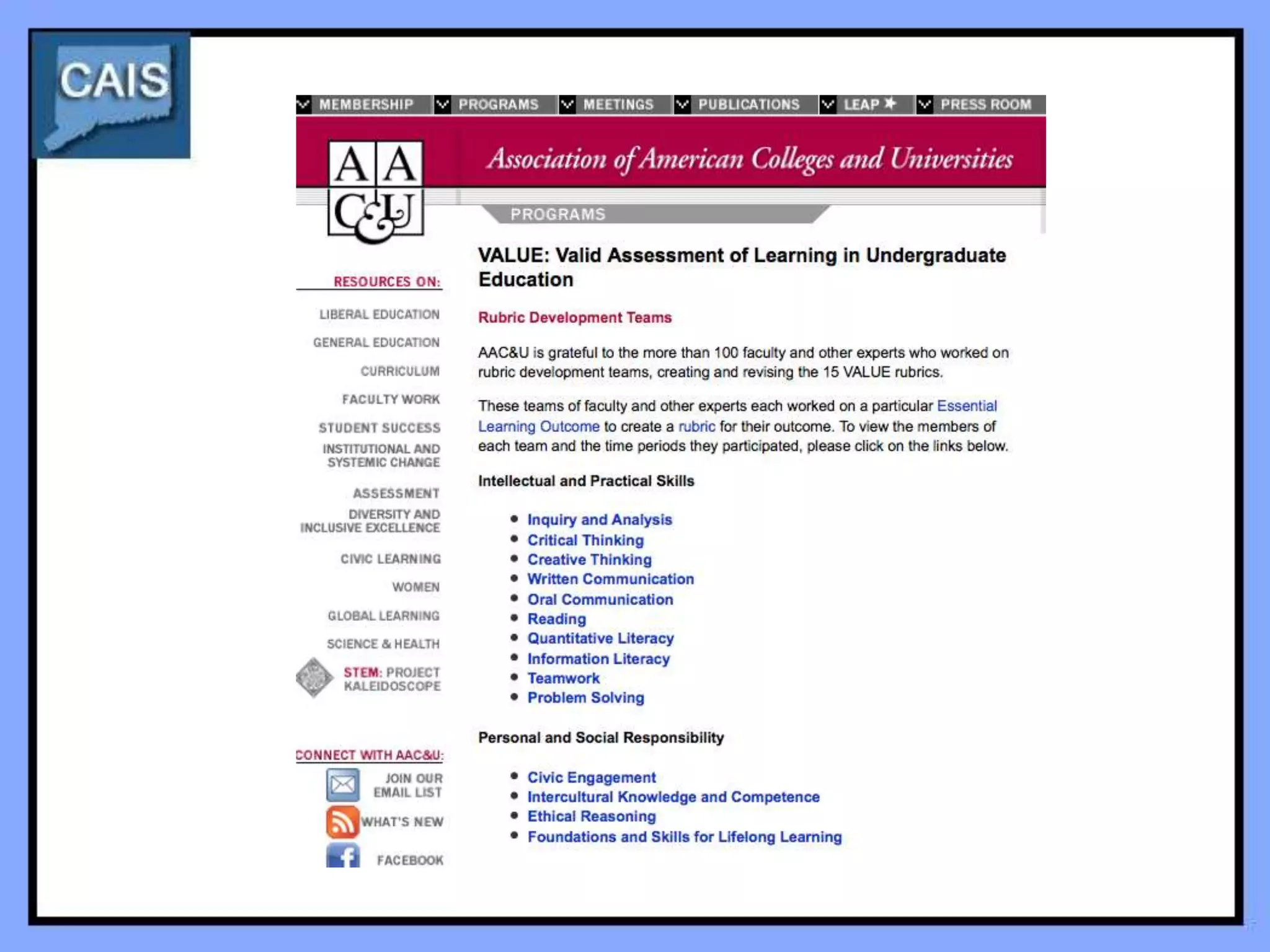
Rubics – Association of American Colleges and Universities (rubics on critical
thinking, creative thinking, problem-solving and others!)
www.aacu.org/value/rubics

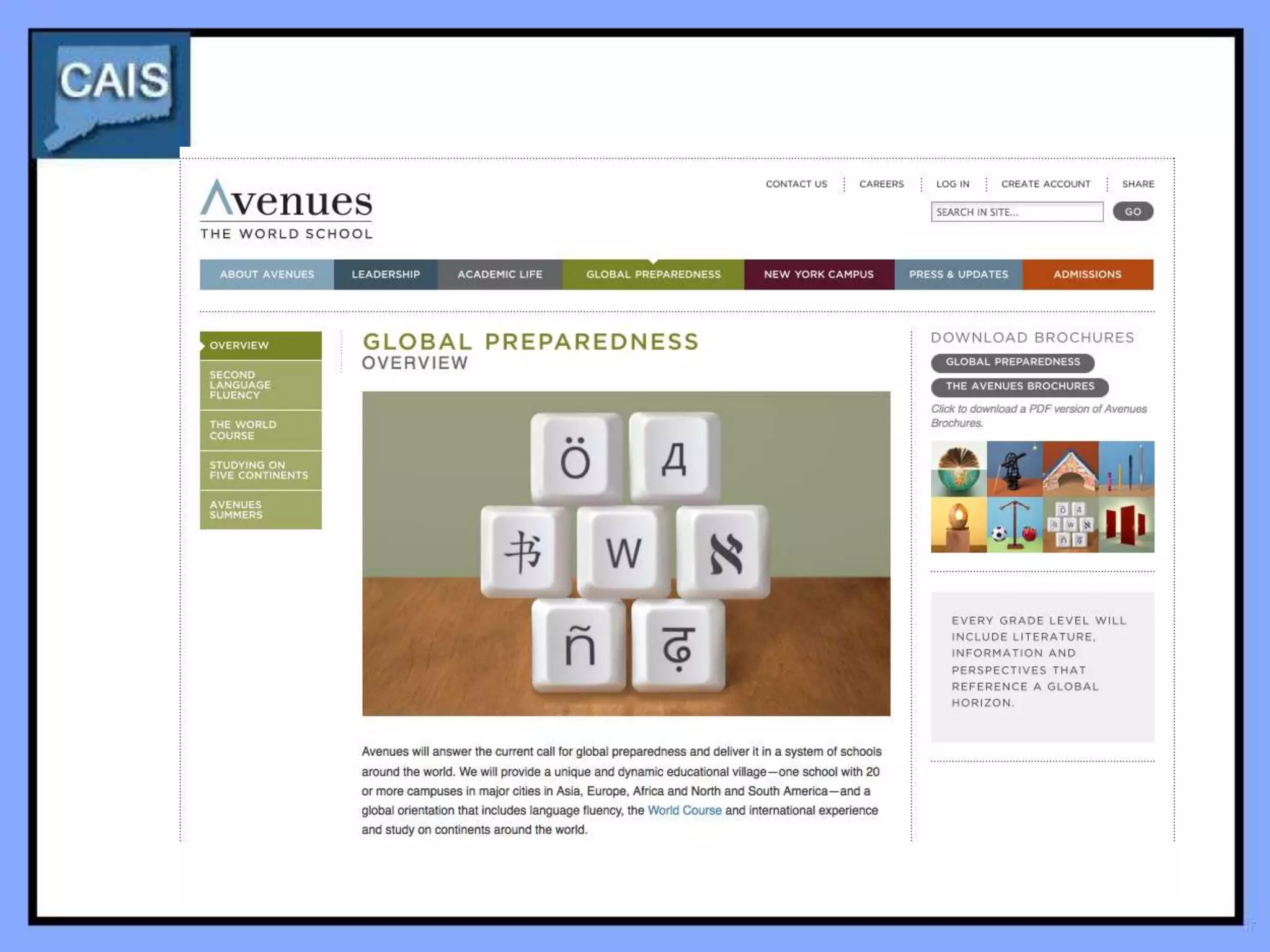
Avenues
http://www.avenues.org/

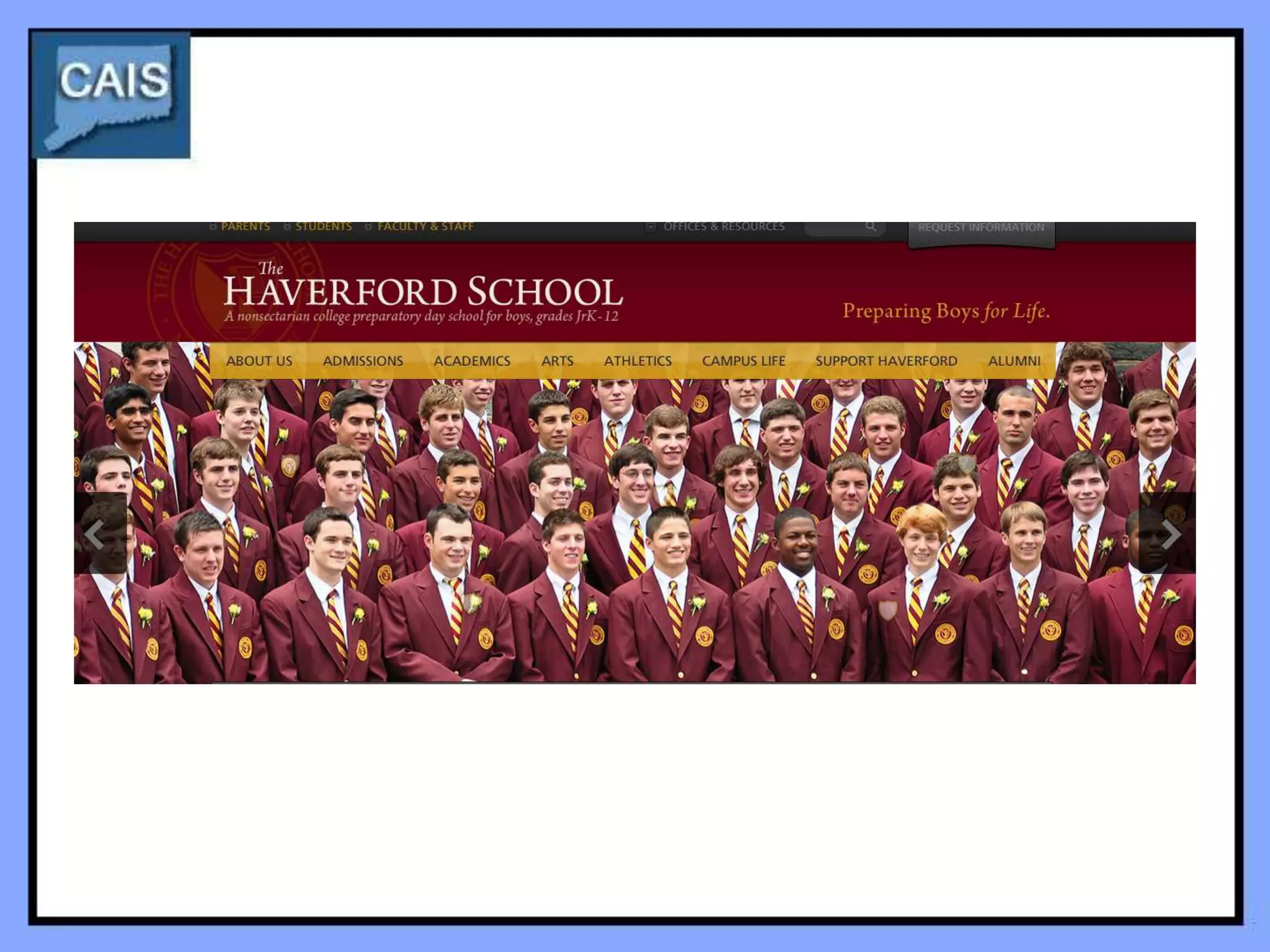
Haverford School (Decision Education)
http://www.haverford.org/

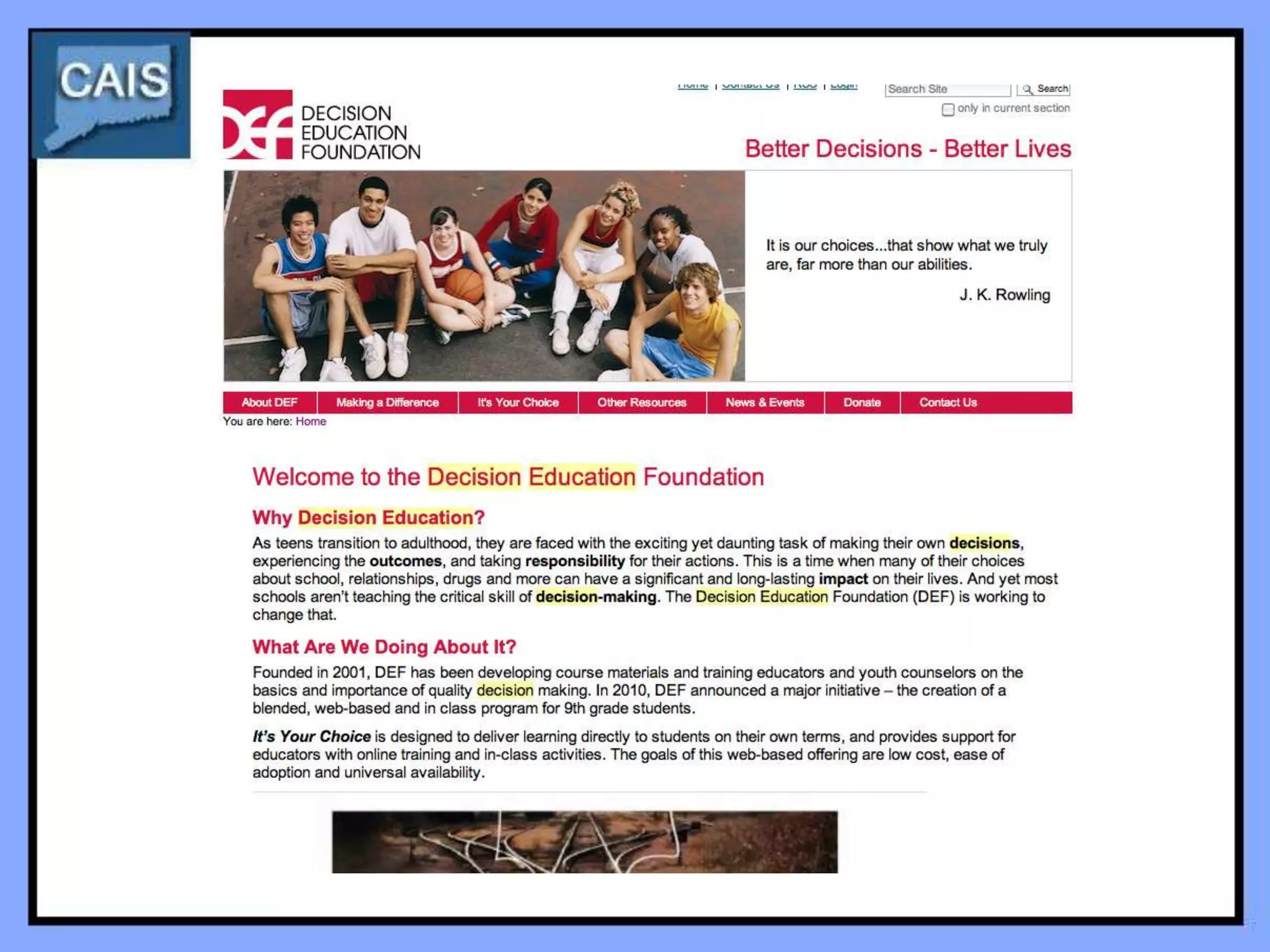
Decision Education (critical thinking/character education program)
http://www.decisioneducation.org/

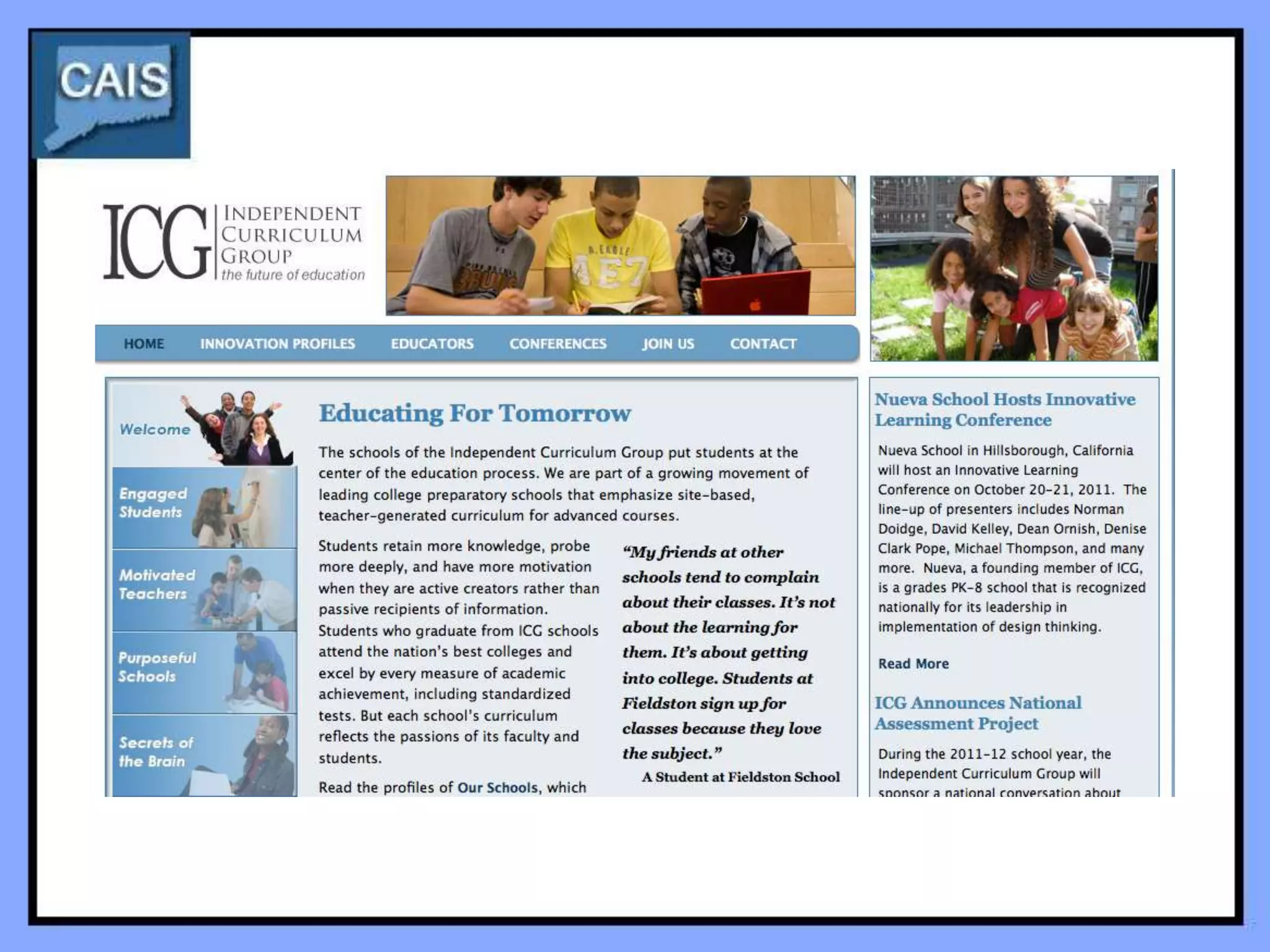
Independent Curriculum Group
http://www.independentcurriculum.org/

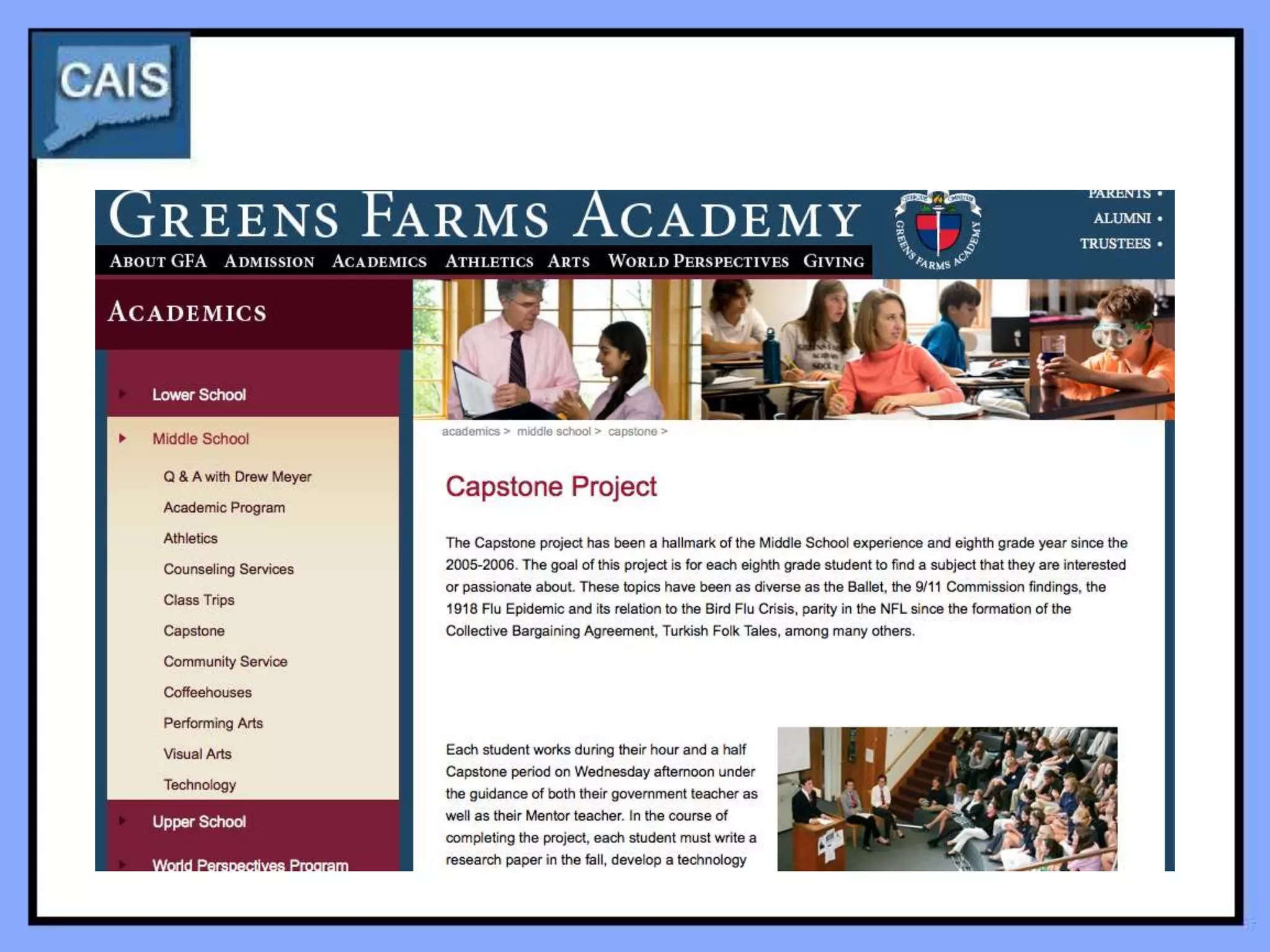
Greens Farms Academy
http://www.gfacademy.org/RelId/607374/ISvars/default/Capstone.htm

Hotchkiss/Loomis Collaborative Learning Project
http://tinyurl.com/3kq8v8f
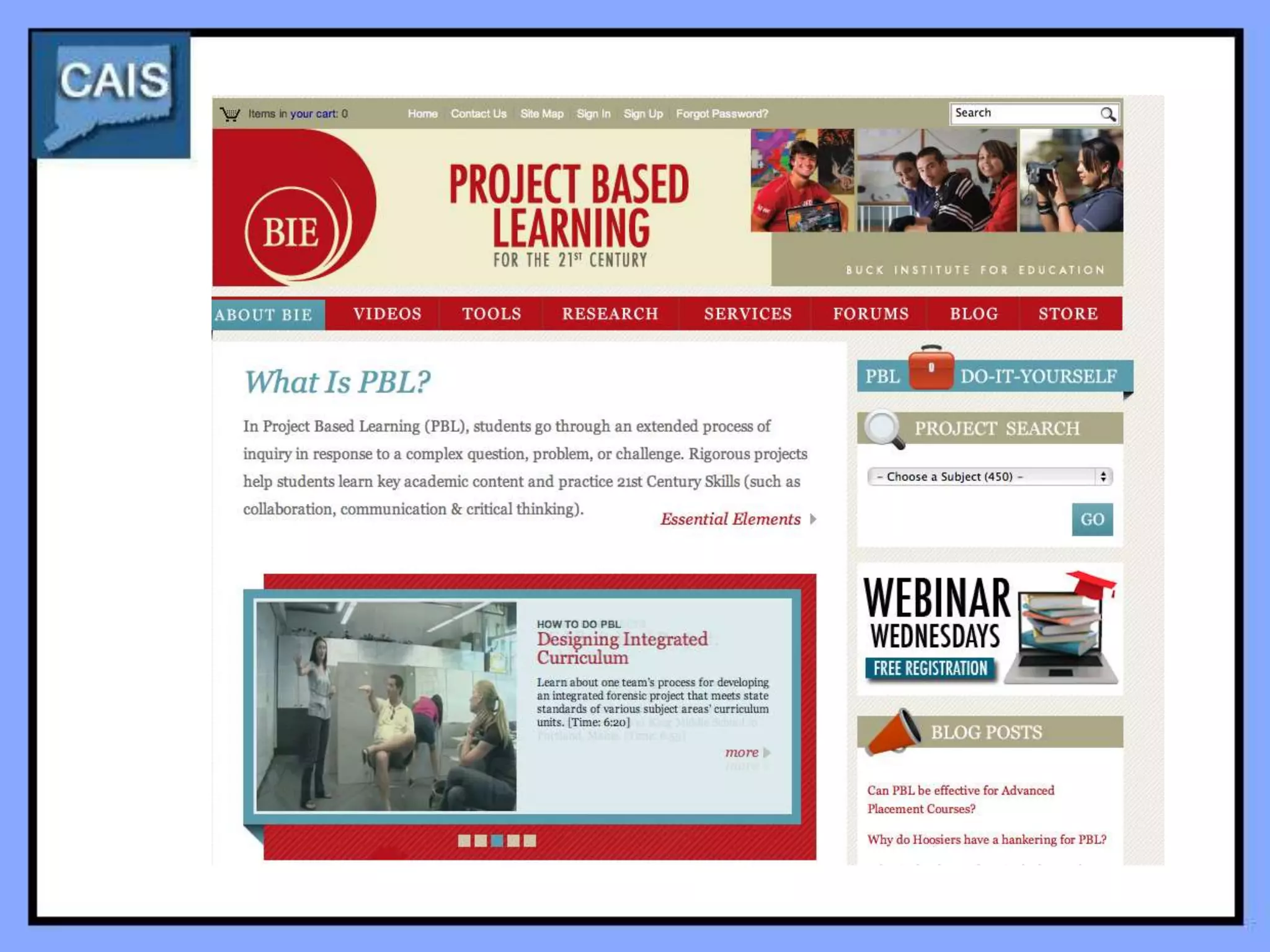
Project-based Learning (450 sample projects – all subjects and grade levels –
templates for organizing projects)
http://pbl-online.org/

Siemens Challenge (sample award-winning projects)
http://www.wecanchange.com/

American Society for Engineering Education (ASEE)
http://teachers.egfi-k12.org/

Exploravision (sample award-winning student projects)
http://www.exploravision.org/

Toyota Tapestry Grants for Science Teachers (sample grant-winning ($10,000) projects)
http://www.nsta.org/pd/tapestry/
aniblock@hamdenhall.org
lyons@caisct.org

Measuring what we value - lyons and niblock presentation

  • 1.
    Measuring what wevalue: 21st Century Assessments for Independent Schools Douglas Lyons, Executive Director, CAIS-CT Andrew Niblock, Lower School Head, Hamden Hall (CT)
  • 2.
    Good to Great Jim Collins • Determine what you value most, then find a way to measure it. • Success can be a powerful disincentive: it may be hard to become a great school if you are a very good school
  • 3.
    Goals of thisworkshop 1. Identify measures of school quality that have historically been valued by educators and/or the public. 2. Suggest new ways to report achievement in those measures. Why? • To better tell our story (the Value Proposition) • To make certain that these measures have stature appropriate to their significance
  • 4.
    Goals, cont. 3. Provide a quick preview of new and emerging assessment tools –instruments designed to measure skills that are increasing in demand in the new century 4. Describe the assessment practices in a select group of schools that define themselves – and are recognized by others – as “Schools of the Future”
  • 5.
    Criterion 13: The Standardsrequire a school to provide evidence of a thoughtful process, respectful of its mission, for the collection and use in school decision making of data (both external and internal) about student learning.
  • 6.
    “Not everything thatcan be counted, counts, and not everything that counts can be counted”
  • 7.
    “It would beeasier to change the course of history…”
  • 8.
    Powerpoint presentation isavailable at www.caisct.org look for ADVIS presentation on home page
  • 9.
    Jim Collins –“whenever possible, use the language of metrics to define what you value” What is the language of metrics?
  • 10.
    4 “ways ofknowing” • Data: raw input, no context, facts, figures, symbols • Information: organized, processed, analyzed data • Knowledge: information with higher context - accurate, relevant, current • Wisdom: evaluated knowledge; merged with life experience
  • 11.
    • Heads letterin viewbook; wisdom • Description of school history and mission in viewbook: knowledge • Course catalogue: information • SAT scores, college placement stats: data
  • 12.
    What are peoplemost interested in ? Data! • conveys a lot of information - quickly • Is viewed as objective, “no spin” • Can be benchmarked, used for comparison Data is the language of metrics
  • 13.
    Risks / Misusesof Data • Garbage in; garbage out • Data is easily manipulated, corrupted: Harvard Business School caution If you torture data long enough, it will admit to anything
  • 16.
    Data Management /Data Creation in the independent school community The Challenge: • To frame the data that define us, or have defined us in the past, in ways that do not elevate modestly valuable information • To gather and/or to present new data that is beneficial to educators in our planning for the future and is data that measures performance in relation to the achievement of our highest goals.
  • 17.
    The S.A.T. • Decreasingin stature, but still powerful • Has poor validity statistics • Does not measure 21st century Skills • Historically, did not provide faculty with instructionally useful information • Consider giving the School Day SAT with Enhanced Scoring
  • 19.
    Standardized Achievement Tests These test are increasing in stature What happened to elevate these tests above all other forms of data, in public education and to a lesser degree, in independent schools?
  • 21.
    “Effects” of standardizedtests today: from educating the whole child to educating the whole test-taker • Hyper-focus on scores, minor fluctuations • Unprecedented “score chasing” • M.D.I “measurement-driven instruction” • Mind numbing drill and practice
  • 22.
    Most popular formof data presentation: percentiles Math Math Reading Reading concepts applications comprehensio Skill n 1 91 87 83 83 2 88 84 85 83 3 92 90 88 88 4 84 89 80 90 5 84 86 78 82 6 89 80 81 79 7 90 89 90 87 8 87 87 81 83
  • 23.
    Second most popularform of data presentation: Grade Equivalence Math Math Reading Reading concepts application comprehensio skill s n 1 1.8 2.1 2.3 2.5 2 2.6 2.8 3.3 3.6 3 3.5 4.0 3.9 4.0 4 4.5 4.9 4.8 4.7 5 5.8 5.2 6.3 6.0 6 6.6 7.3 7.0 7.5 7 8.2 9.0 8.8 8.8 8 9.0 9.6 9.9 10.4
  • 24.
    A better wayto present achievement data • Determine and defend your norming group • Determine a worthy and realistic goal within the norming group • Publish data relative to the goal
  • 25.
    Goal: to scorewithin the top third of norming group on all subtests Reading Reading Math Math skill comprehensio skills applications n 1 √ √ √ √ 2 √ √ -4 √ 3 √ √ √ √ 4 √ √ √ √ 5 √ √ √ √ 6 √ √ √ √ 7 -2 √ √ √ 8 √ √ √ √
  • 26.
    The International Database •Most schools administer one or more normed tests that compare American student achievement with American peers • Is there a way to assess our international competitiveness? • Would this data be valuable to us?
  • 27.
    Benefits of theNew York State “Truth in Testing” Law • Thousands of released items available to educators • Released items available for NAEP tests • Released items available for TIMMS tests • Released items available for PISA tests • Construct your own “replica test” or form a research partnership to develop replica tests
  • 30.
    CAIS score reportsfor TIMMS replica test ABC Country Day School TIMMS “released item” test results 95% of students scored in the top 1/2 of I.A. 92% of students scored in the top 1/3 of I.A. 90% of students scored in the top 10% of I.A.
  • 32.
    Course of studyguides: how we describe our program US HISTORY HONORS GREENWICH HIGH SCHOOL This course addresses the events and experiences that comprise American history from the period of European colonial settlement through the Civil War (1st semester) And from the period of Reconstruction through the advent of the Second World War. The goal of the course is to provide for our students substantial opportunity to develop the ability to make informed and reasoned decisions as citizens concerned with the public good. (More text follows)
  • 33.
    US HISTORY HONORS Astudy of the events and critical changes that took place from the first American settlement to the present day.We will focus on these events in the context of larger themes; including the shift from an agricultural to an industrial society, the recognition and cultural identification of different groups of people, the transition to a stronger national government, immense territorial expansion, technological change and globalization.
  • 34.
    History at LakelandPrep: In the four year History sequence at Lakeland Prep, all students will complete the following Demonstrations of Learning: • 24 research based position papers (4 to 7 pages) in which an analysis, synthesis and/ or evaluation of both original and modern sources is offered in answer to a provocative question in history. • 6 research based position papers (10 to 15 pages) focused on a students original response to one of identified Essential Questions in American History. • 12 oral presentations • 8 collaborative projects, • 3 projects completed in collaboration with students in other schools and/ or countries • 4 interviews with elected officials • 6 Letters to the Editor written on a current topic in local and/or state government
  • 35.
    HSSSE - what do you believe your high school emphasizes most? • 21% memorizing facts and figures • 32% understanding information and ideas • 22% analyzing ideas in depth • 68% my school challenges me academically
  • 36.
    HSSSE: what instructional methods do you find exciting or engaging? • 60% discussion and debate • 60% group projects • 44% student presentations • 24% teacher lectures
  • 37.
    Using an Engagement Survey • Use the HSSSE and contribute your school data for national benchmarking; • Or, create your own survey, then compare your results to the national HSSSE 2009 data, where applicable .
  • 42.
    The Emergence ofLongitudenal Data • The National Clearinghouse has 93% of all US colleges collecting and providing longitudenal data • Two independent school associations require student tracking for accreditation (freshman GPA): • CAIS Canada ntp@cais.ca • ISASW www.isasw.org
  • 43.
    Measuring teacher engagement, professionalism, attachment to school Can that be quantified? • Longevity statistics • % faculty with advanced degrees • % faculty participating in Annual Giving
  • 44.
    Occasional Teacher Absenteeism •Reported in “school district report cards” • Measures only consecutive days absent, less than 5, 7 or 10 days. After the threshold, absence considered “long term illness”, removed from calculation • O.C.A considered an indicator of faculty commitment, professionalism, attachment
  • 45.
    Greenwich CT HighSchool: State Report Card
  • 46.
    Measure your O.T.A. •Compare it to your local or state public school average • Inform your Board of Trustees • Inform your Parents Association
  • 47.
    Measuring teacher effectiveness:in the best public schools, teacher evaluation is an informed, professional process How can independent school leaders become more skilled in the clinical observation and evaluation of teaching? How can we measure what we value in teaching practice? The TIMSS video study – teaching practices in 7 select countries
  • 52.
    New and emergingassessment instruments – workshop goal 3 • We have just reviewed ideas for improving the use of existing data • What about new tools and techniques? • Are the assessment instruments and practices of earlier generations obsolete or incomplete? • If so, why is that true?
  • 53.
    Did something occuron January 1, 2001 that changed everything?
  • 54.
    Turn of themillenium events First successful HTTP communication (modern WEB)1990 Netscape, easy to use browser 1995 Google, as a research project 1996 LiveJournal, Blogger, hosting sites 1999 Ericsson smartphone 2000 Wikipedia 2001 Facebook 2004 MIT Open Courseware 2004 YouTube 2005 Skype 2005 The World is Flat first edition 2005 Internet/Multimedia Smart phone (iphone) 2007 Global financial crisis 2008 Khan Academy (2600 videos and growing) 2009
  • 55.
    100 most influentialpeople of the 2nd Millenium • Jonas Salk 97 • Steven Spielberg 91 • Elvis Presley 57 • Gregor Mendel 42 • Martin Luther King 33 • Henry Ford 29 • Michelangelo 19 • Galileo 10 • Columbus 6 • Charles Darwin 4 • Who is Number 1?
  • 56.
    Johann Gutenberg The printingpress was information technology What about modern day visionaries in information technology? What number is Bill Gates? Steve Jobs?
  • 57.
    What’s Past isPrologue vs The Future is Not What it Used to Be • “What does an educated person need to know?” • Education is defined by a remembered body of knowledge, the “canon” • Critical, sarcastic view of the canon: Education as inoculation:” American history? I had that, Tetanus shot? I had that…)
  • 58.
    20th century technology: •Radio, television and film had great promise, but no demonstrable effect on schooling What 20th century technology had a revolutionary effect on teaching and learning?
  • 59.
    SCANTRON! Bubble answer sheets! • 1948 – Scantron Corporation revolutionized the speed and efficiency of data collection and advanced the notion that student proficiency and school quality can be determined through mass-produced, multiple choice metrics • Scantron, to this day, has had a greater impact on k-12 curricular design than any other technology in history.
  • 60.
    in post scantrondecades: “What gets measured is what gets taught”. • Tests “drive” instruction in ways that mimic both the content and format of the test. • What gets measured is almost exclusively content • In the Information Age, we measured recall of information
  • 61.
    In 2012, inThe Conceptual Age There are no books, conferences, op-ed pieces on “21st Century Content”. The canon has been buried under the information explosion However, There is near universal agreement on a short list of 21st century skills. There is near universal agreement on the need to employ technology in a thoughtful but robust manner
  • 62.
    Nicholas Negroponte onapplying technology in a robust manner: • “When you drop a penny into a glass of clear water, you get a glass of clear water with a penny in it; the change is additive.” • “When you place a drop of red dye in a glass of clear water, you get a glass of pink water. The change is ecological.” • Technology in education needs to be ecological; pink water
  • 63.
    The i generation •Defined mostly by their use of technology • Accustomed to learning things on their own and learning from peers • Expect technology to be interactive and customizable • Non-linear thinkers; web thinkers, scanners, multi- taskers
  • 64.
    Clay Shirke, futuristdescribing the i generation: “A father sets up a new television in the living room. His 4 year old daughter is seen rummaging through the box. What is she looking for?” Passive media experiences will hold less appeal for this generation
  • 65.
    The 21st centuryskills movement, the Schools of the Future movement, focus on the development of these skills: Communication Collaboration Critical/Analytical Thinking Creativity Problem-solving Content is still important; but content in these areas will need to be acquired through active exploration as well as through instruction.
  • 66.
    American work inthe 21st century
  • 67.
    Non–Routine Tasks defined in the Journal of Economics, volume 118 • Gathering, synthesizing, and analyzing information. • Working autonomously to a high standard with minimal supervision. • Leading other autonomous workers through influence. • Being creative and turning that creativity into action. • Thinking critically and asking the right questions. • Striving to understand others’ perspectives and to understand the entirety of an issue. Communicating effectively, often using technology.
  • 69.
    Current assessment toolsdo not measure these skills. You cannot have 21st century schools using 20th century assessments.
  • 70.
    Ideal Assessment: Provides accuratedemonstration of student proficiency Yields information for faculty planning Is valid as a learning experience in and of itself An assessment of, for and as learning
  • 71.
    What is aperformance task? Students assume roles in a scenario that is based in the "real world" and contains the types of problems they might need to solve in the future. The task requires critical thinking, analytical reasoning and problem solving. Communication skills are used in describing the solution.
  • 72.
    Ohio Mastery Test,Grade 9 • Ms. Johnson installs new insulation to save money on heating costs, but then learns that her bills have not declined by much from the previous year. Her contractor points out that heating costs have risen and weather has been colder. Ms. Johnson wants to find out how much she has actually saved due to the insulation she installed. On the basis of the situation painted above, details about Ms. Johnson’s heating bills (rates, units of heat used), temperature changes, and some initial information to help them begin to research “heating degree days” on the internet, students are given two tasks: • (1) Assess the cost-effectiveness of Ms. Johnson’s new insulation and window sealing. • (2) Create a short pamphlet for gas company customers to guide them in making decisions about increasing the energy efficiency of their homes.
  • 87.
    Students get answersto questions THEY ask • For example – Family history – Is this breast cancer possibly caused by abnormal oncogene expression? If so, certain types of hormonal therapy or receptor antagonists are more effective treatments. – What level of stage III cancer, A, B or C?
  • 90.
    CBAL • Extended, constructed-responsetasks that are delivered by computer and automatically scored. • Pilot testing occurred in 2010 and 2011, spring of 2012. • Tests should be available for use in 2012. • Sample tests available online Website information is in your folders.
  • 93.
    features real-time, scenario-basedtasks that measure an individual's ability to navigate, critically evaluate and understand the wealth of information available through digital technology
  • 95.
    Ken Robinson Age and education: • Increase routines of behavior and habits of thought (left brain logical thinking ) • Decrease divergent thinking (free association of ideas. Right brain, creative thinking)
  • 98.
    Creativity Index: thenew state mandate? • Gov. Deval Patrick has made Massachusetts the first state in the country to call for the formation of a creativity index aimed at rating public schools statewide based on their ability to teach, encourage and foster creativity in students. • Similar legislation is pending in California and Oklahoma
  • 99.
    Torrence Test ofCreative Thinking Verbal Activity 4: Product Improvement Look at the stuffed toy elephant in the drawing. It is six inches tall and weighs a half pound. In the space provided, list the cleverest, most interesting and unusual ways you can think of for changing this toy so that children will have more fun playing with it. Do not worry about how much the change would cost.Think only about what would make it more fun to play with. Activity 2 and 3: Guessing Causes and Guessing Consequences measures “idea fluency”
  • 100.
    What do youget if you solve this problem and visit the website?
  • 101.
    The 4th goalof this workshop: Examples of assessment practices in a select group of schools that define themselves – and are recognized by others as “Schools of the Future”
  • 102.
    Schools that definethemselves as Schools of the future • Who are the pioneers? • What do these schools have in common?
  • 109.
    Science Leadership Academy Philadelphia, Pennsylvania
  • 110.
    All of theseschools have 2 common characteristics • urban public charter schools. • experimenting with a dramatically different view of teaching and learning; A Collaborative, Conceptual Model
  • 111.
    21st Century education: from coverage model to conceptual model • Recall of information (content) is still important • Skill in accessing and selecting information (internet searches now deliver 2000 hits) vitally important • Ability to use or apply information in new and/or novel settings most important (Its not what you know, but what you can do with what you know) • Expanded role of the teacher: guide, coach, facilitator
  • 112.
    Schools of theFuture: characteristics • Performance tasks • Project-based learning, individually and in groups • Capstone projects, individually and in groups • Independent study • Online learning, online tools (courseware, Skype, You Tube, Ning, Moodle, Web 2.0 etc…) • Students given choices in assignments and in demonstrations of mastery
  • 113.
    Schools of thefuture, cont. • Extensive use of essential questions relating to content area why, how and what if questions • Computer-adaptive learning (program adjusts to student skill level) • E-portfolios, published within the community or on the web – seeking Facebook-type conversations in the academic community, on academic topics • Flipped classroom strategies – routinely or occasionally • Partnerships, learning experiences beyond the school campus • RUBRICS used to assess performance
  • 115.
  • 116.
    A New Definitionof School “we need to invert the conventional classroom dynamic: instead of teaching information and content first, and then asking students to answer questions about it second, we should put the question/problem first, and then facilitate students with information and guidance as they seek the answer and hold them accountable for the excellence of their solutions and of their presentation of their results”. -Ted Mccain Teaching for Tomorrow
  • 119.
  • 120.
    Independent schools • leadthe nation in communication skills; writing, speaking, the performing arts • Engagement has been supported by very strong student-faculty relationships • An incremental approach to the challenges of the future; preserving strong, successful, traditional programs while expanding collaborative learning, online learning, project-based assessments, exhibitions of learning and use of digital portfolios • Growing interest in “Essential Questions” theory of learning
  • 125.
  • 126.
    Lessons from our research: Schoolsin the 21st century will define success in much broader terms Great Schools in the 21st century will include some that have far fewer resources than independent schools. What they have is the freedom to take big risks in designing innovative cultures
  • 128.
    “Measuring What WeValue” Sites Referenced in Presentation Hechinger Article containing multiple links of sample questions on new 2012 assessments http://hechingered.org/content/are-new-online-standardized-tests- revolutionary-decide-for-yourself_5655/ Information on Torrance Test http://www.ststesting.com/ High School Survey of Student Engagement www.indiana.edu/~ceep/hssse/ College Student Experiences Questionnaire http://cseq.iub.edu/cseq_generalinfo.cfm National Student Clearinghouse www.studentclearinghouse.org/ The Self-Regulation Questionnaire www.psych.rochester.edu/SDT/measures/SRQ_text.php MHISC: Mental Health in Independent Schools http://www.harthosp.org/InstituteOfLiving/OtherServices/MHISC/default.aspx
  • 129.
    C-bal Cognitively BasedAssessment for Learning http://www.ets.org/research/topics/cbal/initiative/ The CWRA: College to Work Readiness Assessment www.cae.org/cwra/ Science Leadership Academy www.scienceleadership.org/ High Tech High http://www.hightechhigh.org/ New Tech High http://newtechhigh.org/ Big Picture Learning http://www.bigpicture.org/ NYC i school http://www.nycischool.org/ Microsoft School of the Future http://www.microsoft.com/education/en- us/leadership/partners_in_learning/Pages/School-of-the-Future.aspx
  • 130.
    Performance Assessment Groupof NYC Schools (check out the rubics!) http://performanceassessment.org/ Rubics – Association of American Colleges and Universities (rubics on critical thinking, creative thinking, problem-solving and others!) www.aacu.org/value/rubics Avenues http://www.avenues.org/ Haverford School (Decision Education) http://www.haverford.org/ Decision Education (critical thinking/character education program) http://www.decisioneducation.org/ Independent Curriculum Group http://www.independentcurriculum.org/ Greens Farms Academy http://www.gfacademy.org/RelId/607374/ISvars/default/Capstone.htm Hotchkiss/Loomis Collaborative Learning Project http://tinyurl.com/3kq8v8f
  • 131.
    Project-based Learning (450sample projects – all subjects and grade levels – templates for organizing projects) http://pbl-online.org/ Siemens Challenge (sample award-winning projects) http://www.wecanchange.com/ American Society for Engineering Education (ASEE) http://teachers.egfi-k12.org/ Exploravision (sample award-winning student projects) http://www.exploravision.org/ Toyota Tapestry Grants for Science Teachers (sample grant-winning ($10,000) projects) http://www.nsta.org/pd/tapestry/
  • 132.
  • 133.