Teachers Need Technology                                                                         1 of 23


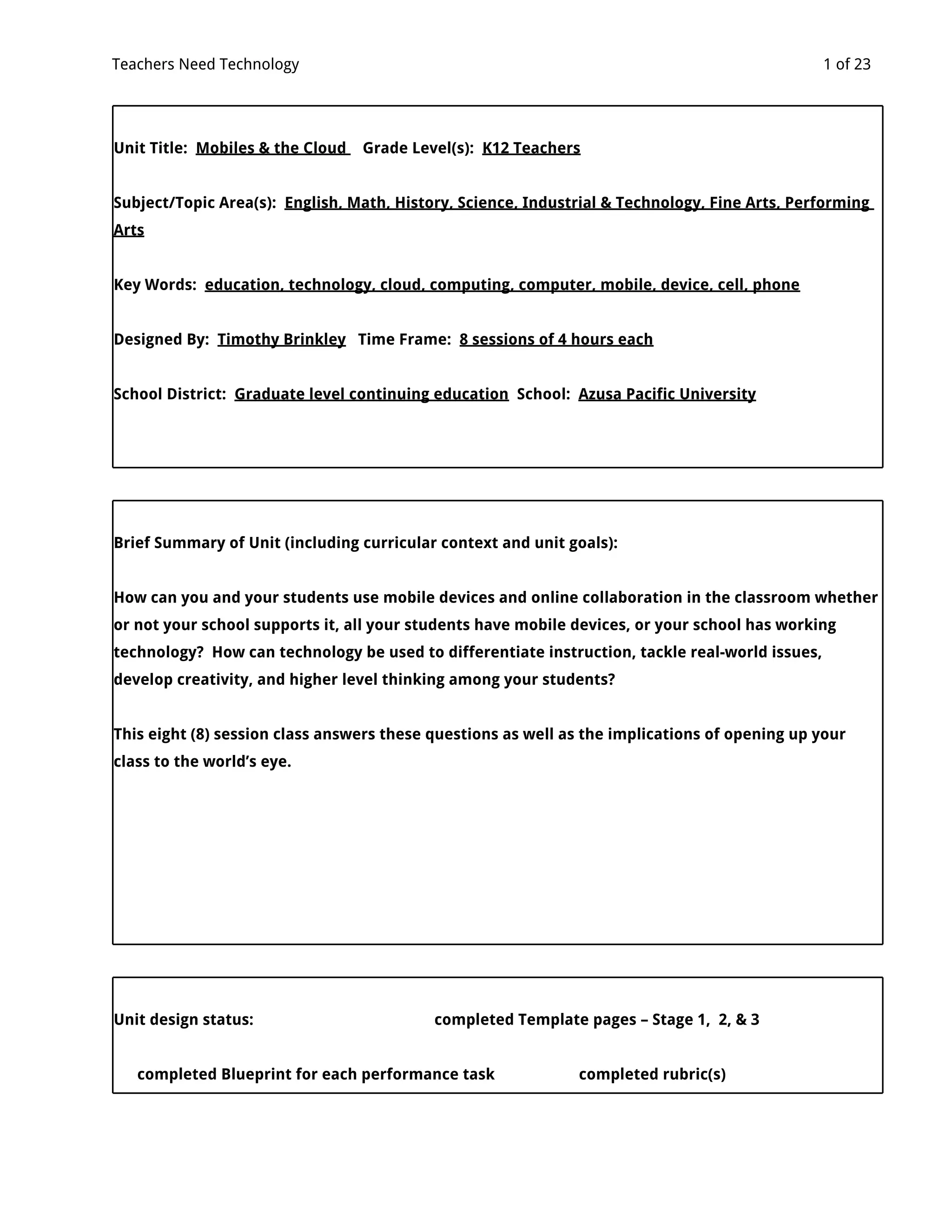
Unit Title: Mobiles & the Cloud   Grade Level(s): K12 Teachers


Subject/Topic Area(s): English, Math, History, Science, Industrial & Technology, Fine Arts, Performing
Arts


Key Words: education, technology, cloud, computing, computer, mobile, device, cell, phone


Designed By: Timothy Brinkley Time Frame: 8 sessions of 4 hours each


School District: Graduate level continuing education School: Azusa Pacific University


Brief Summary of Unit (including curricular context and unit goals):


How can you and your students use mobile devices and online collaboration in the classroom whether
or not your school supports it, all your students have mobile devices, or your school has working
technology? How can technology be used to differentiate instruction, tackle real-world issues,
develop creativity, and higher level thinking among your students?


This eight (8) session class answers these questions as well as the implications of opening up your
class to the world’s eye.


Unit design status:                        completed Template pages – Stage 1, 2, & 3


   completed Blueprint for each performance task              completed rubric(s)
Teachers Need Technology                                                                          2 of 23

   directions to students & teachers                  materials & resources listed


   suggested accommodations                           suggested extensions


Status:     О initial draft (date - _____________ )     О revised draft (date - _____________ )


О peer reviewed      О content reviewed         О field tested      О validated      О anchored
Teachers Need Technology                                                                         3 of 23
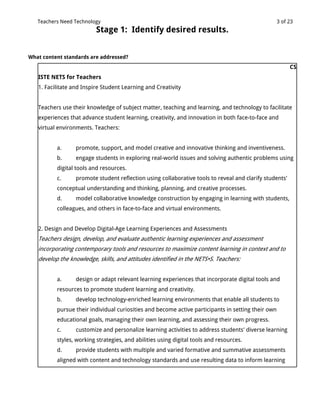
                          Stage 1: Identify desired results.


What content standards are addressed?
                                                                                                         CS
   ISTE NETS for Teachers
   1. Facilitate and Inspire Student Learning and Creativity


   Teachers use their knowledge of subject matter, teaching and learning, and technology to facilitate
   experiences that advance student learning, creativity, and innovation in both face-to-face and
   virtual environments. Teachers:


          a.      promote, support, and model creative and innovative thinking and inventiveness.
          b.      engage students in exploring real-world issues and solving authentic problems using
          digital tools and resources.
          c.      promote student reflection using collaborative tools to reveal and clarify students'
          conceptual understanding and thinking, planning, and creative processes.
          d.      model collaborative knowledge construction by engaging in learning with students,
          colleagues, and others in face-to-face and virtual environments.


   2. Design and Develop Digital-Age Learning Experiences and Assessments
   Teachers design, develop, and evaluate authentic learning experiences and assessment
   incorporating contemporary tools and resources to maximize content learning in context and to
   develop the knowledge, skills, and attitudes identified in the NETS•S. Teachers:


          a.      design or adapt relevant learning experiences that incorporate digital tools and
          resources to promote student learning and creativity.
          b.      develop technology-enriched learning environments that enable all students to
          pursue their individual curiosities and become active participants in setting their own
          educational goals, managing their own learning, and assessing their own progress.
          c.      customize and personalize learning activities to address students' diverse learning
          styles, working strategies, and abilities using digital tools and resources.
          d.      provide students with multiple and varied formative and summative assessments
          aligned with content and technology standards and use resulting data to inform learning
Teachers Need Technology                                                                       4 of 23
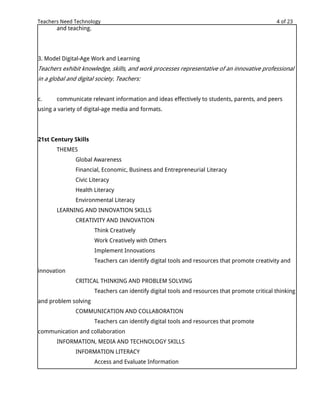
       and teaching.


3. Model Digital-Age Work and Learning
Teachers exhibit knowledge, skills, and work processes representative of an innovative professional
in a global and digital society. Teachers:


c.     communicate relevant information and ideas effectively to students, parents, and peers
using a variety of digital-age media and formats.


21st Century Skills
       THEMES
               Global Awareness
               Financial, Economic, Business and Entrepreneurial Literacy
               Civic Literacy
               Health Literacy
               Environmental Literacy
       LEARNING AND INNOVATION SKILLS
               CREATIVITY AND INNOVATION
                       Think Creatively
                       Work Creatively with Others
                       Implement Innovations
                       Teachers can identify digital tools and resources that promote creativity and
innovation
               CRITICAL THINKING AND PROBLEM SOLVING
                       Teachers can identify digital tools and resources that promote critical thinking
and problem solving
               COMMUNICATION AND COLLABORATION
                       Teachers can identify digital tools and resources that promote
communication and collaboration
       INFORMATION, MEDIA AND TECHNOLOGY SKILLS
               INFORMATION LITERACY
                       Access and Evaluate Information
Teachers Need Technology                                                                    5 of 23
                         Use and Manage Information
                 MEDIA LITERACY
                         Analyze Media
                         Create Media Products
                 ICT (Information, Communications and Technology) LITERACY
                         Apply Technology Effectively
          LIFE AND CAREER SKILLS
                 FLEXIBILITY AND ADAPTABILITY
                         Adapt to Change
                         Be Flexible
                 INITIATIVE AND SELF-DIRECTION
                         Manage Goals and Time
                         Work Independently
                         Be Self-directed Learners
                 SOCIAL AND CROSS-CULTURAL SKILLS
                         Interact Effectively with Others
                         Work Effectively in Diverse Teams
                 PRODUCTIVITY AND ACCOUNTABILITY
                         Manage Projects
                         Produce Results
                 LEADERSHIP AND RESPONSIBILITY
                         Guide and Lead Others
                         Be Responsible to Others


What enduring understandings are desired (and what misunderstandings will be addressed)?

                                                                                                     U
   Session 1-
   1b: engage students in exploring [local and global] real-world issues and solving authentic problems
   using digital tools and resources


   Session 2-
   1a: promote, support, and model creative and innovative thinking and inventiveness
Teachers Need Technology                                                                          6 of 23


   Session 3-
   1c: promote student reflection using collaborative tools to reveal and clarify students' conceptual
   understanding and thinking, planning, and creative processes.


   Session 4-
   1d: model collaborative knowledge construction by engaging in learning with students, colleagues,
   and others in face-to-face and virtual environments.
   3c: communicate relevant information and ideas effectively to students, parents, and peers using a
   variety of digital-age media and formats.


   Session 5-
   2a: design or adapt relevant learning experiences that incorporate digital tools and resources to
   promote student learning and creativity.


   Session 6-
   2b: develop technology-enriched learning environments that enable all students to pursue their
   individual curiosities and become active participants in setting their own educational goals,
   managing their own learning, and assessing their own progress.


   Session 7-
   2c: customize and personalize learning activities to address students' diverse learning styles,
   working strategies, and abilities using digital tools and resources.


   Session 8-
   2d: provide students with multiple and varied formative and summative assessments aligned with
   content and technology standards and use resulting data to inform learning and teaching.


What essential questions will guide this unit and focus teaching/learning?
                                                                                                           Q
   1: How can using technology be worth the educators’ time?
   In what ways can the payoff of using technology be worth the educator's time and effort?
Teachers Need Technology                                                                      7 of 23
   2: Pedagogical: How do educators nurture creativity among their students?
   Technological: How is technology related to creative and innovative thinking?


   3: Isn’t online collaboration the same as writing a reflection on paper and discussing them in class?
   What is the different between online collaboration and face-to-face collaboration?


   4: What risks and how much time are involved in using online collaborative tools?
   Why would anyone care to see my students’ work?
   What should I share about my work?


   5:      Since technology changes so fast, why should I bother?
           Which digital tools should I use?
           When is there too much technology?


   6: How can I use technology if my school does not support it?


   7:      Is differentiating learning using technology worth my time and effort?
           What are the best tools for differentiating with technology?


   8:      When my students do not have access to technology outside of class, how can I use it for
   assessment?


What key knowledge and skills will students acquire as a result of this unit?

                                                                                                       K
    Key:
    PK = Pedagogical Knowledge
    CK = Content Knowledge
    TK = Technological Knowledge
    TPK = Technological & Pedagogical Knowledge
    TCK = Technological & Content Knowledge
    TPCK = Technological, Pedagogical, & Content Knowledge


    Students will know & do (skill):
Teachers Need Technology                                                                         8 of 23
Session 1:
PK: the effects of the real world, an audience outside of school, authentic problems in action,
professional roles and meaningful/ useful products on students
TPK: how technology extends a teachers ability to use authentic, real-world problems and issues
TPK: examples of schools that are reaping the rewards of technology integration. What are the
elements of a successful implementation?
Skill: TPCK: Select three possible local or global authentic problems, professional roles, meaningful/
useful products, or real-world issues to which your students could give a possible solution--whether
feasible, realistic or not in an environment free of criticism.


Session 2:
TCK: which and how technology can help students develop creativity in relationship to their content
area.
TPK: show/read some technology stories of grappling, ambiguity in the classroom.
PK: available research on higher order thinking skills, critical thinking, meta-cognition, and self-
regulation
According to research creativity is promoted in the following ways:
grappling, ambiguity, high mental processes and skills, inventing, ideational fluency, originality
of ideas, and sensitivity to missing elements (Guilford, 1950; Torrance, 1974), creative thinking
requires at least a minimal level of expertise and fluency within a knowledge domain (Bransford et
al., 2000; Crawford and Brophy, 2006), Repeatedly encourage idea generation, Cross-fertilize ideas,
Build self-efficacy, Constantly question assumptions, Imagine other viewpoints (DeHaan, 2009),
tolerance for ambiguity and independence, the use of humor, metaphorical thinking, and problem
defining (Bull, et al. 1995)
Skill: TPCK: of the tools and resources from session 1, identify what in them develops creativity.
Which would you select and how would you use those to develop creativity in curriculum,
instruction, and assessment?


Session 3:
PK: importance of understanding what is going on in the students’ head and what is actually going
on in the classroom
Research showing a different kind of participation online versus face-to-face
TCK: know how to find available digital tools that promote student reflection using collaborative
tools to reveal and clarify students' conceptual understanding and thinking, planning, and creative
Teachers Need Technology                                                                          9 of 23
processes in their content area.
         Gliffy
         Xmind
         Google Docs, Forms
         YouTube
         PollAnywhere
Skill: TPCK: can use tools for reflection, tools for formative assessment, tools for conceptual
understanding and thinking, tools that nuture creative processes


Session 4:
TCK: what is, and examples of collaborative knowledge construction.
Stories of success and failure.
Skill: participate in the collaborative creation of knowledge
         Google Sites
         Engrade
         Content websites
—------------------------------------
TPK: how to share student work online and examples of other schools
Benefits of sharing student work
Skill: Share their work online with the world


Session 5:
TCK: Principles to select digital tools:
         tracking & comparing work submitted
         intuitive user interface
         engaging audio-visuals
         different users/profiles
         sharing work and/or performance
Skill: Evaluate the technology tools and resources your school currently has.


Session 6:
TPK: Know examples of teachers and schools that have technology-enriched environment.
TPK: Know procedures how to implement a technology enriched environment
Teachers Need Technology                                                                      10 of 23
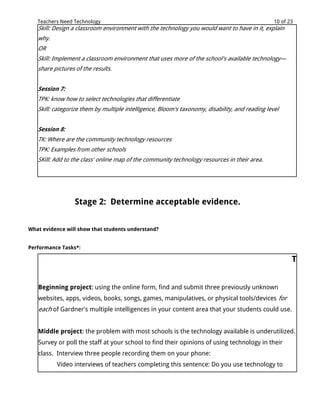
   Skill: Design a classroom environment with the technology you would want to have in it, explain
   why.
   OR
   Skill: Implement a classroom environment that uses more of the school's available technology—
   share pictures of the results.


   Session 7:
   TPK: know how to select technologies that differentiate
   Skill: categorize them by multiple intelligence, Bloom's taxonomy, disability, and reading level


   Session 8:
   TK: Where are the community technology resources
   TPK: Examples from other schools
   SKill: Add to the class' online map of the community technology resources in their area.


                  Stage 2: Determine acceptable evidence.


What evidence will show that students understand?


Performance Tasks*:

                                                                                                        T


   Beginning project: using the online form, find and submit three previously unknown
   websites, apps, videos, books, songs, games, manipulatives, or physical tools/devices for
   each of Gardner's multiple intelligences in your content area that your students could use.


   Middle project: the problem with most schools is the technology available is underutilized.
   Survey or poll the staff at your school to find their opinions of using technology in their
   class. Interview three people recording them on your phone:
          Video interviews of teachers completing this sentence: Do you use technology to
Teachers Need Technology                                                                   11 of 23
help your students discover answers independently or collaboratively? How?
if neither,
How does your use of technology relate to your educational philosophy?
       Or if technology is already widely used at your campus have them answer this
question: How has technology impacted student learning?
       Upload and converge the videos in an online video editing tool (e.g. YouTube) and
share with the world.
       Journal each step of your whole experience in APU's Google Docs sharing it with the
instructor and the classmates in your group.


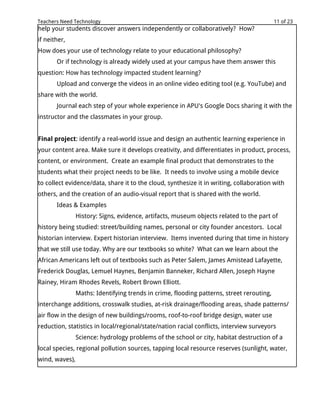
Final project: identify a real-world issue and design an authentic learning experience in
your content area. Make sure it develops creativity, and differentiates in product, process,
content, or environment. Create an example final product that demonstrates to the
students what their project needs to be like. It needs to involve using a mobile device
to collect evidence/data, share it to the cloud, synthesize it in writing, collaboration with
others, and the creation of an audio-visual report that is shared with the world.
       Ideas & Examples
                History: Signs, evidence, artifacts, museum objects related to the part of
history being studied: street/building names, personal or city founder ancestors. Local
historian interview. Expert historian interview. Items invented during that time in history
that we still use today. Why are our textbooks so white? What can we learn about the
African Americans left out of textbooks such as Peter Salem, James Amistead Lafayette,
Frederick Douglas, Lemuel Haynes, Benjamin Banneker, Richard Allen, Joseph Hayne
Rainey, Hiram Rhodes Revels, Robert Brown Elliott.
                Maths: Identifying trends in crime, flooding patterns, street rerouting,
interchange additions, crosswalk studies, at-risk drainage/flooding areas, shade patterns/
air flow in the design of new buildings/rooms, roof-to-roof bridge design, water use
reduction, statistics in local/regional/state/nation racial conflicts, interview surveyors
                Science: hydrology problems of the school or city, habitat destruction of a
local species, regional pollution sources, tapping local resource reserves (sunlight, water,
wind, waves),
Teachers Need Technology                                                                    12 of 23
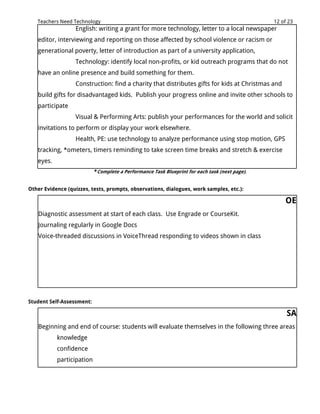
                  English: writing a grant for more technology, letter to a local newspaper
   editor, interviewing and reporting on those affected by school violence or racism or
   generational poverty, letter of introduction as part of a university application,
                  Technology: identify local non-profits, or kid outreach programs that do not
   have an online presence and build something for them.
                  Construction: find a charity that distributes gifts for kids at Christmas and
   build gifts for disadvantaged kids. Publish your progress online and invite other schools to
   participate
                  Visual & Performing Arts: publish your performances for the world and solicit
   invitations to perform or display your work elsewhere.
                  Health, PE: use technology to analyze performance using stop motion, GPS
   tracking, *ometers, timers reminding to take screen time breaks and stretch & exercise
   eyes.
                           *Complete a Performance Task Blueprint for each task (next page).


Other Evidence (quizzes, tests, prompts, observations, dialogues, work samples, etc.):

                                                                                                   OE
   Diagnostic assessment at start of each class. Use Engrade or CourseKit.
   Journaling regularly in Google Docs
   Voice-threaded discussions in VoiceThread responding to videos shown in class


Student Self-Assessment:

                                                                                                    SA
   Beginning and end of course: students will evaluate themselves in the following three areas
           knowledge
           confidence
           participation
Teachers Need Technology                                                                                  13 of 23


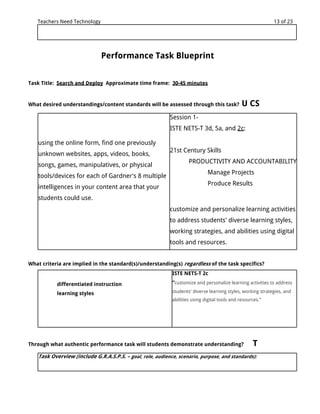
                              Performance Task Blueprint


Task Title: Search and Deploy Approximate time frame: 30-45 minutes


What desired understandings/content standards will be assessed through this task?              U CS
                                                           Session 1-
                                                           ISTE NETS-T 3d, 5a, and 2c:

   using the online form, find one previously
                                                           21st Century Skills
   unknown websites, apps, videos, books,
                                                                    PRODUCTIVITY AND ACCOUNTABILITY
   songs, games, manipulatives, or physical
                                                                             Manage Projects
   tools/devices for each of Gardner's 8 multiple
                                                                             Produce Results
   intelligences in your content area that your
   students could use.
                                                           customize and personalize learning activities
                                                           to address students' diverse learning styles,
                                                           working strategies, and abilities using digital
                                                           tools and resources.


What criteria are implied in the standard(s)/understanding(s) regardless of the task specifics?
                                                            ISTE NETS-T 2c

           differentiated instruction                       “customize and personalize learning activities to address

           learning styles                                  students' diverse learning styles, working strategies, and
                                                            abilities using digital tools and resources.”


Through what authentic performance task will students demonstrate understanding?                    T
   Task Overview (include G.R.A.S.P.S. – goal, role, audience, scenario, purpose, and standards):
Teachers Need Technology                                                                                         14 of 23
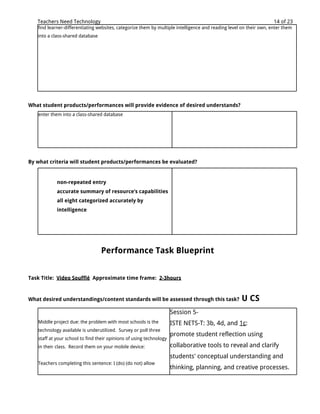
   find learner-differentiating websites, categorize them by multiple intelligence and reading level on their own, enter them
   into a class-shared database


What student products/performances will provide evidence of desired understands?
   enter them into a class-shared database


By what criteria will student products/performances be evaluated?


            non-repeated entry
            accurate summary of resource’s capabilities
            all eight categorized accurately by
            intelligence


                                  Performance Task Blueprint


Task Title: Video Soufflé Approximate time frame: 2-3hours


What desired understandings/content standards will be assessed through this task?                   U CS
                                                                     Session 5-
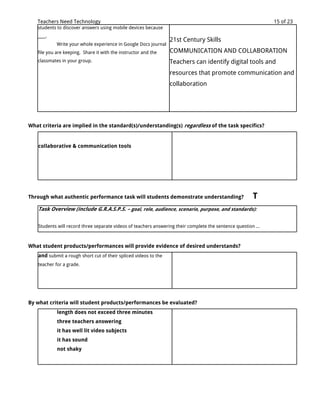
   Middle project due: the problem with most schools is the          ISTE NETS-T: 3b, 4d, and 1c:
   technology available is underutilized. Survey or poll three
                                                                     promote student reflection using
   staff at your school to find their opinions of using technology
   in their class. Record them on your mobile device:                collaborative tools to reveal and clarify
                                                                     students' conceptual understanding and
   Teachers completing this sentence: I (do) (do not) allow
                                                                     thinking, planning, and creative processes.
Teachers Need Technology                                                                                    15 of 23
   students to discover answers using mobile devices because
   ____.
                                                                 21st Century Skills
            Write your whole experience in Google Docs journal
   file you are keeping. Share it with the instructor and the    COMMUNICATION AND COLLABORATION
   classmates in your group.                                     Teachers can identify digital tools and
                                                                 resources that promote communication and
                                                                 collaboration


What criteria are implied in the standard(s)/understanding(s) regardless of the task specifics?


   collaborative & communication tools


Through what authentic performance task will students demonstrate understanding?                        T
   Task Overview (include G.R.A.S.P.S. – goal, role, audience, scenario, purpose, and standards):


   Students will record three separate videos of teachers answering their complete the sentence question ...


What student products/performances will provide evidence of desired understands?
   and submit a rough short cut of their spliced videos to the
   teacher for a grade.


By what criteria will student products/performances be evaluated?
            length does not exceed three minutes
            three teachers answering
            it has well lit video subjects
            it has sound
            not shaky
Teachers Need Technology                                                                            16 of 23
                                 Performance Task Blueprint


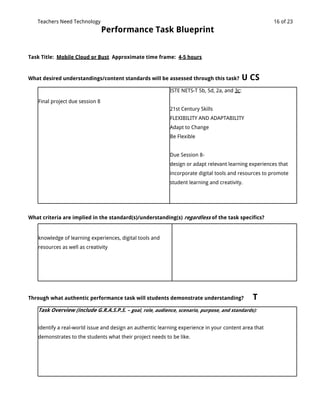
Task Title: Mobile Cloud or Bust Approximate time frame: 4-5 hours


What desired understandings/content standards will be assessed through this task?            U CS
                                                           ISTE NETS-T 5b, 5d, 2a, and 3c:

   Final project due session 8
                                                           21st Century Skills
                                                           FLEXIBILITY AND ADAPTABILITY
                                                           Adapt to Change
                                                           Be Flexible


                                                           Due Session 8-
                                                           design or adapt relevant learning experiences that
                                                           incorporate digital tools and resources to promote
                                                           student learning and creativity.


What criteria are implied in the standard(s)/understanding(s) regardless of the task specifics?


   knowledge of learning experiences, digital tools and
   resources as well as creativity


Through what authentic performance task will students demonstrate understanding?               T
   Task Overview (include G.R.A.S.P.S. – goal, role, audience, scenario, purpose, and standards):


   identify a real-world issue and design an authentic learning experience in your content area that
   demonstrates to the students what their project needs to be like.
Teachers Need Technology                                                                      17 of 23


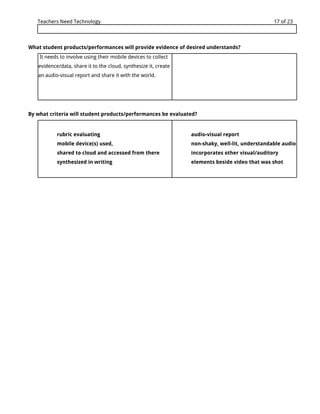
What student products/performances will provide evidence of desired understands?
    It needs to involve using their mobile devices to collect
   evidence/data, share it to the cloud, synthesize it, create
   an audio-visual report and share it with the world.


By what criteria will student products/performances be evaluated?


           rubric evaluating                                     audio-visual report
           mobile device(s) used,                                non-shaky, well-lit, understandable audio
           shared to cloud and accessed from there               incorporates other visual/auditory
           synthesized in writing                                elements beside video that was shot
Teachers Need Technology                                                                             18 of 23
           Stage 3: Plan learning experiences & instruction.


What sequence of teaching and learning experiences will equip students to develop and demonstrate
the desired understandings?
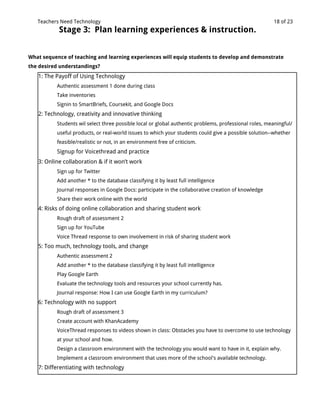
   1: The Payoff of Using Technology
          Authentic assessment 1 done during class
          Take inventories
          Signin to SmartBriefs, Coursekit, and Google Docs
   2: Technology, creativity and innovative thinking
          Students wil select three possible local or global authentic problems, professional roles, meaningful/
          useful products, or real-world issues to which your students could give a possible solution--whether
          feasible/realistic or not, in an environment free of criticism.
          Signup for Voicethread and practice
   3: Online collaboration & if it won’t work
          Sign up for Twitter
          Add another * to the database classifying it by least full intelligence
          Journal responses in Google Docs: participate in the collaborative creation of knowledge
          Share their work online with the world
   4: Risks of doing online collaboration and sharing student work
          Rough draft of assessment 2
          Sign up for YouTube
          Voice Thread response to own involvement in risk of sharing student work
   5: Too much, technology tools, and change
          Authentic assessment 2
          Add another * to the database classifying it by least full intelligence
          Play Google Earth
          Evaluate the technology tools and resources your school currently has.
          Journal response: How I can use Google Earth in my curriculum?
   6: Technology with no support
          Rough draft of assessment 3
          Create account with KhanAcademy
          VoiceThread responses to videos shown in class: Obstacles you have to overcome to use technology
          at your school and how.
          Design a classroom environment with the technology you would want to have in it, explain why.
          Implement a classroom environment that uses more of the school's available technology.
   7: Differentiating with technology
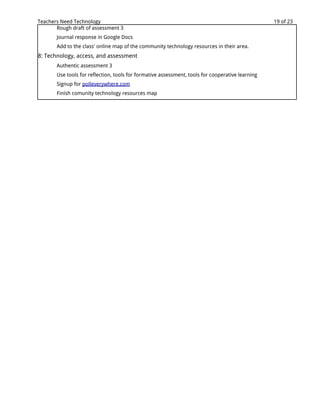
Teachers Need Technology                                                                          19 of 23
       Rough draft of assessment 3
       Journal response in Google Docs
       Add to the class' online map of the community technology resources in their area.
8: Technology, access, and assessment
       Authentic assessment 3
       Use tools for reflection, tools for formative assessment, tools for cooperative learning
       Signup for polleverywhere.com
       Finish comunity technology resources map
Teachers Need Technology                                                                   20 of 23
            Stage 3: Plan learning experiences & instruction.


What sequence of teaching and learning experiences will equip students to engage with, develop, and
demonstrate the desired understandings?


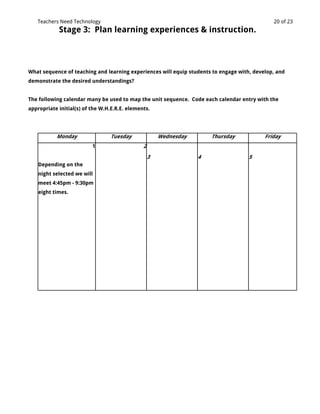
The following calendar many be used to map the unit sequence. Code each calendar entry with the
appropriate initial(s) of the W.H.E.R.E. elements.


           Monday                Tuesday               Wednesday       Thursday            Friday
                          1                    2
                                                   3               4                 5
    Depending on the
    night selected we will
    meet 4:45pm - 9:30pm
    eight times.
Teachers Need Technology                    21 of 23
                     6

                        7    8    9    10


                   11

                        12   13   14   15
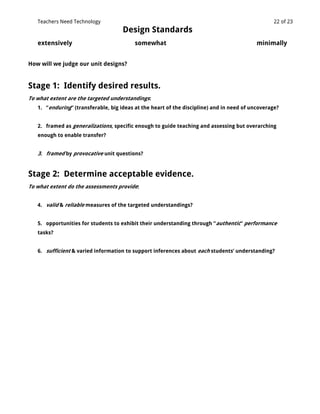
Teachers Need Technology                                                                       22 of 23
                                     Design Standards
   extensively                            somewhat                                         minimally


How will we judge our unit designs?


Stage 1: Identify desired results.
To what extent are the targeted understandings:
   1. “enduring” (transferable, big ideas at the heart of the discipline) and in need of uncoverage?


   2. framed as generalizations, specific enough to guide teaching and assessing but overarching
   enough to enable transfer?


   3. framed by provocative unit questions?


Stage 2: Determine acceptable evidence.
To what extent do the assessments provide:


   4. valid & reliable measures of the targeted understandings?


   5. opportunities for students to exhibit their understanding through “ authentic” performance
   tasks?


   6. sufficient & varied information to support inferences about each students’ understanding?
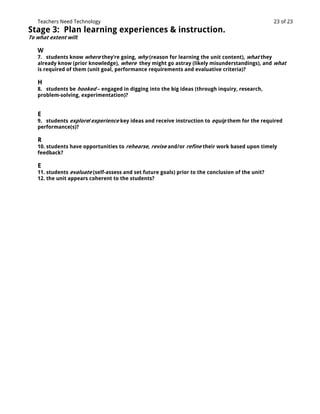
Teachers Need Technology                                                                        23 of 23
Stage 3: Plan learning experiences & instruction.
To what extent will:

   W
   7. students know where they’re going, why (reason for learning the unit content), what they
   already know (prior knowledge), where they might go astray (likely misunderstandings), and what
   is required of them (unit goal, performance requirements and evaluative criteria)?

   H
   8. students be hooked – engaged in digging into the big ideas (through inquiry, research,
   problem-solving, experimentation)?


   E
   9. students explore/experience key ideas and receive instruction to equip them for the required
   performance(s)?

   R
   10. students have opportunities to rehearse, revise and/or refine their work based upon timely
   feedback?

   E
   11. students evaluate (self-assess and set future goals) prior to the conclusion of the unit?
   12. the unit appears coherent to the students?

Backward Planning Design Example

  • 1.
    Teachers Need Technology 1 of 23 Unit Title: Mobiles & the Cloud Grade Level(s): K12 Teachers Subject/Topic Area(s): English, Math, History, Science, Industrial & Technology, Fine Arts, Performing Arts Key Words: education, technology, cloud, computing, computer, mobile, device, cell, phone Designed By: Timothy Brinkley Time Frame: 8 sessions of 4 hours each School District: Graduate level continuing education School: Azusa Pacific University Brief Summary of Unit (including curricular context and unit goals): How can you and your students use mobile devices and online collaboration in the classroom whether or not your school supports it, all your students have mobile devices, or your school has working technology? How can technology be used to differentiate instruction, tackle real-world issues, develop creativity, and higher level thinking among your students? This eight (8) session class answers these questions as well as the implications of opening up your class to the world’s eye. Unit design status: completed Template pages – Stage 1, 2, & 3 completed Blueprint for each performance task completed rubric(s)
  • 2.
    Teachers Need Technology 2 of 23 directions to students & teachers materials & resources listed suggested accommodations suggested extensions Status: О initial draft (date - _____________ ) О revised draft (date - _____________ ) О peer reviewed О content reviewed О field tested О validated О anchored
  • 3.
    Teachers Need Technology 3 of 23 Stage 1: Identify desired results. What content standards are addressed? CS ISTE NETS for Teachers 1. Facilitate and Inspire Student Learning and Creativity Teachers use their knowledge of subject matter, teaching and learning, and technology to facilitate experiences that advance student learning, creativity, and innovation in both face-to-face and virtual environments. Teachers: a. promote, support, and model creative and innovative thinking and inventiveness. b. engage students in exploring real-world issues and solving authentic problems using digital tools and resources. c. promote student reflection using collaborative tools to reveal and clarify students' conceptual understanding and thinking, planning, and creative processes. d. model collaborative knowledge construction by engaging in learning with students, colleagues, and others in face-to-face and virtual environments. 2. Design and Develop Digital-Age Learning Experiences and Assessments Teachers design, develop, and evaluate authentic learning experiences and assessment incorporating contemporary tools and resources to maximize content learning in context and to develop the knowledge, skills, and attitudes identified in the NETS•S. Teachers: a. design or adapt relevant learning experiences that incorporate digital tools and resources to promote student learning and creativity. b. develop technology-enriched learning environments that enable all students to pursue their individual curiosities and become active participants in setting their own educational goals, managing their own learning, and assessing their own progress. c. customize and personalize learning activities to address students' diverse learning styles, working strategies, and abilities using digital tools and resources. d. provide students with multiple and varied formative and summative assessments aligned with content and technology standards and use resulting data to inform learning
  • 4.
    Teachers Need Technology 4 of 23 and teaching. 3. Model Digital-Age Work and Learning Teachers exhibit knowledge, skills, and work processes representative of an innovative professional in a global and digital society. Teachers: c. communicate relevant information and ideas effectively to students, parents, and peers using a variety of digital-age media and formats. 21st Century Skills THEMES Global Awareness Financial, Economic, Business and Entrepreneurial Literacy Civic Literacy Health Literacy Environmental Literacy LEARNING AND INNOVATION SKILLS CREATIVITY AND INNOVATION Think Creatively Work Creatively with Others Implement Innovations Teachers can identify digital tools and resources that promote creativity and innovation CRITICAL THINKING AND PROBLEM SOLVING Teachers can identify digital tools and resources that promote critical thinking and problem solving COMMUNICATION AND COLLABORATION Teachers can identify digital tools and resources that promote communication and collaboration INFORMATION, MEDIA AND TECHNOLOGY SKILLS INFORMATION LITERACY Access and Evaluate Information
  • 5.
    Teachers Need Technology 5 of 23 Use and Manage Information MEDIA LITERACY Analyze Media Create Media Products ICT (Information, Communications and Technology) LITERACY Apply Technology Effectively LIFE AND CAREER SKILLS FLEXIBILITY AND ADAPTABILITY Adapt to Change Be Flexible INITIATIVE AND SELF-DIRECTION Manage Goals and Time Work Independently Be Self-directed Learners SOCIAL AND CROSS-CULTURAL SKILLS Interact Effectively with Others Work Effectively in Diverse Teams PRODUCTIVITY AND ACCOUNTABILITY Manage Projects Produce Results LEADERSHIP AND RESPONSIBILITY Guide and Lead Others Be Responsible to Others What enduring understandings are desired (and what misunderstandings will be addressed)? U Session 1- 1b: engage students in exploring [local and global] real-world issues and solving authentic problems using digital tools and resources Session 2- 1a: promote, support, and model creative and innovative thinking and inventiveness
  • 6.
    Teachers Need Technology 6 of 23 Session 3- 1c: promote student reflection using collaborative tools to reveal and clarify students' conceptual understanding and thinking, planning, and creative processes. Session 4- 1d: model collaborative knowledge construction by engaging in learning with students, colleagues, and others in face-to-face and virtual environments. 3c: communicate relevant information and ideas effectively to students, parents, and peers using a variety of digital-age media and formats. Session 5- 2a: design or adapt relevant learning experiences that incorporate digital tools and resources to promote student learning and creativity. Session 6- 2b: develop technology-enriched learning environments that enable all students to pursue their individual curiosities and become active participants in setting their own educational goals, managing their own learning, and assessing their own progress. Session 7- 2c: customize and personalize learning activities to address students' diverse learning styles, working strategies, and abilities using digital tools and resources. Session 8- 2d: provide students with multiple and varied formative and summative assessments aligned with content and technology standards and use resulting data to inform learning and teaching. What essential questions will guide this unit and focus teaching/learning? Q 1: How can using technology be worth the educators’ time? In what ways can the payoff of using technology be worth the educator's time and effort?
  • 7.
    Teachers Need Technology 7 of 23 2: Pedagogical: How do educators nurture creativity among their students? Technological: How is technology related to creative and innovative thinking? 3: Isn’t online collaboration the same as writing a reflection on paper and discussing them in class? What is the different between online collaboration and face-to-face collaboration? 4: What risks and how much time are involved in using online collaborative tools? Why would anyone care to see my students’ work? What should I share about my work? 5: Since technology changes so fast, why should I bother? Which digital tools should I use? When is there too much technology? 6: How can I use technology if my school does not support it? 7: Is differentiating learning using technology worth my time and effort? What are the best tools for differentiating with technology? 8: When my students do not have access to technology outside of class, how can I use it for assessment? What key knowledge and skills will students acquire as a result of this unit? K Key: PK = Pedagogical Knowledge CK = Content Knowledge TK = Technological Knowledge TPK = Technological & Pedagogical Knowledge TCK = Technological & Content Knowledge TPCK = Technological, Pedagogical, & Content Knowledge Students will know & do (skill):
  • 8.
    Teachers Need Technology 8 of 23 Session 1: PK: the effects of the real world, an audience outside of school, authentic problems in action, professional roles and meaningful/ useful products on students TPK: how technology extends a teachers ability to use authentic, real-world problems and issues TPK: examples of schools that are reaping the rewards of technology integration. What are the elements of a successful implementation? Skill: TPCK: Select three possible local or global authentic problems, professional roles, meaningful/ useful products, or real-world issues to which your students could give a possible solution--whether feasible, realistic or not in an environment free of criticism. Session 2: TCK: which and how technology can help students develop creativity in relationship to their content area. TPK: show/read some technology stories of grappling, ambiguity in the classroom. PK: available research on higher order thinking skills, critical thinking, meta-cognition, and self- regulation According to research creativity is promoted in the following ways: grappling, ambiguity, high mental processes and skills, inventing, ideational fluency, originality of ideas, and sensitivity to missing elements (Guilford, 1950; Torrance, 1974), creative thinking requires at least a minimal level of expertise and fluency within a knowledge domain (Bransford et al., 2000; Crawford and Brophy, 2006), Repeatedly encourage idea generation, Cross-fertilize ideas, Build self-efficacy, Constantly question assumptions, Imagine other viewpoints (DeHaan, 2009), tolerance for ambiguity and independence, the use of humor, metaphorical thinking, and problem defining (Bull, et al. 1995) Skill: TPCK: of the tools and resources from session 1, identify what in them develops creativity. Which would you select and how would you use those to develop creativity in curriculum, instruction, and assessment? Session 3: PK: importance of understanding what is going on in the students’ head and what is actually going on in the classroom Research showing a different kind of participation online versus face-to-face TCK: know how to find available digital tools that promote student reflection using collaborative tools to reveal and clarify students' conceptual understanding and thinking, planning, and creative
  • 9.
    Teachers Need Technology 9 of 23 processes in their content area. Gliffy Xmind Google Docs, Forms YouTube PollAnywhere Skill: TPCK: can use tools for reflection, tools for formative assessment, tools for conceptual understanding and thinking, tools that nuture creative processes Session 4: TCK: what is, and examples of collaborative knowledge construction. Stories of success and failure. Skill: participate in the collaborative creation of knowledge Google Sites Engrade Content websites —------------------------------------ TPK: how to share student work online and examples of other schools Benefits of sharing student work Skill: Share their work online with the world Session 5: TCK: Principles to select digital tools: tracking & comparing work submitted intuitive user interface engaging audio-visuals different users/profiles sharing work and/or performance Skill: Evaluate the technology tools and resources your school currently has. Session 6: TPK: Know examples of teachers and schools that have technology-enriched environment. TPK: Know procedures how to implement a technology enriched environment
  • 10.
    Teachers Need Technology 10 of 23 Skill: Design a classroom environment with the technology you would want to have in it, explain why. OR Skill: Implement a classroom environment that uses more of the school's available technology— share pictures of the results. Session 7: TPK: know how to select technologies that differentiate Skill: categorize them by multiple intelligence, Bloom's taxonomy, disability, and reading level Session 8: TK: Where are the community technology resources TPK: Examples from other schools SKill: Add to the class' online map of the community technology resources in their area. Stage 2: Determine acceptable evidence. What evidence will show that students understand? Performance Tasks*: T Beginning project: using the online form, find and submit three previously unknown websites, apps, videos, books, songs, games, manipulatives, or physical tools/devices for each of Gardner's multiple intelligences in your content area that your students could use. Middle project: the problem with most schools is the technology available is underutilized. Survey or poll the staff at your school to find their opinions of using technology in their class. Interview three people recording them on your phone: Video interviews of teachers completing this sentence: Do you use technology to
  • 11.
    Teachers Need Technology 11 of 23 help your students discover answers independently or collaboratively? How? if neither, How does your use of technology relate to your educational philosophy? Or if technology is already widely used at your campus have them answer this question: How has technology impacted student learning? Upload and converge the videos in an online video editing tool (e.g. YouTube) and share with the world. Journal each step of your whole experience in APU's Google Docs sharing it with the instructor and the classmates in your group. Final project: identify a real-world issue and design an authentic learning experience in your content area. Make sure it develops creativity, and differentiates in product, process, content, or environment. Create an example final product that demonstrates to the students what their project needs to be like. It needs to involve using a mobile device to collect evidence/data, share it to the cloud, synthesize it in writing, collaboration with others, and the creation of an audio-visual report that is shared with the world. Ideas & Examples History: Signs, evidence, artifacts, museum objects related to the part of history being studied: street/building names, personal or city founder ancestors. Local historian interview. Expert historian interview. Items invented during that time in history that we still use today. Why are our textbooks so white? What can we learn about the African Americans left out of textbooks such as Peter Salem, James Amistead Lafayette, Frederick Douglas, Lemuel Haynes, Benjamin Banneker, Richard Allen, Joseph Hayne Rainey, Hiram Rhodes Revels, Robert Brown Elliott. Maths: Identifying trends in crime, flooding patterns, street rerouting, interchange additions, crosswalk studies, at-risk drainage/flooding areas, shade patterns/ air flow in the design of new buildings/rooms, roof-to-roof bridge design, water use reduction, statistics in local/regional/state/nation racial conflicts, interview surveyors Science: hydrology problems of the school or city, habitat destruction of a local species, regional pollution sources, tapping local resource reserves (sunlight, water, wind, waves),
  • 12.
    Teachers Need Technology 12 of 23 English: writing a grant for more technology, letter to a local newspaper editor, interviewing and reporting on those affected by school violence or racism or generational poverty, letter of introduction as part of a university application, Technology: identify local non-profits, or kid outreach programs that do not have an online presence and build something for them. Construction: find a charity that distributes gifts for kids at Christmas and build gifts for disadvantaged kids. Publish your progress online and invite other schools to participate Visual & Performing Arts: publish your performances for the world and solicit invitations to perform or display your work elsewhere. Health, PE: use technology to analyze performance using stop motion, GPS tracking, *ometers, timers reminding to take screen time breaks and stretch & exercise eyes. *Complete a Performance Task Blueprint for each task (next page). Other Evidence (quizzes, tests, prompts, observations, dialogues, work samples, etc.): OE Diagnostic assessment at start of each class. Use Engrade or CourseKit. Journaling regularly in Google Docs Voice-threaded discussions in VoiceThread responding to videos shown in class Student Self-Assessment: SA Beginning and end of course: students will evaluate themselves in the following three areas knowledge confidence participation
  • 13.
    Teachers Need Technology 13 of 23 Performance Task Blueprint Task Title: Search and Deploy Approximate time frame: 30-45 minutes What desired understandings/content standards will be assessed through this task? U CS Session 1- ISTE NETS-T 3d, 5a, and 2c: using the online form, find one previously 21st Century Skills unknown websites, apps, videos, books, PRODUCTIVITY AND ACCOUNTABILITY songs, games, manipulatives, or physical Manage Projects tools/devices for each of Gardner's 8 multiple Produce Results intelligences in your content area that your students could use. customize and personalize learning activities to address students' diverse learning styles, working strategies, and abilities using digital tools and resources. What criteria are implied in the standard(s)/understanding(s) regardless of the task specifics? ISTE NETS-T 2c differentiated instruction “customize and personalize learning activities to address learning styles students' diverse learning styles, working strategies, and abilities using digital tools and resources.” Through what authentic performance task will students demonstrate understanding? T Task Overview (include G.R.A.S.P.S. – goal, role, audience, scenario, purpose, and standards):
  • 14.
    Teachers Need Technology 14 of 23 find learner-differentiating websites, categorize them by multiple intelligence and reading level on their own, enter them into a class-shared database What student products/performances will provide evidence of desired understands? enter them into a class-shared database By what criteria will student products/performances be evaluated? non-repeated entry accurate summary of resource’s capabilities all eight categorized accurately by intelligence Performance Task Blueprint Task Title: Video Soufflé Approximate time frame: 2-3hours What desired understandings/content standards will be assessed through this task? U CS Session 5- Middle project due: the problem with most schools is the ISTE NETS-T: 3b, 4d, and 1c: technology available is underutilized. Survey or poll three promote student reflection using staff at your school to find their opinions of using technology in their class. Record them on your mobile device: collaborative tools to reveal and clarify students' conceptual understanding and Teachers completing this sentence: I (do) (do not) allow thinking, planning, and creative processes.
  • 15.
    Teachers Need Technology 15 of 23 students to discover answers using mobile devices because ____. 21st Century Skills Write your whole experience in Google Docs journal file you are keeping. Share it with the instructor and the COMMUNICATION AND COLLABORATION classmates in your group. Teachers can identify digital tools and resources that promote communication and collaboration What criteria are implied in the standard(s)/understanding(s) regardless of the task specifics? collaborative & communication tools Through what authentic performance task will students demonstrate understanding? T Task Overview (include G.R.A.S.P.S. – goal, role, audience, scenario, purpose, and standards): Students will record three separate videos of teachers answering their complete the sentence question ... What student products/performances will provide evidence of desired understands? and submit a rough short cut of their spliced videos to the teacher for a grade. By what criteria will student products/performances be evaluated? length does not exceed three minutes three teachers answering it has well lit video subjects it has sound not shaky
  • 16.
    Teachers Need Technology 16 of 23 Performance Task Blueprint Task Title: Mobile Cloud or Bust Approximate time frame: 4-5 hours What desired understandings/content standards will be assessed through this task? U CS ISTE NETS-T 5b, 5d, 2a, and 3c: Final project due session 8 21st Century Skills FLEXIBILITY AND ADAPTABILITY Adapt to Change Be Flexible Due Session 8- design or adapt relevant learning experiences that incorporate digital tools and resources to promote student learning and creativity. What criteria are implied in the standard(s)/understanding(s) regardless of the task specifics? knowledge of learning experiences, digital tools and resources as well as creativity Through what authentic performance task will students demonstrate understanding? T Task Overview (include G.R.A.S.P.S. – goal, role, audience, scenario, purpose, and standards): identify a real-world issue and design an authentic learning experience in your content area that demonstrates to the students what their project needs to be like.
  • 17.
    Teachers Need Technology 17 of 23 What student products/performances will provide evidence of desired understands? It needs to involve using their mobile devices to collect evidence/data, share it to the cloud, synthesize it, create an audio-visual report and share it with the world. By what criteria will student products/performances be evaluated? rubric evaluating audio-visual report mobile device(s) used, non-shaky, well-lit, understandable audio shared to cloud and accessed from there incorporates other visual/auditory synthesized in writing elements beside video that was shot
  • 18.
    Teachers Need Technology 18 of 23 Stage 3: Plan learning experiences & instruction. What sequence of teaching and learning experiences will equip students to develop and demonstrate the desired understandings? 1: The Payoff of Using Technology Authentic assessment 1 done during class Take inventories Signin to SmartBriefs, Coursekit, and Google Docs 2: Technology, creativity and innovative thinking Students wil select three possible local or global authentic problems, professional roles, meaningful/ useful products, or real-world issues to which your students could give a possible solution--whether feasible/realistic or not, in an environment free of criticism. Signup for Voicethread and practice 3: Online collaboration & if it won’t work Sign up for Twitter Add another * to the database classifying it by least full intelligence Journal responses in Google Docs: participate in the collaborative creation of knowledge Share their work online with the world 4: Risks of doing online collaboration and sharing student work Rough draft of assessment 2 Sign up for YouTube Voice Thread response to own involvement in risk of sharing student work 5: Too much, technology tools, and change Authentic assessment 2 Add another * to the database classifying it by least full intelligence Play Google Earth Evaluate the technology tools and resources your school currently has. Journal response: How I can use Google Earth in my curriculum? 6: Technology with no support Rough draft of assessment 3 Create account with KhanAcademy VoiceThread responses to videos shown in class: Obstacles you have to overcome to use technology at your school and how. Design a classroom environment with the technology you would want to have in it, explain why. Implement a classroom environment that uses more of the school's available technology. 7: Differentiating with technology
  • 19.
    Teachers Need Technology 19 of 23 Rough draft of assessment 3 Journal response in Google Docs Add to the class' online map of the community technology resources in their area. 8: Technology, access, and assessment Authentic assessment 3 Use tools for reflection, tools for formative assessment, tools for cooperative learning Signup for polleverywhere.com Finish comunity technology resources map
  • 20.
    Teachers Need Technology 20 of 23 Stage 3: Plan learning experiences & instruction. What sequence of teaching and learning experiences will equip students to engage with, develop, and demonstrate the desired understandings? The following calendar many be used to map the unit sequence. Code each calendar entry with the appropriate initial(s) of the W.H.E.R.E. elements. Monday Tuesday Wednesday Thursday Friday 1 2 3 4 5 Depending on the night selected we will meet 4:45pm - 9:30pm eight times.
  • 21.
    Teachers Need Technology 21 of 23 6 7 8 9 10 11 12 13 14 15
  • 22.
    Teachers Need Technology 22 of 23 Design Standards extensively somewhat minimally How will we judge our unit designs? Stage 1: Identify desired results. To what extent are the targeted understandings: 1. “enduring” (transferable, big ideas at the heart of the discipline) and in need of uncoverage? 2. framed as generalizations, specific enough to guide teaching and assessing but overarching enough to enable transfer? 3. framed by provocative unit questions? Stage 2: Determine acceptable evidence. To what extent do the assessments provide: 4. valid & reliable measures of the targeted understandings? 5. opportunities for students to exhibit their understanding through “ authentic” performance tasks? 6. sufficient & varied information to support inferences about each students’ understanding?
  • 23.
    Teachers Need Technology 23 of 23 Stage 3: Plan learning experiences & instruction. To what extent will: W 7. students know where they’re going, why (reason for learning the unit content), what they already know (prior knowledge), where they might go astray (likely misunderstandings), and what is required of them (unit goal, performance requirements and evaluative criteria)? H 8. students be hooked – engaged in digging into the big ideas (through inquiry, research, problem-solving, experimentation)? E 9. students explore/experience key ideas and receive instruction to equip them for the required performance(s)? R 10. students have opportunities to rehearse, revise and/or refine their work based upon timely feedback? E 11. students evaluate (self-assess and set future goals) prior to the conclusion of the unit? 12. the unit appears coherent to the students?