Reviewing the Research Regarding PBL Efficacy
-- several slides borrowed from Jason Ravitz, former Director of Research,
BIE, available here: http://www.slideshare.net/biepbl/metasynthesis-3slides
A design view of PBL
“a systematic teaching method that engages
  students in learning essential knowledge and
  life-enhancing skills through an extended,
  student-influenced inquiry process that is
  structured around complex, authentic
  questions and carefully designed products and
  tasks”

                Mergendoller, et al., 2006
Today’s PBL
Looks nothing like the ‘Project Method” popularized by William
    H. Kilpatrick (1918), in the early 20th century

Nor does it look like “discovery learning” or “minimally-guided
  instruction”, popularized later 20th century


–    High Tech High School (hightechhigh.org/projects/)
–    Envision Schools (envisionprojects.org)
–    Expeditionary Learning schools (elschools.org)
–    New Tech Network (newtechnetwork.org)
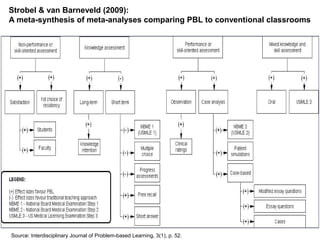
Strobel & van Barneveld (2009):
A meta-synthesis of meta-analyses comparing PBL to conventional classrooms


Source: Interdisciplinary Journal of Problem-based Learning, 3(1), p. 52.
See next slide for more information.
Parker, W., Mosberg, S., Bransford, J., Vye, N., Wilderson, J., & Abbott, R. (2011).


Rethinking
advanced high school coursework: Tackling the depth/breadth tension in the
.

Journal of Curriculum Studies, 43(4), 533-559.
Researchers from the University of Washington, the Bellevue Schools Foundation, and
The George Lucas Educational Foundation conducted a multiyear study to test a rigorous
project-based learning approach to teaching Advanced Placement (AP) U.S. Government
and Politics. Three hundred fourteen students from Washington's Bellevue School District
were randomly assigned to a traditional course or project-based learning course on AP
U.S. Government and Politics (AP+). The PBL course included five project cycles: (1)
role- playing a United Nations task force advising a new nation on the various forms and
features of democracy, (2) proposing a public policy and actions to improve society, (3)
role-playing legislators in the U.S. Congress, (4) role-playing party campaign strategists
in an election, and (5) role-playing a Supreme Court case.

The PBL students performed as well as or better than traditionally taught students
on the AP test and better on a complex scenario test, which measures strategies
for realistically monitoring and influencing public policy.
Maxwell, N., Mergendoller, J. R., & Bellisimo, Y. (2005).
 
Problem-based learning and high school macroeconomics: A comparative stu
. 

The Journal of Economic Education, 36(4), 315-331.

 Researchers at California State University, East Bay; the 
Buck Institute for Education; and the College of Marin analyzed data 
from 252 economics students at 11 high schools, while controlling for 
individual characteristics, such as verbal ability. PBL modestly
increased learning of macroeconomics at the high school level as
compared with traditional classes. Findings suggest that problem-
based instruction can improve student learning if instructors are well 
trained in both the PBL technique and economics.
•  The Effectiveness of Problem-Based Instruction: A Comparative Study of Instructional Metho
•  Interdisciplinary Journal of Problem-based Learning, 1(2).
John R. Mergendoller
   Nan L. Maxwell
   Yolanda Bellisimo
•   This study compared the effectiveness of problem-based learning (PBL) and 
    traditional instructional approaches in developing high-school students’ 
    macroeconomics knowledge and examined whether PBL was differentially 
    effective with students demonstrating different levels of four aptitudes: 
    verbal ability, interest in economics, preference for group work, and 
    problem-solving efficacy. 

•   Over all, PBL was found to be a more effective instructional approach
    for teaching macroeconomics than traditional lecture–discussion (p
    = .05).
•   Additional analyses provided evidence that PBL was more effective than 
    traditional instruction with students of average verbal ability and below, 
    students who were more interested in learning economics, and students 
    who were most and least confident in their ability to solve problems.
Content Acquisition in Problem-Based Learning: Depth 
versus Breadth in American Studies.
Authors:                                                Gallagher, Shelagh A.; Stepien, William J.
Descriptors:                                            Academic Achievement; Academically Gifted; 
                                                        American Studies; Critical Thinking; High Schools; 
                                                        Instructional Effectiveness; Knowledge Level; 
                                                        Problem Based Learning; Problem Solving; 
                                                        Secondary School Curriculum; Teaching Methods; 
                                                        Thinking Skills
Source:                                                 Journal for the Education of the Gifted, v19 n3 p257-75 
                                                        Spr 1996


Abstract:           This study found no differences in content acquisition
                    (as measured by a standardized test) of 167 gifted 10th
                    graders in American Studies classes who received
                    either a problem-based learning approach or
                    traditional instruction. Results did not support the 
                    common assumption that curriculum fostering higher order 
                    thinking skills inevitably results in lower content acquisition. 
                    (Author/DB)
Standardized Test Outcomes: Inquiry-Based Science in an 
Urban Setting
Geier, R., Blumenfeld, P., Marx, R., Krajcik, J., Fishman,
B., Soloway, E. & Clay-Chambers, J. (2004)
Journal of Research in Science Teaching, 45(8), 922-939
Findings demonstrate that a standards-based, inquiry science curriculum can lead to
standardized achievement test gains in historically underserved urban students, when the
curriculum is highly specified, developed, and aligned with professional development and
administrative support. 

A scalable systemic reform effort in Detroit Public Schools used highly specified and developed 
project-based inquiry science units supported by professional development and learning technologies. 
Two cohorts of 7th and 8th graders are compared with the remainder of the district population, using 
results from the high-stakes state standardized test in science. Both the initial and scaled up cohorts 
show increases in science content understanding and process skills over their peers, and significantly 
higher pass rates on the statewide test. The effect of participation in units at different grade levels is 
independent and cumulative, with higher levels of participation associated with similarly higher 
achievement scores. Examination of results by gender reveals that the curriculum effort succeeds in 
reducing the gender gap in achievement experienced by urban African-American boys.
Narrowing the Achievement Gap in Second-Grade Social Studies
                   and Content Area Literacy:
            The Promise of a Project-Based Approach
                      Theory and Research in Social Education, 40, 198-229
                         Anne-Lise Halvorsen, Michigan State University
                             Nell K. Duke, Michigan State University
                       Kristy Brugar, Meghan Block, Stephanie Strachan,
                    Meghan Berka and Jason Brown, Michigan State University
This design experiment addresses the question: How can second-grade
students from low-SES schools attain the same levels of achievement as
students from high-SES schools on standards-based social studies and content
area literacy assessments? Students from two high-SES school districts were
assessed in order to establish target levels of achievement. Two project-based
units focused on state standards in economics; civics and government; public
discourse, decision making, and citizen involvement; and content area literacy
were developed and implemented successively in four classrooms in low-SES
school districts.


Achievement of students in the low-SES districts was then
compared to that of students in high-SES districts. Results show
no statistically significant differences: following instruction, there
was no SES achievement gap on these standards-based
assessments.
Journal of Research on
  Technology in Education            EJ868627

  Title:                             Learning History in Middle School by
                                     Designing Multimedia in a Project-Based
                                     Learning Experience
  Authors:                           Hernandez-Ramos, Pedro; De La Paz,
                                     Susan

This article describes a study in which eighth grade students in one school learned to
create multimedia mini-documentaries in a six-week history unit on early 19th-century
U.S. history. The authors examined content knowledge tests, group projects, and
attitude and opinion surveys to determine relative benefits for students who
participated in a technology-assisted project-based learning experience, and
contrasted their experiences to those of students who received a more traditional
form of instruction.

Results from content knowledge measures showed significant gains for
students in the project-based learning condition as compared to students in
the comparison school. Students' work in the intervention condition also revealed
growth in their historical thinking skills, as many were able to grasp a fundamental
understanding that history is more than presenting facts.

Pbl research summarized

  • 1.
    Reviewing the ResearchRegarding PBL Efficacy -- several slides borrowed from Jason Ravitz, former Director of Research, BIE, available here: http://www.slideshare.net/biepbl/metasynthesis-3slides
  • 2.
    A design viewof PBL “a systematic teaching method that engages students in learning essential knowledge and life-enhancing skills through an extended, student-influenced inquiry process that is structured around complex, authentic questions and carefully designed products and tasks” Mergendoller, et al., 2006
  • 3.
    Today’s PBL Looks nothinglike the ‘Project Method” popularized by William H. Kilpatrick (1918), in the early 20th century Nor does it look like “discovery learning” or “minimally-guided instruction”, popularized later 20th century – High Tech High School (hightechhigh.org/projects/) – Envision Schools (envisionprojects.org) – Expeditionary Learning schools (elschools.org) – New Tech Network (newtechnetwork.org)
  • 4.
    Strobel & vanBarneveld (2009): A meta-synthesis of meta-analyses comparing PBL to conventional classrooms Source: Interdisciplinary Journal of Problem-based Learning, 3(1), p. 52.
  • 5.
    See next slidefor more information.
  • 6.
    Parker, W., Mosberg,S., Bransford, J., Vye, N., Wilderson, J., & Abbott, R. (2011). Rethinking advanced high school coursework: Tackling the depth/breadth tension in the . Journal of Curriculum Studies, 43(4), 533-559. Researchers from the University of Washington, the Bellevue Schools Foundation, and The George Lucas Educational Foundation conducted a multiyear study to test a rigorous project-based learning approach to teaching Advanced Placement (AP) U.S. Government and Politics. Three hundred fourteen students from Washington's Bellevue School District were randomly assigned to a traditional course or project-based learning course on AP U.S. Government and Politics (AP+). The PBL course included five project cycles: (1) role- playing a United Nations task force advising a new nation on the various forms and features of democracy, (2) proposing a public policy and actions to improve society, (3) role-playing legislators in the U.S. Congress, (4) role-playing party campaign strategists in an election, and (5) role-playing a Supreme Court case. The PBL students performed as well as or better than traditionally taught students on the AP test and better on a complex scenario test, which measures strategies for realistically monitoring and influencing public policy.
  • 9.
    Maxwell, N., Mergendoller,J. R., & Bellisimo, Y. (2005).   Problem-based learning and high school macroeconomics: A comparative stu .  The Journal of Economic Education, 36(4), 315-331.  Researchers at California State University, East Bay; the  Buck Institute for Education; and the College of Marin analyzed data  from 252 economics students at 11 high schools, while controlling for  individual characteristics, such as verbal ability. PBL modestly increased learning of macroeconomics at the high school level as compared with traditional classes. Findings suggest that problem- based instruction can improve student learning if instructors are well  trained in both the PBL technique and economics.
  • 10.
    • The Effectiveness of Problem-Based Instruction: A Comparative Study of Instructional Metho • Interdisciplinary Journal of Problem-based Learning, 1(2). John R. Mergendoller Nan L. Maxwell Yolanda Bellisimo • This study compared the effectiveness of problem-based learning (PBL) and  traditional instructional approaches in developing high-school students’  macroeconomics knowledge and examined whether PBL was differentially  effective with students demonstrating different levels of four aptitudes:  verbal ability, interest in economics, preference for group work, and  problem-solving efficacy.  • Over all, PBL was found to be a more effective instructional approach for teaching macroeconomics than traditional lecture–discussion (p = .05). • Additional analyses provided evidence that PBL was more effective than  traditional instruction with students of average verbal ability and below,  students who were more interested in learning economics, and students  who were most and least confident in their ability to solve problems.
  • 11.
    Content Acquisition in Problem-Based Learning: Depth  versus Breadth in American Studies. Authors: Gallagher, Shelagh A.; Stepien, William J. Descriptors: Academic Achievement; Academically Gifted;  American Studies; Critical Thinking; High Schools;  Instructional Effectiveness; Knowledge Level;  Problem Based Learning; Problem Solving;  Secondary School Curriculum; Teaching Methods;  Thinking Skills Source: Journal for the Education of the Gifted, v19 n3 p257-75  Spr 1996 Abstract: This study found no differences in content acquisition (as measured by a standardized test) of 167 gifted 10th graders in American Studies classes who received either a problem-based learning approach or traditional instruction. Results did not support the  common assumption that curriculum fostering higher order  thinking skills inevitably results in lower content acquisition.  (Author/DB)
  • 12.
    Standardized Test Outcomes: Inquiry-Based Science in an  Urban Setting Geier, R., Blumenfeld,P., Marx, R., Krajcik, J., Fishman, B., Soloway, E. & Clay-Chambers, J. (2004) Journal of Research in Science Teaching, 45(8), 922-939 Findings demonstrate that a standards-based, inquiry science curriculum can lead to standardized achievement test gains in historically underserved urban students, when the curriculum is highly specified, developed, and aligned with professional development and administrative support.  A scalable systemic reform effort in Detroit Public Schools used highly specified and developed  project-based inquiry science units supported by professional development and learning technologies.  Two cohorts of 7th and 8th graders are compared with the remainder of the district population, using  results from the high-stakes state standardized test in science. Both the initial and scaled up cohorts  show increases in science content understanding and process skills over their peers, and significantly  higher pass rates on the statewide test. The effect of participation in units at different grade levels is  independent and cumulative, with higher levels of participation associated with similarly higher  achievement scores. Examination of results by gender reveals that the curriculum effort succeeds in  reducing the gender gap in achievement experienced by urban African-American boys.
  • 13.
    Narrowing the AchievementGap in Second-Grade Social Studies and Content Area Literacy: The Promise of a Project-Based Approach Theory and Research in Social Education, 40, 198-229 Anne-Lise Halvorsen, Michigan State University Nell K. Duke, Michigan State University Kristy Brugar, Meghan Block, Stephanie Strachan, Meghan Berka and Jason Brown, Michigan State University This design experiment addresses the question: How can second-grade students from low-SES schools attain the same levels of achievement as students from high-SES schools on standards-based social studies and content area literacy assessments? Students from two high-SES school districts were assessed in order to establish target levels of achievement. Two project-based units focused on state standards in economics; civics and government; public discourse, decision making, and citizen involvement; and content area literacy were developed and implemented successively in four classrooms in low-SES school districts. Achievement of students in the low-SES districts was then compared to that of students in high-SES districts. Results show no statistically significant differences: following instruction, there was no SES achievement gap on these standards-based assessments.
  • 14.
    Journal of Researchon Technology in Education EJ868627 Title: Learning History in Middle School by Designing Multimedia in a Project-Based Learning Experience Authors: Hernandez-Ramos, Pedro; De La Paz, Susan This article describes a study in which eighth grade students in one school learned to create multimedia mini-documentaries in a six-week history unit on early 19th-century U.S. history. The authors examined content knowledge tests, group projects, and attitude and opinion surveys to determine relative benefits for students who participated in a technology-assisted project-based learning experience, and contrasted their experiences to those of students who received a more traditional form of instruction. Results from content knowledge measures showed significant gains for students in the project-based learning condition as compared to students in the comparison school. Students' work in the intervention condition also revealed growth in their historical thinking skills, as many were able to grasp a fundamental understanding that history is more than presenting facts.