The Game-Changer
How You Can Drive Revenue and Profit Growth With Innovation
by AG Lafley & Ram
Charan
How and Why Innovation At P&G Changed Its Game
Chapter One:
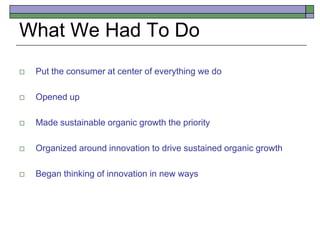
What We Had To Do
 Put the consumer at center of everything we do
 Opened up
 Made sustainable organic growth the priority
 Organized around innovation to drive sustained organic growth
 Began thinking of innovation in new ways
What We Had To Do
 Put the consumer at center of everything we do
 “consumer is boss” standard
 Spend more time with consumers
 In stores
 In their homes
 Consumer testing centers
 Delight our consumers at two moments of truth
 When they buy
 When they use
 Opened up
 Seek out innovation from all sources, inside and outside the
company
 Innovation is all about connections; everyone involved
 Connect & develop
 More Connections, more ideas, more solutions
 Goal set that half of new product and technology innovations come
from outside P&G
What We Had To Do
 Made sustainable organic growth the priority
 Innovation enables expansion into new categories
 Allows us to reframe mature business & transform them into
platforms for profitable growth
 Creates bridges into adjacent segments
 Emphasis on organic growth
 Less risky than acquired growth
 More highly valued by investors
 Organized around innovation to drive sustained organic growth
 Innovation as a strategy
 Regular business strategy that focuses on innovation
 Regular innovation reviews for every global business unit
 Careful selection and use of the right metrics
 Evaluating, development and promotion of outstanding business
and innovation leaders
 Allocation of resources …to outstanding innovation
What We Had To Do
 Began thinking of innovation in new ways
 Run innovation like we run a factory
 Broadened way we thought about innovation
 Not just products, services but to include business models, supply
chains etc.
 Not just disruptive, but also incremental
 Innovation is risky
 Learned how to pinpoint the risks
 Developed tools and the know-how to manage them
How We Did It…First Things
First
1. Improve our execution
“we were trying to do too much, too fast and nothing was being done well.”
 Growing the core
 Laser-sharp focus on current consumers, current retailers,
wholesalers, and distributors
2. Pricing
 Too high, find pricing “sweet spot” “…better value for consumers,
gave retailers a fair profit, and would drive P&G to improved market
share, net sales, and margin performance.”
3. Innovation
 Key to winning medium and long term
 Strategy of differentiation
 Brands are promises of something different and better in terms of
performance, quality and value.
 Brand are guarantees of consistent quality, performance, and value.
Critical Questions on Innovation
 How could we put innovation at the center of everything
we do?
 How could we turn innovation into a more consistent,
more decisive, and more sustainable competitive
advantage?
 How could we manage the risks associated with our all-
in and full-on commitment to innovation?
 Could we identify and take advantage of the
opportunities innovation might offer us?
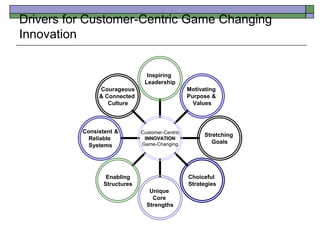
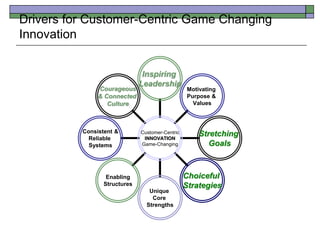
Courageous
& Connected
Culture
Consistent &
Reliable
Systems
Enabling
Structures
Unique
Core
Strengths
Choiceful
Strategies
Stretching
Goals
Motivating
Purpose &
Values
Inspiring
Leadership
Customer-Centric
INNOVATION
Game-Changing
Drivers for Customer-Centric Game Changing
Innovation
Drivers for Customer-Centric Game Changing
Innovation
 Motivating Purpose & Values
 Companies centered on innovation are inspiring places to work
and the people who work there are turned on by a higher
purpose
 Purpose inspires; Values unite
 Stretching Goals
 A few critical goals creates clarity in focusing on strategies that
win and align everyone’s energy
 Stretching but achievable, yet cannot be reached w/o sustained
innovation; driven by leaders who see it as game changer
 Choiceful Strategies
 Choices that result in wining with consumers and customers
and against competition
 Focus on four core businesses, ten leading brands
 Enabled where not to play (exited most food & beverage)
 Unique Core Strengths
 Focus on how to win by building on, enhancing and deploying
our unique core strengths
 Effectively leverage global learning
 Immersive research living, shopping and being part of
consumers’ lives
Drivers for Customer-Centric Game Changing
Innovation
 Enabling Structures
 Unique core strengths require design of organizational
structure that supports innovation at the center
 Era of open corporation (end of internally focused, vertical integrated
organization)
 Need to be comfortable designing structures and processes
that bring in and commercialize outside ideas
 Consistent & Reliable Systems
 Innovation is creative but not chaotic
 Systematic way of moving from concept to commercialization
 Has well-defined success criteria, milestones, and measures
Drivers for Customer-Centric Game Changing
Innovation
 Courageous & Connected Culture
 Culture is what people do day in and day out without being told
 No fear of innovation = know-how to manage risk
 Employees are more connected to:
 Consumers whose lives committed to improving
 Customers and suppliers who are important innovation partners
 Each other based on open-learning culture “that applies and reapplies with pride”
 Inspiring Leadership
 Link all the drivers together, energize people, and inspire them to new
heights
 Leaders are instigators
 Passionate about knowing about consumers, immersing in finding
insights about consumer needs
 In time they develop confidence, how to deal with risk and inherent
risk in innovation
Drivers for Customer-Centric Game Changing
Innovation
Courageous
& Connected
Culture
Consistent &
Reliable
Systems
Enabling
Structures
Unique
Core
Strengths
Choiceful
Strategies
Stretching
Goals
Motivating
Purpose &
Values
Inspiring
Leadership
Customer-Centric
INNOVATION
Game-Changing
Drivers for Customer-Centric Game Changing
Innovation
What P&G’s Innovation Transformation Means For Yo
Chapter Two:
What P&G’s Innovation Transformation Means For
You
 P&G’s managerial breakthrough was to conceive of and implement
innovation as an integrated process based on the idea of customer
is boss
 Continual innovation process can change the landscape of the
business
 P&G change form technology-push innovation model to a
customer-pull one
 Other companies:
 General Electric (under Immelt)
 Nokia
 HP (personal computer unit under Bradley)
What is real Innovation?
 Differences between invention & innovation:
 Invention is new idea that is often turned into a tangible outcome.
 Innovation is the conversion of a new idea into revenues and profits.
“Innovation without a customer is nonsense; it’s not even innovation.” --Jeff Immelt
 Innovation is not complete until it shows up in the financial results
 Real innovation can change the context (market space, customer space,
competitive space, societal space)
 Innovation enables you to be on the offensive
 Commoditization drive down prices; differentiation from innovation
carries an economic premium
 Key to shaping corporate life, helping leaders
conceive previously unimagined strategic
options
 Enables you to potential acquisitions through a
different lens
 Provides an edge in being able to enter new
markets faster & deeper
 Puts companies on the offensive
Why Innovation Matters
Innovation Leader Skill Set
 Effective at evoking the skills of others to build an
innovation culture
 Collaboration is essential
 Failure is a regular visitor
 Comfortable with uncertainty and have an open mind
 Receptive to ideas from very different disciplines
 Have organized innovation into disciplined process that
is replicable
 Have tools and skills to pinpoint and manage the risks
inherent in innovation
Myths of Innovation
 It’s all about new products
 Functions, logistics business models and processes can also benefit
greatly through innovation
 Toyota’s Global Production Systems
 Wal-Mart’s Inventory Management
 Innovation is for geniuses
 Waiting for the “eureka” moment will be fatal
 True innovation matters for the present, not for centuries hence
“Anything that won’t sell, I don’t want to invent. Its sale is proof of utility
and utility is success.” --Thomas Edison
 Size matters
 Innovation can happen in companies as large as P&G, GE, DuPont or
as small as Ram Charan’s fathers’ shoe store in India
Innovation is a social process
 When people do that simple, profound
thing – connect to share problems,
opportunities, and learning
 Anyone can innovate, but practically no
one can innovate alone
 Develop leaders of the future
 Improve productivity
 Execute strategy
 Create innovation
To prosper, companies need to do four things:
 A strategy
 Ideas
 A process that moves these ideas to market
 An organizational structure that supports
innovation (and protects and rewards innovators) up and
down the line.
To create an innovation culture, you need,
Innovation Is A Team Sport
Chapter Nine:
Total Immersion
 Co-location
 Released from usual duties
 Discouraged from emailing colleagues
 Constantly accessible to each other
 Deeply concentrated
 Multiple disciplines, demographics
 Outsiders
 Full-time staff for immersion (brand strategy, description
of product and category, introductions, etc)
Breakthroughs
 Knowing the consumer
 Teamwork
Building an Innovation Team
 Idea Generator – Push beyond plausible
to create provocative ideas
 Project Manager – Ensure all pieces
come together
 Executor – make things happen
 Team Leader – pragmatic dreamer
The Key is intellectual diversity!
Building an Innovation Team
 Risk Diversity
 No “like” thinkers
 Deadlines – can spur creativity and it is a
business after all…
 5-12 people on the team
 Communication
 Say No to bad ideas
 Team connectedness
 Interdisciplinary – “T” Shape
Changing Culture requires Changing
Behavior
 Clearly defined business and personal
development expectations
 Change the consequences that follow
success and failures – reward
entrepreneurial behavior
 Start small and focus on four important
elements: Courageous, Connected,
Collaborative, Curious, and Open.
Innovation Culture Elements and
Interventions
 Courageous
 Connective &
collaborative
 Curious
 Open
Innovation Culture Elements and Interventions:
Courageous
What it looks like
 No fear
 Learn from failure
 Knows how to manage risk based on measures
Expectation Interventions
 Use innovation portfolio to manage risks
 Qualify few, meaningful broadly applied measures
 Establish there’s no bad idea
 Test prototype, and iterate
Consequence Interventions
 Limited human and financial resources are sufficient to support in well-managed
portfolio
 Capture learning from failed innovations and share with other teams
 Broadly reward and recognize teams who fail
 Assign talent from a failed innovation to a new high-profile innovation project
Innovation Culture Elements and Interventions:
Connected and Collaborative
What it looks like
 Works effectively and productively with others—inside and outside the
company
 Works seamlessly across business, functions et al
 Uses personal and professional networks to seek out information ideas
Expectation Interventions
 Creates in-house communities to foster knowledge exchange
 Select team leaders who facilitate connections and expect collaboration
 Establish ways to employees to leverage their external networks
Consequence Interventions
 Include in performance evaluations
 Be prepared to change the leader and/or team members
 Continuity of team members builds trust
Innovation Culture Elements and Interventions:
Curious
What it looks like
 Remains childlike, naïve
 Looks for obvious patterns
 Explores and likes to discover
 Looks for analogies and metaphors
 Asks “Why? and Why not?” “What’s Possible?” “How does that work?”
 Uses “Columbo” approach to solve; focuses on solutions
Expectation Interventions
 set an expectation of ongoing learning
 Brainstorming
 Consumer, shopper and customer immersion
 External connections and diverse experiences
Consequence Interventions
 Challenges the team’s thinking
 Keep asking “Why? and Why not?” again
Innovation Culture Elements and Interventions:
Open
What it looks like
 Open-minded to new ideas
 Open to learn to assumption that others’ ideas will make the product or
service better
 Open to empathy to consumer/customer
 Open to suspend judgment
Expectation Interventions
 Institute an open architecture
 Establish and communicate clear goals
 Eliminate “not invented here”; encourage “apply and reapply with pride”
Consequence Interventions
 Reward and recognize those who seek out/commercialize innovation
opportunities from outside
 Reward and recognize those who reapply others’ success to their business
 Include open-mindedness in performance evaluations
Emphasize Out of the Box IDEAS
 Inclusive: Reaping benefits of diverse thinking and ideas
needed to foster innovation
 Decisive: Eliminating organizational swirl, debate, and
over analysis - faster innovation, development,
qualification, and commercialization
 External: Externally focused to stay in touch with clusters,
consumers, suppliers – honest and objective
 Agile: Quickly reacting to changing conditions, forward
thinking – taking calculated risks
 Simple: Ongoing streamlining and simplification of
structures and processes
Rules of brainstorming
 Get a facilitator
 Be prepared
 Relax
 Ladders should follow
 Get everyone to contribute
 Keep track of ideas
 Think ahead
 Use props
 Outside the lines
 Follow the rules.
Questions for Leaders
 What are you doing to encourage and eliminate fear of failure?
 How are you fostering a culture of curiosity and openness?
 How are you eliminating unnecessary bureaucracy?
 How are the team leaders and members chosen?
 What are you doing to encourage open communications within the
innovation team?
 How well do you manager the development of an individual’s
innovation skills?
 How do you enable individuals to reenter more traditional
assignments in the most productive way?
 Do you use special approaches to enable teams to immerse
themselves in customers?
 Do you use co-location to help business units build innovation?
New Job of the Leader
Chapter Ten:
Developing Leaders of Innovation
 Performance Evaluations
 Early Identification
 Job experiences
 Reward and recognition
 Clear sense of purpose / inspiring them
Leaders need to be good at…
 Drawing people out
 Synthesize ideas
 Facilitating debates
 getting the group to be decisive and
action-oriented
How innovation Leaders Dream
 See the world as it can be not as it is
 View the external landscape in a new way
 Imagine possibilities that elude others
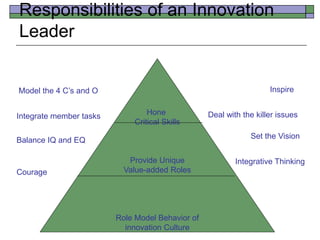
Responsibilities of an Innovation
Leader
Hone
Critical Skills
Provide Unique
Value-added Roles
Role Model Behavior of
innovation Culture
Model the 4 C’s and O
Integrate member tasks
Courage
Balance IQ and EQ
Inspire
Set the Vision
Deal with the killer issues
Integrative Thinking
Building the Pipeline
 Performance Evaluation
 Power of Minds, People, Agility
 Start them from day one
 Personal Coaching
 Support systems and training
 Intentional assignments
 Reward and recognition
How Jeff Immelt Made Innovation A Way
Of Life At GE
Conclusion:
GE Case Study
How Jeff Immelt Made Innovation A Way Of Life At GE
 Put innovation and productivity on Your personal
leadership agenda
 Give innovation a seat at the table
 Find and follow up on the best ideas
 Shift the focus to customers and the longer term
 Rethink Leadership
 Build capabilities you are lacking
 Architect the social process of innovation
 Create the resources you need to fund growth
 Open up to learn from others
 Reorganize or restructure to get close to customers
 Reinforce the culture you want
 Let Innovation spread

Game Changer Book Summary.ppt

  • 1.
    The Game-Changer How YouCan Drive Revenue and Profit Growth With Innovation by AG Lafley & Ram Charan
  • 2.
    How and WhyInnovation At P&G Changed Its Game Chapter One:
  • 3.
    What We HadTo Do  Put the consumer at center of everything we do  Opened up  Made sustainable organic growth the priority  Organized around innovation to drive sustained organic growth  Began thinking of innovation in new ways
  • 4.
    What We HadTo Do  Put the consumer at center of everything we do  “consumer is boss” standard  Spend more time with consumers  In stores  In their homes  Consumer testing centers  Delight our consumers at two moments of truth  When they buy  When they use  Opened up  Seek out innovation from all sources, inside and outside the company  Innovation is all about connections; everyone involved  Connect & develop  More Connections, more ideas, more solutions  Goal set that half of new product and technology innovations come from outside P&G
  • 5.
    What We HadTo Do  Made sustainable organic growth the priority  Innovation enables expansion into new categories  Allows us to reframe mature business & transform them into platforms for profitable growth  Creates bridges into adjacent segments  Emphasis on organic growth  Less risky than acquired growth  More highly valued by investors  Organized around innovation to drive sustained organic growth  Innovation as a strategy  Regular business strategy that focuses on innovation  Regular innovation reviews for every global business unit  Careful selection and use of the right metrics  Evaluating, development and promotion of outstanding business and innovation leaders  Allocation of resources …to outstanding innovation
  • 6.
    What We HadTo Do  Began thinking of innovation in new ways  Run innovation like we run a factory  Broadened way we thought about innovation  Not just products, services but to include business models, supply chains etc.  Not just disruptive, but also incremental  Innovation is risky  Learned how to pinpoint the risks  Developed tools and the know-how to manage them
  • 7.
    How We DidIt…First Things First 1. Improve our execution “we were trying to do too much, too fast and nothing was being done well.”  Growing the core  Laser-sharp focus on current consumers, current retailers, wholesalers, and distributors 2. Pricing  Too high, find pricing “sweet spot” “…better value for consumers, gave retailers a fair profit, and would drive P&G to improved market share, net sales, and margin performance.” 3. Innovation  Key to winning medium and long term  Strategy of differentiation  Brands are promises of something different and better in terms of performance, quality and value.  Brand are guarantees of consistent quality, performance, and value.
  • 8.
    Critical Questions onInnovation  How could we put innovation at the center of everything we do?  How could we turn innovation into a more consistent, more decisive, and more sustainable competitive advantage?  How could we manage the risks associated with our all- in and full-on commitment to innovation?  Could we identify and take advantage of the opportunities innovation might offer us?
  • 9.
    Courageous & Connected Culture Consistent & Reliable Systems Enabling Structures Unique Core Strengths Choiceful Strategies Stretching Goals Motivating Purpose& Values Inspiring Leadership Customer-Centric INNOVATION Game-Changing Drivers for Customer-Centric Game Changing Innovation
  • 10.
    Drivers for Customer-CentricGame Changing Innovation  Motivating Purpose & Values  Companies centered on innovation are inspiring places to work and the people who work there are turned on by a higher purpose  Purpose inspires; Values unite  Stretching Goals  A few critical goals creates clarity in focusing on strategies that win and align everyone’s energy  Stretching but achievable, yet cannot be reached w/o sustained innovation; driven by leaders who see it as game changer
  • 11.
     Choiceful Strategies Choices that result in wining with consumers and customers and against competition  Focus on four core businesses, ten leading brands  Enabled where not to play (exited most food & beverage)  Unique Core Strengths  Focus on how to win by building on, enhancing and deploying our unique core strengths  Effectively leverage global learning  Immersive research living, shopping and being part of consumers’ lives Drivers for Customer-Centric Game Changing Innovation
  • 12.
     Enabling Structures Unique core strengths require design of organizational structure that supports innovation at the center  Era of open corporation (end of internally focused, vertical integrated organization)  Need to be comfortable designing structures and processes that bring in and commercialize outside ideas  Consistent & Reliable Systems  Innovation is creative but not chaotic  Systematic way of moving from concept to commercialization  Has well-defined success criteria, milestones, and measures Drivers for Customer-Centric Game Changing Innovation
  • 13.
     Courageous &Connected Culture  Culture is what people do day in and day out without being told  No fear of innovation = know-how to manage risk  Employees are more connected to:  Consumers whose lives committed to improving  Customers and suppliers who are important innovation partners  Each other based on open-learning culture “that applies and reapplies with pride”  Inspiring Leadership  Link all the drivers together, energize people, and inspire them to new heights  Leaders are instigators  Passionate about knowing about consumers, immersing in finding insights about consumer needs  In time they develop confidence, how to deal with risk and inherent risk in innovation Drivers for Customer-Centric Game Changing Innovation
  • 14.
    Courageous & Connected Culture Consistent & Reliable Systems Enabling Structures Unique Core Strengths Choiceful Strategies Stretching Goals Motivating Purpose& Values Inspiring Leadership Customer-Centric INNOVATION Game-Changing Drivers for Customer-Centric Game Changing Innovation
  • 15.
    What P&G’s InnovationTransformation Means For Yo Chapter Two:
  • 16.
    What P&G’s InnovationTransformation Means For You  P&G’s managerial breakthrough was to conceive of and implement innovation as an integrated process based on the idea of customer is boss  Continual innovation process can change the landscape of the business  P&G change form technology-push innovation model to a customer-pull one  Other companies:  General Electric (under Immelt)  Nokia  HP (personal computer unit under Bradley)
  • 17.
    What is realInnovation?  Differences between invention & innovation:  Invention is new idea that is often turned into a tangible outcome.  Innovation is the conversion of a new idea into revenues and profits. “Innovation without a customer is nonsense; it’s not even innovation.” --Jeff Immelt  Innovation is not complete until it shows up in the financial results  Real innovation can change the context (market space, customer space, competitive space, societal space)  Innovation enables you to be on the offensive  Commoditization drive down prices; differentiation from innovation carries an economic premium
  • 18.
     Key toshaping corporate life, helping leaders conceive previously unimagined strategic options  Enables you to potential acquisitions through a different lens  Provides an edge in being able to enter new markets faster & deeper  Puts companies on the offensive Why Innovation Matters
  • 19.
    Innovation Leader SkillSet  Effective at evoking the skills of others to build an innovation culture  Collaboration is essential  Failure is a regular visitor  Comfortable with uncertainty and have an open mind  Receptive to ideas from very different disciplines  Have organized innovation into disciplined process that is replicable  Have tools and skills to pinpoint and manage the risks inherent in innovation
  • 20.
    Myths of Innovation It’s all about new products  Functions, logistics business models and processes can also benefit greatly through innovation  Toyota’s Global Production Systems  Wal-Mart’s Inventory Management  Innovation is for geniuses  Waiting for the “eureka” moment will be fatal  True innovation matters for the present, not for centuries hence “Anything that won’t sell, I don’t want to invent. Its sale is proof of utility and utility is success.” --Thomas Edison  Size matters  Innovation can happen in companies as large as P&G, GE, DuPont or as small as Ram Charan’s fathers’ shoe store in India
  • 21.
    Innovation is asocial process  When people do that simple, profound thing – connect to share problems, opportunities, and learning  Anyone can innovate, but practically no one can innovate alone
  • 22.
     Develop leadersof the future  Improve productivity  Execute strategy  Create innovation To prosper, companies need to do four things:
  • 23.
     A strategy Ideas  A process that moves these ideas to market  An organizational structure that supports innovation (and protects and rewards innovators) up and down the line. To create an innovation culture, you need,
  • 24.
    Innovation Is ATeam Sport Chapter Nine:
  • 25.
    Total Immersion  Co-location Released from usual duties  Discouraged from emailing colleagues  Constantly accessible to each other  Deeply concentrated  Multiple disciplines, demographics  Outsiders  Full-time staff for immersion (brand strategy, description of product and category, introductions, etc)
  • 26.
    Breakthroughs  Knowing theconsumer  Teamwork
  • 27.
    Building an InnovationTeam  Idea Generator – Push beyond plausible to create provocative ideas  Project Manager – Ensure all pieces come together  Executor – make things happen  Team Leader – pragmatic dreamer The Key is intellectual diversity!
  • 28.
    Building an InnovationTeam  Risk Diversity  No “like” thinkers  Deadlines – can spur creativity and it is a business after all…  5-12 people on the team  Communication  Say No to bad ideas  Team connectedness  Interdisciplinary – “T” Shape
  • 29.
    Changing Culture requiresChanging Behavior  Clearly defined business and personal development expectations  Change the consequences that follow success and failures – reward entrepreneurial behavior  Start small and focus on four important elements: Courageous, Connected, Collaborative, Curious, and Open.
  • 30.
    Innovation Culture Elementsand Interventions  Courageous  Connective & collaborative  Curious  Open
  • 31.
    Innovation Culture Elementsand Interventions: Courageous What it looks like  No fear  Learn from failure  Knows how to manage risk based on measures Expectation Interventions  Use innovation portfolio to manage risks  Qualify few, meaningful broadly applied measures  Establish there’s no bad idea  Test prototype, and iterate Consequence Interventions  Limited human and financial resources are sufficient to support in well-managed portfolio  Capture learning from failed innovations and share with other teams  Broadly reward and recognize teams who fail  Assign talent from a failed innovation to a new high-profile innovation project
  • 32.
    Innovation Culture Elementsand Interventions: Connected and Collaborative What it looks like  Works effectively and productively with others—inside and outside the company  Works seamlessly across business, functions et al  Uses personal and professional networks to seek out information ideas Expectation Interventions  Creates in-house communities to foster knowledge exchange  Select team leaders who facilitate connections and expect collaboration  Establish ways to employees to leverage their external networks Consequence Interventions  Include in performance evaluations  Be prepared to change the leader and/or team members  Continuity of team members builds trust
  • 33.
    Innovation Culture Elementsand Interventions: Curious What it looks like  Remains childlike, naïve  Looks for obvious patterns  Explores and likes to discover  Looks for analogies and metaphors  Asks “Why? and Why not?” “What’s Possible?” “How does that work?”  Uses “Columbo” approach to solve; focuses on solutions Expectation Interventions  set an expectation of ongoing learning  Brainstorming  Consumer, shopper and customer immersion  External connections and diverse experiences Consequence Interventions  Challenges the team’s thinking  Keep asking “Why? and Why not?” again
  • 34.
    Innovation Culture Elementsand Interventions: Open What it looks like  Open-minded to new ideas  Open to learn to assumption that others’ ideas will make the product or service better  Open to empathy to consumer/customer  Open to suspend judgment Expectation Interventions  Institute an open architecture  Establish and communicate clear goals  Eliminate “not invented here”; encourage “apply and reapply with pride” Consequence Interventions  Reward and recognize those who seek out/commercialize innovation opportunities from outside  Reward and recognize those who reapply others’ success to their business  Include open-mindedness in performance evaluations
  • 35.
    Emphasize Out ofthe Box IDEAS  Inclusive: Reaping benefits of diverse thinking and ideas needed to foster innovation  Decisive: Eliminating organizational swirl, debate, and over analysis - faster innovation, development, qualification, and commercialization  External: Externally focused to stay in touch with clusters, consumers, suppliers – honest and objective  Agile: Quickly reacting to changing conditions, forward thinking – taking calculated risks  Simple: Ongoing streamlining and simplification of structures and processes
  • 36.
    Rules of brainstorming Get a facilitator  Be prepared  Relax  Ladders should follow  Get everyone to contribute  Keep track of ideas  Think ahead  Use props  Outside the lines  Follow the rules.
  • 37.
    Questions for Leaders What are you doing to encourage and eliminate fear of failure?  How are you fostering a culture of curiosity and openness?  How are you eliminating unnecessary bureaucracy?  How are the team leaders and members chosen?  What are you doing to encourage open communications within the innovation team?  How well do you manager the development of an individual’s innovation skills?  How do you enable individuals to reenter more traditional assignments in the most productive way?  Do you use special approaches to enable teams to immerse themselves in customers?  Do you use co-location to help business units build innovation?
  • 38.
    New Job ofthe Leader Chapter Ten:
  • 39.
    Developing Leaders ofInnovation  Performance Evaluations  Early Identification  Job experiences  Reward and recognition  Clear sense of purpose / inspiring them
  • 40.
    Leaders need tobe good at…  Drawing people out  Synthesize ideas  Facilitating debates  getting the group to be decisive and action-oriented
  • 41.
    How innovation LeadersDream  See the world as it can be not as it is  View the external landscape in a new way  Imagine possibilities that elude others
  • 42.
    Responsibilities of anInnovation Leader Hone Critical Skills Provide Unique Value-added Roles Role Model Behavior of innovation Culture Model the 4 C’s and O Integrate member tasks Courage Balance IQ and EQ Inspire Set the Vision Deal with the killer issues Integrative Thinking
  • 43.
    Building the Pipeline Performance Evaluation  Power of Minds, People, Agility  Start them from day one  Personal Coaching  Support systems and training  Intentional assignments  Reward and recognition
  • 44.
    How Jeff ImmeltMade Innovation A Way Of Life At GE Conclusion:
  • 45.
    GE Case Study HowJeff Immelt Made Innovation A Way Of Life At GE  Put innovation and productivity on Your personal leadership agenda  Give innovation a seat at the table  Find and follow up on the best ideas  Shift the focus to customers and the longer term  Rethink Leadership  Build capabilities you are lacking  Architect the social process of innovation  Create the resources you need to fund growth  Open up to learn from others  Reorganize or restructure to get close to customers  Reinforce the culture you want  Let Innovation spread