“ Driving innovation”


INNOVATION
in IT Service Management
Ersen Celebi
Contents
1    Introduction to ITSM

2    Innovation

3    Driving Innovation

4    Innovation Management

5     German Study Case

6     Case Study: Samsung

7     Case Study: DHL First Choice

8     Conclusion

9     Back-Up: ITIL

10     Q/A

                                     2
Introduction to ITSM

 Providers of IT services can no longer afford to focus
  on technology and their internal organization[;] they
  now have to consider the quality of the services they
  provide and focus on the relationship with customers

 No one author, organization, or vendor owns the term
  "IT service management" and the origins of the phrase
  are unclear.


                               http://en.wikipedia.org/wiki/ITSM


                                                   3
Introduction to ITSM

 IT service management (ITSM or IT services) is a
  discipline for managing information technology (IT)
  systems, philosophically centered on the customer's
  perspective of IT's contribution to the business.

 ITSM stands in deliberate contrast to technology-
  centered approaches to IT management and business
  interaction.

 The ITSM framework can be defined as “a set of
  processes that co-operate to ensure the quality of live
  IT services, according to the levels of service agreed to
  by the customer”.


                                              4
Introduction to ITSM

 It can also be seen as a philosophy for orientation
  toward market, service, life-cycle and process in
  general.

 The main focus of the framework is not the
  development of IT applications, but rather the
  management of services.

 The most frequently adopted ITSM resource is the IT
  Infrastructure Library (ITIL), the de facto standard for IT
  Service. Other ITSM frameworks include HP ITSM,
  CobiT and ISO 20000..

                                                5
Innovation

Innovation can be defined as:
 “the application of new ideas to the products, processes
  or any other aspect of a firm’s activities.”

 Innovations can also be understood as: “improvement,
  and when implemented in the market, they expand the
  competitiveness of the innovator for at least a limited
  amount of time”

 “innovation as an idea that is new to the people involved,
  even though it may appear to others as an imitation.”

 “Innovation is the adoption of an idea or behavior that is
  new to the organization adopting it”
                                             6
Driving innovation

        CEOs view innovation as the lifeblood of thriving
organizations. They see the integration of business and
technology as essential to the success of innovative
efforts designed to enable organizations to reach their
highest potential.

      IT’s ability to control service quality and costs, and
to enable increased innovation, is now a business
imperative.


                                                7
Driving innovation

As a result, IT can be better positioned to:
 Create value by driving or responding to new project
and service requests through timely, high-quality and on-
budget delivery.

 Manage value in real time with an agile, integrated
infrastructure that runs efficiently and cost-effectively.


                                                8
Driving innovation

      1                   2
So many           By distributing
business          decision rights
processes         and accountability,
depend on IT      effective
these days that   governance can
                  help to ensure              3                       4
when a service
problem arises,   service-oriented
it’s often        decision making                              IT must get out
headline news.    across silos.         Breaking down          of firefighting
                                        silos to improve       mode before it
                                        service                can focus on
                                        excellence             customer
                                                               requirements.


                                                           9
Driving innovation

      5                       6                       7
                   UK banking Group
Managing a         was to create a           Service excellence
service desk is    centralized identity      means more than
more than call     management model.         continual process
tracking—it        The group improved        improvement— it
should provide a   its ability to rapidly    means continually
reliable, single   respond to                improving and
point of contact   opportunities and         adding value to
for all service    saved $11 m.              the customer
requests.          annually trough
                   process efficiencies


                                            10
Innovation Management

 “Innovation Management is about learning to find the
  most appropriate solution to the problem of consistently
  managing this process”

 It can also be defined as: “planning, organizing, executing
  and controlling all activities related to the development
  and implementation of innovations”


                                             11
Innovation Management

 To stay competitive and to promote innovation,
  companies cannot rely on chance alone.

 It is crucial to manage the innovation process
  systematically, providing both structure and goals

 This necessity is based on limited financial,material and
  human resources


                                             12
Innovation Management

Innovation Management as consisting of five activities:
 technological integration
 the process of innovation
 strategic technology planning
 organizational change
 business development


                                            13
Innovation Management
  The Need for Innovation:
   Innovation is composed of four components-creativity,
  strategy, implementation, and profitability.

 Three Types of Innovation:
   Efficiency Innovation
   Evolutionary Innovation
   Revolutionary Innovation

 The Seeds of Innovation:
   Creative Thinking
   Strategic Thinking
   Transformational Thinking


                                            14
Efficiency Innovation

 Efficiency Innovation focuses on identifying new ideas for
  improving what already exists. This approach requires
  minimal investment since the team is building on the past
  and only looking for small changes in what’s already being
  done.

 The strategy for efficiency innovations is usually to cut
  costs, reduce cycle time,improve quality, offset a
  competitor’s move or attract new customers. Typically, only
  small gains are realized


                                              15
Efficiency Innovation


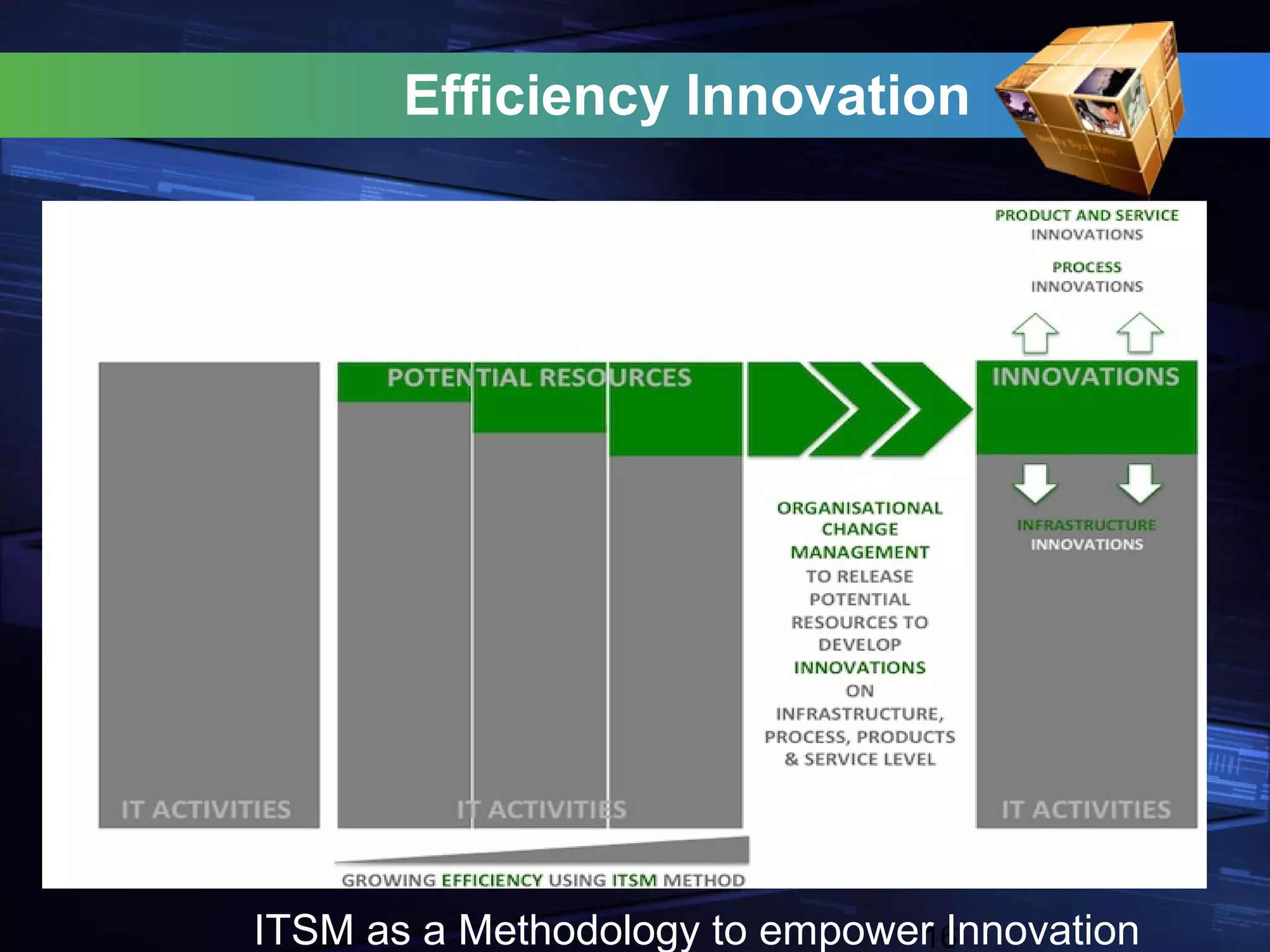
ITSM as a Methodology to empower Innovation
                               16
Efficiency Innovation

1. Phase 1 illustrates the situation before introducing
   ITSM. Expressed as a ratio, 100% of the time is used
   for original tasks.
2. The efficiency of IT increases by using best practices.
   The workload from the original IT activities is reduced
   over the medium term. Sustained optimization and
   expansion of the use of ITSM can attain a further
   reduction of the load and open up corresponding


                                            17
Efficiency Innovation

3. In the third step, the innovation potential is set free.
   Other changes must be made to the way of
   thinking and acting. Using technology stabilizes the
   use of innovation potential
4. In the final state (for the time being), the workload
   is reduced and the resources thus freed up are
   used to create innovation on infrastructure,
   business process and product and service level.


                                               18
Evolutionary Innovation

Evolutionary Innovation focuses on identifying
ideas that represent something distinctly new and better.

   An example was the introduction of automated
banking machines, which changed the way banks
viewed their staffing needs and shifted banking habits
from set hours to banking at any hour.


                                           19
Evolutionary Innovation


Evolutionary innovation requires looking more
broadly than Total Quality Management
improvements and cost savings to see the bigger
picture of what’s really needed in the organization
and marketplace.

Instead of duplicating what already exists, the team
must look for new ways to bring value to the
organization and the customer.


                                         20
Revolutionary Innovation


   Revolutionary Innovation focuses on radically new
and better ideas that don’t operate within the existing
structure of the organization and marketplace but may
in fact dismantle that structure. For example,

   Dell Computer’s direct-to-consumer sales
strategy in the computer industry.


                                           21
German Case Study

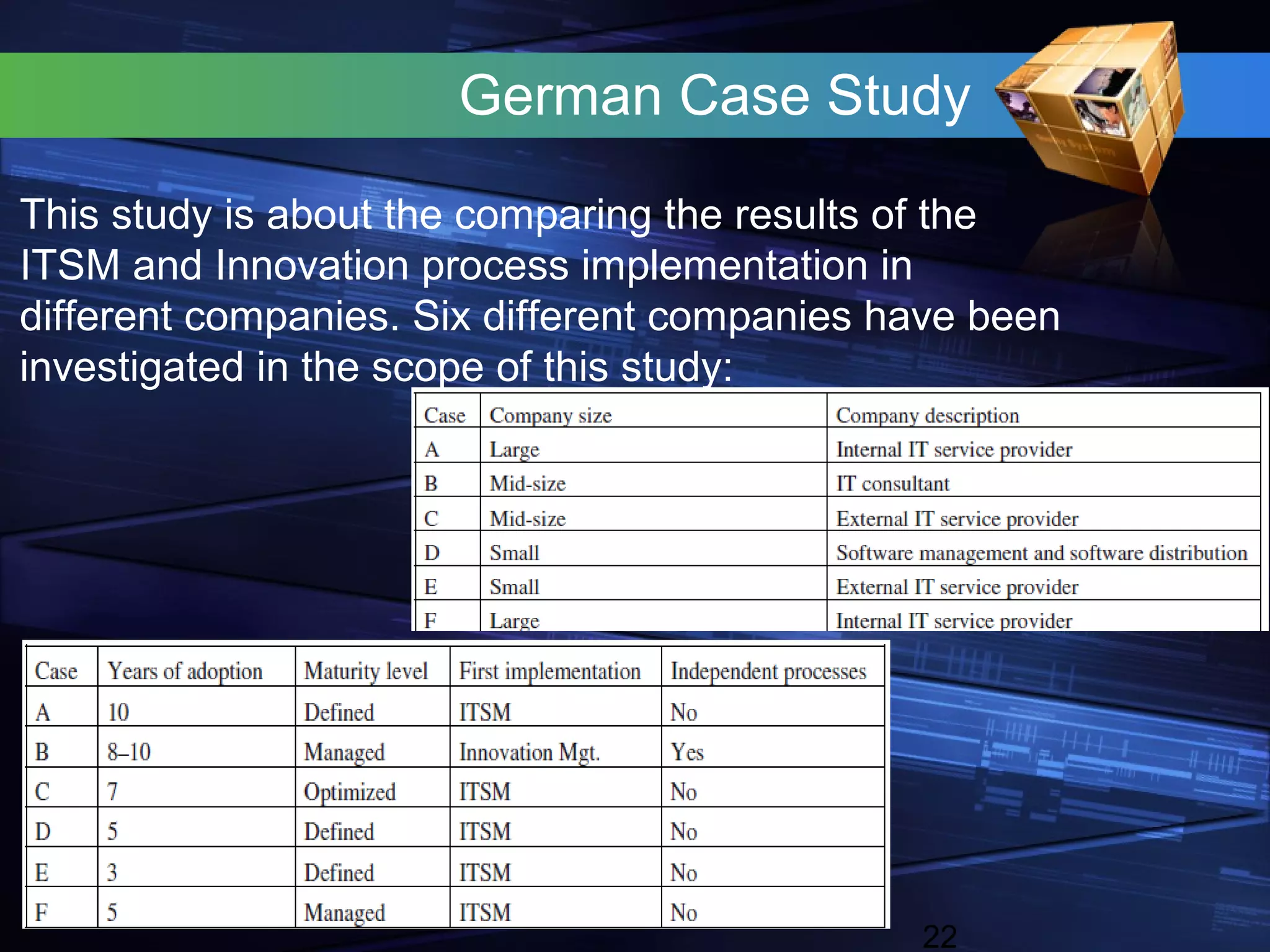
This study is about the comparing the results of the
ITSM and Innovation process implementation in
different companies. Six different companies have been
investigated in the scope of this study:


                                              22
German Case Study

The results based on:

 considering separately ITSM adoption and Innovation
  Management implementation

 ‘the interviewees’ perception of the impact of ITSM on
  their Innovation Management.


                                            23
German Case Study
In case A:
 No direct impact of ITSM on Innovation Management.

 The two need to be considered as separate processes.

 Only when all ITSM processes have been installed
  properly and reached a certain maturity level can
  Innovation Management follow as a next step, to optimize
  and develop processes.


                                          24
German Case Study
Case B:

 Describes ITSM and Innovation Management as “natural
  enemies.”

 the adoption of an innovative process distracts from the
  main objective of ITSM frameworks


                                            25
German Case Study
Case C:
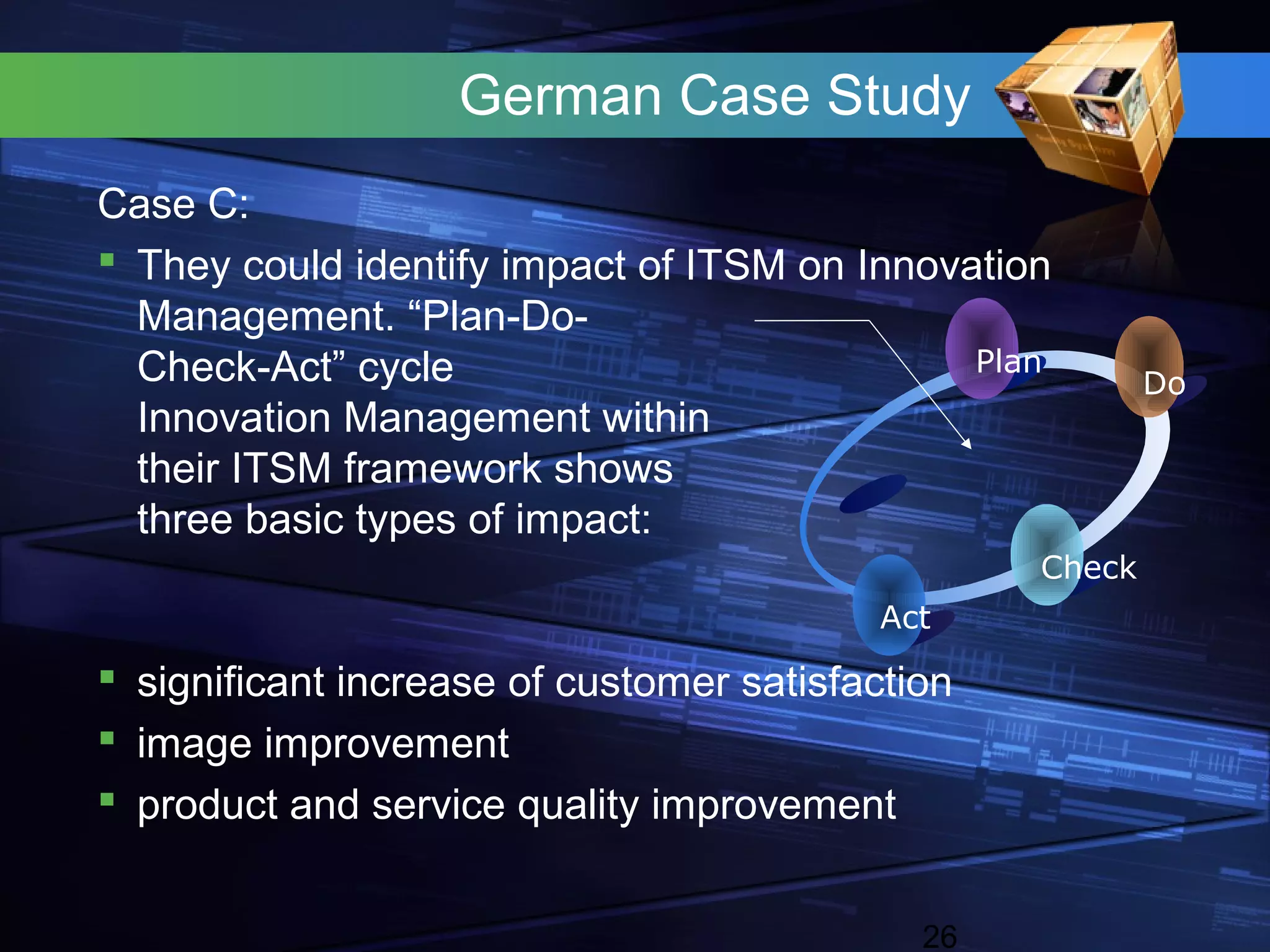
 They could identify impact of ITSM on Innovation
  Management. “Plan-Do-
  Check-Act” cycle                            Plan
                                                          Do
  Innovation Management within
  their ITSM framework shows
  three basic types of impact:
                                                  Check
                                          Act
 significant increase of customer satisfaction
 image improvement
 product and service quality improvement


                                             26
German Case Study
Case D:
 it is not a question for them whether there is an impact,
  but rather how great this impact is.

 Specifically, they have noticed that, due to the faster
  adoption of innovations via the ITSM, customers’ needs
  can be handled more efficiently


                                             27
German Case Study
Case F:
 For them ITSM as the superior model. After first
  implementing ITSM, they later introduced Innovation
  Management into the framework as an independent
  process.

 Innovation Management as a new strategic process was
  possible since case F’s ITSM consists of not only
  operational processes (e.g. Incident Management) but
  also strategic processes


                                          28
Transformational Thinking
 Organizational Innovation
  The Innovation Systems Architecture Model
     Shared Innovation Vision and Strategy
     Innovation Environment Supports
     Innovation Resource Allocation
     Innovation Process Networks
     Innovation Programs
     Innovation Skills Development
     Innovation Rewards and Recognition
     External Stakeholder Innovation (Customers and
      Partners)

                                           29
Transformational Thinking


 The Innovative Organization Assessment:
  A Holistic Approach Two ways to measure these
  efforts:
   Innovation output
   Innovation throughput


                                    30
Case Study :SAMSUNG-TRIZ
 Shared Innovation Vision and Strategy
    At SAMSUNG VIP center the goal is to train every
     engineer and researcher in TRIZ think.

    “We put ideas on the table they put ideas on the table
     and we go from there” says TRIZ specialist Lee.
    SAMSUNG Six Sigma Method (SS DFSS) Drives
     Innovation leading with TRIZ and other tools.

 TRIZ is a family of tools providing potential solution
  paths to technical problems.
    3.000.000 patents have been investigated making the
     TRIZ methodology statistically significant

                                               31
TRIZ


 Innovation Resource Allocation
   SAMSUNG have 50 Full Time TRIZ Experts in
    SAIT(SAMSUNG Advanced Institute of Technology)

 Innovation Environment Supports
   SAMSUNG invested TRIZ by building expertise
    Training & Infrastructure to Deploy TRIZ

 Innovation Skills Development
   Now TRIZ part of basic technology training.


                                          32
TRIZ


 Innovation output: DVD Player
 This project resulted in
     ~$100M in cost reduction
     9 Patents
     Reduction in components from 8 to 4
     Increased reliabilty.


                                            33
ITIL approach

ITIL can provide a mechanism for fostering
innovation.
The value network must be addressed in order to seamlessly
bring suppliers together

Stakeholders demands value from IT.

A common dictionary is needed.

There is no value without fit for purpose and fit for use.


                                                 34
ITIL approach

Lower cost of ownership can enable IT to address the low
margin markets.
Customers will ultimately base their service selection on price.
Resources can be diverted to new capabilities needed to
service low margin markets.
Provide distinct and measurable competitive differentiation.
Recovered resources can be allocated to the creation of
disruptive services.
Identify potential disruptive technologies.
Build the markets and the supporting services.
The exploitation of disruptive technologies create results.


                                                35
ITIL approach

IT Leaders must demonstrate capability for optimal IT
Service delivery
 Reportable metrics drive action.
     Customers recognize tangible value.
     Performance information is motivation for moving the
    needle.
     Control objectives enable on-demand capability
    audits.
     Point in time readings validate improvements.
     Regulatory compliance no longer becomes an issue.
     Identifies acceptable levels of risk.


                                             36
ITIL approach

 Continuous improvement is the key to success.
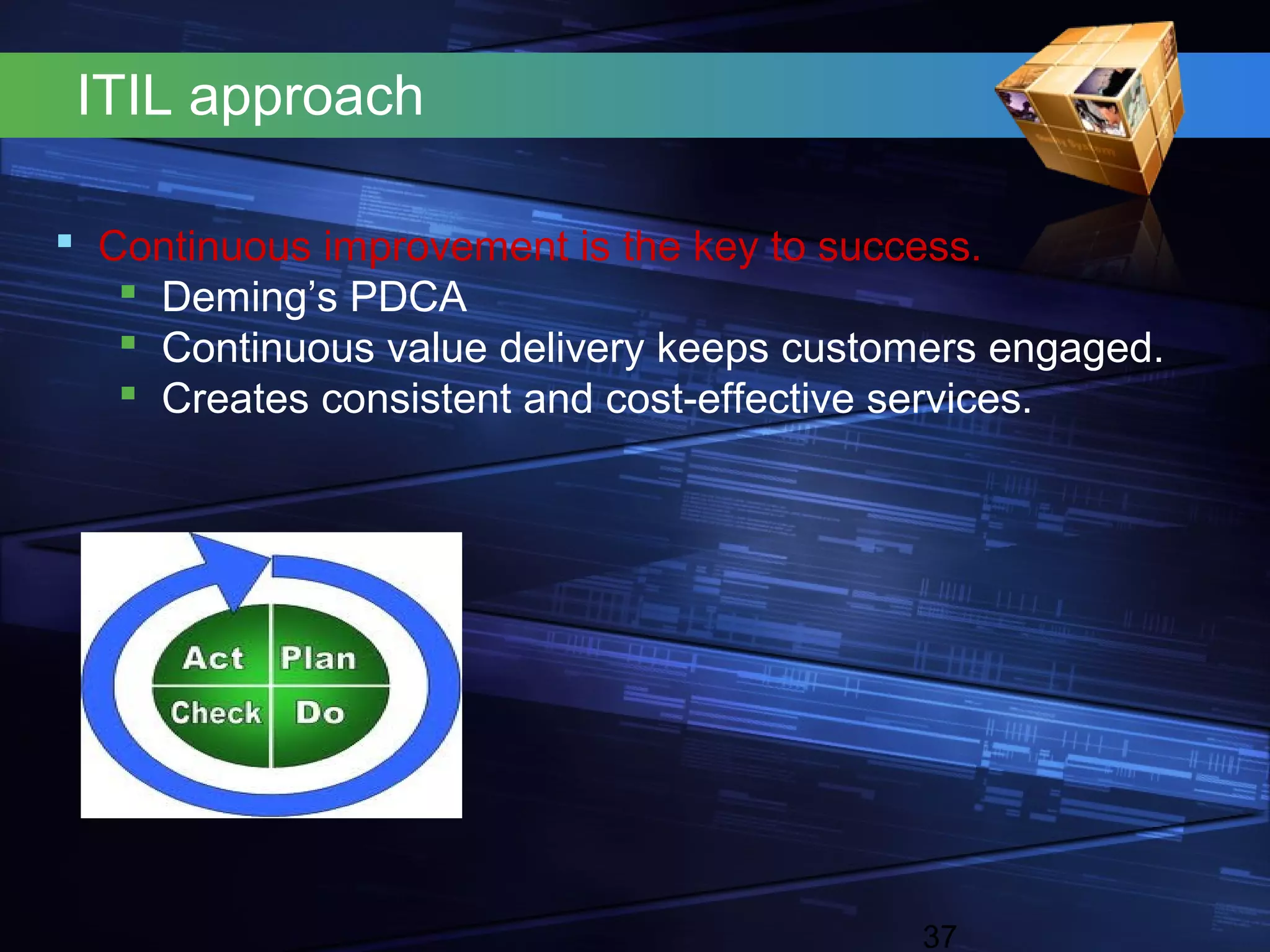
    Deming’s PDCA
    Continuous value delivery keeps customers engaged.
    Creates consistent and cost-effective services.


                                          37
Conclusion

Regarding to all of the content above:
In a ITSM environment, innovation is supported by the
Improvement Process in most of the cases.
Innovative ideas can be transformed to the real life in
case there is an effective Improvement process in place.
There are some standards such as ITIL, which helps to
increase the quality of the ITSM environment and also
brings solutions to stumbling blocks for innovation.


                                            38
Q&A
BACKUP

In the following slides you can find
ITIL approach to Innovation & Innovation Management in
a ITSM environment:


                                        41
ITIL

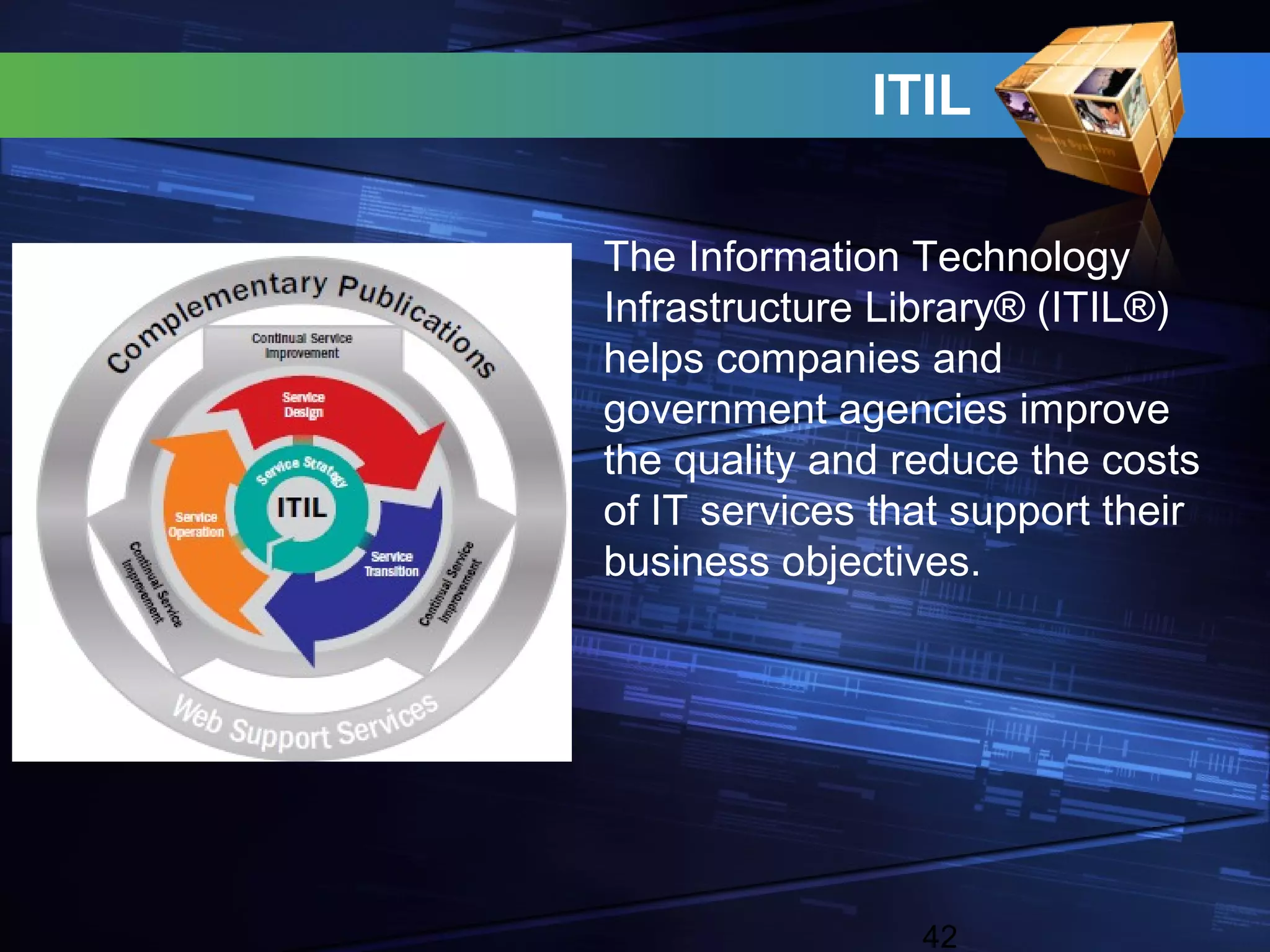
The Information Technology
Infrastructure Library® (ITIL®)
helps companies and
government agencies improve
the quality and reduce the costs
of IT services that support their
business objectives.


                 42
ITIL

The Federal government recognized that by leveraging
ITIL’s recommendations and best practices agency IT
departments could decrease overall IT spending and
continually improve IT service management.


                                          43
ITIL History

 ITIL originated in the 1980s when the British government
  determined that it was not receiving a sufficient level of IT
  service quality.

 First released as the Government Information Technology
  Infrastructure Management (GITIM) framework by the
  United Kingdom’s Office of Government Commerce, this
  series of 31 books provided best practices and guidelines
  for managing and maintaining IT infrastructures.


                                               44
ITIL History

 In the 1990s, the second version of ITIL was released
  and rapidly accepted by companies and government
  agencies in Europe and throughout the world. With ITIL
  V2, the number of books was reduced from the original
  31 to 10.


                                            45
ITIL History

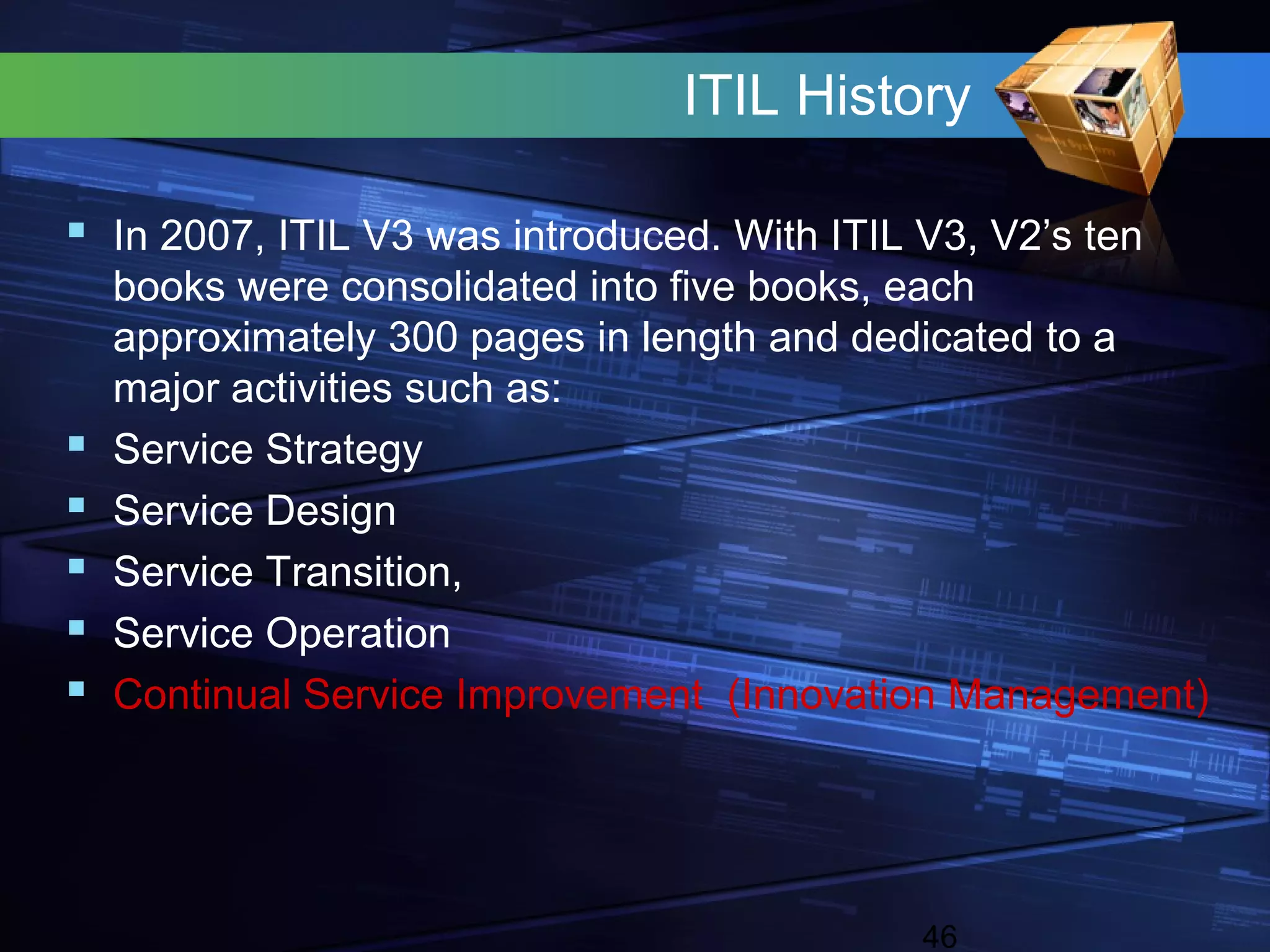
 In 2007, ITIL V3 was introduced. With ITIL V3, V2’s ten
    books were consolidated into five books, each
    approximately 300 pages in length and dedicated to a
    major activities such as:
   Service Strategy
   Service Design
   Service Transition,
   Service Operation
   Continual Service Improvement (Innovation Management)


                                             46
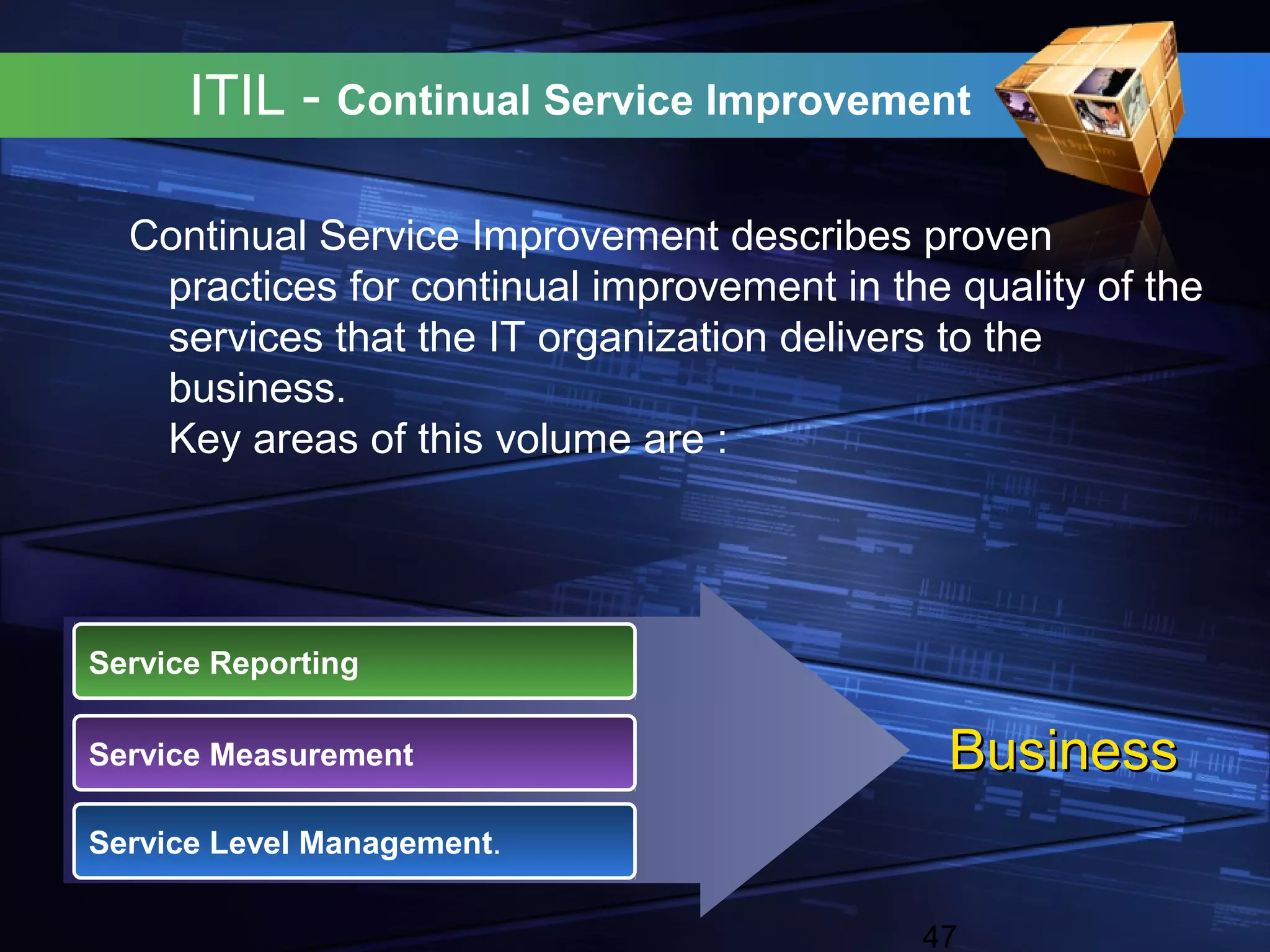
ITIL - Continual Service Improvement

  Continual Service Improvement describes proven
   practices for continual improvement in the quality of the
   services that the IT organization delivers to the
   business.
   Key areas of this volume are :


Service Reporting

Service Measurement                           Business
Service Level Management.

                                            47
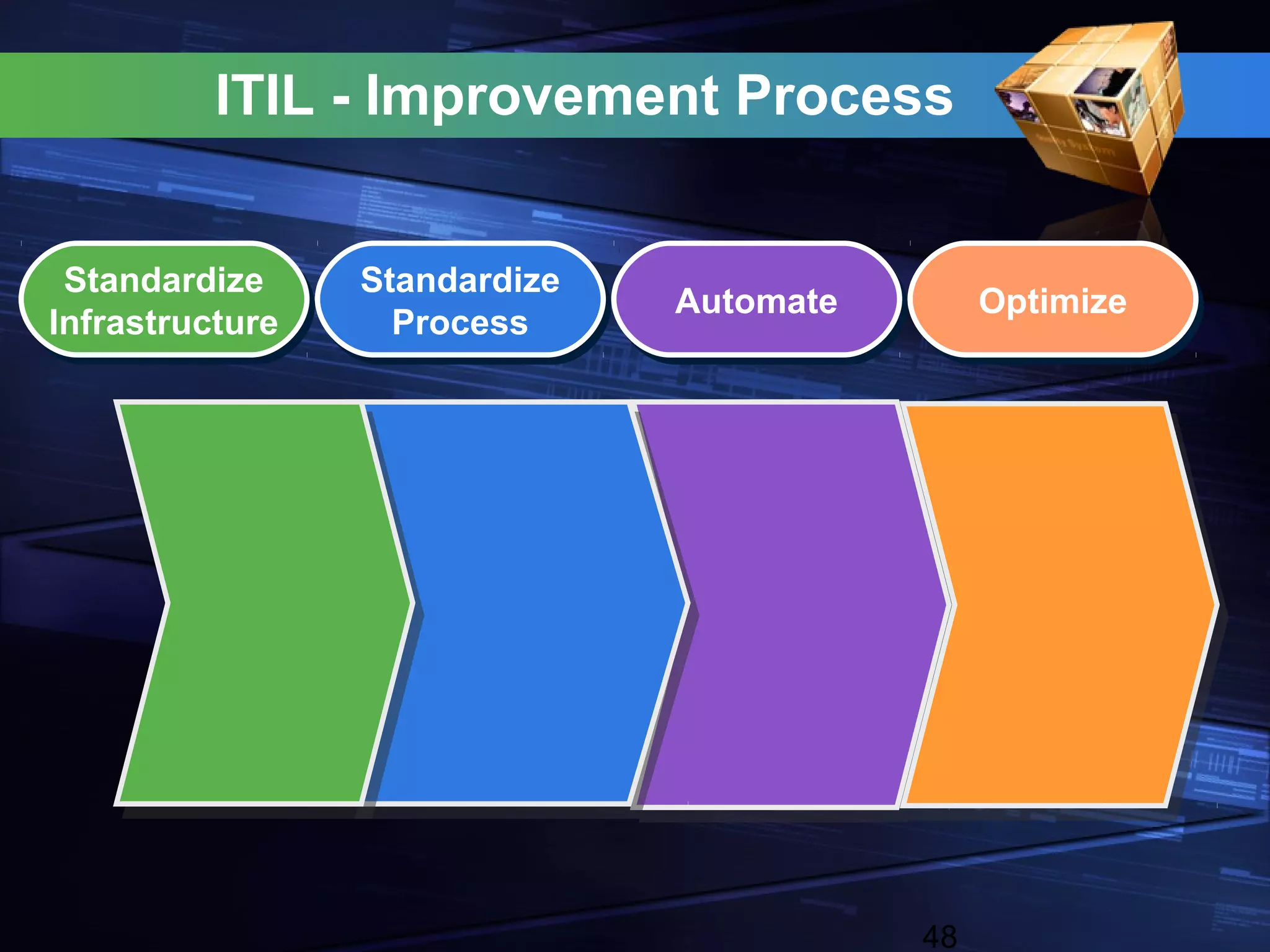
ITIL - Improvement Process


  Standardize
  Standardize     Standardize
                  Standardize   Automate
                                Automate        Optimize
                                                Optimize
Infrastructure
 Infrastructure     Process
                    Process


                                           48
References

 Influence of IT Service Management on Innovation Management: First
Insights from Exploratory Studies
                        M. Kießling*, M. Marrone† and L. M. Kolbe‡

Service Innovation Studie '04 Arthur D. Little

INNOTRAIN Project

The Seeds of Innovation (ISBN 0814471463)

SAMSUNG TRIZ

DHL FIRST CHOICE

Wikipedia


                                                    49

Innovation& it service_management_v1.2

  • 1.
    “ Driving innovation” INNOVATION inIT Service Management Ersen Celebi
  • 2.
    Contents 1 Introduction to ITSM 2 Innovation 3 Driving Innovation 4 Innovation Management 5 German Study Case 6 Case Study: Samsung 7 Case Study: DHL First Choice 8 Conclusion 9 Back-Up: ITIL 10 Q/A 2
  • 3.
    Introduction to ITSM Providers of IT services can no longer afford to focus on technology and their internal organization[;] they now have to consider the quality of the services they provide and focus on the relationship with customers  No one author, organization, or vendor owns the term "IT service management" and the origins of the phrase are unclear. http://en.wikipedia.org/wiki/ITSM 3
  • 4.
    Introduction to ITSM IT service management (ITSM or IT services) is a discipline for managing information technology (IT) systems, philosophically centered on the customer's perspective of IT's contribution to the business.  ITSM stands in deliberate contrast to technology- centered approaches to IT management and business interaction.  The ITSM framework can be defined as “a set of processes that co-operate to ensure the quality of live IT services, according to the levels of service agreed to by the customer”. 4
  • 5.
    Introduction to ITSM It can also be seen as a philosophy for orientation toward market, service, life-cycle and process in general.  The main focus of the framework is not the development of IT applications, but rather the management of services.  The most frequently adopted ITSM resource is the IT Infrastructure Library (ITIL), the de facto standard for IT Service. Other ITSM frameworks include HP ITSM, CobiT and ISO 20000.. 5
  • 6.
    Innovation Innovation can bedefined as:  “the application of new ideas to the products, processes or any other aspect of a firm’s activities.”  Innovations can also be understood as: “improvement, and when implemented in the market, they expand the competitiveness of the innovator for at least a limited amount of time”  “innovation as an idea that is new to the people involved, even though it may appear to others as an imitation.”  “Innovation is the adoption of an idea or behavior that is new to the organization adopting it” 6
  • 7.
    Driving innovation CEOs view innovation as the lifeblood of thriving organizations. They see the integration of business and technology as essential to the success of innovative efforts designed to enable organizations to reach their highest potential. IT’s ability to control service quality and costs, and to enable increased innovation, is now a business imperative. 7
  • 8.
    Driving innovation As aresult, IT can be better positioned to:  Create value by driving or responding to new project and service requests through timely, high-quality and on- budget delivery.  Manage value in real time with an agile, integrated infrastructure that runs efficiently and cost-effectively. 8
  • 9.
    Driving innovation 1 2 So many By distributing business decision rights processes and accountability, depend on IT effective these days that governance can help to ensure 3 4 when a service problem arises, service-oriented it’s often decision making IT must get out headline news. across silos. Breaking down of firefighting silos to improve mode before it service can focus on excellence customer requirements. 9
  • 10.
    Driving innovation 5 6 7 UK banking Group Managing a was to create a Service excellence service desk is centralized identity means more than more than call management model. continual process tracking—it The group improved improvement— it should provide a its ability to rapidly means continually reliable, single respond to improving and point of contact opportunities and adding value to for all service saved $11 m. the customer requests. annually trough process efficiencies 10
  • 11.
    Innovation Management  “InnovationManagement is about learning to find the most appropriate solution to the problem of consistently managing this process”  It can also be defined as: “planning, organizing, executing and controlling all activities related to the development and implementation of innovations” 11
  • 12.
    Innovation Management  Tostay competitive and to promote innovation, companies cannot rely on chance alone.  It is crucial to manage the innovation process systematically, providing both structure and goals  This necessity is based on limited financial,material and human resources 12
  • 13.
    Innovation Management Innovation Managementas consisting of five activities:  technological integration  the process of innovation  strategic technology planning  organizational change  business development 13
  • 14.
    Innovation Management The Need for Innovation: Innovation is composed of four components-creativity, strategy, implementation, and profitability.  Three Types of Innovation:  Efficiency Innovation  Evolutionary Innovation  Revolutionary Innovation  The Seeds of Innovation:  Creative Thinking  Strategic Thinking  Transformational Thinking 14
  • 15.
    Efficiency Innovation  EfficiencyInnovation focuses on identifying new ideas for improving what already exists. This approach requires minimal investment since the team is building on the past and only looking for small changes in what’s already being done.  The strategy for efficiency innovations is usually to cut costs, reduce cycle time,improve quality, offset a competitor’s move or attract new customers. Typically, only small gains are realized 15
  • 16.
    Efficiency Innovation ITSM asa Methodology to empower Innovation 16
  • 17.
    Efficiency Innovation 1. Phase1 illustrates the situation before introducing ITSM. Expressed as a ratio, 100% of the time is used for original tasks. 2. The efficiency of IT increases by using best practices. The workload from the original IT activities is reduced over the medium term. Sustained optimization and expansion of the use of ITSM can attain a further reduction of the load and open up corresponding 17
  • 18.
    Efficiency Innovation 3. Inthe third step, the innovation potential is set free. Other changes must be made to the way of thinking and acting. Using technology stabilizes the use of innovation potential 4. In the final state (for the time being), the workload is reduced and the resources thus freed up are used to create innovation on infrastructure, business process and product and service level. 18
  • 19.
    Evolutionary Innovation Evolutionary Innovationfocuses on identifying ideas that represent something distinctly new and better. An example was the introduction of automated banking machines, which changed the way banks viewed their staffing needs and shifted banking habits from set hours to banking at any hour. 19
  • 20.
    Evolutionary Innovation Evolutionary innovationrequires looking more broadly than Total Quality Management improvements and cost savings to see the bigger picture of what’s really needed in the organization and marketplace. Instead of duplicating what already exists, the team must look for new ways to bring value to the organization and the customer. 20
  • 21.
    Revolutionary Innovation Revolutionary Innovation focuses on radically new and better ideas that don’t operate within the existing structure of the organization and marketplace but may in fact dismantle that structure. For example, Dell Computer’s direct-to-consumer sales strategy in the computer industry. 21
  • 22.
    German Case Study Thisstudy is about the comparing the results of the ITSM and Innovation process implementation in different companies. Six different companies have been investigated in the scope of this study: 22
  • 23.
    German Case Study Theresults based on:  considering separately ITSM adoption and Innovation Management implementation  ‘the interviewees’ perception of the impact of ITSM on their Innovation Management. 23
  • 24.
    German Case Study Incase A:  No direct impact of ITSM on Innovation Management.  The two need to be considered as separate processes.  Only when all ITSM processes have been installed properly and reached a certain maturity level can Innovation Management follow as a next step, to optimize and develop processes. 24
  • 25.
    German Case Study CaseB:  Describes ITSM and Innovation Management as “natural enemies.”  the adoption of an innovative process distracts from the main objective of ITSM frameworks 25
  • 26.
    German Case Study CaseC:  They could identify impact of ITSM on Innovation Management. “Plan-Do- Check-Act” cycle Plan Do Innovation Management within their ITSM framework shows three basic types of impact: Check Act  significant increase of customer satisfaction  image improvement  product and service quality improvement 26
  • 27.
    German Case Study CaseD:  it is not a question for them whether there is an impact, but rather how great this impact is.  Specifically, they have noticed that, due to the faster adoption of innovations via the ITSM, customers’ needs can be handled more efficiently 27
  • 28.
    German Case Study CaseF:  For them ITSM as the superior model. After first implementing ITSM, they later introduced Innovation Management into the framework as an independent process.  Innovation Management as a new strategic process was possible since case F’s ITSM consists of not only operational processes (e.g. Incident Management) but also strategic processes 28
  • 29.
    Transformational Thinking  OrganizationalInnovation The Innovation Systems Architecture Model  Shared Innovation Vision and Strategy  Innovation Environment Supports  Innovation Resource Allocation  Innovation Process Networks  Innovation Programs  Innovation Skills Development  Innovation Rewards and Recognition  External Stakeholder Innovation (Customers and Partners) 29
  • 30.
    Transformational Thinking  TheInnovative Organization Assessment: A Holistic Approach Two ways to measure these efforts:  Innovation output  Innovation throughput 30
  • 31.
    Case Study :SAMSUNG-TRIZ Shared Innovation Vision and Strategy  At SAMSUNG VIP center the goal is to train every engineer and researcher in TRIZ think.  “We put ideas on the table they put ideas on the table and we go from there” says TRIZ specialist Lee.  SAMSUNG Six Sigma Method (SS DFSS) Drives Innovation leading with TRIZ and other tools.  TRIZ is a family of tools providing potential solution paths to technical problems.  3.000.000 patents have been investigated making the TRIZ methodology statistically significant 31
  • 32.
    TRIZ  Innovation ResourceAllocation  SAMSUNG have 50 Full Time TRIZ Experts in SAIT(SAMSUNG Advanced Institute of Technology)  Innovation Environment Supports  SAMSUNG invested TRIZ by building expertise Training & Infrastructure to Deploy TRIZ  Innovation Skills Development  Now TRIZ part of basic technology training. 32
  • 33.
    TRIZ  Innovation output:DVD Player This project resulted in  ~$100M in cost reduction  9 Patents  Reduction in components from 8 to 4  Increased reliabilty. 33
  • 34.
    ITIL approach ITIL canprovide a mechanism for fostering innovation. The value network must be addressed in order to seamlessly bring suppliers together Stakeholders demands value from IT. A common dictionary is needed. There is no value without fit for purpose and fit for use. 34
  • 35.
    ITIL approach Lower costof ownership can enable IT to address the low margin markets. Customers will ultimately base their service selection on price. Resources can be diverted to new capabilities needed to service low margin markets. Provide distinct and measurable competitive differentiation. Recovered resources can be allocated to the creation of disruptive services. Identify potential disruptive technologies. Build the markets and the supporting services. The exploitation of disruptive technologies create results. 35
  • 36.
    ITIL approach IT Leadersmust demonstrate capability for optimal IT Service delivery  Reportable metrics drive action.  Customers recognize tangible value.  Performance information is motivation for moving the needle.  Control objectives enable on-demand capability audits.  Point in time readings validate improvements.  Regulatory compliance no longer becomes an issue.  Identifies acceptable levels of risk. 36
  • 37.
    ITIL approach  Continuousimprovement is the key to success.  Deming’s PDCA  Continuous value delivery keeps customers engaged.  Creates consistent and cost-effective services. 37
  • 38.
    Conclusion Regarding to allof the content above: In a ITSM environment, innovation is supported by the Improvement Process in most of the cases. Innovative ideas can be transformed to the real life in case there is an effective Improvement process in place. There are some standards such as ITIL, which helps to increase the quality of the ITSM environment and also brings solutions to stumbling blocks for innovation. 38
  • 39.
  • 41.
    BACKUP In the followingslides you can find ITIL approach to Innovation & Innovation Management in a ITSM environment: 41
  • 42.
    ITIL The Information Technology InfrastructureLibrary® (ITIL®) helps companies and government agencies improve the quality and reduce the costs of IT services that support their business objectives. 42
  • 43.
    ITIL The Federal governmentrecognized that by leveraging ITIL’s recommendations and best practices agency IT departments could decrease overall IT spending and continually improve IT service management. 43
  • 44.
    ITIL History  ITILoriginated in the 1980s when the British government determined that it was not receiving a sufficient level of IT service quality.  First released as the Government Information Technology Infrastructure Management (GITIM) framework by the United Kingdom’s Office of Government Commerce, this series of 31 books provided best practices and guidelines for managing and maintaining IT infrastructures. 44
  • 45.
    ITIL History  Inthe 1990s, the second version of ITIL was released and rapidly accepted by companies and government agencies in Europe and throughout the world. With ITIL V2, the number of books was reduced from the original 31 to 10. 45
  • 46.
    ITIL History  In2007, ITIL V3 was introduced. With ITIL V3, V2’s ten books were consolidated into five books, each approximately 300 pages in length and dedicated to a major activities such as:  Service Strategy  Service Design  Service Transition,  Service Operation  Continual Service Improvement (Innovation Management) 46
  • 47.
    ITIL - ContinualService Improvement Continual Service Improvement describes proven practices for continual improvement in the quality of the services that the IT organization delivers to the business. Key areas of this volume are : Service Reporting Service Measurement Business Service Level Management. 47
  • 48.
    ITIL - ImprovementProcess Standardize Standardize Standardize Standardize Automate Automate Optimize Optimize Infrastructure Infrastructure Process Process 48
  • 49.
    References  Influence ofIT Service Management on Innovation Management: First Insights from Exploratory Studies M. Kießling*, M. Marrone† and L. M. Kolbe‡ Service Innovation Studie '04 Arthur D. Little INNOTRAIN Project The Seeds of Innovation (ISBN 0814471463) SAMSUNG TRIZ DHL FIRST CHOICE Wikipedia 49