INTRODUCTORY SEMINAR
LECTURE
7th May 2013
Leonard Raphael
 The role of innovation
 What is innovation?
 What is innovation management?
The aim of innovation...
 Depends on the type of firm
 Goal is mostly to survive, to grow, to
make profit
 R&D departments generally strive for
the best technical solution...
 ... but what matters for innovation is
how it influences survival chances,
profit and growth opportunities!
Innovation management.....
 Has to be understood as a core process of
the organisation -> It is related to what is
being produced
 Is a long term race
 Is about continuity
 Has to deal with complexity!!
 Is about being systematic  developing
routines around innovation
 Invention
 Technology
 Innovation
 Creating new or improved products,
processes and services
 Knowledge and learning
 Uncertainty
 An ’invention’ is an idea, a sketch or model for
a new or improved device, product, process
or system. It has not yet entered to economic
system, and most inventions never do so.
 An ’innovation’ is accomplished only with the
first commercial transaction involving the
new product, process, system or device. It is
part of the economic system.
Product innovation: changes in the things
(products or services) which an
organisation offers
Process innovation: changes in the ways in
which they are created an delivered
Position innovation: changes in the context
in which the product or services are
introduced
Paradigm innovation: changes in the
underlying mental modes which frame what
an organisation does
The ‘4Ps’ of innovation
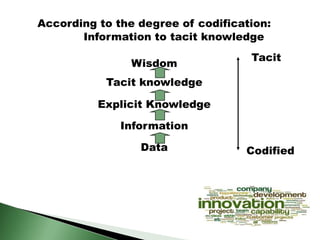
According to the degree of codification:
Information to tacit knowledge
Wisdom
Tacit knowledge
Explicit Knowledge
Information
Data
Tacit
Codified
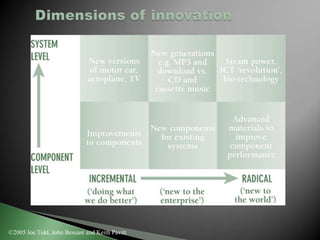
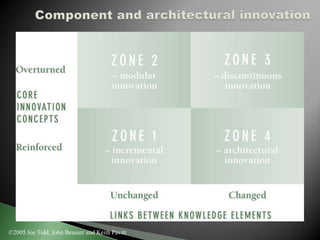
©2005 Joe Tidd, John Bessant and Keith Pavitt
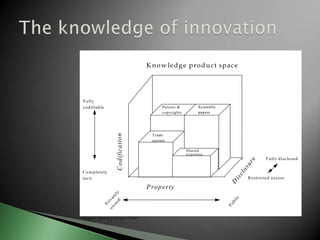
Patents &
copyrights
Scientific
papers
Scientific
papers
Trade
secrets
Trade
secrets
Shared
expertise
Codification
Property
D
isclosure
Completely
tacit
Fully
codifiablePrivately
ow
ned
Public
Restricted access
Fully disclosed
Know ledge product space
Source: David y Foray (1994)
 New market emerges
 New technology emerges
 New political rules emerge
 Running out of road
 Change in market sentiment or behaviour
 Deregulation or reregulation
 Fractures along ’fault lines’
 Unthinkable events
 Business model innovation
 Shifts in techno-economic paradigm
 Architectural innovation
 Type of sector
 Size of firm
 The country and region
 The stage in the industry life cycle
 Political regulations
 Globalisation
 Sustainability
 Networking organisation
The transitional phase
A dominant design
 Convergence around one design
 Rolling bandwagon → innovation channeled around
a core set of possibilities → a technological
trajectory
Imitation and development
 Reliability, cheaply, higher functionality, quality
 The specific phase
 Rationalisation & scale economies
 Differentiation through customisation
 Scope for innovation becomes smaller
 Different kind of innovations
 Context specific
 Innovation has different stages
 Knowledge is the key

Seminar presentation-innovation-slides

  • 2.
  • 3.
     The roleof innovation  What is innovation?  What is innovation management?
  • 4.
    The aim ofinnovation...  Depends on the type of firm  Goal is mostly to survive, to grow, to make profit  R&D departments generally strive for the best technical solution...  ... but what matters for innovation is how it influences survival chances, profit and growth opportunities!
  • 5.
    Innovation management.....  Hasto be understood as a core process of the organisation -> It is related to what is being produced  Is a long term race  Is about continuity  Has to deal with complexity!!  Is about being systematic  developing routines around innovation
  • 6.
     Invention  Technology Innovation  Creating new or improved products, processes and services  Knowledge and learning  Uncertainty
  • 7.
     An ’invention’is an idea, a sketch or model for a new or improved device, product, process or system. It has not yet entered to economic system, and most inventions never do so.  An ’innovation’ is accomplished only with the first commercial transaction involving the new product, process, system or device. It is part of the economic system.
  • 8.
    Product innovation: changesin the things (products or services) which an organisation offers Process innovation: changes in the ways in which they are created an delivered Position innovation: changes in the context in which the product or services are introduced Paradigm innovation: changes in the underlying mental modes which frame what an organisation does The ‘4Ps’ of innovation
  • 9.
    According to thedegree of codification: Information to tacit knowledge Wisdom Tacit knowledge Explicit Knowledge Information Data Tacit Codified
  • 10.
    ©2005 Joe Tidd,John Bessant and Keith Pavitt
  • 11.
    ©2005 Joe Tidd,John Bessant and Keith Pavitt
  • 12.
  • 13.
     New marketemerges  New technology emerges  New political rules emerge  Running out of road  Change in market sentiment or behaviour  Deregulation or reregulation  Fractures along ’fault lines’  Unthinkable events  Business model innovation  Shifts in techno-economic paradigm  Architectural innovation
  • 14.
     Type ofsector  Size of firm  The country and region  The stage in the industry life cycle  Political regulations
  • 15.
  • 16.
    The transitional phase Adominant design  Convergence around one design  Rolling bandwagon → innovation channeled around a core set of possibilities → a technological trajectory Imitation and development  Reliability, cheaply, higher functionality, quality  The specific phase  Rationalisation & scale economies  Differentiation through customisation  Scope for innovation becomes smaller
  • 17.
     Different kindof innovations  Context specific  Innovation has different stages  Knowledge is the key