Innovative EC Systems: From E-Government to
E-Learning, Collaborative Commerce, and C2C Commerce
Learning Objectives
1. Describe various e-government initiatives.
2. Describe e-government activities and
implementation issues including e-government 2.0
and m-government.
3. Describe e-learning, virtual universities, and e-
training.
4. Describe e-books and their readers.
Copyright © 2012 Pearson Education 5-1
Learning Objectives
5. Describe knowledge management and dissemination
as an e-business.
6. Describe and discuss online advisory systems.
7. Describe collaborative e-commerce.
8. Describe collaboration 2.0.
9. Describe C2C activities in e-commerce.
Copyright © 2012 Pearson Education 5-2
E-Government: An Overview
e-government
E-commerce model in which a government entity buys
or provides goods, services, or information to
businesses or individual citizens
government-to-citizens (G2C)
E-government category that includes all the
interactions between a government and its citizens
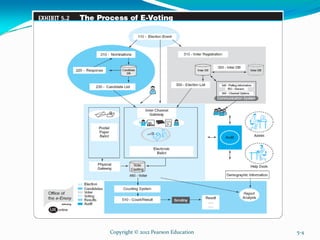
Electronic Voting
Electronic Benefits Transfer
Copyright © 2012 Pearson Education 5-3
Copyright © 2012 Pearson Education 5-4
E-Government: An Overview
government-to-business (G2B)
E-government category that includes interactions
between governments and businesses (government
selling to businesses and providing them with services
and businesses selling products and services to the
government)
Government E-Procurement
Group Purchasing
Copyright © 2012 Pearson Education 5-5
E-Government: An Overview
government-to-government (G2G)
E-government category that includes activities within
government units and those between governments
government-to-employees (G2E)
E-government category that includes activities and
services between government units and their
employees
Internal Efficiency and Effectiveness (IEE)
Copyright © 2012 Pearson Education 5-6
E-Government: An Overview
IMPLEMENTING E-GOVERNMENT
THE TRANSFORMATION TO E-GOVERNMENT
Government 2.0
How government makes use of Web 2.0 technologies
to interact with citizens and provide government
services
The Promise of Government 2.0
Copyright © 2012 Pearson Education 5-7
E-Government: An Overview
mobile government (m-government)
The wireless implementation of e-government mostly
to citizens but also to businesses
The Benefits of M-Government
Some Implementation Issues
Applications
Copyright © 2012 Pearson Education 5-8
E-Learning, E-Training, and E-Books
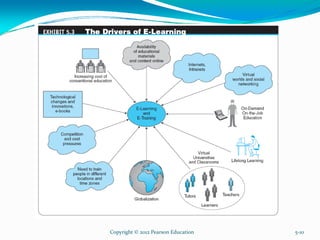
e-learning
The online delivery of information for purposes of
education, training, or knowledge management
BENEFITS AND DRAWBACKS OF E-LEARNING
Copyright © 2012 Pearson Education 5-9
Copyright © 2012 Pearson Education 5-10
E-Learning, E-Training, and E-Books
distance learning
Formal education that takes place off campus, usually,
but not always, through online resources
virtual university
An online university from which students take classes
from home or other offsite locations, usually via the
Internet
Innovations in E-Learning
Copyright © 2012 Pearson Education 5-11
E-Learning, E-Training, and E-Books
ONLINE CORPORATE TRAINING
Examples of Corporate Training
social learning
Learning, training, and knowledge sharing in social
networks and by using social software tools for
learning
Copyright © 2012 Pearson Education 5-12
E-Learning, E-Training, and E-Books
LEARNING IN VIRTUAL WORLDS AND SECOND
LIFE
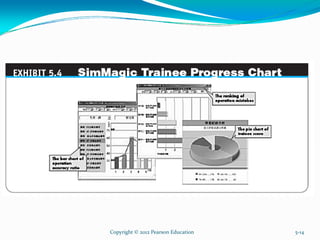
VISUAL INTERACTIVE SIMULATION
learning on-demand
Learning provided to an employee while the work is being
done (in terms of troubleshooting or performance support)
In a learning on-demand environment, courses, references,
help files, documents, Webcasts, audios, videos, books, and
presentations are all made available when and where a worker
needs them.
Copyright © 2012 Pearson Education 5-13
Copyright © 2012 Pearson Education 5-14
E-Learning, E-Training, and E-Books
learning management system (LMS)
Software applications for the administration,
documentation, tracking, and reporting of training
programs, classroom and online events, e-learning
programs, and training content
IMPLEMENTING E-LEARNING AND E-TRAINING
Some Representative E-Learning Tools
Copyright © 2012 Pearson Education 5-15
E-Learning, E-Training, and E-Books
electronic book (e-book)
A book in digital form that can be read on a computer
screen or on a special device
Devices for Reading E-Books
Advantages and Limitations of E-Books
Copyright © 2012 Pearson Education 5-16
Knowledge Management, Advisory
Systems, and Electronic Commerce
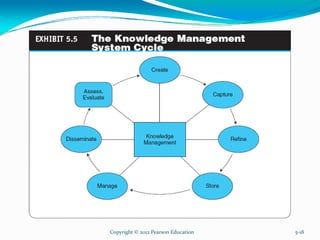
knowledge management (KM)
The process of capturing or creating knowledge, storing it,
updating it constantly, disseminating it, and using it
whenever necessary
KM TYPES AND ACTIVITIES
Create knowledge
Capture knowledge
Refine knowledge
Store knowledge
Manage knowledge
Disseminate knowledge
Copyright © 2012 Pearson Education 5-17
Copyright © 2012 Pearson Education 5-18
Knowledge Management, Advisory
Systems, and Electronic Commerce
KNOWLEDGE SHARING
Software Tools for Knowledge Sharing
HOW IS KNOWLEDGE MANAGEMENT RELATED
TO E-COMMERCE?
KM AND SOCIAL NETWORKS
Knowledge creation
Knowledge sharing
DEPLOYING KM TECHNOLOGIES
Copyright © 2012 Pearson Education 5-19
Knowledge Management, Advisory
Systems, and Electronic Commerce
ONLINE ADVICE AND CONSULTING
Medical advice
Management consulting
Legal advice
Gurus
Financial advice
Social networks
Other advisory services
Copyright © 2012 Pearson Education 5-20
Knowledge Management, Advisory
Systems, and Electronic Commerce
automated question/answer (QA) system
A system that locates, extracts, and provides specific
answers to user questions expressed in natural
language
Live Chat with Experts
Copyright © 2012 Pearson Education 5-21
Knowledge Management, Advisory
Systems, and Electronic Commerce
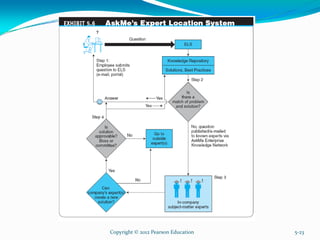
expert location systems (ELS)
Interactive computerized systems that help employees
find and connect with colleagues who have expertise
required for specific problems—whether they are
across the country or across the room—in order to
solve specific, critical business problems in seconds
Seeking Expertise in Social Networks
Copyright © 2012 Pearson Education 5-22
Copyright © 2012 Pearson Education 5-23
Collaborative Commerce
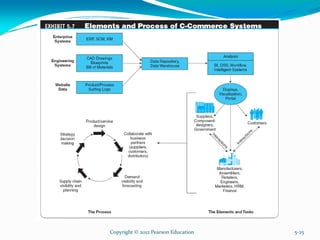
collaborative commerce (c-commerce)
The use of digital technologies that enable companies
to collaboratively plan, design, develop, manage, and
research products, services, and innovative EC
applications
collaboration hub (c-hub)
The central point of control for an e-market; a single c-
hub, representing one e-market owner, can host
multiple collaboration spaces (c-spaces) in which
trading partners use c-enablers to exchange data with
the c-hub
Copyright © 2012 Pearson Education 5-24
Copyright © 2012 Pearson Education 5-25
Collaborative Commerce
REPRESENTATIVE EXAMPLES OF
COLLABORATIVE COMMERCE
vendor-managed inventory (VMI)
A system in which retailers make their suppliers fully
responsible for determining when to order and possibly
how much to order
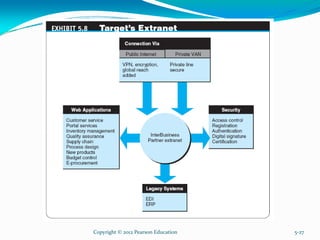
Retailer-Supplier Collaboration
Example: Target
Copyright © 2012 Pearson Education 5-26
Copyright © 2012 Pearson Education 5-27
Collaborative Commerce
Reducing Transportation and Inventory Costs
Reduction of Design Cycle Time
Reduction of Product Development Time
Elimination of Channel Conflict: Collaboration
with Dealers and Retailers
IMPLEMENTING C-COMMERCE
BARRIERS TO C-COMMERCE
Overcoming Barriers to Collaboration
Copyright © 2012 Pearson Education 5-28
Consumer-to-Consumer
Electronic Commerce
consumer-to-consumer (C2C) EC
E-commerce model in which consumers sell directly to
other consumers
E-COMMERCE: C2C APPLICATIONS
C2C Auctions
Classified Ads
Personal Services
File-Sharing Utilities: Napster and Others
C2C Activities in Social Networks and Trading
Virtual Properties
Copyright © 2012 Pearson Education 5-29
Managerial Issues
1. What are the e-government opportunities?
2. How do we design the most cost-efficient
government e-procurement system?
3. How do we design the portfolio of e-learning
knowledge sources?
4. How do we incorporate social networking–based
learning and services in our organization?
5. What will the impact be of the e-book platform?
Copyright © 2012 Pearson Education 5-30
Managerial Issues
6. How do we connect our expert location system and
social networking initiatives?
7. How difficult is it to introduce e-collaboration?
8. Can we capitalize on C2C EC?
9. How much can be shared with business partners?
10. Who benefits from vendor-managed inventory?
Copyright © 2012 Pearson Education 5-31
Summary
1. E-government activities
2. Implementing e-government to citizens, businesses,
and its own operations
3. E-learning and training
4. E-books and their readers
5. Knowledge management and dissemination as an e-
business
Copyright © 2012 Pearson Education 5-32
Summary
6. Online advisory systems
7. C-commerce
8. Collaboration 2.0
9. C2C activities
Copyright © 2012 Pearson Education 5-33
Copyright © 2012 Pearson Education 5-34
All rights reserved. No part of this publication may be reproduced, stored in a
retrieval system, or transmitted, in any form or by any means, electronic,
mechanical, photocopying, recording, or otherwise, without the prior written
permission of the publisher. Printed in the United States of America.
Copyright © 2012 Pearson Education

Innovative ec systems from e government to e-learning, collaborative commerce, and c2 c commerce

  • 1.
    Innovative EC Systems:From E-Government to E-Learning, Collaborative Commerce, and C2C Commerce
  • 2.
    Learning Objectives 1. Describevarious e-government initiatives. 2. Describe e-government activities and implementation issues including e-government 2.0 and m-government. 3. Describe e-learning, virtual universities, and e- training. 4. Describe e-books and their readers. Copyright © 2012 Pearson Education 5-1
  • 3.
    Learning Objectives 5. Describeknowledge management and dissemination as an e-business. 6. Describe and discuss online advisory systems. 7. Describe collaborative e-commerce. 8. Describe collaboration 2.0. 9. Describe C2C activities in e-commerce. Copyright © 2012 Pearson Education 5-2
  • 4.
    E-Government: An Overview e-government E-commercemodel in which a government entity buys or provides goods, services, or information to businesses or individual citizens government-to-citizens (G2C) E-government category that includes all the interactions between a government and its citizens Electronic Voting Electronic Benefits Transfer Copyright © 2012 Pearson Education 5-3
  • 5.
    Copyright © 2012Pearson Education 5-4
  • 6.
    E-Government: An Overview government-to-business(G2B) E-government category that includes interactions between governments and businesses (government selling to businesses and providing them with services and businesses selling products and services to the government) Government E-Procurement Group Purchasing Copyright © 2012 Pearson Education 5-5
  • 7.
    E-Government: An Overview government-to-government(G2G) E-government category that includes activities within government units and those between governments government-to-employees (G2E) E-government category that includes activities and services between government units and their employees Internal Efficiency and Effectiveness (IEE) Copyright © 2012 Pearson Education 5-6
  • 8.
    E-Government: An Overview IMPLEMENTINGE-GOVERNMENT THE TRANSFORMATION TO E-GOVERNMENT Government 2.0 How government makes use of Web 2.0 technologies to interact with citizens and provide government services The Promise of Government 2.0 Copyright © 2012 Pearson Education 5-7
  • 9.
    E-Government: An Overview mobilegovernment (m-government) The wireless implementation of e-government mostly to citizens but also to businesses The Benefits of M-Government Some Implementation Issues Applications Copyright © 2012 Pearson Education 5-8
  • 10.
    E-Learning, E-Training, andE-Books e-learning The online delivery of information for purposes of education, training, or knowledge management BENEFITS AND DRAWBACKS OF E-LEARNING Copyright © 2012 Pearson Education 5-9
  • 11.
    Copyright © 2012Pearson Education 5-10
  • 12.
    E-Learning, E-Training, andE-Books distance learning Formal education that takes place off campus, usually, but not always, through online resources virtual university An online university from which students take classes from home or other offsite locations, usually via the Internet Innovations in E-Learning Copyright © 2012 Pearson Education 5-11
  • 13.
    E-Learning, E-Training, andE-Books ONLINE CORPORATE TRAINING Examples of Corporate Training social learning Learning, training, and knowledge sharing in social networks and by using social software tools for learning Copyright © 2012 Pearson Education 5-12
  • 14.
    E-Learning, E-Training, andE-Books LEARNING IN VIRTUAL WORLDS AND SECOND LIFE VISUAL INTERACTIVE SIMULATION learning on-demand Learning provided to an employee while the work is being done (in terms of troubleshooting or performance support) In a learning on-demand environment, courses, references, help files, documents, Webcasts, audios, videos, books, and presentations are all made available when and where a worker needs them. Copyright © 2012 Pearson Education 5-13
  • 15.
    Copyright © 2012Pearson Education 5-14
  • 16.
    E-Learning, E-Training, andE-Books learning management system (LMS) Software applications for the administration, documentation, tracking, and reporting of training programs, classroom and online events, e-learning programs, and training content IMPLEMENTING E-LEARNING AND E-TRAINING Some Representative E-Learning Tools Copyright © 2012 Pearson Education 5-15
  • 17.
    E-Learning, E-Training, andE-Books electronic book (e-book) A book in digital form that can be read on a computer screen or on a special device Devices for Reading E-Books Advantages and Limitations of E-Books Copyright © 2012 Pearson Education 5-16
  • 18.
    Knowledge Management, Advisory Systems,and Electronic Commerce knowledge management (KM) The process of capturing or creating knowledge, storing it, updating it constantly, disseminating it, and using it whenever necessary KM TYPES AND ACTIVITIES Create knowledge Capture knowledge Refine knowledge Store knowledge Manage knowledge Disseminate knowledge Copyright © 2012 Pearson Education 5-17
  • 19.
    Copyright © 2012Pearson Education 5-18
  • 20.
    Knowledge Management, Advisory Systems,and Electronic Commerce KNOWLEDGE SHARING Software Tools for Knowledge Sharing HOW IS KNOWLEDGE MANAGEMENT RELATED TO E-COMMERCE? KM AND SOCIAL NETWORKS Knowledge creation Knowledge sharing DEPLOYING KM TECHNOLOGIES Copyright © 2012 Pearson Education 5-19
  • 21.
    Knowledge Management, Advisory Systems,and Electronic Commerce ONLINE ADVICE AND CONSULTING Medical advice Management consulting Legal advice Gurus Financial advice Social networks Other advisory services Copyright © 2012 Pearson Education 5-20
  • 22.
    Knowledge Management, Advisory Systems,and Electronic Commerce automated question/answer (QA) system A system that locates, extracts, and provides specific answers to user questions expressed in natural language Live Chat with Experts Copyright © 2012 Pearson Education 5-21
  • 23.
    Knowledge Management, Advisory Systems,and Electronic Commerce expert location systems (ELS) Interactive computerized systems that help employees find and connect with colleagues who have expertise required for specific problems—whether they are across the country or across the room—in order to solve specific, critical business problems in seconds Seeking Expertise in Social Networks Copyright © 2012 Pearson Education 5-22
  • 24.
    Copyright © 2012Pearson Education 5-23
  • 25.
    Collaborative Commerce collaborative commerce(c-commerce) The use of digital technologies that enable companies to collaboratively plan, design, develop, manage, and research products, services, and innovative EC applications collaboration hub (c-hub) The central point of control for an e-market; a single c- hub, representing one e-market owner, can host multiple collaboration spaces (c-spaces) in which trading partners use c-enablers to exchange data with the c-hub Copyright © 2012 Pearson Education 5-24
  • 26.
    Copyright © 2012Pearson Education 5-25
  • 27.
    Collaborative Commerce REPRESENTATIVE EXAMPLESOF COLLABORATIVE COMMERCE vendor-managed inventory (VMI) A system in which retailers make their suppliers fully responsible for determining when to order and possibly how much to order Retailer-Supplier Collaboration Example: Target Copyright © 2012 Pearson Education 5-26
  • 28.
    Copyright © 2012Pearson Education 5-27
  • 29.
    Collaborative Commerce Reducing Transportationand Inventory Costs Reduction of Design Cycle Time Reduction of Product Development Time Elimination of Channel Conflict: Collaboration with Dealers and Retailers IMPLEMENTING C-COMMERCE BARRIERS TO C-COMMERCE Overcoming Barriers to Collaboration Copyright © 2012 Pearson Education 5-28
  • 30.
    Consumer-to-Consumer Electronic Commerce consumer-to-consumer (C2C)EC E-commerce model in which consumers sell directly to other consumers E-COMMERCE: C2C APPLICATIONS C2C Auctions Classified Ads Personal Services File-Sharing Utilities: Napster and Others C2C Activities in Social Networks and Trading Virtual Properties Copyright © 2012 Pearson Education 5-29
  • 31.
    Managerial Issues 1. Whatare the e-government opportunities? 2. How do we design the most cost-efficient government e-procurement system? 3. How do we design the portfolio of e-learning knowledge sources? 4. How do we incorporate social networking–based learning and services in our organization? 5. What will the impact be of the e-book platform? Copyright © 2012 Pearson Education 5-30
  • 32.
    Managerial Issues 6. Howdo we connect our expert location system and social networking initiatives? 7. How difficult is it to introduce e-collaboration? 8. Can we capitalize on C2C EC? 9. How much can be shared with business partners? 10. Who benefits from vendor-managed inventory? Copyright © 2012 Pearson Education 5-31
  • 33.
    Summary 1. E-government activities 2.Implementing e-government to citizens, businesses, and its own operations 3. E-learning and training 4. E-books and their readers 5. Knowledge management and dissemination as an e- business Copyright © 2012 Pearson Education 5-32
  • 34.
    Summary 6. Online advisorysystems 7. C-commerce 8. Collaboration 2.0 9. C2C activities Copyright © 2012 Pearson Education 5-33
  • 35.
    Copyright © 2012Pearson Education 5-34 All rights reserved. No part of this publication may be reproduced, stored in a retrieval system, or transmitted, in any form or by any means, electronic, mechanical, photocopying, recording, or otherwise, without the prior written permission of the publisher. Printed in the United States of America. Copyright © 2012 Pearson Education