5-1
Electronic Commerce
Chapter 5
5-2
Learning Objectives
• Define e-commerce and describe how it differs from e-
business
• Identify the unique features of e-commerce technology
and discuss their business significance
• Describe the major types of e-commerce
• Understand the visions and forces behind the E-
commerce
• Understand the limitations of E-commerce
• Identify the major academic disciplines contributing to e-
commerce research
E-commerce Defined
• E-commerce involves digitally enabled
commercial transactions between and
among organizations and individuals
• Digitally enabled transactions include all
transactions mediated by digital technology
• Commercial transactions involve the
exchange of value across organizational or
individual boundaries in return for products
or services
5-3
E-commerce vs. E-business
• Debate among consultants and academics
about meanings and limitations of terms e-
commerce and e-business
• We use the term e-business to refer primarily
to the digital enablement of transactions and
processes within a firm, involving information
systems under the control of the firm
• E-business does not include commercial
transactions involving an exchange of value
across organizational boundaries
5-4
Seven Unique Features of E-commerce
Technology and Their Significance
• Is ubiquitous (available everywhere, all the time)
• Offers global reach (across cultural/national boundaries)
• Operates according to universal standards (lowers market
entry for merchants and search costs for consumers)
• Provides information richness (more powerful selling
environment)
• Is interactive (can simulate face-to-face experience, but on
global scale)
• Increases information density (amount and quality of
information available to all market participants)
• Permits personalization/customization
5-5
Slide 1-6
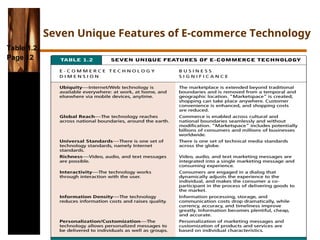
Seven Unique Features of E-commerce Technology
Table 1.2,
Page 12
Types of E-commerce
Classified by nature of market
relationship
• Business-to-Consumer (B2C)
• Business-to-Business (B2B)
• Consumer-to-Consumer (C2C)
5-7
Business-to-Consumer (B2C)
E-commerce
• Involves online businesses attempting to
reach individual consumers
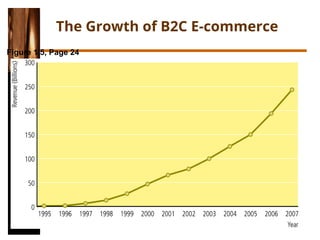
• In 2010, total B2C revenues were about
$255 billion
• Many types of business models within
this category including online retailers,
content providers, portals, transaction
brokers, service providers, market
creators and community providers
5-8
Business-to-Business (B2B)
E-commerce
• Involves businesses focusing on selling to other
businesses
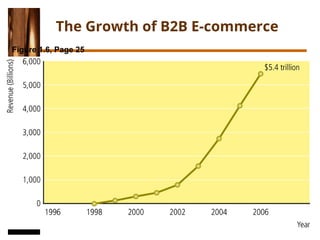
• Largest form of e-commerce ($3.6 trillion in
2010)
• Two primary business models within B2B:
 Net marketplaces (includes e-distributors, e-
procurement companies, exchanges and
industry consortia)
 Private industrial networks (includes single
firm networks and industry-wide networks)
5-9
Consumer-to-Consumer (C2C) E-
commerce
• Provides a way for consumers to sell to each
other, with the help of an online market maker
• eBay most well-known example
• Estimated that size of C2C commerce will
reach $80 billion by 2010
5-10
E-government
• Use of Internet technologies and e-commerce to
deliver information and services to citizens
– Gives citizens more access to information
– Allows for more feedback from citizens
– Facilitates fundamental changes in relationships between
citizen and government
• Types
– Government-to-citizens (G2C)
• Electronic benefits transfer, payment of taxes
– Government-to-business (G2B)
• RFQs, RFBs, reverse auctions
– Government-to-government (G2G)
• Sharing of databases, information
5-11
E-learning
• Online delivery of information for educational or
training purposes
• Benefits
– Eliminates barriers of time, distance, socioeconomic
status
– Saves money, reduces travel time
– Increases access to experts
– Enables large numbers to take classes
– Provides on-demand, self-paced learning
• Limitations
– Special training for instructors and students
– Requires special equipment and support services
– Lack of face-to-face interaction
5-12
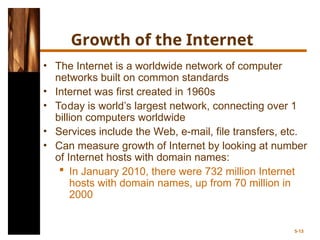
Growth of the Internet
• The Internet is a worldwide network of computer
networks built on common standards
• Internet was first created in 1960s
• Today is world’s largest network, connecting over 1
billion computers worldwide
• Services include the Web, e-mail, file transfers, etc.
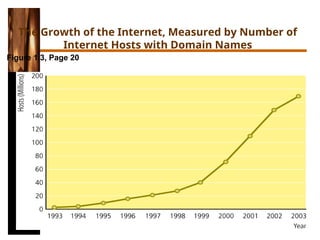
• Can measure growth of Internet by looking at number
of Internet hosts with domain names:
 In January 2010, there were 732 million Internet
hosts with domain names, up from 70 million in
2000
5-13
Copyright © 2004 Pearson Education, Inc. Slide 1-14
The Growth of the Internet, Measured by Number of
Internet Hosts with Domain Names
Figure 1.3, Page 20
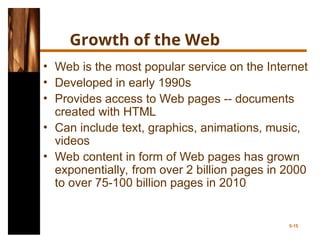
Growth of the Web
• Web is the most popular service on the Internet
• Developed in early 1990s
• Provides access to Web pages -- documents
created with HTML
• Can include text, graphics, animations, music,
videos
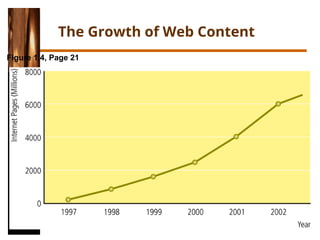
• Web content in form of Web pages has grown
exponentially, from over 2 billion pages in 2000
to over 75-100 billion pages in 2010
5-15
Copyright © 2004 Pearson Education, Inc. Slide 1-16
The Growth of Web Content
Figure 1.4, Page 21
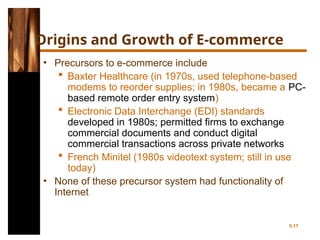
Origins and Growth of E-commerce
• Precursors to e-commerce include
 Baxter Healthcare (in 1970s, used telephone-based
modems to reorder supplies; in 1980s, became a PC-
based remote order entry system)
 Electronic Data Interchange (EDI) standards
developed in 1980s; permitted firms to exchange
commercial documents and conduct digital
commercial transactions across private networks
 French Minitel (1980s videotext system; still in use
today)
• None of these precursor system had functionality of
Internet
5-17
Copyright © 2004 Pearson Education, Inc. Slide 1-18
The Growth of B2C E-commerce
Figure 1.5, Page 24
Copyright © 2004 Pearson Education, Inc. Slide 1-19
The Growth of B2B E-commerce
Figure 1.6, Page 25
Copyright © 2004 Pearson Education, Inc. Slide 1-20
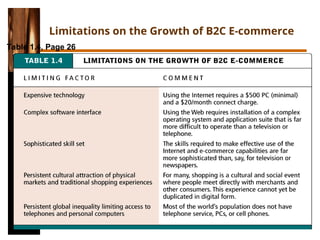
Limitations on the Growth of B2C E-commerce
Table 1.4, Page 26
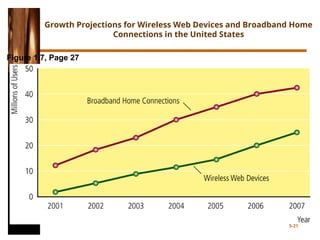
Growth Projections for Wireless Web Devices and Broadband Home
Connections in the United States
Figure 1.7, Page 27
5-21
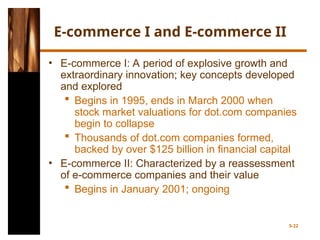
E-commerce I and E-commerce II
• E-commerce I: A period of explosive growth and
extraordinary innovation; key concepts developed
and explored
 Begins in 1995, ends in March 2000 when
stock market valuations for dot.com companies
begin to collapse
 Thousands of dot.com companies formed,
backed by over $125 billion in financial capital
• E-commerce II: Characterized by a reassessment
of e-commerce companies and their value
 Begins in January 2001; ongoing
5-22

Management information technology lecture 5

  • 1.
  • 2.
    5-2 Learning Objectives • Definee-commerce and describe how it differs from e- business • Identify the unique features of e-commerce technology and discuss their business significance • Describe the major types of e-commerce • Understand the visions and forces behind the E- commerce • Understand the limitations of E-commerce • Identify the major academic disciplines contributing to e- commerce research
  • 3.
    E-commerce Defined • E-commerceinvolves digitally enabled commercial transactions between and among organizations and individuals • Digitally enabled transactions include all transactions mediated by digital technology • Commercial transactions involve the exchange of value across organizational or individual boundaries in return for products or services 5-3
  • 4.
    E-commerce vs. E-business •Debate among consultants and academics about meanings and limitations of terms e- commerce and e-business • We use the term e-business to refer primarily to the digital enablement of transactions and processes within a firm, involving information systems under the control of the firm • E-business does not include commercial transactions involving an exchange of value across organizational boundaries 5-4
  • 5.
    Seven Unique Featuresof E-commerce Technology and Their Significance • Is ubiquitous (available everywhere, all the time) • Offers global reach (across cultural/national boundaries) • Operates according to universal standards (lowers market entry for merchants and search costs for consumers) • Provides information richness (more powerful selling environment) • Is interactive (can simulate face-to-face experience, but on global scale) • Increases information density (amount and quality of information available to all market participants) • Permits personalization/customization 5-5
  • 6.
    Slide 1-6 Seven UniqueFeatures of E-commerce Technology Table 1.2, Page 12
  • 7.
    Types of E-commerce Classifiedby nature of market relationship • Business-to-Consumer (B2C) • Business-to-Business (B2B) • Consumer-to-Consumer (C2C) 5-7
  • 8.
    Business-to-Consumer (B2C) E-commerce • Involvesonline businesses attempting to reach individual consumers • In 2010, total B2C revenues were about $255 billion • Many types of business models within this category including online retailers, content providers, portals, transaction brokers, service providers, market creators and community providers 5-8
  • 9.
    Business-to-Business (B2B) E-commerce • Involvesbusinesses focusing on selling to other businesses • Largest form of e-commerce ($3.6 trillion in 2010) • Two primary business models within B2B:  Net marketplaces (includes e-distributors, e- procurement companies, exchanges and industry consortia)  Private industrial networks (includes single firm networks and industry-wide networks) 5-9
  • 10.
    Consumer-to-Consumer (C2C) E- commerce •Provides a way for consumers to sell to each other, with the help of an online market maker • eBay most well-known example • Estimated that size of C2C commerce will reach $80 billion by 2010 5-10
  • 11.
    E-government • Use ofInternet technologies and e-commerce to deliver information and services to citizens – Gives citizens more access to information – Allows for more feedback from citizens – Facilitates fundamental changes in relationships between citizen and government • Types – Government-to-citizens (G2C) • Electronic benefits transfer, payment of taxes – Government-to-business (G2B) • RFQs, RFBs, reverse auctions – Government-to-government (G2G) • Sharing of databases, information 5-11
  • 12.
    E-learning • Online deliveryof information for educational or training purposes • Benefits – Eliminates barriers of time, distance, socioeconomic status – Saves money, reduces travel time – Increases access to experts – Enables large numbers to take classes – Provides on-demand, self-paced learning • Limitations – Special training for instructors and students – Requires special equipment and support services – Lack of face-to-face interaction 5-12
  • 13.
    Growth of theInternet • The Internet is a worldwide network of computer networks built on common standards • Internet was first created in 1960s • Today is world’s largest network, connecting over 1 billion computers worldwide • Services include the Web, e-mail, file transfers, etc. • Can measure growth of Internet by looking at number of Internet hosts with domain names:  In January 2010, there were 732 million Internet hosts with domain names, up from 70 million in 2000 5-13
  • 14.
    Copyright © 2004Pearson Education, Inc. Slide 1-14 The Growth of the Internet, Measured by Number of Internet Hosts with Domain Names Figure 1.3, Page 20
  • 15.
    Growth of theWeb • Web is the most popular service on the Internet • Developed in early 1990s • Provides access to Web pages -- documents created with HTML • Can include text, graphics, animations, music, videos • Web content in form of Web pages has grown exponentially, from over 2 billion pages in 2000 to over 75-100 billion pages in 2010 5-15
  • 16.
    Copyright © 2004Pearson Education, Inc. Slide 1-16 The Growth of Web Content Figure 1.4, Page 21
  • 17.
    Origins and Growthof E-commerce • Precursors to e-commerce include  Baxter Healthcare (in 1970s, used telephone-based modems to reorder supplies; in 1980s, became a PC- based remote order entry system)  Electronic Data Interchange (EDI) standards developed in 1980s; permitted firms to exchange commercial documents and conduct digital commercial transactions across private networks  French Minitel (1980s videotext system; still in use today) • None of these precursor system had functionality of Internet 5-17
  • 18.
    Copyright © 2004Pearson Education, Inc. Slide 1-18 The Growth of B2C E-commerce Figure 1.5, Page 24
  • 19.
    Copyright © 2004Pearson Education, Inc. Slide 1-19 The Growth of B2B E-commerce Figure 1.6, Page 25
  • 20.
    Copyright © 2004Pearson Education, Inc. Slide 1-20 Limitations on the Growth of B2C E-commerce Table 1.4, Page 26
  • 21.
    Growth Projections forWireless Web Devices and Broadband Home Connections in the United States Figure 1.7, Page 27 5-21
  • 22.
    E-commerce I andE-commerce II • E-commerce I: A period of explosive growth and extraordinary innovation; key concepts developed and explored  Begins in 1995, ends in March 2000 when stock market valuations for dot.com companies begin to collapse  Thousands of dot.com companies formed, backed by over $125 billion in financial capital • E-commerce II: Characterized by a reassessment of e-commerce companies and their value  Begins in January 2001; ongoing 5-22