TITLE LOREM IPSUM
Sit Dolor Amet
How Businesses & Professionals Can Utilize
E-commerce & E-learning To
Overcome Post Covid-19 Challenges
Tokunboh Smith FITD, FIIMS
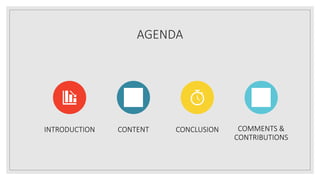
AGENDA
INTRODUCTION CONTENT CONCLUSION COMMENTS &
CONTRIBUTIONS
ABOUT THE FACILITATOR
Tokunbo Smith FITD, FIIM, FOSHA (UK), MCPN
PRINCIPAL CONSULTANT
T&Y INFORMATION MANAGEMENT SERVICES LIMITED
Tel: 08023030021
email: toks@tyims.org.ng
INTRODUCTION
COVID-19 continues to spread rapidly around the
world.
Almost every country has reported cases,
but the burden is not equally distributed.
The economic impact from this global health
crisis remains to be seen, but it’s clear that It will
undoubtedly have an effect on E-Commerce and
E-Learning
SOME ONLINE PLATFORMS
◦ Zoho Meeting.
◦ Nextiva
◦ GoToMeeting
◦ Skype for Business
◦ Zoom
◦ RingCentral
◦ Join.me
◦ Digitell
◦ Evia
◦ Intrado
◦ ON24
◦ ezTalks Meetings
◦ HighFive
◦ Roundee
◦ Google Hangouts
◦ Adobe Connect
E-Commerce
 E-Commerce, also known as electronic
commerce or internet commerce, refers to the
buying and selling of goods or services using the
internet, and the transfer of money and data to
execute these transactions.
 Types of E-Commerce
 Business-to-Business (B2B), Business-to-
Consumer (B2C), Consumer-to-Consumer (C2C), Consumer-to-Business
(C2B), Business-to-Administration (B2A) and Consumer-
to-Administration (C2A)
 The E-Commerce giants Amazon, Konga and
Jumia are witnessing real growth
The Challenges
 Taking action and moving forward
 Security (human, cyber and data privacy
/protection)
 Keeping up with legislation
 Selecting the right focus (Employees, customers
and vendors)
 Attracting and hiring the right people to make it
all happen
 Choosing the right technology and partners
 Achieving profitable long-term growth
 Managing distractions, online platforms ethics
and code of conducts
Solutions to Challenges
Proactive in taking decisions.
Securing data and infrastructures
Training on human security, cybercrime, data protection
regulations and infrastructures for stakeholders
Keep up with legislation
Recruitment of employees with Information Communication and
Technology knowledge
Uniformity in infrastructures and devices
between organizations and vendors
Consider short, medium and long term goal.
Investment on online platforms usage, ethics
and working from home guidelines
STRATEGIC RESPONSES TO CHALLENGES USING
CURRENT INFRASTRUCTURES
• Strategy 1: Same Products, Different
Channel (deploying existing infrastructure
to produce different products or to offer
new
types of services)
• Strategy 2: Same Infrastructure,
Different Products (Collaboration with
other organizations)
• Strategy 3: Same Products, Different
Infrastructure (Hiring from other organizations)
• From Reactive to Proactive
TECHNOLOGY IMPACT
• Use of ICT for production and services.
• Most jobs will be taken over by ICT professionals.
• ICT knowledge will become a criteria for
employment.
• Increase in computer related crime (cybercrime,
identity theft, data privacy breach etc)
• Creativity, innovation, communication and
collaboration will drive e-commerce
• Dependent on functional interactive webs and Apps
Challenged Sectors
Aviation
Hotels and Hospitality
Routine Jobs
Event Centers, Restaurants and Club Houses
Commercial and High Brow Residential Estates
Effect of Post Covid-19 on Society and Economy
• Increase in crime rate
• High unemployment rate
• Scarcity of funds
• Decline in productivity, growth and profitability
• Increased social problems
• Lower purchasing power
• Decrease in standard of living
• High inflation
• High demand for Medical Personnel
• High demand for freelance jobs
Online education
The education sector is responding to quarantine with a sudden shift to online learning.
Nonetheless, online teaching requires careful thinking about how learners and teachers are
equipped for the shift and serious consideration about whether the teaching style is still
effective when taken from the classroom and transposed to technological devices. Moreover,
inequalities are exacerbated when it comes to access to technology and to digital devices.
Many learners suffer a form of digital inequality whereby they lack the connections and devices
to learn remotely. In fact, this outbreak widens the gap between those able to access digital
learning opportunities and those who are shut out. Access is not equal, and we see inequality
growing.
And yet, even though the immediate focus is now on technology and tools, the most
compelling quality is still human compassion.
E-LEARNING
In a world where knowledge is a mouse-click, L & D
Professionals behaviours, thinking, growth and
outcomes will change. Technology will continue
to play a key role in educating future generations.
Types of E-learning
 Synchronous e-Learning
 Asynchronous e-Learning
ONLINE PLATFORMS
1. Udemy
2. Khan Academy
3. Coursera
4. edX
5. Udacity
6. Lynda
7. FutureLearn
8. MasterClass
9. Corporate Finance Institute
10. Open2Study
Useful tools
Digital learning management systems, communication tools and e-learning
platforms are playing a crucial role during this pandemic.
Software and apps can help learning providers to manage, plan, deliver and
track the learning process.
Let’s have a look at a few useful tools.
The list is not exhaustive and adapted for adult education; is an excerpt of a
more comprehensive list published by UNESCO
Digital learning management systems
 Moodle(link is external) is a free open source software designed to help educators create effective online courses
 Google Classroom(link is external) helps students and teachers organise assignments, boost collaboration, and foster better communication
 Docebo(link is external) is a service offering a learning management system focusing on professional development
 Blackboard(link is external) offers solutions, resources and tools to help deliver quality online teaching
 Edmodo(link is external) is a tool for educators to send messages, share class materials, and make learning accessible for students anywhere
 Skooler(link is external) is a system exclusively and fully integrated with Microsoft Office 365
 Ekstep(link is external) offers a collection of literacy and numeracy learning resources and the chance to create new ones
 Cell-Ed(link is external) is designed to meet the needs of adult learners
 LabXchange(link is external) is an online community for learning, sharing, and collaboration
 Quizlet(link is external) is a mobile and web-based study application that allows learning and teaching through tools and games
Communication tools
Zoom(link is external) is a tool enabling video communications, video and audio
conferencing, chats and webinars
Skype(link is external) is a free tool for making videos and one-to-one and group calls
Microsoft Teams(link is external) is a platform that combines workplace chat, video
meetings, and file storage
Google Hangouts Meet(link is external) enables text, voice, or video chats, either one-
to-one or in a group
Dingtalk(link is external) is an audio and video conferencing system
MOOCs
Canvas(link is external) offers free online courses and classes aimed at the professional development of educators
Alison (link is external) is a self-paced course designed by subject experts, with an interactive and enriched learning experience
Coursera(link is external) gives access to more than 2000 courses and specialisations developed by the best universities in the
world
EdX(link is external) delivers 2000 Online courses from 140 leading institutions worldwide offering the chance to gain new skills
Future Learn(link is external) delivers online courses aimed at further study, building professional skills, and connecting with
experts
Funzi(link is external) delivers training and educational programs via a mobile learning service
Empower(link is external) supports collaboration and the sharing of expertise between European universities and providers on
the latest developments in online, open and flexible education
E-learning Issues
Supporting participants
Keeping participants interested and engaged
Quality of materials
Limits to technology
Accessibility and access for everyone
Timing and scheduling
Technical adaptability
Cost of Internet services
Availability of Electricity
Low enlightenment on e-learning
E-Learning Benefits Post Covid-19
Self development by business owners, professionals and
employees
Increase in computer literacy
Increase in knowledge acquisition
Reduce cost of capacity building
Encourage e-learning at the grassroots
Easy transfer of knowledge and information
L&D ROLES IN POST COVID19
Remain visible on social media and hold meetings with
clients. L&D must maintain a voice and presence in the
market, continue to publish content.
Focus on the challenges of virtual work, change
management or market disruption. offer people something
useful
L&D ROLES IN POST COVID19
• Old problems still exist. Continue to provide solutions for old
challenges before the pandemic and those issues the new
challenges brought about by COVID-19.
• Build future-forward solutions. Offer solutions that not only help
companies manage the current crisis but can also help them
deliver learning to employees and customers as they assimilate
into the “new normal.”
Conclusion
 E-commerce is a flexible solution for both businesses and
buyers.
 Ecommerce is an important profit driver for business than
traditional commerce.
Broaden the Brand
It’s More Convenient
Increase the Reach to Clients
Gives Marketing Opportunities
Scalable
Conclusion
• Organizations must empower their stakeholders to remain in
business
• Learn together: Organizations should create a learning culture
by listening to and addressing the needs of their stakeholders
to celebrate success and learn from their failures.
• Organizations must make learning enjoyable and have fun
while they are learning.
• There will be more innovation and creativity
• Partnership and collaboration will be encouraged
• Increase in knowledge and use of IT
• Knowledge sharing is easier
References:
 trainingindustry.com
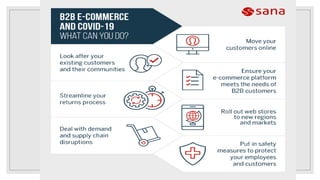
 https://www.sana-commerce.com/blog/b2b-ecommerce-covid-19-
challenges-opportunities/
 https://www.mckinsey.com/business-functions
 /risk/our-insights/covid-19-implications-for-business
 www.weforum.org/agenda/2020/03/this-is-
 the-human-impact-of-covid-19-and-how-business-can-
help/corporatefinanceinstitute.com
 Michael Wade Digital Business Transformation at IMD in MIT SMR
 Futurelearn
 www.discoverydesign
THANK YOU

E commerce e-learning to overcome post covid-19 challenges

  • 1.
    TITLE LOREM IPSUM SitDolor Amet How Businesses & Professionals Can Utilize E-commerce & E-learning To Overcome Post Covid-19 Challenges Tokunboh Smith FITD, FIIMS
  • 4.
  • 5.
    ABOUT THE FACILITATOR TokunboSmith FITD, FIIM, FOSHA (UK), MCPN PRINCIPAL CONSULTANT T&Y INFORMATION MANAGEMENT SERVICES LIMITED Tel: 08023030021 email: toks@tyims.org.ng
  • 6.
    INTRODUCTION COVID-19 continues tospread rapidly around the world. Almost every country has reported cases, but the burden is not equally distributed. The economic impact from this global health crisis remains to be seen, but it’s clear that It will undoubtedly have an effect on E-Commerce and E-Learning
  • 7.
    SOME ONLINE PLATFORMS ◦Zoho Meeting. ◦ Nextiva ◦ GoToMeeting ◦ Skype for Business ◦ Zoom ◦ RingCentral ◦ Join.me ◦ Digitell ◦ Evia ◦ Intrado ◦ ON24 ◦ ezTalks Meetings ◦ HighFive ◦ Roundee ◦ Google Hangouts ◦ Adobe Connect
  • 8.
    E-Commerce  E-Commerce, alsoknown as electronic commerce or internet commerce, refers to the buying and selling of goods or services using the internet, and the transfer of money and data to execute these transactions.  Types of E-Commerce  Business-to-Business (B2B), Business-to- Consumer (B2C), Consumer-to-Consumer (C2C), Consumer-to-Business (C2B), Business-to-Administration (B2A) and Consumer- to-Administration (C2A)  The E-Commerce giants Amazon, Konga and Jumia are witnessing real growth
  • 9.
    The Challenges  Takingaction and moving forward  Security (human, cyber and data privacy /protection)  Keeping up with legislation  Selecting the right focus (Employees, customers and vendors)  Attracting and hiring the right people to make it all happen  Choosing the right technology and partners  Achieving profitable long-term growth  Managing distractions, online platforms ethics and code of conducts
  • 10.
    Solutions to Challenges Proactivein taking decisions. Securing data and infrastructures Training on human security, cybercrime, data protection regulations and infrastructures for stakeholders Keep up with legislation Recruitment of employees with Information Communication and Technology knowledge Uniformity in infrastructures and devices between organizations and vendors Consider short, medium and long term goal. Investment on online platforms usage, ethics and working from home guidelines
  • 12.
    STRATEGIC RESPONSES TOCHALLENGES USING CURRENT INFRASTRUCTURES • Strategy 1: Same Products, Different Channel (deploying existing infrastructure to produce different products or to offer new types of services) • Strategy 2: Same Infrastructure, Different Products (Collaboration with other organizations) • Strategy 3: Same Products, Different Infrastructure (Hiring from other organizations) • From Reactive to Proactive
  • 14.
    TECHNOLOGY IMPACT • Useof ICT for production and services. • Most jobs will be taken over by ICT professionals. • ICT knowledge will become a criteria for employment. • Increase in computer related crime (cybercrime, identity theft, data privacy breach etc) • Creativity, innovation, communication and collaboration will drive e-commerce • Dependent on functional interactive webs and Apps
  • 15.
    Challenged Sectors Aviation Hotels andHospitality Routine Jobs Event Centers, Restaurants and Club Houses Commercial and High Brow Residential Estates
  • 16.
    Effect of PostCovid-19 on Society and Economy • Increase in crime rate • High unemployment rate • Scarcity of funds • Decline in productivity, growth and profitability • Increased social problems • Lower purchasing power • Decrease in standard of living • High inflation • High demand for Medical Personnel • High demand for freelance jobs
  • 17.
    Online education The educationsector is responding to quarantine with a sudden shift to online learning. Nonetheless, online teaching requires careful thinking about how learners and teachers are equipped for the shift and serious consideration about whether the teaching style is still effective when taken from the classroom and transposed to technological devices. Moreover, inequalities are exacerbated when it comes to access to technology and to digital devices. Many learners suffer a form of digital inequality whereby they lack the connections and devices to learn remotely. In fact, this outbreak widens the gap between those able to access digital learning opportunities and those who are shut out. Access is not equal, and we see inequality growing. And yet, even though the immediate focus is now on technology and tools, the most compelling quality is still human compassion.
  • 18.
    E-LEARNING In a worldwhere knowledge is a mouse-click, L & D Professionals behaviours, thinking, growth and outcomes will change. Technology will continue to play a key role in educating future generations. Types of E-learning  Synchronous e-Learning  Asynchronous e-Learning
  • 19.
    ONLINE PLATFORMS 1. Udemy 2.Khan Academy 3. Coursera 4. edX 5. Udacity 6. Lynda 7. FutureLearn 8. MasterClass 9. Corporate Finance Institute 10. Open2Study
  • 20.
    Useful tools Digital learningmanagement systems, communication tools and e-learning platforms are playing a crucial role during this pandemic. Software and apps can help learning providers to manage, plan, deliver and track the learning process. Let’s have a look at a few useful tools. The list is not exhaustive and adapted for adult education; is an excerpt of a more comprehensive list published by UNESCO
  • 21.
    Digital learning managementsystems  Moodle(link is external) is a free open source software designed to help educators create effective online courses  Google Classroom(link is external) helps students and teachers organise assignments, boost collaboration, and foster better communication  Docebo(link is external) is a service offering a learning management system focusing on professional development  Blackboard(link is external) offers solutions, resources and tools to help deliver quality online teaching  Edmodo(link is external) is a tool for educators to send messages, share class materials, and make learning accessible for students anywhere  Skooler(link is external) is a system exclusively and fully integrated with Microsoft Office 365  Ekstep(link is external) offers a collection of literacy and numeracy learning resources and the chance to create new ones  Cell-Ed(link is external) is designed to meet the needs of adult learners  LabXchange(link is external) is an online community for learning, sharing, and collaboration  Quizlet(link is external) is a mobile and web-based study application that allows learning and teaching through tools and games
  • 22.
    Communication tools Zoom(link isexternal) is a tool enabling video communications, video and audio conferencing, chats and webinars Skype(link is external) is a free tool for making videos and one-to-one and group calls Microsoft Teams(link is external) is a platform that combines workplace chat, video meetings, and file storage Google Hangouts Meet(link is external) enables text, voice, or video chats, either one- to-one or in a group Dingtalk(link is external) is an audio and video conferencing system
  • 23.
    MOOCs Canvas(link is external)offers free online courses and classes aimed at the professional development of educators Alison (link is external) is a self-paced course designed by subject experts, with an interactive and enriched learning experience Coursera(link is external) gives access to more than 2000 courses and specialisations developed by the best universities in the world EdX(link is external) delivers 2000 Online courses from 140 leading institutions worldwide offering the chance to gain new skills Future Learn(link is external) delivers online courses aimed at further study, building professional skills, and connecting with experts Funzi(link is external) delivers training and educational programs via a mobile learning service Empower(link is external) supports collaboration and the sharing of expertise between European universities and providers on the latest developments in online, open and flexible education
  • 24.
    E-learning Issues Supporting participants Keepingparticipants interested and engaged Quality of materials Limits to technology Accessibility and access for everyone Timing and scheduling Technical adaptability Cost of Internet services Availability of Electricity Low enlightenment on e-learning
  • 25.
    E-Learning Benefits PostCovid-19 Self development by business owners, professionals and employees Increase in computer literacy Increase in knowledge acquisition Reduce cost of capacity building Encourage e-learning at the grassroots Easy transfer of knowledge and information
  • 26.
    L&D ROLES INPOST COVID19 Remain visible on social media and hold meetings with clients. L&D must maintain a voice and presence in the market, continue to publish content. Focus on the challenges of virtual work, change management or market disruption. offer people something useful
  • 27.
    L&D ROLES INPOST COVID19 • Old problems still exist. Continue to provide solutions for old challenges before the pandemic and those issues the new challenges brought about by COVID-19. • Build future-forward solutions. Offer solutions that not only help companies manage the current crisis but can also help them deliver learning to employees and customers as they assimilate into the “new normal.”
  • 28.
    Conclusion  E-commerce isa flexible solution for both businesses and buyers.  Ecommerce is an important profit driver for business than traditional commerce. Broaden the Brand It’s More Convenient Increase the Reach to Clients Gives Marketing Opportunities Scalable
  • 29.
    Conclusion • Organizations mustempower their stakeholders to remain in business • Learn together: Organizations should create a learning culture by listening to and addressing the needs of their stakeholders to celebrate success and learn from their failures. • Organizations must make learning enjoyable and have fun while they are learning. • There will be more innovation and creativity • Partnership and collaboration will be encouraged • Increase in knowledge and use of IT • Knowledge sharing is easier
  • 30.
    References:  trainingindustry.com  https://www.sana-commerce.com/blog/b2b-ecommerce-covid-19- challenges-opportunities/ https://www.mckinsey.com/business-functions  /risk/our-insights/covid-19-implications-for-business  www.weforum.org/agenda/2020/03/this-is-  the-human-impact-of-covid-19-and-how-business-can- help/corporatefinanceinstitute.com  Michael Wade Digital Business Transformation at IMD in MIT SMR  Futurelearn  www.discoverydesign
  • 32.