B2B E-Commerce
CIS 579 – Technology of E-Business
Joseph H. Schuessler, PhD
joseph.schuesslersounds.com
Tarleton State University
Stephenville, Texas
schuessler@tarleton.edu
Learning Objectives
1. Describe the B2B field.
2. Describe the major types of B2B models.
3. Discuss the models and characteristics of the sell-
side marketplace, including auctions.
4. Describe the sell-side intermediaries.
5. Describe the characteristics of the buy-side
marketplace and e-procurement.
6. Explain how reverse auctions work in B2B.
7. Describe B2B aggregation and group purchasing
models.
4-2
Copyright © 2012 Pearson Education, Inc.
Publishing as Prentice Hall
Learning Objectives
8. Describe other procurement methods.
9. Define exchanges and describe their major types.
10. Describe B2B portals.
11. Describe third-party exchanges.
12. Describe how B2B can benefit from social
networking and Web 2.0.
13. Describe Internet marketing in B2B, including
organizational buyer behavior.
4-3
Copyright © 2012 Pearson Education, Inc.
Publishing as Prentice Hall
Concepts, Characteristics,
and Models of B2B E-Commerce
business-to-business e-commerce (B2B EC)
Transactions between businesses conducted
electronically over the Internet, extranets, intranets,
or private networks; also known as eB2B (electronic
B2B) or just B2B
4-4
Copyright © 2012 Pearson Education, Inc.
Publishing as Prentice Hall
Concepts, Characteristics,
and Models of B2B E-Commerce
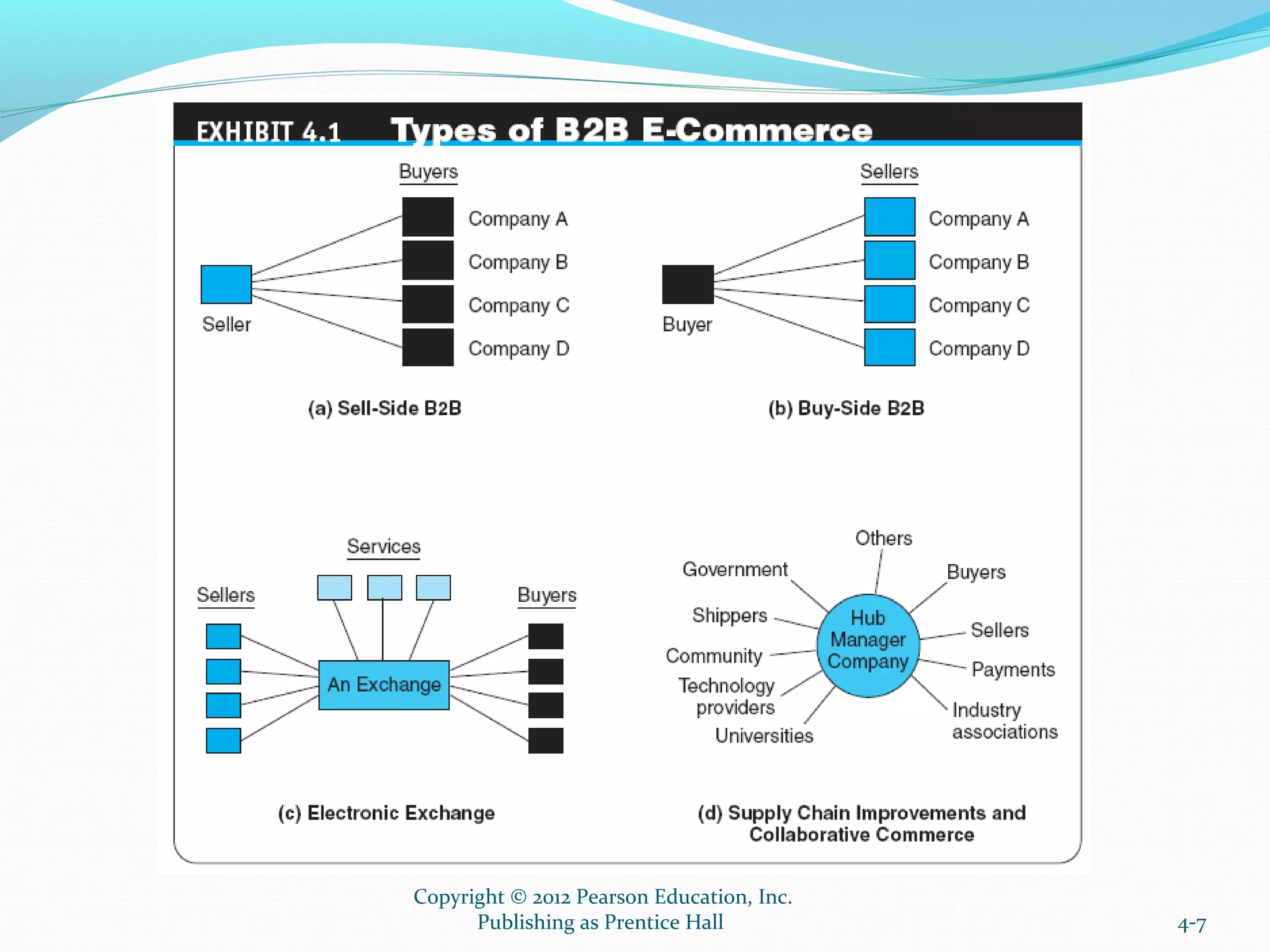
THE BASIC TYPES OF B2B TRANSACTIONS AND
ACTIVITIES
Sell-side
Buy-side
Exchanges
Supply chain improvements and collaborative
commerce
4-5
Copyright © 2012 Pearson Education, Inc.
Publishing as Prentice Hall
Concepts, Characteristics,
and Models of B2B E-Commerce
THE BASIC TYPES OF B2B E-MARKETPLACES
AND SERVICES
One-to-Many and Many-to-One: Private E-
Marketplaces
 company-centric EC
E-commerce that focuses on a single company’s buying needs
(many-to- one, or buy-side) or selling needs (one-to- many,
or sell-side)
4-6
Copyright © 2012 Pearson Education, Inc.
Publishing as Prentice Hall
4-7
Copyright © 2012 Pearson Education, Inc.
Publishing as Prentice Hall
Concepts, Characteristics,
and Models of B2B E-Commerce
Many-to-Many: Public Exchanges
 exchanges (trading communities or trading exchanges)
Many-to-many e-marketplaces, usually owned and run by a
third party or a consortium, in which many buyers and many
sellers meet electronically to trade with each other
 public e-marketplaces
Third-party exchanges open to all interested parties (sellers
and buyers)
Supply Chain Improvers and Collaborative
Commerce
4-8
Copyright © 2012 Pearson Education, Inc.
Publishing as Prentice Hall
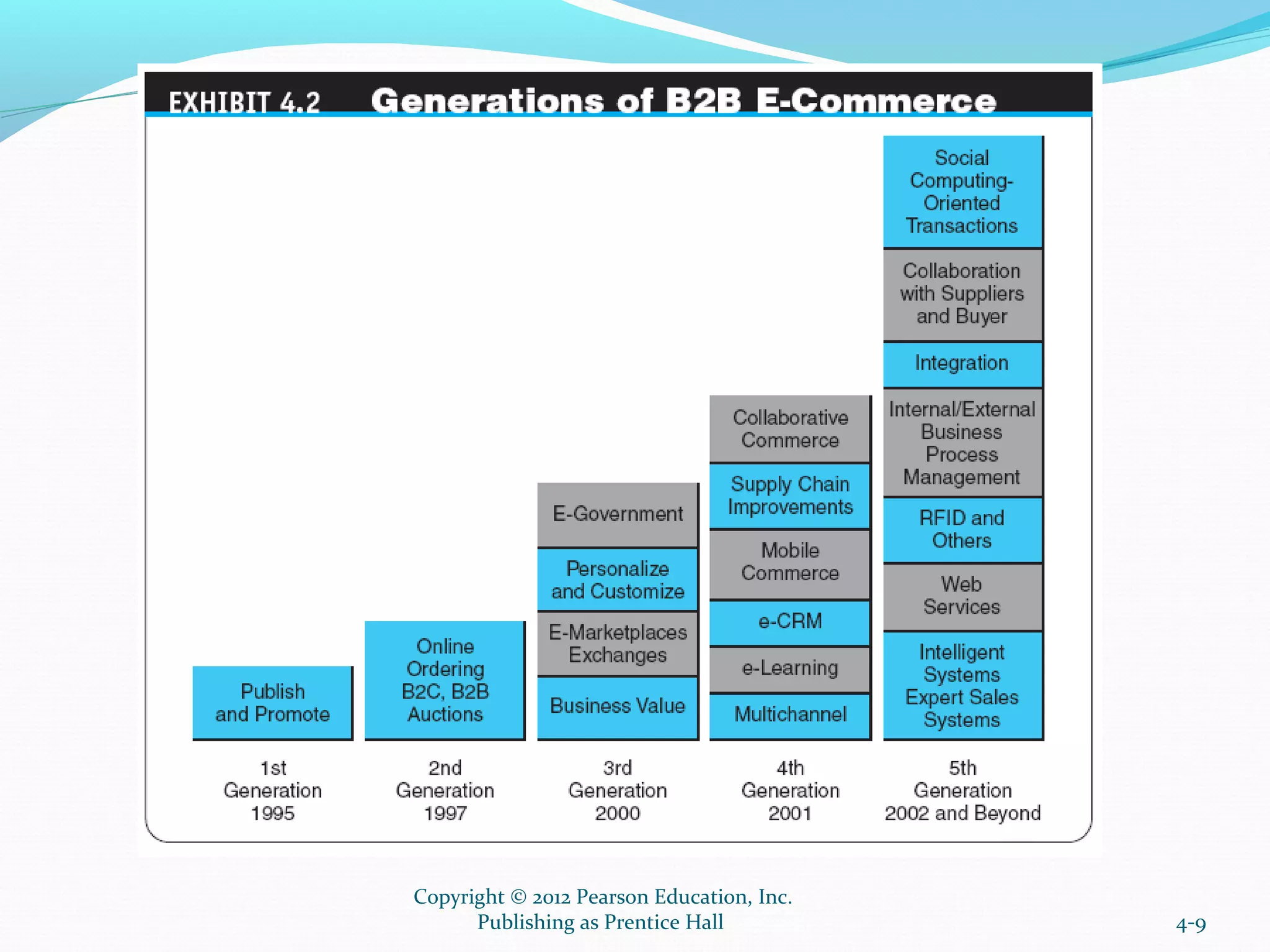
4-9
Copyright © 2012 Pearson Education, Inc.
Publishing as Prentice Hall
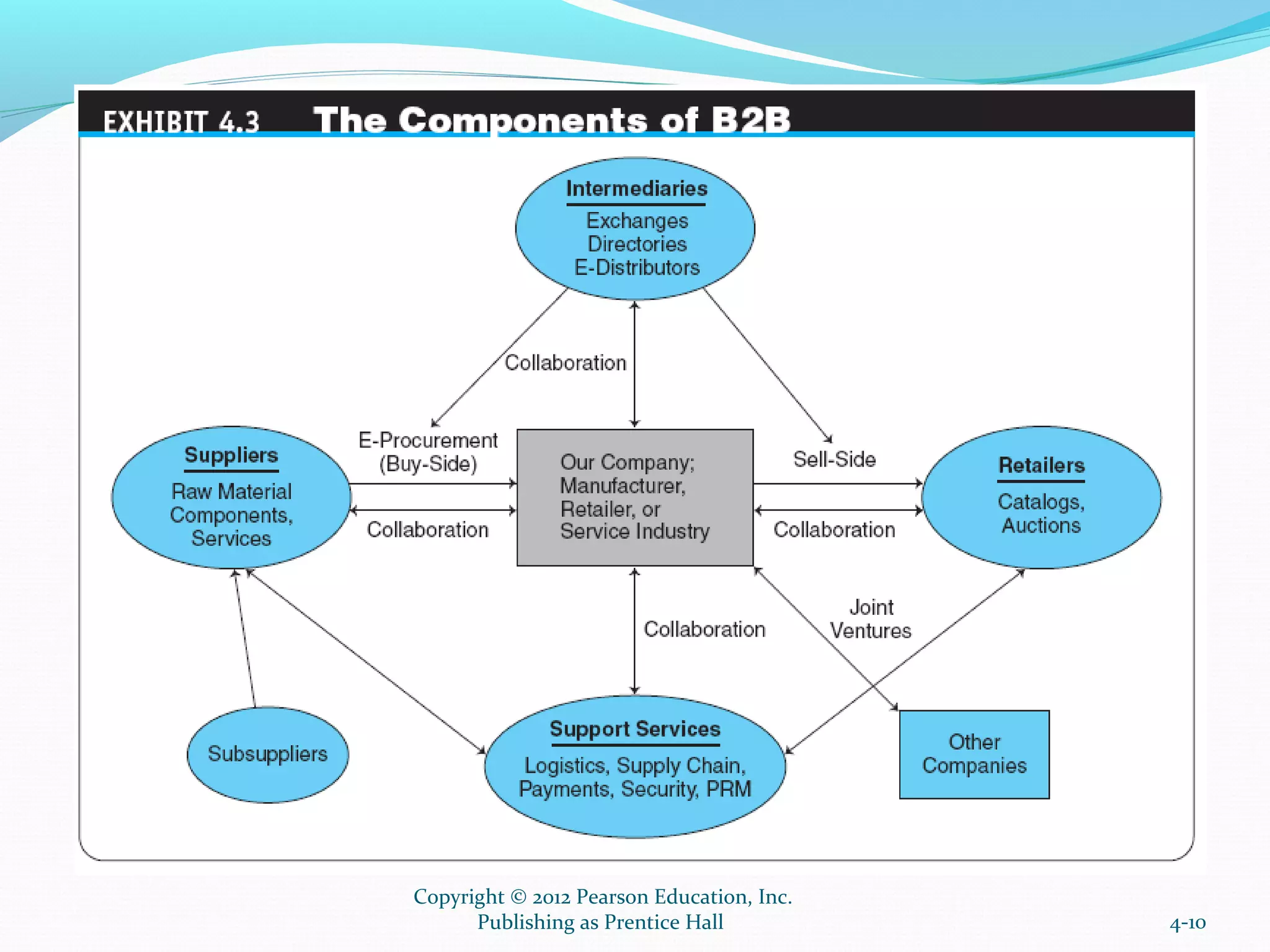
4-10
Copyright © 2012 Pearson Education, Inc.
Publishing as Prentice Hall
Concepts, Characteristics,
and Models of B2B E-Commerce
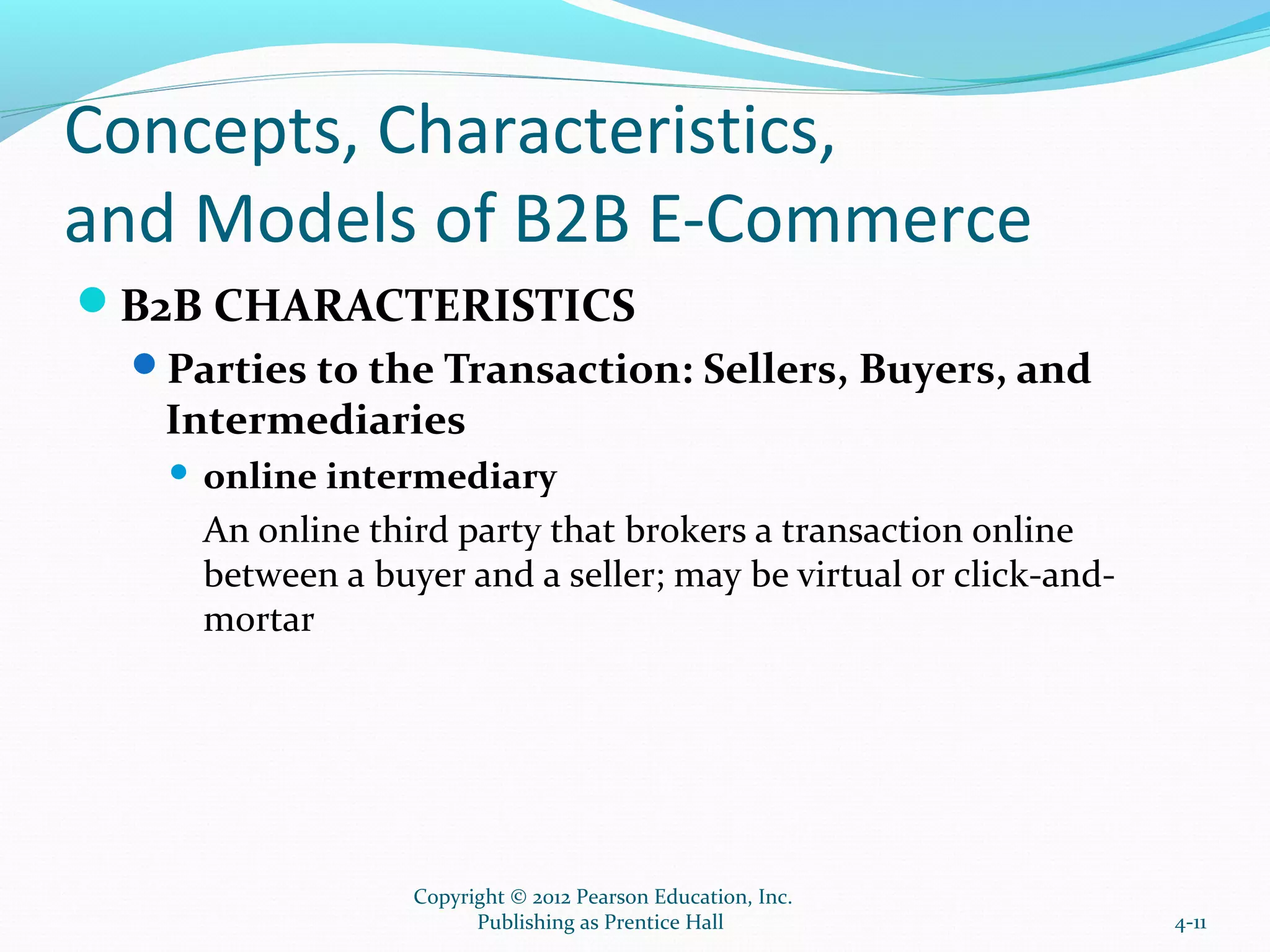
B2B CHARACTERISTICS
Parties to the Transaction: Sellers, Buyers, and
Intermediaries
 online intermediary
An online third party that brokers a transaction online
between a buyer and a seller; may be virtual or click-and-
mortar
4-11
Copyright © 2012 Pearson Education, Inc.
Publishing as Prentice Hall
Concepts, Characteristics,
and Models of B2B E-Commerce
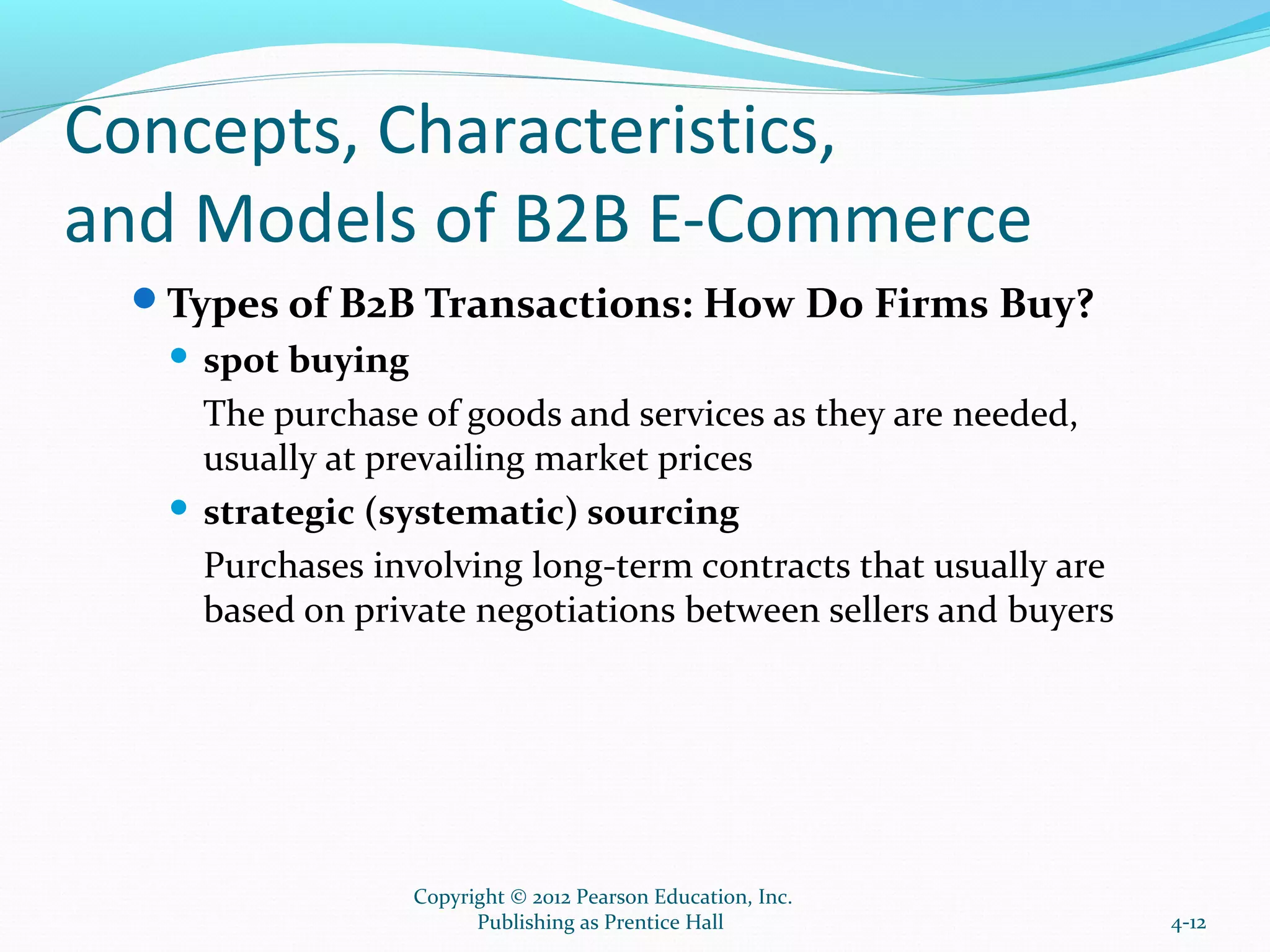
Types of B2B Transactions: How Do Firms Buy?
 spot buying
The purchase of goods and services as they are needed,
usually at prevailing market prices
 strategic (systematic) sourcing
Purchases involving long-term contracts that usually are
based on private negotiations between sellers and buyers
4-12
Copyright © 2012 Pearson Education, Inc.
Publishing as Prentice Hall
Concepts, Characteristics,
and Models of B2B E-Commerce
Types of Materials Traded: What Do Firms Buy?
 direct materials
Materials used in the production of a product (e.g., steel in
a car or paper in a book)
 indirect materials
Materials used to support production (e.g., office supplies
or light bulbs)
 MRO (maintenance, repair, and operation)
Indirect materials used in activities that support
production
4-13
Copyright © 2012 Pearson Education, Inc.
Publishing as Prentice Hall
Concepts, Characteristics,
and Models of B2B E-Commerce
The Direction of the Trades
 vertical marketplaces
Markets that deal with one industry or industry segment
(e.g., steel, chemicals)
 horizontal marketplaces
Markets that concentrate on a service, material, or a
product that is used in all types of industries (e.g., office
supplies, PCs)
4-14
Copyright © 2012 Pearson Education, Inc.
Publishing as Prentice Hall
Concepts, Characteristics,
and Models of B2B E-Commerce
SUPPLY CHAIN RELATIONSHIPS IN B2B
SERVICE INDUSTRIES ONLINE IN B2B
PARTNER AND SUPPLIER RELATIONSHIP
MANAGEMENT
partner relationship management (PRM)
Business strategy that focuses on providing comprehensive
quality service to business partners
supplier relationship management (SRM)
A comprehensive approach to managing an enterprise’s
interactions with the organizations that supply the goods
and services it uses.
THE BENEFITS AND LIMITATIONS OF B2B
4-15
Copyright © 2012 Pearson Education, Inc.
Publishing as Prentice Hall
One-to-Many:
Sell-Side E-Marketplaces
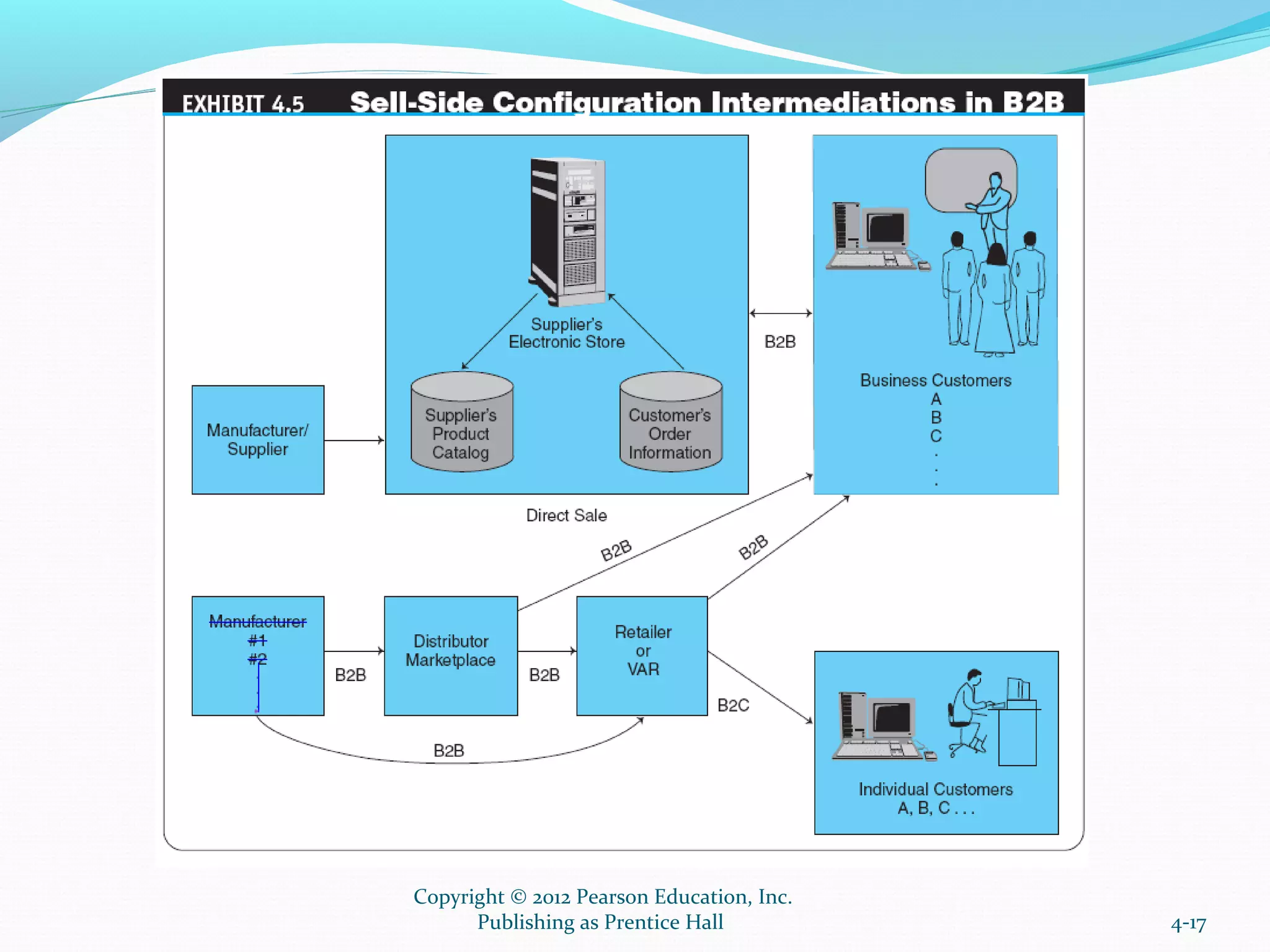
sell-side e-marketplace
A Web-based marketplace in which one company sells
to many business buyers from e-catalogs or auctions,
frequently over an extranet
B2B Sellers
Customer Service
4-16
Copyright © 2012 Pearson Education, Inc.
Publishing as Prentice Hall
4-17
Copyright © 2012 Pearson Education, Inc.
Publishing as Prentice Hall
One-to-Many:
Sell-Side E-Marketplaces
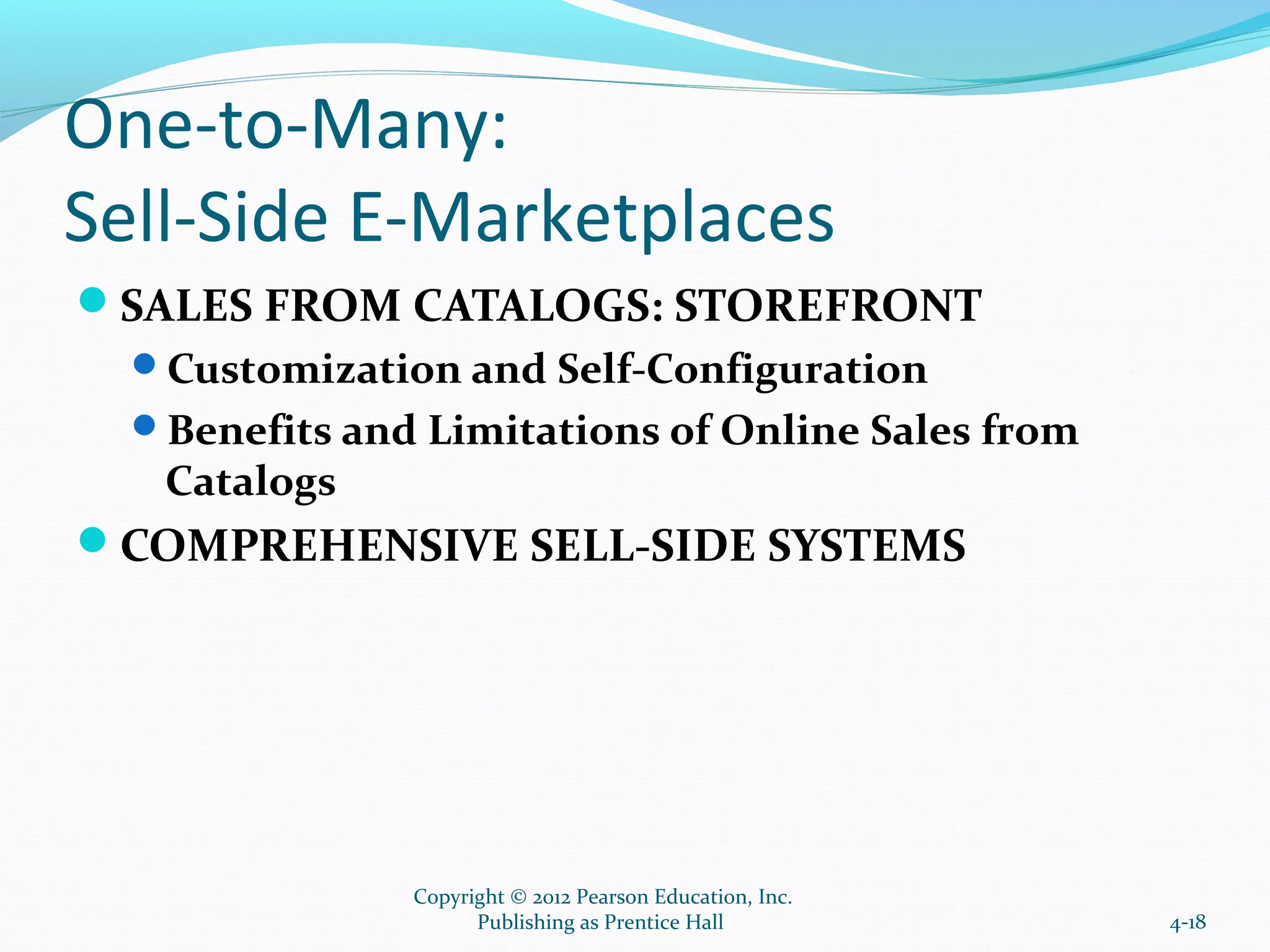
SALES FROM CATALOGS: STOREFRONT
Customization and Self-Configuration
Benefits and Limitations of Online Sales from
Catalogs
COMPREHENSIVE SELL-SIDE SYSTEMS
4-18
Copyright © 2012 Pearson Education, Inc.
Publishing as Prentice Hall
Selling Via Distributors
and Other Intermediaries
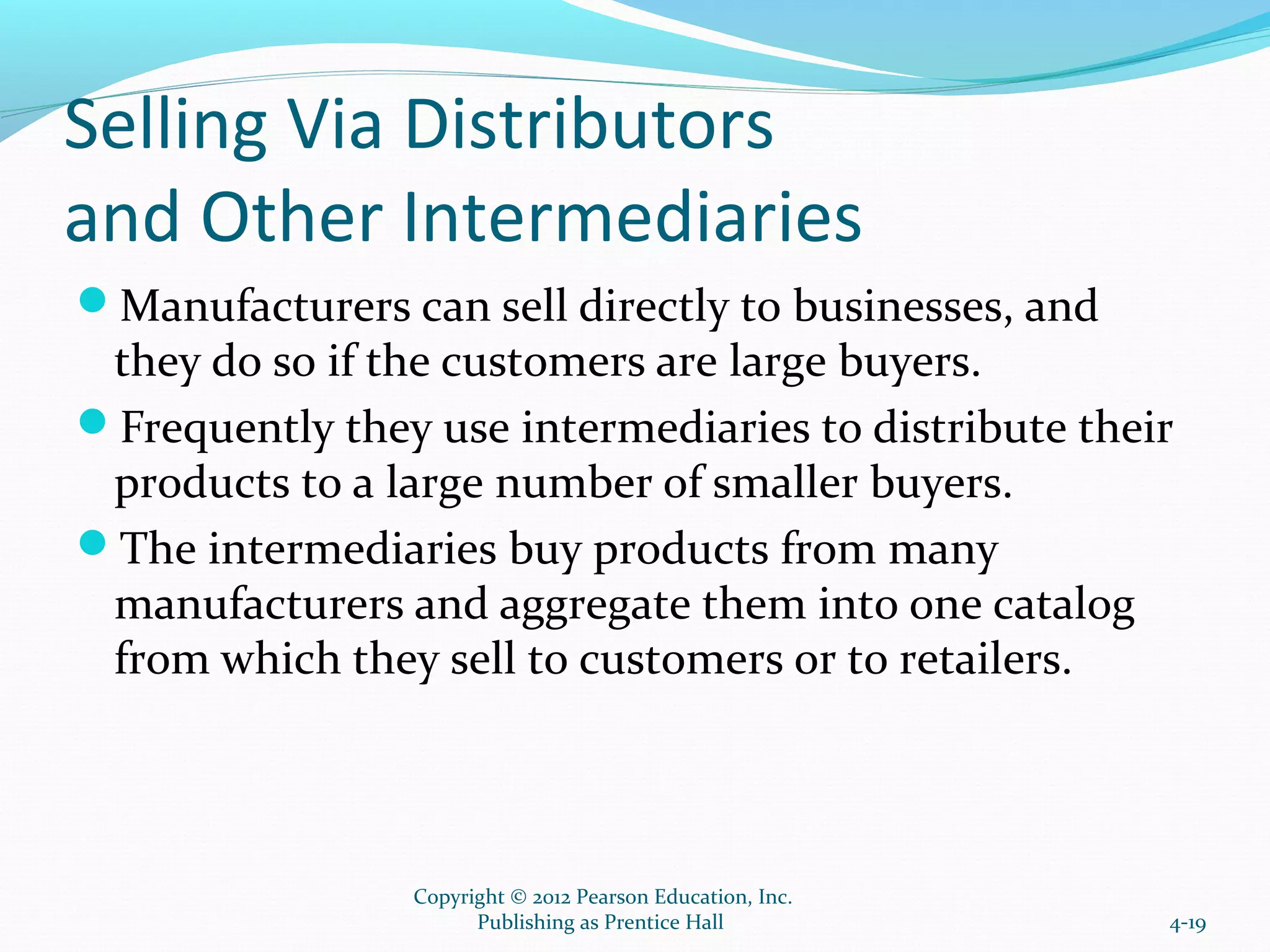
Manufacturers can sell directly to businesses, and
they do so if the customers are large buyers.
Frequently they use intermediaries to distribute their
products to a large number of smaller buyers.
The intermediaries buy products from many
manufacturers and aggregate them into one catalog
from which they sell to customers or to retailers.
4-19
Copyright © 2012 Pearson Education, Inc.
Publishing as Prentice Hall
Selling Via E-Auctions
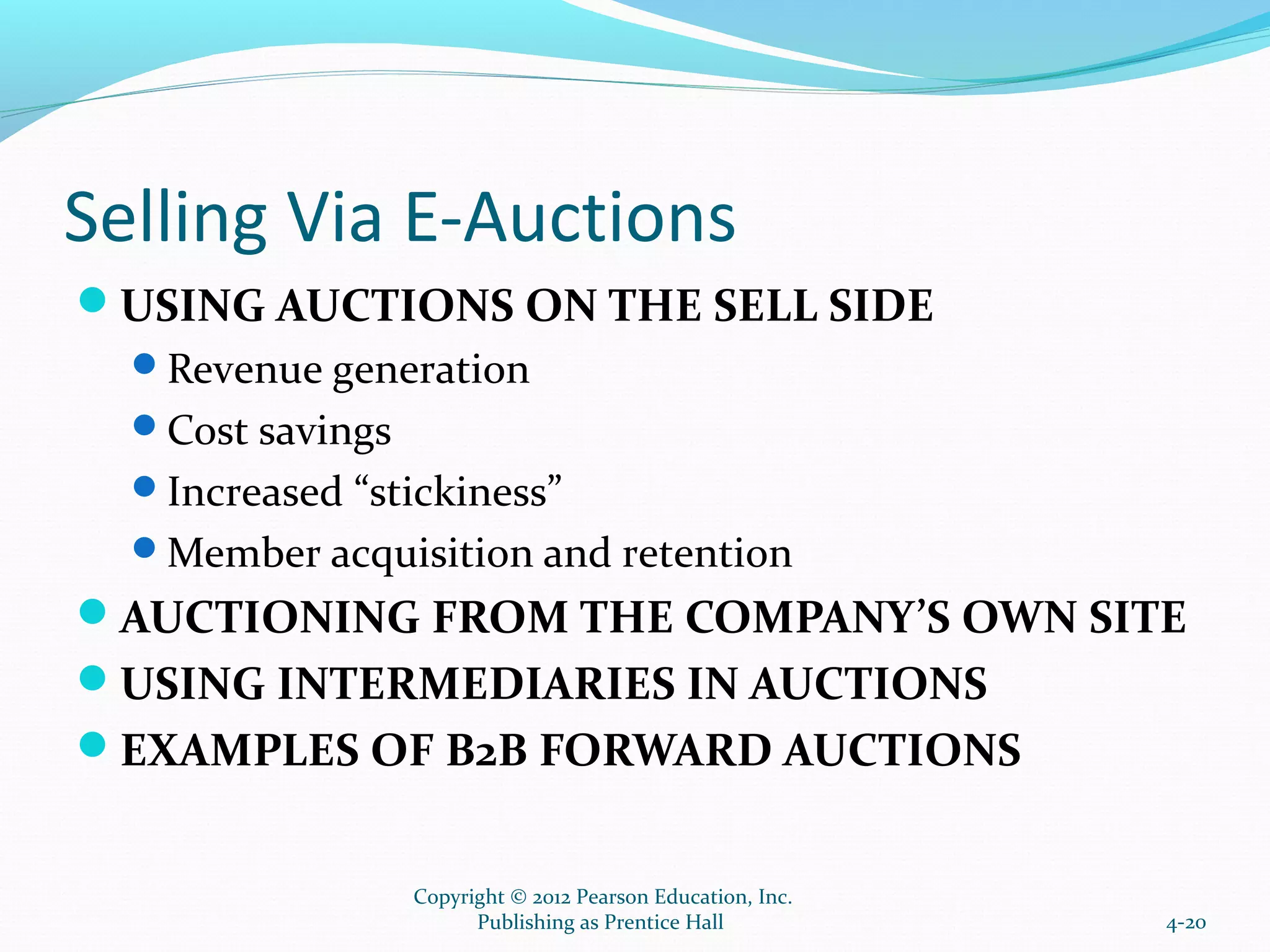
USING AUCTIONS ON THE SELL SIDE
Revenue generation
Cost savings
Increased “stickiness”
Member acquisition and retention
AUCTIONING FROM THE COMPANY’S OWN SITE
USING INTERMEDIARIES IN AUCTIONS
EXAMPLES OF B2B FORWARD AUCTIONS
4-20
Copyright © 2012 Pearson Education, Inc.
Publishing as Prentice Hall
One-from-Many: E-Procurement
at Buy-Side E-Marketplaces
buy-side e-marketplace
A corporate-based acquisition site that uses reverse
auctions, negotiations, group purchasing, or any other
e-procurement method
4-21
Copyright © 2012 Pearson Education, Inc.
Publishing as Prentice Hall
One-from-Many: E-Procurement
at Buy-Side E-Marketplaces
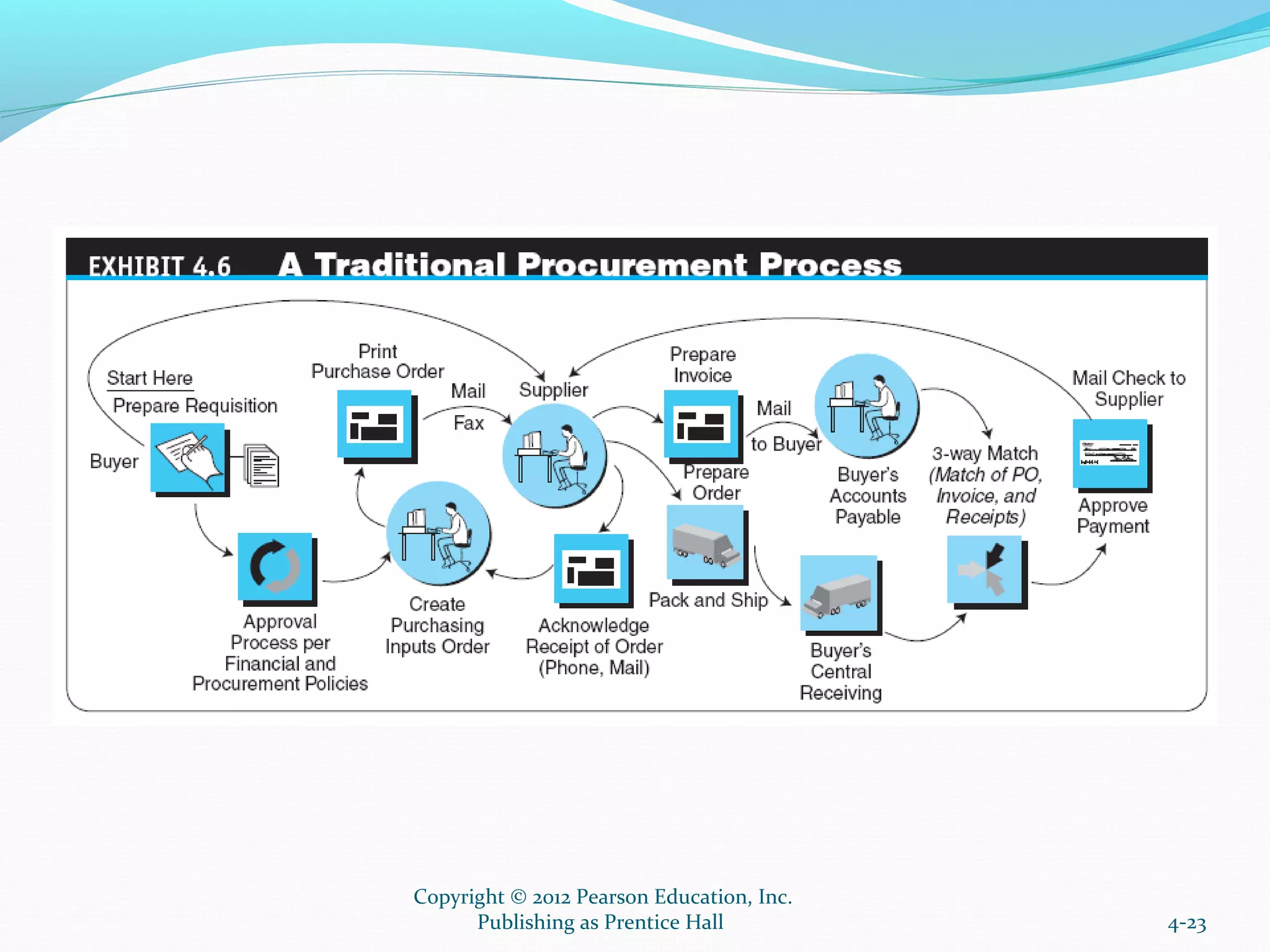
INEFFICIENCIES IN TRADITIONAL
PROCUREMENT MANAGEMENT
procurement management
The planning, organizing, and coordinating of all the
activities relating to purchasing goods and services
needed to accomplish the organization’s mission
maverick buying
Unplanned purchases of items needed quickly, often at
non-prenegotiated higher prices
4-22
Copyright © 2012 Pearson Education, Inc.
Publishing as Prentice Hall
4-23
Copyright © 2012 Pearson Education, Inc.
Publishing as Prentice Hall
One-from-Many: E-Procurement
at Buy-Side E-Marketplaces
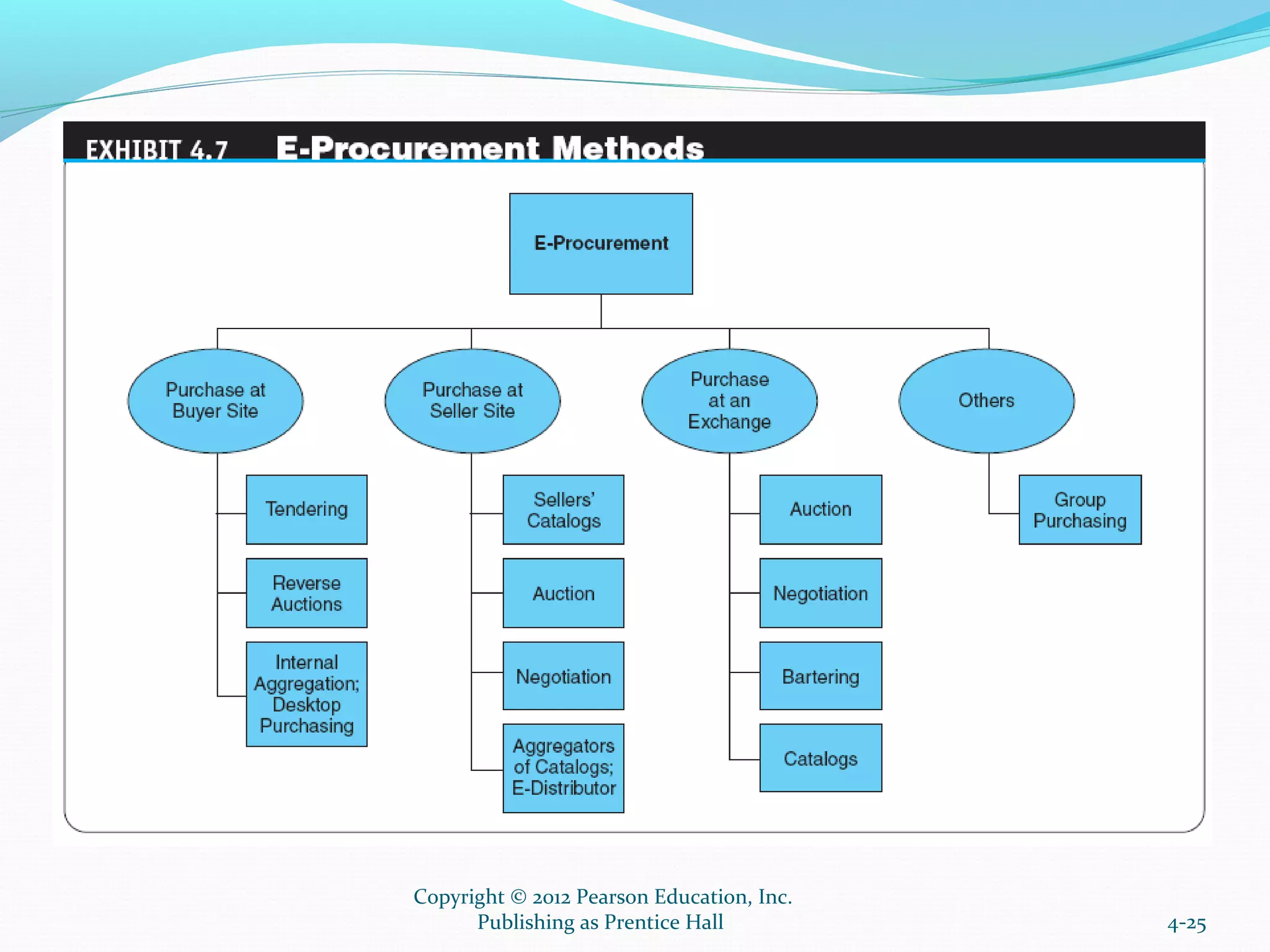
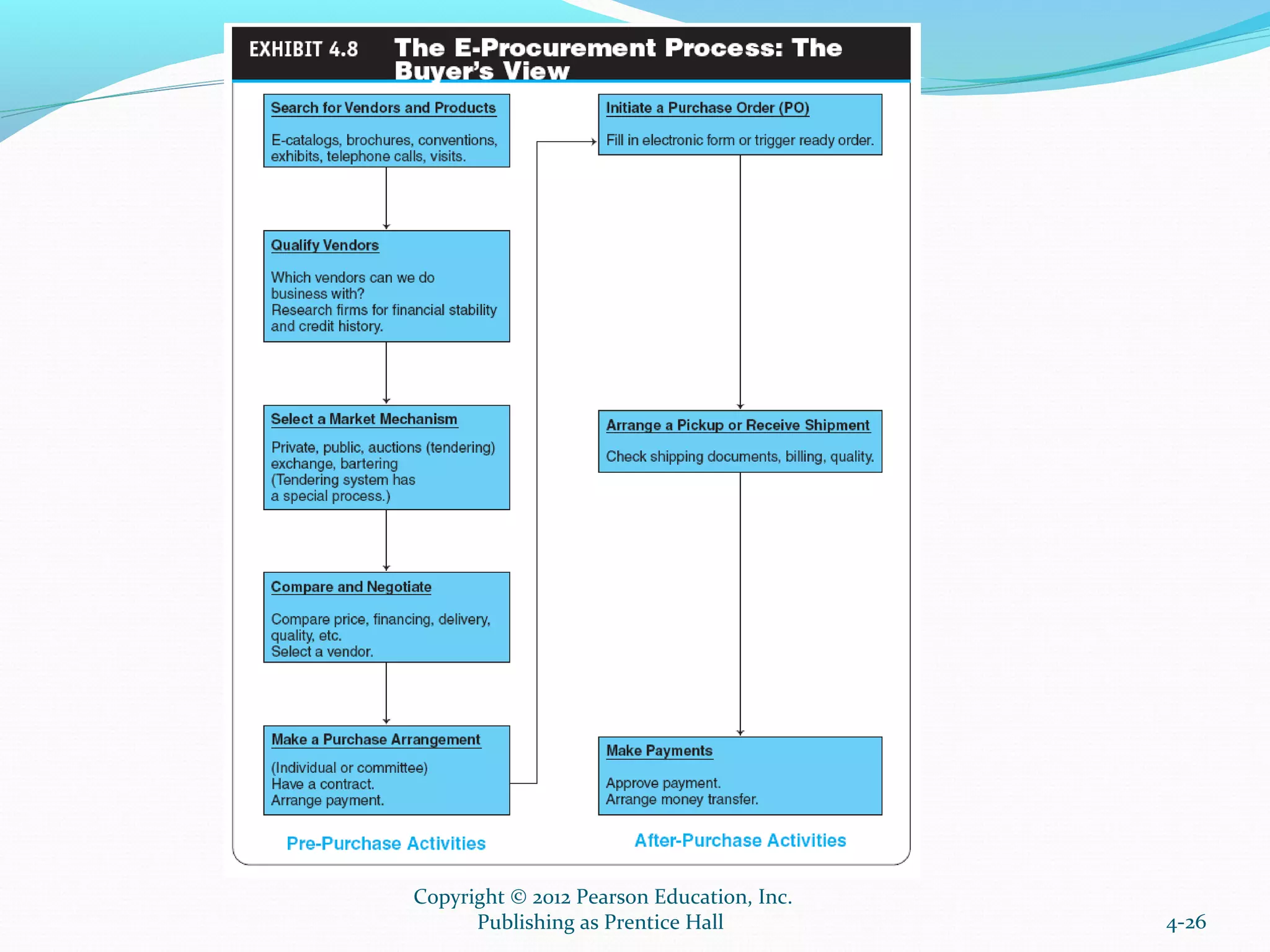
e-procurement (electronic procurement)
The electronic acquisition of goods and services for
organizations via the Internet, EDI, etc.
THE GOALS AND PROCESS OF E-PROCUREMENT
Types of E-Procurement
 E-sourcing
 E-tendering
 E-reverse auctioning
 E-informing
 Web-based ERP
 E-market sites
 E-MRO
4-24
Copyright © 2012 Pearson Education, Inc.
Publishing as Prentice Hall
4-25
Copyright © 2012 Pearson Education, Inc.
Publishing as Prentice Hall
4-26
Copyright © 2012 Pearson Education, Inc.
Publishing as Prentice Hall
One-from-Many: E-Procurement
at Buy-Side E-Marketplaces
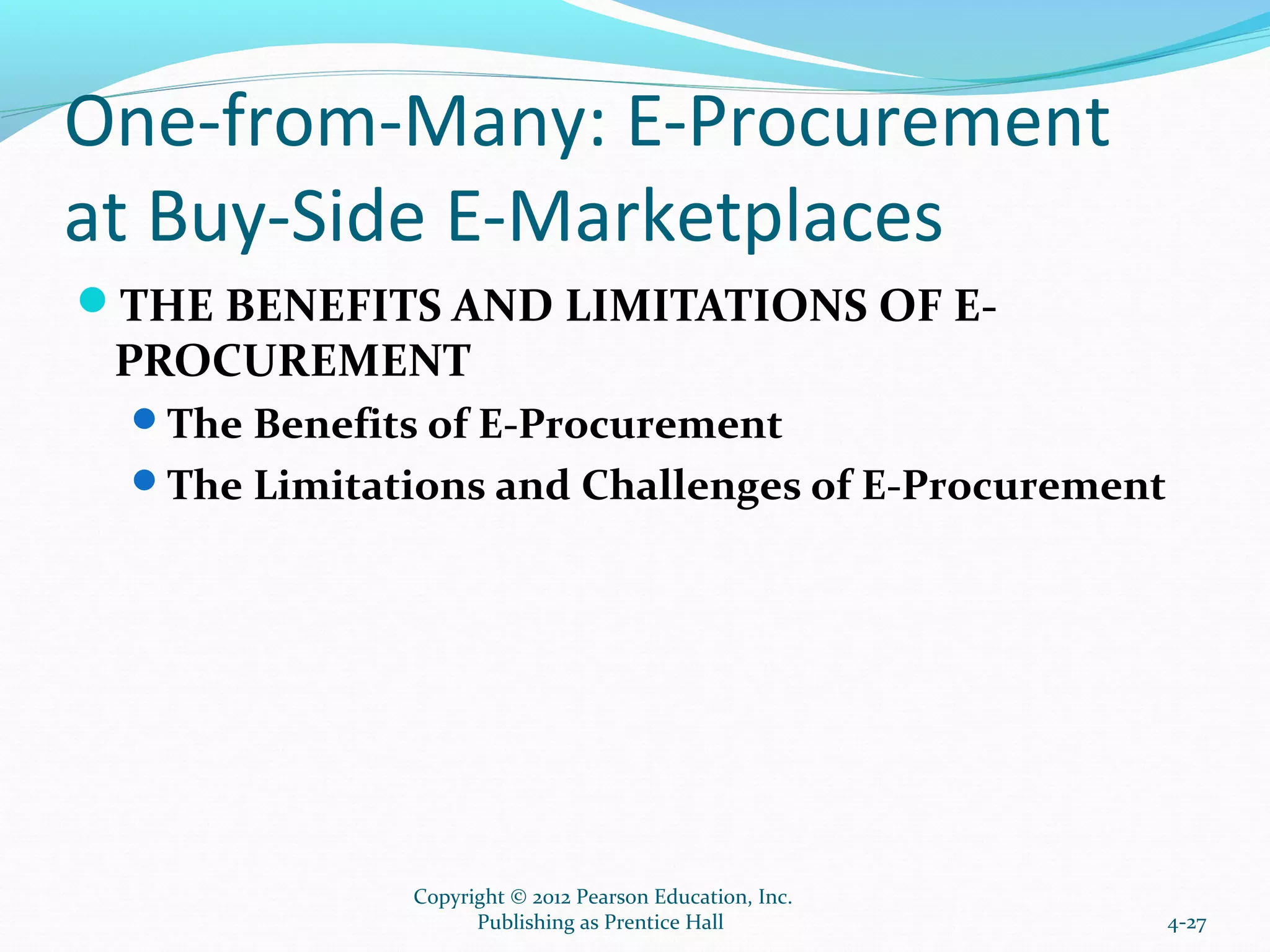
THE BENEFITS AND LIMITATIONS OF E-
PROCUREMENT
The Benefits of E-Procurement
The Limitations and Challenges of E-Procurement
4-27
Copyright © 2012 Pearson Education, Inc.
Publishing as Prentice Hall
Reverse Auctions
at Buy-Side E-Marketplaces
request for quote (RFQ)
The “invitation” to participate in a tendering (bidding)
system
CONDUCTING REVERSE AUCTIONS
E-Tendering by Governments
GROUP REVERSE AUCTIONS
4-28
Copyright © 2012 Pearson Education, Inc.
Publishing as Prentice Hall
4-29
Copyright © 2012 Pearson Education, Inc.
Publishing as Prentice Hall
Other E-Procurement Methods
internal procurement marketplace
The aggregated catalogs of all approved suppliers
combined into a single internal electronic catalog
Benefits of Internal Aggregated Catalogs
desktop purchasing
Direct purchasing from internal marketplaces without
the approval of supervisors and without the
intervention of a procurement department
4-30
Copyright © 2012 Pearson Education, Inc.
Publishing as Prentice Hall
Other E-Procurement Methods
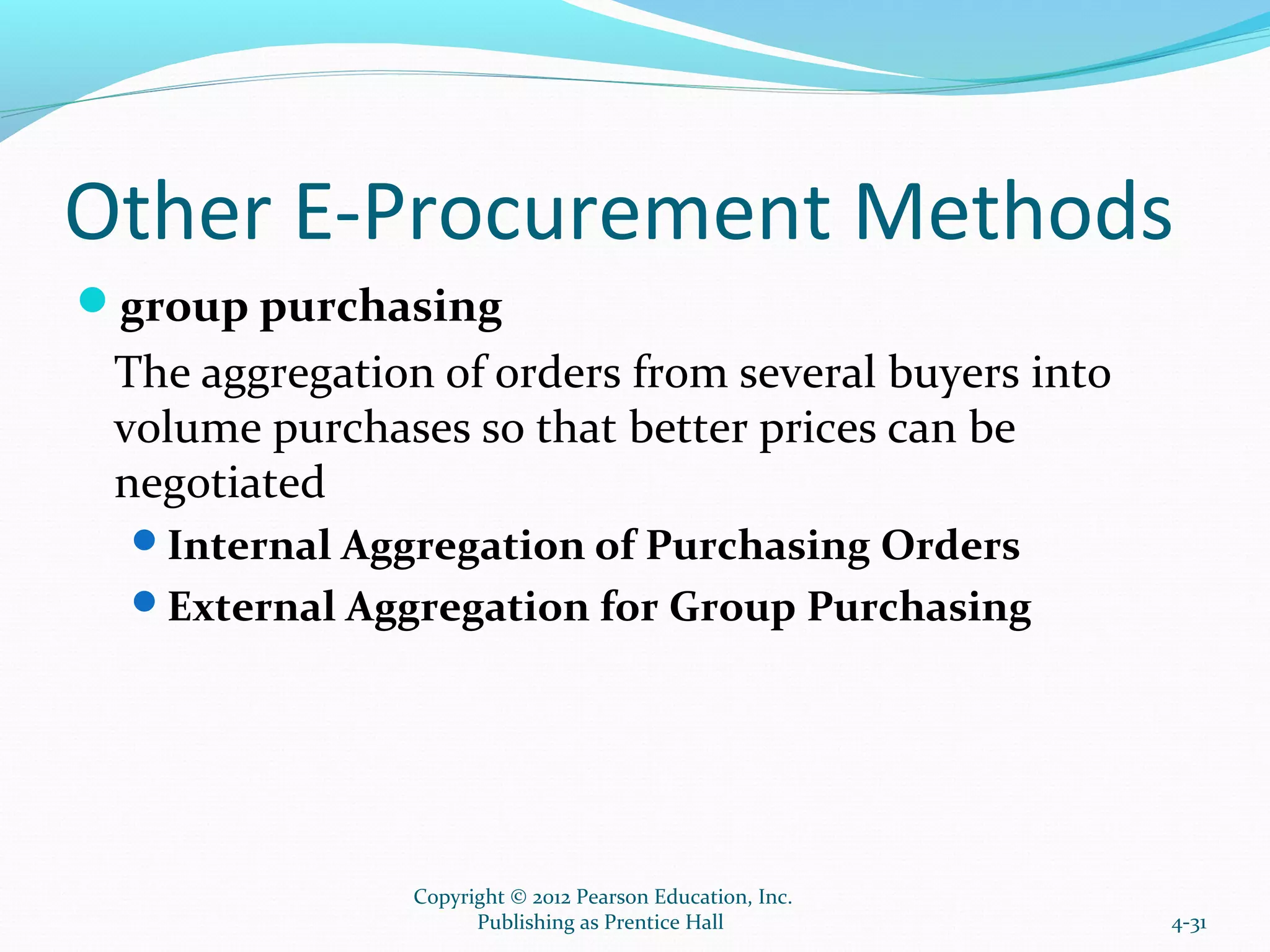
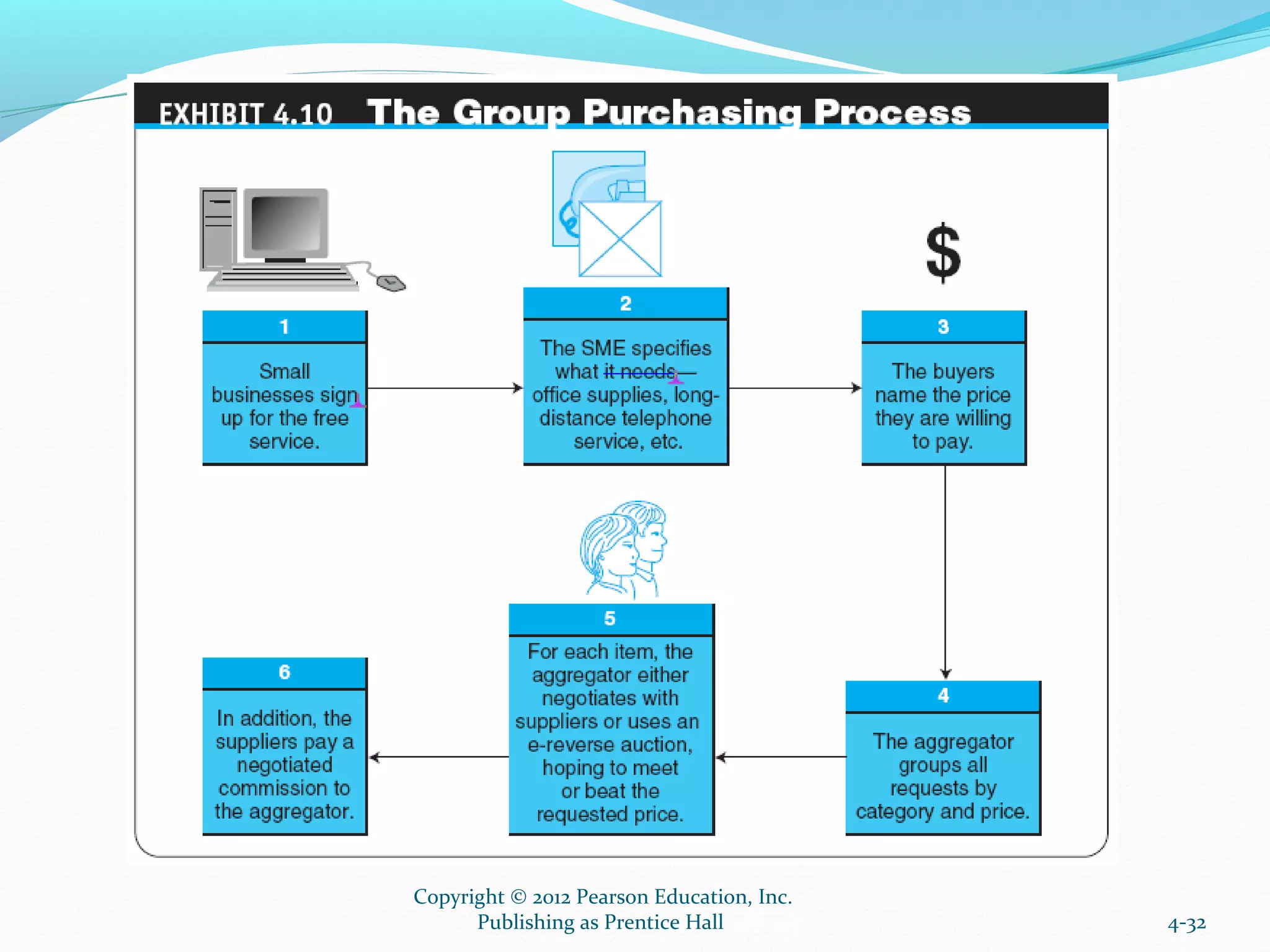
group purchasing
The aggregation of orders from several buyers into
volume purchases so that better prices can be
negotiated
Internal Aggregation of Purchasing Orders
External Aggregation for Group Purchasing
4-31
Copyright © 2012 Pearson Education, Inc.
Publishing as Prentice Hall
4-32
Copyright © 2012 Pearson Education, Inc.
Publishing as Prentice Hall
Other E-Procurement Methods
BUYING AT SELLERS’ SITES
Purchasing Direct Goods
ACQUISITION VIA ELECTRONIC BARTERING
bartering exchange
An intermediary that links parties in a barter; a
company submits its surplus to the exchange and
receives points of credit, which can be used to buy the
items that the company needs from other exchange
participants
SELECTING AN APPROPRIATE E-PROCUREMENT
SOLUTION
4-33
Copyright © 2012 Pearson Education, Inc.
Publishing as Prentice Hall
B2B Exchanges:
Definitions and Concepts
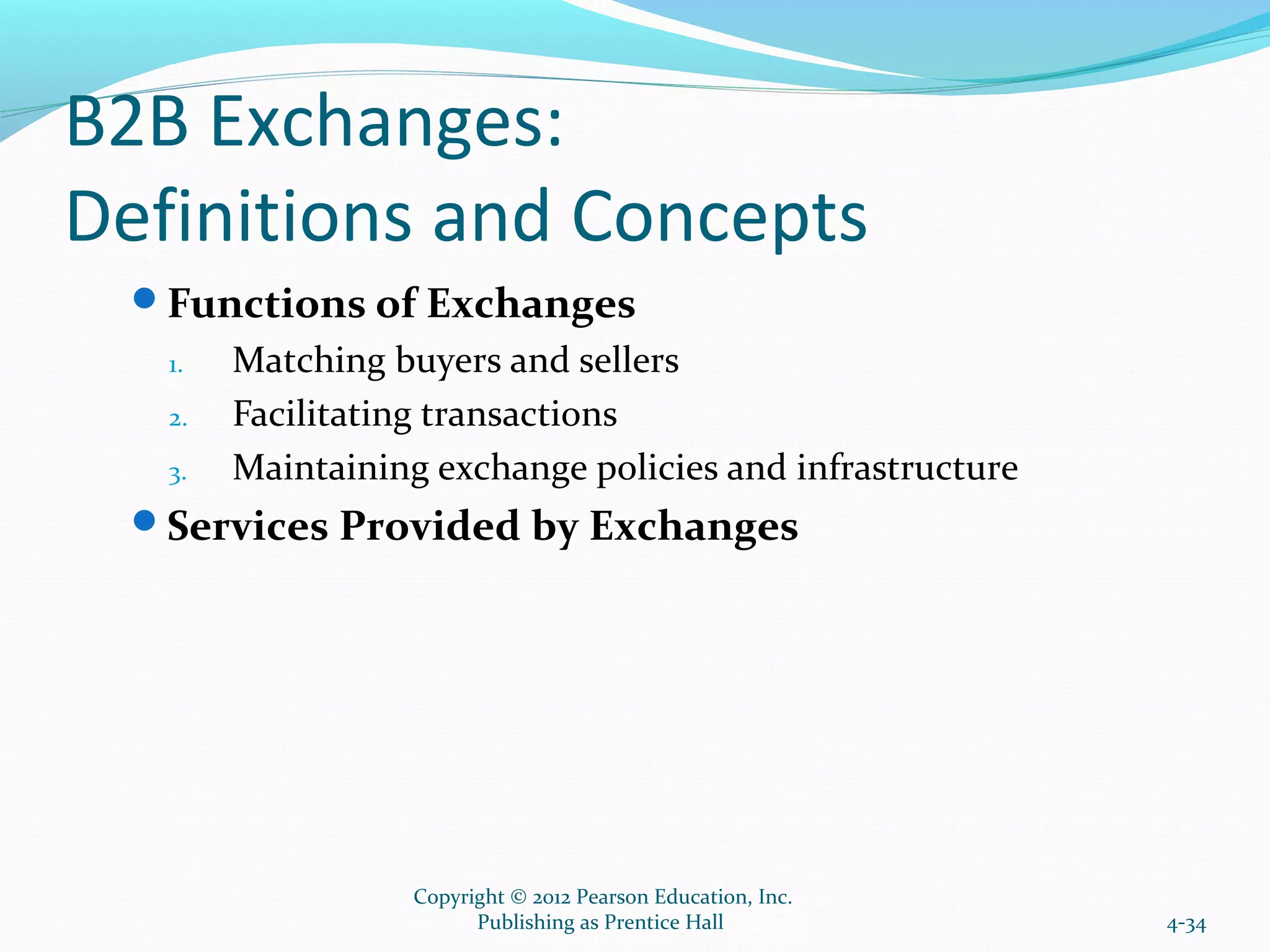
Functions of Exchanges
1. Matching buyers and sellers
2. Facilitating transactions
3. Maintaining exchange policies and infrastructure
Services Provided by Exchanges
4-34
Copyright © 2012 Pearson Education, Inc.
Publishing as Prentice Hall
4-35
Copyright © 2012 Pearson Education, Inc.
Publishing as Prentice Hall
4-36
Copyright © 2012 Pearson Education, Inc.
Publishing as Prentice Hall
B2B Exchanges:
Definitions and Concepts
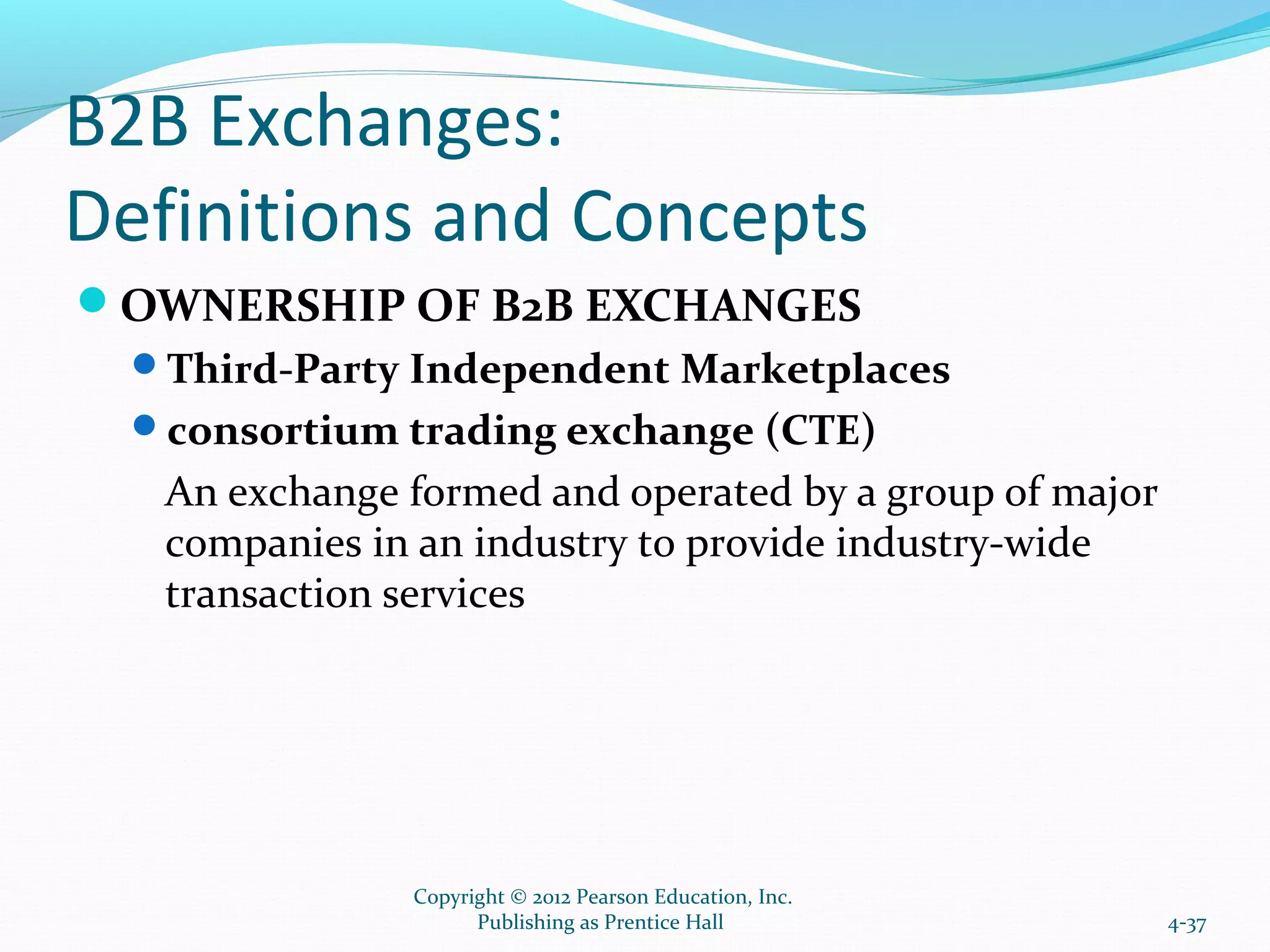
OWNERSHIP OF B2B EXCHANGES
Third-Party Independent Marketplaces
consortium trading exchange (CTE)
An exchange formed and operated by a group of major
companies in an industry to provide industry-wide
transaction services
4-37
Copyright © 2012 Pearson Education, Inc.
Publishing as Prentice Hall
B2B Exchanges:
Definitions and Concepts
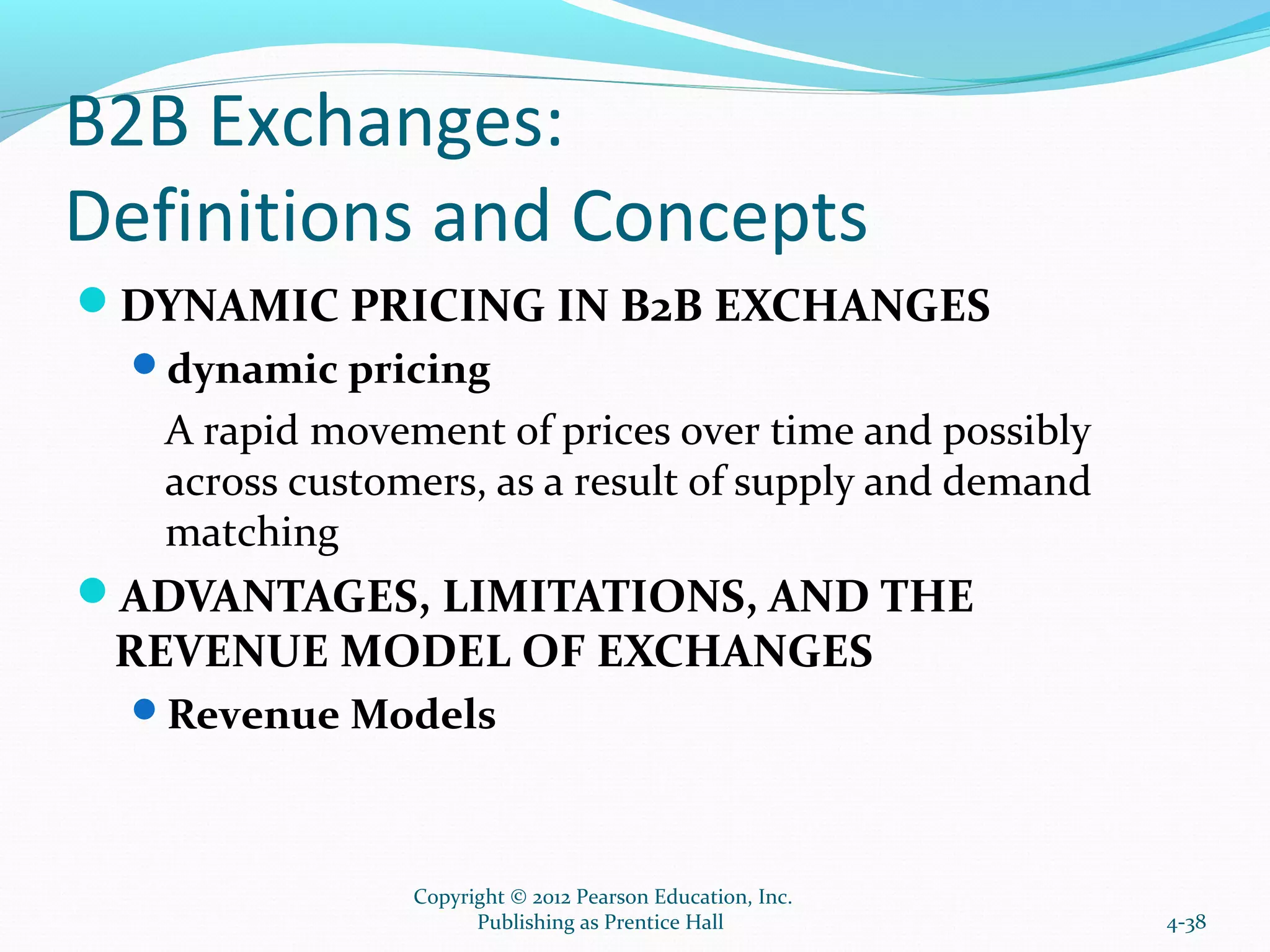
DYNAMIC PRICING IN B2B EXCHANGES
dynamic pricing
A rapid movement of prices over time and possibly
across customers, as a result of supply and demand
matching
ADVANTAGES, LIMITATIONS, AND THE
REVENUE MODEL OF EXCHANGES
Revenue Models
4-38
Copyright © 2012 Pearson Education, Inc.
Publishing as Prentice Hall
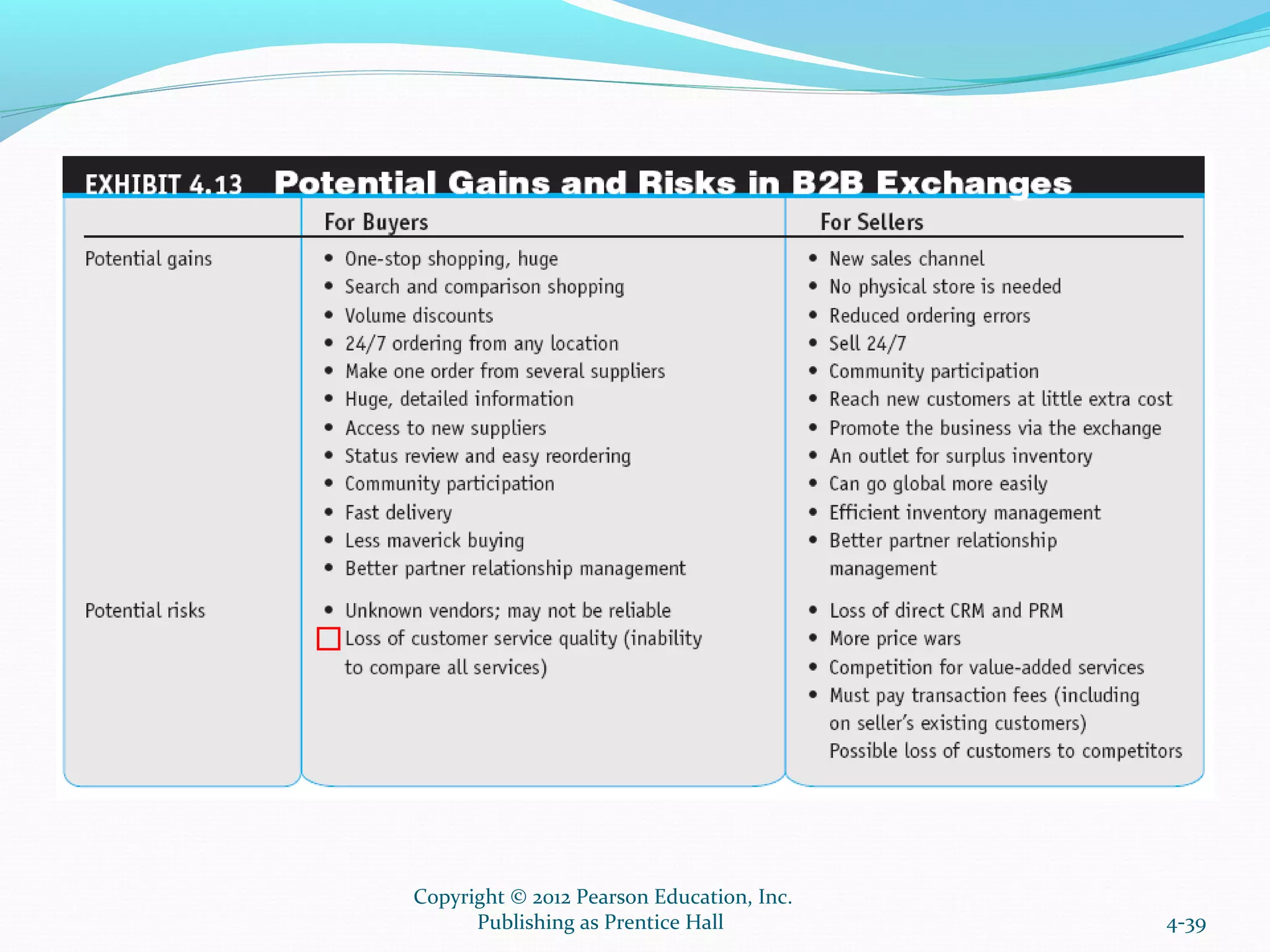
4-39
Copyright © 2012 Pearson Education, Inc.
Publishing as Prentice Hall
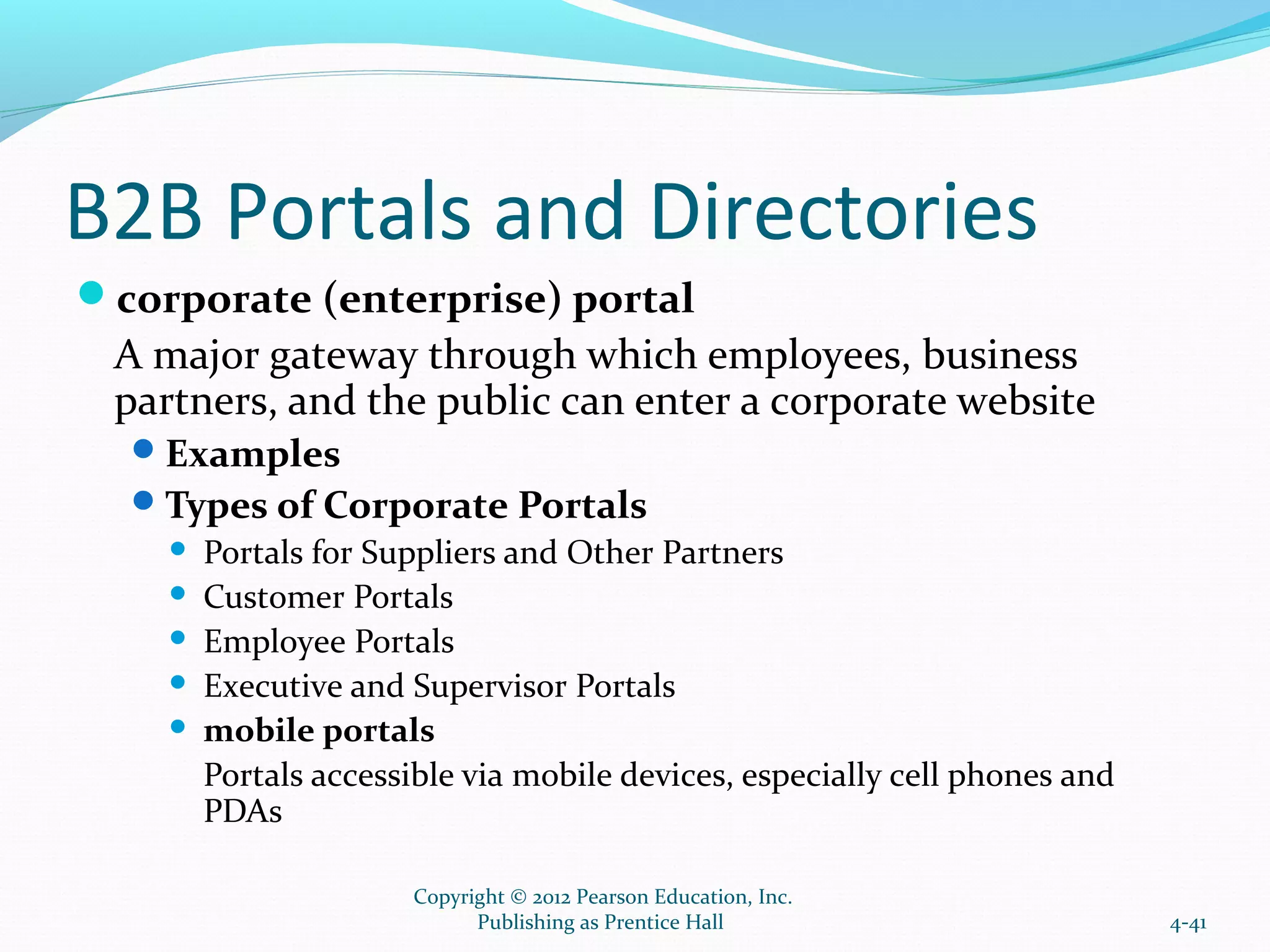
B2B Portals and Directories
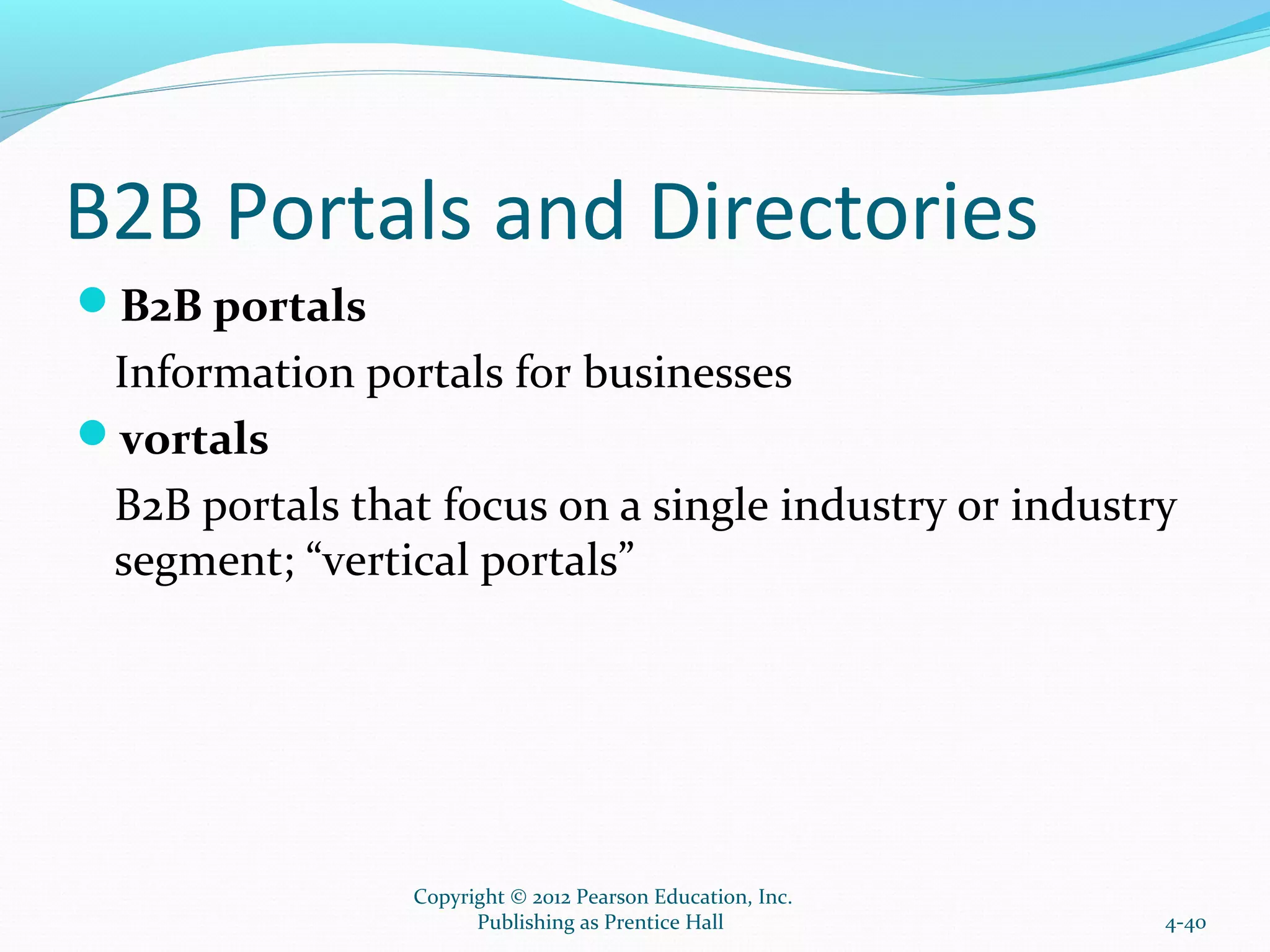
B2B portals
Information portals for businesses
vortals
B2B portals that focus on a single industry or industry
segment; “vertical portals”
4-40
Copyright © 2012 Pearson Education, Inc.
Publishing as Prentice Hall
B2B Portals and Directories
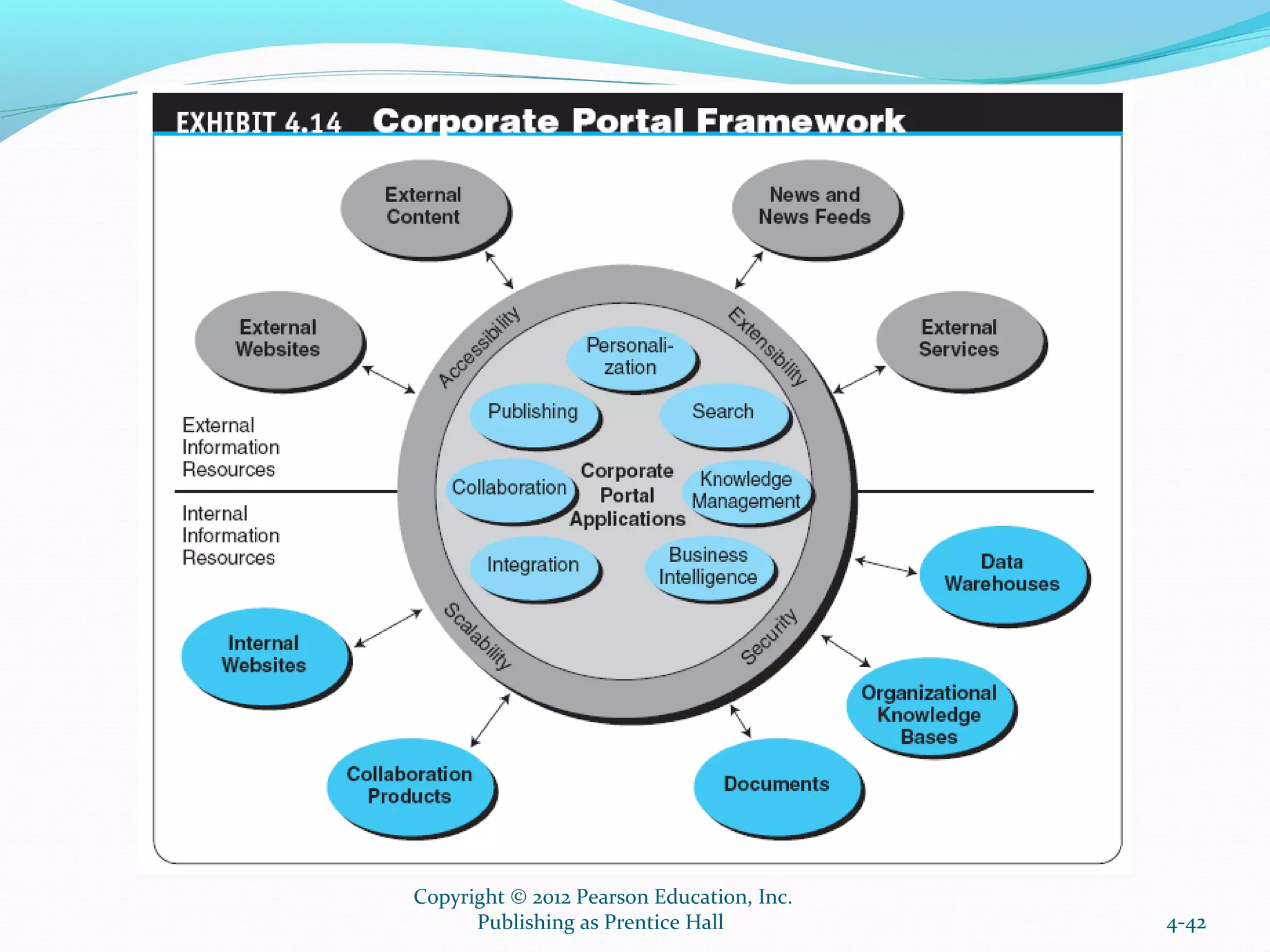
corporate (enterprise) portal
A major gateway through which employees, business
partners, and the public can enter a corporate website
Examples
Types of Corporate Portals
 Portals for Suppliers and Other Partners
 Customer Portals
 Employee Portals
 Executive and Supervisor Portals
 mobile portals
Portals accessible via mobile devices, especially cell phones and
PDAs
4-41
Copyright © 2012 Pearson Education, Inc.
Publishing as Prentice Hall
4-42
Copyright © 2012 Pearson Education, Inc.
Publishing as Prentice Hall
B2B Portals and Directories
The Functionalities of Portals
 information portals
Portals that store data and enable users to navigate and query
these data
 collaborative portals
Portals that allow collaboration
Corporate Portal Applications and Issues
Directory Services and Search Engines
Thomas Register and ThomasNet
Alibaba.com
4-43
Copyright © 2012 Pearson Education, Inc.
Publishing as Prentice Hall
B2B In Web 2.0
and Social Networking
E-COMMUNITIES IN B2B
THE OPPORTUNITIES OF SOCIAL COMMERCE
IN B2B
THE USE OF WEB 2.0 TOOLS IN B2B
4-44
Copyright © 2012 Pearson Education, Inc.
Publishing as Prentice Hall
B2B In Web 2.0
and Social Networking
SOCIAL NETWORKING IN B2B
EXAMPLES OF OTHER ACTIVITIES OF B2B
SOCIAL NETWORKS
Success Stories
STRATEGY FOR B2B SOCIAL NETWORKING
THE FUTURE OF B2B SOCIAL NETWORKING
4-45
Copyright © 2012 Pearson Education, Inc.
Publishing as Prentice Hall
B2B Internet Marketing
B2B marketing
Marketing by manufacturers and wholesalers along
the sell-side of the supply chain
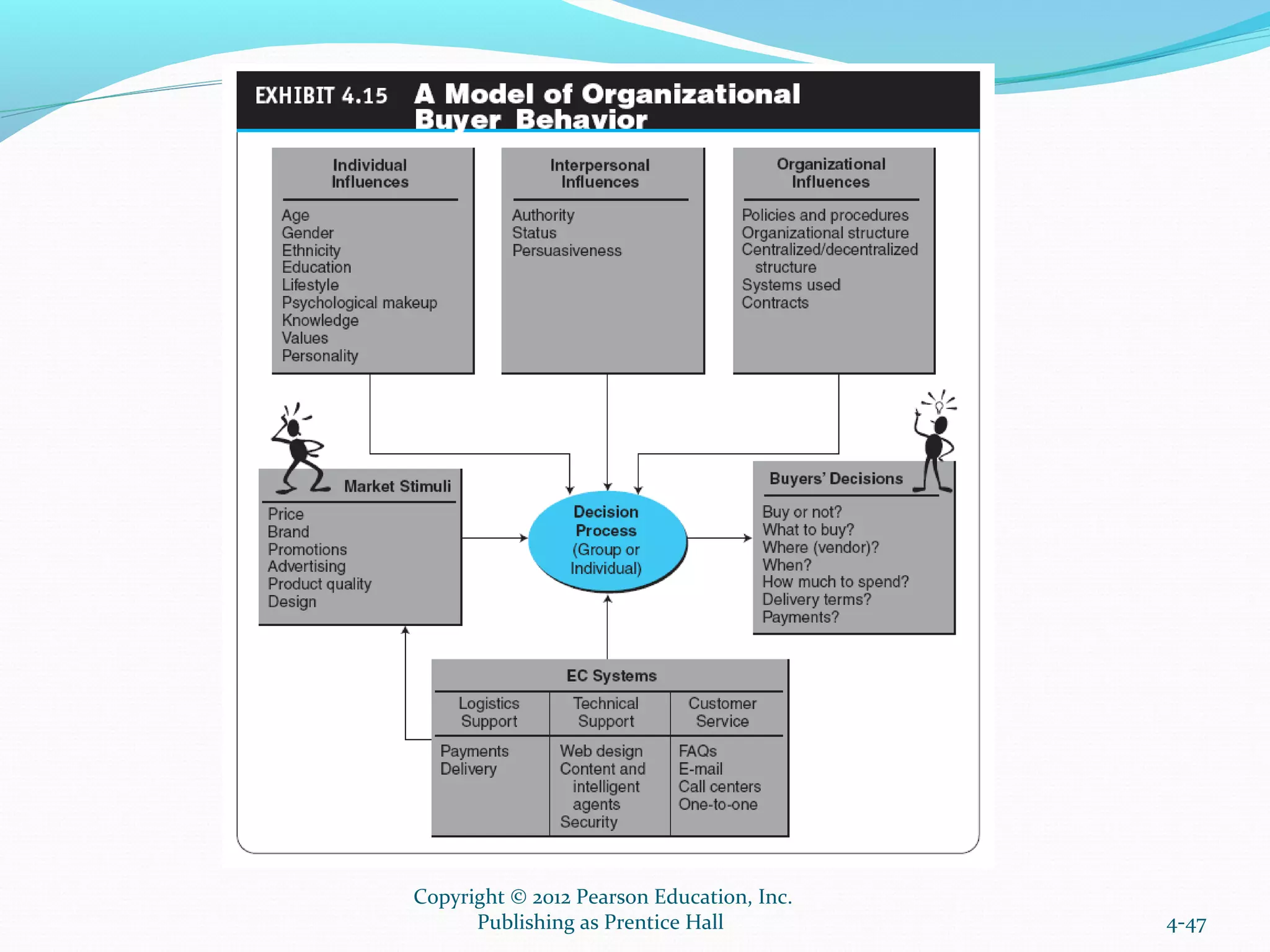
ORGANIZATIONAL BUYER BEHAVIOR
A Behavioral Model of Organizational Buyers
THE MARKETING AND ADVERTISING
PROCESSES IN B2B
4-46
Copyright © 2012 Pearson Education, Inc.
Publishing as Prentice Hall
4-47
Copyright © 2012 Pearson Education, Inc.
Publishing as Prentice Hall
B2B Internet Marketing
METHODS FOR B2B ONLINE MARKETING
Targeting Customers
AFFILIATE PROGRAMS, MARKET RESEARCH,
AND DATA MINING
Affiliate Programs
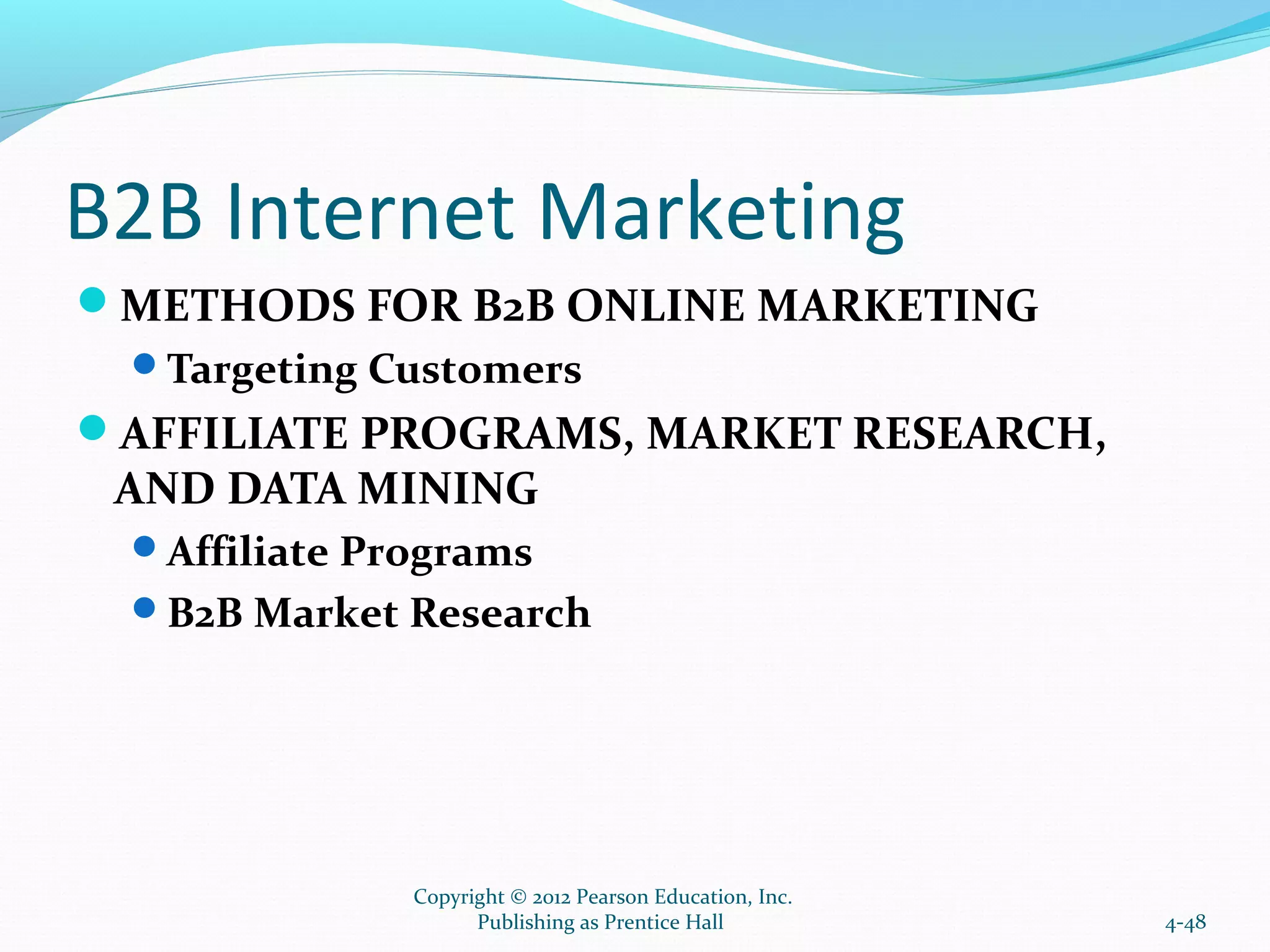
B2B Market Research
4-48
Copyright © 2012 Pearson Education, Inc.
Publishing as Prentice Hall
Managerial Issues
1. Which B2B model(s) should we use for e-procurement?
2. Which B2B model(s) should we use for online B2B sales?
3. Which exchange should we join?
4. Which solutions and vendor(s) should we select?
5. What is the organizational impact of B2B?
6. What are some ethical issues in B2B?
7. How shall we manage the suppliers?
8. Which type of social network should we use—private
(proprietary) or public?
9. Can we use B2C marketing methods and research in
B2B? 4-49
Copyright © 2012 Pearson Education, Inc.
Publishing as Prentice Hall
Summary
1. The B2B field
2. The major B2B models
3. The characteristics and models of sell-side
marketplaces
4. Sell-side intermediaries
5. The characteristics of buy-side marketplaces and e-
procurement
6. B2B reverse auctions
7. B2B aggregation and group purchasing
4-50
Copyright © 2012 Pearson Education, Inc.
Publishing as Prentice Hall
Summary
8. Other procurement methods
9. Exchanges defined and the major types of exchanges
10. B2B portals
11. Third-party exchanges
12. B2B in Web 2.0 and social networks
13. B2B Internet marketing methods and organizational
buyers
4-51
Copyright © 2012 Pearson Education, Inc.
Publishing as Prentice Hall

Chapter 4/B2B E-Commerce – Technology of E-Business

  • 1.
    B2B E-Commerce CIS 579– Technology of E-Business Joseph H. Schuessler, PhD joseph.schuesslersounds.com Tarleton State University Stephenville, Texas schuessler@tarleton.edu
  • 2.
    Learning Objectives 1. Describethe B2B field. 2. Describe the major types of B2B models. 3. Discuss the models and characteristics of the sell- side marketplace, including auctions. 4. Describe the sell-side intermediaries. 5. Describe the characteristics of the buy-side marketplace and e-procurement. 6. Explain how reverse auctions work in B2B. 7. Describe B2B aggregation and group purchasing models. 4-2 Copyright © 2012 Pearson Education, Inc. Publishing as Prentice Hall
  • 3.
    Learning Objectives 8. Describeother procurement methods. 9. Define exchanges and describe their major types. 10. Describe B2B portals. 11. Describe third-party exchanges. 12. Describe how B2B can benefit from social networking and Web 2.0. 13. Describe Internet marketing in B2B, including organizational buyer behavior. 4-3 Copyright © 2012 Pearson Education, Inc. Publishing as Prentice Hall
  • 4.
    Concepts, Characteristics, and Modelsof B2B E-Commerce business-to-business e-commerce (B2B EC) Transactions between businesses conducted electronically over the Internet, extranets, intranets, or private networks; also known as eB2B (electronic B2B) or just B2B 4-4 Copyright © 2012 Pearson Education, Inc. Publishing as Prentice Hall
  • 5.
    Concepts, Characteristics, and Modelsof B2B E-Commerce THE BASIC TYPES OF B2B TRANSACTIONS AND ACTIVITIES Sell-side Buy-side Exchanges Supply chain improvements and collaborative commerce 4-5 Copyright © 2012 Pearson Education, Inc. Publishing as Prentice Hall
  • 6.
    Concepts, Characteristics, and Modelsof B2B E-Commerce THE BASIC TYPES OF B2B E-MARKETPLACES AND SERVICES One-to-Many and Many-to-One: Private E- Marketplaces  company-centric EC E-commerce that focuses on a single company’s buying needs (many-to- one, or buy-side) or selling needs (one-to- many, or sell-side) 4-6 Copyright © 2012 Pearson Education, Inc. Publishing as Prentice Hall
  • 7.
    4-7 Copyright © 2012Pearson Education, Inc. Publishing as Prentice Hall
  • 8.
    Concepts, Characteristics, and Modelsof B2B E-Commerce Many-to-Many: Public Exchanges  exchanges (trading communities or trading exchanges) Many-to-many e-marketplaces, usually owned and run by a third party or a consortium, in which many buyers and many sellers meet electronically to trade with each other  public e-marketplaces Third-party exchanges open to all interested parties (sellers and buyers) Supply Chain Improvers and Collaborative Commerce 4-8 Copyright © 2012 Pearson Education, Inc. Publishing as Prentice Hall
  • 9.
    4-9 Copyright © 2012Pearson Education, Inc. Publishing as Prentice Hall
  • 10.
    4-10 Copyright © 2012Pearson Education, Inc. Publishing as Prentice Hall
  • 11.
    Concepts, Characteristics, and Modelsof B2B E-Commerce B2B CHARACTERISTICS Parties to the Transaction: Sellers, Buyers, and Intermediaries  online intermediary An online third party that brokers a transaction online between a buyer and a seller; may be virtual or click-and- mortar 4-11 Copyright © 2012 Pearson Education, Inc. Publishing as Prentice Hall
  • 12.
    Concepts, Characteristics, and Modelsof B2B E-Commerce Types of B2B Transactions: How Do Firms Buy?  spot buying The purchase of goods and services as they are needed, usually at prevailing market prices  strategic (systematic) sourcing Purchases involving long-term contracts that usually are based on private negotiations between sellers and buyers 4-12 Copyright © 2012 Pearson Education, Inc. Publishing as Prentice Hall
  • 13.
    Concepts, Characteristics, and Modelsof B2B E-Commerce Types of Materials Traded: What Do Firms Buy?  direct materials Materials used in the production of a product (e.g., steel in a car or paper in a book)  indirect materials Materials used to support production (e.g., office supplies or light bulbs)  MRO (maintenance, repair, and operation) Indirect materials used in activities that support production 4-13 Copyright © 2012 Pearson Education, Inc. Publishing as Prentice Hall
  • 14.
    Concepts, Characteristics, and Modelsof B2B E-Commerce The Direction of the Trades  vertical marketplaces Markets that deal with one industry or industry segment (e.g., steel, chemicals)  horizontal marketplaces Markets that concentrate on a service, material, or a product that is used in all types of industries (e.g., office supplies, PCs) 4-14 Copyright © 2012 Pearson Education, Inc. Publishing as Prentice Hall
  • 15.
    Concepts, Characteristics, and Modelsof B2B E-Commerce SUPPLY CHAIN RELATIONSHIPS IN B2B SERVICE INDUSTRIES ONLINE IN B2B PARTNER AND SUPPLIER RELATIONSHIP MANAGEMENT partner relationship management (PRM) Business strategy that focuses on providing comprehensive quality service to business partners supplier relationship management (SRM) A comprehensive approach to managing an enterprise’s interactions with the organizations that supply the goods and services it uses. THE BENEFITS AND LIMITATIONS OF B2B 4-15 Copyright © 2012 Pearson Education, Inc. Publishing as Prentice Hall
  • 16.
    One-to-Many: Sell-Side E-Marketplaces sell-side e-marketplace AWeb-based marketplace in which one company sells to many business buyers from e-catalogs or auctions, frequently over an extranet B2B Sellers Customer Service 4-16 Copyright © 2012 Pearson Education, Inc. Publishing as Prentice Hall
  • 17.
    4-17 Copyright © 2012Pearson Education, Inc. Publishing as Prentice Hall
  • 18.
    One-to-Many: Sell-Side E-Marketplaces SALES FROMCATALOGS: STOREFRONT Customization and Self-Configuration Benefits and Limitations of Online Sales from Catalogs COMPREHENSIVE SELL-SIDE SYSTEMS 4-18 Copyright © 2012 Pearson Education, Inc. Publishing as Prentice Hall
  • 19.
    Selling Via Distributors andOther Intermediaries Manufacturers can sell directly to businesses, and they do so if the customers are large buyers. Frequently they use intermediaries to distribute their products to a large number of smaller buyers. The intermediaries buy products from many manufacturers and aggregate them into one catalog from which they sell to customers or to retailers. 4-19 Copyright © 2012 Pearson Education, Inc. Publishing as Prentice Hall
  • 20.
    Selling Via E-Auctions USINGAUCTIONS ON THE SELL SIDE Revenue generation Cost savings Increased “stickiness” Member acquisition and retention AUCTIONING FROM THE COMPANY’S OWN SITE USING INTERMEDIARIES IN AUCTIONS EXAMPLES OF B2B FORWARD AUCTIONS 4-20 Copyright © 2012 Pearson Education, Inc. Publishing as Prentice Hall
  • 21.
    One-from-Many: E-Procurement at Buy-SideE-Marketplaces buy-side e-marketplace A corporate-based acquisition site that uses reverse auctions, negotiations, group purchasing, or any other e-procurement method 4-21 Copyright © 2012 Pearson Education, Inc. Publishing as Prentice Hall
  • 22.
    One-from-Many: E-Procurement at Buy-SideE-Marketplaces INEFFICIENCIES IN TRADITIONAL PROCUREMENT MANAGEMENT procurement management The planning, organizing, and coordinating of all the activities relating to purchasing goods and services needed to accomplish the organization’s mission maverick buying Unplanned purchases of items needed quickly, often at non-prenegotiated higher prices 4-22 Copyright © 2012 Pearson Education, Inc. Publishing as Prentice Hall
  • 23.
    4-23 Copyright © 2012Pearson Education, Inc. Publishing as Prentice Hall
  • 24.
    One-from-Many: E-Procurement at Buy-SideE-Marketplaces e-procurement (electronic procurement) The electronic acquisition of goods and services for organizations via the Internet, EDI, etc. THE GOALS AND PROCESS OF E-PROCUREMENT Types of E-Procurement  E-sourcing  E-tendering  E-reverse auctioning  E-informing  Web-based ERP  E-market sites  E-MRO 4-24 Copyright © 2012 Pearson Education, Inc. Publishing as Prentice Hall
  • 25.
    4-25 Copyright © 2012Pearson Education, Inc. Publishing as Prentice Hall
  • 26.
    4-26 Copyright © 2012Pearson Education, Inc. Publishing as Prentice Hall
  • 27.
    One-from-Many: E-Procurement at Buy-SideE-Marketplaces THE BENEFITS AND LIMITATIONS OF E- PROCUREMENT The Benefits of E-Procurement The Limitations and Challenges of E-Procurement 4-27 Copyright © 2012 Pearson Education, Inc. Publishing as Prentice Hall
  • 28.
    Reverse Auctions at Buy-SideE-Marketplaces request for quote (RFQ) The “invitation” to participate in a tendering (bidding) system CONDUCTING REVERSE AUCTIONS E-Tendering by Governments GROUP REVERSE AUCTIONS 4-28 Copyright © 2012 Pearson Education, Inc. Publishing as Prentice Hall
  • 29.
    4-29 Copyright © 2012Pearson Education, Inc. Publishing as Prentice Hall
  • 30.
    Other E-Procurement Methods internalprocurement marketplace The aggregated catalogs of all approved suppliers combined into a single internal electronic catalog Benefits of Internal Aggregated Catalogs desktop purchasing Direct purchasing from internal marketplaces without the approval of supervisors and without the intervention of a procurement department 4-30 Copyright © 2012 Pearson Education, Inc. Publishing as Prentice Hall
  • 31.
    Other E-Procurement Methods grouppurchasing The aggregation of orders from several buyers into volume purchases so that better prices can be negotiated Internal Aggregation of Purchasing Orders External Aggregation for Group Purchasing 4-31 Copyright © 2012 Pearson Education, Inc. Publishing as Prentice Hall
  • 32.
    4-32 Copyright © 2012Pearson Education, Inc. Publishing as Prentice Hall
  • 33.
    Other E-Procurement Methods BUYINGAT SELLERS’ SITES Purchasing Direct Goods ACQUISITION VIA ELECTRONIC BARTERING bartering exchange An intermediary that links parties in a barter; a company submits its surplus to the exchange and receives points of credit, which can be used to buy the items that the company needs from other exchange participants SELECTING AN APPROPRIATE E-PROCUREMENT SOLUTION 4-33 Copyright © 2012 Pearson Education, Inc. Publishing as Prentice Hall
  • 34.
    B2B Exchanges: Definitions andConcepts Functions of Exchanges 1. Matching buyers and sellers 2. Facilitating transactions 3. Maintaining exchange policies and infrastructure Services Provided by Exchanges 4-34 Copyright © 2012 Pearson Education, Inc. Publishing as Prentice Hall
  • 35.
    4-35 Copyright © 2012Pearson Education, Inc. Publishing as Prentice Hall
  • 36.
    4-36 Copyright © 2012Pearson Education, Inc. Publishing as Prentice Hall
  • 37.
    B2B Exchanges: Definitions andConcepts OWNERSHIP OF B2B EXCHANGES Third-Party Independent Marketplaces consortium trading exchange (CTE) An exchange formed and operated by a group of major companies in an industry to provide industry-wide transaction services 4-37 Copyright © 2012 Pearson Education, Inc. Publishing as Prentice Hall
  • 38.
    B2B Exchanges: Definitions andConcepts DYNAMIC PRICING IN B2B EXCHANGES dynamic pricing A rapid movement of prices over time and possibly across customers, as a result of supply and demand matching ADVANTAGES, LIMITATIONS, AND THE REVENUE MODEL OF EXCHANGES Revenue Models 4-38 Copyright © 2012 Pearson Education, Inc. Publishing as Prentice Hall
  • 39.
    4-39 Copyright © 2012Pearson Education, Inc. Publishing as Prentice Hall
  • 40.
    B2B Portals andDirectories B2B portals Information portals for businesses vortals B2B portals that focus on a single industry or industry segment; “vertical portals” 4-40 Copyright © 2012 Pearson Education, Inc. Publishing as Prentice Hall
  • 41.
    B2B Portals andDirectories corporate (enterprise) portal A major gateway through which employees, business partners, and the public can enter a corporate website Examples Types of Corporate Portals  Portals for Suppliers and Other Partners  Customer Portals  Employee Portals  Executive and Supervisor Portals  mobile portals Portals accessible via mobile devices, especially cell phones and PDAs 4-41 Copyright © 2012 Pearson Education, Inc. Publishing as Prentice Hall
  • 42.
    4-42 Copyright © 2012Pearson Education, Inc. Publishing as Prentice Hall
  • 43.
    B2B Portals andDirectories The Functionalities of Portals  information portals Portals that store data and enable users to navigate and query these data  collaborative portals Portals that allow collaboration Corporate Portal Applications and Issues Directory Services and Search Engines Thomas Register and ThomasNet Alibaba.com 4-43 Copyright © 2012 Pearson Education, Inc. Publishing as Prentice Hall
  • 44.
    B2B In Web2.0 and Social Networking E-COMMUNITIES IN B2B THE OPPORTUNITIES OF SOCIAL COMMERCE IN B2B THE USE OF WEB 2.0 TOOLS IN B2B 4-44 Copyright © 2012 Pearson Education, Inc. Publishing as Prentice Hall
  • 45.
    B2B In Web2.0 and Social Networking SOCIAL NETWORKING IN B2B EXAMPLES OF OTHER ACTIVITIES OF B2B SOCIAL NETWORKS Success Stories STRATEGY FOR B2B SOCIAL NETWORKING THE FUTURE OF B2B SOCIAL NETWORKING 4-45 Copyright © 2012 Pearson Education, Inc. Publishing as Prentice Hall
  • 46.
    B2B Internet Marketing B2Bmarketing Marketing by manufacturers and wholesalers along the sell-side of the supply chain ORGANIZATIONAL BUYER BEHAVIOR A Behavioral Model of Organizational Buyers THE MARKETING AND ADVERTISING PROCESSES IN B2B 4-46 Copyright © 2012 Pearson Education, Inc. Publishing as Prentice Hall
  • 47.
    4-47 Copyright © 2012Pearson Education, Inc. Publishing as Prentice Hall
  • 48.
    B2B Internet Marketing METHODSFOR B2B ONLINE MARKETING Targeting Customers AFFILIATE PROGRAMS, MARKET RESEARCH, AND DATA MINING Affiliate Programs B2B Market Research 4-48 Copyright © 2012 Pearson Education, Inc. Publishing as Prentice Hall
  • 49.
    Managerial Issues 1. WhichB2B model(s) should we use for e-procurement? 2. Which B2B model(s) should we use for online B2B sales? 3. Which exchange should we join? 4. Which solutions and vendor(s) should we select? 5. What is the organizational impact of B2B? 6. What are some ethical issues in B2B? 7. How shall we manage the suppliers? 8. Which type of social network should we use—private (proprietary) or public? 9. Can we use B2C marketing methods and research in B2B? 4-49 Copyright © 2012 Pearson Education, Inc. Publishing as Prentice Hall
  • 50.
    Summary 1. The B2Bfield 2. The major B2B models 3. The characteristics and models of sell-side marketplaces 4. Sell-side intermediaries 5. The characteristics of buy-side marketplaces and e- procurement 6. B2B reverse auctions 7. B2B aggregation and group purchasing 4-50 Copyright © 2012 Pearson Education, Inc. Publishing as Prentice Hall
  • 51.
    Summary 8. Other procurementmethods 9. Exchanges defined and the major types of exchanges 10. B2B portals 11. Third-party exchanges 12. B2B in Web 2.0 and social networks 13. B2B Internet marketing methods and organizational buyers 4-51 Copyright © 2012 Pearson Education, Inc. Publishing as Prentice Hall