
E-commerce

business. technology. society.
Second Edition

Kenneth C. Laudon
Carol Guercio Traver

Copyright © 2004 Pearson Education, Inc.

Slide 2-1
Chapter 2b
E-commerce Business
Models and Concepts

Copyright © 2004 Pearson Education, Inc.

Slide 2-2
Insight on Technology: Google: In
Search of Profits, Accepts Paid Listings








Founded in 1998 by 2 Stanford grad students
Focused solely on search engine business in contrast
to Yahoo, MSN, AOL
Almost missed major market shift in way companies
advertise on Web – paid search listings, pioneered by
GoTo.com (now Overture.com) in 1999
2000, introduced tiny paid advertising boxes on the
right of Search Results page; Feb 2002, began to
allow firms to bid for placement and added sponsored
links at top of Search Results page
2003, Yahoo buys Inktomi and Overture (which owns
AltaVista) – new questions as to whether Google will
remain the leading search engine

Copyright © 2004 Pearson Education, Inc.

Slide 2-3
Insight on Technology: Google: In
Search of Profits, Accepts Paid Listings
Page 79

Copyright © 2004 Pearson Education, Inc.

Slide 2-4
B2B Business Models
Table 2.4, Page 82

Copyright © 2004 Pearson Education, Inc.

Slide 2-5
E-distributor




Company that supplies products and services
directly to individual businesses
Owned by one company seeking to serve
many customers
Examples:
 Grainger.com
 GE Electric Aircraft Engines (geae.com)

Copyright © 2004 Pearson Education, Inc.

Slide 2-6
E-procurement Companies






Create and sell access to digital electronic markets
B2B service provider is one type – offer purchasing
firms sophisticated set of sourcing and supply chain
management tools
Application service providers a subset of B2B service
providers
Examples:
 Ariba
 CommerceOne

Copyright © 2004 Pearson Education, Inc.

Slide 2-7
Exchanges (B2B Hubs)






An electronic digital marketplace where suppliers and
commercial purchasers can conduct transactions
Usually owned by independent firms whose business
is making a market
Generate revenue by charging transaction fees
Usually serve a single vertical industry
Number of exchanges has fallen to around 700 in
2003

Copyright © 2004 Pearson Education, Inc.

Slide 2-8
Insight on Business: C02E.com:
Global Pollution Market







Kyoto Protocol includes provisions for use of markets
to trade pollution rights as one means to reduce
emissions
C02e.com is one of the markets that has been
created in response – is a worldwide global trading
platform for greenhouse gas pollution rights
Chicago Climate Exchange is another example
So far, about $200 million tons of greenhouse gas
rights have been traded on various B2B exchanges,
and volumes are growing about 50% a year/

Copyright © 2004 Pearson Education, Inc.

Slide 2-9
C02E.com: Global Pollution Market
Page 84

Copyright © 2004 Pearson Education, Inc.

Slide 2-10
Industry Consortia





Industry-owned vertical marketplaces that
serve specific industries
Horizontal marketplaces, in contrast, sell
specific products and services to a wide
range of industries
Leading example: Covisint

Copyright © 2004 Pearson Education, Inc.

Slide 2-11
Private Industrial Networks





Digital networks (usually, but not always
Internet-based) designed to coordinate the
flow of communications among firms
engaged in business together
Single firm network: the most common form
(example – Walmart)
Industry-wide networks: often evolve out of
industry associations (example – WWRE)

Copyright © 2004 Pearson Education, Inc.

Slide 2-12
Business Models in Emerging Ecommerce Areas
Table 2.5, Page 88

Copyright © 2004 Pearson Education, Inc.

Slide 2-13
Consumer-to-Consumer (C2C)
Business Models



Provide a way for consumers to sell to each
other, with the help of a online marketmaker
Best example: eBay.com

Copyright © 2004 Pearson Education, Inc.

Slide 2-14
Peer-to-Peer (P2P) Business Models




Links users, enabling them to share files and
common resources without a common server
Challenge is for P2P ventures to develop
viable, legal business models
Example: Kazaa; Groovenetworks

Copyright © 2004 Pearson Education, Inc.

Slide 2-15
M-Commerce Business Models






Takes traditional e-commerce business
models and leverages emerging new wireless
technologies
Key technologies are telephone-based 3G;
Wi-Fi; and Bluetooth
To date, a disappointment in the U.S.
However, technology platform continues to
evolve

Copyright © 2004 Pearson Education, Inc.

Slide 2-16
Insight on Society: Is Privacy
Possible in a Wireless World





Capabilities of wireless networks (location
services; E911) pose privacy threats
Wireless industry calling for self-regulation to
avoid government-imposed regulation
How to implement consumer choice
controversial (opt-in vs. opt-out)
Some possible technology solutions

Copyright © 2004 Pearson Education, Inc.

Slide 2-17
E-commerce Enablers: The Gold
Rush Model




Internet infrastructure companies: Companies
whose business model is focused on
providing infrastructure necessary for ecommerce companies to exist, grow and
prosper
Provide hardware, software, networking,
security, e-commerce software systems,
payment systems, databases, hosting
services, etc.

Copyright © 2004 Pearson Education, Inc.

Slide 2-18
E-commerce Enablers
Table 2.6, Page 90

Copyright © 2004 Pearson Education, Inc.

Slide 2-19
How the Internet and the Web Change
Business: Strategy, Structure, and
Process


Important to understand how Internet and
Web have changed business environment,
including industry structures, business
strategies, and industry and firm operations

Copyright © 2004 Pearson Education, Inc.

Slide 2-20
Seven Unique Features of E-commerce
Technology
Table 2.7,
Page 94

Copyright © 2004 Pearson Education, Inc.

Slide 2-21
Industry Structure


E-commerce changes the nature of players in
an industry and their relative bargaining
power by changing:
 the basis of competition among rivals
 the barriers to entry
 the threat of new substitute products
 the strength of suppliers
 the bargaining power of buyers

Copyright © 2004 Pearson Education, Inc.

Slide 2-22
How the Internet Influences
Industry Structure
Figure 2.2, Page 96

Copyright © 2004 Pearson Education, Inc.

Slide 2-23
Industry Value Chains




A set of activities performed in an industry by
suppliers by suppliers, manufacturers,
transporters, distributors, and retailers that
transform raw inputs into final products and
services
Reduces the cost of information and other
transactional costs

Copyright © 2004 Pearson Education, Inc.

Slide 2-24
E-commerce and Industry Value Chains
Figure 2.3, Page 98

Copyright © 2004 Pearson Education, Inc.

Slide 2-25
Firm Value Chains



A set of activities that a firm engages in to
create final products from raw inputs
Increases operational efficiency

Copyright © 2004 Pearson Education, Inc.

Slide 2-26
E-commerce and Firm Value Chains
Figure 2.4, Page 99

Copyright © 2004 Pearson Education, Inc.

Slide 2-27
Firm Value Webs




A networked business ecosystem that uses
Internet technology to coordinate the value
chains of business partners within an
industry, or within a group of firms
Coordinates a firm’s suppliers with its own
production needs using an Internet-based
supply chain management system

Copyright © 2004 Pearson Education, Inc.

Slide 2-28
Internet-Enabled Value Web
Figure 2.5, Page 101

Copyright © 2004 Pearson Education, Inc.

Slide 2-29
Business Strategy




A set of plans for achieving superior longterm returns on the capital invested in a
business firm (i.e, a plan for making a profit in
a competitive environment)
Four generic strategies
 Differentiation
 Cost
 Scope
 Focus

Copyright © 2004 Pearson Education, Inc.

Slide 2-30
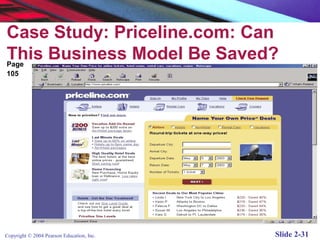
Case Study: Priceline.com: Can
This Business Model Be Saved?
Page
105

Copyright © 2004 Pearson Education, Inc.

Slide 2-31
Case Study: Priceline.com Can
This Business Model Be Saved?






Priceline.com – one of Web’s most well-known
companies
What went wrong with a business model that seemed
so promising?
 Financial climate
 Costs
 Extensibility
New strategy: select expansion with stringent
financial controls; refocus on core business
Strategic moves appear to have shored up core
business, but questions about future still exist – travel
industry declines due to terrorism, severe competition

Copyright © 2004 Pearson Education, Inc.

Slide 2-32

E commerce

  • 1.
    E-commerce business. technology. society. SecondEdition Kenneth C. Laudon Carol Guercio Traver Copyright © 2004 Pearson Education, Inc. Slide 2-1
  • 2.
    Chapter 2b E-commerce Business Modelsand Concepts Copyright © 2004 Pearson Education, Inc. Slide 2-2
  • 3.
    Insight on Technology:Google: In Search of Profits, Accepts Paid Listings      Founded in 1998 by 2 Stanford grad students Focused solely on search engine business in contrast to Yahoo, MSN, AOL Almost missed major market shift in way companies advertise on Web – paid search listings, pioneered by GoTo.com (now Overture.com) in 1999 2000, introduced tiny paid advertising boxes on the right of Search Results page; Feb 2002, began to allow firms to bid for placement and added sponsored links at top of Search Results page 2003, Yahoo buys Inktomi and Overture (which owns AltaVista) – new questions as to whether Google will remain the leading search engine Copyright © 2004 Pearson Education, Inc. Slide 2-3
  • 4.
    Insight on Technology:Google: In Search of Profits, Accepts Paid Listings Page 79 Copyright © 2004 Pearson Education, Inc. Slide 2-4
  • 5.
    B2B Business Models Table2.4, Page 82 Copyright © 2004 Pearson Education, Inc. Slide 2-5
  • 6.
    E-distributor    Company that suppliesproducts and services directly to individual businesses Owned by one company seeking to serve many customers Examples:  Grainger.com  GE Electric Aircraft Engines (geae.com) Copyright © 2004 Pearson Education, Inc. Slide 2-6
  • 7.
    E-procurement Companies     Create andsell access to digital electronic markets B2B service provider is one type – offer purchasing firms sophisticated set of sourcing and supply chain management tools Application service providers a subset of B2B service providers Examples:  Ariba  CommerceOne Copyright © 2004 Pearson Education, Inc. Slide 2-7
  • 8.
    Exchanges (B2B Hubs)      Anelectronic digital marketplace where suppliers and commercial purchasers can conduct transactions Usually owned by independent firms whose business is making a market Generate revenue by charging transaction fees Usually serve a single vertical industry Number of exchanges has fallen to around 700 in 2003 Copyright © 2004 Pearson Education, Inc. Slide 2-8
  • 9.
    Insight on Business:C02E.com: Global Pollution Market     Kyoto Protocol includes provisions for use of markets to trade pollution rights as one means to reduce emissions C02e.com is one of the markets that has been created in response – is a worldwide global trading platform for greenhouse gas pollution rights Chicago Climate Exchange is another example So far, about $200 million tons of greenhouse gas rights have been traded on various B2B exchanges, and volumes are growing about 50% a year/ Copyright © 2004 Pearson Education, Inc. Slide 2-9
  • 10.
    C02E.com: Global PollutionMarket Page 84 Copyright © 2004 Pearson Education, Inc. Slide 2-10
  • 11.
    Industry Consortia    Industry-owned verticalmarketplaces that serve specific industries Horizontal marketplaces, in contrast, sell specific products and services to a wide range of industries Leading example: Covisint Copyright © 2004 Pearson Education, Inc. Slide 2-11
  • 12.
    Private Industrial Networks    Digitalnetworks (usually, but not always Internet-based) designed to coordinate the flow of communications among firms engaged in business together Single firm network: the most common form (example – Walmart) Industry-wide networks: often evolve out of industry associations (example – WWRE) Copyright © 2004 Pearson Education, Inc. Slide 2-12
  • 13.
    Business Models inEmerging Ecommerce Areas Table 2.5, Page 88 Copyright © 2004 Pearson Education, Inc. Slide 2-13
  • 14.
    Consumer-to-Consumer (C2C) Business Models   Providea way for consumers to sell to each other, with the help of a online marketmaker Best example: eBay.com Copyright © 2004 Pearson Education, Inc. Slide 2-14
  • 15.
    Peer-to-Peer (P2P) BusinessModels    Links users, enabling them to share files and common resources without a common server Challenge is for P2P ventures to develop viable, legal business models Example: Kazaa; Groovenetworks Copyright © 2004 Pearson Education, Inc. Slide 2-15
  • 16.
    M-Commerce Business Models     Takestraditional e-commerce business models and leverages emerging new wireless technologies Key technologies are telephone-based 3G; Wi-Fi; and Bluetooth To date, a disappointment in the U.S. However, technology platform continues to evolve Copyright © 2004 Pearson Education, Inc. Slide 2-16
  • 17.
    Insight on Society:Is Privacy Possible in a Wireless World     Capabilities of wireless networks (location services; E911) pose privacy threats Wireless industry calling for self-regulation to avoid government-imposed regulation How to implement consumer choice controversial (opt-in vs. opt-out) Some possible technology solutions Copyright © 2004 Pearson Education, Inc. Slide 2-17
  • 18.
    E-commerce Enablers: TheGold Rush Model   Internet infrastructure companies: Companies whose business model is focused on providing infrastructure necessary for ecommerce companies to exist, grow and prosper Provide hardware, software, networking, security, e-commerce software systems, payment systems, databases, hosting services, etc. Copyright © 2004 Pearson Education, Inc. Slide 2-18
  • 19.
    E-commerce Enablers Table 2.6,Page 90 Copyright © 2004 Pearson Education, Inc. Slide 2-19
  • 20.
    How the Internetand the Web Change Business: Strategy, Structure, and Process  Important to understand how Internet and Web have changed business environment, including industry structures, business strategies, and industry and firm operations Copyright © 2004 Pearson Education, Inc. Slide 2-20
  • 21.
    Seven Unique Featuresof E-commerce Technology Table 2.7, Page 94 Copyright © 2004 Pearson Education, Inc. Slide 2-21
  • 22.
    Industry Structure  E-commerce changesthe nature of players in an industry and their relative bargaining power by changing:  the basis of competition among rivals  the barriers to entry  the threat of new substitute products  the strength of suppliers  the bargaining power of buyers Copyright © 2004 Pearson Education, Inc. Slide 2-22
  • 23.
    How the InternetInfluences Industry Structure Figure 2.2, Page 96 Copyright © 2004 Pearson Education, Inc. Slide 2-23
  • 24.
    Industry Value Chains   Aset of activities performed in an industry by suppliers by suppliers, manufacturers, transporters, distributors, and retailers that transform raw inputs into final products and services Reduces the cost of information and other transactional costs Copyright © 2004 Pearson Education, Inc. Slide 2-24
  • 25.
    E-commerce and IndustryValue Chains Figure 2.3, Page 98 Copyright © 2004 Pearson Education, Inc. Slide 2-25
  • 26.
    Firm Value Chains   Aset of activities that a firm engages in to create final products from raw inputs Increases operational efficiency Copyright © 2004 Pearson Education, Inc. Slide 2-26
  • 27.
    E-commerce and FirmValue Chains Figure 2.4, Page 99 Copyright © 2004 Pearson Education, Inc. Slide 2-27
  • 28.
    Firm Value Webs   Anetworked business ecosystem that uses Internet technology to coordinate the value chains of business partners within an industry, or within a group of firms Coordinates a firm’s suppliers with its own production needs using an Internet-based supply chain management system Copyright © 2004 Pearson Education, Inc. Slide 2-28
  • 29.
    Internet-Enabled Value Web Figure2.5, Page 101 Copyright © 2004 Pearson Education, Inc. Slide 2-29
  • 30.
    Business Strategy   A setof plans for achieving superior longterm returns on the capital invested in a business firm (i.e, a plan for making a profit in a competitive environment) Four generic strategies  Differentiation  Cost  Scope  Focus Copyright © 2004 Pearson Education, Inc. Slide 2-30
  • 31.
    Case Study: Priceline.com:Can This Business Model Be Saved? Page 105 Copyright © 2004 Pearson Education, Inc. Slide 2-31
  • 32.
    Case Study: Priceline.comCan This Business Model Be Saved?     Priceline.com – one of Web’s most well-known companies What went wrong with a business model that seemed so promising?  Financial climate  Costs  Extensibility New strategy: select expansion with stringent financial controls; refocus on core business Strategic moves appear to have shored up core business, but questions about future still exist – travel industry declines due to terrorism, severe competition Copyright © 2004 Pearson Education, Inc. Slide 2-32