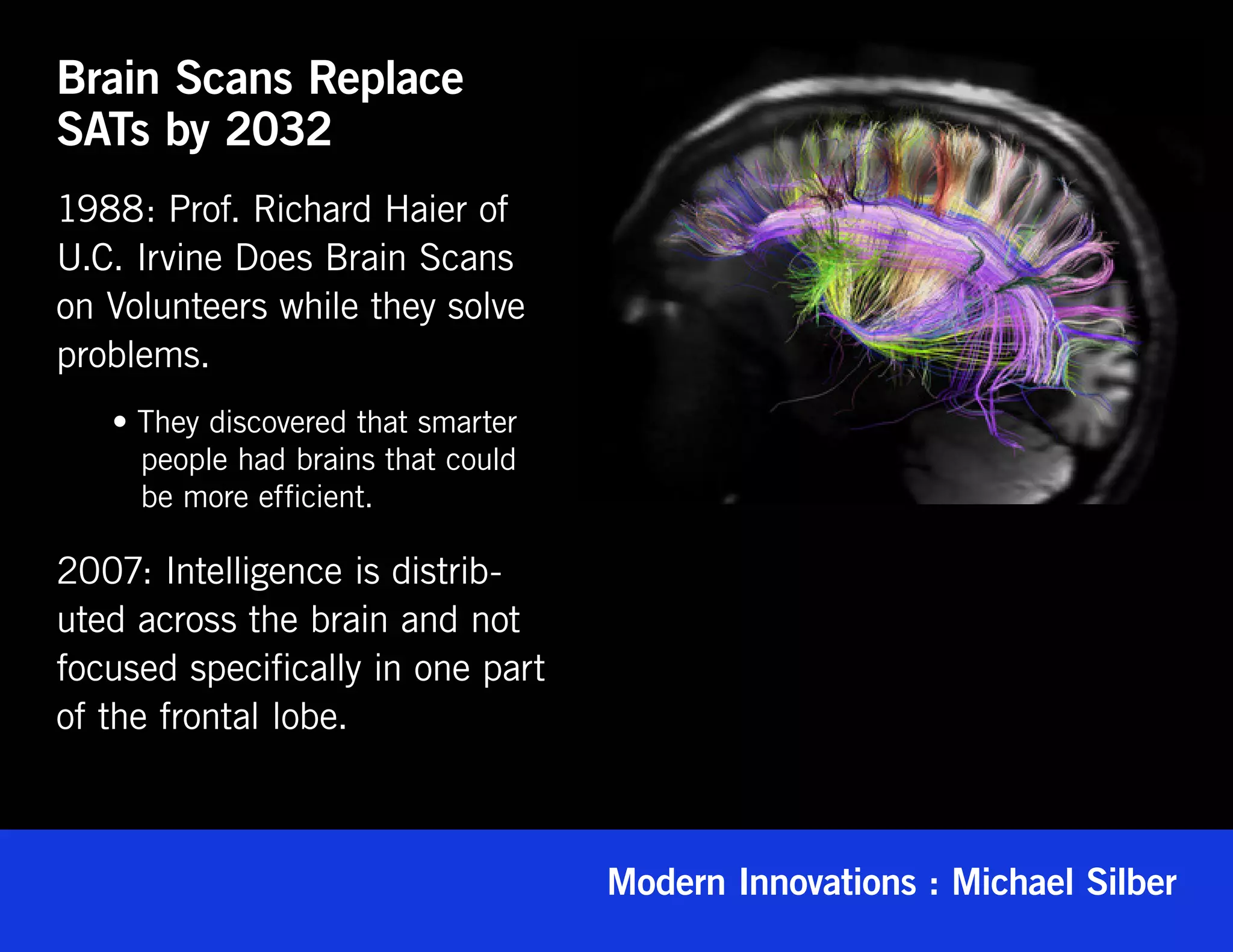
Brain Scans Replace
SATs by 2032
1988: Prof. Richard Haier of
U.C. Irvine Does Brain Scans
on Volunteers while they solve
problems.
	   • They discovered that smarter 	
	     people had brains that could 	
	     be more efficient.

2007: Intelligence is distrib-
uted across the brain and not
focused specifically in one part
of the frontal lobe.


                                       Modern Innovations : Michael Silber
“Haier notes that ‘The goal of our research is not to
 replace  the SAT with brain imaging. The goal is to
 understand what it is about brain characteristics that
 make some people smarter than others. As we learn
 about brain/intelligence relationships and mechanisms,
 we might be able to manipulate the brain to substan-
 tially increase intelligence using neurochemicals or
 other means.’”

					                               -Psychology Today


                           Modern Innovations : Michael Silber
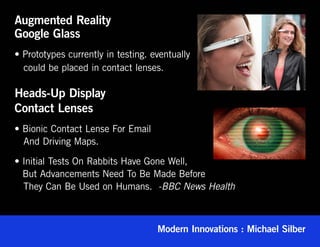
Augmented Reality
Google Glass
• Prototypes currently in testing. eventually
  could be placed in contact lenses.

Heads-Up Display
Contact Lenses
• Bionic Contact Lense For Email
  And Driving Maps.

• Initial Tests On Rabbits Have Gone Well,
   But Advancements Need To Be Made Before
   They Can Be Used on Humans. -BBC News Health


                                    Modern Innovations : Michael Silber
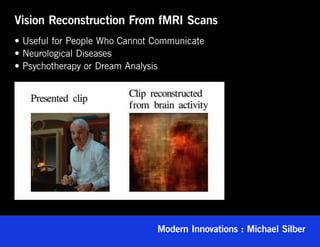
Vision Reconstruction From fMRI Scans
• Useful for People Who Cannot Communicate
• Neurological Diseases
• Psychotherapy or Dream Analysis


                               Modern Innovations : Michael Silber
National Human Genome Research Institute
and the Human Genome Project
April 2003
Entire Human Genome Successfully Sequenced

March 2012
1000 Genomes Project data available on Amazon Cloud

• Wide Medical Benefits and Future Applications
   of this knowledge. Ability to Label, Predict, Prevent,
   and Fight Diseases.

• Ethical, Legal, and Social Implications.


                    Modern Innovations : Michael Silber
Facial Recognition Software / Retinal Scans
• iPhoto and Picassa use Facial Recognition to assist labeling images.

• RecognizeMe iPhone App that scans your face to as a passcode.

• Sony Introducing facial recognition that makes Avatars respond to
   your gestures and facial features. They are also able to alter and
   apply your voice to the avatar.

• Facial Recognition Bars: SceneTap and other bars are using cameras
   and facial recognition to scan their clientele, determine demogra-
   pics, and adjust their marketing based on the acquired data.


                                   Modern Innovations : Michael Silber
Microchips in the Brain
• Increase Memory and/or Repair Brain Damage.
RAT TESTING: “These integrated experimental modeling studies show for the first
time that with sufficient information about the neural coding of memories, a neural
prosthesis capable of real-time identification and manipulation of the encoding
process can restore and even enhance cognitive mnemonic processes,”

• Enable Movement of Prosthetic Limbs
“The FDA has accepted its first submission from the Defense Advanced Research
Projects Agency (DARPA) to review a brain-controlled, upper-extremity prosthetic
designed to restore near-natural arm, hand and finger function to patients suffering
from spinal cord injury, stroke or amputation. The arm system uses a microchip
implanted on the surface of the brain to record neuronal activity and decode the
signals to actuate motor neurons that control the prosthesis. DARPA and the FDA
have signed a Memorandum of Understanding addressing boththe development and
review of this project.”


                                          Modern Innovations : Michael Silber

Innovation current

  • 1.
    Brain Scans Replace SATsby 2032 1988: Prof. Richard Haier of U.C. Irvine Does Brain Scans on Volunteers while they solve problems. • They discovered that smarter people had brains that could be more efficient. 2007: Intelligence is distrib- uted across the brain and not focused specifically in one part of the frontal lobe. Modern Innovations : Michael Silber
  • 2.
    “Haier notes that‘The goal of our research is not to replace the SAT with brain imaging. The goal is to understand what it is about brain characteristics that make some people smarter than others. As we learn about brain/intelligence relationships and mechanisms, we might be able to manipulate the brain to substan- tially increase intelligence using neurochemicals or other means.’” -Psychology Today Modern Innovations : Michael Silber
  • 3.
    Augmented Reality Google Glass •Prototypes currently in testing. eventually could be placed in contact lenses. Heads-Up Display Contact Lenses • Bionic Contact Lense For Email And Driving Maps. • Initial Tests On Rabbits Have Gone Well, But Advancements Need To Be Made Before They Can Be Used on Humans. -BBC News Health Modern Innovations : Michael Silber
  • 4.
    Vision Reconstruction FromfMRI Scans • Useful for People Who Cannot Communicate • Neurological Diseases • Psychotherapy or Dream Analysis Modern Innovations : Michael Silber
  • 5.
    National Human GenomeResearch Institute and the Human Genome Project April 2003 Entire Human Genome Successfully Sequenced March 2012 1000 Genomes Project data available on Amazon Cloud • Wide Medical Benefits and Future Applications of this knowledge. Ability to Label, Predict, Prevent, and Fight Diseases. • Ethical, Legal, and Social Implications. Modern Innovations : Michael Silber
  • 6.
    Facial Recognition Software/ Retinal Scans • iPhoto and Picassa use Facial Recognition to assist labeling images. • RecognizeMe iPhone App that scans your face to as a passcode. • Sony Introducing facial recognition that makes Avatars respond to your gestures and facial features. They are also able to alter and apply your voice to the avatar. • Facial Recognition Bars: SceneTap and other bars are using cameras and facial recognition to scan their clientele, determine demogra- pics, and adjust their marketing based on the acquired data. Modern Innovations : Michael Silber
  • 7.
    Microchips in theBrain • Increase Memory and/or Repair Brain Damage. RAT TESTING: “These integrated experimental modeling studies show for the first time that with sufficient information about the neural coding of memories, a neural prosthesis capable of real-time identification and manipulation of the encoding process can restore and even enhance cognitive mnemonic processes,” • Enable Movement of Prosthetic Limbs “The FDA has accepted its first submission from the Defense Advanced Research Projects Agency (DARPA) to review a brain-controlled, upper-extremity prosthetic designed to restore near-natural arm, hand and finger function to patients suffering from spinal cord injury, stroke or amputation. The arm system uses a microchip implanted on the surface of the brain to record neuronal activity and decode the signals to actuate motor neurons that control the prosthesis. DARPA and the FDA have signed a Memorandum of Understanding addressing boththe development and review of this project.” Modern Innovations : Michael Silber