THESIS ONE


  Humor & Humanity
Abstraction, Memory, and Consciousness


      Michael Silber | Professor Tom Klinkowstein
“At the moment it’s just a Notion,
 but with a bit of backing I think
   I could turn it into Concept,
        and then an Idea.”
                           –Woody Allen


      Michael Silber | Directed Research | Professor Tom Klinkowstein
This thesis presents the hypothesis that humor arises
from the synthesis of abstracted thought, memory,
and self-reflexive consciousness, representing a form
of active creative intelligence with transformative
problem-solving potential.
Contrary to existing understanding, humor should not be
viewed as trivial and silly, as it involves a sophisticated
combination of cognitive skills, which can promote
unexpected analogies and metaphorical thinking to
explain otherwise baffling concepts.
Such a hypothesis suggests that the rapid advancement
of computer memory and the expansive growth of
digital information presents the possibility for increased
explorations into the connectivity of seemingly dissimilar,
incongruous information in pursuit of both new
understanding and new avenues for humor.

        Michael Silber | Directed Research | Professor Tom Klinkowstein
Abstracted Thought allows us to
pursue understanding in the absence
of explicit information.
Memory enables us to store and
organize personal experiences and
learned knowledge.
Self-Reflexive Consciousness is
the uniquely human trait that
helps us define ourselves and our
mortality within the context of our
environment and our society.

  Michael Silber | Directed Research | Professor Tom Klinkowstein
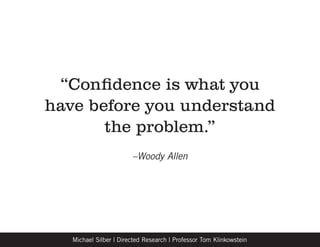
“Confidence is what you
have before you understand
       the problem.”
                        –Woody Allen


   Michael Silber | Directed Research | Professor Tom Klinkowstein
The Philosophy of Humor
1. Incongruity [leading approach- Kant, Kierkegaard, [Aristotle]
	 Ambiguity, logical impossibility, irrelevance,
	 and inappropriateness.
2. Superiority [Thomas Hobbes, Plato, Aristotle]
	 Aggressive supremacy.
3. Relief [Freud, Herbert Spencer]
	 Release or save energy generated by repression.

4. Play
	 An extension of “animal play” behavior.

            Michael Silber | Directed Research | Professor Tom Klinkowstein
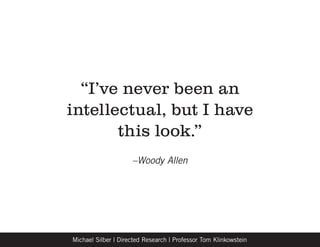
“I’ve never been an
intellectual, but I have
       this look.”
                     –Woody Allen


Michael Silber | Directed Research | Professor Tom Klinkowstein

Outline presentationthesis1v09

  • 1.
    THESIS ONE Humor & Humanity Abstraction, Memory, and Consciousness Michael Silber | Professor Tom Klinkowstein
  • 2.
    “At the momentit’s just a Notion, but with a bit of backing I think I could turn it into Concept, and then an Idea.” –Woody Allen Michael Silber | Directed Research | Professor Tom Klinkowstein
  • 3.
    This thesis presentsthe hypothesis that humor arises from the synthesis of abstracted thought, memory, and self-reflexive consciousness, representing a form of active creative intelligence with transformative problem-solving potential. Contrary to existing understanding, humor should not be viewed as trivial and silly, as it involves a sophisticated combination of cognitive skills, which can promote unexpected analogies and metaphorical thinking to explain otherwise baffling concepts. Such a hypothesis suggests that the rapid advancement of computer memory and the expansive growth of digital information presents the possibility for increased explorations into the connectivity of seemingly dissimilar, incongruous information in pursuit of both new understanding and new avenues for humor. Michael Silber | Directed Research | Professor Tom Klinkowstein
  • 4.
    Abstracted Thought allowsus to pursue understanding in the absence of explicit information. Memory enables us to store and organize personal experiences and learned knowledge. Self-Reflexive Consciousness is the uniquely human trait that helps us define ourselves and our mortality within the context of our environment and our society. Michael Silber | Directed Research | Professor Tom Klinkowstein
  • 5.
    “Confidence is whatyou have before you understand the problem.” –Woody Allen Michael Silber | Directed Research | Professor Tom Klinkowstein
  • 6.
    The Philosophy ofHumor 1. Incongruity [leading approach- Kant, Kierkegaard, [Aristotle] Ambiguity, logical impossibility, irrelevance, and inappropriateness. 2. Superiority [Thomas Hobbes, Plato, Aristotle] Aggressive supremacy. 3. Relief [Freud, Herbert Spencer] Release or save energy generated by repression. 4. Play An extension of “animal play” behavior. Michael Silber | Directed Research | Professor Tom Klinkowstein
  • 7.
    “I’ve never beenan intellectual, but I have this look.” –Woody Allen Michael Silber | Directed Research | Professor Tom Klinkowstein