Seminar Work Presentation
On
DEPARTMENT OF ELECTRONICS AND COMMUNICATION ENGINEERING
“BRAIN CHIPS”
Presented by:
Ms Urmila S
4AD16EC079
Dept of ECE
ATMECE
Under the Guidance of
Mrs Keerthi A Kumbar
Assistant Professor
Dept of ECE
ATMECE
CONTENTS
 Introduction
 Evolution towards implantable brain chips
 Achievements
 Benefits of brain chips
 Drawbacks of brain chips
 Future vision of brain chips
 Conclusion
 Reference
Dept. of ECE 1 ATMECE
INTRODUCTION
 For generations, humans have fantasized about the ability to communicate and
interact with machines through thought alone or to create devices that can peer into
person’s mind and thoughts.
 The Brain Chip Technology is a technology that involves brain implants.
 Brain Chip Technology implements the brain computer interface.
 Brain Chip consists of both biological and electronics terms.
 They are usually placed on the surface of the brain, or attached to brain’s cortex.
Dept. of ECE 2 ATMECE
Dept. of ECE 3 ATMECE
 Brain chips can enhance memory of human beings, help paralyzed patients and are
indented for military purpose.
 It develops a direct interface between brain and computers.
 These implantable brain chips that records brain signals and transmit them to
muscles.
 A common purpose of modern brain implants to establish a biomedical
dysfunctionality after the stroke or other head injuries.
 Brain gate is a device that was designed to help those who have lost control Of their
limbs or other body functions.
WHAT IS BRAIN CHIP ?
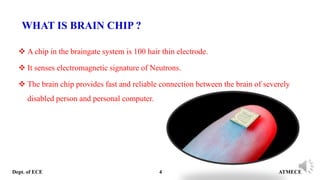
 A chip in the braingate system is 100 hair thin electrode.
 It senses electromagnetic signature of Neutrons.
 The brain chip provides fast and reliable connection between the brain of severely
disabled person and personal computer.
Dept. of ECE 4 ATMECE
EVOLUTION TOWARDS IMLPANTABLE BRAIN CHIP
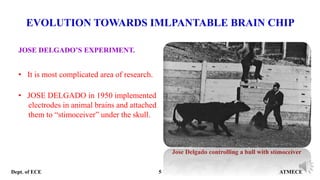
JOSE DELGADO’S EXPERIMENT.
• It is most complicated area of research.
• JOSE DELGADO in 1950 implemented
electrodes in animal brains and attached
them to “stimoceiver” under the skull.
Jose Delgado controlling a bull with stimoceiver
Dept. of ECE 5 ATMECE
BRAIN COMPUTER INTERFACE (BCI)
WHAT IS BCI ?
Dept. of ECE 6 ATMECE
ACHIVEMENTS
 “BRAIN GATE”
 Brain gate was developed by the bio-tech
company Cyberkinetics in 2003.
 The sensor, which is implemented into the brain,
monitors brain activity in the patient and
converts the intention of the user into computer
commands.
Dept. of ECE 7 ATMECE
Dept. of ECE 8 ATMECE
 First implementation of brain gate.
 A paralyzed man in the US has become the first
person to benefit from a brain chip that reads his
mind.
 Matthew nagle,25 year old was left paralyzed from
the neck down and confined to wheel chair after a
knife attack in 2001.
 He can think his TV on and off, change volume ,
and alter the channel.
 He has also been able to thought to move a
prosthetic hand and robotic arm.
Dept. of ECE 9 ATMECE
 BRAIN “PACE MAKERS’’
 They are implantable silicon neurons that
would perform the function of part of brain
that has been damaged by stroke or epilepsy.
 These medical devices are implanted into
the brain with the purpose to stimulate
nervous tissue with electrical signals.
Dept. of ECE 10 ATMECE
 “REMOTE CONTROLLED RAT OR RATBOTS”
 Moment signals are transmitted from
computer to brain of the rat through
a radio receiver strapped to its back.
 Military purpose and human rescue
operation.
BENEFITS OF BRAIN CHIPS
 It will increase the dynamic range of senses.
 Giving a light to blind and giving paralyzed patients full mental control of limbs.
 No genetic modification in the next generation.
 Rescue mission.
 Best decision making power.
Dept. of ECE 11 ATMECE
DRAWBACKS
 Cost.
 Losing identity in some cases.
 Risk for surgeons.
 Research is still in the beginning stages.
 Decreasing the size of the chip.
 Interface between biology and technology.
Dept. of ECE 12 ATMECE
FUTURE VISION OF BRAIN CHIPS
 It will enhance memory.
 It might enable “cyberthink”-invisible communication.
 Automakers could use the chip to help pilot the driverless cars of the future.
 Neuromorphic chips could be integrated into smart phones to improve their visual
and voice recognition.
 Another brain implants aims to help the blind regain their sight.
Dept. of ECE 13 ATMECE
CONCLUSION
The Brain chip technology helps the patients who cannot perform even simple actions
without the help of other person. Such patients are able to do things like checking e-
mails, turn the TV on or off, and control a prosthetic arm with just their thoughts. Brain
chip technology does not promise miracles. For incidence ,say that a paralyzed man will
one day walk using an artificial leg by his thoughts alone. let’s hope this technology will
be used restoring peace in the world and not giving the world a devastating end.
Dept. of ECE 14 ATMECE
REFERENCES
1. “Brain inspired technologies:towards chips that think", Barbara De Salvo, chief’
Scientist and Science director , IEEE-2018.
2. “The Future Technology Brain Chip Interference”Gulshan saba,Mohammed sayeed
khaleel,Saniya Taskeen, ISSN:2278-0181, IJERT-2017.
3. “Brain Gate Technology For Differently Abled Person”,Jagan M Pandya,Prathik R
Patel,Tejal S Pandya, |Volume 5,Issue 3|ISSN:2321-9939|IJEDR-2017.
Dept. of ECE 15 ATMECE
THANK YOU

BRAIN CHIPS

  • 1.
    Seminar Work Presentation On DEPARTMENTOF ELECTRONICS AND COMMUNICATION ENGINEERING “BRAIN CHIPS” Presented by: Ms Urmila S 4AD16EC079 Dept of ECE ATMECE Under the Guidance of Mrs Keerthi A Kumbar Assistant Professor Dept of ECE ATMECE
  • 2.
    CONTENTS  Introduction  Evolutiontowards implantable brain chips  Achievements  Benefits of brain chips  Drawbacks of brain chips  Future vision of brain chips  Conclusion  Reference Dept. of ECE 1 ATMECE
  • 3.
    INTRODUCTION  For generations,humans have fantasized about the ability to communicate and interact with machines through thought alone or to create devices that can peer into person’s mind and thoughts.  The Brain Chip Technology is a technology that involves brain implants.  Brain Chip Technology implements the brain computer interface.  Brain Chip consists of both biological and electronics terms.  They are usually placed on the surface of the brain, or attached to brain’s cortex. Dept. of ECE 2 ATMECE
  • 4.
    Dept. of ECE3 ATMECE  Brain chips can enhance memory of human beings, help paralyzed patients and are indented for military purpose.  It develops a direct interface between brain and computers.  These implantable brain chips that records brain signals and transmit them to muscles.  A common purpose of modern brain implants to establish a biomedical dysfunctionality after the stroke or other head injuries.  Brain gate is a device that was designed to help those who have lost control Of their limbs or other body functions.
  • 5.
    WHAT IS BRAINCHIP ?  A chip in the braingate system is 100 hair thin electrode.  It senses electromagnetic signature of Neutrons.  The brain chip provides fast and reliable connection between the brain of severely disabled person and personal computer. Dept. of ECE 4 ATMECE
  • 6.
    EVOLUTION TOWARDS IMLPANTABLEBRAIN CHIP JOSE DELGADO’S EXPERIMENT. • It is most complicated area of research. • JOSE DELGADO in 1950 implemented electrodes in animal brains and attached them to “stimoceiver” under the skull. Jose Delgado controlling a bull with stimoceiver Dept. of ECE 5 ATMECE
  • 7.
    BRAIN COMPUTER INTERFACE(BCI) WHAT IS BCI ? Dept. of ECE 6 ATMECE
  • 8.
    ACHIVEMENTS  “BRAIN GATE” Brain gate was developed by the bio-tech company Cyberkinetics in 2003.  The sensor, which is implemented into the brain, monitors brain activity in the patient and converts the intention of the user into computer commands. Dept. of ECE 7 ATMECE
  • 9.
    Dept. of ECE8 ATMECE  First implementation of brain gate.  A paralyzed man in the US has become the first person to benefit from a brain chip that reads his mind.  Matthew nagle,25 year old was left paralyzed from the neck down and confined to wheel chair after a knife attack in 2001.  He can think his TV on and off, change volume , and alter the channel.  He has also been able to thought to move a prosthetic hand and robotic arm.
  • 10.
    Dept. of ECE9 ATMECE  BRAIN “PACE MAKERS’’  They are implantable silicon neurons that would perform the function of part of brain that has been damaged by stroke or epilepsy.  These medical devices are implanted into the brain with the purpose to stimulate nervous tissue with electrical signals.
  • 11.
    Dept. of ECE10 ATMECE  “REMOTE CONTROLLED RAT OR RATBOTS”  Moment signals are transmitted from computer to brain of the rat through a radio receiver strapped to its back.  Military purpose and human rescue operation.
  • 12.
    BENEFITS OF BRAINCHIPS  It will increase the dynamic range of senses.  Giving a light to blind and giving paralyzed patients full mental control of limbs.  No genetic modification in the next generation.  Rescue mission.  Best decision making power. Dept. of ECE 11 ATMECE
  • 13.
    DRAWBACKS  Cost.  Losingidentity in some cases.  Risk for surgeons.  Research is still in the beginning stages.  Decreasing the size of the chip.  Interface between biology and technology. Dept. of ECE 12 ATMECE
  • 14.
    FUTURE VISION OFBRAIN CHIPS  It will enhance memory.  It might enable “cyberthink”-invisible communication.  Automakers could use the chip to help pilot the driverless cars of the future.  Neuromorphic chips could be integrated into smart phones to improve their visual and voice recognition.  Another brain implants aims to help the blind regain their sight. Dept. of ECE 13 ATMECE
  • 15.
    CONCLUSION The Brain chiptechnology helps the patients who cannot perform even simple actions without the help of other person. Such patients are able to do things like checking e- mails, turn the TV on or off, and control a prosthetic arm with just their thoughts. Brain chip technology does not promise miracles. For incidence ,say that a paralyzed man will one day walk using an artificial leg by his thoughts alone. let’s hope this technology will be used restoring peace in the world and not giving the world a devastating end. Dept. of ECE 14 ATMECE
  • 16.
    REFERENCES 1. “Brain inspiredtechnologies:towards chips that think", Barbara De Salvo, chief’ Scientist and Science director , IEEE-2018. 2. “The Future Technology Brain Chip Interference”Gulshan saba,Mohammed sayeed khaleel,Saniya Taskeen, ISSN:2278-0181, IJERT-2017. 3. “Brain Gate Technology For Differently Abled Person”,Jagan M Pandya,Prathik R Patel,Tejal S Pandya, |Volume 5,Issue 3|ISSN:2321-9939|IJEDR-2017. Dept. of ECE 15 ATMECE
  • 17.